Various Applications of Data
Warehouse
Rafiul Hasan Khan
ID: 1220617
420-DF1-GC-Datawarehouse
Introduction
• The Past and The Problem
• What is a Data Warehouse?
• Components of a Data Warehouse
• OLAP, Metadata, Data Mining
• Getting the Data in
• Benefits vs. Costs
• Conclusion
The Past and The Problem
• Only had scattered transactional systems in the
organization – data spread among different
systems
• Transactional systems were not designed for
decision support analysis
• Data constantly changes on transactional systems
• Lack of historical data
• Often resources were taxed with both needs on
the same systems
The Past and The Problem
• Operational databases are designed to keep transactions
from daily operations. It is optimized to efficiently
update or create individual records
• A database for analysis on the other hand needs to be
geared toward flexible requests or queries (Ad hoc,
statistical analysis)
What is a Data Warehouse?
Data warehousing is an architectural model designed to
gather data from various sources into a single unified
data model for analysis purposes.
What Is a Data Warehouse?
Term was introduced in 1990 by William Immon
A managed database in which the data is:
• Subject Oriented
• Integrated
• Time Variant
• Non Volatile
Subject Oriented
• Organized around major subject areas in the enterprise
(Sales, Inventory, Financial, etc.)
• Only includes data which is used in the decision making
processes
• Elements used for transactional processing are removed
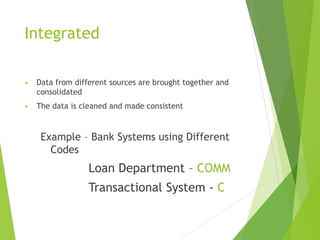
Integrated
• Data from different sources are brought together and
consolidated
• The data is cleaned and made consistent
Example – Bank Systems using Different
Codes
Loan Department – COMM
Transactional System - C
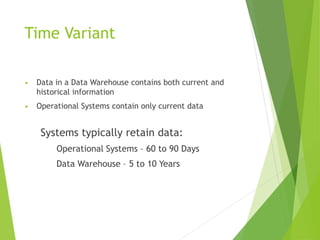
Time Variant
• Data in a Data Warehouse contains both current and
historical information
• Operational Systems contain only current data
Systems typically retain data:
Operational Systems – 60 to 90 Days
Data Warehouse – 5 to 10 Years
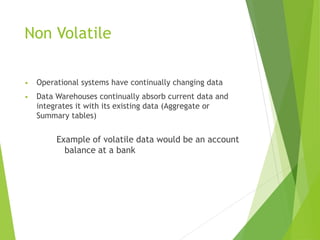
Non Volatile
• Operational systems have continually changing data
• Data Warehouses continually absorb current data and
integrates it with its existing data (Aggregate or
Summary tables)
Example of volatile data would be an account
balance at a bank
What Is a Data Warehouse?
• Not a product, it is a process
• Combination of hardware and software
• Concept of a Data Warehouse is not new, but the
technology that allows it is
What Is a Data Warehouse?
Can often be set up as one VLDB (Very Large Database) or a
collection of subject areas called Data Marts.
There are now tools which “unify” these Data Marts and
make it appear as a single database.
What Is a Data Warehouse?
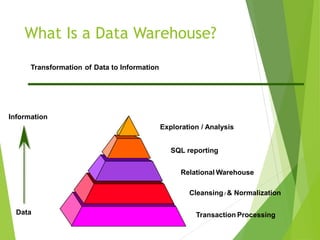
Transformation of Data to Information
Transaction Processing
Cleansing / & Normalization
Relational Warehouse
SQL reporting
Exploration / Analysis
Data
Information
Components of a Data
Warehouse
Four General Components:
• Hardware
• DBMS - Database Management System
• Front End Access Tools
• Other Tools
In all components scalability is vital
Scalability is the ability to grow as your data and
processing needs increase
Components of a Data
Warehouse - Hardware
• Power - # of Processors, Memory, I/O
Bandwidth, and Speed of the Bus
• Availability – Redundant equipment
• Disk Storage - Speed and enough
storage for the loaded data set
• Backup Solution - Automated and be
able to allow for incremental backups
and archiving older data
Components of a Data
Warehouse - DBMS
• Physical storage capacity of the DBMS
• Loading, indexing, and processing speed
• Availability
• Handle your data needs
• Operational integrity, reliability, and manageability
Components of a Data Warehouse
- Front End & Other Tools
• Query Tools (SQL & GUI based)
• Report Writers
• Metadata Repositories
• OLAP (Online Analytical Processing)
• Data Mining Products
Components of a Data Warehouse
– Metadata Repositories
Metadata is Data about Data. Users and
Developers often need a way to find
information on the data they use.
Information can include:
• Source System(s) of the Data, contact
information
• Related tables or subject areas
• Programs or Processes which use the data
• Population rules (Update or Insert and
how often)
• Status of the Data Warehouse’s processing
and condition
Components of a Data
Warehouse – OLAP Tools
OLAP - Online Analytical Processing. It works by
aggregating detail data and looks at it by
dimensions
• Gives the ability to “Drill Down” in to the detail
data
• Decision Support Analysis Tool
• Multidimensional DB focusing on retrieval of
precalculated data
• Ends the “big reports” with large amounts of
detailed data
• These tools are often graphical and can run on a
“thin client” such as a web browser
Components of a Data
Warehouse – Data Mining
• Answers the questions you didn’t know to ask
• Analyzes great amounts of data (usually contained in a
Data Warehouse) and looks for trends in the data
• Technology now allows us to do this better than in the
past
Components of a Data
Warehouse – Data Mining
• Most famous example is the Huggies - Heineken case
• Used in Retail sector to analyze buying habits
• Used in financial areas to detect fraud
• Used in the stock market to find trends
• Used in scientific research
• Used in national security
Getting the Data In
• Data will come from multiple databases and files within
the organization
• Also can come from outside sources
• Examples:
•Weather Reports
•Demographic information
by Zip Code
Getting the Data In
Three Steps :
1. Extraction Phase
2. Transformation Phase
3. Loading Phase
Getting the Data In
Extraction Phase:
• Source systems export data via files or populates
directly when the databases can “talk” to each other
• Transfers them to the Data Warehouse server and puts it
into some sort of staging area
Getting the Data In
Transformation Phase:
• Takes data and turns it into a form that is
suitable for insertion into the warehouse
• Combines related data
• Removes redundancies
• Common Codes (Commercial Customer)
• Spelling Mistakes (Lozenges)
• Consistency (PA,Pa,Penna,Pennsylvania)
• Formatting (Addresses)
Getting the Data In
Loading Phase:
• Places the cleaned data into the DBMS in its final,
useable form
• Compare data from source systems and the Data
Warehouse
• Document the load information for the users
Benefits vs. Costs
Benefits
• Creates a single point for all data
• System is optimized and designed specifically for
analysis
• Access data without impacting the operational systems
• Users can access the data directly without the direct
help from IT dept
Costs
• Cost of implementation & maintenance (hardware,
software, and staffing)
• Lack of compatibility between components
• Data from many sources are hard to combine, data
integrity issues
• Bad designs and practices can lead to costly failures
Conclusion
• What is a Data Warehouse?
• Components of a Data Warehouse
• How the Data Gets In
• OLAP, Metadata, and Data Mining
• Benefits vs. Costs

Various Applications of Data Warehouse.ppt

  • 1.
    Various Applications ofData Warehouse Rafiul Hasan Khan ID: 1220617 420-DF1-GC-Datawarehouse
  • 2.
    Introduction • The Pastand The Problem • What is a Data Warehouse? • Components of a Data Warehouse • OLAP, Metadata, Data Mining • Getting the Data in • Benefits vs. Costs • Conclusion
  • 3.
    The Past andThe Problem • Only had scattered transactional systems in the organization – data spread among different systems • Transactional systems were not designed for decision support analysis • Data constantly changes on transactional systems • Lack of historical data • Often resources were taxed with both needs on the same systems
  • 4.
    The Past andThe Problem • Operational databases are designed to keep transactions from daily operations. It is optimized to efficiently update or create individual records • A database for analysis on the other hand needs to be geared toward flexible requests or queries (Ad hoc, statistical analysis)
  • 5.
    What is aData Warehouse? Data warehousing is an architectural model designed to gather data from various sources into a single unified data model for analysis purposes.
  • 6.
    What Is aData Warehouse? Term was introduced in 1990 by William Immon A managed database in which the data is: • Subject Oriented • Integrated • Time Variant • Non Volatile
  • 7.
    Subject Oriented • Organizedaround major subject areas in the enterprise (Sales, Inventory, Financial, etc.) • Only includes data which is used in the decision making processes • Elements used for transactional processing are removed
  • 8.
    Integrated • Data fromdifferent sources are brought together and consolidated • The data is cleaned and made consistent Example – Bank Systems using Different Codes Loan Department – COMM Transactional System - C
  • 9.
    Time Variant • Datain a Data Warehouse contains both current and historical information • Operational Systems contain only current data Systems typically retain data: Operational Systems – 60 to 90 Days Data Warehouse – 5 to 10 Years
  • 10.
    Non Volatile • Operationalsystems have continually changing data • Data Warehouses continually absorb current data and integrates it with its existing data (Aggregate or Summary tables) Example of volatile data would be an account balance at a bank
  • 11.
    What Is aData Warehouse? • Not a product, it is a process • Combination of hardware and software • Concept of a Data Warehouse is not new, but the technology that allows it is
  • 12.
    What Is aData Warehouse? Can often be set up as one VLDB (Very Large Database) or a collection of subject areas called Data Marts. There are now tools which “unify” these Data Marts and make it appear as a single database.
  • 13.
    What Is aData Warehouse? Transformation of Data to Information Transaction Processing Cleansing / & Normalization Relational Warehouse SQL reporting Exploration / Analysis Data Information
  • 14.
    Components of aData Warehouse Four General Components: • Hardware • DBMS - Database Management System • Front End Access Tools • Other Tools In all components scalability is vital Scalability is the ability to grow as your data and processing needs increase
  • 15.
    Components of aData Warehouse - Hardware • Power - # of Processors, Memory, I/O Bandwidth, and Speed of the Bus • Availability – Redundant equipment • Disk Storage - Speed and enough storage for the loaded data set • Backup Solution - Automated and be able to allow for incremental backups and archiving older data
  • 16.
    Components of aData Warehouse - DBMS • Physical storage capacity of the DBMS • Loading, indexing, and processing speed • Availability • Handle your data needs • Operational integrity, reliability, and manageability
  • 17.
    Components of aData Warehouse - Front End & Other Tools • Query Tools (SQL & GUI based) • Report Writers • Metadata Repositories • OLAP (Online Analytical Processing) • Data Mining Products
  • 18.
    Components of aData Warehouse – Metadata Repositories Metadata is Data about Data. Users and Developers often need a way to find information on the data they use. Information can include: • Source System(s) of the Data, contact information • Related tables or subject areas • Programs or Processes which use the data • Population rules (Update or Insert and how often) • Status of the Data Warehouse’s processing and condition
  • 19.
    Components of aData Warehouse – OLAP Tools OLAP - Online Analytical Processing. It works by aggregating detail data and looks at it by dimensions • Gives the ability to “Drill Down” in to the detail data • Decision Support Analysis Tool • Multidimensional DB focusing on retrieval of precalculated data • Ends the “big reports” with large amounts of detailed data • These tools are often graphical and can run on a “thin client” such as a web browser
  • 20.
    Components of aData Warehouse – Data Mining • Answers the questions you didn’t know to ask • Analyzes great amounts of data (usually contained in a Data Warehouse) and looks for trends in the data • Technology now allows us to do this better than in the past
  • 21.
    Components of aData Warehouse – Data Mining • Most famous example is the Huggies - Heineken case • Used in Retail sector to analyze buying habits • Used in financial areas to detect fraud • Used in the stock market to find trends • Used in scientific research • Used in national security
  • 22.
    Getting the DataIn • Data will come from multiple databases and files within the organization • Also can come from outside sources • Examples: •Weather Reports •Demographic information by Zip Code
  • 23.
    Getting the DataIn Three Steps : 1. Extraction Phase 2. Transformation Phase 3. Loading Phase
  • 24.
    Getting the DataIn Extraction Phase: • Source systems export data via files or populates directly when the databases can “talk” to each other • Transfers them to the Data Warehouse server and puts it into some sort of staging area
  • 25.
    Getting the DataIn Transformation Phase: • Takes data and turns it into a form that is suitable for insertion into the warehouse • Combines related data • Removes redundancies • Common Codes (Commercial Customer) • Spelling Mistakes (Lozenges) • Consistency (PA,Pa,Penna,Pennsylvania) • Formatting (Addresses)
  • 26.
    Getting the DataIn Loading Phase: • Places the cleaned data into the DBMS in its final, useable form • Compare data from source systems and the Data Warehouse • Document the load information for the users
  • 27.
  • 28.
    Benefits • Creates asingle point for all data • System is optimized and designed specifically for analysis • Access data without impacting the operational systems • Users can access the data directly without the direct help from IT dept
  • 29.
    Costs • Cost ofimplementation & maintenance (hardware, software, and staffing) • Lack of compatibility between components • Data from many sources are hard to combine, data integrity issues • Bad designs and practices can lead to costly failures
  • 30.
    Conclusion • What isa Data Warehouse? • Components of a Data Warehouse • How the Data Gets In • OLAP, Metadata, and Data Mining • Benefits vs. Costs