Trematode
Aman Ullah
B.Sc. MLT
M. Phil Microbiology
Master in Health Reseach
Certificate in Health Professional Education
INTRODUCTION
• The important trematodes are
• Schistosoma species (blood flukes)
• Clonorchis sinensis (liver fluke)
• Paragonimus westermani (lung fluke)
• Fasciola hepatica
• Fasciolopsis buski
• Heterophyes heterophyes
Trematodes According to Habitat
• Intestinal Trematodes:
1. Heterophyes
2. Metagonimus
3. Fasciolopsis
4. Echinostoma
• Liver trematodes:
1. Fasciola.
2. Clonorchis
3. Opistorchis
• Lung trematodes:
1. Paragonimus.
• Blood trematodes:
1. Schistosoma
INTRODUCTION
• The life cycle of the medically important
trematodes involves a sexual cycle in humans
(definitive host) and asexual reproduction in
freshwater snails (intermediate hosts)
• Transmission to humans takes place either via
penetration of the skin by the free-swimming
cercariae of the schistosomes or via ingestion of
cysts in undercooked (raw) fish or crabs in
Clonorchis and Paragonimus infection,
respectively
SCHISTOSOMA
Disease: Schistosomiasis
1. Schistosoma mansoni and Schistosoma
japonicum affect the gastrointestinal tract
2. Schistosoma haematobium affects the
urinary tract
Important Properties
• Adult schistosomes exist as separate sexes but
live attached to each other
• S. mansoni and S. japonicum adults live in the
mesenteric veins, whereas S. haematobium
lives in the veins draining the urinary bladder.
Schistosomes are therefore known as blood
flukes
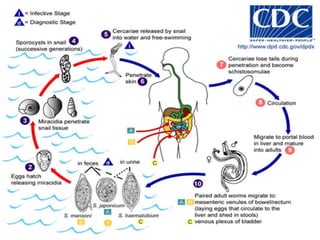
Life cycle
• Humans are infected when the free-swimming, fork-tailed cercariae penetrate the
skin
• They differentiate to larvae (schistosomula), enter the blood, and are carried via
the veins into the arterial circulation
• Those that enter the superior mesenteric artery pass into the portal circulation
and reach the liver, where they mature into adult flukes
• S. mansoni and S. japonicum adults migrate against the portal flow to reside in the
mesenteric venules
• S. haematobium adults reach the bladder veins through the venous plexus
between the rectum and the bladder
• In their definitive venous site, the female lays fertilized eggs, which penetrate the
vascular endothelium and enter the gut or bladder lumen, respectively
• The eggs are excreted in the stools or urine and must enter fresh water to hatch
• Once hatched, the ciliated larvae (miracidia) penetrate snails and undergo further
development and multiplication to produce many cercariae
• (The three schistosomes use different species of snails as intermediate hosts)
• Cercariae leave the snails, enter fresh water, and complete the cycle by
penetrating human skin
Pathogenesis
• Most of the pathologic findings are caused by the presence of eggs in the
liver, spleen, or wall of the gut or bladder
• Eggs in the liver induce granulomas, which lead to fibrosis, hepatomegaly,
and portal hypertension
• The granulomas are formed in response to antigens secreted by the eggs
• Hepatocytes are usually undamaged, and liver function tests remain
normal
• S. mansoni eggs damage the wall of the distal colon (inferior mesenteric
venules), whereas S. japonicum eggs damage the walls of both the small
and large intestines (superior and inferior mesenteric venules)
• The damage is due both to digestion of tissue by proteolytic enzymes
produced by the egg and to the host inflammatory response that forms
granulomas in the venules
• The eggs of S. haematobium in the wall of the bladder induce granulomas
and fibrosis, which can lead to carcinoma of the bladder
Clinical Findings
• Most patients are asymptomatic, but chronic infections may
become symptomatic
• The acute stage, which begins shortly after cercarial penetration,
consists of itching and dermatitis followed 2 to 3 weeks later by
fever, chills, diarrhea, lymphadenopathy, and hepatosplenomegaly
• Eosinophilia is seen in response to the migrating larvae
• This stage usually resolves spontaneously
• The chronic stage can cause significant morbidity and mortality
• In patients with S. mansoni or S. japonicum infection,
gastrointestinal hemorrhage, hepatomegaly, and massive
splenomegaly can develop
• Patients infected with S. haematobium have hematuria as their
chief early complaint
• Superimposed bacterial urinary tract infections occur frequently
Laboratory Diagnosis
• Diagnosis depends on finding the
characteristic ova in the feces or urine
Fasciola
• Fasciola hepatica: Sheep liver fluke, causes disease primarily in sheep and
other domestic animals
• Humans are infected by eating watercress (or other aquatic plants)
contaminated by larvae (metacercariae) that excyst in the duodenum,
penetrate the gut wall, and reach the liver, where they mature into adults
• Hermaphroditic adults in the bile ducts produce eggs, which are excreted
in the feces
• The eggs hatch in fresh water, and miracidia enter the snails
• Miracidia develop into cercariae, which then encyst on aquatic vegetation
• Sheep and humans eat the plants, thus completing the life cycle
• Symptoms are due primarily to the presence of the adult worm in the
biliary tract
• In early infection, right-upper-quadrant pain, fever, and hepatomegaly can
occur, but most infections are asymptomatic
• Months or years later, obstructive jaundice can occur
• Diagnosis is made by identification of eggs in the feces
Fasciolopsis
• Fasciolopsis buski is an intestinal parasite of humans and pigs that is
endemic to Asia and India
• Humans are infected by eating aquatic vegetation that carries the
cysts
• After excysting in the small intestine, the parasites attach to the
mucosa and differentiate into adults
• Eggs are passed in the feces; on reaching fresh water, they
differentiate into miracidia
• The ciliated miracidia penetrate snails and, after several stages,
develop into cercariae that encyst on aquatic vegetation
• The cycle is completed when plants carrying the cysts are eaten
• Pathologic findings are due to damage of the intestinal mucosa by
the adult fluke
• Most infections are asymptomatic, but ulceration, abscess
formation, and hemorrhage can occur
• Diagnosis is based on finding typical eggs in the feces
Questions/Suggestions
khurramthalwi@hotmail.com

Trematode

  • 1.
    Trematode Aman Ullah B.Sc. MLT M.Phil Microbiology Master in Health Reseach Certificate in Health Professional Education
  • 2.
    INTRODUCTION • The importanttrematodes are • Schistosoma species (blood flukes) • Clonorchis sinensis (liver fluke) • Paragonimus westermani (lung fluke) • Fasciola hepatica • Fasciolopsis buski • Heterophyes heterophyes
  • 3.
    Trematodes According toHabitat • Intestinal Trematodes: 1. Heterophyes 2. Metagonimus 3. Fasciolopsis 4. Echinostoma • Liver trematodes: 1. Fasciola. 2. Clonorchis 3. Opistorchis • Lung trematodes: 1. Paragonimus. • Blood trematodes: 1. Schistosoma
  • 4.
    INTRODUCTION • The lifecycle of the medically important trematodes involves a sexual cycle in humans (definitive host) and asexual reproduction in freshwater snails (intermediate hosts) • Transmission to humans takes place either via penetration of the skin by the free-swimming cercariae of the schistosomes or via ingestion of cysts in undercooked (raw) fish or crabs in Clonorchis and Paragonimus infection, respectively
  • 5.
    SCHISTOSOMA Disease: Schistosomiasis 1. Schistosomamansoni and Schistosoma japonicum affect the gastrointestinal tract 2. Schistosoma haematobium affects the urinary tract
  • 6.
    Important Properties • Adultschistosomes exist as separate sexes but live attached to each other • S. mansoni and S. japonicum adults live in the mesenteric veins, whereas S. haematobium lives in the veins draining the urinary bladder. Schistosomes are therefore known as blood flukes
  • 7.
    Life cycle • Humansare infected when the free-swimming, fork-tailed cercariae penetrate the skin • They differentiate to larvae (schistosomula), enter the blood, and are carried via the veins into the arterial circulation • Those that enter the superior mesenteric artery pass into the portal circulation and reach the liver, where they mature into adult flukes • S. mansoni and S. japonicum adults migrate against the portal flow to reside in the mesenteric venules • S. haematobium adults reach the bladder veins through the venous plexus between the rectum and the bladder • In their definitive venous site, the female lays fertilized eggs, which penetrate the vascular endothelium and enter the gut or bladder lumen, respectively • The eggs are excreted in the stools or urine and must enter fresh water to hatch • Once hatched, the ciliated larvae (miracidia) penetrate snails and undergo further development and multiplication to produce many cercariae • (The three schistosomes use different species of snails as intermediate hosts) • Cercariae leave the snails, enter fresh water, and complete the cycle by penetrating human skin
  • 9.
    Pathogenesis • Most ofthe pathologic findings are caused by the presence of eggs in the liver, spleen, or wall of the gut or bladder • Eggs in the liver induce granulomas, which lead to fibrosis, hepatomegaly, and portal hypertension • The granulomas are formed in response to antigens secreted by the eggs • Hepatocytes are usually undamaged, and liver function tests remain normal • S. mansoni eggs damage the wall of the distal colon (inferior mesenteric venules), whereas S. japonicum eggs damage the walls of both the small and large intestines (superior and inferior mesenteric venules) • The damage is due both to digestion of tissue by proteolytic enzymes produced by the egg and to the host inflammatory response that forms granulomas in the venules • The eggs of S. haematobium in the wall of the bladder induce granulomas and fibrosis, which can lead to carcinoma of the bladder
  • 10.
    Clinical Findings • Mostpatients are asymptomatic, but chronic infections may become symptomatic • The acute stage, which begins shortly after cercarial penetration, consists of itching and dermatitis followed 2 to 3 weeks later by fever, chills, diarrhea, lymphadenopathy, and hepatosplenomegaly • Eosinophilia is seen in response to the migrating larvae • This stage usually resolves spontaneously • The chronic stage can cause significant morbidity and mortality • In patients with S. mansoni or S. japonicum infection, gastrointestinal hemorrhage, hepatomegaly, and massive splenomegaly can develop • Patients infected with S. haematobium have hematuria as their chief early complaint • Superimposed bacterial urinary tract infections occur frequently
  • 11.
    Laboratory Diagnosis • Diagnosisdepends on finding the characteristic ova in the feces or urine
  • 12.
    Fasciola • Fasciola hepatica:Sheep liver fluke, causes disease primarily in sheep and other domestic animals • Humans are infected by eating watercress (or other aquatic plants) contaminated by larvae (metacercariae) that excyst in the duodenum, penetrate the gut wall, and reach the liver, where they mature into adults • Hermaphroditic adults in the bile ducts produce eggs, which are excreted in the feces • The eggs hatch in fresh water, and miracidia enter the snails • Miracidia develop into cercariae, which then encyst on aquatic vegetation • Sheep and humans eat the plants, thus completing the life cycle • Symptoms are due primarily to the presence of the adult worm in the biliary tract • In early infection, right-upper-quadrant pain, fever, and hepatomegaly can occur, but most infections are asymptomatic • Months or years later, obstructive jaundice can occur • Diagnosis is made by identification of eggs in the feces
  • 14.
    Fasciolopsis • Fasciolopsis buskiis an intestinal parasite of humans and pigs that is endemic to Asia and India • Humans are infected by eating aquatic vegetation that carries the cysts • After excysting in the small intestine, the parasites attach to the mucosa and differentiate into adults • Eggs are passed in the feces; on reaching fresh water, they differentiate into miracidia • The ciliated miracidia penetrate snails and, after several stages, develop into cercariae that encyst on aquatic vegetation • The cycle is completed when plants carrying the cysts are eaten • Pathologic findings are due to damage of the intestinal mucosa by the adult fluke • Most infections are asymptomatic, but ulceration, abscess formation, and hemorrhage can occur • Diagnosis is based on finding typical eggs in the feces
  • 15.