Characteristics
All parasitic,mostly in vertebrates
Covered externally by a non-ciliated syncytium
(tegument)
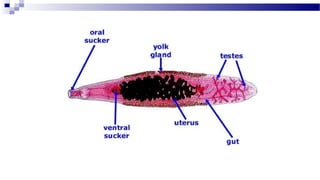
Oral sucker surrounds mouth
Ventral sucker used for attachment
Mouth is anterior
Digestive tract is -shaped,, with 2 main trunks
and smaller branches
Complex life cycles (involving at least one
intermediate host)
3.
The foodconsists of the tissues or body fluids
of the host, which are sucked in by action of
the muscular pharynx
Are more like turbellarians
Complex muscle layers, excretory organs,
and a nervous system
Parasitic life, the development of a resistant
cuticle, suckers, and hooks and general lack
of sense organs.
Sensory organs, such as dorsal eyespots
occur in some larve and in some flukes that
are ectoparasites.
5.
Subclass Monogenea
Inhabit onlyone host
Ectoparasites of fishes, amphibians, and
reptiles, but some inhabit the mouth
cavities or urinary bladders.
At the posterior end is a well-developed
adhesive organ with one or more suckers
and chitinous hooks or anchors
Cross-fertilization
Development is direct adult form
6.
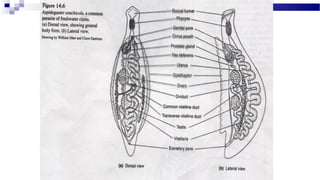
Subclass Aspidobothrea
Internal parasiteof lower vertebrates
and mollusks and have but a single host
Characterized by huge adhesive
structure (sucker) covering the whole
ventral part of the body
They show features of both Monogenea
and Digenea and may have one or two
hosts.
8.
Subclass Digenea
Largest groupof trematodes
All internal parasites
Must live in two or more host species to
complete the life cycle, larvae in a certain
snail (intermediate host) and the adult in
some vertebrate (primary host)
Live in the parts of digestive tract, lungs,
urinary bladder, blood vessels, or other
organs
9.
Sheep liver
fluke
Common liverfluke or Fasciola hepatica
Inhabits the bile ducts and sometimes
invades other organs
Commonest in sheep and cattle but is
sometimes found in other mammals and
occasionally in humans, producing the
disease known as liver rot or fasciolosis
10.
One ofthe largest flukes of the world, reaching a length of
30mm and a width of 13mm
It is leaf shaped, pointed posteriorly and
wide interiorly
The anterior sucker is terminal surrounding
the mouth, and close behind is the ventral
(posterior) sucker for attachment in host
Between them the genital opening
Digestive system: mouth, muscular pharynx,
short esophagus, and two branched enteron.
11.
Muscles are complex
Excretoryhas many flame cells
Nervous system: double
ganglion, 2 lengthwise
nerve cords, and
various nerves
Hermaphroditic
12.
The testesare large and greatly
branched, arranged in tandem behind the
ovary.
The smaller, dendritic ovary lies on the
right side, coiling between the ovary and
the preacetabular cirrus pouch. Vitelline
follicles are extensive, filling most of the
lateral body and becoming confluent
behind the testes.
13.
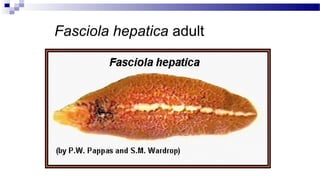
Fasciola hepatica
Commonly knownas the sheep liver fluke
Important parasite of sheep and cattle
(other grazers) can be found in humans.
Morphology
Large size, frequently over 30 mm long
Characteristic cone-shaped projection at
anterior end followed by wide shoulders
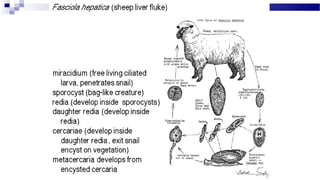
Fasciola hepatica:
Trematode LifeCycle
Representative
Ova or egg
Miracidium
Sporocyst
(Daughter sporocyst, or redia)
Cercaria
Metacercaria
Adult
16.
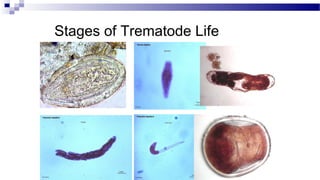
Stages of TrematodeLife
Cycle
Ova or egg - shelled embryo.
Contains miracidium inside shell
Under appropriate conditions, the operculum
(cap on shell) opens to allow miracidium to
escape.
Many of flukes have very distinctive eggs.
17.
Stages of TrematodeLife
Cycle
Miracidium
Ciliated organism that can be mistaken for a
ciliated protozoan.
In species that hatch in water, it contains
penetration glands that release histolytic or
proteolytic enzymes to help penetrate
snail
Some species do not hatch until eaten by
snail host.
18.
Stages of TrematodeLife
Cycle
Sporocyst
The miracidium develops into sporocyst often
in the digestive gland of the snail.
The sporocyst is an embryonic bag or
germinal sac.
The sporocyst will produce many daughter
stages called rediae or in some cases
daughter sporocysts.
19.
Stages of TrematodeLife
Cycle
Rediae or Daughter Sporocyst
In function they are very similar to sporocysts.
Contain digestive tract and are more active
Asexually reproduce to yield many cercariae.
Some species they can live for many years.
20.
Stages of TrematodeLife
Cycle
Cercariae
Usually escape snail and often swim by some
means of tail structure.
Responsible for transmission from snail to the
next host.
21.
Stages of TrematodeLife
Cycle
Metacercaria
Resistant stage that is formed in many
species
Cercaria that have this stage contain
cystogenic glands that helps the organism
encyst on vegetation.
Cercaria that form metacercaria in second
intermediate hosts, often have
penetration glands that enable them to
penetrate the second intermediate host.
22.
Stages of TrematodeLife
Cycle
Adult
Always found in the definitive host
Responsible for sexual reproduction
Often restricted to specific region of host.
Often very host specific.
Fasciola hepatica
Adult inbile duct of definitive host passes
eggs in feces.
If eggs land in water, they hatch into
miracidium that actively swims until it finds
an appropriate snail. (Galba truncatula)
Penetrates snail, develops into germinal
sac (sporocyst), asexual stages of rediae
and cercariae formed.
26.
Fasciola hepatica
Cercariae leavesnail, encyst on
vegetation, and form metacercaria.
Herbivore infected when it ingests
vegetation with metacercaria.
Metacercaria develop into adult
penetrates gut wall, moves to the liver.
Humans infected by eating watercress that
has metacercaria on it.
27.
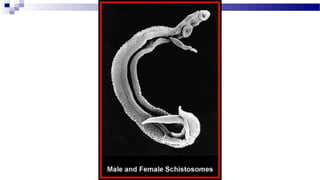
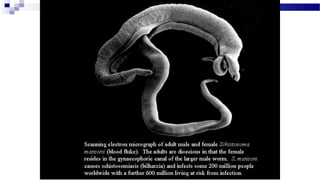
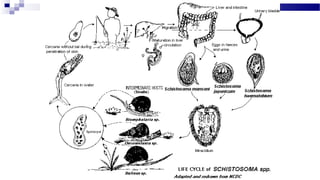
Schistosoma sp.
Adult wormsare found in blood vessels of
digestive tract or urinary bladder thus
called blood flukes
male worm has a split body called the
gynecophoral canal. The female is
usually found within this canal.She leaves
only during the egg laying period.
31.
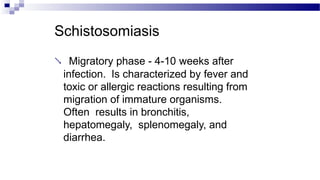
Schistosomiasis
Migratory phase- 4-10 weeks after
infection. Is characterized by fever and
toxic or allergic reactions resulting from
migration of immature organisms.
Often results in bronchitis,
hepatomegaly, splenomegaly, and
diarrhea.
32.
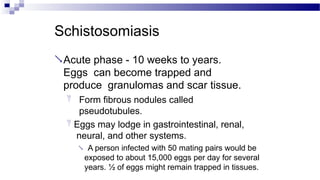
Schistosomiasis
Acute phase -10 weeks to years.
Eggs can become trapped and
produce granulomas and scar tissue.
Form fibrous nodules called
pseudotubules.
Eggs may lodge in gastrointestinal, renal,
neural, and other systems.
A person infected with 50 mating pairs would be
exposed to about 15,000 eggs per day for several
years. ½ of eggs might remain trapped in tissues.
33.
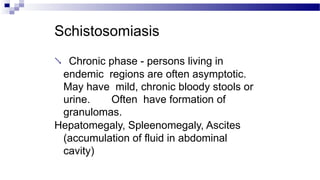
Schistosomiasis
Chronic phase- persons living in
endemic regions are often asymptotic.
May have mild, chronic bloody stools or
urine. Often have formation of
granulomas.
Hepatomegaly, Spleenomegaly, Ascites
(accumulation of fluid in abdominal
cavity)
34.
Schistosoma sp.
Important parasitesof man and some
domesticated animals
Three species infect man
Schistosoma mansoni
Schistosoma japonicum
Schistosoma haematobium
35.
Schistosoma japonicum.
Common inparts of Japan, China, Taiwan,
Philippines, Thailand, and other parts of Southeast
Asia.
Most pathogenic and most difficult to control
Located in blood vessels of small intestine.
Eggs may lodge in brain causing CNS damage,
coma, and paralysis.
Low host specificity
36.
Schistosoma mansoni
Common inEgypt, the Middle East,
parts of Africa, and parts of South and
Central America.
Found in portal veins draining large
intestine
The sharp lateral spine is
distinctive
Primary pathological effects come from
the damage done by eggs.
37.
Schistosoma mansoni
In heavyinfections eggs become trapped
in the mucous and submucosa of the gut
and cause granuloma formation
If extensive, they can cause colon
blockage and significant blood loss.
In liver can cause hepatomegaly.
Destruction of lungs and heart
tissue.
Reservoir hosts are of limited or no
38.
Schistosoma haematobium
often referredto as Bilharzia after
Theodore Bilharz who discovered it.
found in parts of Africa, and parts of the
Middle East, southern Europe and some
parts of Asia.
Found primarily in the veins of the urinary
bladder. Eggs released in urine.
They are least pathogenic
Schistosome cercarial
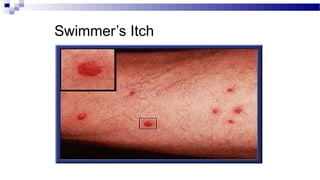
dermatitis orswimmers itch
Schistosomes of animals other than man
(usually rodents and birds) try to penetrate
the skin of man, they can not establish
themselves in the blood vascular system
of man.
Often cause a dermatitis which can be
severe and in some cases life threatening.
Allergic reaction
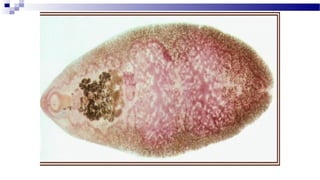
Fasciolopsis buski -
Intestinalfluke of man
large fluke infects man when he
ingests metacercaria found on
vegetation including water chestnuts,
bamboo, and water caltrop.
eat these raw or peel or crack with
teeth.
elimination of feces (human and animal)
into water and use of night soil for farming
44.
Fasciolopsis buski -
Pathology
Blockage of food passage or interference with
normal digestive processes
Destruction of intestinal tissue resulting in
ulcers, hemorrhages, and abscesses
formation
Chronic diarrhea
Verminous intoxication - result of
absorption of parasite metabolites (waste
products), can lead to death.
45.
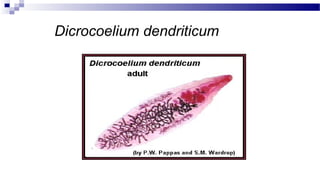
Dicrocoelium dendriticum
Common parasiteof herbivores, rare in
man
Not dependent upon aquatic
environment
Eggs eaten by land snail (asexual
reproduction occurs producing cercariae.
Cercariae surrounded forming slime
balls.
Ant eats slime ball and metacercaria
Paragonimus
westermani
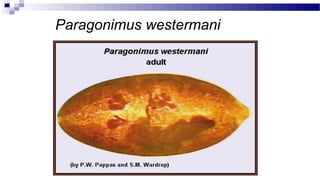
the human lungfluke, it is found in the
Orient including India and Philippines
Definitive host becomes infected by eating
improperly cooked crustacean. Adult
infections become established in lungs but
larval forms may wander into brain,
pleura, mesentery, etc.(ectopic infection).
Paragonimus
westermani
Reservoir hosts include- dogs, cats, pigs,
rodents, and other animals
Man becomes infected by eating
improperly cooked crabs, ingestion of
metacercaria from cutting boards where
salads are fixed, medicinal use of crab
juices)
Smoked or pickled crab do not kill