1
SARVAJANIK COLLEGE OF ENGINEERING &
TECHNOLOGY
ATHWALINES, SURAT
TRANSPORTATION IN INDIA: 2012 SCENARIO
Presented By:
1. Manoj Patel
Guided By:
Prof. Himanshu Padhya
• Area: 3.3 million sq. kms.
• Population: 1.21 billion (2011 Census)
• GDP: 1848 US $ billion.
• Per capita income: 1527 US $
2
Definition:-
• A well known and co-ordinate
system of transport plays an
important role in the sustained
economic growth of a country.
3
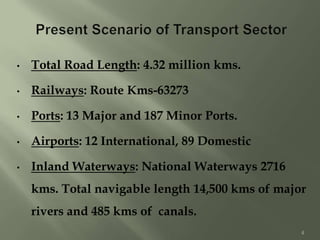
• Total Road Length: 4.32 million kms.
• Railways: Route Kms-63273
• Ports: 13 Major and 187 Minor Ports.
• Airports: 12 International, 89 Domestic
• Inland Waterways: National Waterways 2716
kms. Total navigable length 14,500 kms of major
rivers and 485 kms of canals.
4
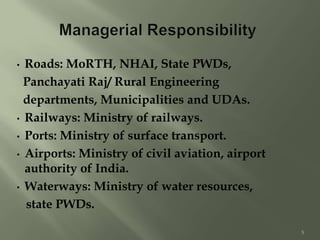
• Roads: MoRTH, NHAI, State PWDs,
Panchayati Raj/ Rural Engineering
departments, Municipalities and UDAs.
• Railways: Ministry of railways.
• Ports: Ministry of surface transport.
• Airports: Ministry of civil aviation, airport
authority of India.
• Waterways: Ministry of water resources,
state PWDs.
5
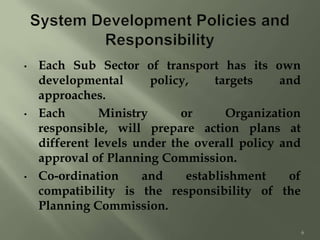
• Each Sub Sector of transport has its own
developmental policy, targets and
approaches.
• Each Ministry or Organization
responsible, will prepare action plans at
different levels under the overall policy and
approval of Planning Commission.
• Co-ordination and establishment of
compatibility is the responsibility of the
Planning Commission.
6
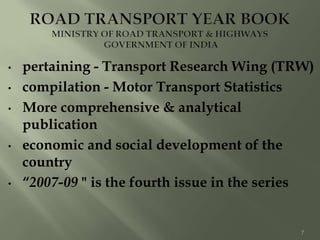
• pertaining - Transport Research Wing (TRW)
• compilation - Motor Transport Statistics
• More comprehensive & analytical
publication
• economic and social development of the
country
• “2007-09 " is the fourth issue in the series
7
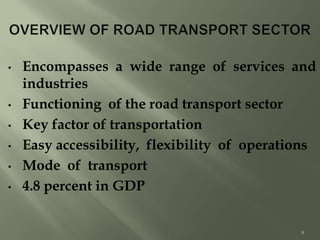
• Encompasses a wide range of services and
industries
• Functioning of the road transport sector
• Key factor of transportation
• Easy accessibility, flexibility of operations
• Mode of transport
• 4.8 percent in GDP
8
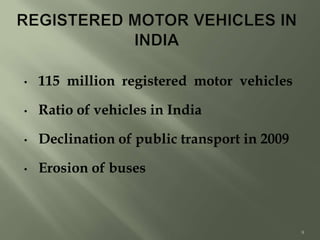
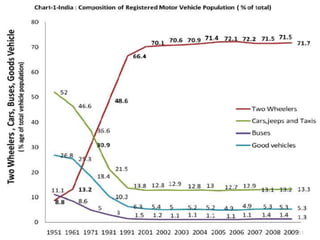
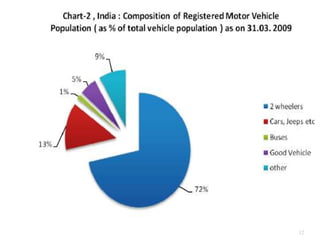
• 115 million registered motor vehicles
• Ratio of vehicles in India
• Declination of public transport in 2009
• Erosion of buses
9
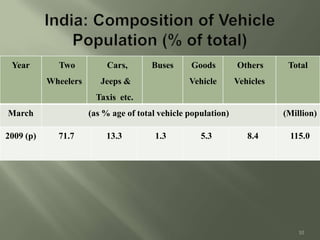
Year Two
Wheelers
Cars,
Jeeps &
Taxis etc.
Buses Goods
Vehicle
Others
Vehicles
Total
March (as % age of total vehicle population) (Million)
2009 (p) 71.7 13.3 1.3 5.3 8.4 115.0
10
11
12
13
14
15
16
17
• http://www.facts-about-
india.com/transportation-in-India.php
• www.iwai.nic.in
• www.aai.aero
• www.indianrailways.gov.in
• http://www.urbanindia.nic.in/programme/ut/ur
ban_transport.htm
• http://www.worldbank.org/en/country/india
• http://ncrb.gov.in/
• http://morth.nic.in/writereaddata/mainlinkFile/
File420.pdf
References
18
Thank You
19

TRANSPORTATION IN INDIA: 2012 SCENARIO

  • 1.
    1 SARVAJANIK COLLEGE OFENGINEERING & TECHNOLOGY ATHWALINES, SURAT TRANSPORTATION IN INDIA: 2012 SCENARIO Presented By: 1. Manoj Patel Guided By: Prof. Himanshu Padhya
  • 2.
    • Area: 3.3million sq. kms. • Population: 1.21 billion (2011 Census) • GDP: 1848 US $ billion. • Per capita income: 1527 US $ 2
  • 3.
    Definition:- • A wellknown and co-ordinate system of transport plays an important role in the sustained economic growth of a country. 3
  • 4.
    • Total RoadLength: 4.32 million kms. • Railways: Route Kms-63273 • Ports: 13 Major and 187 Minor Ports. • Airports: 12 International, 89 Domestic • Inland Waterways: National Waterways 2716 kms. Total navigable length 14,500 kms of major rivers and 485 kms of canals. 4
  • 5.
    • Roads: MoRTH,NHAI, State PWDs, Panchayati Raj/ Rural Engineering departments, Municipalities and UDAs. • Railways: Ministry of railways. • Ports: Ministry of surface transport. • Airports: Ministry of civil aviation, airport authority of India. • Waterways: Ministry of water resources, state PWDs. 5
  • 6.
    • Each SubSector of transport has its own developmental policy, targets and approaches. • Each Ministry or Organization responsible, will prepare action plans at different levels under the overall policy and approval of Planning Commission. • Co-ordination and establishment of compatibility is the responsibility of the Planning Commission. 6
  • 7.
    • pertaining -Transport Research Wing (TRW) • compilation - Motor Transport Statistics • More comprehensive & analytical publication • economic and social development of the country • “2007-09 " is the fourth issue in the series 7
  • 8.
    • Encompasses awide range of services and industries • Functioning of the road transport sector • Key factor of transportation • Easy accessibility, flexibility of operations • Mode of transport • 4.8 percent in GDP 8
  • 9.
    • 115 millionregistered motor vehicles • Ratio of vehicles in India • Declination of public transport in 2009 • Erosion of buses 9
  • 10.
    Year Two Wheelers Cars, Jeeps & Taxisetc. Buses Goods Vehicle Others Vehicles Total March (as % age of total vehicle population) (Million) 2009 (p) 71.7 13.3 1.3 5.3 8.4 115.0 10
  • 11.
  • 12.
  • 13.
  • 14.
  • 15.
  • 16.
  • 17.
  • 18.
    • http://www.facts-about- india.com/transportation-in-India.php • www.iwai.nic.in •www.aai.aero • www.indianrailways.gov.in • http://www.urbanindia.nic.in/programme/ut/ur ban_transport.htm • http://www.worldbank.org/en/country/india • http://ncrb.gov.in/ • http://morth.nic.in/writereaddata/mainlinkFile/ File420.pdf References 18
  • 19.