
INDIAN TRANSPORTATION SECTOR: AN OVERVIEW


                            SUBMITTED BY: AMAR ASHISH
SUBMITTED TO: Dr. ASHISH            MBA(PSM)
   MANOHAR URKUDE               SAP ID: 500015422
                               ROLL NO: R310211003
INDIAN TRANPORT SECTOR


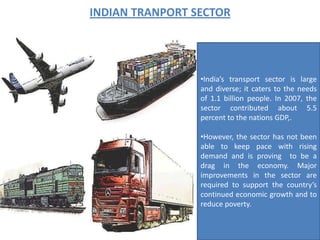
                 •India’s transport sector is large
                 and diverse; it caters to the needs
                 of 1.1 billion people. In 2007, the
                 sector contributed about 5.5
                 percent to the nations GDP,.

                 •However, the sector has not been
                 able to keep pace with rising
                 demand and is proving to be a
                 drag in the economy. Major
                 improvements in the sector are
                 required to support the country’s
                 continued economic growth and to
                 reduce poverty.
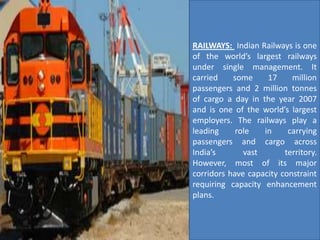
RAILWAYS: Indian Railways is one
of the world’s largest railways
under single management. It
carried    some     17     million
passengers and 2 million tonnes
of cargo a day in the year 2007
and is one of the world’s largest
employers. The railways play a
leading     role   in     carrying
passengers and cargo across
India’s       vast       territory.
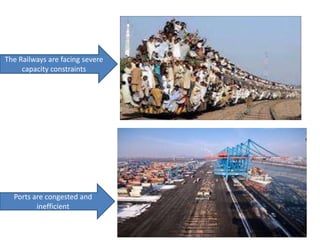
However, most of its major
corridors have capacity constraint
requiring capacity enhancement
plans.
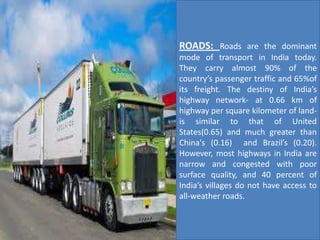
ROADS: Roads are the dominant
mode of transport in India today.
They carry almost 90% of the
country’s passenger traffic and 65%of
its freight. The destiny of India’s
highway network- at 0.66 km of
highway per square kilometer of land-
is similar to that of United
States(0.65) and much greater than
China's (0.16) and Brazil’s (0.20).
However, most highways in India are
narrow and congested with poor
surface quality, and 40 percent of
India’s villages do not have access to
all-weather roads.
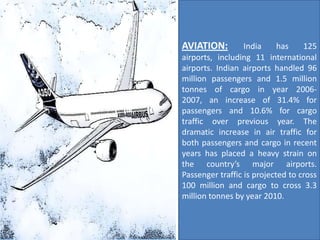
AVIATION:         India     has    125
airports, including 11 international
airports. Indian airports handled 96
million passengers and 1.5 million
tonnes of cargo in year 2006-
2007, an increase of 31.4% for
passengers and 10.6% for cargo
traffic over previous year. The
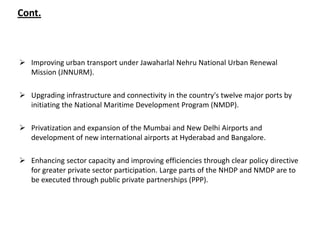
dramatic increase in air traffic for
both passengers and cargo in recent
years has placed a heavy strain on
the country’s major airports.
Passenger traffic is projected to cross
100 million and cargo to cross 3.3
million tonnes by year 2010.
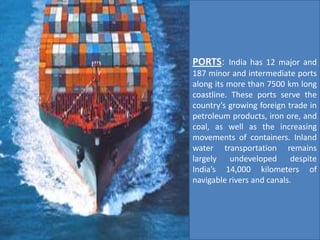
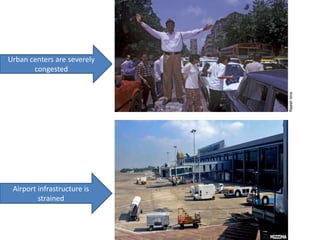
PORTS: India has 12 major and
187 minor and intermediate ports
along its more than 7500 km long
coastline. These ports serve the
country’s growing foreign trade in
petroleum products, iron ore, and
coal, as well as the increasing
movements of containers. Inland
water transportation remains
largely undeveloped despite
India’s 14,000 kilometers of
navigable rivers and canals.
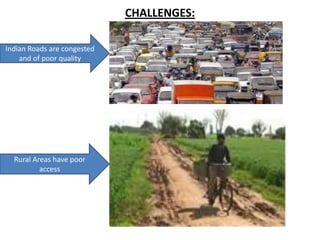
CHALLENGES:

Indian Roads are congested
    and of poor quality


  Rural Areas have poor
          access
The Railways are facing severe
     capacity constraints


  Ports are congested and
         inefficient
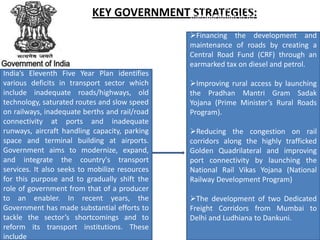
Urban centers are severely
       congested


 Airport infrastructure is
         strained
Increasing public funding for
                           KEY    GOVERNMENTtransportation in its five year plans
                                             STRATEGIES:
                                                   Financing the development and
                                                   maintenance of roads by creating a
                                                   Central Road Fund (CRF) through an
                                                   earmarked tax on diesel and petrol.
India’s Eleventh Five Year Plan identifies
various deficits in transport sector which         Improving rural access by launching
include inadequate roads/highways, old             the Pradhan Mantri Gram Sadak
technology, saturated routes and slow speed        Yojana (Prime Minister’s Rural Roads
on railways, inadequate berths and rail/road       Program).
connectivity at ports and inadequate
runways, aircraft handling capacity, parking       Reducing the congestion on rail
space and terminal building at airports.           corridors along the highly trafficked
Government aims to modernize, expand,              Golden Quadrilateral and improving
and integrate the country's transport              port connectivity by launching the
services. It also seeks to mobilize resources      National Rail Vikas Yojana (National
for this purpose and to gradually shift the        Railway Development Program)
role of government from that of a producer
to an enabler. In recent years, the                The development of two Dedicated
Government has made substantial efforts to         Freight Corridors from Mumbai to
tackle the sector’s shortcomings and to            Delhi and Ludhiana to Dankuni.
reform its transport institutions. These
include
Cont.


 Improving urban transport under Jawaharlal Nehru National Urban Renewal
  Mission (JNNURM).

 Upgrading infrastructure and connectivity in the country's twelve major ports by
  initiating the National Maritime Development Program (NMDP).

 Privatization and expansion of the Mumbai and New Delhi Airports and
  development of new international airports at Hyderabad and Bangalore.

 Enhancing sector capacity and improving efficiencies through clear policy directive
  for greater private sector participation. Large parts of the NHDP and NMDP are to
  be executed through public private partnerships (PPP).
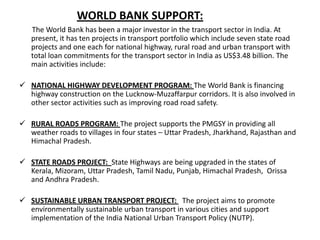
WORLD BANK SUPPORT:
   The World Bank has been a major investor in the transport sector in India. At
   present, it has ten projects in transport portfolio which include seven state road
   projects and one each for national highway, rural road and urban transport with
   total loan commitments for the transport sector in India as US$3.48 billion. The
   main activities include:

 NATIONAL HIGHWAY DEVELOPMENT PROGRAM: The World Bank is financing
  highway construction on the Lucknow-Muzaffarpur corridors. It is also involved in
  other sector activities such as improving road road safety.

 RURAL ROADS PROGRAM: The project supports the PMGSY in providing all
  weather roads to villages in four states – Uttar Pradesh, Jharkhand, Rajasthan and
  Himachal Pradesh.

 STATE ROADS PROJECT: State Highways are being upgraded in the states of
  Kerala, Mizoram, Uttar Pradesh, Tamil Nadu, Punjab, Himachal Pradesh, Orissa
  and Andhra Pradesh.

 SUSTAINABLE URBAN TRANSPORT PROJECT: The project aims to promote
  environmentally sustainable urban transport in various cities and support
  implementation of the India National Urban Transport Policy (NUTP).
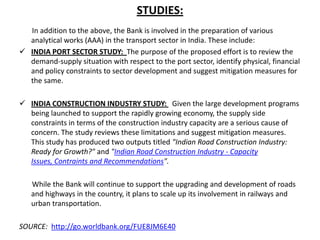
STUDIES:
  In addition to the above, the Bank is involved in the preparation of various
  analytical works (AAA) in the transport sector in India. These include:
 INDIA PORT SECTOR STUDY: The purpose of the proposed effort is to review the
  demand-supply situation with respect to the port sector, identify physical, financial
  and policy constraints to sector development and suggest mitigation measures for
  the same.

 INDIA CONSTRUCTION INDUSTRY STUDY: Given the large development programs
  being launched to support the rapidly growing economy, the supply side
  constraints in terms of the construction industry capacity are a serious cause of
  concern. The study reviews these limitations and suggest mitigation measures.
  This study has produced two outputs titled "Indian Road Construction Industry:
  Ready for Growth?" and "Indian Road Construction Industry - Capacity
  Issues, Contraints and Recommendations".

   While the Bank will continue to support the upgrading and development of roads
   and highways in the country, it plans to scale up its involvement in railways and
   urban transportation.

SOURCE: http://go.worldbank.org/FUE8JM6E40
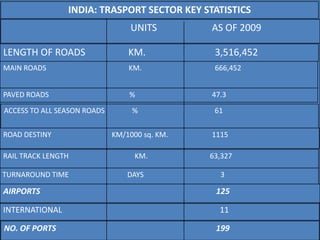
INDIA: TRASPORT SECTOR KEY STATISTICS
                                  UNITS        AS OF 2009

LENGTH OF ROADS                  KM.            3,516,452
MAIN ROADS                       KM.            666,452


PAVED ROADS                      %             47.3

ACCESS TO ALL SEASON ROADS        %             61


ROAD DESTINY                 KM/1000 sq. KM.   1115

RAIL TRACK LENGTH                  KM.         63,327

TURNAROUND TIME                  DAYS            3

AIRPORTS                                        125

INTERNATIONAL                                    11

NO. OF PORTS                                    199
Indian tranport sector 1

Indian tranport sector 1

  • 1.
    INDIAN TRANSPORTATION SECTOR:AN OVERVIEW SUBMITTED BY: AMAR ASHISH SUBMITTED TO: Dr. ASHISH MBA(PSM) MANOHAR URKUDE SAP ID: 500015422 ROLL NO: R310211003
  • 2.
    INDIAN TRANPORT SECTOR •India’s transport sector is large and diverse; it caters to the needs of 1.1 billion people. In 2007, the sector contributed about 5.5 percent to the nations GDP,. •However, the sector has not been able to keep pace with rising demand and is proving to be a drag in the economy. Major improvements in the sector are required to support the country’s continued economic growth and to reduce poverty.
  • 3.
    RAILWAYS: Indian Railwaysis one of the world’s largest railways under single management. It carried some 17 million passengers and 2 million tonnes of cargo a day in the year 2007 and is one of the world’s largest employers. The railways play a leading role in carrying passengers and cargo across India’s vast territory. However, most of its major corridors have capacity constraint requiring capacity enhancement plans.
  • 4.
    ROADS: Roads arethe dominant mode of transport in India today. They carry almost 90% of the country’s passenger traffic and 65%of its freight. The destiny of India’s highway network- at 0.66 km of highway per square kilometer of land- is similar to that of United States(0.65) and much greater than China's (0.16) and Brazil’s (0.20). However, most highways in India are narrow and congested with poor surface quality, and 40 percent of India’s villages do not have access to all-weather roads.
  • 5.
    AVIATION: India has 125 airports, including 11 international airports. Indian airports handled 96 million passengers and 1.5 million tonnes of cargo in year 2006- 2007, an increase of 31.4% for passengers and 10.6% for cargo traffic over previous year. The dramatic increase in air traffic for both passengers and cargo in recent years has placed a heavy strain on the country’s major airports. Passenger traffic is projected to cross 100 million and cargo to cross 3.3 million tonnes by year 2010.
  • 6.
    PORTS: India has12 major and 187 minor and intermediate ports along its more than 7500 km long coastline. These ports serve the country’s growing foreign trade in petroleum products, iron ore, and coal, as well as the increasing movements of containers. Inland water transportation remains largely undeveloped despite India’s 14,000 kilometers of navigable rivers and canals.
  • 7.
    CHALLENGES: Indian Roads arecongested and of poor quality Rural Areas have poor access
  • 8.
    The Railways arefacing severe capacity constraints Ports are congested and inefficient
  • 9.
    Urban centers areseverely congested Airport infrastructure is strained
  • 10.
    Increasing public fundingfor KEY GOVERNMENTtransportation in its five year plans STRATEGIES: Financing the development and maintenance of roads by creating a Central Road Fund (CRF) through an earmarked tax on diesel and petrol. India’s Eleventh Five Year Plan identifies various deficits in transport sector which Improving rural access by launching include inadequate roads/highways, old the Pradhan Mantri Gram Sadak technology, saturated routes and slow speed Yojana (Prime Minister’s Rural Roads on railways, inadequate berths and rail/road Program). connectivity at ports and inadequate runways, aircraft handling capacity, parking Reducing the congestion on rail space and terminal building at airports. corridors along the highly trafficked Government aims to modernize, expand, Golden Quadrilateral and improving and integrate the country's transport port connectivity by launching the services. It also seeks to mobilize resources National Rail Vikas Yojana (National for this purpose and to gradually shift the Railway Development Program) role of government from that of a producer to an enabler. In recent years, the The development of two Dedicated Government has made substantial efforts to Freight Corridors from Mumbai to tackle the sector’s shortcomings and to Delhi and Ludhiana to Dankuni. reform its transport institutions. These include
  • 11.
    Cont.  Improving urbantransport under Jawaharlal Nehru National Urban Renewal Mission (JNNURM).  Upgrading infrastructure and connectivity in the country's twelve major ports by initiating the National Maritime Development Program (NMDP).  Privatization and expansion of the Mumbai and New Delhi Airports and development of new international airports at Hyderabad and Bangalore.  Enhancing sector capacity and improving efficiencies through clear policy directive for greater private sector participation. Large parts of the NHDP and NMDP are to be executed through public private partnerships (PPP).
  • 12.
    WORLD BANK SUPPORT: The World Bank has been a major investor in the transport sector in India. At present, it has ten projects in transport portfolio which include seven state road projects and one each for national highway, rural road and urban transport with total loan commitments for the transport sector in India as US$3.48 billion. The main activities include:  NATIONAL HIGHWAY DEVELOPMENT PROGRAM: The World Bank is financing highway construction on the Lucknow-Muzaffarpur corridors. It is also involved in other sector activities such as improving road road safety.  RURAL ROADS PROGRAM: The project supports the PMGSY in providing all weather roads to villages in four states – Uttar Pradesh, Jharkhand, Rajasthan and Himachal Pradesh.  STATE ROADS PROJECT: State Highways are being upgraded in the states of Kerala, Mizoram, Uttar Pradesh, Tamil Nadu, Punjab, Himachal Pradesh, Orissa and Andhra Pradesh.  SUSTAINABLE URBAN TRANSPORT PROJECT: The project aims to promote environmentally sustainable urban transport in various cities and support implementation of the India National Urban Transport Policy (NUTP).
  • 13.
    STUDIES: Inaddition to the above, the Bank is involved in the preparation of various analytical works (AAA) in the transport sector in India. These include:  INDIA PORT SECTOR STUDY: The purpose of the proposed effort is to review the demand-supply situation with respect to the port sector, identify physical, financial and policy constraints to sector development and suggest mitigation measures for the same.  INDIA CONSTRUCTION INDUSTRY STUDY: Given the large development programs being launched to support the rapidly growing economy, the supply side constraints in terms of the construction industry capacity are a serious cause of concern. The study reviews these limitations and suggest mitigation measures. This study has produced two outputs titled "Indian Road Construction Industry: Ready for Growth?" and "Indian Road Construction Industry - Capacity Issues, Contraints and Recommendations". While the Bank will continue to support the upgrading and development of roads and highways in the country, it plans to scale up its involvement in railways and urban transportation. SOURCE: http://go.worldbank.org/FUE8JM6E40
  • 14.
    INDIA: TRASPORT SECTORKEY STATISTICS UNITS AS OF 2009 LENGTH OF ROADS KM. 3,516,452 MAIN ROADS KM. 666,452 PAVED ROADS % 47.3 ACCESS TO ALL SEASON ROADS % 61 ROAD DESTINY KM/1000 sq. KM. 1115 RAIL TRACK LENGTH KM. 63,327 TURNAROUND TIME DAYS 3 AIRPORTS 125 INTERNATIONAL 11 NO. OF PORTS 199