
By:- Sandeep Singh
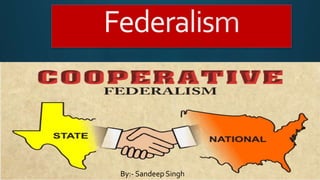
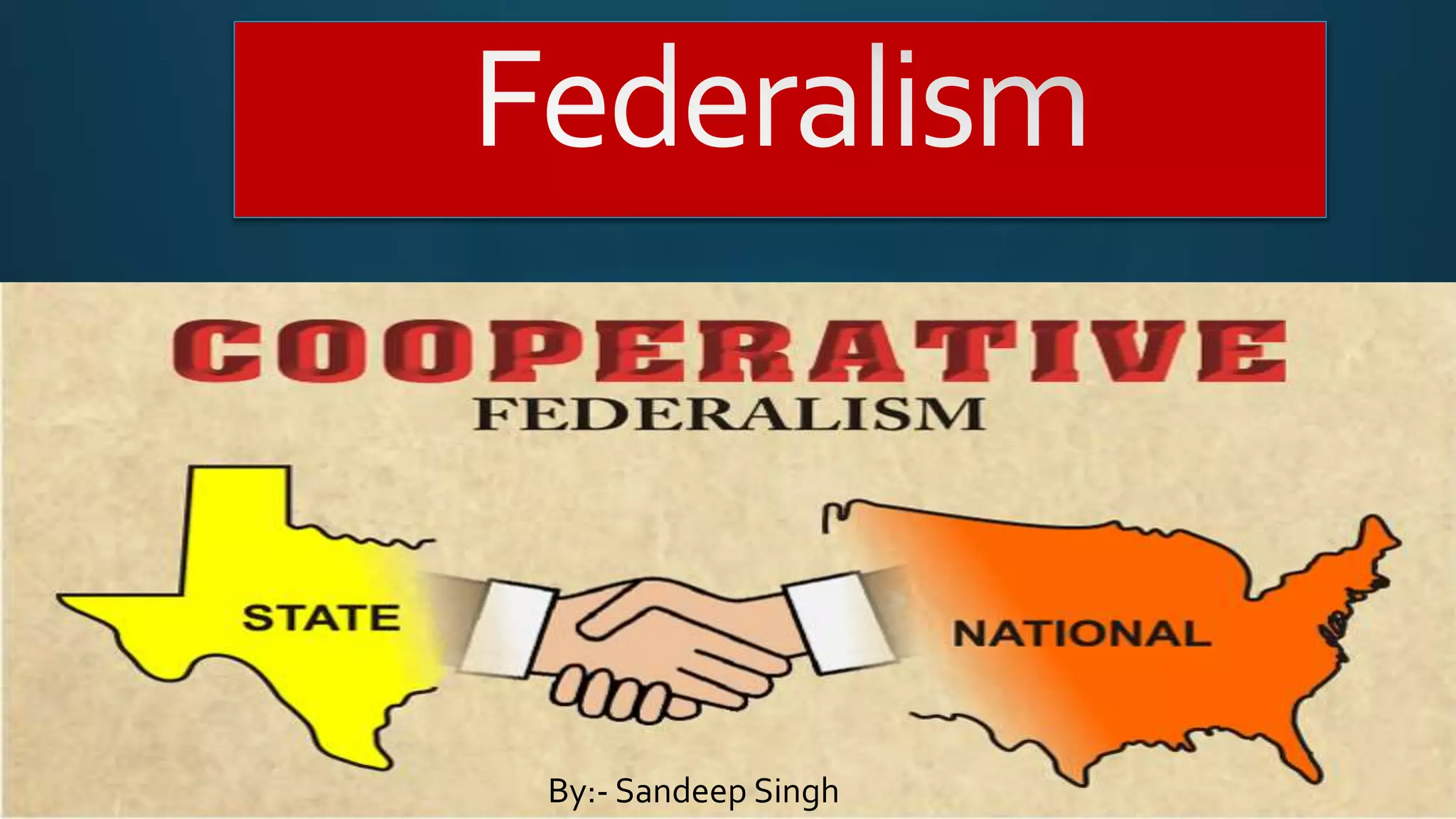
Federalism
• A system of Govt. in which power is divided into different levels of Govt.
• A system of Govt. in which power is divided between a central authority
and the various constituencies units of Govt.
Features of Federalism
There are two or more level of govt.
Central
State
Diff. levels of Govt. govern the same citizen. Each level has its jurisdiction.
Jurisdiction of each level of govt. is classified by the constitution.
Changes in Constitutional rules and rights need the consent of each level of
Govt.
Features of Federalism
Courts have the power to interpret the constitution & to solve the conflict
b/w political parties.
Sources of revenue of each level of govt. is specified by the Constitution.
An ideal federal system has two aspect.
MutualTrust
Agreement to live together
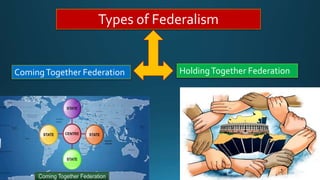
Types of Federalism
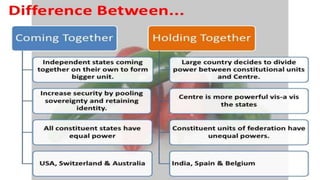
ComingTogether Federation HoldingTogether Federation
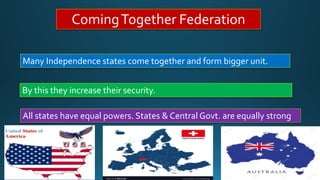
ComingTogether Federation
Many Independence states come together and form bigger unit.
By this they increase their security.
All states have equal powers. States & Central Govt. are equally strong
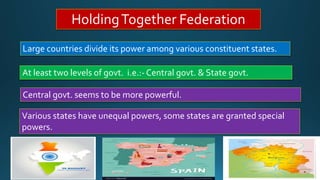
HoldingTogether Federation
Large countries divide its power among various constituent states.
At least two levels of govt. i.e.:- Central govt. & State govt.
Central govt. seems to be more powerful.
Various states have unequal powers, some states are granted special
powers.
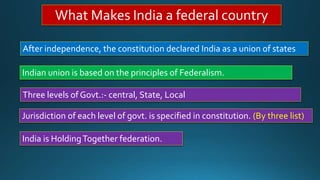
What Makes India a federal country
After independence, the constitution declared India as a union of states
Indian union is based on the principles of Federalism.
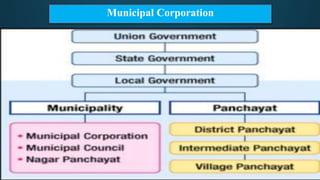
Three levels of Govt.:- central, State, Local
Jurisdiction of each level of govt. is specified in constitution. (By three list)
India is HoldingTogether federation.
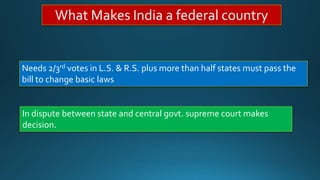
What Makes India a federal country
Needs 2/3rd votes in L.S. & R.S. plus more than half states must pass the
bill to change basic laws
In dispute between state and central govt. supreme court makes
decision.
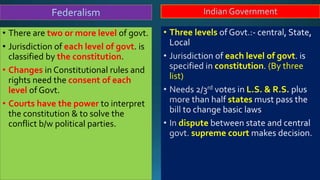
• There are two or more level of govt.
• Jurisdiction of each level of govt. is
classified by the constitution.
• Changes in Constitutional rules and
rights need the consent of each
level of Govt.
• Courts have the power to interpret
the constitution & to solve the
conflict b/w political parties.
• Three levels
each level of govt
constitution (By three
list)
L.S. & R.S.
states
dispute
supreme court
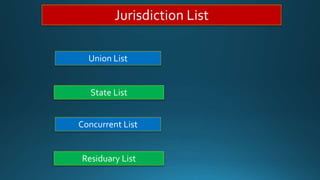
Jurisdiction List
Union List
State List
Concurrent List
Residuary List
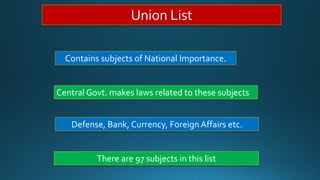
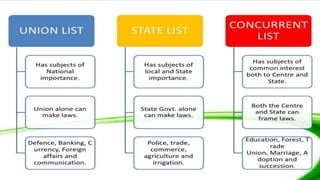
Union List
Contains subjects of National Importance.
Central Govt. makes laws related to these subjects
Defense, Bank, Currency, Foreign Affairs etc.
There are 97 subjects in this list
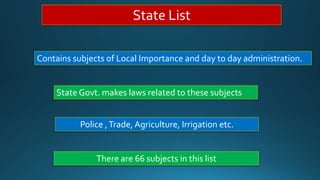
State List
Contains subjects of Local Importance and day to day administration.
State Govt. makes laws related to these subjects
Police ,Trade, Agriculture, Irrigation etc.
There are 66 subjects in this list
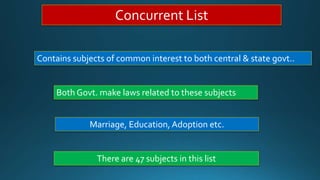
Concurrent List
Contains subjects of common interest to both central & state govt..
Both Govt. make laws related to these subjects
Marriage, Education, Adoption etc.
There are 47 subjects in this list
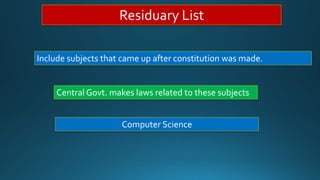
Residuary List
Include subjects that came up after constitution was made.
Central Govt. makes laws related to these subjects
Computer Science
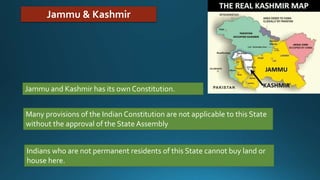
Jammu & Kashmir
Jammu and Kashmir has its own Constitution.
Many provisions of the Indian Constitution are not applicable to this State
without the approval of the State Assembly
Indians who are not permanent residents of this State cannot buy land or
house here.
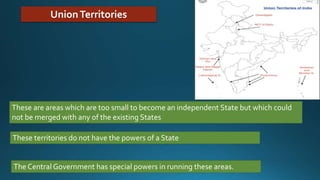
UnionTerritories
These are areas which are too small to become an independent State but which could
not be merged with any of the existing States
These territories do not have the powers of a State
The Central Government has special powers in running these areas.
Federalism Practiced in India
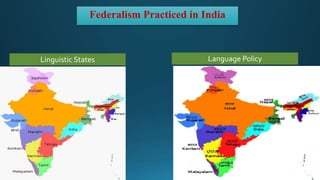
Linguistic States Language Policy
Linguistic States
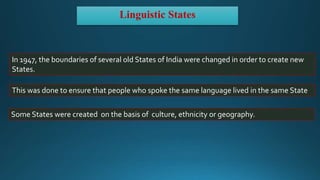
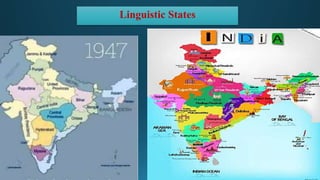
In 1947, the boundaries of several old States of India were changed in order to create new
States.
This was done to ensure that people who spoke the same language lived in the same State
Some States were created on the basis of culture, ethnicity or geography.
Linguistic States
Language Policy
Our Constitution did not give the status of national language to any one language
Hindi was identified as the official language.
21 languages were recognised as scheduled language by the Constitution.
Candidates can opt.To take examination in any of these 22 languages for a central govt. position
States have their own official language.
According to the Constitution, the use of English for official purposes was to stop in 1965.
However, many non-Hindi speaking States demanded that the use of English continue.
Centre-State Relation
1947-1990
Centre-State Relation
After 1990
Centre-State Relation
1947-1990
After 1947, for a long time same party ruled centre and state.This did not
allowed state govt. to exercise their rights as autonomous federal units.
If the party ruling in centre and state was different.The central govt.
often misused the constitution to dismiss state govt.
This undermined the spirit of federalism
Centre-State Relation
After 1990
No single party had majority in L.S.The era of coalition govt. started.
This led to a new culture of power sharing and respect for the
autonomy of State Governments.
It became difficult to dismiss State Govt.
StateGovt. Now ruled autonomously and became powerful.
Decentralisation
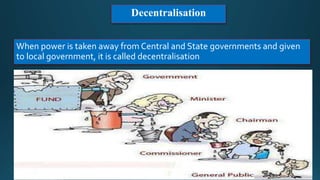
When power is taken away from Central and State governments and given
to local government, it is called decentralisation
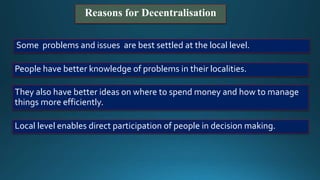
Reasons for Decentralisation
Some problems and issues are best settled at the local level.
People have better knowledge of problems in their localities.
They also have better ideas on where to spend money and how to manage
things more efficiently.
Local level enables direct participation of people in decision making.
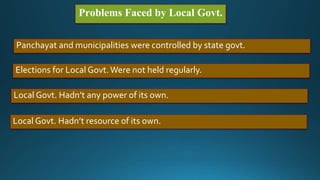
Problems Faced by Local Govt.
Panchayat and municipalities were controlled by state govt.
Elections for Local Govt.Were not held regularly.
Local Govt. Hadn’t any power of its own.
Local Govt. Hadn’t resource of its own.
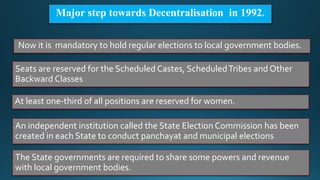
Major step towards Decentralisation in 1992.
Now it is mandatory to hold regular elections to local government bodies.
Seats are reserved for the Scheduled Castes, ScheduledTribes and Other
Backward Classes
At least one-third of all positions are reserved for women.
An independent institution called the State Election Commission has been
created in each State to conduct panchayat and municipal elections
The State governments are required to share some powers and revenue
with local government bodies.
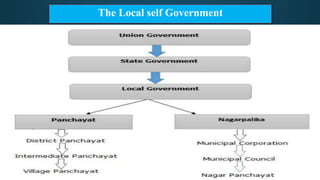
The Local self Government
The Panchayati Raj
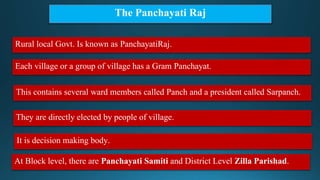
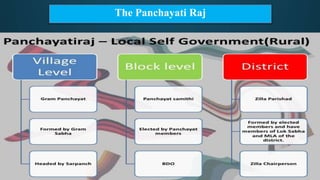
Rural local Govt. Is known as PanchayatiRaj.
Each village or a group of village has a Gram Panchayat.
This contains several ward members called Panch and a president called Sarpanch.
They are directly elected by people of village.
It is decision making body.
At Block level, there are Panchayati Samiti and District Level Zilla Parishad.
The Panchayati Raj
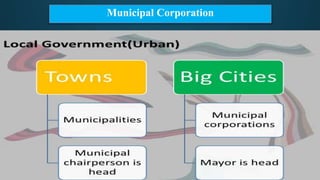
Municipal Corporation
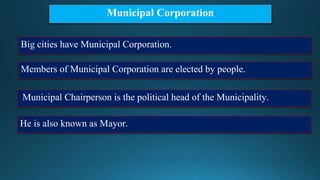
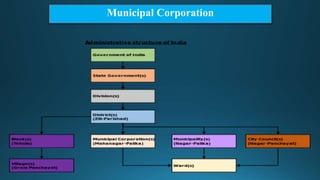
Big cities have Municipal Corporation.
Members of Municipal Corporation are elected by people.
Municipal Chairperson is the political head of the Municipality.
He is also known as Mayor.
Municipal Corporation
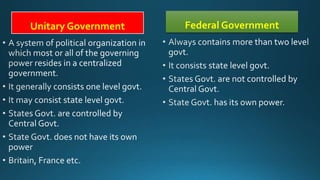
Unitary Government Federal Government
Federalism

Federalism

  • 1.
  • 2.
    Federalism • A systemof Govt. in which power is divided into different levels of Govt. • A system of Govt. in which power is divided between a central authority and the various constituencies units of Govt.
  • 3.
    Features of Federalism Thereare two or more level of govt. Central State Diff. levels of Govt. govern the same citizen. Each level has its jurisdiction. Jurisdiction of each level of govt. is classified by the constitution. Changes in Constitutional rules and rights need the consent of each level of Govt.
  • 4.
    Features of Federalism Courtshave the power to interpret the constitution & to solve the conflict b/w political parties. Sources of revenue of each level of govt. is specified by the Constitution. An ideal federal system has two aspect. MutualTrust Agreement to live together
  • 5.
    Types of Federalism ComingTogetherFederation HoldingTogether Federation
  • 6.
    ComingTogether Federation Many Independencestates come together and form bigger unit. By this they increase their security. All states have equal powers. States & Central Govt. are equally strong
  • 7.
    HoldingTogether Federation Large countriesdivide its power among various constituent states. At least two levels of govt. i.e.:- Central govt. & State govt. Central govt. seems to be more powerful. Various states have unequal powers, some states are granted special powers.
  • 9.
    What Makes Indiaa federal country After independence, the constitution declared India as a union of states Indian union is based on the principles of Federalism. Three levels of Govt.:- central, State, Local Jurisdiction of each level of govt. is specified in constitution. (By three list) India is HoldingTogether federation.
  • 10.
    What Makes Indiaa federal country Needs 2/3rd votes in L.S. & R.S. plus more than half states must pass the bill to change basic laws In dispute between state and central govt. supreme court makes decision.
  • 11.
    • There aretwo or more level of govt. • Jurisdiction of each level of govt. is classified by the constitution. • Changes in Constitutional rules and rights need the consent of each level of Govt. • Courts have the power to interpret the constitution & to solve the conflict b/w political parties. • Three levels each level of govt constitution (By three list) L.S. & R.S. states dispute supreme court
  • 12.
    Jurisdiction List Union List StateList Concurrent List Residuary List
  • 13.
    Union List Contains subjectsof National Importance. Central Govt. makes laws related to these subjects Defense, Bank, Currency, Foreign Affairs etc. There are 97 subjects in this list
  • 14.
    State List Contains subjectsof Local Importance and day to day administration. State Govt. makes laws related to these subjects Police ,Trade, Agriculture, Irrigation etc. There are 66 subjects in this list
  • 15.
    Concurrent List Contains subjectsof common interest to both central & state govt.. Both Govt. make laws related to these subjects Marriage, Education, Adoption etc. There are 47 subjects in this list
  • 16.
    Residuary List Include subjectsthat came up after constitution was made. Central Govt. makes laws related to these subjects Computer Science
  • 18.
    Jammu & Kashmir Jammuand Kashmir has its own Constitution. Many provisions of the Indian Constitution are not applicable to this State without the approval of the State Assembly Indians who are not permanent residents of this State cannot buy land or house here.
  • 19.
    UnionTerritories These are areaswhich are too small to become an independent State but which could not be merged with any of the existing States These territories do not have the powers of a State The Central Government has special powers in running these areas.
  • 20.
    Federalism Practiced inIndia Linguistic States Language Policy
  • 21.
    Linguistic States In 1947,the boundaries of several old States of India were changed in order to create new States. This was done to ensure that people who spoke the same language lived in the same State Some States were created on the basis of culture, ethnicity or geography.
  • 22.
  • 23.
    Language Policy Our Constitutiondid not give the status of national language to any one language Hindi was identified as the official language. 21 languages were recognised as scheduled language by the Constitution. Candidates can opt.To take examination in any of these 22 languages for a central govt. position States have their own official language. According to the Constitution, the use of English for official purposes was to stop in 1965. However, many non-Hindi speaking States demanded that the use of English continue.
  • 24.
  • 25.
    Centre-State Relation 1947-1990 After 1947,for a long time same party ruled centre and state.This did not allowed state govt. to exercise their rights as autonomous federal units. If the party ruling in centre and state was different.The central govt. often misused the constitution to dismiss state govt. This undermined the spirit of federalism
  • 26.
    Centre-State Relation After 1990 Nosingle party had majority in L.S.The era of coalition govt. started. This led to a new culture of power sharing and respect for the autonomy of State Governments. It became difficult to dismiss State Govt. StateGovt. Now ruled autonomously and became powerful.
  • 27.
    Decentralisation When power istaken away from Central and State governments and given to local government, it is called decentralisation
  • 28.
    Reasons for Decentralisation Someproblems and issues are best settled at the local level. People have better knowledge of problems in their localities. They also have better ideas on where to spend money and how to manage things more efficiently. Local level enables direct participation of people in decision making.
  • 29.
    Problems Faced byLocal Govt. Panchayat and municipalities were controlled by state govt. Elections for Local Govt.Were not held regularly. Local Govt. Hadn’t any power of its own. Local Govt. Hadn’t resource of its own.
  • 30.
    Major step towardsDecentralisation in 1992. Now it is mandatory to hold regular elections to local government bodies. Seats are reserved for the Scheduled Castes, ScheduledTribes and Other Backward Classes At least one-third of all positions are reserved for women. An independent institution called the State Election Commission has been created in each State to conduct panchayat and municipal elections The State governments are required to share some powers and revenue with local government bodies.
  • 31.
    The Local selfGovernment
  • 32.
    The Panchayati Raj Rurallocal Govt. Is known as PanchayatiRaj. Each village or a group of village has a Gram Panchayat. This contains several ward members called Panch and a president called Sarpanch. They are directly elected by people of village. It is decision making body. At Block level, there are Panchayati Samiti and District Level Zilla Parishad.
  • 33.
  • 34.
    Municipal Corporation Big citieshave Municipal Corporation. Members of Municipal Corporation are elected by people. Municipal Chairperson is the political head of the Municipality. He is also known as Mayor.
  • 35.
  • 36.
  • 37.
  • 38.