INDIAN INSTITUTE OF TOURISM & TRAVEL
MANAGEMENT, GWALIOR
Tourist Transportation Service In India
10/11/2019
1
Submitted To:
Amit Tiwari
Assistant Professor
Submitted By:
Divyajit
OBJECTIVES
 To understand the transportation system in India
 Modes of Transportation
 Problems of Present Transportation System
 Solution of the Problems
 Conclusion of the Presentation
10/11/2019
2
10/11/2019
3
DIFFERENT MODES OF TRANSPORT
Road Transport
Rail Transport Air Transport
Water Transport
10/11/2019
4
AVIATION SECTOR
 The sector deals with the transport of passenger and cargo
from one place to another, using the aerial route.
 Size :
 About 75 million Passengers
 $5.6billion
 Growth
 Around 15% growth in last 10 years.
 Vision 2020 statement predicts handling 280 million
customers by 2020
10/11/2019
5

 INTERNATIONAL AIR TRANSPORT ASSIOCIATION

 INTERNATIONAL CIVIL AVIATION ORGANISATION

 DIRECTORATE GENERAL OF CIVIL AVIATION

 AIRPORT AUTHORITY OF INDIA
10/11/2019
6
ROADWAYS
 Roadways play vital role by providing flexibility,
reliability speed and door to door services besides
supplementing and increasing the efficiency of
other modes of transportation .
 Road transports provides access to millions of
people by using National Highways, State
Highways & District Roads
10/11/2019
7
VARIOUS TYPES OF HIGHWAYS
 NATIONAL HIGHWAYS
 National highways which are about 100,087 km,
including over 1000 kms of expressways.
Maintained by NHAI.
 STATE HIGHWAYS
 State highways which are about 150000 km, and
maintained by state governments. They connect
important cities as well as towns.
10/11/2019
8
10/11/2019
9
RAILWAYS IN INDIA
o Train between Bombay-Thane , April 16
1853.
o The second train between Howrah and
Hooghly in 1854.
o Electronic train in India- Deccan quean in
1929 between Bombay and Poona.
o Fastest train in India shatabdi express-
140km/h
 Longest train route is vivek express from dibrugarh
to kanyakumari covering4273 km.
 Second longest train route is of himsagar express
from vaishnodevi to kanyakumari . It covers 3726
km.
 Longest railway platform – Gorakhpur.
10/11/2019
10
TRAINS FOR TOURISTS
Trains for Tourists:
 Palace on Wheels
 Royal Rajasthan on Wheels
 Deccan Odyssey
 Golden Chariot
 Maharajas' Express
Above trains attracts national and international tourist
for luxury tours.
10/11/2019
11
INDIAN RAILWAY CATERING AND TOURISM
CORPORATION(IRCTC)
 RAILWAY HELP :-
 Enquiry no – 139
 Toll free no – 1800111139
 Fax no – 011-23345400
 Email – feedback@irctc.com
10/11/2019
12
WATER TRANSPORT
o Before the coming of road and rail transport it was
water transport (regarded as the oldest
transportation mode) which carried goods and
persons from one place to another. In spite of the
bridges constructed over the rivers it still has
relevance because of environmental considerations
and of being economical.
o Inland Waterways Authority of India The Inland
Waterways Authority of India (IWAI) came into
existence on 27 October 1986 for development and
regulation of inland waterways for shipping and
navigation
10/11/2019
13
Their are three broad categories of water transport.
They are:
 Coastal Shipping
 Inland Waterways
 Foreign Going Traffic
10/11/2019
14
10/11/2019
15
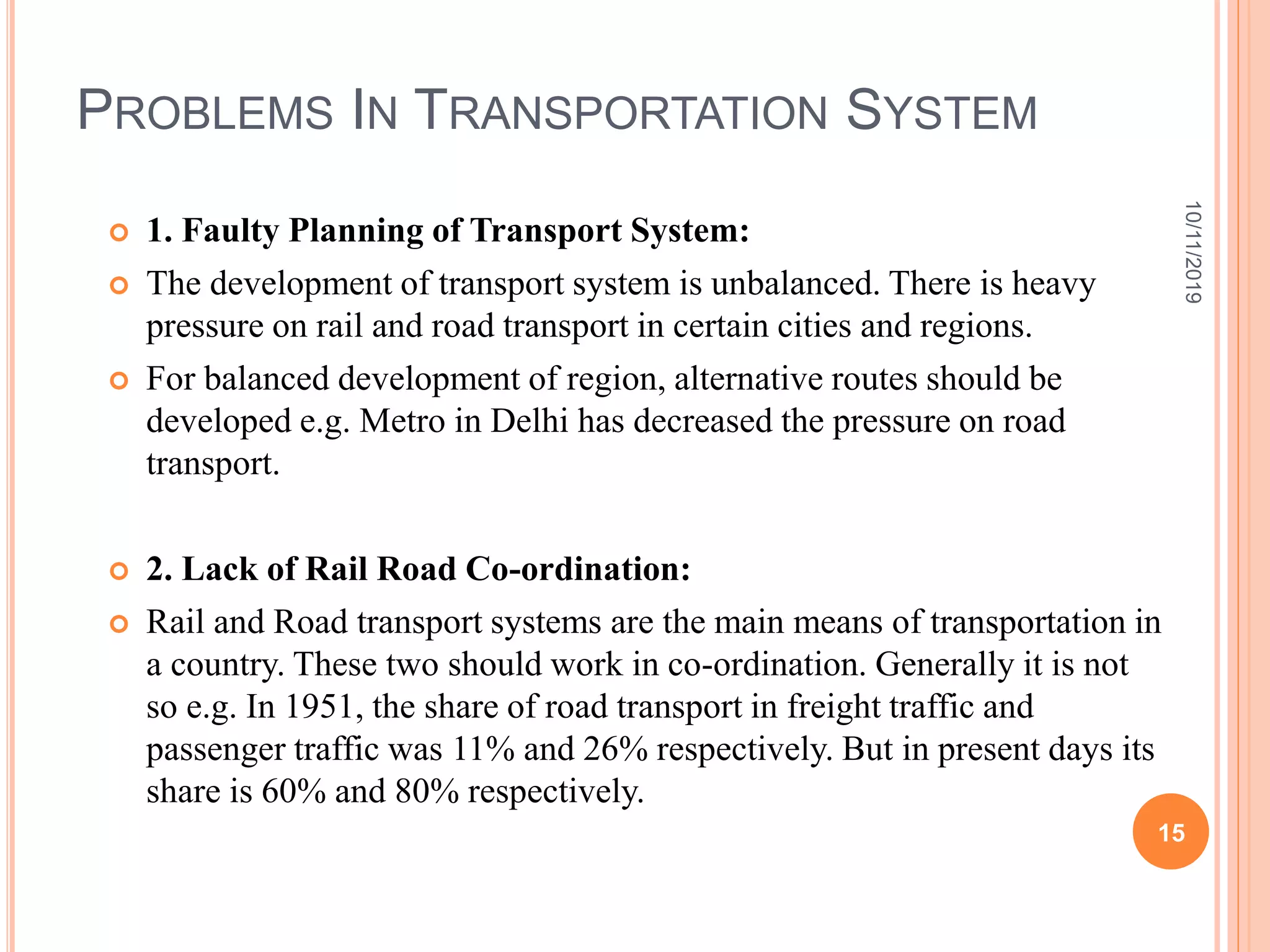
PROBLEMS IN TRANSPORTATION SYSTEM
 1. Faulty Planning of Transport System:
 The development of transport system is unbalanced. There is heavy
pressure on rail and road transport in certain cities and regions.
 For balanced development of region, alternative routes should be
developed e.g. Metro in Delhi has decreased the pressure on road
transport.
 2. Lack of Rail Road Co-ordination:
 Rail and Road transport systems are the main means of transportation in
a country. These two should work in co-ordination. Generally it is not
so e.g. In 1951, the share of road transport in freight traffic and
passenger traffic was 11% and 26% respectively. But in present days its
share is 60% and 80% respectively.
3. Worn out and Obsolete Assets :
The main problem of our transport system is its worn out and
obsolete assets. In all modes of transport there are old and worn out
infrastructure. These need immediate replacement. They are main
cause of accidents and environmental pollution. In air transport
nearly one third of the total fleet requires immediate replacement.
4. Improved technology:
Modernization and use of latest technology in transport system is
the need of hour. In rail and road transport system, we are using age
old technology so our progress is slow. Our road construction is of
substandard and it increases wear and tear of vehicles and over
head expenditure. Our engine design, old signaling system, multi-
axle vehicles and worn out tracks are the main problem of railway
transport.
10/11/2019
16
SOLUTION TO THE PROBLEM
 Moving walkways
Government must develop the side walkways so that it must
be easy for the people to roam around and they will get a
good space to walk around the city.
 Mini Buses/ Coaches
Minibuses have the advantage of being small. They can
come more often, and can fit into smaller bus stations and
smaller roads. Minibuses/coaches provide the necessary
flexibility in case you want to change the itinerary during the
journey
Minibuses/coaches provide the necessary flexibility in case
you want to change the itinerary during the journey.
10/11/2019
17
 Government legislation to support the nascent sustainable
transportation industry. It was only in 1991 that the first stage
emission norms came into force for petrol vehicles; norms for diesel
vehicles were passed in 1992.
 Private companies need to do their part too, both to take full
advantage of Government and market opportunities—and to create
them. Pressure for positive change from the industries that underpin
India’s transformational economic growth can drive pro-environment
legislation, increase government attention to infrastructure, and
educate consumers about sustainable choices.
 Use of Public transport and the use of metro-trains should be
encouraged, considering that these vehicles are already overflowing
with increasing population adding more buses and trains can be a
problem but it demands more and spacious roads
10/11/2019
18
CONCLUSION
 India’s share of world tourist traffic is 0.29% with
around a million per annum visiting India. One
amongst the various obstacles in achieving an
increase in international tourism in India is the
serious deficiency in travel facilities from the main
points of arrival in the country to the centre of
tourist attraction which they want to visit and stay
at.
 The growth of air travel capacity during the next
decade will have to cater to this requirement.
Tourist traffic is estimated to grow at 6% annually.
10/11/2019
19
 Tourism as an industry can only be developed in
the time taken to cover the long distances is cut
short to the minimum.
 So their must to good plans and policies to develop
the transportation facilities in India so that a
tourist/Visitor can enjoy their journey.
 Govt. must make good rules and regulations so that
it will help the transportation system to grow
effectively and efficiently.
10/11/2019
20
10/11/2019
21

Tourist transportation service in india

  • 1.
    INDIAN INSTITUTE OFTOURISM & TRAVEL MANAGEMENT, GWALIOR Tourist Transportation Service In India 10/11/2019 1 Submitted To: Amit Tiwari Assistant Professor Submitted By: Divyajit
  • 2.
    OBJECTIVES  To understandthe transportation system in India  Modes of Transportation  Problems of Present Transportation System  Solution of the Problems  Conclusion of the Presentation 10/11/2019 2
  • 3.
    10/11/2019 3 DIFFERENT MODES OFTRANSPORT Road Transport Rail Transport Air Transport Water Transport
  • 4.
    10/11/2019 4 AVIATION SECTOR  Thesector deals with the transport of passenger and cargo from one place to another, using the aerial route.  Size :  About 75 million Passengers  $5.6billion  Growth  Around 15% growth in last 10 years.  Vision 2020 statement predicts handling 280 million customers by 2020
  • 5.
  • 6.
      INTERNATIONAL AIRTRANSPORT ASSIOCIATION   INTERNATIONAL CIVIL AVIATION ORGANISATION   DIRECTORATE GENERAL OF CIVIL AVIATION   AIRPORT AUTHORITY OF INDIA 10/11/2019 6
  • 7.
    ROADWAYS  Roadways playvital role by providing flexibility, reliability speed and door to door services besides supplementing and increasing the efficiency of other modes of transportation .  Road transports provides access to millions of people by using National Highways, State Highways & District Roads 10/11/2019 7
  • 8.
    VARIOUS TYPES OFHIGHWAYS  NATIONAL HIGHWAYS  National highways which are about 100,087 km, including over 1000 kms of expressways. Maintained by NHAI.  STATE HIGHWAYS  State highways which are about 150000 km, and maintained by state governments. They connect important cities as well as towns. 10/11/2019 8
  • 9.
    10/11/2019 9 RAILWAYS IN INDIA oTrain between Bombay-Thane , April 16 1853. o The second train between Howrah and Hooghly in 1854. o Electronic train in India- Deccan quean in 1929 between Bombay and Poona. o Fastest train in India shatabdi express- 140km/h
  • 10.
     Longest trainroute is vivek express from dibrugarh to kanyakumari covering4273 km.  Second longest train route is of himsagar express from vaishnodevi to kanyakumari . It covers 3726 km.  Longest railway platform – Gorakhpur. 10/11/2019 10
  • 11.
    TRAINS FOR TOURISTS Trainsfor Tourists:  Palace on Wheels  Royal Rajasthan on Wheels  Deccan Odyssey  Golden Chariot  Maharajas' Express Above trains attracts national and international tourist for luxury tours. 10/11/2019 11
  • 12.
    INDIAN RAILWAY CATERINGAND TOURISM CORPORATION(IRCTC)  RAILWAY HELP :-  Enquiry no – 139  Toll free no – 1800111139  Fax no – 011-23345400  Email – feedback@irctc.com 10/11/2019 12
  • 13.
    WATER TRANSPORT o Beforethe coming of road and rail transport it was water transport (regarded as the oldest transportation mode) which carried goods and persons from one place to another. In spite of the bridges constructed over the rivers it still has relevance because of environmental considerations and of being economical. o Inland Waterways Authority of India The Inland Waterways Authority of India (IWAI) came into existence on 27 October 1986 for development and regulation of inland waterways for shipping and navigation 10/11/2019 13
  • 14.
    Their are threebroad categories of water transport. They are:  Coastal Shipping  Inland Waterways  Foreign Going Traffic 10/11/2019 14
  • 15.
    10/11/2019 15 PROBLEMS IN TRANSPORTATIONSYSTEM  1. Faulty Planning of Transport System:  The development of transport system is unbalanced. There is heavy pressure on rail and road transport in certain cities and regions.  For balanced development of region, alternative routes should be developed e.g. Metro in Delhi has decreased the pressure on road transport.  2. Lack of Rail Road Co-ordination:  Rail and Road transport systems are the main means of transportation in a country. These two should work in co-ordination. Generally it is not so e.g. In 1951, the share of road transport in freight traffic and passenger traffic was 11% and 26% respectively. But in present days its share is 60% and 80% respectively.
  • 16.
    3. Worn outand Obsolete Assets : The main problem of our transport system is its worn out and obsolete assets. In all modes of transport there are old and worn out infrastructure. These need immediate replacement. They are main cause of accidents and environmental pollution. In air transport nearly one third of the total fleet requires immediate replacement. 4. Improved technology: Modernization and use of latest technology in transport system is the need of hour. In rail and road transport system, we are using age old technology so our progress is slow. Our road construction is of substandard and it increases wear and tear of vehicles and over head expenditure. Our engine design, old signaling system, multi- axle vehicles and worn out tracks are the main problem of railway transport. 10/11/2019 16
  • 17.
    SOLUTION TO THEPROBLEM  Moving walkways Government must develop the side walkways so that it must be easy for the people to roam around and they will get a good space to walk around the city.  Mini Buses/ Coaches Minibuses have the advantage of being small. They can come more often, and can fit into smaller bus stations and smaller roads. Minibuses/coaches provide the necessary flexibility in case you want to change the itinerary during the journey Minibuses/coaches provide the necessary flexibility in case you want to change the itinerary during the journey. 10/11/2019 17
  • 18.
     Government legislationto support the nascent sustainable transportation industry. It was only in 1991 that the first stage emission norms came into force for petrol vehicles; norms for diesel vehicles were passed in 1992.  Private companies need to do their part too, both to take full advantage of Government and market opportunities—and to create them. Pressure for positive change from the industries that underpin India’s transformational economic growth can drive pro-environment legislation, increase government attention to infrastructure, and educate consumers about sustainable choices.  Use of Public transport and the use of metro-trains should be encouraged, considering that these vehicles are already overflowing with increasing population adding more buses and trains can be a problem but it demands more and spacious roads 10/11/2019 18
  • 19.
    CONCLUSION  India’s shareof world tourist traffic is 0.29% with around a million per annum visiting India. One amongst the various obstacles in achieving an increase in international tourism in India is the serious deficiency in travel facilities from the main points of arrival in the country to the centre of tourist attraction which they want to visit and stay at.  The growth of air travel capacity during the next decade will have to cater to this requirement. Tourist traffic is estimated to grow at 6% annually. 10/11/2019 19
  • 20.
     Tourism asan industry can only be developed in the time taken to cover the long distances is cut short to the minimum.  So their must to good plans and policies to develop the transportation facilities in India so that a tourist/Visitor can enjoy their journey.  Govt. must make good rules and regulations so that it will help the transportation system to grow effectively and efficiently. 10/11/2019 20
  • 21.