1
presented by…
Name : Sohail Shareef
Branch: ECE-1
Roll No. :1601-11-735-039
2
Introduction
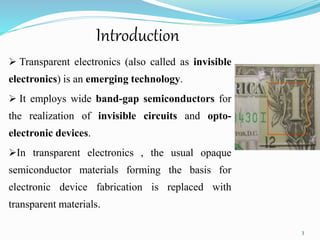
 Transparent electronics (also called as invisible
electronics) is an emerging technology.
 It employs wide band-gap semiconductors for
the realization of invisible circuits and opto-
electronic devices.
In transparent electronics , the usual opaque
semiconductor materials forming the basis for
electronic device fabrication is replaced with
transparent materials.
3
4
The first scientific goal of this technology must be to
discover, understand, and implement transparent high-
performance electronic materials.
The second goal is their implementation and evaluation
in transistor and circuit structures.
The third goal relates to achieving application-specific
properties since transistor performance and materials
property requirements vary, depending on the final
product device specifications.
5
6
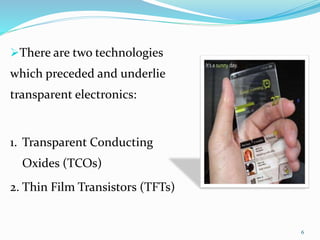
There are two technologies
which preceded and underlie
transparent electronics:
1. Transparent Conducting
Oxides (TCOs)
2. Thin Film Transistors (TFTs)
TCOs constitute an unusual
class of materials possessing two
contradictory physical properties:
• High optical transparency
• High electrical conductivity
 The three most common TCOs
are indium oxide In2O3, tin
oxide SnO2 and zinc oxide
ZnO2.
Mate
rial
Band
gap
(eV)
Conducti
vity
(Scm-1)
Electron
Concentr
ation (cm-
3)
Mobil
ity
(cm2V-
1s-1)
In2O3 3.75 10,000 >1021 35
ZnO2 3.35 8,000 >1021 20
SnO2 3.6 5,000 >1020 15
Electrical properties of
common TCOs
7
8
 The thin-film transistor (TFTs) is
another technology underlying
transparent electronics, since it is a
bridge between passive electrical and
active electronic applications. But it
does not evolve a fully transparent
transistor.
 Two possible configurations are:
• Bottom gate
• Top gate
9
 The challenge for producing "invisible" electronic circuitry and
opto-electronic devices is that the transistor materials must be
transparent to visible light yet have good carrier mobilities which
requires a special class of materials having "contra-indicated
properties".
 Oxide semiconductors are very interesting materials because
they combine simultaneously high/low conductivity with high
visual transparency.
 Transparent oxide semiconductor based transistors have recently
been proposed using as active channel intrinsic zinc oxide (ZnO).
 The main advantages of using ZnO are:
1. The fact that it is possible to growth at/near
room temperature high quality
polycrystalline ZnO, which is a particular
advantage for electronic drivers, where the
response speed is of major importance.
2. Since ZnO is a wide band gap material (3.4
eV), it is transparent in the visible region of
the spectra and therefore, also less light
sensitive.
 The second is amorphous oxides with heavy
metal content, such as amorphous InGaZnO4 (a-
IGZO) also used in this application.
 A comparison of ZnO and a-IGZO shows that
ZnO has the lead when it comes to carrier
mobility. At present, though, a-IGZO is the
material of choice for large-area displays,
electronic paper utilizing low-temperature
processing, etc.
Oxides play key role:
Oxides
ZnO InGaZnO4
There are 2 types of technique for fabrication of
epitaxial films of semiconductors. They are
1.Vapor Phase Epitaxy
2. Reactive Solid-Phase Epitaxy
 Researchers at Oregon State University and Hewlett Packard have reported
their first example of an entirely new class of materials which could be used to
make transparent transistors that are inexpensive, stable, and environmentally
benign.
ADVANCEMENTS MADE IN
TRANSPARENT ELECTRONICS
 Significant advances in the emerging
science of transparent electronics, creating
transparent "p-type" semiconductors that
have more than 200 times the conductivity
of the best materials available for that
purpose a few years ago.
 This basic research is opening the door to
new types of electronic circuits that, when
deposited onto glass, are literally invisible.
12
13
Characteristics other than Transparency.
Transparent semiconductors, in addition to being transparent, have a
number of useful characteristics, including a wide band gap, relatively
high carrier mobility, low-temperature manufacturability, and low
manufacturing costs thanks to the low-temperature process and
inexpensive materials. As a result, R&D into properties other than
transparency is also active.
Lets consider the properties of materials
other than transparency and their
applications…
Strengths Weaknesses
Visible transparency High resistance of TCO’s
Large area Lack of complementary devices
Low cost (solution based deposition
and printing)
Low temperature processing Technological immaturity
Free real estate
Passive availability (R & C)
Robust stable inorganic materials
Safe, nontoxic materials
15
APPLICATIONS OF TRANSPARENT
ELECTRONICS
 Transparent circuits will have
unprecedented applications in flat panel
displays and other electronic devices, such
as see through display or novel display
structures.
 They have been widely used in a variety
of applications like:
1. Antistatic coatings
2. Touch display panels
3. Solar cells,
4. Flat panel displays
5. Heaters
6. Defrosters
7. Optical coatings.
and many more….
16
Future Scope
 In the field of solar cells, although
much progress has been made in
developing new materials and
devices for high performance
transparent solar cells, there is still
plenty of opportunity to study and
improve device performance and
fabrication techniques compared with
the nontransparent solar cell devices.
 It is likely that new scientific
discoveries and technological
advances will continue to cross
fertilize each other for the foreseeable
future.
17
 Oxides represent a relatively new class
of semiconductor materials applied to
active devices, such as TFTs, SWNT
transistors.
 The combination of high field effect
mobility and low processing temperature
for oxide semiconductors makes them
attractive for high performance electronics
on flexible plastic substrates.
Let us hope that we are soon going to
see transparent technology being
implemented in our lives…!!!
REFERENCES
‘Transparent Electronics ’, Springer
publications, J.F.Wager, D. A. Keszler, R. E.
Presley.
‘Transparent electronics: from synthesis to
applications’, Wiley publications: Antonio
Facchetti, Tobin J. Marks.
www.wikipedia.org
www.ieee.org
www.alternative-energy-news.info/transparent-
a-solar-energy-breakthrough/
www.nanomarkets.net
www.nikkeibp.co.jp
That’s all about
Transparent
Electronics…!!!
Transparent Electronics PPT  (For download https://www.youtube.com/watch?v=wsdIhXRLch4 )

Transparent Electronics PPT (For download https://www.youtube.com/watch?v=wsdIhXRLch4 )

  • 1.
  • 2.
    presented by… Name :Sohail Shareef Branch: ECE-1 Roll No. :1601-11-735-039 2
  • 3.
    Introduction  Transparent electronics(also called as invisible electronics) is an emerging technology.  It employs wide band-gap semiconductors for the realization of invisible circuits and opto- electronic devices. In transparent electronics , the usual opaque semiconductor materials forming the basis for electronic device fabrication is replaced with transparent materials. 3
  • 4.
  • 5.
    The first scientificgoal of this technology must be to discover, understand, and implement transparent high- performance electronic materials. The second goal is their implementation and evaluation in transistor and circuit structures. The third goal relates to achieving application-specific properties since transistor performance and materials property requirements vary, depending on the final product device specifications. 5
  • 6.
    6 There are twotechnologies which preceded and underlie transparent electronics: 1. Transparent Conducting Oxides (TCOs) 2. Thin Film Transistors (TFTs)
  • 7.
    TCOs constitute anunusual class of materials possessing two contradictory physical properties: • High optical transparency • High electrical conductivity  The three most common TCOs are indium oxide In2O3, tin oxide SnO2 and zinc oxide ZnO2. Mate rial Band gap (eV) Conducti vity (Scm-1) Electron Concentr ation (cm- 3) Mobil ity (cm2V- 1s-1) In2O3 3.75 10,000 >1021 35 ZnO2 3.35 8,000 >1021 20 SnO2 3.6 5,000 >1020 15 Electrical properties of common TCOs 7
  • 8.
    8  The thin-filmtransistor (TFTs) is another technology underlying transparent electronics, since it is a bridge between passive electrical and active electronic applications. But it does not evolve a fully transparent transistor.  Two possible configurations are: • Bottom gate • Top gate
  • 9.
    9  The challengefor producing "invisible" electronic circuitry and opto-electronic devices is that the transistor materials must be transparent to visible light yet have good carrier mobilities which requires a special class of materials having "contra-indicated properties".  Oxide semiconductors are very interesting materials because they combine simultaneously high/low conductivity with high visual transparency.  Transparent oxide semiconductor based transistors have recently been proposed using as active channel intrinsic zinc oxide (ZnO).
  • 10.
     The mainadvantages of using ZnO are: 1. The fact that it is possible to growth at/near room temperature high quality polycrystalline ZnO, which is a particular advantage for electronic drivers, where the response speed is of major importance. 2. Since ZnO is a wide band gap material (3.4 eV), it is transparent in the visible region of the spectra and therefore, also less light sensitive.  The second is amorphous oxides with heavy metal content, such as amorphous InGaZnO4 (a- IGZO) also used in this application.  A comparison of ZnO and a-IGZO shows that ZnO has the lead when it comes to carrier mobility. At present, though, a-IGZO is the material of choice for large-area displays, electronic paper utilizing low-temperature processing, etc. Oxides play key role: Oxides ZnO InGaZnO4
  • 11.
    There are 2types of technique for fabrication of epitaxial films of semiconductors. They are 1.Vapor Phase Epitaxy 2. Reactive Solid-Phase Epitaxy
  • 12.
     Researchers atOregon State University and Hewlett Packard have reported their first example of an entirely new class of materials which could be used to make transparent transistors that are inexpensive, stable, and environmentally benign. ADVANCEMENTS MADE IN TRANSPARENT ELECTRONICS  Significant advances in the emerging science of transparent electronics, creating transparent "p-type" semiconductors that have more than 200 times the conductivity of the best materials available for that purpose a few years ago.  This basic research is opening the door to new types of electronic circuits that, when deposited onto glass, are literally invisible. 12
  • 13.
    13 Characteristics other thanTransparency. Transparent semiconductors, in addition to being transparent, have a number of useful characteristics, including a wide band gap, relatively high carrier mobility, low-temperature manufacturability, and low manufacturing costs thanks to the low-temperature process and inexpensive materials. As a result, R&D into properties other than transparency is also active. Lets consider the properties of materials other than transparency and their applications…
  • 14.
    Strengths Weaknesses Visible transparencyHigh resistance of TCO’s Large area Lack of complementary devices Low cost (solution based deposition and printing) Low temperature processing Technological immaturity Free real estate Passive availability (R & C) Robust stable inorganic materials Safe, nontoxic materials
  • 15.
    15 APPLICATIONS OF TRANSPARENT ELECTRONICS Transparent circuits will have unprecedented applications in flat panel displays and other electronic devices, such as see through display or novel display structures.  They have been widely used in a variety of applications like: 1. Antistatic coatings 2. Touch display panels 3. Solar cells, 4. Flat panel displays 5. Heaters 6. Defrosters 7. Optical coatings. and many more….
  • 16.
    16 Future Scope  Inthe field of solar cells, although much progress has been made in developing new materials and devices for high performance transparent solar cells, there is still plenty of opportunity to study and improve device performance and fabrication techniques compared with the nontransparent solar cell devices.  It is likely that new scientific discoveries and technological advances will continue to cross fertilize each other for the foreseeable future.
  • 17.
    17  Oxides representa relatively new class of semiconductor materials applied to active devices, such as TFTs, SWNT transistors.  The combination of high field effect mobility and low processing temperature for oxide semiconductors makes them attractive for high performance electronics on flexible plastic substrates. Let us hope that we are soon going to see transparent technology being implemented in our lives…!!!
  • 18.
    REFERENCES ‘Transparent Electronics ’,Springer publications, J.F.Wager, D. A. Keszler, R. E. Presley. ‘Transparent electronics: from synthesis to applications’, Wiley publications: Antonio Facchetti, Tobin J. Marks. www.wikipedia.org www.ieee.org www.alternative-energy-news.info/transparent- a-solar-energy-breakthrough/ www.nanomarkets.net www.nikkeibp.co.jp
  • 19.