• Introduction
• Properties(Graphene)
• Synthesis
• Liquid Phase exfoliation
• Direct Ultrasonic Exfoliation in liquid
• Sonication
• Media of liquid Phase Exfoliation
• Some Example of Graphene Synthesis
• Conclusion
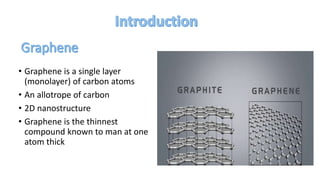
• Graphene is a single layer
(monolayer) of carbon atoms
• An allotrope of carbon
• 2D nanostructure
• Graphene is the thinnest
compound known to man at one
atom thick
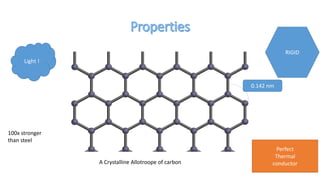
0.142 nm
Light !
100x stronger
than steel
Perfect
Thermal
conductorA Crystalline Allotroope of carbon
RIGID
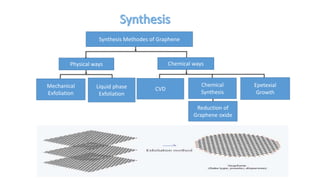
Synthesis Methodes of Graphene
Physical ways Chemical ways
Mechanical
Exfoliation
Liquid phase
Exfoliation
CVD
Chemical
Synthesis
Epetexial
Growth
Reduction of
Graphene oxide
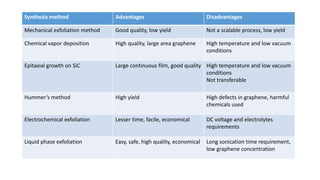
Synthesis method Advantages Disadvantages
Mechanical exfoliation method Good quality, low yield Not a scalable process, low yield
Chemical vapor deposition High quality, large area graphene High temperature and low vacuum
conditions
Epitaxial growth on SiC Large continuous film, good quality High temperature and low vacuum
conditions
Not transferable
Hummer’s method High yield High defects in graphene, harmful
chemicals used
Electrochemical exfoliation Lesser time, facile, economical DC voltage and electrolytes
requirements
Liquid phase exfoliation Easy, safe, high quality, economical Long sonication time requirement,
low graphene concentration
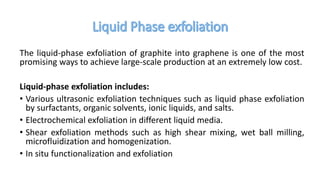
The liquid-phase exfoliation of graphite into graphene is one of the most
promising ways to achieve large-scale production at an extremely low cost.
Liquid-phase exfoliation includes:
• Various ultrasonic exfoliation techniques such as liquid phase exfoliation
by surfactants, organic solvents, ionic liquids, and salts.
• Electrochemical exfoliation in different liquid media.
• Shear exfoliation methods such as high shear mixing, wet ball milling,
microfluidization and homogenization.
• In situ functionalization and exfoliation
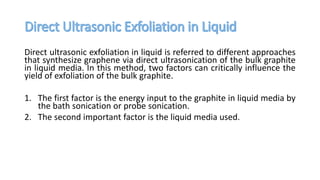
Direct ultrasonic exfoliation in liquid is referred to different approaches
that synthesize graphene via direct ultrasonication of the bulk graphite
in liquid media. In this method, two factors can critically influence the
yield of exfoliation of the bulk graphite.
1. The first factor is the energy input to the graphite in liquid media by
the bath sonication or probe sonication.
2. The second important factor is the liquid media used.
Sonication is the act of applying sound energy to agitate particles in a
sample
• Ultrasonic frequencies (>20 kHz) are usually used.
• In the laboratory, it is usually applied using an ultrasonic bath or an
ultrasonic probe.
• Sonication can be used for the production of nanoparticles.
• Sonication has numerous effects, both chemical and physical.
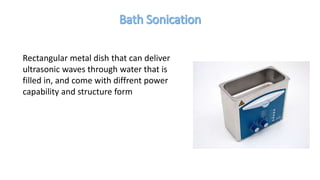
Rectangular metal dish that can deliver
ultrasonic waves through water that is
filled in, and come with diffrent power
capability and structure form
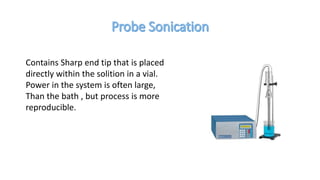
Contains Sharp end tip that is placed
directly within the solition in a vial.
Power in the system is often large,
Than the bath , but process is more
reproducible.
Organic Solvent-Based Exfoliation
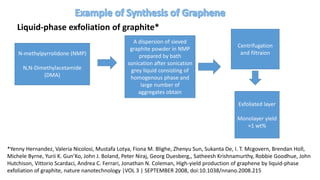
This approach includes the sonication of the bulk graphite in an organic
solvent and the subsequent purification procedure.
Solvents with surface tension of about 40 mJ m-2 such as N-methyl-2-
pyrrolidone (NMP) and N,N-dimethylformamide (DMF) are the best
candidates for massproduction of graphene sheets*.
*Y. Hernandez, V. Nicolosi, M. Lotya, F.M. Blighe, Z. Sun, S. De, I. McGovern, B. Holland, M. Byrne, Y.K. Gun'Ko, Nature
nanotechnology, 3 (2008) 563-568
Exfoliation with Low Boiling Point Solvents
Despite great advantages for the dispersion of graphene in the aforementioned
solvents such as NMP and DMF, there are also some disadvantages such as their
high boiling point and toxicity.
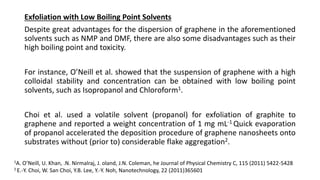
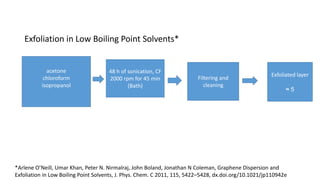
For instance, O’Neill et al. showed that the suspension of graphene with a high
colloidal stability and concentration can be obtained with low boiling point
solvents, such as Isopropanol and Chloroform1.
Choi et al. used a volatile solvent (propanol) for exfoliation of graphite to
graphene and reported a weight concentration of 1 mg mL-1 Quick evaporation
of propanol accelerated the deposition procedure of graphene nanosheets onto
substrates without (prior to) considerable flake aggregation2.
1A. O’Neill, U. Khan, .N. Nirmalraj, J. oland, J.N. Coleman, he Journal of Physical Chemistry C, 115 (2011) 5422-5428
2 E.-Y. Choi, W. San Choi, Y.B. Lee, Y.-Y. Noh, Nanotechnology, 22 (2011)365601
Liquid-phase exfoliation of graphite*
N-methylpyrrolidone (NMP)
N,N-Dimethylacetamide
(DMA)
A dispersion of sieved
graphite powder in NMP
prepared by bath
sonication after sonication
grey liquid consisting of
homogenous phase and
large number of
aggregates obtain
Centrifugation
and filtraion
Exfoliated layer
Monolayer yield
≈1 wt%
*Yenny Hernandez, Valeria Nicolosi, Mustafa Lotya, Fiona M. Blighe, Zhenyu Sun, Sukanta De, I. T. Mcgovern, Brendan Holl,
Michele Byrne, Yurii K. Gun’Ko, John J. Boland, Peter Niraj, Georg Duesberg,, Satheesh Krishnamurthy, Robbie Goodhue, John
Hutchison, Vittorio Scardaci, Andrea C. Ferrari, Jonathan N. Coleman, High-yield production of graphene by liquid-phase
exfoliation of graphite, nature nanotechnology |VOL 3 | SEPTEMBER 2008, doi:10.1038/nnano.2008.215
Exfoliation in Low Boiling Point Solvents*
*Arlene O’Neill, Umar Khan, Peter N. Nirmalraj, John Boland, Jonathan N Coleman, Graphene Dispersion and
Exfoliation in Low Boiling Point Solvents, J. Phys. Chem. C 2011, 115, 5422–5428, dx.doi.org/10.1021/jp110942e
acetone
chloroform
isopropanol
48 h of sonication, CF
2000 rpm for 45 min
(Bath)
Filtering and
cleaning
Exfoliated layer
≈ 5
LPE
CVD
Other
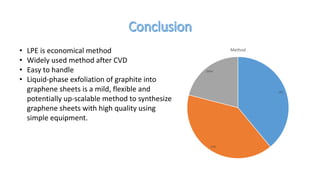
Method• LPE is economical method
• Widely used method after CVD
• Easy to handle
• Liquid-phase exfoliation of graphite into
graphene sheets is a mild, flexible and
potentially up-scalable method to synthesize
graphene sheets with high quality using
simple equipment.
Thank You

Liquid phase exfoliation

  • 2.
    • Introduction • Properties(Graphene) •Synthesis • Liquid Phase exfoliation • Direct Ultrasonic Exfoliation in liquid • Sonication • Media of liquid Phase Exfoliation • Some Example of Graphene Synthesis • Conclusion
  • 3.
    • Graphene isa single layer (monolayer) of carbon atoms • An allotrope of carbon • 2D nanostructure • Graphene is the thinnest compound known to man at one atom thick
  • 4.
    0.142 nm Light ! 100xstronger than steel Perfect Thermal conductorA Crystalline Allotroope of carbon RIGID
  • 5.
    Synthesis Methodes ofGraphene Physical ways Chemical ways Mechanical Exfoliation Liquid phase Exfoliation CVD Chemical Synthesis Epetexial Growth Reduction of Graphene oxide
  • 6.
    Synthesis method AdvantagesDisadvantages Mechanical exfoliation method Good quality, low yield Not a scalable process, low yield Chemical vapor deposition High quality, large area graphene High temperature and low vacuum conditions Epitaxial growth on SiC Large continuous film, good quality High temperature and low vacuum conditions Not transferable Hummer’s method High yield High defects in graphene, harmful chemicals used Electrochemical exfoliation Lesser time, facile, economical DC voltage and electrolytes requirements Liquid phase exfoliation Easy, safe, high quality, economical Long sonication time requirement, low graphene concentration
  • 7.
    The liquid-phase exfoliationof graphite into graphene is one of the most promising ways to achieve large-scale production at an extremely low cost. Liquid-phase exfoliation includes: • Various ultrasonic exfoliation techniques such as liquid phase exfoliation by surfactants, organic solvents, ionic liquids, and salts. • Electrochemical exfoliation in different liquid media. • Shear exfoliation methods such as high shear mixing, wet ball milling, microfluidization and homogenization. • In situ functionalization and exfoliation
  • 8.
    Direct ultrasonic exfoliationin liquid is referred to different approaches that synthesize graphene via direct ultrasonication of the bulk graphite in liquid media. In this method, two factors can critically influence the yield of exfoliation of the bulk graphite. 1. The first factor is the energy input to the graphite in liquid media by the bath sonication or probe sonication. 2. The second important factor is the liquid media used.
  • 9.
    Sonication is theact of applying sound energy to agitate particles in a sample • Ultrasonic frequencies (>20 kHz) are usually used. • In the laboratory, it is usually applied using an ultrasonic bath or an ultrasonic probe. • Sonication can be used for the production of nanoparticles. • Sonication has numerous effects, both chemical and physical.
  • 10.
    Rectangular metal dishthat can deliver ultrasonic waves through water that is filled in, and come with diffrent power capability and structure form
  • 11.
    Contains Sharp endtip that is placed directly within the solition in a vial. Power in the system is often large, Than the bath , but process is more reproducible.
  • 12.
    Organic Solvent-Based Exfoliation Thisapproach includes the sonication of the bulk graphite in an organic solvent and the subsequent purification procedure. Solvents with surface tension of about 40 mJ m-2 such as N-methyl-2- pyrrolidone (NMP) and N,N-dimethylformamide (DMF) are the best candidates for massproduction of graphene sheets*. *Y. Hernandez, V. Nicolosi, M. Lotya, F.M. Blighe, Z. Sun, S. De, I. McGovern, B. Holland, M. Byrne, Y.K. Gun'Ko, Nature nanotechnology, 3 (2008) 563-568
  • 13.
    Exfoliation with LowBoiling Point Solvents Despite great advantages for the dispersion of graphene in the aforementioned solvents such as NMP and DMF, there are also some disadvantages such as their high boiling point and toxicity. For instance, O’Neill et al. showed that the suspension of graphene with a high colloidal stability and concentration can be obtained with low boiling point solvents, such as Isopropanol and Chloroform1. Choi et al. used a volatile solvent (propanol) for exfoliation of graphite to graphene and reported a weight concentration of 1 mg mL-1 Quick evaporation of propanol accelerated the deposition procedure of graphene nanosheets onto substrates without (prior to) considerable flake aggregation2. 1A. O’Neill, U. Khan, .N. Nirmalraj, J. oland, J.N. Coleman, he Journal of Physical Chemistry C, 115 (2011) 5422-5428 2 E.-Y. Choi, W. San Choi, Y.B. Lee, Y.-Y. Noh, Nanotechnology, 22 (2011)365601
  • 14.
    Liquid-phase exfoliation ofgraphite* N-methylpyrrolidone (NMP) N,N-Dimethylacetamide (DMA) A dispersion of sieved graphite powder in NMP prepared by bath sonication after sonication grey liquid consisting of homogenous phase and large number of aggregates obtain Centrifugation and filtraion Exfoliated layer Monolayer yield ≈1 wt% *Yenny Hernandez, Valeria Nicolosi, Mustafa Lotya, Fiona M. Blighe, Zhenyu Sun, Sukanta De, I. T. Mcgovern, Brendan Holl, Michele Byrne, Yurii K. Gun’Ko, John J. Boland, Peter Niraj, Georg Duesberg,, Satheesh Krishnamurthy, Robbie Goodhue, John Hutchison, Vittorio Scardaci, Andrea C. Ferrari, Jonathan N. Coleman, High-yield production of graphene by liquid-phase exfoliation of graphite, nature nanotechnology |VOL 3 | SEPTEMBER 2008, doi:10.1038/nnano.2008.215
  • 15.
    Exfoliation in LowBoiling Point Solvents* *Arlene O’Neill, Umar Khan, Peter N. Nirmalraj, John Boland, Jonathan N Coleman, Graphene Dispersion and Exfoliation in Low Boiling Point Solvents, J. Phys. Chem. C 2011, 115, 5422–5428, dx.doi.org/10.1021/jp110942e acetone chloroform isopropanol 48 h of sonication, CF 2000 rpm for 45 min (Bath) Filtering and cleaning Exfoliated layer ≈ 5
  • 16.
    LPE CVD Other Method• LPE iseconomical method • Widely used method after CVD • Easy to handle • Liquid-phase exfoliation of graphite into graphene sheets is a mild, flexible and potentially up-scalable method to synthesize graphene sheets with high quality using simple equipment.
  • 17.

Editor's Notes

  • #4 Each atom in a graphene sheet is connected to its three nearest neighbors by a σ-bond, and contributes one electron to a conduction band that extends over the whole sheet. This is the same type bonding seen in carbon nanotubes and polycyclic aromatic hydrocarbons, and (partially) in fullerenes and glassy carbo
  • #8 The liquid-phase exfoliation strategy has attracted considerable attention as a costeffective, efficient, and extraordinarily versatile method that has the potential for large-scale production of defect-free graphene
  • #9 1. This is because the bulk graphite is effectively exfoliated upon exposure to the ultrasonic waves. Shear forces or cavitation bubbles created from such waves can generate high amount of energy with the collapse of bubbles in liquids that can change the main structure of bulk graphite from layered structure to single- or few-layered graphene 2. There is commonly an energy barrier in the interlayers of the graphite, and in the subsequent stabilization of nanosheets via interfacial interactions. Different liquid media (ionic liquids, aqueous solutions of stabilizers, and organic solvent) behave differently in decreasing the potential energy barrier.
  • #10 Sonication has numerous effects, both chemical and physical. The chemical effects of ultrasound are concerned with understanding the effect of sonic waves on chemical systems, this is called sonochemistry. The chemical effects of ultrasound do not come from a direct interaction with molecular species. Studies have shown that no direct coupling of the acoustic field with chemical species on a molecular level can account for sonochemistry or sonoluminescence.[4] Instead, in sonochemistry the sound waves migrate through a medium, inducing pressure variations and cavitations that grow and collapse, transforming the sound waves into mechanical energy
  • #13  In this method, the interfacial tension between the bulk graphite and organic solvent is the main factor influencing their interactions. an appropriate organic solvent can decrease the potential energy between adjacent layers in the bulk graphite to overcome the vdW interactions between layers.
  • #14 In particular, these undesirable solvent properties of can hinder their applications and deteriorate the device performance