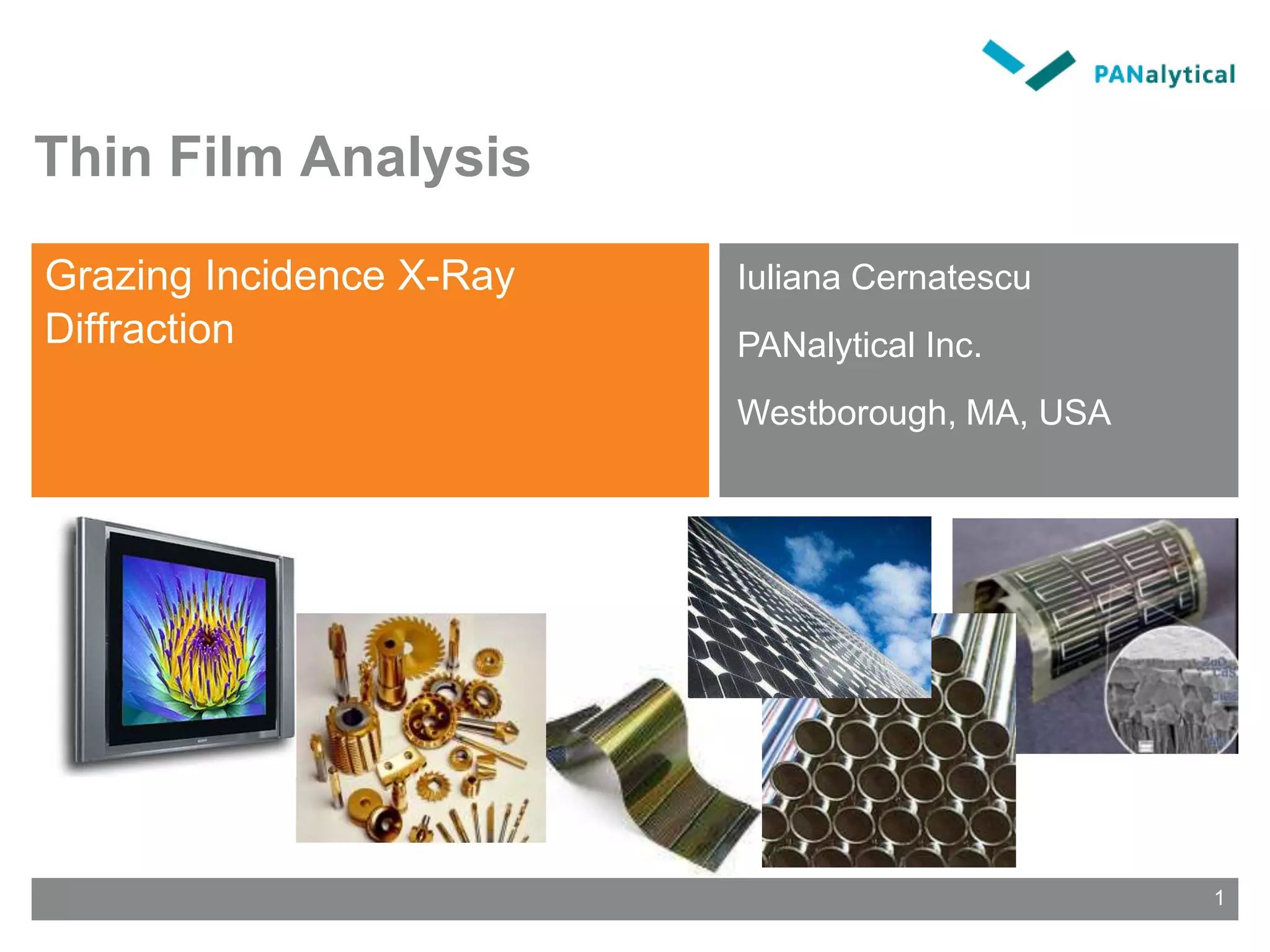
Thin Film Analysis
Grazing Incidence X-Ray
Diffraction
Iuliana Cernatescu
PANalytical Inc.
Westborough, MA, USA
1
Summary
• GIXRD definition
• Applications and System Configurations
• Examples
2
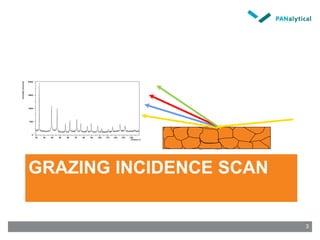
GRAZING INCIDENCE SCAN
20 30 40 50 60 70 80 90 100 110 120 130 140
2Theta (°)
0
400
1600
3600
6400
Intensity(counts)
3
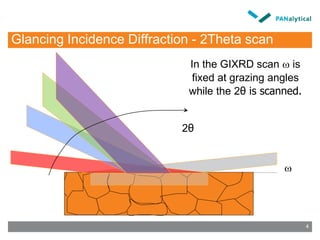
Glancing Incidence Diffraction - 2Theta scan

2θ
In the GIXRD scan  is
fixed at grazing angles
while the 2θ is scanned.
4
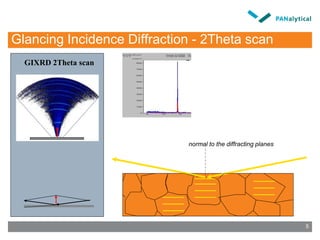
Glancing Incidence Diffraction - 2Theta scan
GIXRD 2Theta scan
normal to the diffracting planes
5
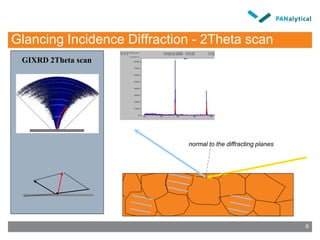
Glancing Incidence Diffraction - 2Theta scan
GIXRD 2Theta scan
normal to the diffracting planes
6
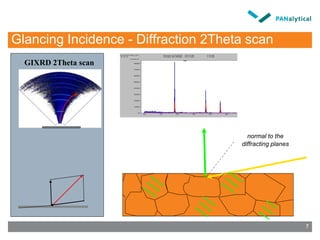
Glancing Incidence - Diffraction 2Theta scan
GIXRD 2Theta scan
normal to the
diffracting planes
7
GIXRD APPLICATIONS AND
CONFIGURATION
8
Why use GIXRD?
Total
reflection
regime
Absorption
limited
regime
0 0.5 1.0 1.5
/c
1
10
10
0
100
0
Z0(nm)
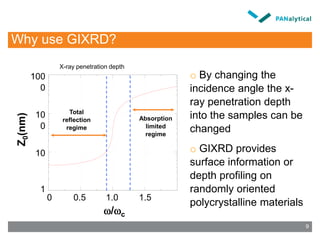
o By changing the
incidence angle the x-
ray penetration depth
into the samples can be
changed
o GIXRD provides
surface information or
depth profiling on
randomly oriented
polycrystalline materials
X-ray penetration depth
9
Grazing incidence Application Areas
Task or challenges Solution
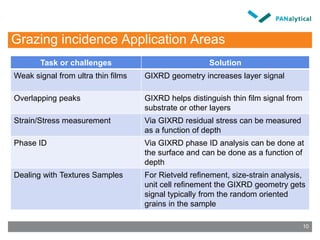
Weak signal from ultra thin films GIXRD geometry increases layer signal
Overlapping peaks GIXRD helps distinguish thin film signal from
substrate or other layers
Strain/Stress measurement Via GIXRD residual stress can be measured
as a function of depth
Phase ID Via GIXRD phase ID analysis can be done at
the surface and can be done as a function of
depth
Dealing with Textures Samples For Rietveld refinement, size-strain analysis,
unit cell refinement the GIXRD geometry gets
signal typically from the random oriented
grains in the sample
10
GIXRD Configuration
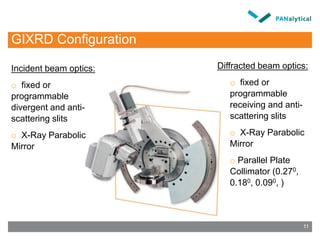
Incident beam optics:
o fixed or
programmable
divergent and anti-
scattering slits
o X-Ray Parabolic
Mirror
Diffracted beam optics:
o fixed or
programmable
receiving and anti-
scattering slits
o X-Ray Parabolic
Mirror
o Parallel Plate
Collimator (0.270,
0.180, 0.090, )
11
GIXRD APPLICATIONS
EXAMPLES
12
GIXRD for CIGS Solar Cells
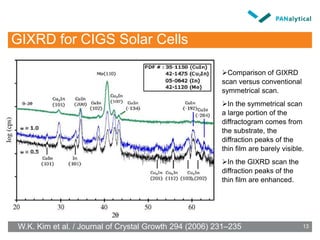
W.K. Kim et al. / Journal of Crystal Growth 294 (2006) 231–235
Comparison of GIXRD
scan versus conventional
symmetrical scan.
In the symmetrical scan
a large portion of the
diffractogram comes from
the substrate, the
diffraction peaks of the
thin film are barely visible.
In the GIXRD scan the
diffraction peaks of the
thin film are enhanced.
13
GIXRD - Thin film depth profiling phase analysis
Position [°2Theta] (Copper (Cu))
10 20 30 40 50 60 70
Counts
0
400
1600
0
400
1600
0
400
1600
3600
, Incident angle
0.45 deg
1.00 deg
2.00 deg
CIGS
Mo
ZnO
ZnO
CIGS
ZnO
Mo

ZnO
CIGS
ZnO
Mo

Position [°2Theta] (Copper (Cu))
10 20 30 40 50 60
0
0
0
0
0
14
GIXRD - Thin film depth profiling phase analysis
Position [°2Theta] (Copper (Cu))
10 20 30 40 50 60 70
Counts
0
400
1600
0
400
1600
0
400
1600
3600
, Incident angle
0.45 deg
1.00 deg
2.00 deg
CIGS
Mo
ZnO
ZnO
CIGS
ZnO
Mo

ZnO
CIGS
ZnO
Mo

Position [°2Theta] (Copper (Cu))
10 20 30 40 50 60
0
0
0
0
0
0
0
15
GIXRD - Thin film depth profiling phase analysis
Position [°2Theta] (Copper (Cu))
10 20 30 40 50 60 70
Counts
0
400
1600
0
400
1600
0
400
1600
3600
, Incident angle
0.45 deg
1.00 deg
2.00 deg
CIGS
Mo
ZnO=0.45
ZnO
CIGS
ZnO
Mo
=1
ZnO
CIGS
ZnO
Mo
=2
16
Example 2 - Surface treatment effect
• Austenitic stainless steels cannot be hardened
by heat treatment
• Colossal Carbon Super-saturation Process is
one way to harden the austenitic steel:
– Carbon diffuses into the steel at elevated to create
compressive residual stress
– As the sample cools down some C is released at
very top surface (few nm)
– As a result the top few nanometers should have
different d-spacing
17
Depth profiling GIXRD-Austenitic stainless steel
Position [°2Theta] (Copper (Cu))
40 50 60 70 80 90 100
Counts
0
1000
0
2000
4000
0
500
1000
0
1000
0
2000
Incidence angle
0.5 0
0.8 0
1.0 0
2.0 0
0.3 0
18
GIXRD - Austenitic stainless steel – Zoom in
Position [°2Theta] (Copper (Cu))
40 45 50 55
Counts
0
1000
0
2000
4000
0
500
1000
0
1000
0
2000
Incidence angle
0.5 0
0.8 0
1.0 0
2.0 0
0.3 0
19
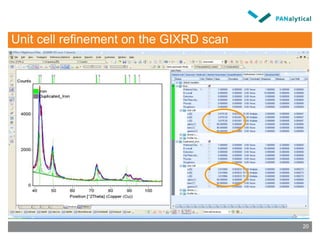
Unit cell refinement on the GIXRD scan
20
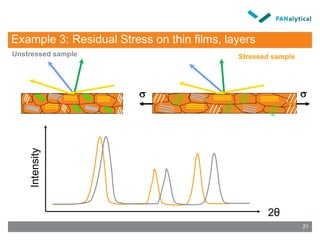
Example 3: Residual Stress on thin films, layers
Unstressed sample Stressed sample
 
2θ
Intensity
21
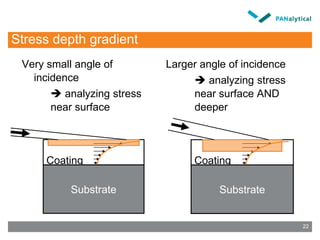
Stress depth gradient
Very small angle of
incidence
 analyzing stress
near surface
Larger angle of incidence
 analyzing stress
near surface AND
deeper
Coating
Substrate
Coating
Substrate
22
Stress with depth in CdTe layer of solar cell
0 2 4 6 8 10 12
-120
-100
-80
-60
-40
-20
ResidualStress[MPa]
Grazing Angle [degrees]
20 30 40 50 60 70 80 90 100 110 120 130 140
2Theta (°)
0
100
400
900
1600
2500
3600
Intensity(counts)
20 30 40 50 60 70 80 90 100 110 120 130 140
2Theta (°)
0
400
1600
3600
6400
Intensity(counts)
20 30 40 50 60 70 80 90 100 110 120 130 140
2Theta (°)
0
400
1600
3600
6400
Intensity(counts)
=0.1
=1
=5
23
Conclusions
• GIXRD is a powerful technique which can be
used to get information regarding:
– Phases present at the surface and as a function of
depth
– Strain/Stress at the surface and as a function of
depth
– Crystallographic changes at the sample surface
– Enhance layer diffraction signal
– Avoid overlapping peaks coming from different
depths on the sample
24

Gixrd

  • 1.
    Thin Film Analysis GrazingIncidence X-Ray Diffraction Iuliana Cernatescu PANalytical Inc. Westborough, MA, USA 1
  • 2.
    Summary • GIXRD definition •Applications and System Configurations • Examples 2
  • 3.
    GRAZING INCIDENCE SCAN 2030 40 50 60 70 80 90 100 110 120 130 140 2Theta (°) 0 400 1600 3600 6400 Intensity(counts) 3
  • 4.
    Glancing Incidence Diffraction- 2Theta scan  2θ In the GIXRD scan  is fixed at grazing angles while the 2θ is scanned. 4
  • 5.
    Glancing Incidence Diffraction- 2Theta scan GIXRD 2Theta scan normal to the diffracting planes 5
  • 6.
    Glancing Incidence Diffraction- 2Theta scan GIXRD 2Theta scan normal to the diffracting planes 6
  • 7.
    Glancing Incidence -Diffraction 2Theta scan GIXRD 2Theta scan normal to the diffracting planes 7
  • 8.
  • 9.
    Why use GIXRD? Total reflection regime Absorption limited regime 00.5 1.0 1.5 /c 1 10 10 0 100 0 Z0(nm) o By changing the incidence angle the x- ray penetration depth into the samples can be changed o GIXRD provides surface information or depth profiling on randomly oriented polycrystalline materials X-ray penetration depth 9
  • 10.
    Grazing incidence ApplicationAreas Task or challenges Solution Weak signal from ultra thin films GIXRD geometry increases layer signal Overlapping peaks GIXRD helps distinguish thin film signal from substrate or other layers Strain/Stress measurement Via GIXRD residual stress can be measured as a function of depth Phase ID Via GIXRD phase ID analysis can be done at the surface and can be done as a function of depth Dealing with Textures Samples For Rietveld refinement, size-strain analysis, unit cell refinement the GIXRD geometry gets signal typically from the random oriented grains in the sample 10
  • 11.
    GIXRD Configuration Incident beamoptics: o fixed or programmable divergent and anti- scattering slits o X-Ray Parabolic Mirror Diffracted beam optics: o fixed or programmable receiving and anti- scattering slits o X-Ray Parabolic Mirror o Parallel Plate Collimator (0.270, 0.180, 0.090, ) 11
  • 12.
  • 13.
    GIXRD for CIGSSolar Cells W.K. Kim et al. / Journal of Crystal Growth 294 (2006) 231–235 Comparison of GIXRD scan versus conventional symmetrical scan. In the symmetrical scan a large portion of the diffractogram comes from the substrate, the diffraction peaks of the thin film are barely visible. In the GIXRD scan the diffraction peaks of the thin film are enhanced. 13
  • 14.
    GIXRD - Thinfilm depth profiling phase analysis Position [°2Theta] (Copper (Cu)) 10 20 30 40 50 60 70 Counts 0 400 1600 0 400 1600 0 400 1600 3600 , Incident angle 0.45 deg 1.00 deg 2.00 deg CIGS Mo ZnO ZnO CIGS ZnO Mo  ZnO CIGS ZnO Mo  Position [°2Theta] (Copper (Cu)) 10 20 30 40 50 60 0 0 0 0 0 14
  • 15.
    GIXRD - Thinfilm depth profiling phase analysis Position [°2Theta] (Copper (Cu)) 10 20 30 40 50 60 70 Counts 0 400 1600 0 400 1600 0 400 1600 3600 , Incident angle 0.45 deg 1.00 deg 2.00 deg CIGS Mo ZnO ZnO CIGS ZnO Mo  ZnO CIGS ZnO Mo  Position [°2Theta] (Copper (Cu)) 10 20 30 40 50 60 0 0 0 0 0 0 0 15
  • 16.
    GIXRD - Thinfilm depth profiling phase analysis Position [°2Theta] (Copper (Cu)) 10 20 30 40 50 60 70 Counts 0 400 1600 0 400 1600 0 400 1600 3600 , Incident angle 0.45 deg 1.00 deg 2.00 deg CIGS Mo ZnO=0.45 ZnO CIGS ZnO Mo =1 ZnO CIGS ZnO Mo =2 16
  • 17.
    Example 2 -Surface treatment effect • Austenitic stainless steels cannot be hardened by heat treatment • Colossal Carbon Super-saturation Process is one way to harden the austenitic steel: – Carbon diffuses into the steel at elevated to create compressive residual stress – As the sample cools down some C is released at very top surface (few nm) – As a result the top few nanometers should have different d-spacing 17
  • 18.
    Depth profiling GIXRD-Austeniticstainless steel Position [°2Theta] (Copper (Cu)) 40 50 60 70 80 90 100 Counts 0 1000 0 2000 4000 0 500 1000 0 1000 0 2000 Incidence angle 0.5 0 0.8 0 1.0 0 2.0 0 0.3 0 18
  • 19.
    GIXRD - Austeniticstainless steel – Zoom in Position [°2Theta] (Copper (Cu)) 40 45 50 55 Counts 0 1000 0 2000 4000 0 500 1000 0 1000 0 2000 Incidence angle 0.5 0 0.8 0 1.0 0 2.0 0 0.3 0 19
  • 20.
    Unit cell refinementon the GIXRD scan 20
  • 21.
    Example 3: ResidualStress on thin films, layers Unstressed sample Stressed sample   2θ Intensity 21
  • 22.
    Stress depth gradient Verysmall angle of incidence  analyzing stress near surface Larger angle of incidence  analyzing stress near surface AND deeper Coating Substrate Coating Substrate 22
  • 23.
    Stress with depthin CdTe layer of solar cell 0 2 4 6 8 10 12 -120 -100 -80 -60 -40 -20 ResidualStress[MPa] Grazing Angle [degrees] 20 30 40 50 60 70 80 90 100 110 120 130 140 2Theta (°) 0 100 400 900 1600 2500 3600 Intensity(counts) 20 30 40 50 60 70 80 90 100 110 120 130 140 2Theta (°) 0 400 1600 3600 6400 Intensity(counts) 20 30 40 50 60 70 80 90 100 110 120 130 140 2Theta (°) 0 400 1600 3600 6400 Intensity(counts) =0.1 =1 =5 23
  • 24.
    Conclusions • GIXRD isa powerful technique which can be used to get information regarding: – Phases present at the surface and as a function of depth – Strain/Stress at the surface and as a function of depth – Crystallographic changes at the sample surface – Enhance layer diffraction signal – Avoid overlapping peaks coming from different depths on the sample 24

Editor's Notes

  • #20 The GIXRD indicates the existence of two austenitic phases at the surface of the sample. One phase is mainly seen at the surface while the other can be seen in the bulk material.