Intra Coding in HEVC
Manohar Kuse
mpkuse@connect.ust.hk
http://ihome.ust.hk/~mpkuse
7th Apr, 2014
Lainema, Jani, and Kemal Ugur. "Angular intra prediction in high
efficiency video coding (HEVC)." Multimedia Signal Processing
(MMSP), 2011 IEEE 13th International Workshop on. IEEE, 2011.
General Introduction of
HEVC (High Efficiency Video Coding)
What is HEVC?
● Video compression standard and successor to H.
264/AVC
● Jointly developed by ‘ISO/IEC Moving Pictures Expert
Group (MPEG)’ & ‘ITU-T Video Coding Expert Group
(VCEG)’
● MPEG & VCEG established ‘Joint Collaborative Team
on Video Coding (JCT-VC)’ to develop HEVC
● Also known as ISO/IEC 23008-2 (MPEG-H Part-2) and
ITU-T H.265
Prominent Features
● Double compression rate for same video
quality*
● Substantially better video quality for same bit
rate*
● Support for 8K UHD resolution
*Compared to H.264/AVC
The Standard Draft
● 1st Version of Standard draft published Early
2013
○ Download URL : http://www.itu.int/rec/T-REC-H.265-201304-I/en
● Extensions still under development (Early
2014)
○ Scalable Coding Extension
○ 3D Video Extensions
○ Screen Content Extension
http://www.itu.int/en/ITU-T/studygroups/2013-2016/16/Pages/video/jctvc.aspx
HEVC – What are CTU, CU, CTB, CB, PB, and TB?
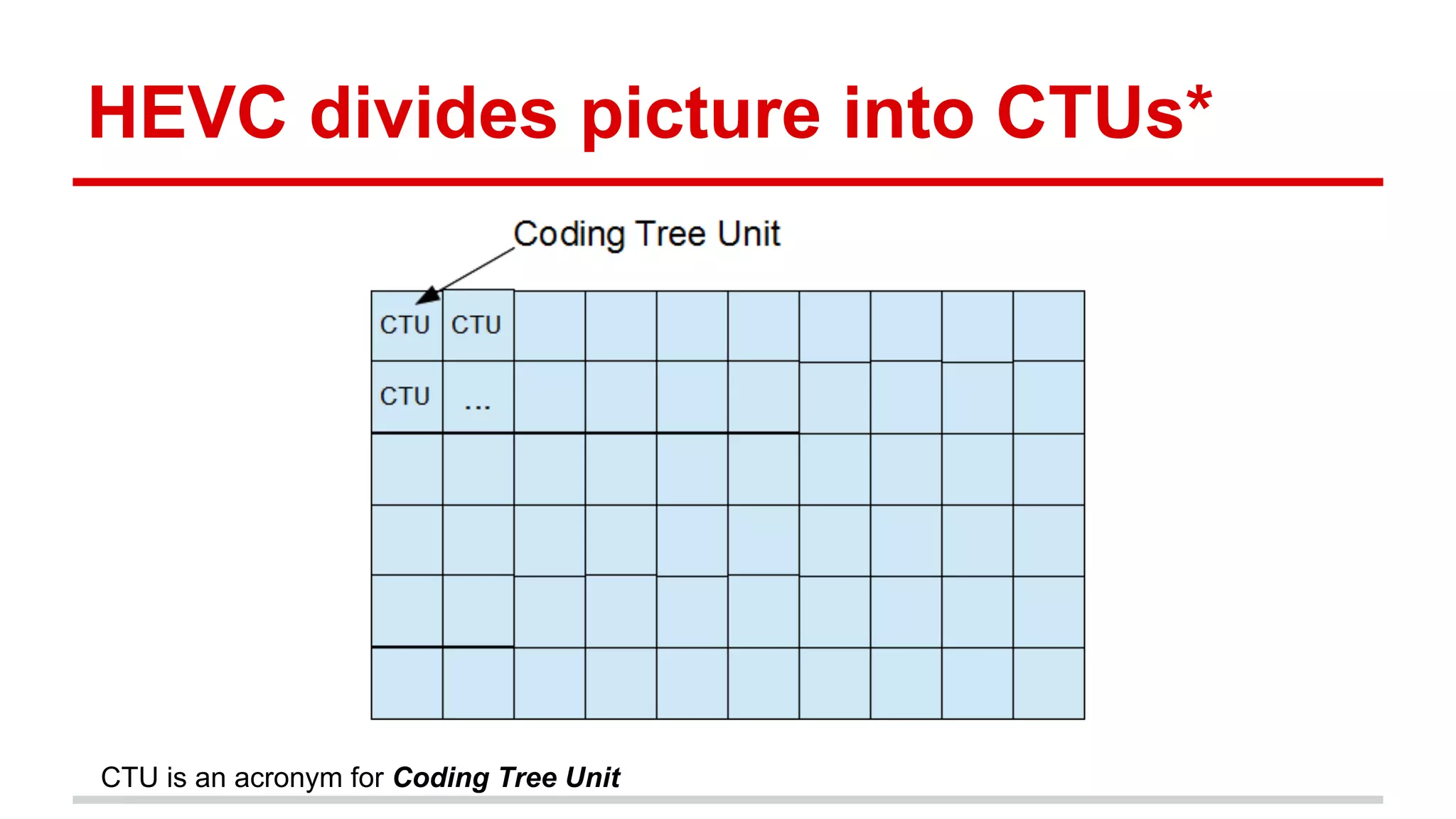
HEVC divides picture into CTUs*
CTU is an acronym for Coding Tree Unit
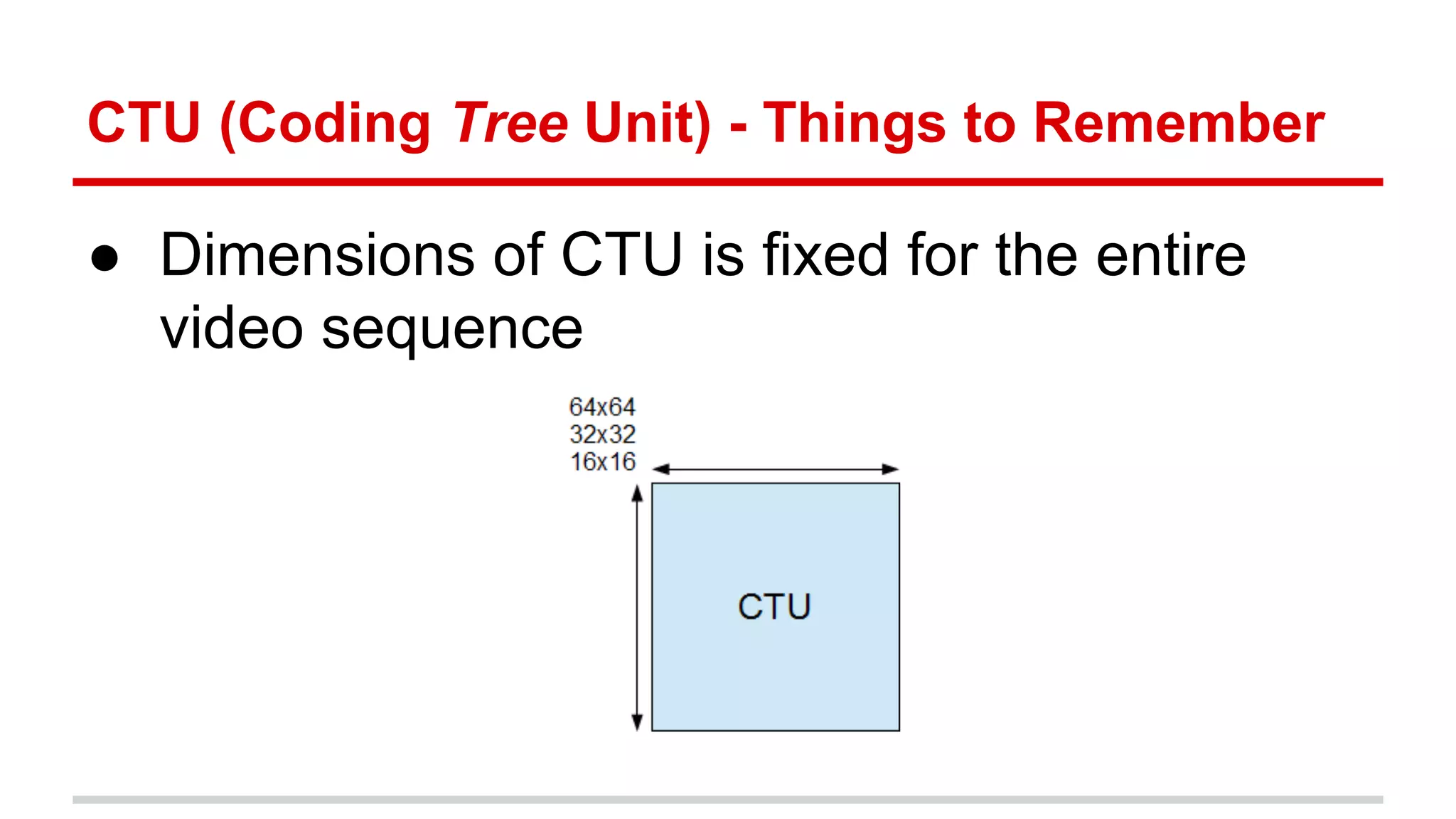
CTU (Coding Tree Unit) - Things to Remember
● Dimensions of CTU is fixed for the entire
video sequence
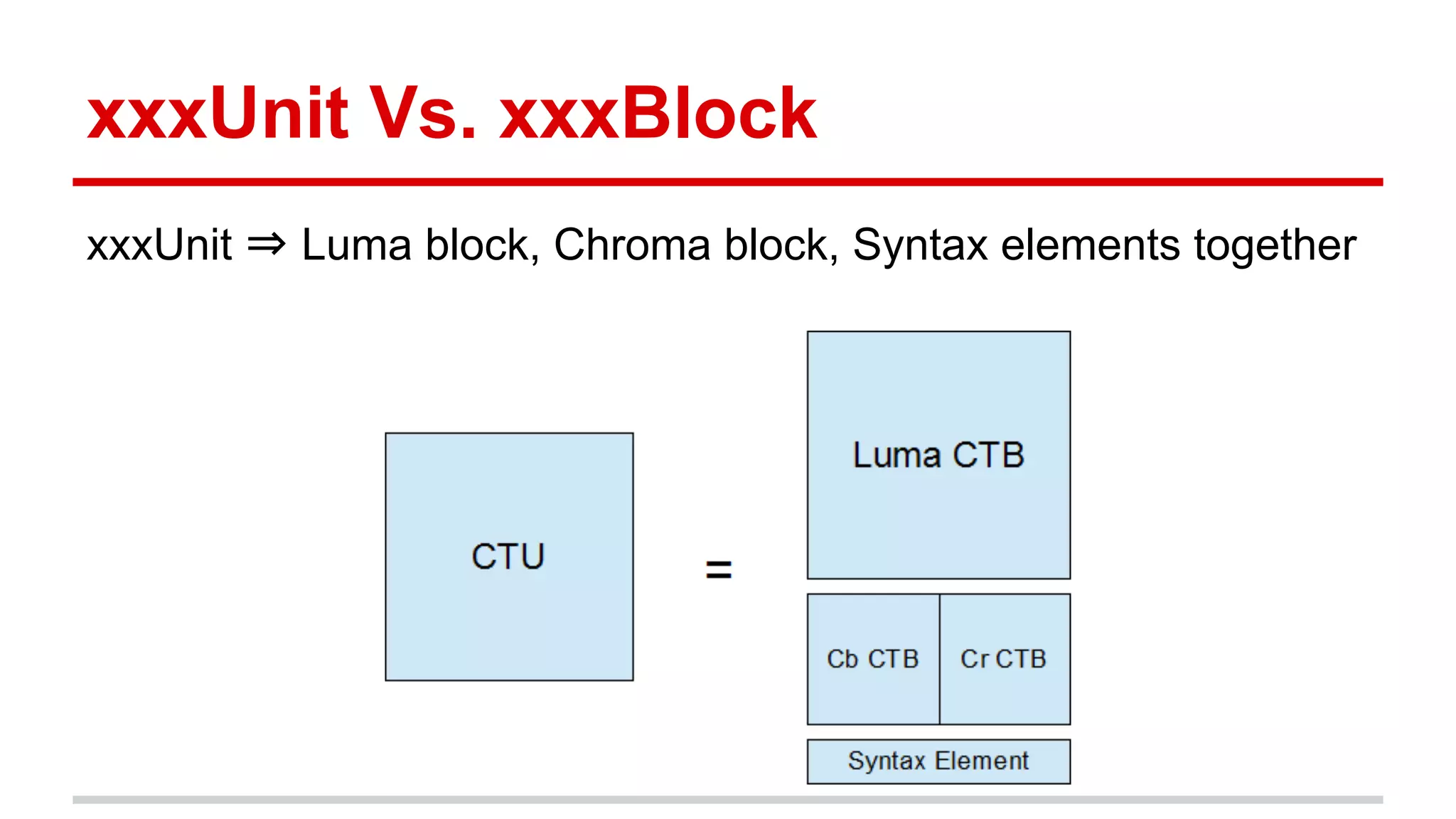
xxxUnit Vs. xxxBlock
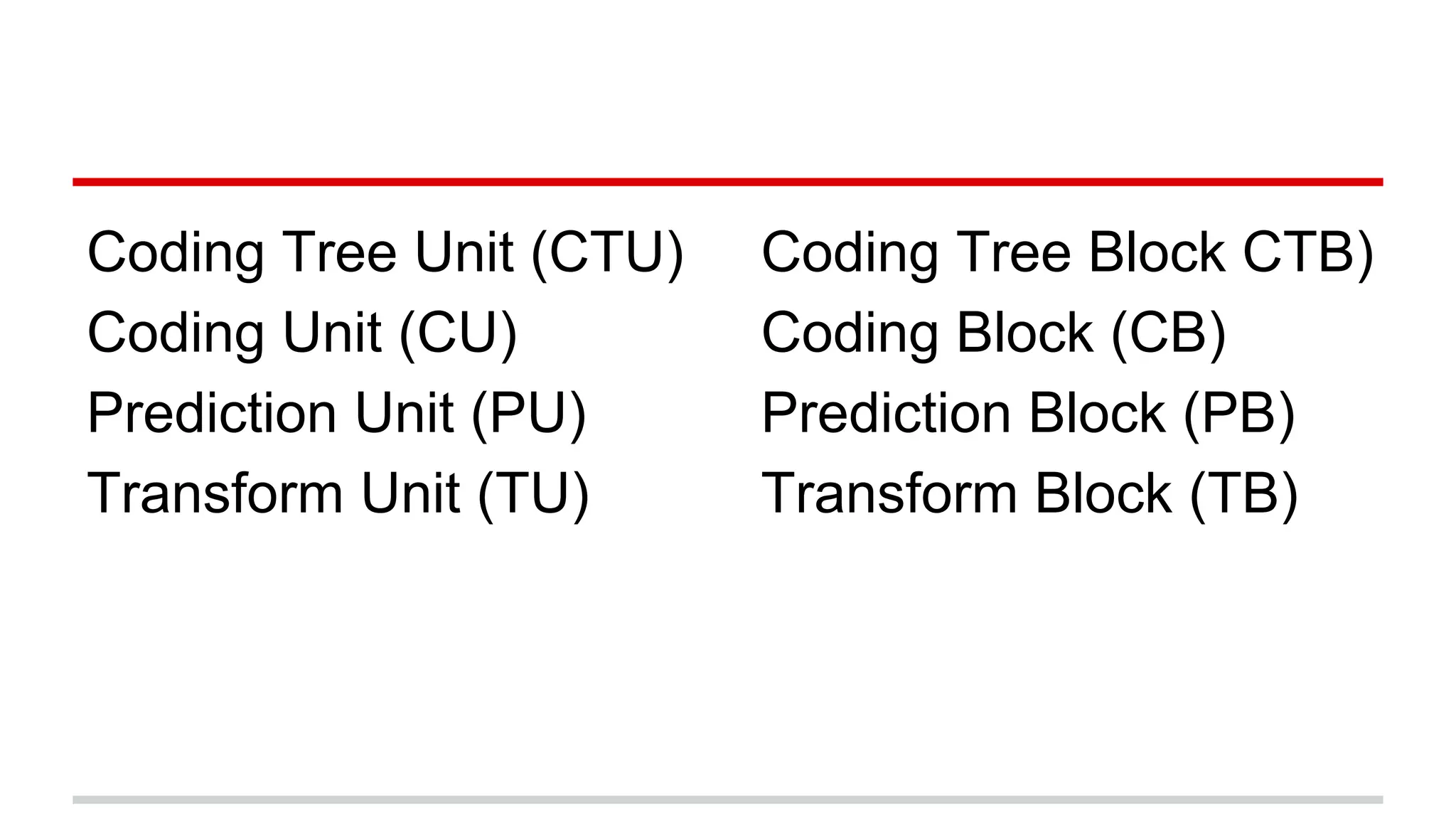
xxxUnit ⇒ Luma block, Chroma block, Syntax elements together
Coding Tree Unit (CTU)
Coding Unit (CU)
Prediction Unit (PU)
Transform Unit (TU)
Coding Tree Block CTB)
Coding Block (CB)
Prediction Block (PB)
Transform Block (TB)
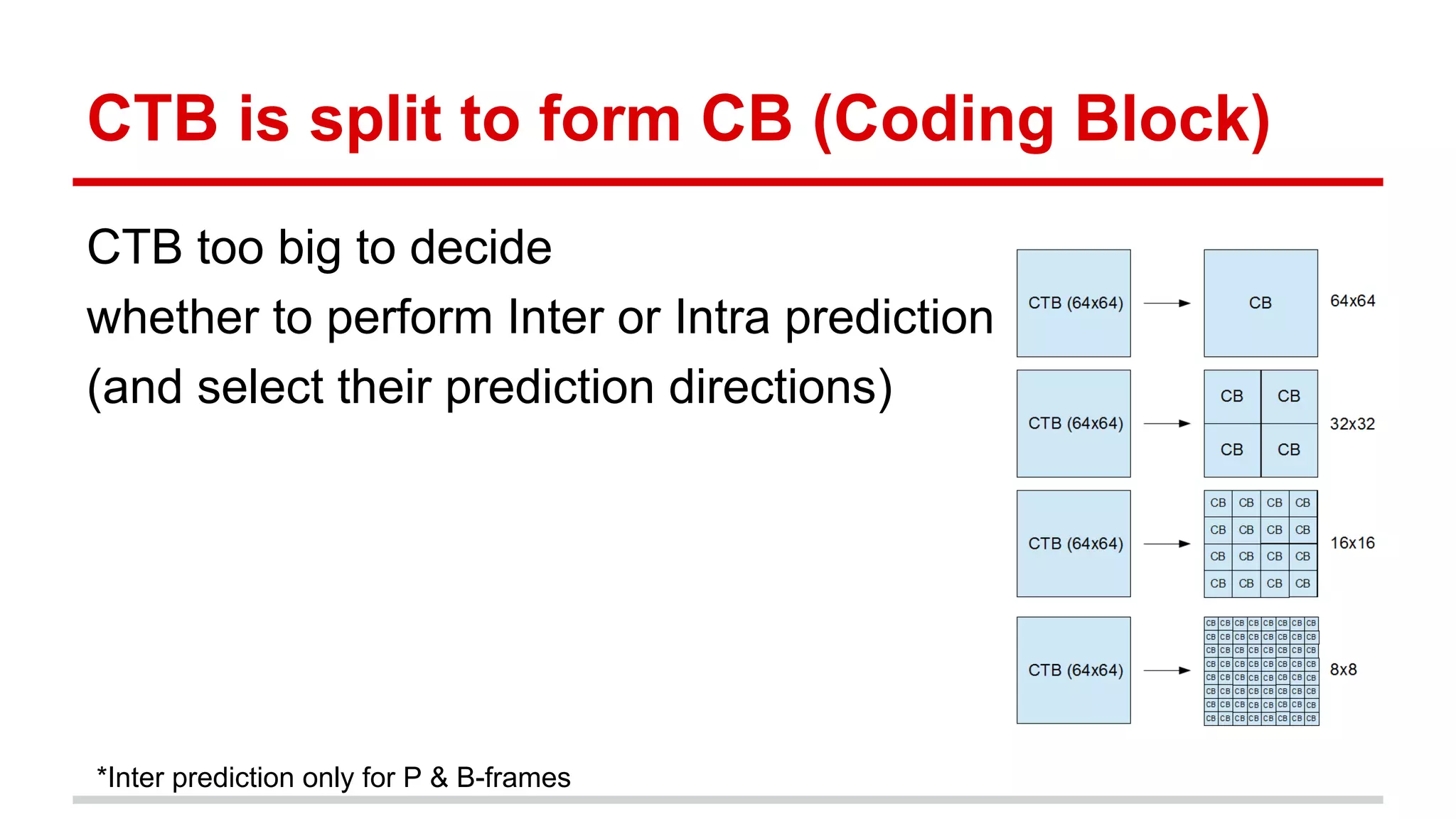
CTB is split to form CB (Coding Block)
CTB too big to decide
whether to perform Inter or Intra prediction
(and select their prediction directions)
*Inter prediction only for P & B-frames
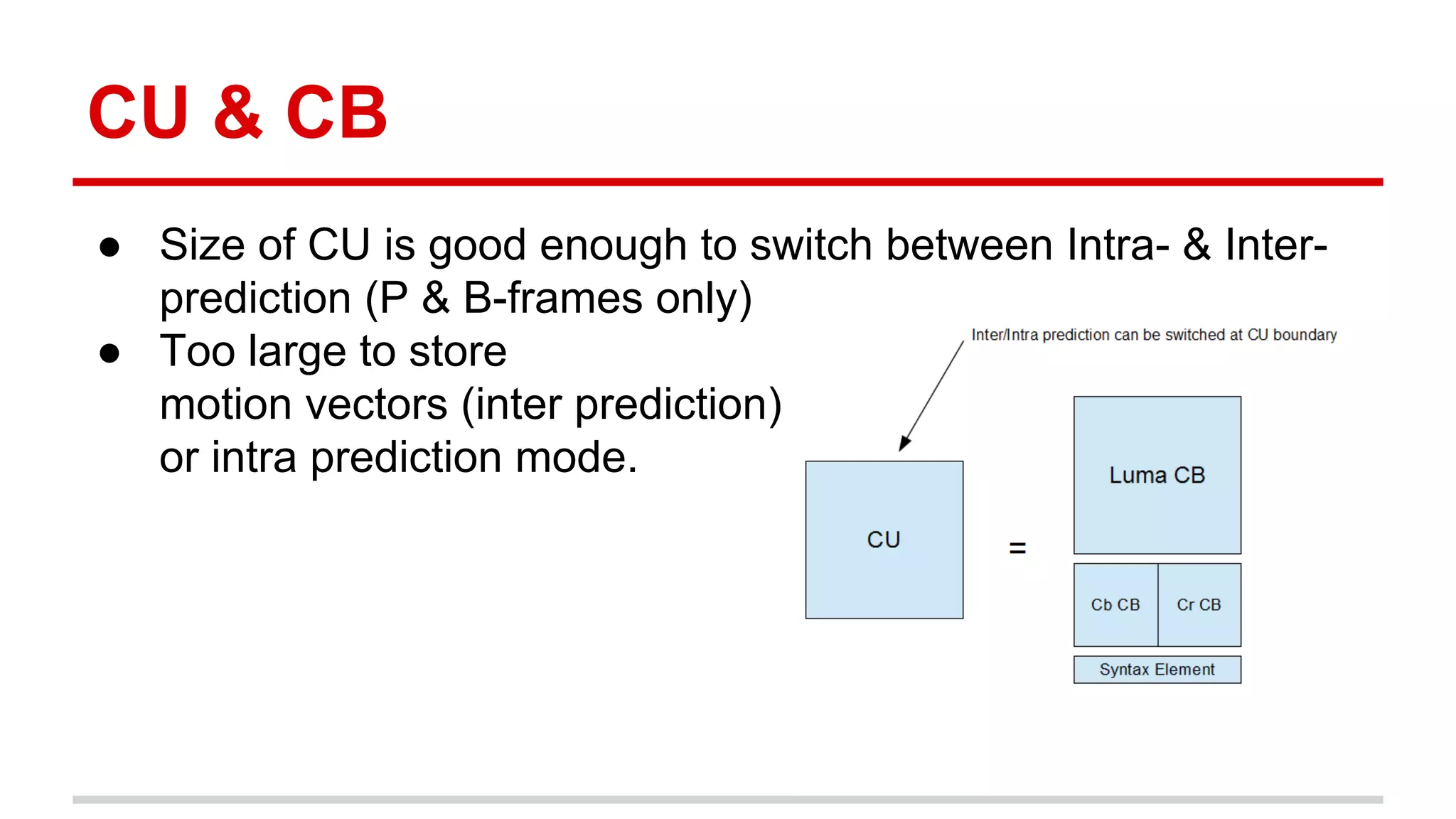
CU & CB
● Size of CU is good enough to switch between Intra- & Inter-
prediction (P & B-frames only)
● Too large to store
motion vectors (inter prediction)
or intra prediction mode.
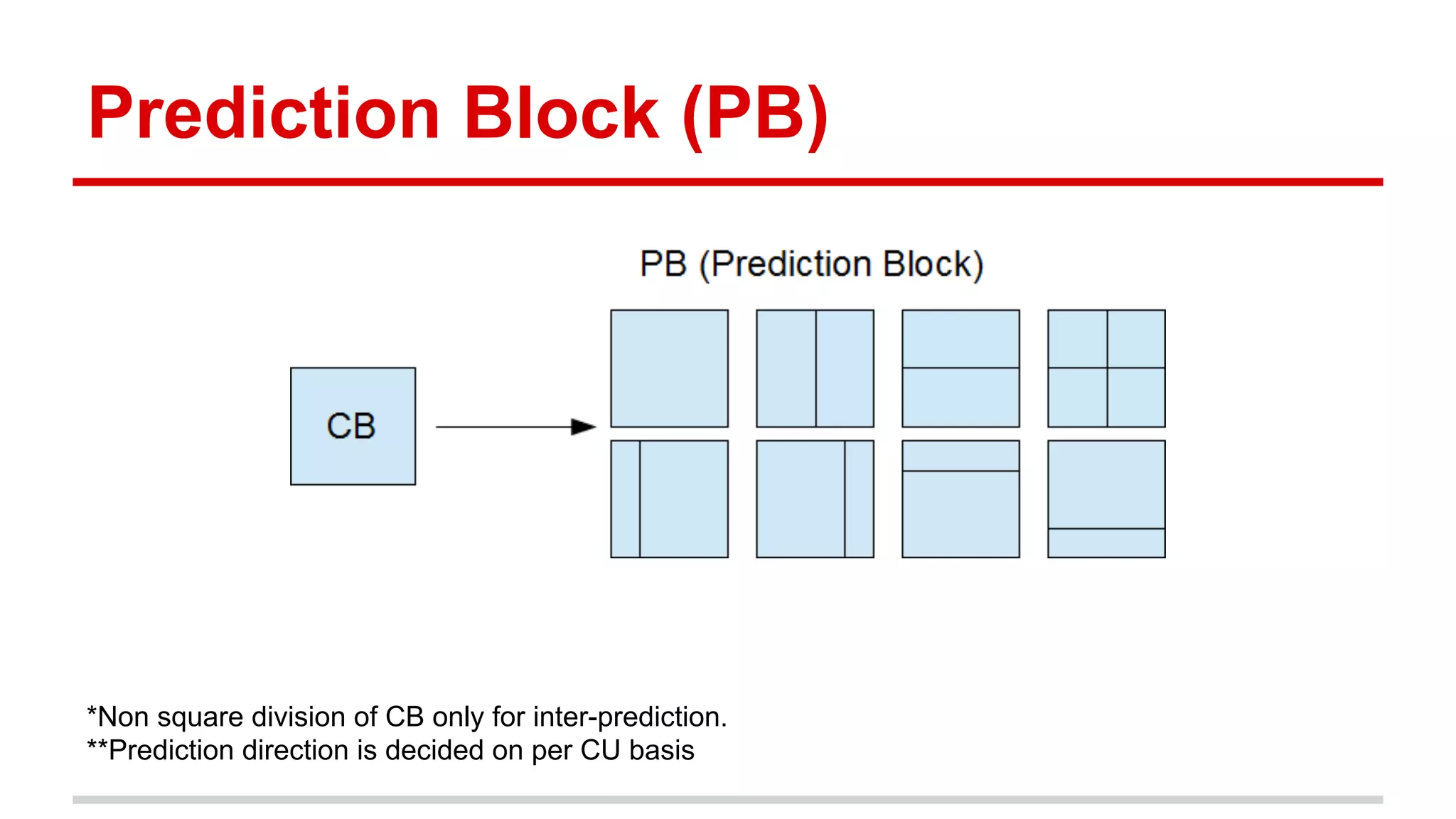
Prediction Block (PB)
*Non square division of CB only for inter-prediction.
**Prediction direction is decided on per CU basis
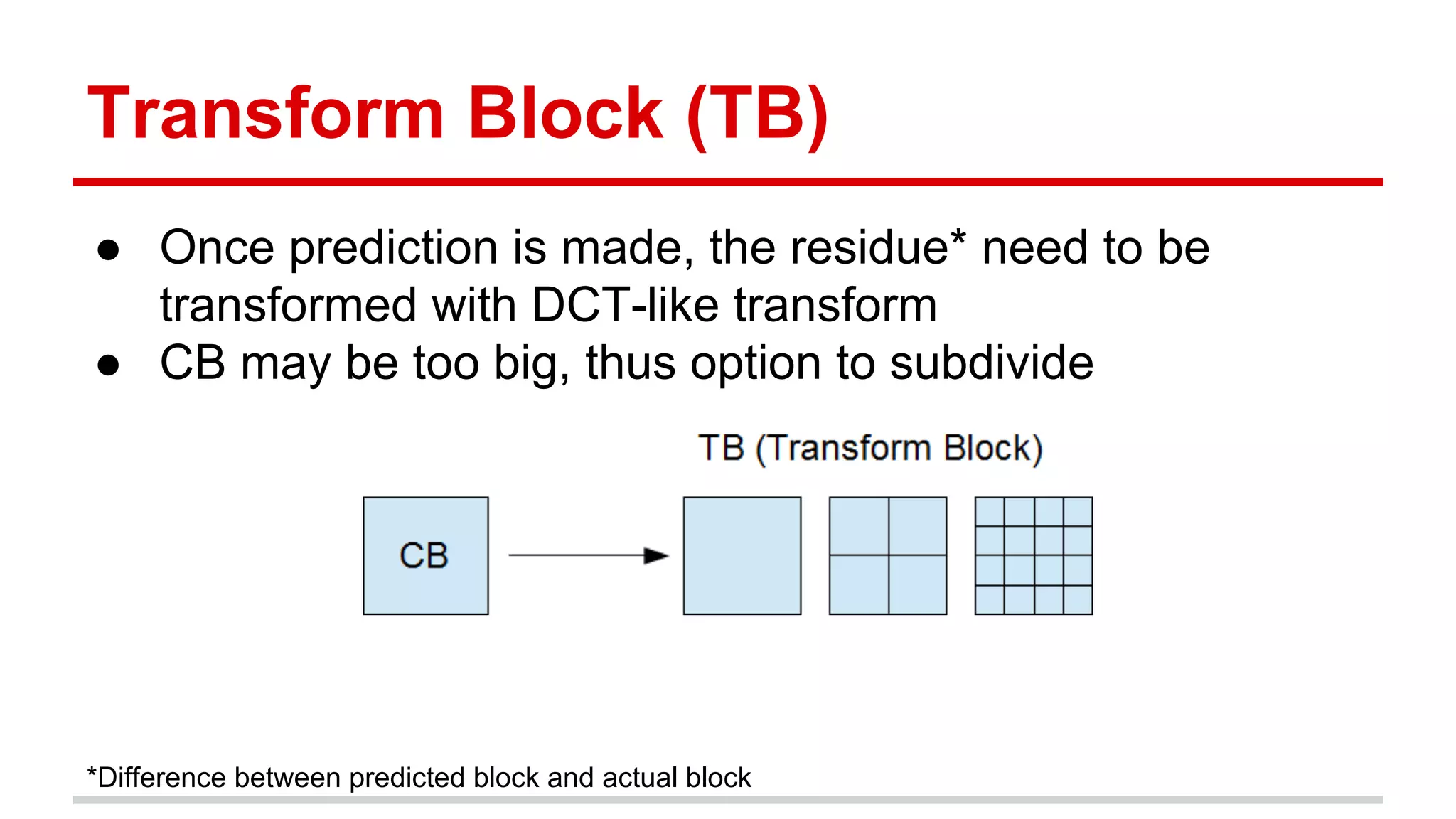
Transform Block (TB)
● Once prediction is made, the residue* need to be
transformed with DCT-like transform
● CB may be too big, thus option to subdivide
*Difference between predicted block and actual block
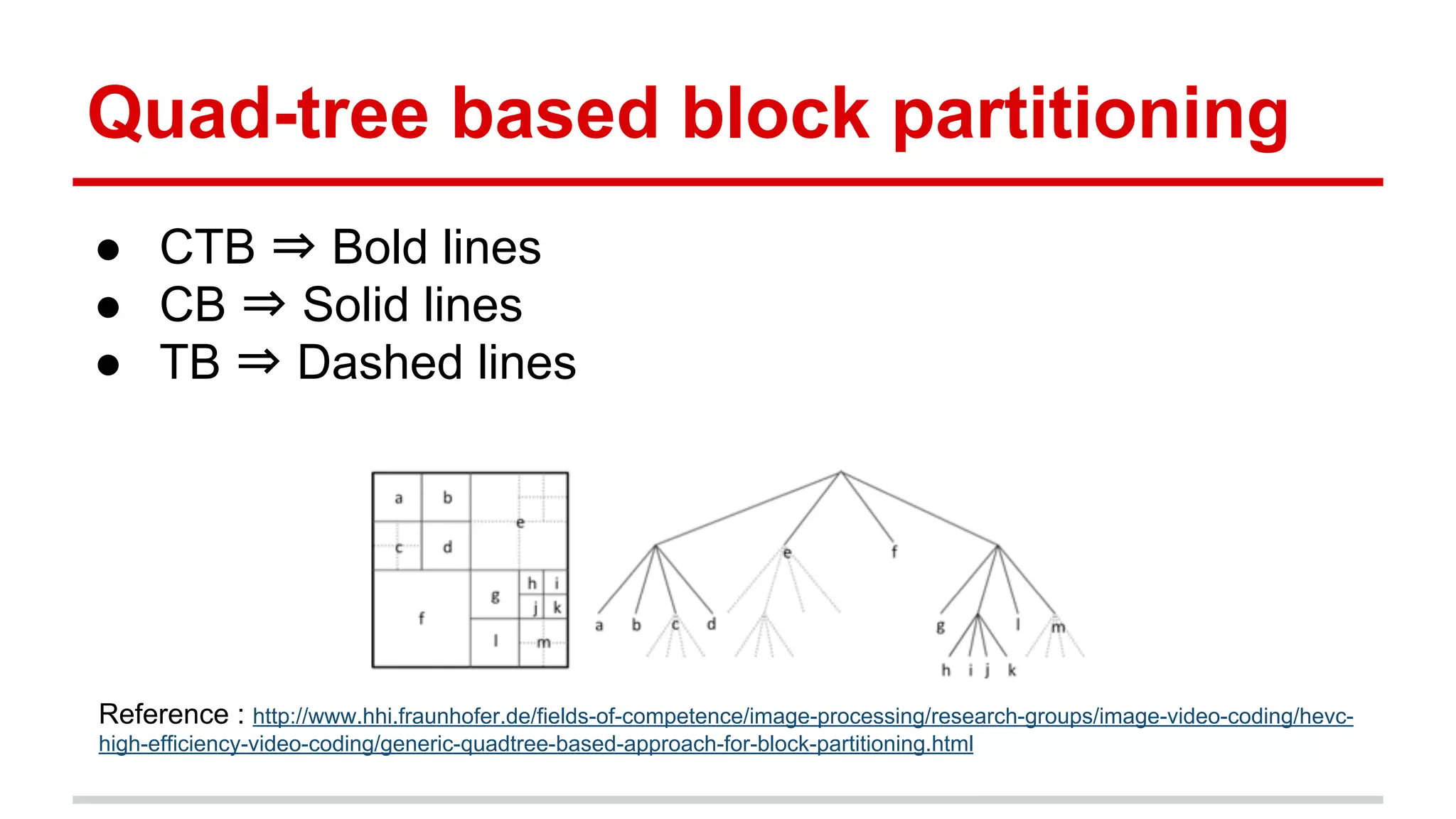
Quad-tree based block partitioning
● CTB ⇒ Bold lines
● CB ⇒ Solid lines
● TB ⇒ Dashed lines
Reference : http://www.hhi.fraunhofer.de/fields-of-competence/image-processing/research-groups/image-video-coding/hevc-
high-efficiency-video-coding/generic-quadtree-based-approach-for-block-partitioning.html
Elecard HEVC Analyzer Demo
http://www.elecard.com/en/index.html
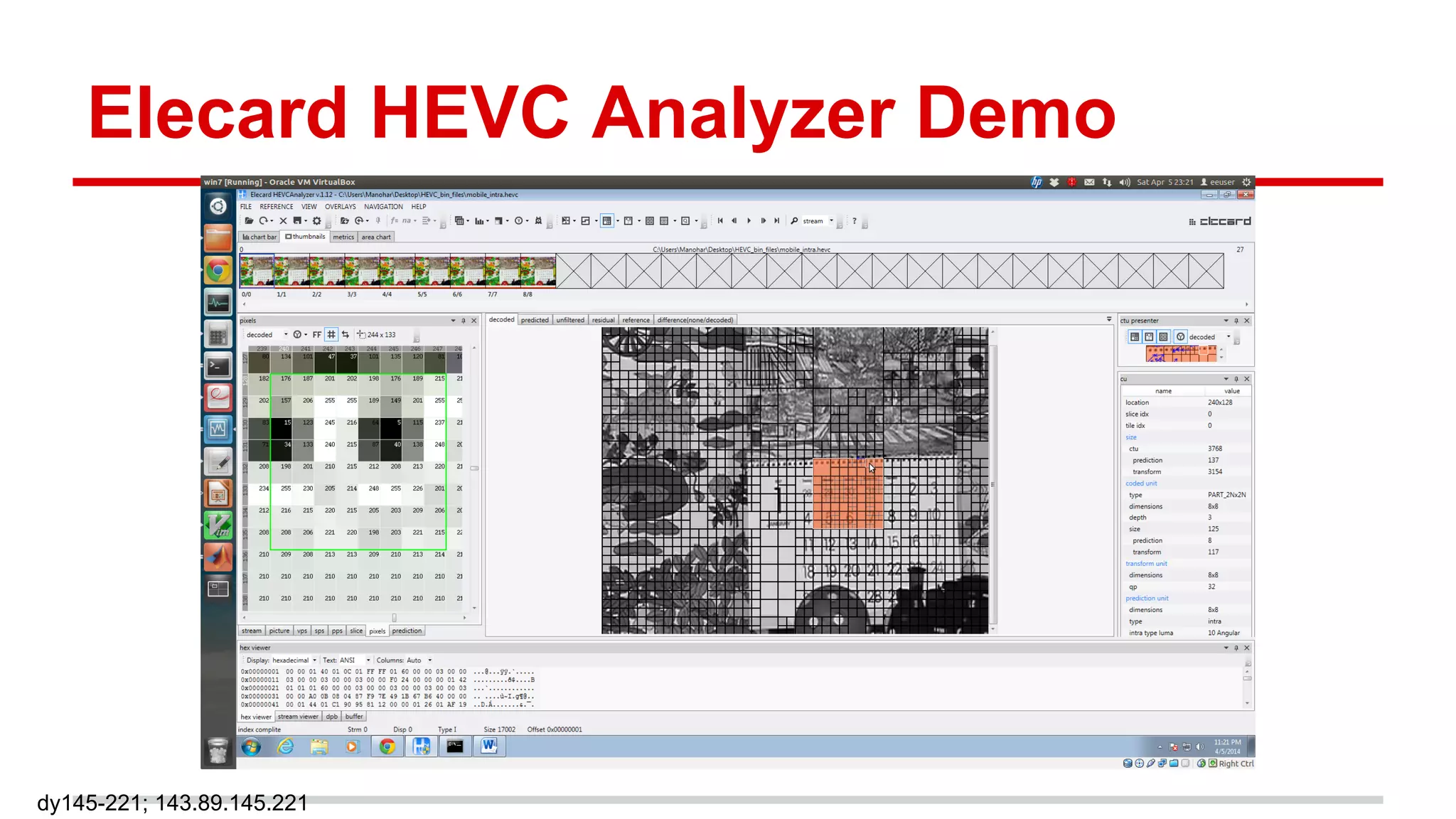
Elecard HEVC Analyzer Demo
dy145-221; 143.89.145.221
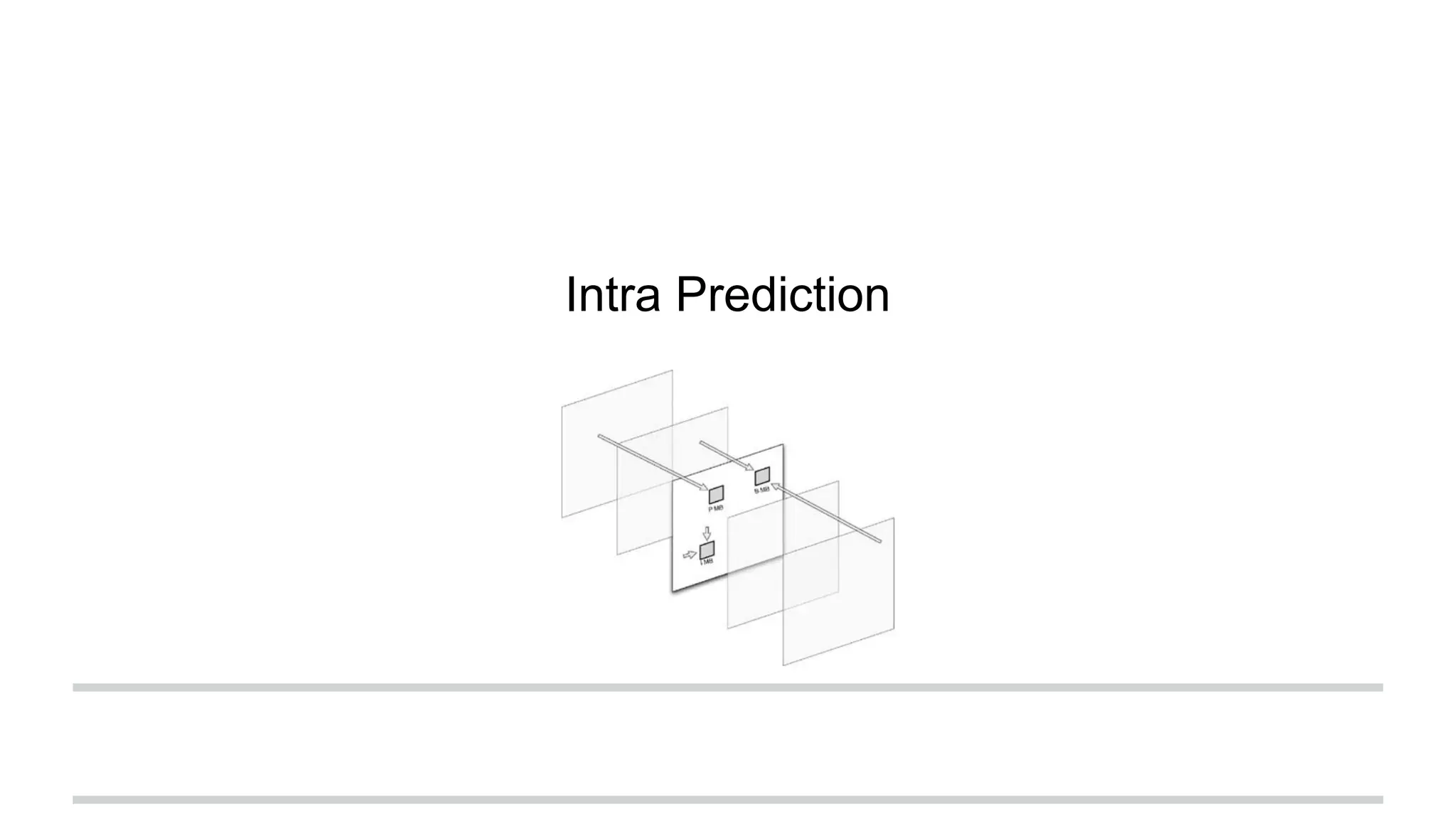
Intra Prediction
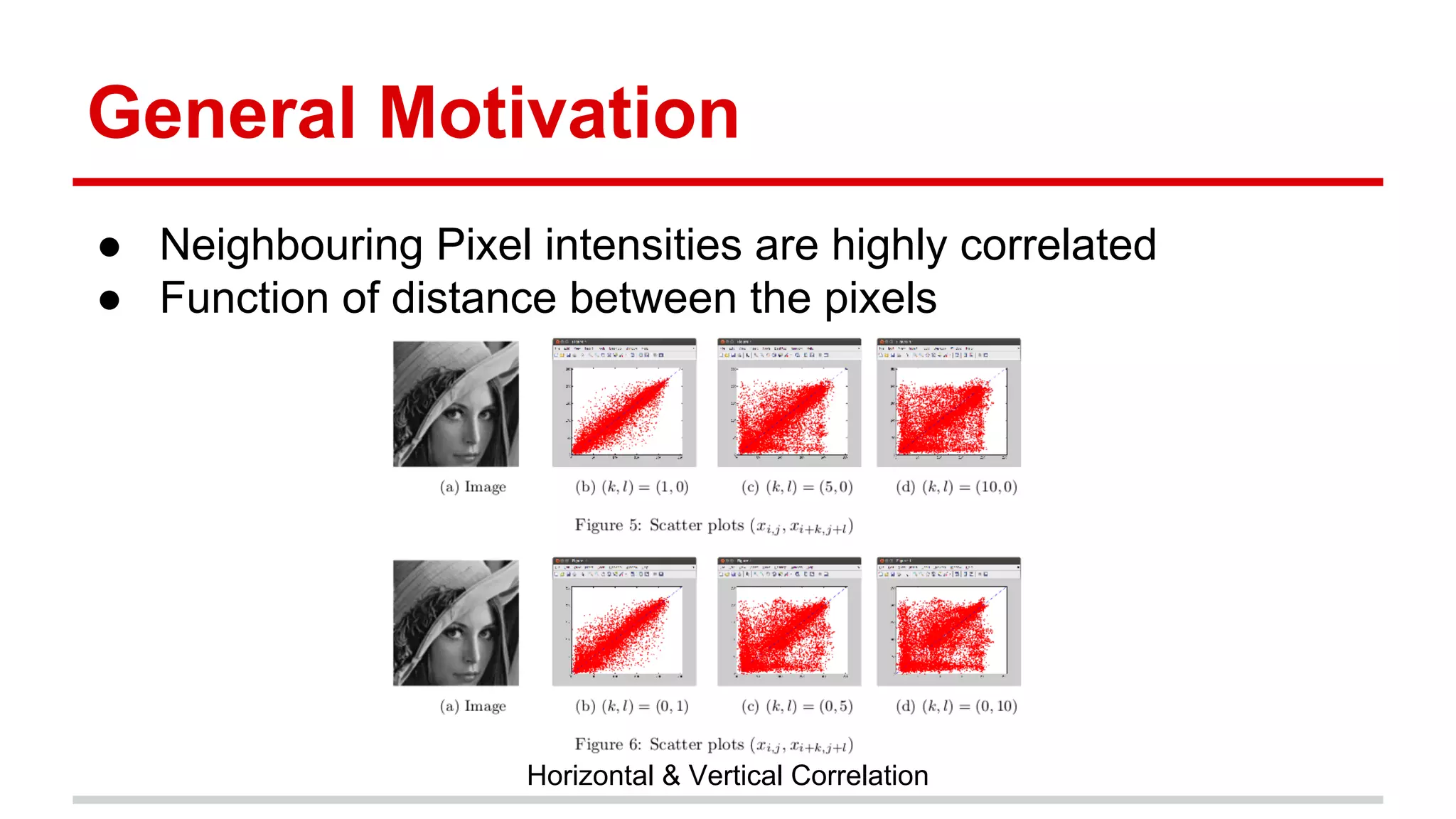
General Motivation
● Neighbouring Pixel intensities are highly correlated
● Function of distance between the pixels
Horizontal & Vertical Correlation
Why difference coding result in better compression ?
1. Predict the unknown pixel intensities
a. from it’s neighbours (this is justified due to
correlation amongst the neighbours)
2. Code the difference
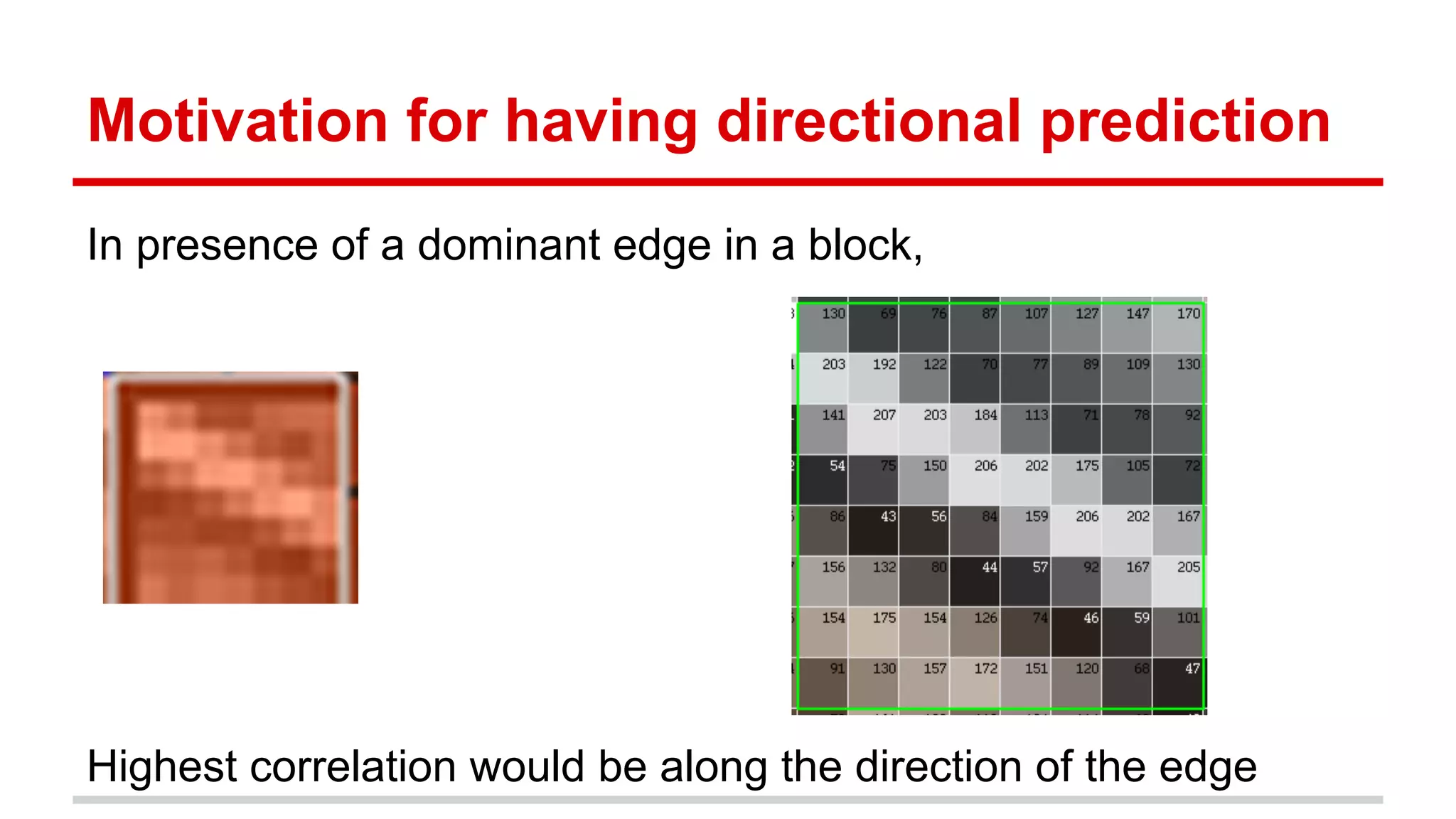
Motivation for having directional prediction
In presence of a dominant edge in a block,
Highest correlation would be along the direction of the edge
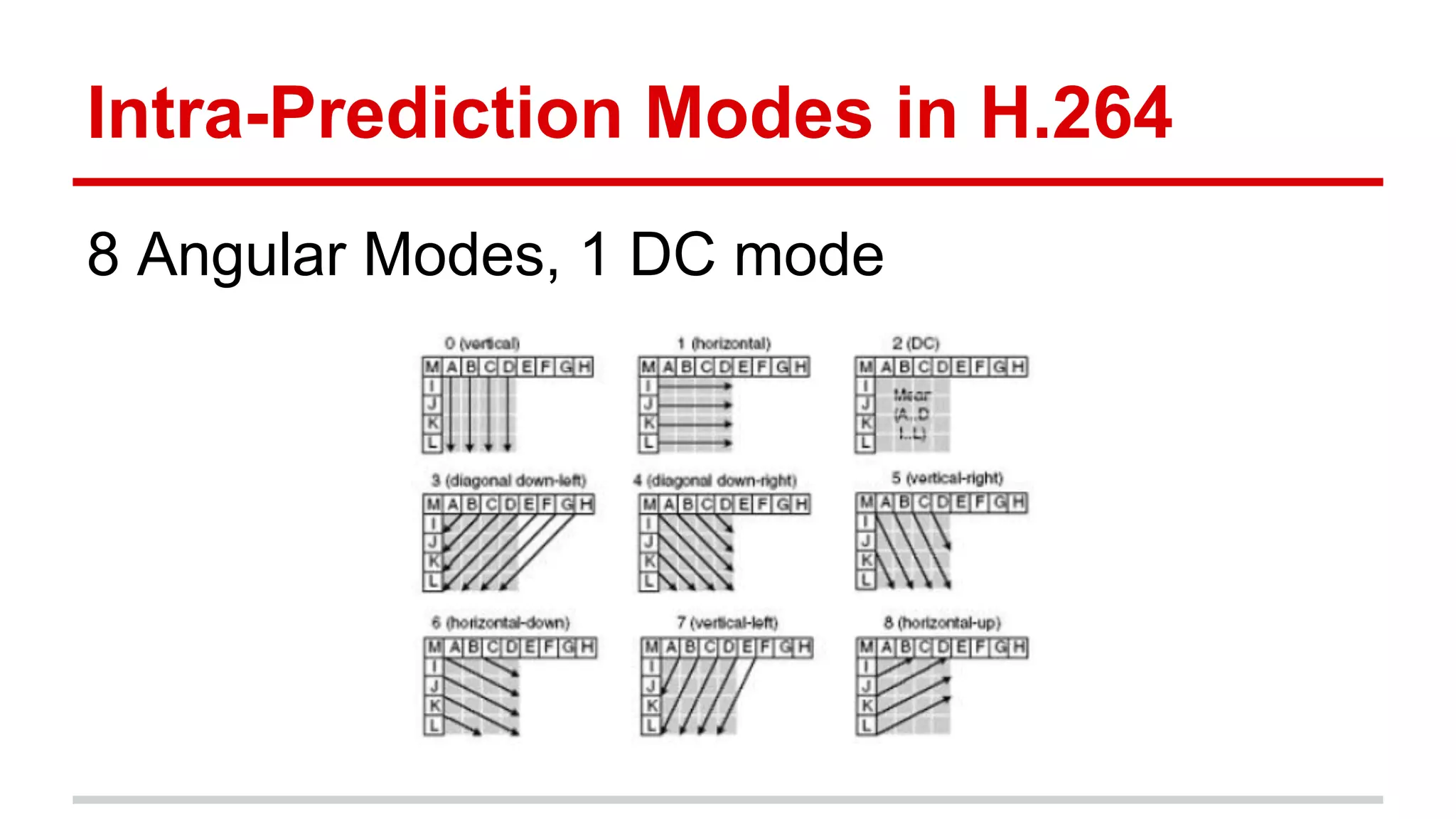
Intra-Prediction Modes in H.264
8 Angular Modes, 1 DC mode
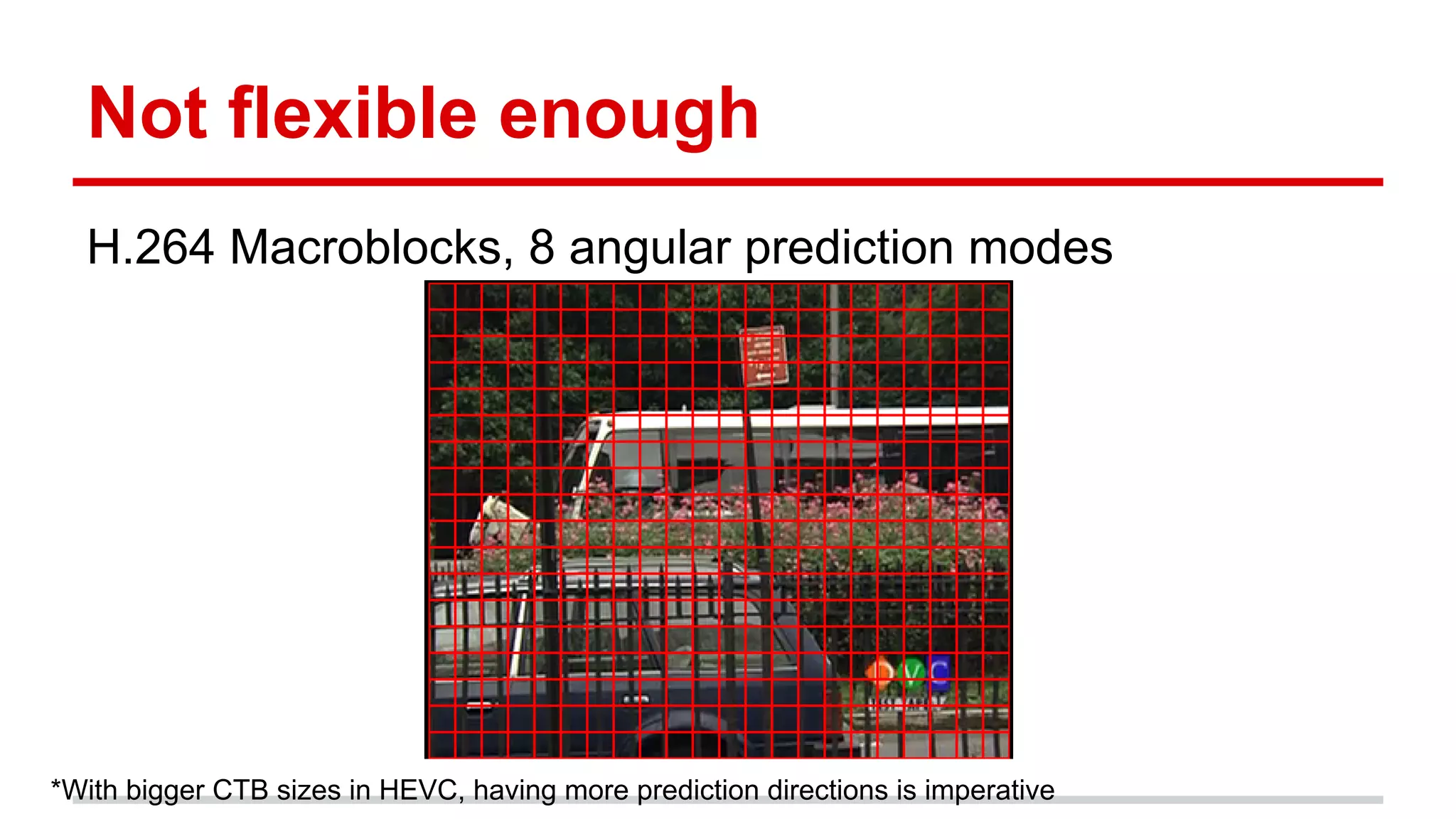
Not flexible enough
H.264 Macroblocks, 8 angular prediction modes
*With bigger CTB sizes in HEVC, having more prediction directions is imperative
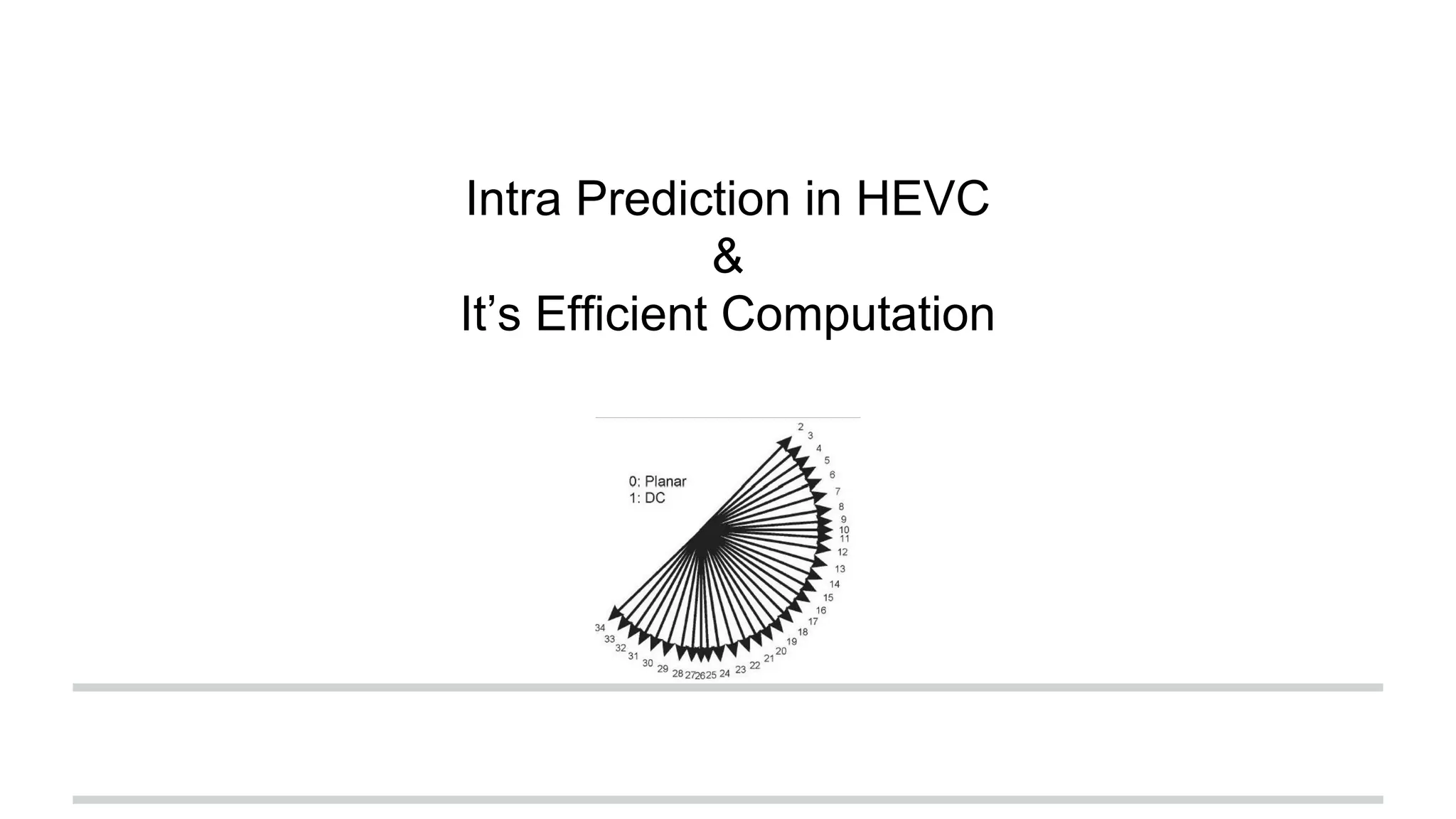
Intra Prediction in HEVC
&
It’s Efficient Computation
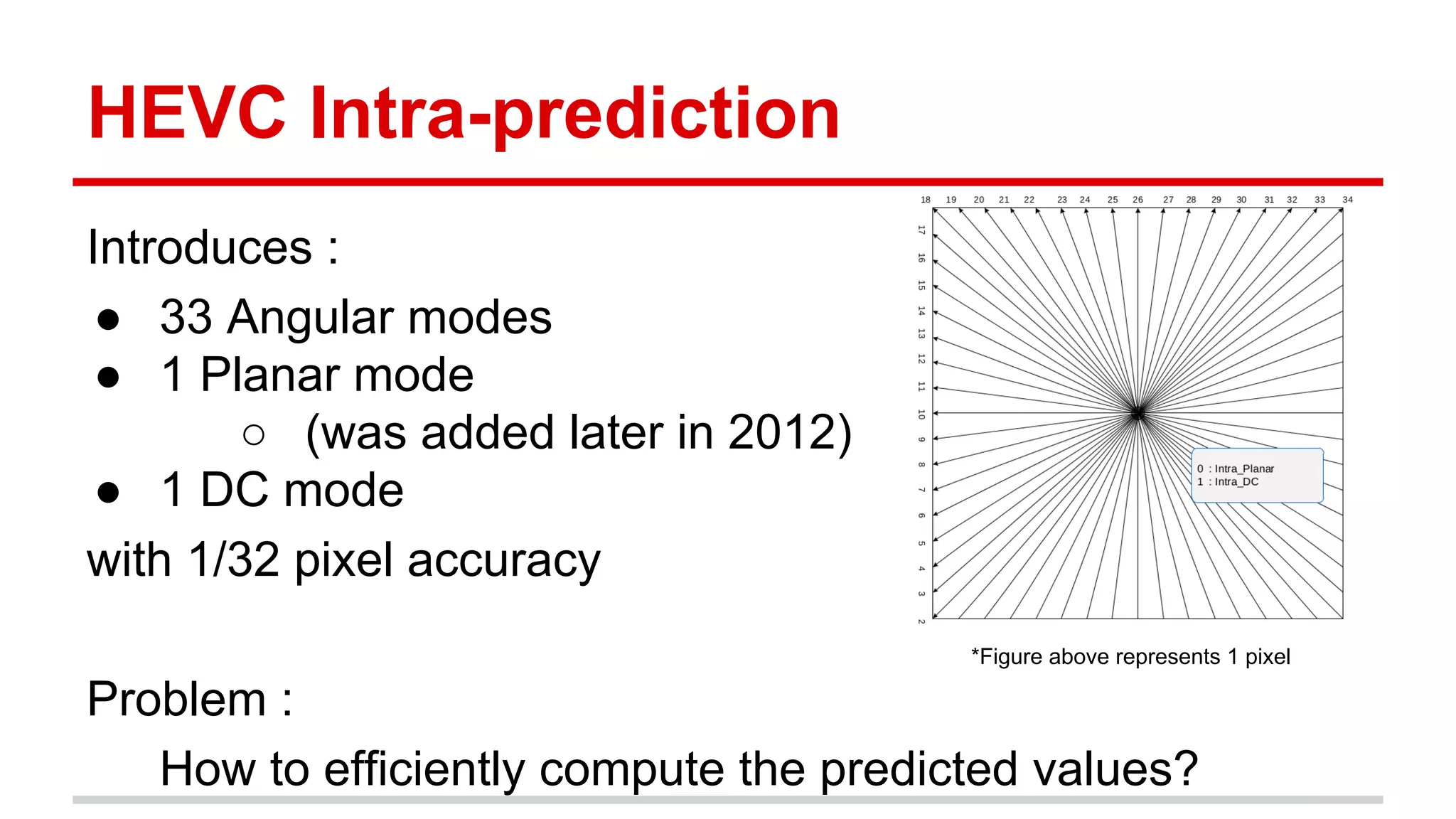
HEVC Intra-prediction
Introduces :
● 33 Angular modes
● 1 Planar mode
○ (was added later in 2012)
● 1 DC mode
with 1/32 pixel accuracy
Problem :
How to efficiently compute the predicted values?
*Figure above represents 1 pixel
Computing Predicted Samples
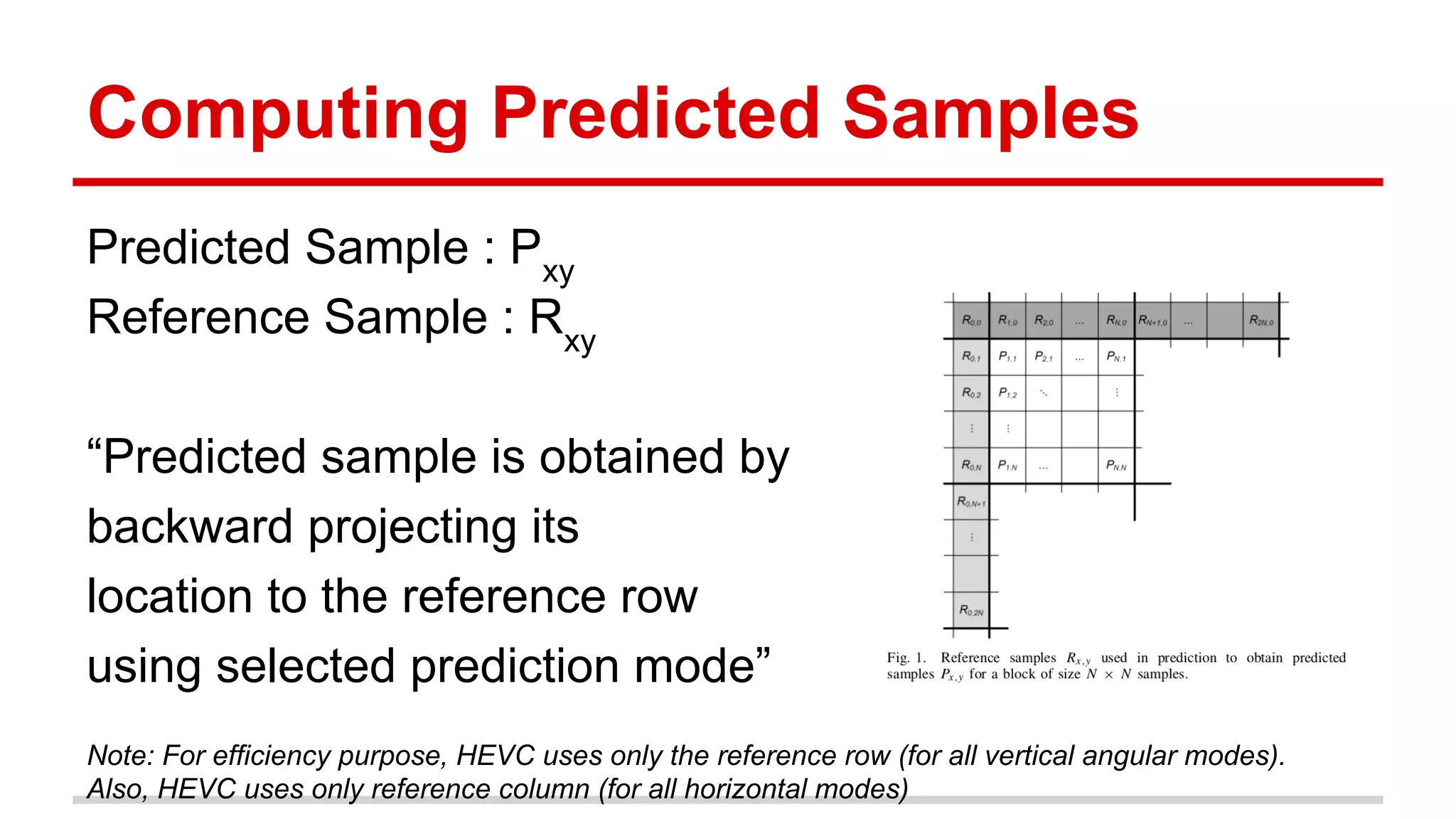
Predicted Sample : Pxy
Reference Sample : Rxy
“Predicted sample is obtained by
backward projecting its
location to the reference row
using selected prediction mode”
Note: For efficiency purpose, HEVC uses only the reference row (for all vertical angular modes).
Also, HEVC uses only reference column (for all horizontal modes)
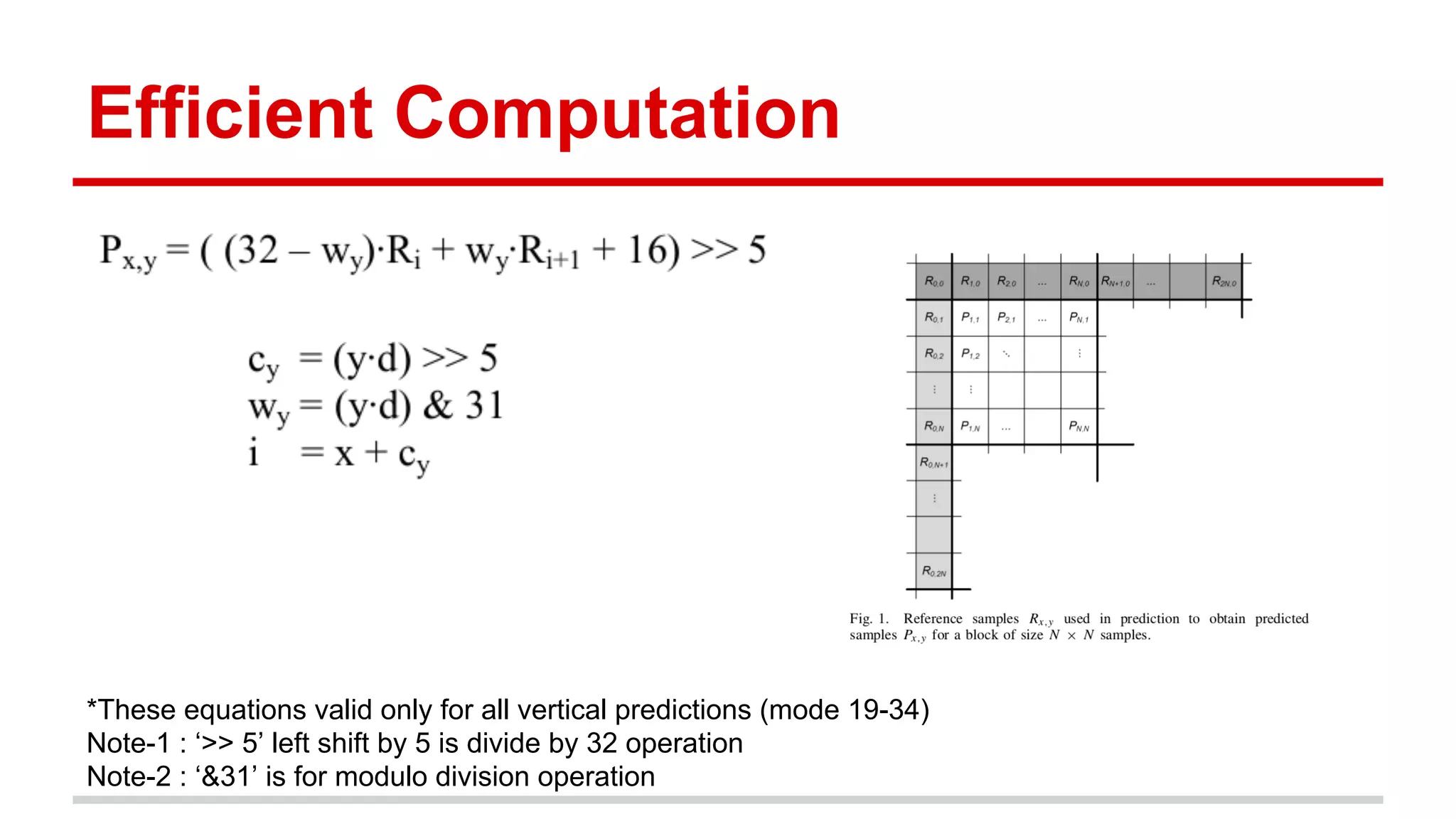
Efficient Computation
*These equations valid only for all vertical predictions (mode 19-34)
Note-1 : ‘>> 5’ left shift by 5 is divide by 32 operation
Note-2 : ‘&31’ is for modulo division operation
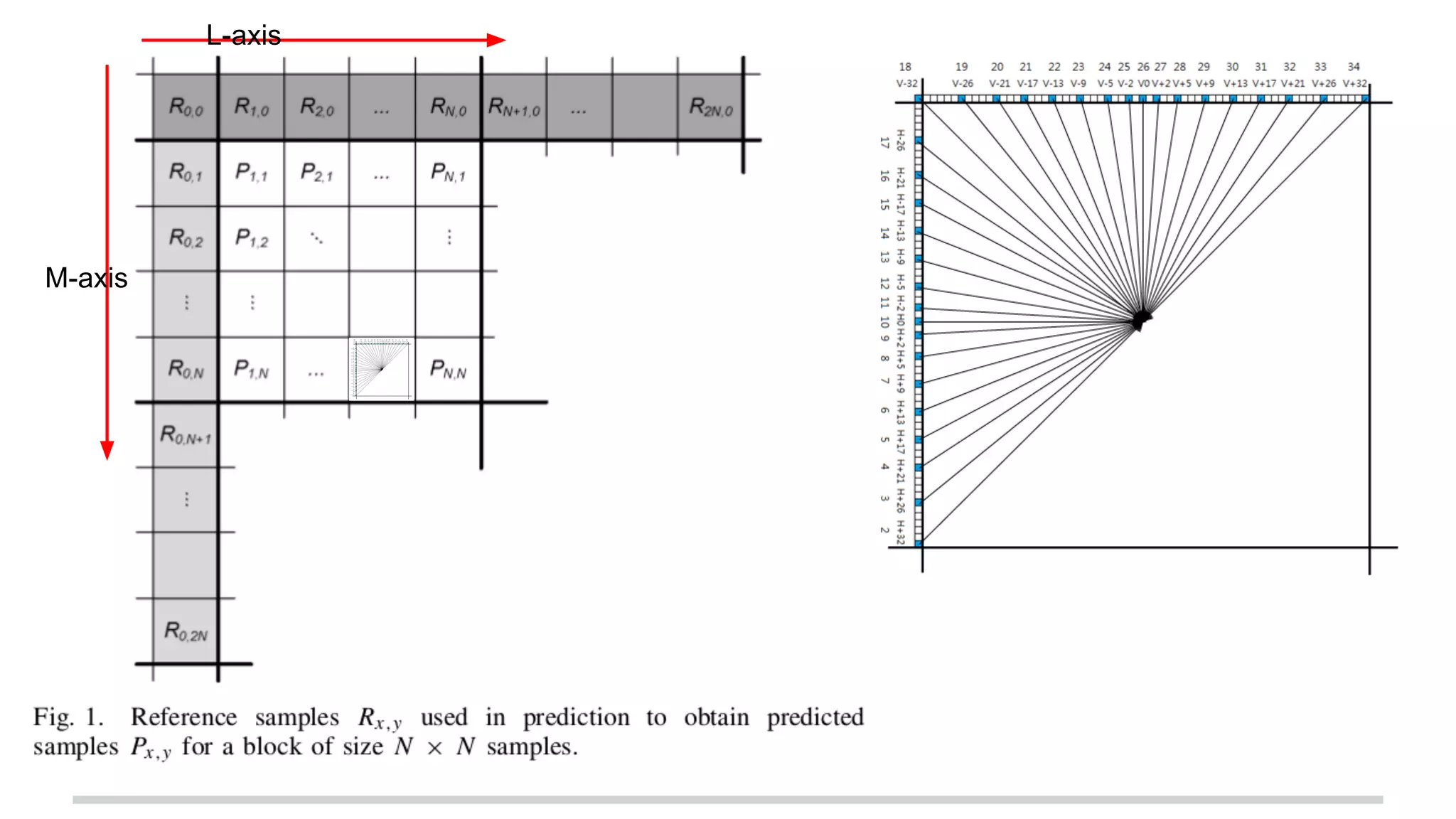
L-axis
M-axis
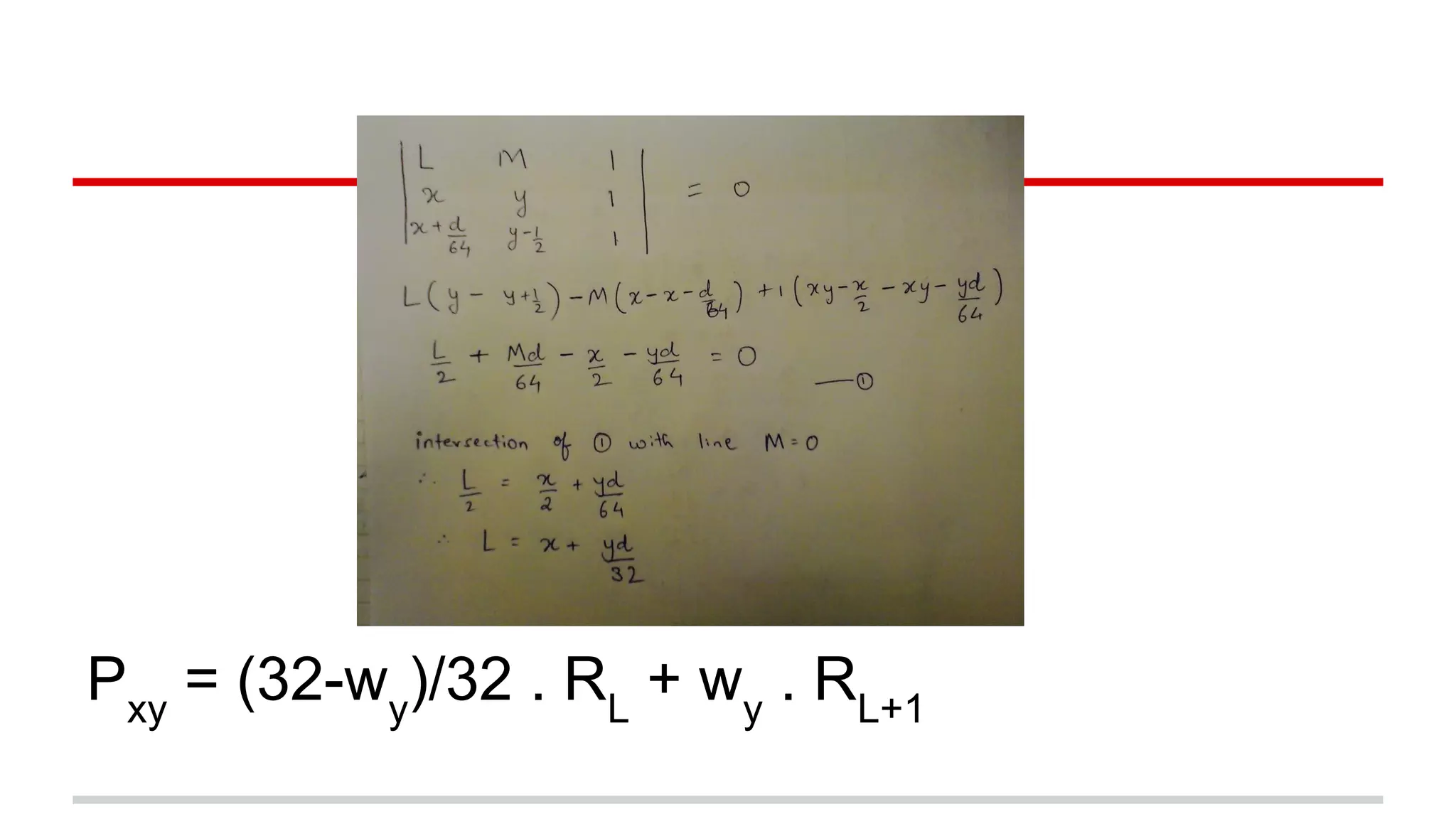
Pxy
= (32-wy
)/32 . RL
+ wy
. RL+1
Dealing with values outside reference rows
In this case, row is extended by projecting left reference
column.
For performance reasons
copying rightmost value*
*Negligible effect for compression performance JCTVC-C046. [12]
Experimental Results
Experiment
Use H.264 modes (9) in HEVC Intra-main profile
vs
Use 33 Angular & 1 DC mode in HEVC Intra-main profile
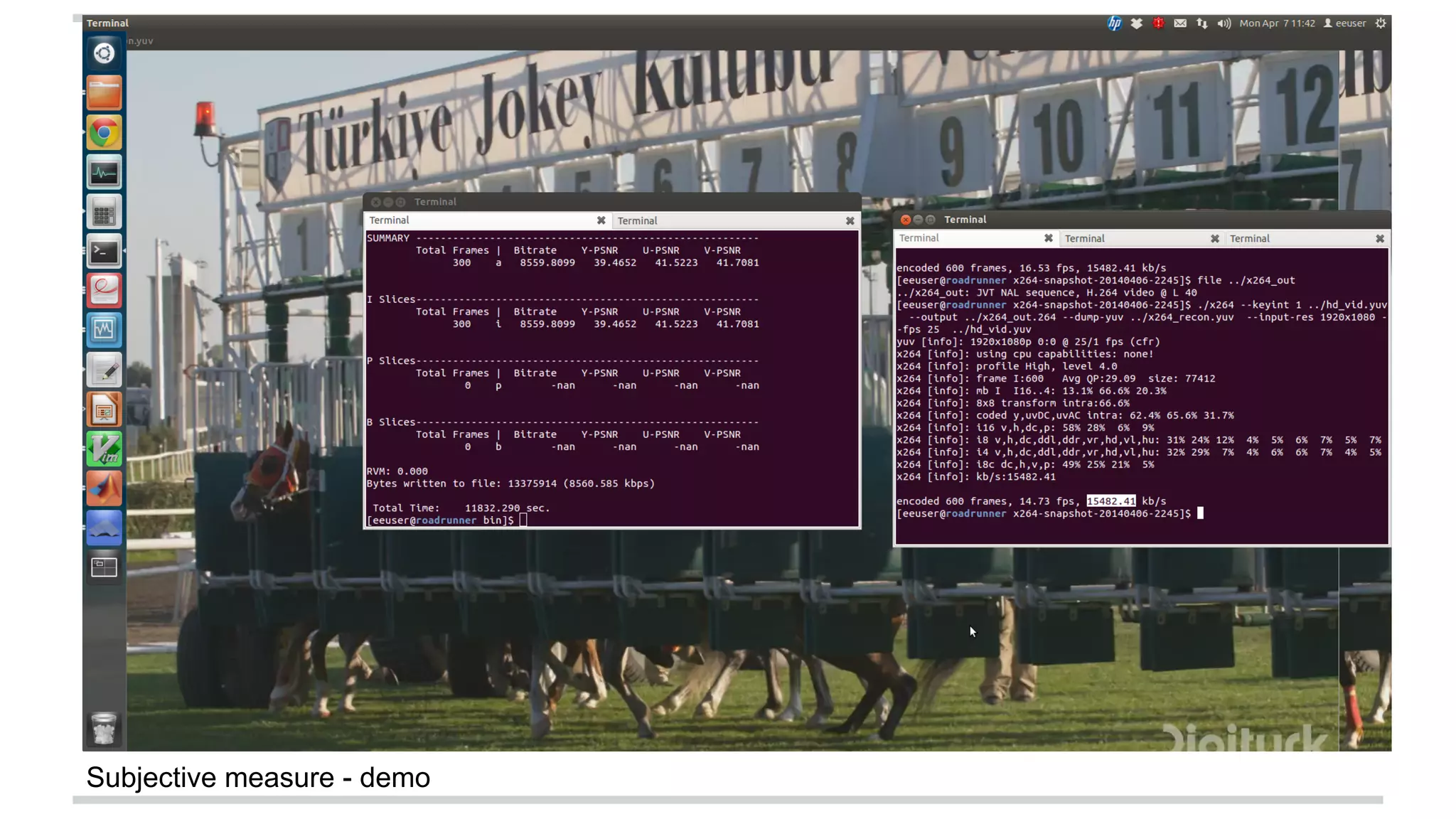
Subjective measure - demo
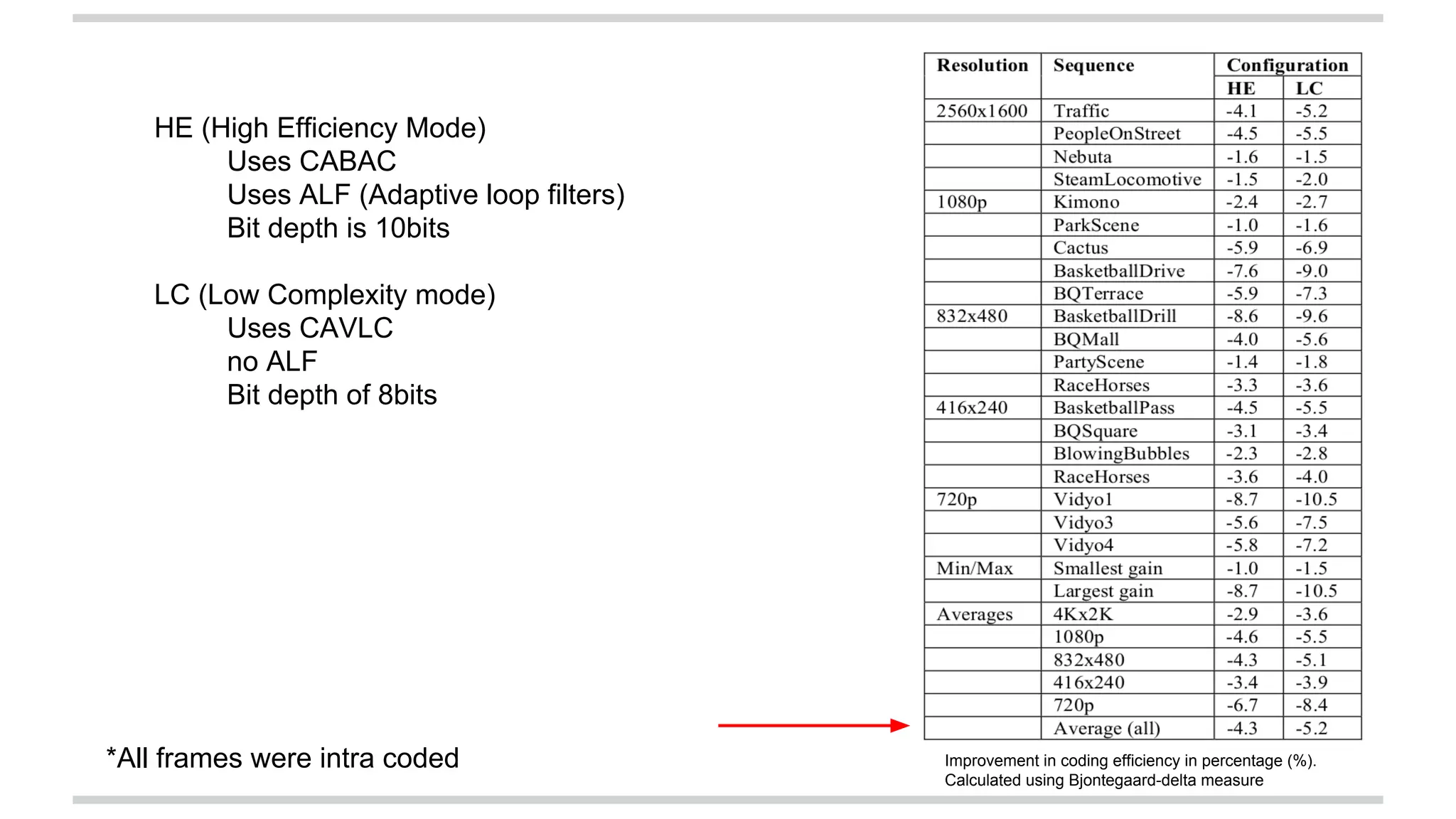
HE (High Efficiency Mode)
Uses CABAC
Uses ALF (Adaptive loop filters)
Bit depth is 10bits
LC (Low Complexity mode)
Uses CAVLC
no ALF
Bit depth of 8bits
*All frames were intra coded Improvement in coding efficiency in percentage (%).
Calculated using Bjontegaard-delta measure
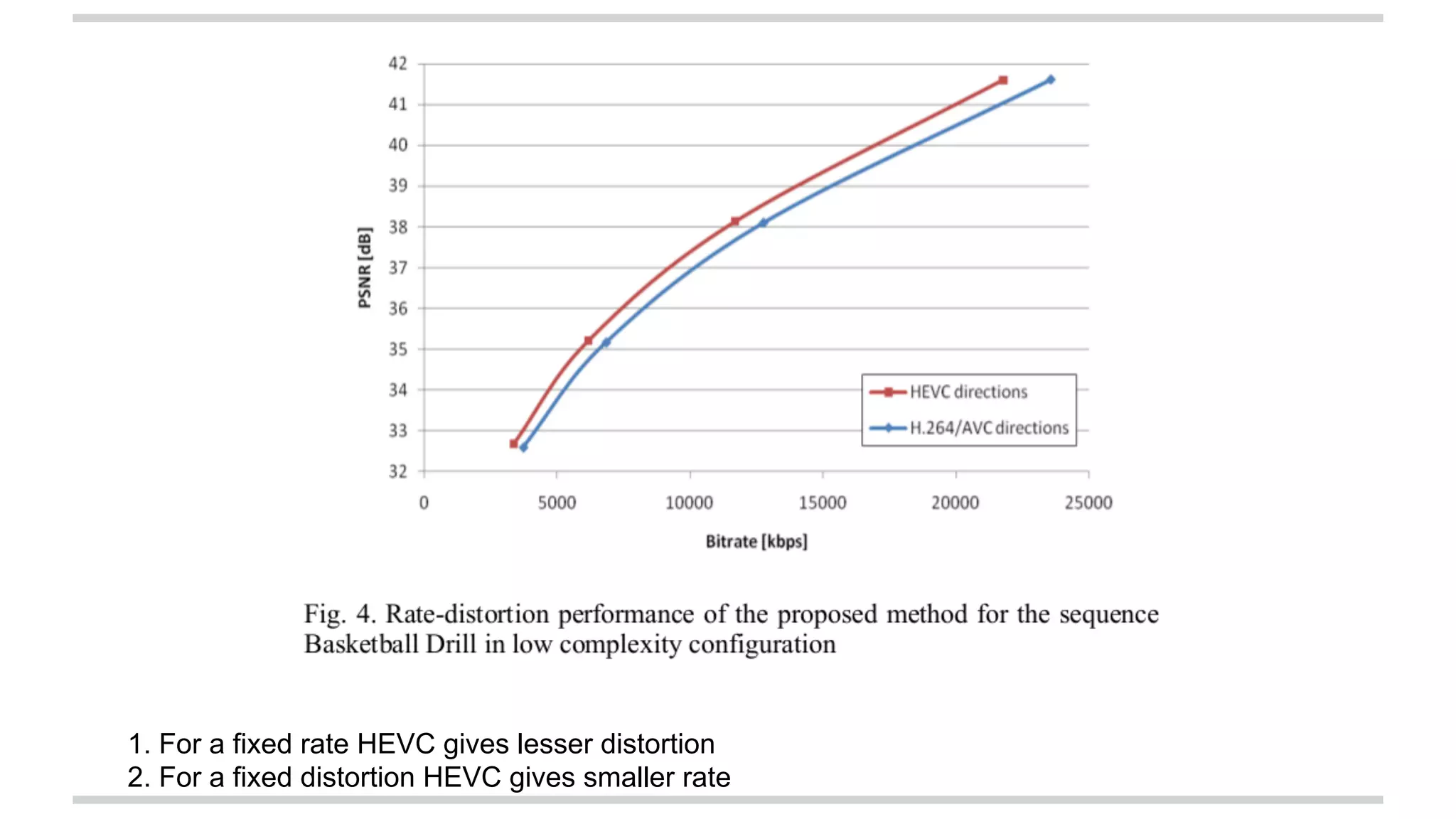
1. For a fixed rate HEVC gives lesser distortion
2. For a fixed distortion HEVC gives smaller rate

HEVC intra coding

  • 1.
    Intra Coding inHEVC Manohar Kuse mpkuse@connect.ust.hk http://ihome.ust.hk/~mpkuse 7th Apr, 2014 Lainema, Jani, and Kemal Ugur. "Angular intra prediction in high efficiency video coding (HEVC)." Multimedia Signal Processing (MMSP), 2011 IEEE 13th International Workshop on. IEEE, 2011.
  • 2.
    General Introduction of HEVC(High Efficiency Video Coding)
  • 3.
    What is HEVC? ●Video compression standard and successor to H. 264/AVC ● Jointly developed by ‘ISO/IEC Moving Pictures Expert Group (MPEG)’ & ‘ITU-T Video Coding Expert Group (VCEG)’ ● MPEG & VCEG established ‘Joint Collaborative Team on Video Coding (JCT-VC)’ to develop HEVC ● Also known as ISO/IEC 23008-2 (MPEG-H Part-2) and ITU-T H.265
  • 4.
    Prominent Features ● Doublecompression rate for same video quality* ● Substantially better video quality for same bit rate* ● Support for 8K UHD resolution *Compared to H.264/AVC
  • 5.
    The Standard Draft ●1st Version of Standard draft published Early 2013 ○ Download URL : http://www.itu.int/rec/T-REC-H.265-201304-I/en ● Extensions still under development (Early 2014) ○ Scalable Coding Extension ○ 3D Video Extensions ○ Screen Content Extension http://www.itu.int/en/ITU-T/studygroups/2013-2016/16/Pages/video/jctvc.aspx
  • 6.
    HEVC – Whatare CTU, CU, CTB, CB, PB, and TB?
  • 7.
    HEVC divides pictureinto CTUs* CTU is an acronym for Coding Tree Unit
  • 8.
    CTU (Coding TreeUnit) - Things to Remember ● Dimensions of CTU is fixed for the entire video sequence
  • 9.
    xxxUnit Vs. xxxBlock xxxUnit⇒ Luma block, Chroma block, Syntax elements together
  • 10.
    Coding Tree Unit(CTU) Coding Unit (CU) Prediction Unit (PU) Transform Unit (TU) Coding Tree Block CTB) Coding Block (CB) Prediction Block (PB) Transform Block (TB)
  • 11.
    CTB is splitto form CB (Coding Block) CTB too big to decide whether to perform Inter or Intra prediction (and select their prediction directions) *Inter prediction only for P & B-frames
  • 12.
    CU & CB ●Size of CU is good enough to switch between Intra- & Inter- prediction (P & B-frames only) ● Too large to store motion vectors (inter prediction) or intra prediction mode.
  • 13.
    Prediction Block (PB) *Nonsquare division of CB only for inter-prediction. **Prediction direction is decided on per CU basis
  • 14.
    Transform Block (TB) ●Once prediction is made, the residue* need to be transformed with DCT-like transform ● CB may be too big, thus option to subdivide *Difference between predicted block and actual block
  • 15.
    Quad-tree based blockpartitioning ● CTB ⇒ Bold lines ● CB ⇒ Solid lines ● TB ⇒ Dashed lines Reference : http://www.hhi.fraunhofer.de/fields-of-competence/image-processing/research-groups/image-video-coding/hevc- high-efficiency-video-coding/generic-quadtree-based-approach-for-block-partitioning.html
  • 16.
    Elecard HEVC AnalyzerDemo http://www.elecard.com/en/index.html
  • 17.
    Elecard HEVC AnalyzerDemo dy145-221; 143.89.145.221
  • 18.
  • 19.
    General Motivation ● NeighbouringPixel intensities are highly correlated ● Function of distance between the pixels Horizontal & Vertical Correlation
  • 20.
    Why difference codingresult in better compression ? 1. Predict the unknown pixel intensities a. from it’s neighbours (this is justified due to correlation amongst the neighbours) 2. Code the difference
  • 21.
    Motivation for havingdirectional prediction In presence of a dominant edge in a block, Highest correlation would be along the direction of the edge
  • 22.
    Intra-Prediction Modes inH.264 8 Angular Modes, 1 DC mode
  • 23.
    Not flexible enough H.264Macroblocks, 8 angular prediction modes *With bigger CTB sizes in HEVC, having more prediction directions is imperative
  • 24.
    Intra Prediction inHEVC & It’s Efficient Computation
  • 25.
    HEVC Intra-prediction Introduces : ●33 Angular modes ● 1 Planar mode ○ (was added later in 2012) ● 1 DC mode with 1/32 pixel accuracy Problem : How to efficiently compute the predicted values? *Figure above represents 1 pixel
  • 26.
    Computing Predicted Samples PredictedSample : Pxy Reference Sample : Rxy “Predicted sample is obtained by backward projecting its location to the reference row using selected prediction mode” Note: For efficiency purpose, HEVC uses only the reference row (for all vertical angular modes). Also, HEVC uses only reference column (for all horizontal modes)
  • 27.
    Efficient Computation *These equationsvalid only for all vertical predictions (mode 19-34) Note-1 : ‘>> 5’ left shift by 5 is divide by 32 operation Note-2 : ‘&31’ is for modulo division operation
  • 28.
  • 29.
    Pxy = (32-wy )/32 .RL + wy . RL+1
  • 30.
    Dealing with valuesoutside reference rows In this case, row is extended by projecting left reference column. For performance reasons copying rightmost value* *Negligible effect for compression performance JCTVC-C046. [12]
  • 31.
  • 32.
    Experiment Use H.264 modes(9) in HEVC Intra-main profile vs Use 33 Angular & 1 DC mode in HEVC Intra-main profile
  • 33.
  • 34.
    HE (High EfficiencyMode) Uses CABAC Uses ALF (Adaptive loop filters) Bit depth is 10bits LC (Low Complexity mode) Uses CAVLC no ALF Bit depth of 8bits *All frames were intra coded Improvement in coding efficiency in percentage (%). Calculated using Bjontegaard-delta measure
  • 35.
    1. For afixed rate HEVC gives lesser distortion 2. For a fixed distortion HEVC gives smaller rate