An English translation course
How does translation
(even)
exist?
A visual teaching aid for the textbook
Step by Step originally written by Ana Rojo.
With summaries, brand new mindmaps and illustrations
by Begoña Martínez Pagán (@minibego / minibego.com)
for the University of Murcia 2016-2017 course “(3096) TRADUCCIÓN GENERAL C-A I (INGLÉS)”
How does translation
(even)
exist?
Lesson 1:
DOES TRANSLATION
EVEN EXIST?
1. DEFINITION
2. FEASIBILITY
3. IMPORTANCE
4. EQUIVALENCE
5. FORCES
Translation is not rocket
science
(nor tango)
Is translation…
art?
craft?
science?
technique?
law?
commerce?
YES.
That, and
more.
1. Definition
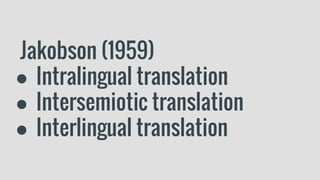
Jakobson (1959)
● Intralingual translation
● Intersemiotic translation
● Interlingual translation
Munday (2001):
● Product
● Process
● Subject matter
● Oral vs written
2. Feasibility
3. Importance
4. Forces
TRUTH ⬌COMPETENCE
WRITER ⬌TRANSLATOR ⬌READER
● INTENTIONS
● STYLE
WRITER ⬌TRANSLATOR ⬌READER
● INTENTIONS
● STYLE
● SKILLS
CONVENTIONS
+ CULTURE
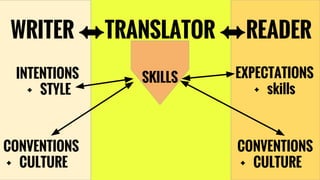
WRITER ⬌TRANSLATOR ⬌READER
INTENTIONS
+ STYLE
SKILLS EXPECTATIONS
+ skills
CONVENTIONS
+ CULTURE
Can we create an ideal
replica? A clone?
● An EQUIVALENT
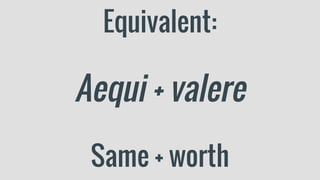
Equivalent:
Aequi + valere
Same + worth
TRANSLATION:
AN OPTIMIZATION
PROBLEM
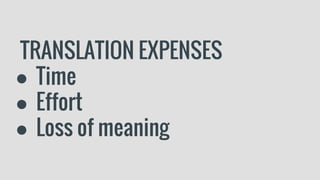
TRANSLATION EXPENSES
● Time
● Effort
● Loss of meaning
SOLUTION
● Linguistic analyisis
● Skilled production
Lesson 2:
WORDS
Lexicon
● Structured network,
“tree”
● Not “a list”
● FLUID
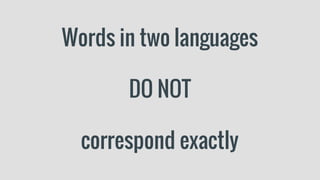
Words in two languages
DO NOT
correspond exactly
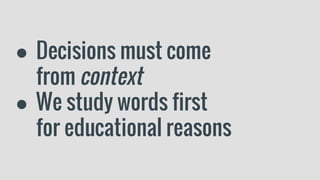
● Decisions must come
from context
● We study words first
for educational reasons
Strategies
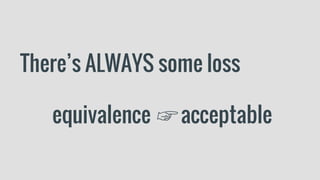
There’s ALWAYS some loss
equivalence ☞ acceptable
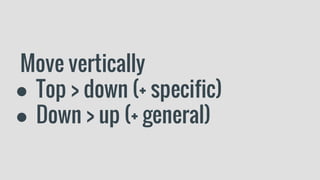
Move vertically
● Top > down (+ specific)
● Down > up (+ general)
Ambiguity
+ vague
- vague
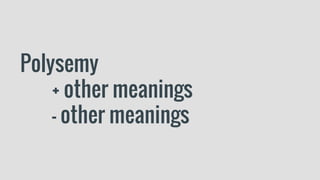
Polysemy
+ other meanings
- other meanings
Connotation
+ force
- force
Recapitulation
● Moving vertically
● Ambiguity
● Polysemy
● Connotation
What is a
word?
Everybody thinks they know what
a word is. But the matter, which
seems so simple, is in fact
enormously problematical.
Aitchison, J. (1994)
There once was a fisher named Fisher
Who fished for a fish in a fissure.
But the fish with a grin
Pulled the fisherman in
Now they all fish the fissure for Fisher.
Aitchison, J. (1994)
1.1. The smallest
meaningful unit?
1.2. Minimal permutable element
(Cruse, 2000)
● Cannot be interrupted
● Cannot be moved, or new material inserted
1.3. Any sequence of letters with
an orthographic space at either
side (Baker, 1992)
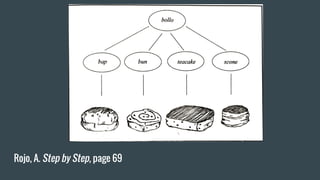
Dissimilarity
Same world?
Different views?
Different “cuts”?
Can words determine thoughts?
(Sapir-Whorf)
Rojo, A. Step by Step, page 69
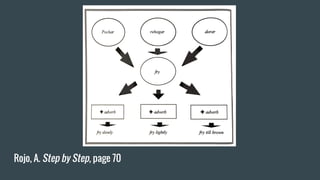
Rojo, A. Step by Step, page 70
Equivalence
at word level
Kussmaul (1995):
What are the
relevant features of the meaning of a word,
in a given context,
with regard to the function of the translation?
Word nuisance
Choose the
RIGHT
meaning
Cope with
AMBIGUITY
He got a boot in his stomach
The Bishop will marry the Prince
Children should
always be belted in cars
Iraqi head is caught
in possession of arms
A survey of milk drinkers reveals
that many are turning to powder
The World’s
Most Beautiful Mummy
Legal text:
ambiguous on purpose
(serve papers)
Humorous texts
Move across the
semantic category
1. Sinonymy (same)
2. Antonymy (opposite)
3. Hyponymy (categories)
4. Meronymy (parts)
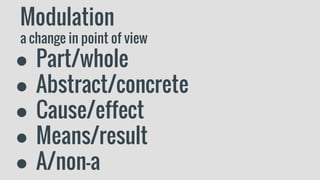
Modulation:
move up and down
the semantic category
Modulation
a change in point of view
● Part/whole
● Abstract/concrete
● Cause/effect
● Means/result
● A/non-a
Movefrom
one language type
to another
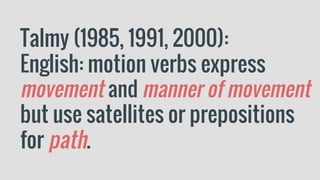
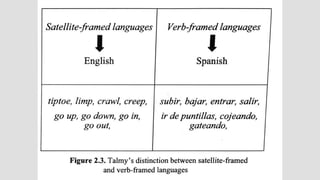
Talmy (1985, 1991, 2000):
English: motion verbs express
movement and manner of movement
but use satellites or prepositions
for path.
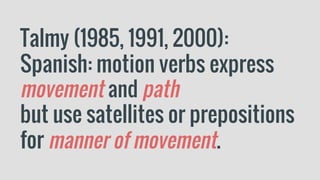
Talmy (1985, 1991, 2000):
Spanish: motion verbs express
movement and path
but use satellites or prepositions
for manner of movement.
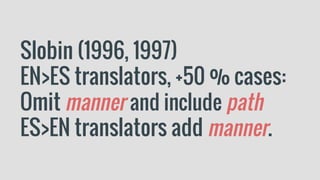
Slobin (1996, 1997)
EN>ES translators, +50 % cases:
Omit manner and include path
ES>EN translators add manner.
Language acts
Secondary meanings
Lesson 3:
MULTI-WORD
STRUCTURES
TRANSLATING PHRASEOLOGICAL UNITS
KNOCK, KNOCK
—Is this the translators’ club?
—Well, it depends.
-On the context?
-Come in!
Surrounding linguistic
environment restricts
the meaning of a term.
—Rojo, Step by Step
SPEAKERS FOLLOW
(PRE-ESTABLISHED)
PATTERNS
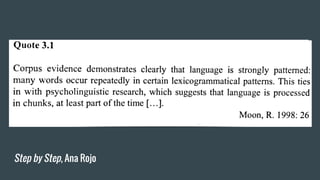
Step by Step, Ana Rojo
SPEAKING IN SILVER
FROM LOST TO THE RIVER
“Lexical pattern”
Any group of words that
is relatively fixed.
Too general?
PHRASEOLOGICAL UNITS
● Fixedness (doesn’t change much)
● Idiomaticity (natural to native speakers)
PHRASEOLOGICAL UNITS
● Such as:
○ Collocations, idioms, proverbs,
formulaic expressions, clichés
How to classify them?
● Semantic? (meaning)
● Syntactic? (structure)
● Other?
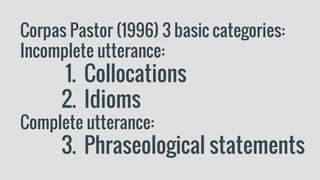
Corpas Pastor (1996) 3 basic categories:
Incomplete utterance:
1. Collocations
2. Idioms
Complete utterance:
3. Phraseological statements
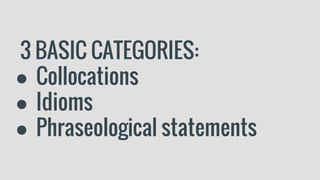
3 BASIC CATEGORIES:
● Collocations
● Idioms
● Phraseological statements
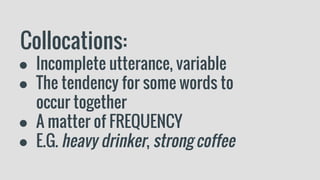
Collocations:
● Incomplete utterance, variable
● The tendency for some words to
occur together
● A matter of FREQUENCY
● E.G. heavy drinker, strong coffee
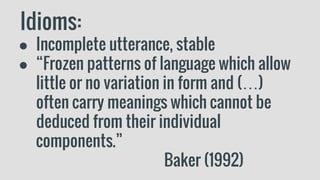
Idioms:
● Incomplete utterance, stable
● “Frozen patterns of language which allow
little or no variation in form and (…)
often carry meanings which cannot be
deduced from their individual
components.”
Baker (1992)
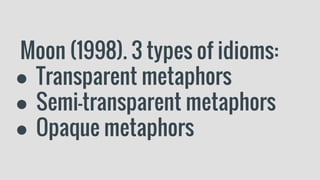
Moon (1998). 3 types of idioms:
● Transparent metaphors
● Semi-transparent metaphors
● Opaque metaphors
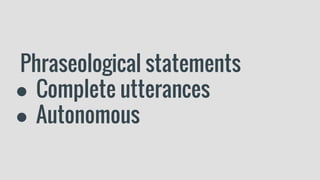
Phraseological statements
● Complete utterances
● Autonomous
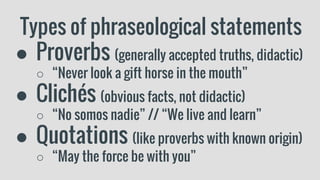
Types of phraseological statements
● Proverbs (generally accepted truths, didactic)
○ “Never look a gift horse in the mouth”
● Clichés (obvious facts, not didactic)
○ “No somos nadie” // “We live and learn”
● Quotations (like proverbs with known origin)
○ “May the force be with you”
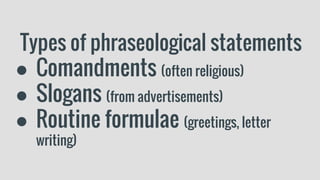
Types of phraseological statements
● Comandments (often religious)
● Slogans (from advertisements)
● Routine formulae (greetings, letter
writing)
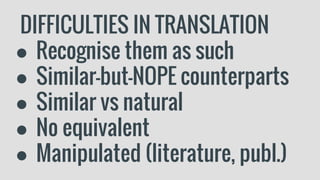
DIFFICULTIES IN TRANSLATION
● Recognise them as such
● Similar-but-NOPE counterparts
● Similar vs natural
● No equivalent
● Manipulated (literature, publ.)
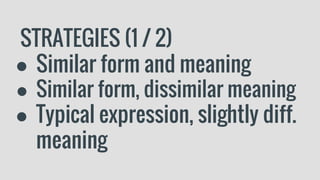
STRATEGIES (1 / 2)
● Similar form and meaning
● Similar form, dissimilar meaning
● Typical expression, slightly diff.
meaning
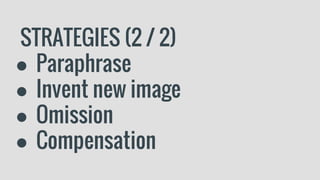
STRATEGIES (2 / 2)
● Paraphrase
● Invent new image
● Omission
● Compensation
Lesson 4:
ABOVE THE WORD
TRANSLATING
GRAMMAR
ORDER MATTERS
● Mi más vieja amiga
● Mi amiga más vieja
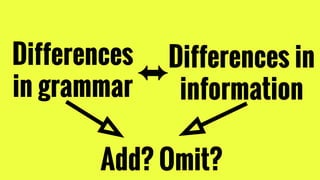
Differences
in grammar
⬌Differences in
information
Add? Omit?
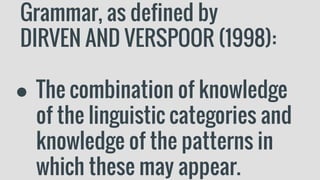
Grammar, as defined by
DIRVEN AND VERSPOOR (1998):
● The combination of knowledge
of the linguistic categories and
knowledge of the patterns in
which these may appear.
This includes:
● Lexicology
● Morphology
● Syntax
● Phonetics
● Phonology
But we will focus on:
● Syntax
● Morphology
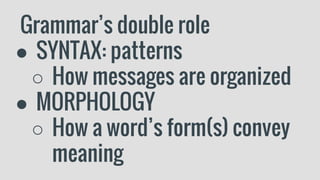
Grammar’s double role
● SYNTAX: patterns
○ How messages are organized
● MORPHOLOGY
○ How a word’s form(s) convey
meaning
Morphemes
● Inflectional
● Derivational
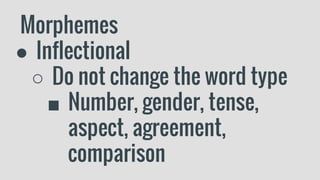
Morphemes
● Inflectional
○ Do not change the word type
■ Number, gender, tense,
aspect, agreement,
comparison
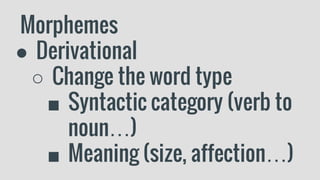
Morphemes
● Derivational
○ Change the word type
■ Syntactic category (verb to
noun…)
■ Meaning (size, affection…)
ALTMANN (1997):
[Saying] that we ignore meaning and we
ignore grammar is to say that we do the
linguistic equivalent of driving on the wrong
side of the road, through red, with no brakes!
Problems in translating
grammatical meaning
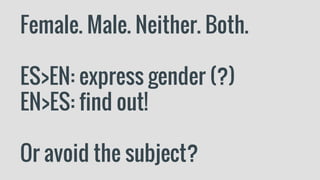
Gender
Female. Male. Neither. Both.
ES>EN: express gender (?)
EN>ES: find out!
Or avoid the subject?
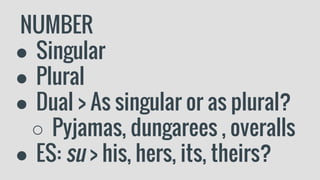
Number
NUMBER
● Singular
● Plural
● Dual > As singular or as plural?
○ Pyjamas, dungarees , overalls
● ES: su > his, hers, its, theirs?
Person
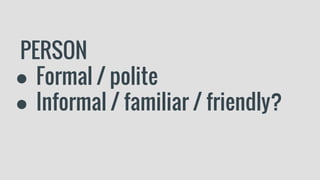
PERSON
● Formal / polite
● Informal / familiar / friendly?
Tense
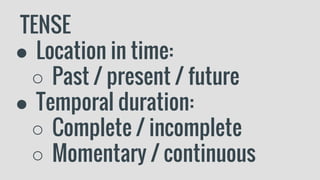
TENSE
● Location in time:
○ Past / present / future
● Temporal duration:
○ Complete / incomplete
○ Momentary / continuous
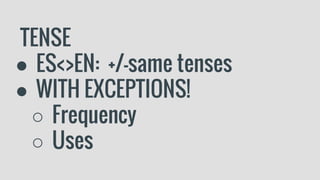
TENSE
● ES<>EN: +/-same tenses
● WITH EXCEPTIONS!
○ Frequency
○ Uses
SPANISH USES
WAY LESS
THE PASSIVE TENSE!
Voice
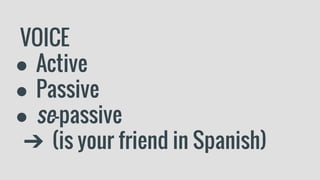
VOICE
● Active
● Passive
● se-passive
➔ (is your friend in Spanish)
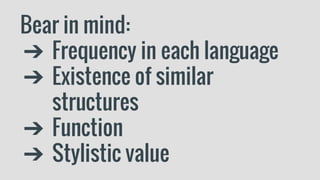
Bear in mind:
➔ Frequency in each language
➔ Existence of similar
structures
➔ Function
➔ Stylistic value
Morphemes
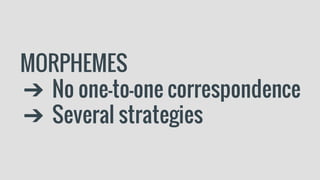
MORPHEMES
➔ No one-to-one correspondence
➔ Several strategies
WATCH OUT FOR
➔ Diminutives
➔ Augmentatives
➔ Pejoratives
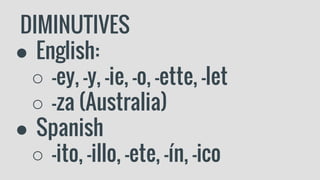
DIMINUTIVES
● English:
○ -ey, -y, -ie, -o, -ette, -let
○ -za (Australia)
● Spanish
○ -ito, -illo, -ete, -ín, -ico
But!
Diminutives in Spanish
have many more uses.
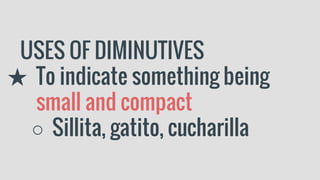
USES OF DIMINUTIVES
★ To indicate something being
small and compact
○ Sillita, gatito, cucharilla
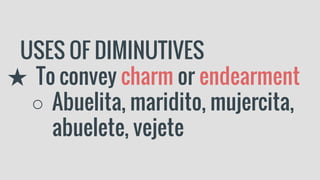
USES OF DIMINUTIVES
★ To convey charm or endearment
○ Abuelita, maridito, mujercita,
abuelete, vejete
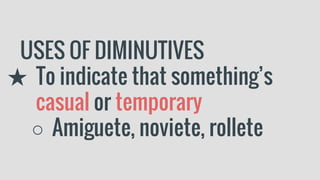
USES OF DIMINUTIVES
★ To indicate that something’s
casual or temporary
○ Amiguete, noviete, rollete
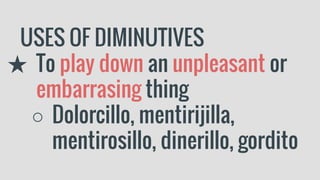
USES OF DIMINUTIVES
★ To play down an unpleasant or
embarrasing thing
○ Dolorcillo, mentirijilla,
mentirosillo, dinerillo, gordito
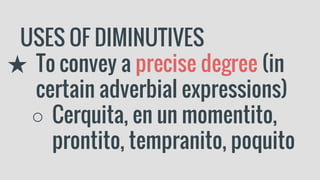
USES OF DIMINUTIVES
★ To convey a precise degree (in
certain adverbial expressions)
○ Cerquita, en un momentito,
prontito, tempranito, poquito
USES OF DIMINUTIVES
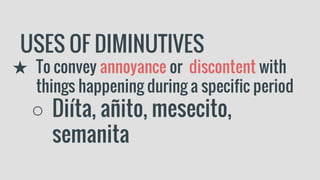
★ To convey annoyance or discontent with
things happening during a specific period
○ Diíta, añito, mesecito,
semanita
USES OF DIMINUTIVES
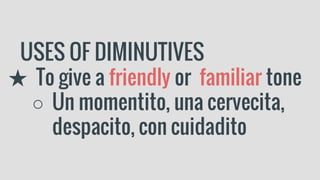
★ To give a friendly or familiar tone
○ Un momentito, una cervecita,
despacito, con cuidadito
USES OF DIMINUTIVES
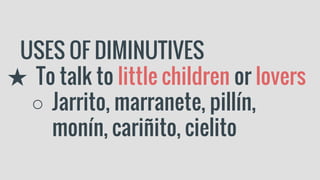
★ To talk to little children or lovers
○ Jarrito, marranete, pillín,
monín, cariñito, cielito
USES OF DIMINUTIVES
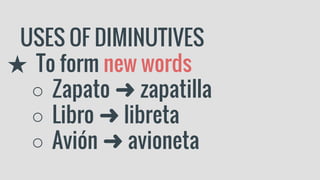
★ To form new words
○ Zapato ➜ zapatilla
○ Libro ➜ libreta
○ Avión ➜ avioneta
USES OF AUGMENTATIVES
★ To express intensity
○ Negative
○ Positive
○ Or depending on context!
USES OF AUGMENTATIVES
★ Disdain, displeasure
○ Solterón, solterona, cabezón,
cabezota, bocazas, manazas,
ricacho, ricachón, pasote
USES OF AUGMENTATIVES
★ Approval, satisfaction
○ Cochazo, pisazo, casaza,
motazo, padrazo, madraza,
pasote, golazo, puntazo,
pintaza
USES OF AUGMENTATIVES
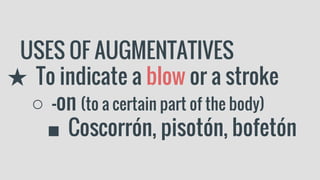
★ To indicate a blow or a stroke
○ -azo
■ Hachazo, martillazo,
puñetazo, cabezazo, codazo,
sartenazo, plumazo
USES OF AUGMENTATIVES
★ To indicate a blow or a stroke
○ -on (to a certain part of the body)
■ Coscorrón, pisotón, bofetón
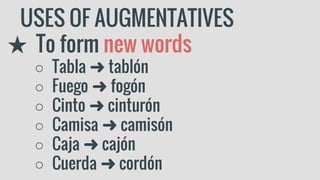
USES OF AUGMENTATIVES
★ To form new words
○ Tabla ➜ tablón
○ Fuego ➜ fogón
○ Cinto ➜ cinturón
○ Camisa ➜ camisón
○ Caja ➜ cajón
○ Cuerda ➜ cordón
USES OF PEJORATIVES
★ Pejoratives indicate contempt,
objection, disapproval.
★ Spanish has pejorative
morphology. English doesn’t.
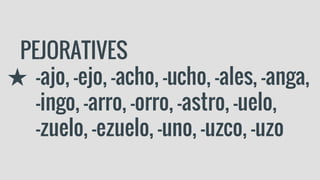
PEJORATIVES
★ -ajo, -ejo, -acho, -ucho, -ales, -anga,
-ingo, -arro, -orro, -astro, -uelo,
-zuelo, -ezuelo, -uno, -uzco, -uzo
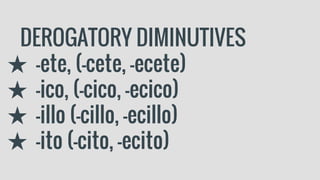
DEROGATORY DIMINUTIVES
★ -ete, (-cete, -ecete)
★ -ico, (-cico, -ecico)
★ -illo (-cillo, -ecillo)
★ -ito (-cito, -ecito)
DEROGATORY AUGMENTATIVES
★ -aco
★ -ote (-zote, -ezote)
★ -ón (-zón, ezón)
USES OF AUGMENTATIVES
★ To indicate resemblance to negative
qualities or mischievous behaviour
○ Caballuno, lobuno, pequeñajo,
chiquitajo, renacuajo,
animalejo, diablejo.
USES OF AUGMENTATIVES
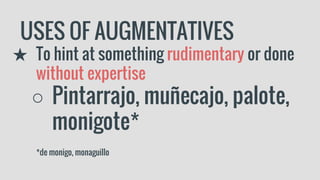
★ To hint at something rudimentary or done
without expertise
○ Pintarrajo, muñecajo, palote,
monigote*
*de monigo, monaguillo
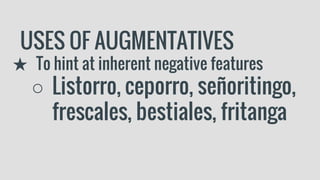
USES OF AUGMENTATIVES
★ To hint at inherent negative features
○ Listorro, ceporro, señoritingo,
frescales, bestiales, fritanga
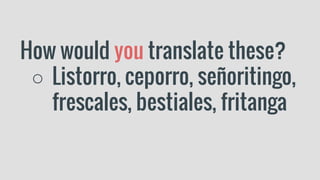
How would you translate these?
○ Listorro, ceporro, señoritingo,
frescales, bestiales, fritanga
USES OF AUGMENTATIVES
★ To mock somebody, without
extra meanings
○ Perico, Pericales
USES OF AUGMENTATIVES
★ To complain about certain
behaviour
○ Acusica, quejica, llorica
USES OF AUGMENTATIVES
★ To hint at the appalling
condition of something (poor,
old, ugly, doesn’t work…)
○ Poblacho, casucha, cacharro
USES OF AUGMENTATIVES
★ To suggest that something has the quality
described, only to a certain degree:
○ Feúcho, malucho, blancuzco,
negruzco, borrachuzo,
borrachuelo, marranuzo
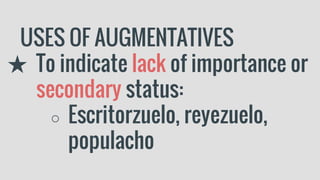
USES OF AUGMENTATIVES
★ To indicate lack of importance or
secondary status:
○ Escritorzuelo, reyezuelo,
populacho
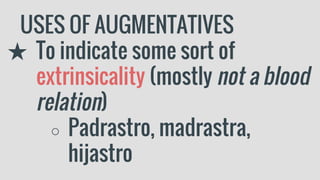
USES OF AUGMENTATIVES
★ To indicate some sort of
extrinsicality (mostly not a blood
relation)
○ Padrastro, madrastra,
hijastro
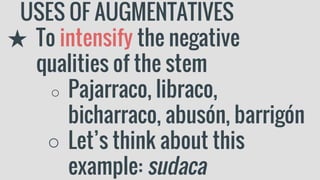
USES OF AUGMENTATIVES
★ To intensify the negative
qualities of the stem
○ Pajarraco, libraco,
bicharraco, abusón, barrigón
○ Let’s think about this
example: sudaca
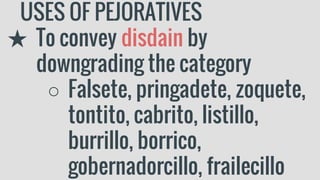
USES OF PEJORATIVES
★ To convey disdain by
downgrading the category
○ Falsete, pringadete, zoquete,
tontito, cabrito, listillo,
burrillo, borrico,
gobernadorcillo, frailecillo
Compounds
COMPOUNDS
➔ Unpredictable
➔ Break up and build again
◆ In general, use common
sense!
Others?!
● SHAPE (YANA, NAVAHO)
○ Long
○ Round
○ Sheet-like
● AMUESHA (Perú)
○ Dead
○ Alive
Lesson 5:
BEYOND THE SENTENCE,
EXPLORING THE NOTION OF
CONTEXT
How do readers
establish
context?
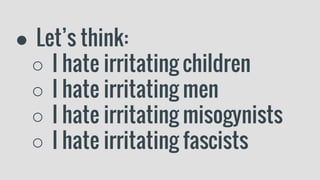
● Let’s think:
○ I hate irritating children
○ I hate irritating men
○ I hate irritating misogynists
○ I hate irritating fascists
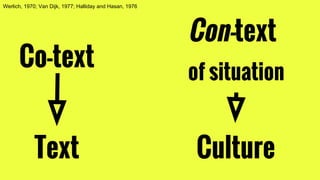
Co-text
Con-text
of situation
Text Culture
Werlich, 1970; Van Dijk, 1977; Halliday and Hasan, 1976
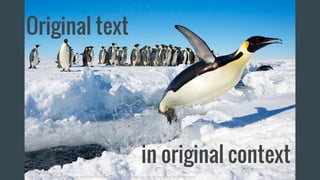
Original text
in original context
Pic: Wikimedia Commons
https://commons.wikimedia.org/wiki/File:Penguin_in_Antarctica_jumping_out_of_the_water.jpg#metadata
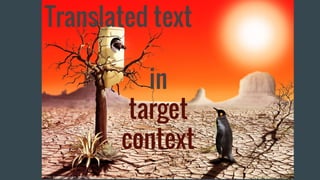
Translated text
in
target
context
Pic: Andreas Lucke, bildlich.org
● Context
○ Cohesion
○ Coherence
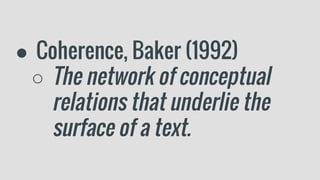
● Coherence, Baker (1992)
○ The network of conceptual
relations that underlie the
surface of a text.
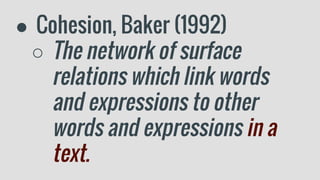
● Cohesion, Baker (1992)
○ The network of surface
relations which link words
and expressions to other
words and expressions in a
text.
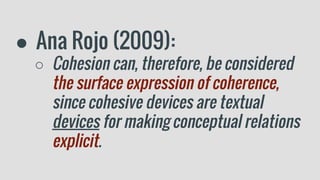
● Ana Rojo (2009):
○ Cohesion can, therefore, be considered
the surface expression of coherence,
since cohesive devices are textual
devices for making conceptual relations
explicit.
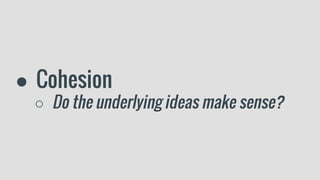
● Cohesion
○ Do the underlying ideas make sense?
● Coherence
○ How meaning is structured
○ Beyond texts / languages
● Cohesive devices in translation:
○ Grammatical differences
○ Lack of stylistic naturalness
● Cohesion
■ Reference
■ Ellipsis
■ Lexical cohesion
■ Conjunction
Reference, (Rojo, 2009):
● The connection of one
linguistic expression to
another, in which one provides
the information needed to
interpret the other correctly.
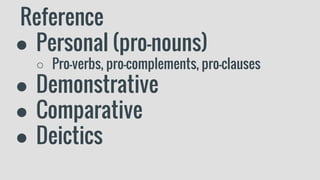
Reference
● Personal (pro-nouns)
○ Pro-verbs, pro-complements, pro-clauses
● Demonstrative
● Comparative
● Deictics
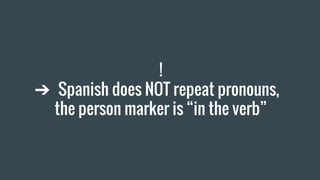
!
➔ Spanish does NOT repeat pronouns,
the person marker is “in the verb”
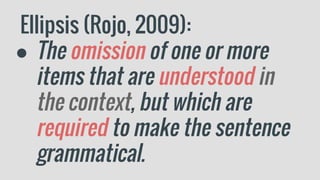
Ellipsis (Rojo, 2009):
● The omission of one or more
items that are understood in
the context, but which are
required to make the sentence
grammatical.
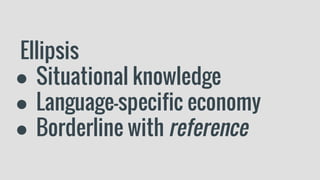
Ellipsis
● Situational knowledge
● Language-specific economy
● Borderline with reference
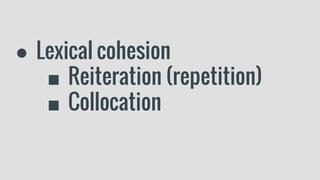
● Lexical cohesion
■ Reiteration (repetition)
■ Collocation
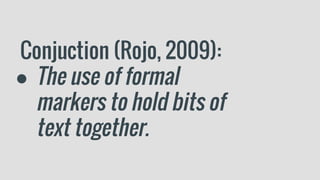
Conjuction (Rojo, 2009):
● The use of formal
markers to hold bits of
text together.
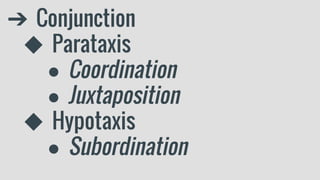
➔ Conjunction
◆ Parataxis
● Coordination
● Juxtaposition
◆ Hypotaxis
● Subordination
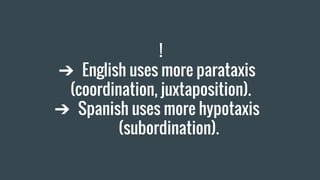
!
➔ English uses more parataxis
(coordination, juxtaposition).
➔ Spanish uses more hypotaxis
(subordination).
The car and I crawled cursing up the street to
my flat. You just cannot park around here
anymore. Even on a Sunday afternoon, you
just cannot park around here anymore. You
can doublepark on people: people can double
park on you.
[Amis, Money, 1982, cited by Rojo, 2009]
Mi coche y yo íbamos a paso de tortuga camino a casa,
cagándonos en todo. Es que aquí ya no se puede
aparcar. Es que ni siquiera en domingo por la noche se
puede aparcar.
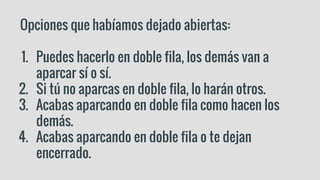
Opciones que habíamos dejado abiertas:
1. Puedes hacerlo en doble fila, los demás van a
aparcar sí o sí.
2. Si tú no aparcas en doble fila, lo harán otros.
3. Acabas aparcando en doble fila como hacen los
demás.
4. Acabas aparcando en doble fila o te dejan
encerrado.
Coherence, Baker (1992) (again)
The network of conceptual
relations that underlie the
surface of a text.
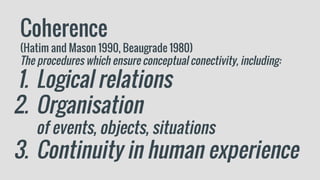
Coherence
(Hatim and Mason 1990, Beaugrade 1980)
The procedures which ensure conceptual conectivity, including:
1. Logical relations
2. Organisation
of events, objects, situations
3. Continuity in human experience
Coherence
(…) depends on the interaction between
textual knowledge and
the reader’s own knowledge and
experience of reality.
(Rojo, 2009)
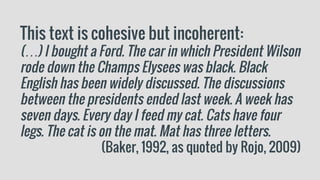
This text is cohesive but incoherent:
(…) I bought a Ford. The car in which President Wilson
rode down the Champs Elysees was black. Black
English has been widely discussed. The discussions
between the presidents ended last week. A week has
seven days. Every day I feed my cat. Cats have four
legs. The cat is on the mat. Mat has three letters.
(Baker, 1992, as quoted by Rojo, 2009)
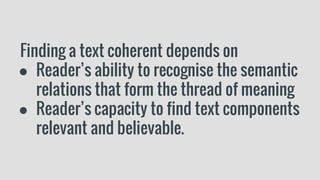
Finding a text coherent depends on
● Reader’s ability to recognise the semantic
relations that form the thread of meaning
● Reader’s capacity to find text components
relevant and believable.
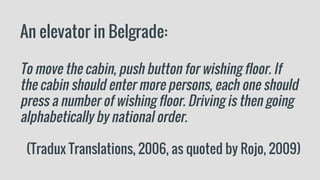
An elevator in Belgrade:
To move the cabin, push button for wishing floor. If
the cabin should enter more persons, each one should
press a number of wishing floor. Driving is then going
alphabetically by national order.
(Tradux Translations, 2006, as quoted by Rojo, 2009)
!
➔ This makes no sense!
?
➔ Why do we understand it?
Frame:
An internalised chunk of knowledge
Rojo, 2009
Frame:
A mental model of reality that helps
us understand the world around us.
Rojo, 2009
Frame:
We have stored an inventory of
these mental models and we use
them to interpret reality.
Rojo, 2009
Interesting, on mental models:
https://joshkaufman.net/mental-models/
The Personal MBA
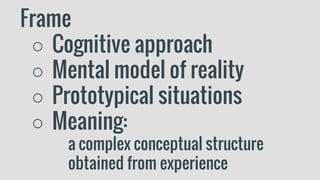
Frame
○ Cognitive approach
○ Mental model of reality
○ Prototypical situations
○ Meaning:
a complex conceptual structure
obtained from experience
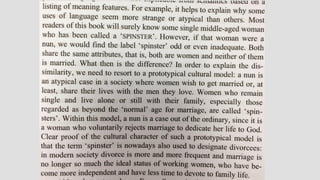
Example of a toxic model,
right here in this chapter
of the book.
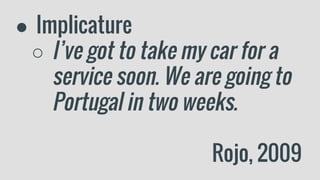
● Implicature
○ I’ve got to take my car for a
service soon. We are going to
Portugal in two weeks.
Rojo, 2009
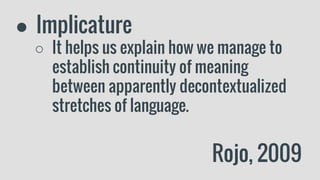
● Implicature
○ It helps us explain how we manage to
establish continuity of meaning
between apparently decontextualized
stretches of language.
Rojo, 2009
Grice (1975):
“We assume that conversation is governed
by a Cooperative Principle”
● Quantity
● Quality
● Relevance
● Manner
Grice (1975)
Cooperative Principle:
● Quantity
○ One should provide just as
much information as required
Grice (1975)
Cooperative Principle:
● Quality
○ One should only say what one
believes is true.
Grice (1975)
Cooperative Principle:
● Relevance
○ What one says must be
relevant to the current
exchange.
Grice (1975)
Cooperative Principle:
● Manner
○ Speakers must be clear, brief,
and orderly.
+Others add one extra:
● Politeness
○ One should always be
courteous and considerate.
If these principles are
right, we will look for that
kind of connections first.
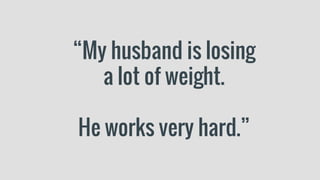
“My husband is losing
a lot of weight.
He works very hard.”
● Implicature
○ Apparently fragmented
language?
○ Metaphor / metonimy
■ My girlfriend is a doll
■ Estoy agotada. Mi hijo es un
auténtico bicho.
“Cognitive metonimy” as
the basis of
pragmatic inference…
… we will skip this part.
Exploiting
the context of situation
We store concepts
together with their
prototypical contexts.
● Situational information
○ Speaker’s geographical,
social, temporal origin
○ Natives choose their register
● Cultural / situational-related
information
○ How much to explain?
○ How much to leave implicit?
■ See: Chip Kidd at TED:
■ https://www.ted.com/talks/chip_kidd_designing_books_is_no_laughing_matter_ok_it
_is
That’s all,* folks!
*For the time being: there’s one
summary/round-up chapter that I’d like
to add at some point.
Remember, this is a
visual teaching aid for
the textbook:
Rojo López, Ana María. Step by Step: A Course in
Contrastive Linguistics and Translation. Oxford:
Peter Lang, 2009. Print. ISBN: 978-3039111336
You can buy it here: http://amzn.to/2ibIXIq
This presentation is a work in progress!
Send your feedback to:
bego(a)minibego.com

A translation course: how does translation (even) exist?