Some Relationships between Lexical
Items
CHAPTER 7
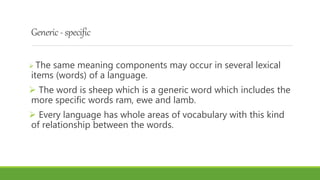
Generic-specific
 The same meaning components may occur in several lexical
items (words) of a language.
 The word is sheep which is a generic word which includes the
more specific words ram, ewe and lamb.
 Every language has whole areas of vocabulary with this kind
of relationship between the words.
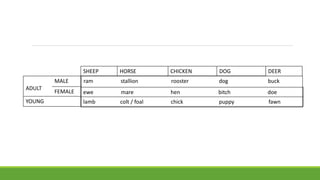
ADULT
MALE
FEMALE
YOUNG
SHEEP HORSE CHICKEN DOG DEER
ram stallion rooster dog buck
ewe mare hen bitch doe
lamb colt / foal chick puppy fawn
 Words have various relationships to other words of that
language.
 The relationship of one word as being more GENERIC and
another as being a SPECIFIC of that GENERIC word is common
to all languages.
 The concept of SPECIFIC – GENERIC can be very helpful in
analysing the vocabulary of both the source language and the
receptor language.
 This GENERIC TERM is a class word, the meaning of which is
also found in two or more different words which are more
SPECIFIC.
 A translator needs to know about the GENERIC and SPECIFIC
relationships of words because this may help him find a good lexical
equivalent.
 A translator will have difficulty in translating a source language word
which represents a concept which is unfamiliar to the receptor
language speakers.
 Notice that languages tend to differ most in GENERIC terminology,
rather than in SPECIFIC.
 The translation of abstract or more GENERIC TERMS is often very
complex, especially if the cultural contexts of the two languages are
very different.
SUBSTITUTEWORDS
 The GENERIC WORDS have been so far are indefinite, they
are referring to a GENERIC CLASS and do not specify a
particular THING or EVENT.
 We will distinguish between these two usages by calling the
latter SUBSTITUTE WORDS and the former GENERIC WORDS.
“ MY OLD PLYMOUTH BROKE DOWN AGAIN. IT HAS BEEN A
GOOD CAR. BUT IT IS TIME TO GET RID OF THE OLD THING.”
 In this example, PLYMOUTH has been referred to by it, car
and thing. These are all SUBSTITUTE WORDS for the
antecedent PLYMOUTH.
 A SUBSTITUTE WORD refer to something already introduced
to the text.
 Sometimes the SUBSTITUTE WORD will be more GENERIC
WORD.
 These are SUBSTITUTE WORD referring to the same THING,
but are not necessarily part of a GENERIC – SPECIFIC hierarchy.
 It is very important to know how SUBSTITUTE WORD are used
in the receptor language in order to translate naturally.
SYNONYMS
 There are words which are very similar in meaning but there
are few exact synonyms.
 Even words which are very similar in meaning will probably
not have exactly the same usage in sentence and paragraph
structures.
 Sometimes the receptor language may have more words to
choose from than the source language.
 A second language may not have a specific word for each of
the synonyms of the source language.
Examples:
Police officer, policeman and cop all refer to the same thing, but
cop is much less formal than police officer.
The words fat, plump and chubby all have a common meaning and
one word may be appropriate in one situation and the other
appropriate in a different situation.
There are only certain contexts in which they are interchangeable.
Yell, shriek and scream are also synonymous but with a slightly
different usage.
ANTONYMS
 A word that is exact opposite or contrasts in some particular part
of its meaning.
 All languages have pairs of words which are antonyms, but
different languages will have different sets.
 It can sometimes be very helpful to a translator who is looking for
a particular word to realize that if he thinks about the antonym, the
word opposite in meaning, he may be able to find the desired word
by constructing negative form of that antonym.
EXAMPLES:
 Others will simply have a word for free while the meaning for “slave” will
be not-free
 Much and little, many and few, open and shut etc. Some languages have
a word for only once of the pair and the other is a negative.
 In Aguaruna, the most complimentary way to say you are beautiful is to
say you are not ugly and not many is a more emphatic way to say few
than the word few.
RECIPROCALWORDS
 Most languages will also have sets of words which are the
reciprocal of one another.
 This may be very helpful sometimes in translating where the
receptor language does not have a specific word used in the same
way as the source language.
 It may be that the same meaning can be communicated by using a
reciprocal word.
EXAMPLES:
One can say “John gave Mary a book,” or one can say “Mary
received a book from John.” The meaning is the same since the two
actions are reciprocal actions.
 The government gave a large grant to the miners, might in some
translation need to be translated conversely, the miners received a
large grant from the government.

Some Relationships between Lexical Items

  • 1.
    Some Relationships betweenLexical Items CHAPTER 7
  • 2.
    Generic-specific  The samemeaning components may occur in several lexical items (words) of a language.  The word is sheep which is a generic word which includes the more specific words ram, ewe and lamb.  Every language has whole areas of vocabulary with this kind of relationship between the words.
  • 3.
    ADULT MALE FEMALE YOUNG SHEEP HORSE CHICKENDOG DEER ram stallion rooster dog buck ewe mare hen bitch doe lamb colt / foal chick puppy fawn
  • 4.
     Words havevarious relationships to other words of that language.  The relationship of one word as being more GENERIC and another as being a SPECIFIC of that GENERIC word is common to all languages.  The concept of SPECIFIC – GENERIC can be very helpful in analysing the vocabulary of both the source language and the receptor language.  This GENERIC TERM is a class word, the meaning of which is also found in two or more different words which are more SPECIFIC.
  • 5.
     A translatorneeds to know about the GENERIC and SPECIFIC relationships of words because this may help him find a good lexical equivalent.  A translator will have difficulty in translating a source language word which represents a concept which is unfamiliar to the receptor language speakers.  Notice that languages tend to differ most in GENERIC terminology, rather than in SPECIFIC.  The translation of abstract or more GENERIC TERMS is often very complex, especially if the cultural contexts of the two languages are very different.
  • 6.
    SUBSTITUTEWORDS  The GENERICWORDS have been so far are indefinite, they are referring to a GENERIC CLASS and do not specify a particular THING or EVENT.  We will distinguish between these two usages by calling the latter SUBSTITUTE WORDS and the former GENERIC WORDS. “ MY OLD PLYMOUTH BROKE DOWN AGAIN. IT HAS BEEN A GOOD CAR. BUT IT IS TIME TO GET RID OF THE OLD THING.”
  • 7.
     In thisexample, PLYMOUTH has been referred to by it, car and thing. These are all SUBSTITUTE WORDS for the antecedent PLYMOUTH.  A SUBSTITUTE WORD refer to something already introduced to the text.  Sometimes the SUBSTITUTE WORD will be more GENERIC WORD.  These are SUBSTITUTE WORD referring to the same THING, but are not necessarily part of a GENERIC – SPECIFIC hierarchy.  It is very important to know how SUBSTITUTE WORD are used in the receptor language in order to translate naturally.
  • 8.
    SYNONYMS  There arewords which are very similar in meaning but there are few exact synonyms.  Even words which are very similar in meaning will probably not have exactly the same usage in sentence and paragraph structures.  Sometimes the receptor language may have more words to choose from than the source language.  A second language may not have a specific word for each of the synonyms of the source language.
  • 9.
    Examples: Police officer, policemanand cop all refer to the same thing, but cop is much less formal than police officer. The words fat, plump and chubby all have a common meaning and one word may be appropriate in one situation and the other appropriate in a different situation. There are only certain contexts in which they are interchangeable. Yell, shriek and scream are also synonymous but with a slightly different usage.
  • 10.
    ANTONYMS  A wordthat is exact opposite or contrasts in some particular part of its meaning.  All languages have pairs of words which are antonyms, but different languages will have different sets.  It can sometimes be very helpful to a translator who is looking for a particular word to realize that if he thinks about the antonym, the word opposite in meaning, he may be able to find the desired word by constructing negative form of that antonym.
  • 11.
    EXAMPLES:  Others willsimply have a word for free while the meaning for “slave” will be not-free  Much and little, many and few, open and shut etc. Some languages have a word for only once of the pair and the other is a negative.  In Aguaruna, the most complimentary way to say you are beautiful is to say you are not ugly and not many is a more emphatic way to say few than the word few.
  • 12.
    RECIPROCALWORDS  Most languageswill also have sets of words which are the reciprocal of one another.  This may be very helpful sometimes in translating where the receptor language does not have a specific word used in the same way as the source language.  It may be that the same meaning can be communicated by using a reciprocal word.
  • 13.
    EXAMPLES: One can say“John gave Mary a book,” or one can say “Mary received a book from John.” The meaning is the same since the two actions are reciprocal actions.  The government gave a large grant to the miners, might in some translation need to be translated conversely, the miners received a large grant from the government.