NEW TECHNIQUES IN PLANT-BACTERIUM GENE MANIPULATION FOR
IMPROVING CROP PRODUCTIVITY
Presented by: Kirandip
Kaur
INTRODUCTION
 Genetictransformationisapowerfulbiotechnologyforintroducingnovelgenes
intoeconomicallyimportantplantsfromdistantly-relatedplantsoreven
unrelatedspeciesuchasmicrobesandanimals.
 Thisfeatisimpossibletobeachievedbyconventionalbreedingtechniques.
 Planttransformationtechniquesplayimportant roleingenetictransformation.
 Planttransformationwasfirstdescribedintobaccoin1984
 MethodsforintroducingdiversegenesintoplantcellsincludeAgrobacterium
tumefaciens-mediatedtransformationanddirectgenetransferintoprotoplasts
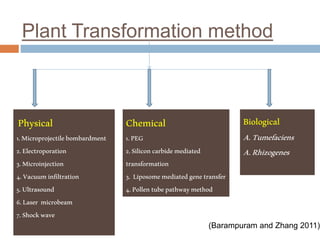
Plant Transformation method
Physical
1.Microprojectilebombardment
2.Electroporation
3.Microinjection
4.Vacuuminfiltration
5.Ultrasound
6.Laser microbeam
7.Shockwave
Chemical
1.PEG
2.Siliconcarbidemediated
transformation
3. Liposomemediatedgenetransfer
4.Pollentubepathwaymethod
Biological
A.Tumefaciens
A.Rhizogenes
(Barampuram and Zhang 2011)
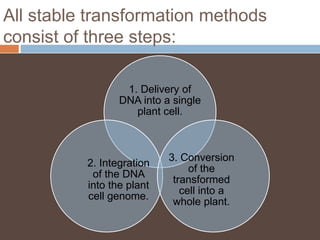
All stable transformation methods
consist of three steps:
1. Delivery of
DNA into a single
plant cell.
2. Integration
of the DNA
into the plant
cell genome.
3. Conversion
of the
transformed
cell into a
whole plant.
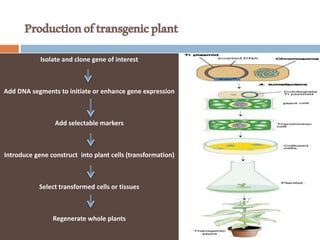
Productionoftransgenicplant
Isolate and clone gene of interest
Add DNA segments to initiate or enhance gene expression
Add selectable markers
Introduce gene construct into plant cells (transformation)
Select transformed cells or tissues
Regenerate whole plants
Planttransformationbybiologicalmethod
 TheglobalareagrownbyGMcropshasseena100-foldincreasesince1996whenonly
1.7millionhaweregrowntoGMcropsto175.2millionhain2013(James2013).
 Agrobacteriuminfectionfollowedbyinvitroplantregenerationremainsthemost
efficienttransformationtechniquewithsomeadvantagesincludingitssimplicity,low
cost,lessgenesilence/cosuppressioneffect,andintegrationoffewercopiesofatarget
gene(Ziemienowicz2014).
 Bythismethod,hightransformationefficiencieshavebeenobtainedinthemaincrops,
forexamples,90%inrice(Ozawa2012),57.1%inmaize(Choetal.2014),45.0%inwheat
(Richardsonetal.2014),25.0%inbarley(Martheetal.2015),11.7%insoybean(Liuetal.
2008),and9.7%incotton(Chenetal.2014).
Planttransformationbybiologicalmethod
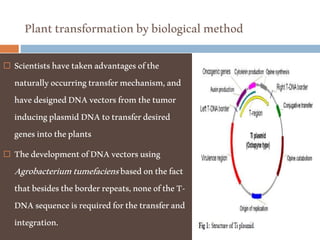
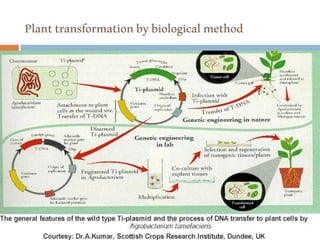
 Scientistshavetakenadvantagesofthe
naturallyoccurringtransfermechanism,and
havedesignedDNAvectorsfromthetumor
inducingplasmidDNAtotransferdesired
genesintotheplants
 ThedevelopmentofDNAvectorsusing
Agrobacteriumtumefaciensbasedonthefact
thatbesidestheborderrepeats,noneoftheT-
DNAsequenceisrequiredforthetransferand
integration.
Planttransformationbybiologicalmethod
 T-DNAgenescanbereplacedbyanyotherDNAofinterest,whichwillbetransformed
intotheplantgenome.
 IthasalsobeenfoundthatT-DNAandvirgenesdonothavetobeinthesameplasmidfor
transferofT-DNA
 ThisachievementalloweddevelopmentofabinaryvectorsystemtotransferforeignDNA
intoplants.
 Twoplasmidsareusedinbinarymethod,i.e.,theTiplasmidcontainingthevirgenes
which oncogeneseliminated,asocalled‘disharmed’plasmidor‘virhelper’,anda
geneticallyengineeredT-DNAplasmidcontainingthedesiredgenes.
Planttransformationbybiologicalmethod
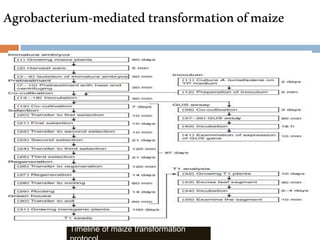
Timeline of maize transformation
Agrobacterium-mediatedtransformationofmaize
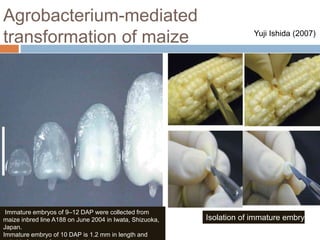
Agrobacterium-mediated
transformation of maize
Isolation of immature embryo.
Immature embryos of 9–12 DAP were collected from
maize inbred line A188 on June 2004 in Iwata, Shizuoka,
Japan.
Immature embryo of 10 DAP is 1.2 mm in length and
Yuji Ishida (2007)
Planttransformationbybiologicalmethod
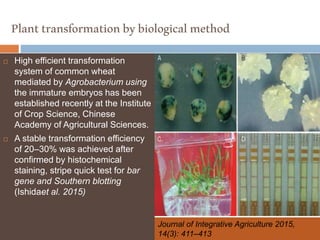
 High efficient transformation
system of common wheat
mediated by Agrobacterium using
the immature embryos has been
established recently at the Institute
of Crop Science, Chinese
Academy of Agricultural Sciences.
 A stable transformation efficiency
of 20–30% was achieved after
confirmed by histochemical
staining, stripe quick test for bar
gene and Southern blotting
(Ishidaet al. 2015)
Journal of Integrative Agriculture 2015,
14(3): 411–413
1. Gene transfer by microprojectile
bombardment
 ThecoceptoftransferingDNA-coatedparticlesdirectlyintocellswasfirst
conceivedbySanfordandco-workersin1984.
 Thefirstresultsusingagunpowder-drivendevicetodelivertungsten
microprojectilescoatedwithviralRNAintoonionepidermalcells.
 Inthesameyear,microprojectile-mediateddeliveryofplasmidDNAresultedin
theintroductionofaforeigngene,alsoinonioncells.
 Thismethodisroutineandreliablewayofproducingtransgenicplants.
Gene transfer by microprojectile
bombardment
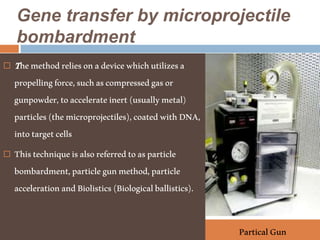
 Themethodreliesonadevicewhichutilizesa
propellingforce,suchascompressedgasor
gunpowder,toaccelerateinert(usuallymetal)
particles(themicroprojectiles),coatedwithDNA,
intotargetcells
 Thistechniqueisalsoreferredtoasparticle
bombardment,particlegunmethod,particle
accelerationandBiolistics(Biologicalballistics).
ParticalGun
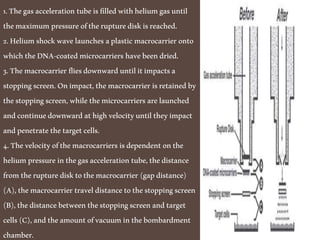
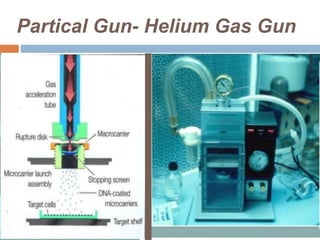
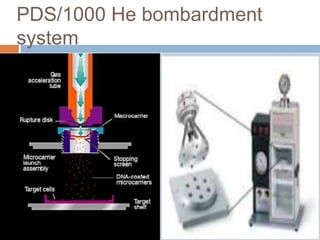
1.Thegasaccelerationtubeisfilledwithheliumgasuntil
themaximumpressureoftherupturediskisreached.
2.Heliumshockwavelaunchesaplasticmacrocarrier onto
whichtheDNA-coatedmicrocarriers havebeendried.
3.Themacrocarrier fliesdownwarduntilitimpactsa
stoppingscreen.Onimpact,themacrocarrier isretainedby
thestoppingscreen,whilethemicrocarriersarelaunched
andcontinuedownwardathighvelocityuntiltheyimpact
andpenetratethetargetcells.
4.Thevelocityofthemacrocarriers isdependentonthe
heliumpressureinthegasaccelerationtube,thedistance
fromtherupturedisktothemacrocarrier (gapdistance)
(A),themacrocarrier traveldistancetothestoppingscreen
(B),thedistancebetweenthestoppingscreenandtarget
cells(C),andtheamountofvacuuminthebombardment
chamber.
Partical Gun- Helium Gas Gun
PDS/1000 He bombardment
system
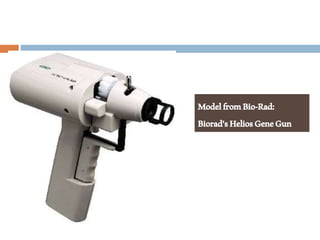
ModelfromBio-Rad:
Biorad'sHeliosGeneGun
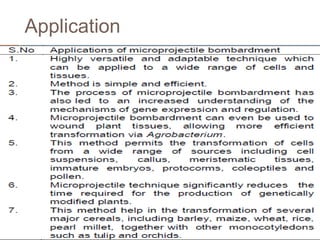
Application
2. Electroporation of protoplast
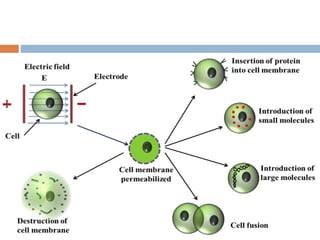
 Electroporationisbasedontheapplicationofastrongelectricalfieldtoenhance
theformationofporesonthecellmembraneduetoapolarityalteration,caused
bytheelectricalfield
 Thatinducesadipolarmomentinsidethecells,andapotentialdifference
throughtheplasmaticmembrane.
 Ifthecellisexposedtoahighfrequencyfield,itscellularmembranesuffersa
shortcircuitanditsdipolarmomentgrowsandrotatestowardsthedirectionof
thefield,producingacellularstretchingalongthisdirection,leadingtoa
temporalpermeabilizationofthemembrane.
Electroporation of protoplast
 Transformationfrequencystronglyeffectedbyseveralphysicalfactorssuchas
pulselength
typeanddurationof theelectricalfield,
transmembranepotentialcreated,
extentofmembranepermeation,
durationofthepermeatedstate
modeanddurationofmolecularflow
globalandlocal(surface)concentrationsofDNA,
formofDNA,toleranceofcellstomembranepermeation
andtheheterogeneityofthecellpopulation
Electroporation of protoplast
 AveryinterestingmethodbasedonelectroporationisNucleofection™,
developedin1998andintroducedtotheresearchmarketin2001
 Ithasbeensuccessfulincancerstudiesandtissueengineering.Nucleofection™is
apatentedcommercialelectroporationsystemdevelopedbyAmaxa,andowned
byLonza.
 Thevoltage,frequency,andpulsedurationforeachcelltypearenotdisclosedto
theuser.
 Themethodologypermitstotransfectmanydifficult-to-transfectprimarycells,
celllines,andstemcells.
 Itwouldbeinterestingtoapplythismethodtoplantandfungalcells.
3.Gene transfer through
microinjection
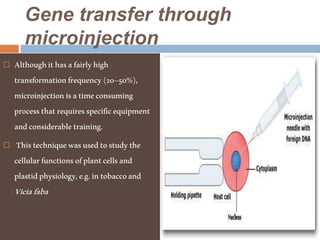
 TransformationthroughmicroinjectionisbasedonintroducingDNAintothecytoplasm
ornucleusbyusingaglassmicrocapillary-injectionpipette
 Thisoperationrequiresamicromanipulator.
 DuringtheintroductionofDNAintothenucleus,cellsareimmobilizedwithaholding
pipetteandgentlesuction.
 Microinjectionismainlyusedforthetransformationoflargeanimalcells.
 Itsimportanceforplanttransformationisratherlimitedduetothecharacteristicsof
plantcellwalls,whichcontainathicklayerofligninandcellulose.
 Theplantcellwallisabarrierforglassmicrotools.Themethodallowedthe
incorporationnotonlyofDNAplasmidsbutalsoofwholechromosomesintoplantcells
Gene transfer through
microinjection
 Althoughithasafairlyhigh
transformationfrequency(20–50%),
microinjectionisatimeconsuming
processthatrequiresspecificequipment
andconsiderabletraining.
 Thistechniquewasusedtostudythe
cellularfunctionsofplantcellsand
plastidphysiology,e.g.intobaccoand
Viciafaba
4. Vacuum Infiltration
 AnotherwaytomediatetheincorporationofAgrobacteriumforgenetic
transformationistoapplyavacuumforacertaintimeperiod.
 Physically,vacuumgeneratesanegativeatmosphericpressurethatcausestheair
spacesbetweenthecellsinthemembranetodecreaseallowingthepenetrationof
Agrobacteriumintotheintercellspaces.
 Thelongerthedurationandthelowerthepressure,thelessairspacethereis
withintheplanttissue.Thetemperature,pHandtimeofinductionofvirulence
geneshaveadramaticeffectonthefrequencyoftransformation.
Vacuum Infiltration
 Ithastheadvantageofbeingafastprocedurewithalowsomaclonal variationbecausethere
isnotissuecultureinvolved.
 ItsmainlimitationisthatsomestrainsofAgrobacteriumareunabletoinfectcertaincell
types.
 VacuuminfiltrationinitiallywasusedfortransformingArabidopsisandapples.
ThefirstfungustransformedwasSaccharomyces cerevisiae.
Themethodhasbeenusedtoproduceaplant-derivedvaccineunderthecurrentGood
ManufacturePracticeregulationsforhumanclinicaltrials.
However,ithasnotbeenappliedfortransformationofbacteriaoranimalcellsduetothe
tumorouscharacteristicofAgrobacterium.
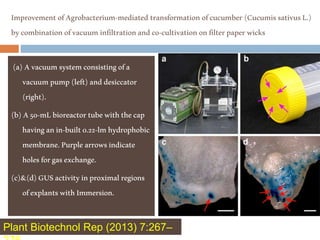
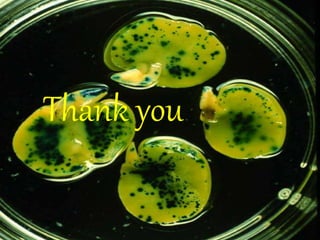
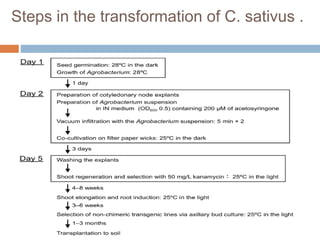
ImprovementofAgrobacterium-mediatedtransformationofcucumber(CucumissativusL.)
bycombinationofvacuuminfiltrationandco-cultivationonfilterpaperwicks
(a)Avacuumsystemconsistingofa
vacuumpump(left)anddesiccator
(right).
(b)A50-mLbioreactortubewiththecap
havinganin-built0.22-lmhydrophobic
membrane.Purplearrowsindicate
holesforgasexchange.
(c)&(d)GUSactivityinproximalregions
ofexplantswithImmersion.
Plant Biotechnol Rep (2013) 7:267–
Steps in the transformation of C. sativus .
P.K. Martins et al. / Biotechnology Reports 6 (2015) 61–
63
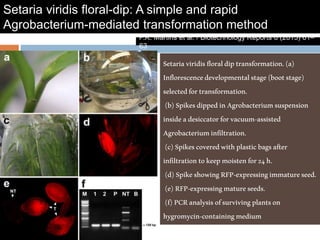
Setaria viridis floral-dip: A simple and rapid
Agrobacterium-mediated transformation method
Setariaviridisfloraldiptransformation.(a)
Inflorescencedevelopmentalstage(bootstage)
selectedfortransformation.
(b)SpikesdippedinAgrobacteriumsuspension
insideadesiccatorforvacuum-assisted
Agrobacteriuminfiltration.
(c)Spikescoveredwithplasticbagsafter
infiltrationtokeepmoistenfor24h.
(d)SpikeshowingRFP-expressingimmatureseed.
(e)RFP-expressingmatureseeds.
(f)PCRanalysisofsurvivingplantson
hygromycin-containingmedium
5. Laser microbeams
 Lasermicrobeamshavebeenusedtointroducegeneticmaterialsintocells
puncturingself-healingholesintothecellwall.
 Completemanipulationbylaserlightallowspreciseandgentletreatmentofcells,
subcellular structures,andevenindividualDNAmolecules;inparticularithas
beenusedinanimalcells.
 Itrequiresanadequatelasersystem(likenitrogenlasers,excimerpumpeddye
lasers,ortitanium-sapphirelasers)thatcanbeusedasopticaltweezers,coupled
totheappropriatemicroscope.
 Thisisanexpensiveandlaborioustechnique.
6. Ultrasound
 Ultrasonicwave-mediatedtransformation,alsoknownassonication,isbasedon
sonoporation(theruptureofcellularmembranesbyacousticwaves).
 Itisanon-invasivewaytointroduceDNAmoleculesintocellsviaacoustic
cavitationthattemporarilychangesthepermeabilityofthecellmembrane.
 Ultrasoundincreasesthetransfectionefficiencyofanimalcells,invitrotissues
andprotoplastswithspatialandtemporalspecificity.
 However,ithasbeenreportedthatultrasoundcandamagethecell,completely
breakingitsmembrane.
 Crucialparametersaretheintensity,exposuretime,centralfrequency,thetype
ofapplication(continuousorpulsed),thepulserepetitionfrequency,andthe
dutycycle.
7. Shock-waves
Shock waves are pressure pulses with a peak
positive pressure in the kof 30 to 150 MPa, lasting
between 0.5 and 3 μs, followed by a tensile pulse of
upto-20MPawithdurationof2to20μs.
They are produced by electrohydraulic,
electromagnetic or piezoelectric shock wave
generators.
Theexactmechanismresponsibleforshock
wave-assisted cell permeabilization is still not clear,
but there is evidence that it is due to shock wave-
inducedcavitation
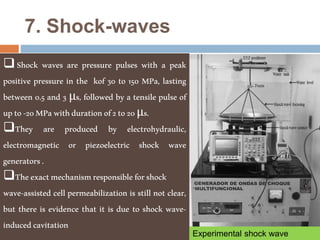
Experimental shock wave
Shock-waves
 Severalauthorshavepublishedarticlesonshock-wave-mediatedDNAdeliveryin
eukaryoticcellsandprokaryotes.
 Certainly,theapplicationofshockwavestotransformcellshasseveral
advantages.
 Transformationfrequencyishigherincomparisonwithotheravailablemethods,
andthemethodisfast,easytoperformandreproducible.
 Additionally,thesamefrequency,energy,voltageandnumberofshockwavescan
beusedtotransformdiversespeciesoffungi.
 Themaindrawbackfortheuseofshockwavesistheneedforrelativelyexpensive
equipment.
1. Gene transfer by polyethylene
glycol
 Thistechnologyisapplicableforprotoplastonly.
 Thechemicalusedispolyethyleneglycol.Itstimulatesendocytosisandthereby
causingtheuptakeofDNA.
 Inthismethodprotoplastarekeptinpolyethyleneglycol(PEG)solution.
 TheconcentrationofPEGusedis15%having8000daltonmolecularweight.
 AfterexposureofprotoplaststoexogenousDNAinpresenceofPEGandother
chemicals,PEGisremovedandintactprotoplastarethenculturedtoformcells
withwallsandcoloniesinturn.
Gene transfer by
polyethylene glycol
 Selectionpressureisthenappliedtogetthetransformants.
 Thetransferofgeneacrosstheprotoplastmembranecanbeinitiatedby
anumberofchemicalsofwhichpolyethyleneglycolisthemost
important.
 Ithasbecomethemostwidelyusedduetotheavailabilityofsimple
transformationprotocol.
 Methodwasdevelopedusingcalciumalginatemicrobeadsto
immobilizeDNAmoleculesincombinationwithpolyethyleneglycol
treatmentalso
2. Silicon carbide mediated
transformation
 Siliconcarbidemediatedmethodisalsooneofthetransformationmethodused
totransformplants.
 Thismethodisleastcomplicated.Inthistechniquefibresareusedwhichare
singlecrystalsofsilicaorganicmineralslikesiliconcarbidewhichpossessan
elongatedshape,havingadiameterof0.6mmandalengthof10–80mm
 Inthismethodsiliconcarbidefibers’areaddedtoasuspensioncontaining
plasmidDNAandplanttissue(immatureembryos,callus,cellcluster).
 Itisthenmixedincommercialshakersorinvortex.FibrescoatedwithDNA
penetratetheplantcellwallinthepresenceofsmallholesproducedatthetime
ofcollisionbetweenfibresandplantcells
Silicon carbide mediated
transformation
 Thisprocessiseasyandquick.Itisnotsoexpensiveandusefulforvariousplant
materials.
 Themaindrawbackofthistechniqueislowtransformationefficiency,damageto
cellsnegativelyinfluencingtheirfurtherregenerationcapability,andtheneedof
followingextraordinarilyrigorousprecautionprotocolsduringlaboratorywork.
 Asbreathingthefibersin,especiallyasbestosones,canleadtoserioussicknesses.
 Siliconcarbidewhisker-mediatedembryogeniccallustransformationofcotton
(GossypiumhirsutumL.)andregenerationofsalttolerantplantswerealso
reported
3. Liposome mediated gene
transfer
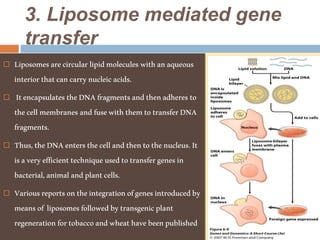
 Liposomesarecircularlipidmolecules withanaqueous
interiorthatcancarrynucleicacids.
 ItencapsulatestheDNAfragmentsandthenadheresto
thecellmembranes andfusewiththemtotransferDNA
fragments.
 Thus,theDNAentersthecellandthentothenucleus.It
isaveryefficienttechniqueusedtotransfergenesin
bacterial,animalandplantcells.
 Variousreportsontheintegrationofgenesintroducedby
meansof liposomesfollowedbytransgenicplant
regenerationfortobaccoandwheathavebeenpublished
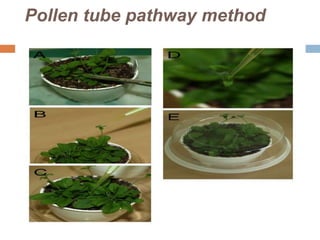
4. Pollen tube pathway method
 Thetransformationmethodviapollen-tube
pathwayhasgreatsignificanceinagriculture
molecularbreeding.
 Afterpollinationthestyleswerecut.TheDNA
wasthenapplied.
 TheDNAreachestheovulebyflowingdownthe
pollen-tube.
 Itwasappliedfirsttimeforthetransformation
ofrice[29].Herethetransgenicplantswere
obtainedatremarkablyhighfrequency.
 AfterwardPTPwasusedforotherspeciese.g.
wheat,soybean,Petuniahybridaand
watermelon.
Pollen tube pathway method
References:
K.H.Khan(2009)GeneTechnologiesinplants:Roleinimprovingcrop.RecentResearchin
ScienceandTechnology(3):116–123
Vermaetal(2014) Recentadvancesintheregenerationandgenetictransformationof
soybeanJournalofInnovativeBiology(1)15-26
P.K.Martinsetal(2015)Setariaviridisfloral-dip:AsimpleandrapidAgrobacterium-
mediatedtransformationmethodBiotechnologyReports(6)61–63
Rivera,etal(2014)GeneticSyndromes&GeneTherapy,JGenet SyndrGeneTher5:4
YEXing-guo(2015)DevelopmentandapplicationofplanttransformationtechniquesJournal
ofIntegrativeAgriculture(3):411–413
ZahidaQamar(2015)Anoverviewofgenetictransformationofglyphosateresistantgenein
ZeamaysNatureandScience2015;13(3)
Thank you

Transformation in plants

Editor's Notes

  • #4 Common methods for genetic transformation are usually divided into indirect or direct transformation [82]. Biological methods using bacteria are referred to as indirect, while direct methods are physical; that is, based on the penetration of the cellular wall. Even if indirect methods are still more popular for plant transformation than direct techniques, recently there has been an increase in the application of physical methods.