Complementary transactions
Prepared By
Manu Melwin Joy
Research Scholar
School of Management Studies
CUSAT, Kerala, India.
Phone – 9744551114
Mail – manu_melwinjoy@yahoo.com
Kindly restrict the use of slides for personal purpose.
Please seek permission to reproduce the same in public
forms and presentations.
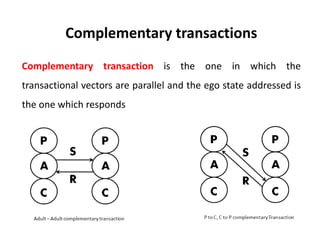
Complementary transactions
Complementary transaction is the one in which the
transactional vectors are parallel and the ego state addressed is
the one which responds
Complementary transactions
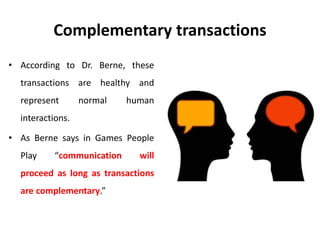
• According to Dr. Berne, these
transactions are healthy and
represent normal human
interactions.
• As Berne says in Games People
Play “communication will
proceed as long as transactions
are complementary.”
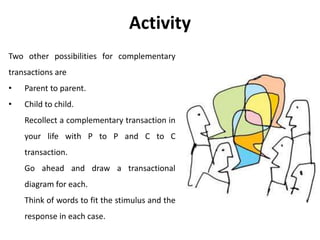
Two other possibilities for complementary
transactions are
• Parent to parent.
• Child to child.
Recollect a complementary transaction in
your life with P to P and C to C
transaction.
Go ahead and draw a transactional
diagram for each.
Think of words to fit the stimulus and the
response in each case.
Activity
0 0
CP
A A
S
R
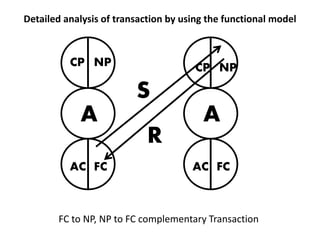
FC to NP, NP to FC complementary Transaction
NP
AC FC AC FC
CP NP
Detailed analysis of transaction by using the functional model
First rule of communication
As long as transactions remain complementary,
communication can continue indefinitely.
• Get into pairs and role
play each kind of
exchange (A to A, P to C, C
to P, FC to NP, NP to FC).
• See how long you can
keep going in a chain of
parallel transactions.
Activity
How to change one’s ego state?
There are three ways of changing ego states.
1. Behavioral way – imitate behaviors which have
been identified as parental, adult and childlike.
2. Phenomenological way – Separate your real self
from operating in the same ego states as your
executive self and to keep it in Adult as monitor for
what you are doing and then shift ego states in
your executive self, first to parent, then to child
and finally to adult.
3. Historical way – Use memories of childhood and
make comparisons with concrete situations you
had then which now seem to have some
connection and then imitate a parental figure or
yourself as a child, to be in the here and now.
• Think about a situation where
you have felt locked into a
familiar uncomfortable groove
of parallel transaction with
someone. Using the functional
model, locate the ego states
you and the other person have
been coming from.
• Now work out at least four
ways you could use you ego
state options to cross this flow
of transaction.
• From this list. Select on which is
safe.
Activity
Thank You
Other TA topics available on slideshare
1. Strokes - http://www.slideshare.net/manumjoy/strokes-24081607.
2. Games People Play - http://www.slideshare.net/manumjoy/psychological-
games-people-play.
3. Structural Analysis - http://www.slideshare.net/manumjoy/the-ego-state-model.
4. What is TA? - http://www.slideshare.net/manumjoy/what-ta-is
5. Cycles of Development - http://www.slideshare.net/manumjoy/cycles-of-
developement-pamela-levin-transactional-analysis.
6. Stages of Cure - http://www.slideshare.net/manumjoy/stages-of-cure.
7. Transactions - http://www.slideshare.net/manumjoy/transactions-33677298.
8. Time Structuring - http://www.slideshare.net/manumjoy/time-structuring.
9. Life Position - http://www.slideshare.net/manumjoy/life-position.
10. Autonomy - http://www.slideshare.net/manumjoy/autonomy-33690557.
11. Structural Pathology - http://www.slideshare.net/manumjoy/structural-pathology.
12. Game Analysis - http://www.slideshare.net/manumjoy/game-analysis-33725636.
13. Integrated Adult - http://www.slideshare.net/manumjoy/integrated-adult.
14. Stroke Economy - http://www.slideshare.net/manumjoy/stroke-economy-
33826702.

Complementary transactions

  • 1.
  • 2.
    Prepared By Manu MelwinJoy Research Scholar School of Management Studies CUSAT, Kerala, India. Phone – 9744551114 Mail – manu_melwinjoy@yahoo.com Kindly restrict the use of slides for personal purpose. Please seek permission to reproduce the same in public forms and presentations.
  • 3.
    Complementary transactions Complementary transactionis the one in which the transactional vectors are parallel and the ego state addressed is the one which responds
  • 4.
    Complementary transactions • Accordingto Dr. Berne, these transactions are healthy and represent normal human interactions. • As Berne says in Games People Play “communication will proceed as long as transactions are complementary.”
  • 5.
    Two other possibilitiesfor complementary transactions are • Parent to parent. • Child to child. Recollect a complementary transaction in your life with P to P and C to C transaction. Go ahead and draw a transactional diagram for each. Think of words to fit the stimulus and the response in each case. Activity
  • 6.
    0 0 CP A A S R FCto NP, NP to FC complementary Transaction NP AC FC AC FC CP NP Detailed analysis of transaction by using the functional model
  • 7.
    First rule ofcommunication As long as transactions remain complementary, communication can continue indefinitely.
  • 8.
    • Get intopairs and role play each kind of exchange (A to A, P to C, C to P, FC to NP, NP to FC). • See how long you can keep going in a chain of parallel transactions. Activity
  • 9.
    How to changeone’s ego state? There are three ways of changing ego states. 1. Behavioral way – imitate behaviors which have been identified as parental, adult and childlike. 2. Phenomenological way – Separate your real self from operating in the same ego states as your executive self and to keep it in Adult as monitor for what you are doing and then shift ego states in your executive self, first to parent, then to child and finally to adult. 3. Historical way – Use memories of childhood and make comparisons with concrete situations you had then which now seem to have some connection and then imitate a parental figure or yourself as a child, to be in the here and now.
  • 10.
    • Think abouta situation where you have felt locked into a familiar uncomfortable groove of parallel transaction with someone. Using the functional model, locate the ego states you and the other person have been coming from. • Now work out at least four ways you could use you ego state options to cross this flow of transaction. • From this list. Select on which is safe. Activity
  • 11.
  • 12.
    Other TA topicsavailable on slideshare 1. Strokes - http://www.slideshare.net/manumjoy/strokes-24081607. 2. Games People Play - http://www.slideshare.net/manumjoy/psychological- games-people-play. 3. Structural Analysis - http://www.slideshare.net/manumjoy/the-ego-state-model. 4. What is TA? - http://www.slideshare.net/manumjoy/what-ta-is 5. Cycles of Development - http://www.slideshare.net/manumjoy/cycles-of- developement-pamela-levin-transactional-analysis. 6. Stages of Cure - http://www.slideshare.net/manumjoy/stages-of-cure. 7. Transactions - http://www.slideshare.net/manumjoy/transactions-33677298. 8. Time Structuring - http://www.slideshare.net/manumjoy/time-structuring. 9. Life Position - http://www.slideshare.net/manumjoy/life-position. 10. Autonomy - http://www.slideshare.net/manumjoy/autonomy-33690557. 11. Structural Pathology - http://www.slideshare.net/manumjoy/structural-pathology. 12. Game Analysis - http://www.slideshare.net/manumjoy/game-analysis-33725636. 13. Integrated Adult - http://www.slideshare.net/manumjoy/integrated-adult. 14. Stroke Economy - http://www.slideshare.net/manumjoy/stroke-economy- 33826702.