talking ‘bout 
Games 
People 
Play 
(every night and 
every day now) 
Eric Berne 
and Transactional Analysis
A phenomenal book 
The bestselling book by psychiatrist Dr. Eric 
Berne that uncovered the dynamics of human 
relationships. Since its publication in 1964 to 
the newly released and updated 40th 
anniversary edition, over 5 million copies have 
been sold worldwide in over ten 
languages. The book remains immensely 
popular and has recently experienced a huge 
increase in sales due to renewed interest.
The value of the book 
"Many times in my life, I was placed in social 
situations that left me feeling so depleted 
afterwards and I could not exactly grasp why 
this was happening. When I read Games People 
Play, I started to understand how many people 
play these games that end up making me feel 
used and hopeless. After a year or so, I also 
began realizing that I play some of these games 
myself... This is when I really decided to change 
my life. I began living with a new awareness of 
the behaviours of not only others but my own as 
well!"
What Game? 
A game is an ongoing series of complementary 
ulterior transactions progressing to a well-defined, 
predictable outcome. 
Descriptively, it is a recurring set of 
transactions... with a concealed motivation... Or 
gimmick.“ 
What happens in the game is explained by 
transactional analysis 
Let’s look at an example called IWFY
If It Weren't For You" or IWFY. 
Mrs. White complained that her husband severely 
restricted her social activities, so that she had never 
learned to dance. Due to changes in her attitude 
brought about psychiatric treatment, her husband 
became less sure of himself and more indulgent. 
Mrs. White was then free to enlarge the scope of her 
activities. She signed up for dancing classes, and 
then discovered to her despair that she had a morbid 
hear of dance floors and had to abandon this project.
If It Weren't For You" or IWFY. 
This unfortunate adventure, along with similar ones, 
laid out some important aspects of her 
marriage. Out of her many suitors, she had picked a 
domineering man for a husband. She was then in a 
position to complain that she could do all sorts of 
things "it if weren't for you." Many of her woman 
friends had domineering husbands, and when they 
met for their morning coffee, they spent a good deal 
of time playing "If It Weren't For Him."
IWFY 
As it turned out, however, contrary to her 
complaints, her husband was performing a 
very real service for her by forbidding her to 
do something she was deeply afraid of, and by 
preventing her, in fact, from even becoming 
aware of her fears. This was one reason... 
[she] had chosen such a husband.
IWFY 
His prohibitions and her complaints frequently 
led to quarrels, so that their sex life was 
seriously impaired. She and her husband had 
little in common besides their household 
worries and the children, so that their quarrels 
stood out as important events.
The Payoff 
Both Mr. and Mrs. White are participating in a game; 
they are not consciously aware of their active 
participation. As with any game, at least one party 
must achieve a "payoff" for the game to proceed. In 
this game, Mrs. White, and to a lesser degree Mr. 
White achieve their respective payoffs. In Mr. White's 
case, by restricting Mrs. White's activities, he can 
retain the role of domineering husband, which 
provides him comfort when things do not necessarily 
go his way.
Mrs White’s Payoff 
Mrs. White obtains her payoff at many levels. On the 
psychological level, the restrictions imposed by Mr. 
White prevent Mrs. White from experiencing neurotic 
fears or being placed in phobic situations. By having 
Mr. White prevent her from being placed in these 
situations, Mrs. White does not have to acknowledge 
(or even be aware of) her fears. 
On the social level, Mrs. White's payoff is that she can 
say "if it weren't for you." This helps to structure the 
time she must spend with her husband, as well as the 
time spent without him. In addition, it allows her to say 
"if it weren't for him" with friends.
Ending the Game 
As with any game, it comes to an abrupt end 
when one player decides (usually 
unconsciously) to stop playing. If instead, Mr. 
White said "Go ahead" instead of "Don't you 
dare", Mrs. White loses her payoff. She can no 
longer say "if it weren't for you" and then 
must go out and confront her fears. 
By continuing to play this game, each 
participant receives his or her payoff, but the 
price is a marriage with serious problems.
Ending the Game 
IWFY, like most other games, when 
perpetuated, can lead to adverse effects. 
Identification of the game is the first step. 
Once the player(s) recognize they are playing a 
game, efforts can be made to improve upon 
the problem. This is the basis of Transactional 
Analysis Therapy.
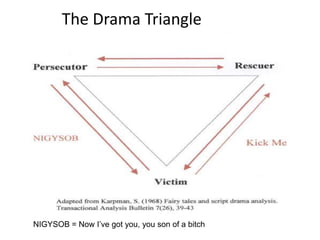
The Drama Triangle 
NIGYSOB = Now I’ve got you, you son of a bitch
Choose your role 
(or choose them all) 
• Victim 
• Perpetrator/Persecutor 
• Rescuer 
What’s the payoff?
The Victim 
The Victim is a person who asks other people to sort 
things out for him or her rather than doing it him- or 
herself: in other words, operating from a "one-down" 
position. Victims may put themselves down and 
disown their capacity to think and act for themselves. 
They may not use their own Adult capacity to think and 
may believe that "I cannot cope on my own". The 
Victim may portray him- or herself as powerless, and 
often feels powerless on the inside; however, even 
though Victims disown their own power, they have the 
power to initiate the switch of roles within a game 
(which gives them a lot of power in relationships).
The Rescuer 
The Rescuer is a person who comes in with the 
overt agenda of doing things for other people or 
sorting them out in some way. The hidden belief 
is that other people are not capable of doing stuff 
for themselves, which puts the Rescuer in a "one-up" 
position. However, the hidden assumption is 
often unconscious and a lot of Rescuers are well-meaning. 
Even so, classic Rescuers go in to help 
people without asking, doing more than their fair 
share, and ending up doing things they don't 
want to do.
The Perpetrator or Persecutor 
Lastly, the Persecutor. He or she 
dismisses the capacity of others to 
think, feel or act on their own 
behalf. The Persecutor has a hidden 
agenda of punishing or belittling 
people in some way. Like the 
Rescuer, he or she comes from a 
one-up position
Start the game! 
A game can start once two people recognize each 
other to be in opposite roles, e.g. a Rescuer and a 
Victim. A set of predictable interactions follows, 
after which one person switches roles, say the 
Victim switches into Persecutor mode and the 
Rescuer follows the switch and becomes the 
Victim (possibly also a Persecutor). The switch in 
the game can be from any of the three positions 
to a different one. Just as with specific roles, 
people will also have a preferred point to switch 
to.
Why do all this? 
There are many reasons why people play 
these types of games. 
One is that it justifies one's outlook on the 
world (the original Victim in the above 
example will feel confirmed in his belief that 
the world is a bad place and he can be angry 
with it). 
It is also a way of not taking responsibility for 
changing anything about oneself.
And more why 
Another reason why people play games is that 
they constitute attention. Games can be 
emotionally highly charged and despite the fact 
that they produce negative attention, this can be 
better than no attention at all. Not playing games 
might leave people feeling their loneliness and 
disconnection from others. 
The Victim/Persecutor in the above example may 
not have any friends or family and manages to 
get some interaction with others through playing 
games.
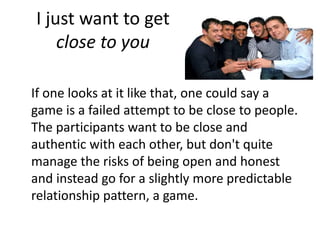
I just want to get 
close to you 
If one looks at it like that, one could say a 
game is a failed attempt to be close to people. 
The participants want to be close and 
authentic with each other, but don't quite 
manage the risks of being open and honest 
and instead go for a slightly more predictable 
relationship pattern, a game.
Authenticity 
So, we have three psychological roles, and once 
you take any one of them, you set yourself up to 
participate in a game. People will have their 
favourite game position, which they start off 
from. Often our favourite position is something 
we have learned as a child. All three positions are 
inauthentic and dismiss some aspects about 
oneself or someone else (e.g. as a Rescuer I 
dismiss other people's capacity to think and act 
on their own behalf).
At least I have structure 
Although games leave us feeling bad, they are still 
structured according to predictable lines: the same 
thing happens again and again, which is much less 
frightening than going for the all-out unknown of 
being really close to someone. 
If I choose to be close to another human being, all 
structure goes, there is just you and me relating to 
each other, and anything may happen! For some 
people that's a very frightening thing, so they divert 
their energy into games instead.
Kick Me 
This is played by men whose social manner is 
equivalent to wearing a sign that reads “Please Don’t 
Kick Me.” The temptation is almost irresistible, and 
when the natural result follows, White cries 
“piteously, “But the sign says ‘don’t kick me.’” Then 
he adds incredulously, “Why does this always happen 
to me?” (WAHM.). Clinically, the WAHM may be 
introjected (unconsciously incorporated) and 
disguised in the “Psychiatry” cliché: “Whenever I’m 
under stress, I get all shook up.” 
One game element in WAHM comes from inverse 
pride: “My misfortunes are better than yours.” This 
factor is often found in paranoids.
Kick Me 
If the people in this environment are restrained from 
striking at him by kind-heartedness, “I’m Only Trying 
to Help You,” at social convention or organizational 
rules, his behaviour becomes more and more 
provocative until he transgresses the limits and 
forces them to oblige. These are men who are cast 
out, the jilted and the job losers. 
The corresponding game among women is 
“Threadbare.”
The light is on 
This time the husband makes up his mind that he is 
really through, that they will find a sexless modus 
vivendi. Months pass. He declines the negligee parade 
and the forgotten towel manoeuvre. The wife becomes 
more provocatively informal and more provocatively 
forgetful, but he still resists. Then one evening she 
actually approaches him and kisses him. At first he 
doesn't respond, remembering his resolution, but soon 
nature begins to take its course after the long famine, 
and now he thinks he surely has it made. His first 
tentative advances are not repulsed. He becomes 
bolder and bolder. Just at the critical point, the wife 
steps back and cries: 'See, what did I tell you! All men 
are beasts, all I wanted was affection, but all you are 
interested in is sex!'
Rapo 
First-Degree 'Rapo', or 'Kiss Off', is popular at social 
gatherings and consists essentially of mild flirtation. 
White signals that she is available and gets her 
pleasure from the man's pursuit. As soon as he has 
committed himself, the game is over. If she is polite, 
she may say quite frankly 'I appreciate your 
compliments and thank you very much', and move on 
to the next conquest. If she is less generous, she may 
simply leave him. A skilful player can make this game 
last for a long time at a large social gathering by 
moving around frequently, so that the man has to carry 
out complicated manoeuvres in order to follow her 
without being too obvious.
Second Degree Rapo 
In Second-Degree 'Rapo', or 'Indignation', White 
gets only secondary satisfaction from Black's 
advances. Her primary gratification codes from 
rejecting him, so that this game is also 
colloquially known as 'Buzz Off, Buster'. She leads 
Black into a much more serious commitment 
than the mild flirtation of First-Degree 'Rapo' and 
enjoys watching his discomfiture when she 
repulses him. Black, of course, is not as helpless 
as he seems, and may have gone to considerable 
trouble to get himself involved. Usually he is 
playing some variation of 'Kick Me'.
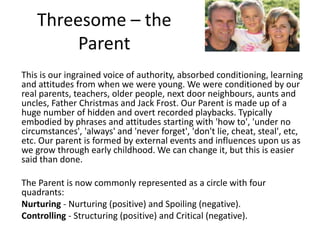
Threesome – the 
Parent 
This is our ingrained voice of authority, absorbed conditioning, learning 
and attitudes from when we were young. We were conditioned by our 
real parents, teachers, older people, next door neighbours, aunts and 
uncles, Father Christmas and Jack Frost. Our Parent is made up of a 
huge number of hidden and overt recorded playbacks. Typically 
embodied by phrases and attitudes starting with 'how to', 'under no 
circumstances', 'always' and 'never forget', 'don't lie, cheat, steal', etc, 
etc. Our parent is formed by external events and influences upon us as 
we grow through early childhood. We can change it, but this is easier 
said than done. 
The Parent is now commonly represented as a circle with four 
quadrants: 
Nurturing - Nurturing (positive) and Spoiling (negative). 
Controlling - Structuring (positive) and Critical (negative).
The Child 
Our internal reaction and feelings to external 
events form the 'Child'. This is the seeing, 
hearing, feeling, and emotional body of data 
within each of us. When anger or despair 
dominates reason, the Child is in control. Like 
our Parent we can change it, but it is no easier. 
The Child is now commonly represented as 
circle with four quadrants: 
Adapted - Co-operative (positive) and 
Compliant/Resistant (negative). 
Free - Spontaneous (positive) and Immature 
(negative).
The Adult 
Our 'Adult' is our ability to think and determine action 
for ourselves, based on received data. The adult in us 
begins to form at around ten months old, and is the 
means by which we keep our Parent and Child under 
control. If we are to change our Parent or Child we 
must do so through our adult. 
In other words: 
Parent is our 'Taught' concept of life 
Adult is our 'Thought' concept of life 
Child is our 'Felt' concept of life
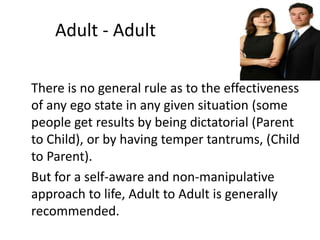
Adult - Adult 
There is no general rule as to the effectiveness 
of any ego state in any given situation (some 
people get results by being dictatorial (Parent 
to Child), or by having temper tantrums, (Child 
to Parent). 
But for a self-aware and non-manipulative 
approach to life, Adult to Adult is generally 
recommended.
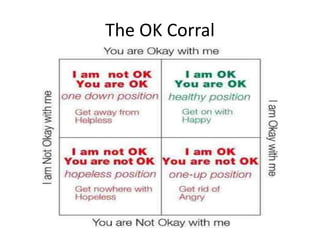
The OK Corral
Fundamental Concepts of TA 
• Everyone is born OK 
• Each person has a right to be in the world, accepted for 
who they are 
• Everyone is responsible for themselves 
• We all seek physical and emotional nurturing so we modify 
our behaviour to achieve this 
• There are three behavioural states we can switch between: 
child, parent and adult 
• Some people have a life script, which will determine : 
– how they behave 
– how they interpret the behaviour of others 
– how they respond to people;
Know thyself

Transactional analysis

  • 1.
    talking ‘bout Games People Play (every night and every day now) Eric Berne and Transactional Analysis
  • 2.
    A phenomenal book The bestselling book by psychiatrist Dr. Eric Berne that uncovered the dynamics of human relationships. Since its publication in 1964 to the newly released and updated 40th anniversary edition, over 5 million copies have been sold worldwide in over ten languages. The book remains immensely popular and has recently experienced a huge increase in sales due to renewed interest.
  • 3.
    The value ofthe book "Many times in my life, I was placed in social situations that left me feeling so depleted afterwards and I could not exactly grasp why this was happening. When I read Games People Play, I started to understand how many people play these games that end up making me feel used and hopeless. After a year or so, I also began realizing that I play some of these games myself... This is when I really decided to change my life. I began living with a new awareness of the behaviours of not only others but my own as well!"
  • 4.
    What Game? Agame is an ongoing series of complementary ulterior transactions progressing to a well-defined, predictable outcome. Descriptively, it is a recurring set of transactions... with a concealed motivation... Or gimmick.“ What happens in the game is explained by transactional analysis Let’s look at an example called IWFY
  • 5.
    If It Weren'tFor You" or IWFY. Mrs. White complained that her husband severely restricted her social activities, so that she had never learned to dance. Due to changes in her attitude brought about psychiatric treatment, her husband became less sure of himself and more indulgent. Mrs. White was then free to enlarge the scope of her activities. She signed up for dancing classes, and then discovered to her despair that she had a morbid hear of dance floors and had to abandon this project.
  • 6.
    If It Weren'tFor You" or IWFY. This unfortunate adventure, along with similar ones, laid out some important aspects of her marriage. Out of her many suitors, she had picked a domineering man for a husband. She was then in a position to complain that she could do all sorts of things "it if weren't for you." Many of her woman friends had domineering husbands, and when they met for their morning coffee, they spent a good deal of time playing "If It Weren't For Him."
  • 7.
    IWFY As itturned out, however, contrary to her complaints, her husband was performing a very real service for her by forbidding her to do something she was deeply afraid of, and by preventing her, in fact, from even becoming aware of her fears. This was one reason... [she] had chosen such a husband.
  • 8.
    IWFY His prohibitionsand her complaints frequently led to quarrels, so that their sex life was seriously impaired. She and her husband had little in common besides their household worries and the children, so that their quarrels stood out as important events.
  • 9.
    The Payoff BothMr. and Mrs. White are participating in a game; they are not consciously aware of their active participation. As with any game, at least one party must achieve a "payoff" for the game to proceed. In this game, Mrs. White, and to a lesser degree Mr. White achieve their respective payoffs. In Mr. White's case, by restricting Mrs. White's activities, he can retain the role of domineering husband, which provides him comfort when things do not necessarily go his way.
  • 10.
    Mrs White’s Payoff Mrs. White obtains her payoff at many levels. On the psychological level, the restrictions imposed by Mr. White prevent Mrs. White from experiencing neurotic fears or being placed in phobic situations. By having Mr. White prevent her from being placed in these situations, Mrs. White does not have to acknowledge (or even be aware of) her fears. On the social level, Mrs. White's payoff is that she can say "if it weren't for you." This helps to structure the time she must spend with her husband, as well as the time spent without him. In addition, it allows her to say "if it weren't for him" with friends.
  • 11.
    Ending the Game As with any game, it comes to an abrupt end when one player decides (usually unconsciously) to stop playing. If instead, Mr. White said "Go ahead" instead of "Don't you dare", Mrs. White loses her payoff. She can no longer say "if it weren't for you" and then must go out and confront her fears. By continuing to play this game, each participant receives his or her payoff, but the price is a marriage with serious problems.
  • 12.
    Ending the Game IWFY, like most other games, when perpetuated, can lead to adverse effects. Identification of the game is the first step. Once the player(s) recognize they are playing a game, efforts can be made to improve upon the problem. This is the basis of Transactional Analysis Therapy.
  • 13.
    The Drama Triangle NIGYSOB = Now I’ve got you, you son of a bitch
  • 14.
    Choose your role (or choose them all) • Victim • Perpetrator/Persecutor • Rescuer What’s the payoff?
  • 15.
    The Victim TheVictim is a person who asks other people to sort things out for him or her rather than doing it him- or herself: in other words, operating from a "one-down" position. Victims may put themselves down and disown their capacity to think and act for themselves. They may not use their own Adult capacity to think and may believe that "I cannot cope on my own". The Victim may portray him- or herself as powerless, and often feels powerless on the inside; however, even though Victims disown their own power, they have the power to initiate the switch of roles within a game (which gives them a lot of power in relationships).
  • 16.
    The Rescuer TheRescuer is a person who comes in with the overt agenda of doing things for other people or sorting them out in some way. The hidden belief is that other people are not capable of doing stuff for themselves, which puts the Rescuer in a "one-up" position. However, the hidden assumption is often unconscious and a lot of Rescuers are well-meaning. Even so, classic Rescuers go in to help people without asking, doing more than their fair share, and ending up doing things they don't want to do.
  • 17.
    The Perpetrator orPersecutor Lastly, the Persecutor. He or she dismisses the capacity of others to think, feel or act on their own behalf. The Persecutor has a hidden agenda of punishing or belittling people in some way. Like the Rescuer, he or she comes from a one-up position
  • 18.
    Start the game! A game can start once two people recognize each other to be in opposite roles, e.g. a Rescuer and a Victim. A set of predictable interactions follows, after which one person switches roles, say the Victim switches into Persecutor mode and the Rescuer follows the switch and becomes the Victim (possibly also a Persecutor). The switch in the game can be from any of the three positions to a different one. Just as with specific roles, people will also have a preferred point to switch to.
  • 19.
    Why do allthis? There are many reasons why people play these types of games. One is that it justifies one's outlook on the world (the original Victim in the above example will feel confirmed in his belief that the world is a bad place and he can be angry with it). It is also a way of not taking responsibility for changing anything about oneself.
  • 20.
    And more why Another reason why people play games is that they constitute attention. Games can be emotionally highly charged and despite the fact that they produce negative attention, this can be better than no attention at all. Not playing games might leave people feeling their loneliness and disconnection from others. The Victim/Persecutor in the above example may not have any friends or family and manages to get some interaction with others through playing games.
  • 21.
    I just wantto get close to you If one looks at it like that, one could say a game is a failed attempt to be close to people. The participants want to be close and authentic with each other, but don't quite manage the risks of being open and honest and instead go for a slightly more predictable relationship pattern, a game.
  • 22.
    Authenticity So, wehave three psychological roles, and once you take any one of them, you set yourself up to participate in a game. People will have their favourite game position, which they start off from. Often our favourite position is something we have learned as a child. All three positions are inauthentic and dismiss some aspects about oneself or someone else (e.g. as a Rescuer I dismiss other people's capacity to think and act on their own behalf).
  • 23.
    At least Ihave structure Although games leave us feeling bad, they are still structured according to predictable lines: the same thing happens again and again, which is much less frightening than going for the all-out unknown of being really close to someone. If I choose to be close to another human being, all structure goes, there is just you and me relating to each other, and anything may happen! For some people that's a very frightening thing, so they divert their energy into games instead.
  • 24.
    Kick Me Thisis played by men whose social manner is equivalent to wearing a sign that reads “Please Don’t Kick Me.” The temptation is almost irresistible, and when the natural result follows, White cries “piteously, “But the sign says ‘don’t kick me.’” Then he adds incredulously, “Why does this always happen to me?” (WAHM.). Clinically, the WAHM may be introjected (unconsciously incorporated) and disguised in the “Psychiatry” cliché: “Whenever I’m under stress, I get all shook up.” One game element in WAHM comes from inverse pride: “My misfortunes are better than yours.” This factor is often found in paranoids.
  • 25.
    Kick Me Ifthe people in this environment are restrained from striking at him by kind-heartedness, “I’m Only Trying to Help You,” at social convention or organizational rules, his behaviour becomes more and more provocative until he transgresses the limits and forces them to oblige. These are men who are cast out, the jilted and the job losers. The corresponding game among women is “Threadbare.”
  • 26.
    The light ison This time the husband makes up his mind that he is really through, that they will find a sexless modus vivendi. Months pass. He declines the negligee parade and the forgotten towel manoeuvre. The wife becomes more provocatively informal and more provocatively forgetful, but he still resists. Then one evening she actually approaches him and kisses him. At first he doesn't respond, remembering his resolution, but soon nature begins to take its course after the long famine, and now he thinks he surely has it made. His first tentative advances are not repulsed. He becomes bolder and bolder. Just at the critical point, the wife steps back and cries: 'See, what did I tell you! All men are beasts, all I wanted was affection, but all you are interested in is sex!'
  • 27.
    Rapo First-Degree 'Rapo',or 'Kiss Off', is popular at social gatherings and consists essentially of mild flirtation. White signals that she is available and gets her pleasure from the man's pursuit. As soon as he has committed himself, the game is over. If she is polite, she may say quite frankly 'I appreciate your compliments and thank you very much', and move on to the next conquest. If she is less generous, she may simply leave him. A skilful player can make this game last for a long time at a large social gathering by moving around frequently, so that the man has to carry out complicated manoeuvres in order to follow her without being too obvious.
  • 28.
    Second Degree Rapo In Second-Degree 'Rapo', or 'Indignation', White gets only secondary satisfaction from Black's advances. Her primary gratification codes from rejecting him, so that this game is also colloquially known as 'Buzz Off, Buster'. She leads Black into a much more serious commitment than the mild flirtation of First-Degree 'Rapo' and enjoys watching his discomfiture when she repulses him. Black, of course, is not as helpless as he seems, and may have gone to considerable trouble to get himself involved. Usually he is playing some variation of 'Kick Me'.
  • 29.
    Threesome – the Parent This is our ingrained voice of authority, absorbed conditioning, learning and attitudes from when we were young. We were conditioned by our real parents, teachers, older people, next door neighbours, aunts and uncles, Father Christmas and Jack Frost. Our Parent is made up of a huge number of hidden and overt recorded playbacks. Typically embodied by phrases and attitudes starting with 'how to', 'under no circumstances', 'always' and 'never forget', 'don't lie, cheat, steal', etc, etc. Our parent is formed by external events and influences upon us as we grow through early childhood. We can change it, but this is easier said than done. The Parent is now commonly represented as a circle with four quadrants: Nurturing - Nurturing (positive) and Spoiling (negative). Controlling - Structuring (positive) and Critical (negative).
  • 30.
    The Child Ourinternal reaction and feelings to external events form the 'Child'. This is the seeing, hearing, feeling, and emotional body of data within each of us. When anger or despair dominates reason, the Child is in control. Like our Parent we can change it, but it is no easier. The Child is now commonly represented as circle with four quadrants: Adapted - Co-operative (positive) and Compliant/Resistant (negative). Free - Spontaneous (positive) and Immature (negative).
  • 31.
    The Adult Our'Adult' is our ability to think and determine action for ourselves, based on received data. The adult in us begins to form at around ten months old, and is the means by which we keep our Parent and Child under control. If we are to change our Parent or Child we must do so through our adult. In other words: Parent is our 'Taught' concept of life Adult is our 'Thought' concept of life Child is our 'Felt' concept of life
  • 32.
    Adult - Adult There is no general rule as to the effectiveness of any ego state in any given situation (some people get results by being dictatorial (Parent to Child), or by having temper tantrums, (Child to Parent). But for a self-aware and non-manipulative approach to life, Adult to Adult is generally recommended.
  • 33.
  • 34.
    Fundamental Concepts ofTA • Everyone is born OK • Each person has a right to be in the world, accepted for who they are • Everyone is responsible for themselves • We all seek physical and emotional nurturing so we modify our behaviour to achieve this • There are three behavioural states we can switch between: child, parent and adult • Some people have a life script, which will determine : – how they behave – how they interpret the behaviour of others – how they respond to people;
  • 35.