www.complianceonlie.com
©2010 Copyright
1
Topic: Understanding and
Implementing a Technology
Transfer Process
Presenter: Steven Laurenz
08/05/17 2
Introduction
The purpose of today’s presentation is to review how
governance systems in combination with technology
transfer tools and templates can be used to transfer
knowledge from R&D to a manufacturing site.
• The focus will be on drug products
AGENDA
308/05/17 3
• The importance of technology transfer
• The use of a technical review system to
update and review technology knowledge
obtained during drug product development
• The use of a Product Strategy Review system
to review important business aspects in
preparation for transfer
• Tools and Templates used for technology
transfer
4
What is Technology Transfer?
The systematic procedure that is followed in order to pass the
documented knowledge and experience gained during
development and/or commercialization to an appropriate,
and
authorized party.
It embodies both the transfer of documentation
and the demonstrated ability of a receiving unit to
effectively
perform the critical elements of the transferred technology,
to
the satisfaction of all parties and any/all regulatory bodies.
5
Why Technology Transfer?
Motivations
• Delivering a product of the highest quality is
paramount to success of not only the transfer but
to the performance of the product and our
business
– Critical for a successful commercial launch
– Timely Development
– Cost of failure
– Quality of Final Product
– Reduce regulatory risk
– Efficient Use of Resources
08/05/17 6
Importance of Technology Transfer
• Reduce time for transfer
• Reduce lost batches on transfer
• Lower level of required inventories
• Rapid and efficient launch of
transferred projects
• Reduced contractual conflicts with third
parties
• Improved compliance upon transfer
• Reduced level of internal effort to
complete transfer: improved efficiency
7
Expected Benefits of a Structured
Process for Technology Transfer
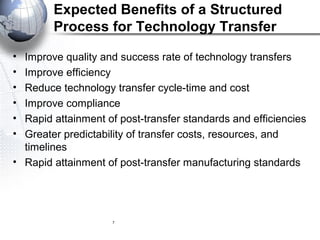
• Improve quality and success rate of technology transfers
• Improve efficiency
• Reduce technology transfer cycle-time and cost
• Improve compliance
• Rapid attainment of post-transfer standards and efficiencies
• Greater predictability of transfer costs, resources, and
timelines
• Rapid attainment of post-transfer manufacturing standards
08/05/17 8
What Needs to be Transferred
• Technical knowledge
To Operations personnel
To Regulatory personnel
To Quality personnel
08/05/17 9
What Needs to be Transferred
• System transfer from R&D site to
Manufacturing site
Manufacturing batch records
Sampling plans
Analytical methods
10
What Needs to be Transferred
• Active Pharmaceutical Ingredient (API)
• Drug Product
• Analytical Methods
• Local and international
• Internal or Third Party
• Implementation of Process Optimization
08/05/17 11
What Needs to be Transferred
• Knowledge in order to select and prepare the site
of manufacture
Capital investment strategy
Raw material sourcing plan
Cleaning validation strategy
Launch strategy
08/05/17 12
Gated System
08/05/17 13
The Need for Gated Systems
• The CMC development process is a
complicated system that can take several
years to complete
• Critical deliverables need to be
accomplished at specific times
• Deliverables have a tremendous impact on
timing. Mistakes could add 6 months or
more onto timeline and have large
business implications
08/05/17 14
Research and
Development
Operations
CMC Development Team
Technical Review
Project Strategy
Review
Quality and Compliance
Quality Review
CMC Development Review Structure
CMC Technical Review
A Technical Governing Program
08/05/17 16
• CMC Technical Reviews are a series of
reviews scheduled at critical milestones
in the CMC development process
08/05/17 17
Purpose
• The appropriate work has been completed for
the stage of development
• Technical decisions made during development
are acceptable to customers/receiving site
Potential risks and/or issues are identified and
appropriate action plans are available to address
them
• Members of R&D, Operations, Regulatory, and
Quality management are in agreement with
moving ahead with development
08/05/17 18
Schedule
Early
Development
Full Development & Commercialization Post-Launch
Full Dev. Decision
(End of Phase 2a)
LaunchFiling
CMC Technical Reviews
CR Guideline
FIM
TR0
Plansforfirstinman
TR1
Pre-CommercialDevelopment
TR2
PilotScaleExperience
TR3
APIcom.Syntheticroute
TR4
Drugprodcutscale-up
TR5
Registrationbatches
TR6
APIval./DPdemolot
TR7
DPValidation
TR8
Manufacturinghistory
08/05/17 19
Deliverables
• Each review has key deliverables that represent
the milestones for that stage of CMC
development
• The CMC team reports on the progress of those
deliverables and maintains the focus
• It is important that risk around the deliverables be
addressed so decisions can be made on moving
forward to the next stage
• Each Stage has an associated responsibility
matrix outlining the role for each functional area
TR1
08/05/17 20
•Route of synthesis for First in
Human (FIH) material and tox lot(s)
•Update on solid form selection
and/or salt selection
•Polymorph update/plans
•Results of forced degradation
studies
•Expected impurities/degradants
•Comparison of impurity profiles for
tox lot and FIH lot
•Available stability data
•Specifications
•Plans through Phase IIa
•Development
•Clinical supplies
•Regulatory submissions
API Drug Product
•Results of excipient compatibility
studies
•Stability data for preliminary
formulations
•Description of formulation for FIH
•Available stability data for FIH
formulation
•Dissolution data for FIH formulation
•Specifications for FIH formulation
•Plans through Phase IIa
•Development
•Clinical supplies
•Regulatory submissions
Intellectual property overview
TR2
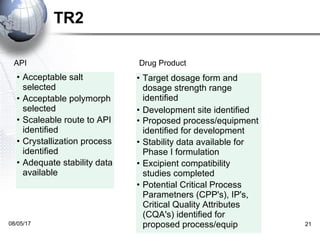
• Acceptable salt
selected
• Acceptable polymorph
selected
• Scaleable route to API
identified
• Crystallization process
identified
• Adequate stability data
available
08/05/17 21
API
• Target dosage form and
dosage strength range
identified
• Development site identified
• Proposed process/equipment
identified for development
• Stability data available for
Phase I formulation
• Excipient compatibility
studies completed
• Potential Critical Process
Parametners (CPP's), IP's,
Critical Quality Attributes
(CQA's) identified for
proposed process/equip
Drug Product
TR3
• Synthetic process proven (pilot scale)
and clinical delivery plan
• API impurity profile controlled in Pilot
Plant (PP) vs lab data
• API physical properties controlled in PP
vs lab data
• Polymorph screen completed
08/05/17 22
API
• Formulation (qualitative composition),
manufacturing process and potential
CPP's, IP's, CQA's identified at pilot
scale
• Dosage strength (range) identified
• Commercial package evaluation
studies completed
• Stability data available for prototype
commercial. formula (pilot, 3-6 mo.)
• Test method for cleaning samples
available for verification of equipment
cleaning
Drug Product
TR4
• Commercial synthetic route identified
• Final finishing steps for API defined
(crystallization, milling drying, etc)
• Special processing, equipment,
containment identified
• Scale and equipment selected for
registration runs
• Tentative Int. specs and analytical
methods
• Starting material / End of Phase 2
(EOP2) meeting strategy
• Test methods and specs appropriate for
stage of development
• Identification of critical parameters and
PJ strategy
08/05/17 23
API
• Commercial process/formulation defined
(final strength/shape/color)
• Primary package(s) defined
• Proposed product test methods and
tentative specs (including dissolution)
• Test method validation complete
• Regulatory filing strategy confirmed,
including equipment, scale, stability
• Stability data available in proposed
commercial package (pref. 6 mo.)
• CPP and CQA revised/updated based on
scale up
• End of Phase 2 strategy defined
• Studies of the effect of API properties on
the DP complete
Drug Product
TR5
• Registration runs completed
• Commercial synthetic process defined
• Appropriate validation of analytical methods
completed
• Development report completed
• Commercial site, equipment, and capital
identified for validation
• Process validation strategy defined
• Analytical methods transfer strategy defined
• Cleaning validation strategy
• Manufacturing checklist initiated
• Commercial timeline defined
• Commercial volumes /estimated Cost of
Goods (COGs)
• Vendor selection
08/05/17 24
API
• Summary of registration run
manufacturing experience
• Process range justification
• CPP's and CQA's identified
• Launch scale plan (covered in detail by
PSR)
Drug Product
TR6
• Process justification critical parameters
updated or PJ completion
• Process validation completed
• Analytical method transfer
• Manufacturing checklist completed
• Evaluation of PAI readiness
08/05/17 25
• Test method transfer to QA labs
• Critical process parameters
confirmed at commercial scale
• Potential manufacturing issues
identified and addressed
• Specifications and manufacturing
ranges revised for filing
• Rework/reprocess procedures
available
• Life cycle management plan
• Validation strategy defined
• Validation protocol complete
API Drug Product
Demonstration or Verification Lot
• Ensure that product processes, analytical methods and
documentation are properly transferred from development
to commercial operations
• Identify and resolve issues with manufacturing, testing and
packaging (if performed) and revise manufacturing
instructions, sampling procedures, specifications, test
methods or other production systems prior to the regulatory
filing.
• Determine readiness for Process validation and confirm
acceptability of validation testing criteria.
08/05/17 26
TR7
• Launch build status
• Post validation monitoring plan
• Technology transfer strategy
update or completion
• Inspection update
• Review and update life cycle
management plan and IP
08/05/17 27
• Overview of validation results, including a
discussion of process capability
• Commercial launch plan
• Technology transfer complete
• Post-validation monitoring plan
• Life cycle management plan
• PAI and FDA review status
• Safety information updated based on
clinical trial experiences
API Drug Product
TR8
• Review and update life cycle
management plan and IP
• Manufacturing history, lab, and
stability data reviewed
• Supplemental filings
08/05/17 28
• Post-validation monitoring commitment
results
• Review of compliance/CAPA history
• Phase IV or other post-approval
commitments completed
• Manufacturing history – process
capability
• Test method history – adequacy of test
methods
• Stability history
• Update CPP's based on manufacturing
history
• Life cycle management plan updated
• Supplemental filings
API Drug Product
08/05/17 29
Approval of Reviews
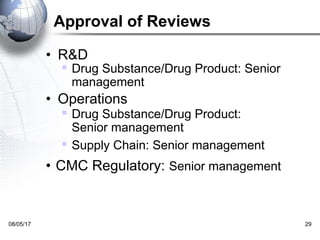
• R&D
 Drug Substance/Drug Product: Senior
management
• Operations
 Drug Substance/Drug Product:
Senior management
 Supply Chain: Senior management
• CMC Regulatory: Senior management
08/05/17 30
Approval of Reviews
• Approval indicates the following:
 Status of the deliverables is represented
accurately in the package and is
acceptable Meeting minutes accurately reflect issues
discussed at the review meeting
 Action plans for addressing individual issues are
acceptable
 Any identified risks have been sufficiently
addressed to allow development to proceed
08/05/17 31
CMC Development Review Structure
Research and
Development
Operations
CMC Development Team
Technical Review
Project Strategy
Review
Quality and Compliance
Quality Review
Project Strategy Review
Need to ensure that the business
infrastructure is prepared for the new
manufacturing process.
08/05/17 33
Project Strategy Review
• A governance system is also needed to ensure that
the designed manufacturing process fits into the
overall business objectives
• Cross functional senior management review body
• Short decision driven meetings - not updates
• Strategic focus
08/05/17 34
Objectives
• Ensure business and project management excellence
• Focus on project risks and mitigation strategies
• Ensure that project teams are resourced for success
• Resolve issues and remove barriers
• Improve commercialization process
• Promote project understanding and cross-functional
communication and alignment
08/05/17 35
Integrated View of PSR
Early
Development
Full Development & Commercialization Post-Launch
Full Dev. Decision
(End of Phase 2a)
LaunchFiling
CMC Technical Reviews
Project Strategy Reviews
CR Guideline
FIM
TR0 TR1 TR2 TR3 TR4 TR5 TR6 TR7 TR8
PSR1
Sourcingstrategy
PSR2
TTandVal.strategy
PSR3
Launchstrategy
PSR4
Commercialreadiness
PSR5
Postlauchreview/LCM
08/05/17 36
Typical Topics for Review, Agreement,
and Decisions
• Project Risk Management Plan
 Key risks in development, transfer, and launch (e.g.,
as identified by CR and QR)
• Site selection
• Sourcing strategy
• Capital investments
• Validation strategy
• COGs strategy
• Technology transfer
• Launch plan
• Product life cycle Management plan
Purpose of each PSR
• PSR1:Gain alignment and approval for the
Sourcing Strategies and selection of commercial
sites for API, Drug Product, and Packaging.
Preliminary plans for API and DP Registration
• PSR2:Gain alignment and approval for the
Integrated Technology Transfer ,capital
investments required, and preliminary plans for
API Process Validation and DP Demonstration
Lots.
08/05/17 37
Purpose of each PSR
• PSR3: Gain alignment on the organization’s
readiness (including R&D and Commercial sites)
for the first Regulatory Submission and to gain
approval for the API and DP launch strategies.
• PSR4: Gain alignment on the organization’s
readiness for commercial launch.
• PSR5: Assess post-launch manufacturing
experience in commercial site(s) and to gain
alignment on the life-cycle strategy for the
product.
08/05/17 38
PSR Templates
Review Name Key Review topics
PSR1: Sourcing Strategy • API Site Selection, and Sourcing
Strategy
• DP Site Selection and Sourcing
Strategy
• Packaging Site Selection
• Capital
• Preliminary API Registration Run Plan
• Preliminary DP Registration Run Plan
• Significant Issues From TR2
08/05/17 39
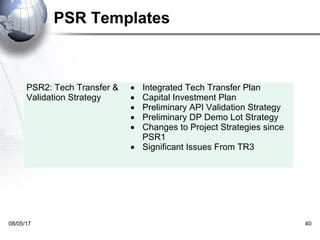
PSR Templates
PSR2: Tech Transfer &
Validation Strategy
• Integrated Tech Transfer Plan
• Capital Investment Plan
• Preliminary API Validation Strategy
• Preliminary DP Demo Lot Strategy
• Changes to Project Strategies since
PSR1
• Significant Issues From TR3
08/05/17 40
PSR Templates
PSR3: Launch Strategy • CMC Filing Readiness
• API Launch Strategy
• DP Launch Strategy incl. DP Validation
Plans
• Changes to Project Strategies since
PSR2
• Significant Issues From previous CRs
(TR4, TR5 & TR6)
08/05/17 41
PSR Templates
PSR4: Commercial
Readiness
• Launch and Commercialization
Readiness
• Product Life Cycle Management
Strategy
• Technology Transfer Metrics
Summary
• Changes to Project Strategies since
PSR3
• Significant Issues From TR7
08/05/17 42
PSR Templates
PSR5: Post-Launch
Review & Life-Cycle
Strategy
• Assessment of post-launch
performance to date
• Tech Transfer Metrics Summary
• Product life-cycle management
strategy
• Changes to Strategies Since
PSR4
• Significant Issues From CR8
08/05/17 43
08/05/17 44
Project Strategy Review (PSR) Logistics
Follow-up
Actions
Communicate
Decision and
Distribute
Minutes
(within 3 days)
Project Strategy Review
Meeting or Teleconference
Review
Decision
Package
One Week
prior
Review Body
Preparation
Presentation
10 – 20 minutes
Discussion
10 – 20 minutes
Decision Making
(Closed
Session)
10 – 20 minutes
Debriefing
(Decision Communication,
Action
Logging)
10 minutes
Tools & Templates
08/05/17 46
Technology Transfer
• Definition
The systematic procedure that is
followed in order to pass the
knowledge and experience gained
during development and/or
commercialization to an
appropriate, responsible, and
authorized party
Tools and Templates
• Drug Product Process/Equipment/Excipients of
Choice
• Preliminary API Process Description
• Preliminary DP Process Description
• Site Capabilities Master Template
• Technology Transfer Gap Analysis
• Technology Transfer Acceptance/Success Criteria
• Integrated Technology Transfer Plan
• Technology Transfer Owners Manual
08/05/17 47
Tools and Templates
Tool/Template Purpose
Drug Product
Process/Equipment/Excipie
nts of Choice
• Guidance documents for project teams on preferred
processes, equipments, and excipients for drug
products
Preliminary API Process
Description
• To communicate high-level API Process information for
site and equipment selection, sourcing, gap analysis,
and capital planning.
Preliminary DP Process
Description
• To communicate high-level Drug Product Process
information for site and equipment selection, sourcing,
gap analysis, and capital planning.
Site Capabilities Master
Template
• To provide description of commercial site capabilities to
support the proposed process
08/05/17 48
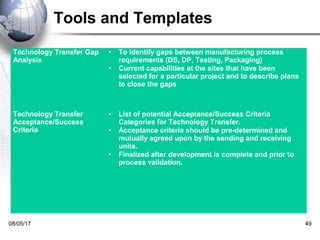
Tools and Templates
Technology Transfer Gap
Analysis
• To identify gaps between manufacturing process
requirements (DS, DP, Testing, Packaging)
• Current capabilities at the sites that have been
selected for a particular project and to describe plans
to close the gaps
Technology Transfer
Acceptance/Success
Criteria
• List of potential Acceptance/Success Criteria
Categories for Technology Transfer.
• Acceptance criteria should be pre-determined and
mutually agreed upon by the sending and receiving
units.
• Finalized after development is complete and prior to
process validation.
08/05/17 49
Integrated Technology
Transfer Plan
• An integrated project management overview of all the
technology transfers (e.g. intermediate and final
steps for Drug Substance, Drug Product, Packaging,
and Analytical Methods)
• Serves as a formal tool for managing coordination
and alignment among the different technology
transfers and with other pharmaceutical
development activities.
• Initially created after site selection, gap analysis, and
determination of initial acceptance criteria.
• Updated as development is completed and the
receiving sites are prepared for technology transfer.
The plan is finalized prior to process validation.
Technology Transfer
Owners Manual
To identify the information and documents necessary as
part of transferring the process and methods for a
product to the receiving manufacturing site
08/05/17 50
08/05/17 51
Process,
Equipment,
Excipients of
Choice
Review Preliminary
Process and Define
Acceptance Criteria
Conduct Gap
Analysis
Select Mfg Sites
(PSR2)
Develop Preliminary
Process Description
(TR2)
Preliminary
Process
Description
Site
Capabilities
Develop Technology
Transfer Master Plan
(TR3/4) (PSR3/4)
Execute Development and
Tech Transfer Plan
(Process Optimization &
Justification and Site
Preparation)
(TR5) (PSR5/6)
Validate Process &
Confirm Acceptance
Criteria
(TR6) (PSR7)
Gap List
(Process &
Facility
Modifications)
Initial
Acceptance
Criteria
Initial
Technology
Transfer
Master Plan
Supply
Chain
Workbook
& Decision
Tree
Updated
Technology
Transfer
Master Plan
DS PV,
Demo Lot
and TMT
Protocols
Technology
Transfer
Owners
Manual
Site
Capabilities
Master
Template
Tools and Templates
How do we measure
success
Technology Transfer Metrics
08/05/17 53
Technology Transfer Metrics
• Schedule adherence for technology transfer
readiness
• Validation (process, analytical, cleaning
validation)
•Number of lots to complete
•System robustness
• Regulatory inspection (adherence to
regulatory requirements, no observations)
08/05/17 54
Technology Transfer Metrics
• New product introduction metrics (planned vs. what
is observed at commercial site)
• Post-transfer process robustness metrics (how well
is the commercial process performing)
08/05/17 55
Summary
• Technology transfer involves using gated
systems and appropriate tools and templates
 Gated systems

Technical reviews ensure development milestones are
met at critical time points

Project Strategy reviews ensure the proposed
manufacturing process fits into the overall business
needs of the organization
 Tools and templates ensure technical knowledge
is captured efficiently for the organization
 Metrics provides a method to measure
technical transfer success to continually
optimize the process
08/05/17 56
Summary
• Each company will have a different technology
transfer structure but the principles will be the
same.
 Success of any program will ultimately
depend on the close cooperation of the
different functional areas and will require
the development of collaborative cross-
functional teams

Training technology transfer training

  • 1.
    www.complianceonlie.com ©2010 Copyright 1 Topic: Understandingand Implementing a Technology Transfer Process Presenter: Steven Laurenz
  • 2.
    08/05/17 2 Introduction The purposeof today’s presentation is to review how governance systems in combination with technology transfer tools and templates can be used to transfer knowledge from R&D to a manufacturing site. • The focus will be on drug products
  • 3.
    AGENDA 308/05/17 3 • Theimportance of technology transfer • The use of a technical review system to update and review technology knowledge obtained during drug product development • The use of a Product Strategy Review system to review important business aspects in preparation for transfer • Tools and Templates used for technology transfer
  • 4.
    4 What is TechnologyTransfer? The systematic procedure that is followed in order to pass the documented knowledge and experience gained during development and/or commercialization to an appropriate, and authorized party. It embodies both the transfer of documentation and the demonstrated ability of a receiving unit to effectively perform the critical elements of the transferred technology, to the satisfaction of all parties and any/all regulatory bodies.
  • 5.
    5 Why Technology Transfer? Motivations •Delivering a product of the highest quality is paramount to success of not only the transfer but to the performance of the product and our business – Critical for a successful commercial launch – Timely Development – Cost of failure – Quality of Final Product – Reduce regulatory risk – Efficient Use of Resources
  • 6.
    08/05/17 6 Importance ofTechnology Transfer • Reduce time for transfer • Reduce lost batches on transfer • Lower level of required inventories • Rapid and efficient launch of transferred projects • Reduced contractual conflicts with third parties • Improved compliance upon transfer • Reduced level of internal effort to complete transfer: improved efficiency
  • 7.
    7 Expected Benefits ofa Structured Process for Technology Transfer • Improve quality and success rate of technology transfers • Improve efficiency • Reduce technology transfer cycle-time and cost • Improve compliance • Rapid attainment of post-transfer standards and efficiencies • Greater predictability of transfer costs, resources, and timelines • Rapid attainment of post-transfer manufacturing standards
  • 8.
    08/05/17 8 What Needsto be Transferred • Technical knowledge To Operations personnel To Regulatory personnel To Quality personnel
  • 9.
    08/05/17 9 What Needsto be Transferred • System transfer from R&D site to Manufacturing site Manufacturing batch records Sampling plans Analytical methods
  • 10.
    10 What Needs tobe Transferred • Active Pharmaceutical Ingredient (API) • Drug Product • Analytical Methods • Local and international • Internal or Third Party • Implementation of Process Optimization
  • 11.
    08/05/17 11 What Needsto be Transferred • Knowledge in order to select and prepare the site of manufacture Capital investment strategy Raw material sourcing plan Cleaning validation strategy Launch strategy
  • 12.
  • 13.
    08/05/17 13 The Needfor Gated Systems • The CMC development process is a complicated system that can take several years to complete • Critical deliverables need to be accomplished at specific times • Deliverables have a tremendous impact on timing. Mistakes could add 6 months or more onto timeline and have large business implications
  • 14.
    08/05/17 14 Research and Development Operations CMCDevelopment Team Technical Review Project Strategy Review Quality and Compliance Quality Review CMC Development Review Structure
  • 15.
    CMC Technical Review ATechnical Governing Program
  • 16.
    08/05/17 16 • CMCTechnical Reviews are a series of reviews scheduled at critical milestones in the CMC development process
  • 17.
    08/05/17 17 Purpose • Theappropriate work has been completed for the stage of development • Technical decisions made during development are acceptable to customers/receiving site Potential risks and/or issues are identified and appropriate action plans are available to address them • Members of R&D, Operations, Regulatory, and Quality management are in agreement with moving ahead with development
  • 18.
    08/05/17 18 Schedule Early Development Full Development& Commercialization Post-Launch Full Dev. Decision (End of Phase 2a) LaunchFiling CMC Technical Reviews CR Guideline FIM TR0 Plansforfirstinman TR1 Pre-CommercialDevelopment TR2 PilotScaleExperience TR3 APIcom.Syntheticroute TR4 Drugprodcutscale-up TR5 Registrationbatches TR6 APIval./DPdemolot TR7 DPValidation TR8 Manufacturinghistory
  • 19.
    08/05/17 19 Deliverables • Eachreview has key deliverables that represent the milestones for that stage of CMC development • The CMC team reports on the progress of those deliverables and maintains the focus • It is important that risk around the deliverables be addressed so decisions can be made on moving forward to the next stage • Each Stage has an associated responsibility matrix outlining the role for each functional area
  • 20.
    TR1 08/05/17 20 •Route ofsynthesis for First in Human (FIH) material and tox lot(s) •Update on solid form selection and/or salt selection •Polymorph update/plans •Results of forced degradation studies •Expected impurities/degradants •Comparison of impurity profiles for tox lot and FIH lot •Available stability data •Specifications •Plans through Phase IIa •Development •Clinical supplies •Regulatory submissions API Drug Product •Results of excipient compatibility studies •Stability data for preliminary formulations •Description of formulation for FIH •Available stability data for FIH formulation •Dissolution data for FIH formulation •Specifications for FIH formulation •Plans through Phase IIa •Development •Clinical supplies •Regulatory submissions Intellectual property overview
  • 21.
    TR2 • Acceptable salt selected •Acceptable polymorph selected • Scaleable route to API identified • Crystallization process identified • Adequate stability data available 08/05/17 21 API • Target dosage form and dosage strength range identified • Development site identified • Proposed process/equipment identified for development • Stability data available for Phase I formulation • Excipient compatibility studies completed • Potential Critical Process Parametners (CPP's), IP's, Critical Quality Attributes (CQA's) identified for proposed process/equip Drug Product
  • 22.
    TR3 • Synthetic processproven (pilot scale) and clinical delivery plan • API impurity profile controlled in Pilot Plant (PP) vs lab data • API physical properties controlled in PP vs lab data • Polymorph screen completed 08/05/17 22 API • Formulation (qualitative composition), manufacturing process and potential CPP's, IP's, CQA's identified at pilot scale • Dosage strength (range) identified • Commercial package evaluation studies completed • Stability data available for prototype commercial. formula (pilot, 3-6 mo.) • Test method for cleaning samples available for verification of equipment cleaning Drug Product
  • 23.
    TR4 • Commercial syntheticroute identified • Final finishing steps for API defined (crystallization, milling drying, etc) • Special processing, equipment, containment identified • Scale and equipment selected for registration runs • Tentative Int. specs and analytical methods • Starting material / End of Phase 2 (EOP2) meeting strategy • Test methods and specs appropriate for stage of development • Identification of critical parameters and PJ strategy 08/05/17 23 API • Commercial process/formulation defined (final strength/shape/color) • Primary package(s) defined • Proposed product test methods and tentative specs (including dissolution) • Test method validation complete • Regulatory filing strategy confirmed, including equipment, scale, stability • Stability data available in proposed commercial package (pref. 6 mo.) • CPP and CQA revised/updated based on scale up • End of Phase 2 strategy defined • Studies of the effect of API properties on the DP complete Drug Product
  • 24.
    TR5 • Registration runscompleted • Commercial synthetic process defined • Appropriate validation of analytical methods completed • Development report completed • Commercial site, equipment, and capital identified for validation • Process validation strategy defined • Analytical methods transfer strategy defined • Cleaning validation strategy • Manufacturing checklist initiated • Commercial timeline defined • Commercial volumes /estimated Cost of Goods (COGs) • Vendor selection 08/05/17 24 API • Summary of registration run manufacturing experience • Process range justification • CPP's and CQA's identified • Launch scale plan (covered in detail by PSR) Drug Product
  • 25.
    TR6 • Process justificationcritical parameters updated or PJ completion • Process validation completed • Analytical method transfer • Manufacturing checklist completed • Evaluation of PAI readiness 08/05/17 25 • Test method transfer to QA labs • Critical process parameters confirmed at commercial scale • Potential manufacturing issues identified and addressed • Specifications and manufacturing ranges revised for filing • Rework/reprocess procedures available • Life cycle management plan • Validation strategy defined • Validation protocol complete API Drug Product
  • 26.
    Demonstration or VerificationLot • Ensure that product processes, analytical methods and documentation are properly transferred from development to commercial operations • Identify and resolve issues with manufacturing, testing and packaging (if performed) and revise manufacturing instructions, sampling procedures, specifications, test methods or other production systems prior to the regulatory filing. • Determine readiness for Process validation and confirm acceptability of validation testing criteria. 08/05/17 26
  • 27.
    TR7 • Launch buildstatus • Post validation monitoring plan • Technology transfer strategy update or completion • Inspection update • Review and update life cycle management plan and IP 08/05/17 27 • Overview of validation results, including a discussion of process capability • Commercial launch plan • Technology transfer complete • Post-validation monitoring plan • Life cycle management plan • PAI and FDA review status • Safety information updated based on clinical trial experiences API Drug Product
  • 28.
    TR8 • Review andupdate life cycle management plan and IP • Manufacturing history, lab, and stability data reviewed • Supplemental filings 08/05/17 28 • Post-validation monitoring commitment results • Review of compliance/CAPA history • Phase IV or other post-approval commitments completed • Manufacturing history – process capability • Test method history – adequacy of test methods • Stability history • Update CPP's based on manufacturing history • Life cycle management plan updated • Supplemental filings API Drug Product
  • 29.
    08/05/17 29 Approval ofReviews • R&D  Drug Substance/Drug Product: Senior management • Operations  Drug Substance/Drug Product: Senior management  Supply Chain: Senior management • CMC Regulatory: Senior management
  • 30.
    08/05/17 30 Approval ofReviews • Approval indicates the following:  Status of the deliverables is represented accurately in the package and is acceptable Meeting minutes accurately reflect issues discussed at the review meeting  Action plans for addressing individual issues are acceptable  Any identified risks have been sufficiently addressed to allow development to proceed
  • 31.
    08/05/17 31 CMC DevelopmentReview Structure Research and Development Operations CMC Development Team Technical Review Project Strategy Review Quality and Compliance Quality Review
  • 32.
    Project Strategy Review Needto ensure that the business infrastructure is prepared for the new manufacturing process.
  • 33.
    08/05/17 33 Project StrategyReview • A governance system is also needed to ensure that the designed manufacturing process fits into the overall business objectives • Cross functional senior management review body • Short decision driven meetings - not updates • Strategic focus
  • 34.
    08/05/17 34 Objectives • Ensurebusiness and project management excellence • Focus on project risks and mitigation strategies • Ensure that project teams are resourced for success • Resolve issues and remove barriers • Improve commercialization process • Promote project understanding and cross-functional communication and alignment
  • 35.
    08/05/17 35 Integrated Viewof PSR Early Development Full Development & Commercialization Post-Launch Full Dev. Decision (End of Phase 2a) LaunchFiling CMC Technical Reviews Project Strategy Reviews CR Guideline FIM TR0 TR1 TR2 TR3 TR4 TR5 TR6 TR7 TR8 PSR1 Sourcingstrategy PSR2 TTandVal.strategy PSR3 Launchstrategy PSR4 Commercialreadiness PSR5 Postlauchreview/LCM
  • 36.
    08/05/17 36 Typical Topicsfor Review, Agreement, and Decisions • Project Risk Management Plan  Key risks in development, transfer, and launch (e.g., as identified by CR and QR) • Site selection • Sourcing strategy • Capital investments • Validation strategy • COGs strategy • Technology transfer • Launch plan • Product life cycle Management plan
  • 37.
    Purpose of eachPSR • PSR1:Gain alignment and approval for the Sourcing Strategies and selection of commercial sites for API, Drug Product, and Packaging. Preliminary plans for API and DP Registration • PSR2:Gain alignment and approval for the Integrated Technology Transfer ,capital investments required, and preliminary plans for API Process Validation and DP Demonstration Lots. 08/05/17 37
  • 38.
    Purpose of eachPSR • PSR3: Gain alignment on the organization’s readiness (including R&D and Commercial sites) for the first Regulatory Submission and to gain approval for the API and DP launch strategies. • PSR4: Gain alignment on the organization’s readiness for commercial launch. • PSR5: Assess post-launch manufacturing experience in commercial site(s) and to gain alignment on the life-cycle strategy for the product. 08/05/17 38
  • 39.
    PSR Templates Review NameKey Review topics PSR1: Sourcing Strategy • API Site Selection, and Sourcing Strategy • DP Site Selection and Sourcing Strategy • Packaging Site Selection • Capital • Preliminary API Registration Run Plan • Preliminary DP Registration Run Plan • Significant Issues From TR2 08/05/17 39
  • 40.
    PSR Templates PSR2: TechTransfer & Validation Strategy • Integrated Tech Transfer Plan • Capital Investment Plan • Preliminary API Validation Strategy • Preliminary DP Demo Lot Strategy • Changes to Project Strategies since PSR1 • Significant Issues From TR3 08/05/17 40
  • 41.
    PSR Templates PSR3: LaunchStrategy • CMC Filing Readiness • API Launch Strategy • DP Launch Strategy incl. DP Validation Plans • Changes to Project Strategies since PSR2 • Significant Issues From previous CRs (TR4, TR5 & TR6) 08/05/17 41
  • 42.
    PSR Templates PSR4: Commercial Readiness •Launch and Commercialization Readiness • Product Life Cycle Management Strategy • Technology Transfer Metrics Summary • Changes to Project Strategies since PSR3 • Significant Issues From TR7 08/05/17 42
  • 43.
    PSR Templates PSR5: Post-Launch Review& Life-Cycle Strategy • Assessment of post-launch performance to date • Tech Transfer Metrics Summary • Product life-cycle management strategy • Changes to Strategies Since PSR4 • Significant Issues From CR8 08/05/17 43
  • 44.
    08/05/17 44 Project StrategyReview (PSR) Logistics Follow-up Actions Communicate Decision and Distribute Minutes (within 3 days) Project Strategy Review Meeting or Teleconference Review Decision Package One Week prior Review Body Preparation Presentation 10 – 20 minutes Discussion 10 – 20 minutes Decision Making (Closed Session) 10 – 20 minutes Debriefing (Decision Communication, Action Logging) 10 minutes
  • 45.
  • 46.
    08/05/17 46 Technology Transfer •Definition The systematic procedure that is followed in order to pass the knowledge and experience gained during development and/or commercialization to an appropriate, responsible, and authorized party
  • 47.
    Tools and Templates •Drug Product Process/Equipment/Excipients of Choice • Preliminary API Process Description • Preliminary DP Process Description • Site Capabilities Master Template • Technology Transfer Gap Analysis • Technology Transfer Acceptance/Success Criteria • Integrated Technology Transfer Plan • Technology Transfer Owners Manual 08/05/17 47
  • 48.
    Tools and Templates Tool/TemplatePurpose Drug Product Process/Equipment/Excipie nts of Choice • Guidance documents for project teams on preferred processes, equipments, and excipients for drug products Preliminary API Process Description • To communicate high-level API Process information for site and equipment selection, sourcing, gap analysis, and capital planning. Preliminary DP Process Description • To communicate high-level Drug Product Process information for site and equipment selection, sourcing, gap analysis, and capital planning. Site Capabilities Master Template • To provide description of commercial site capabilities to support the proposed process 08/05/17 48
  • 49.
    Tools and Templates TechnologyTransfer Gap Analysis • To identify gaps between manufacturing process requirements (DS, DP, Testing, Packaging) • Current capabilities at the sites that have been selected for a particular project and to describe plans to close the gaps Technology Transfer Acceptance/Success Criteria • List of potential Acceptance/Success Criteria Categories for Technology Transfer. • Acceptance criteria should be pre-determined and mutually agreed upon by the sending and receiving units. • Finalized after development is complete and prior to process validation. 08/05/17 49
  • 50.
    Integrated Technology Transfer Plan •An integrated project management overview of all the technology transfers (e.g. intermediate and final steps for Drug Substance, Drug Product, Packaging, and Analytical Methods) • Serves as a formal tool for managing coordination and alignment among the different technology transfers and with other pharmaceutical development activities. • Initially created after site selection, gap analysis, and determination of initial acceptance criteria. • Updated as development is completed and the receiving sites are prepared for technology transfer. The plan is finalized prior to process validation. Technology Transfer Owners Manual To identify the information and documents necessary as part of transferring the process and methods for a product to the receiving manufacturing site 08/05/17 50
  • 51.
    08/05/17 51 Process, Equipment, Excipients of Choice ReviewPreliminary Process and Define Acceptance Criteria Conduct Gap Analysis Select Mfg Sites (PSR2) Develop Preliminary Process Description (TR2) Preliminary Process Description Site Capabilities Develop Technology Transfer Master Plan (TR3/4) (PSR3/4) Execute Development and Tech Transfer Plan (Process Optimization & Justification and Site Preparation) (TR5) (PSR5/6) Validate Process & Confirm Acceptance Criteria (TR6) (PSR7) Gap List (Process & Facility Modifications) Initial Acceptance Criteria Initial Technology Transfer Master Plan Supply Chain Workbook & Decision Tree Updated Technology Transfer Master Plan DS PV, Demo Lot and TMT Protocols Technology Transfer Owners Manual Site Capabilities Master Template Tools and Templates
  • 52.
    How do wemeasure success Technology Transfer Metrics
  • 53.
    08/05/17 53 Technology TransferMetrics • Schedule adherence for technology transfer readiness • Validation (process, analytical, cleaning validation) •Number of lots to complete •System robustness • Regulatory inspection (adherence to regulatory requirements, no observations)
  • 54.
    08/05/17 54 Technology TransferMetrics • New product introduction metrics (planned vs. what is observed at commercial site) • Post-transfer process robustness metrics (how well is the commercial process performing)
  • 55.
    08/05/17 55 Summary • Technologytransfer involves using gated systems and appropriate tools and templates  Gated systems  Technical reviews ensure development milestones are met at critical time points  Project Strategy reviews ensure the proposed manufacturing process fits into the overall business needs of the organization  Tools and templates ensure technical knowledge is captured efficiently for the organization  Metrics provides a method to measure technical transfer success to continually optimize the process
  • 56.
    08/05/17 56 Summary • Eachcompany will have a different technology transfer structure but the principles will be the same.  Success of any program will ultimately depend on the close cooperation of the different functional areas and will require the development of collaborative cross- functional teams