17-Apr-171
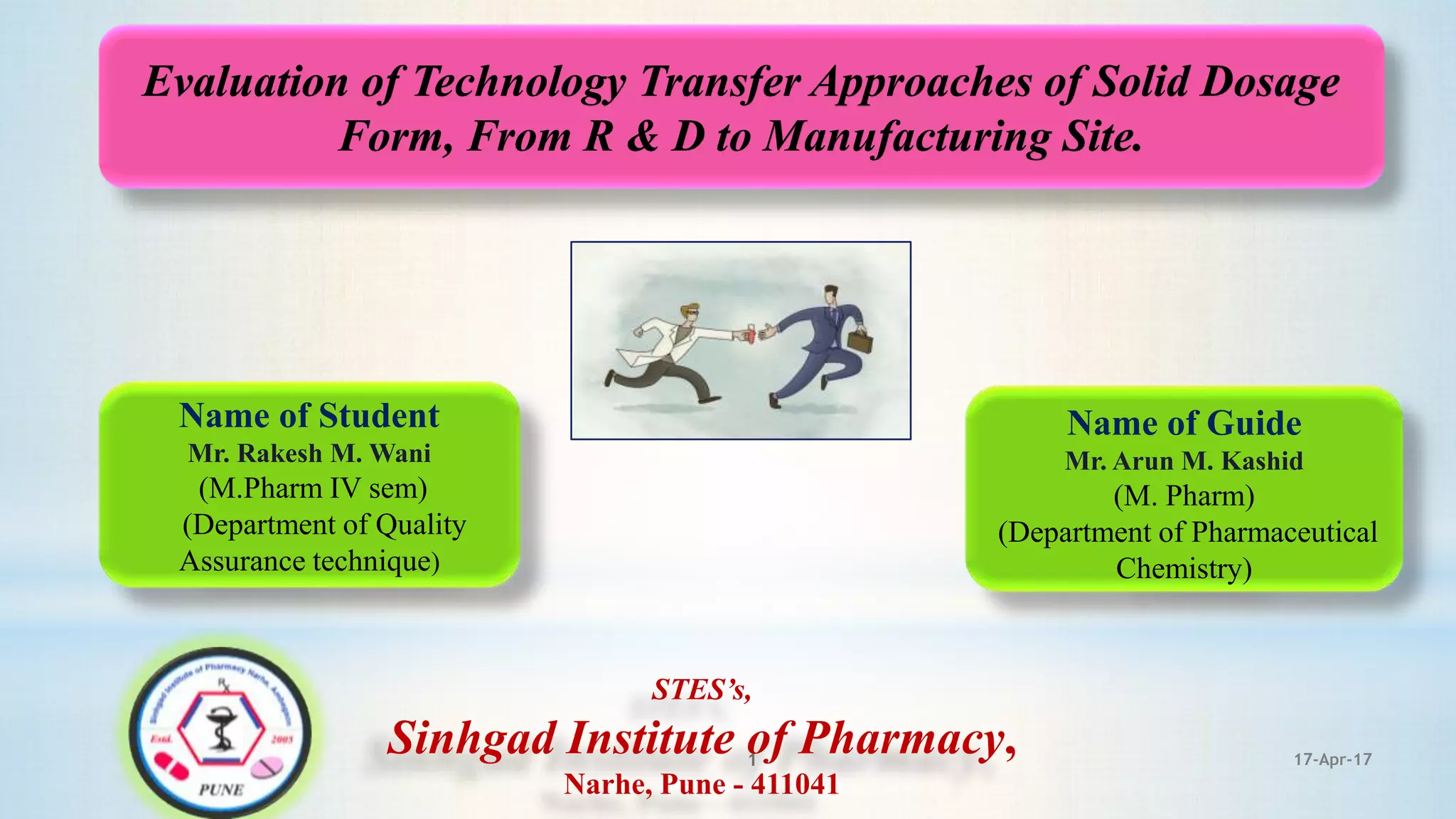
Evaluation of Technology Transfer Approaches of Solid Dosage
Form, From R & D to Manufacturing Site.
Name of Student
Mr. Rakesh M. Wani
(M.Pharm IV sem)
(Department of Quality
Assurance technique)
Name of Guide
Mr. Arun M. Kashid
(M. Pharm)
(Department of Pharmaceutical
Chemistry)
STES’s,
Sinhgad Institute of Pharmacy,
Narhe, Pune - 411041
17-Apr-172
1. Introduction
2. Literature survey
3. Aim and Objective
4. Plan of work
5. Material and Method
6. Evaluation parameter
7. Source of data
8. Outcome
9. References
CONTENT
17-Apr-173
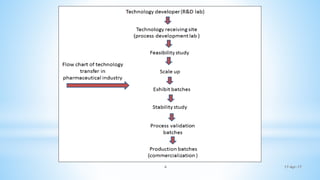
“The transfer of the manufacturing process for a new pharmaceutical Drug
Substance (DS) and Drug Product (DP), respectively, from the transferring site
(in this case R&D) to the receiving site or designated commercial manufacturing
site.” This includes all the associated knowledge, information and skills to be
able to manufacturing the DS and DP at the receiving site.
Introduction
Definition
17-Apr-174
17-Apr-175
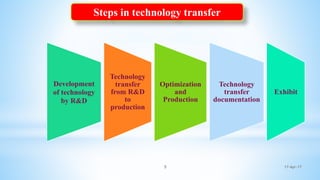
Development
of technology
by R&D
Technology
transfer
from R&D
to
production
Optimization
and
Production
Technology
transfer
documentation
Exhibit
Steps in technology transfer
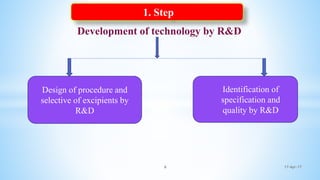
Development of technology by R&D
17-Apr-176
Design of procedure and
selective of excipients by
R&D
Identification of
specification and
quality by R&D
1. Step
17-Apr-177
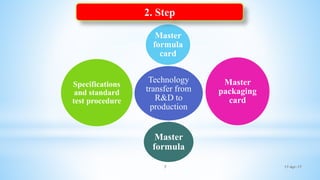
Technology
transfer from
R&D to
production
Master
formula
card
Master
packaging
card
Master
formula
Specifications
and standard
test procedure
2. Step
17-Apr-178
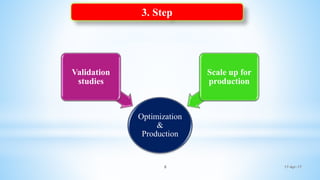
Optimization
&
Production
Validation
studies
Scale up for
production
3. Step
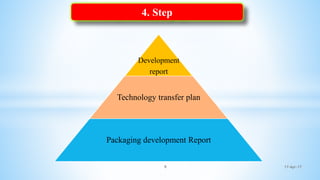
Development
report
Technology transfer plan
Packaging development Report
17-Apr-179
4. Steps in technology transfer4. Step
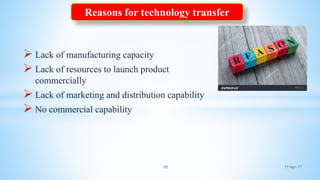
 Lack of manufacturing capacity
 Lack of resources to launch product
commercially
 Lack of marketing and distribution capability
 No commercial capability
17-Apr-1710
Reasons for technology transfer
17-Apr-1711
The more effectively knowledge is shared within an organization.
Innovative R&D.
Drug Approvals.
Effective commercialization.
Ensure safe, pure and effective drug product.
Cost effective production and distribution.
Advantages
17-Apr-1712
Literature Review
17-Apr-1713
LITERATURE REVIEW
17-Apr-1714
LITERATURE REVIEW
17-Apr-1715
LITERATURE REVIEW
17-Apr-1716
LITERATURE REVIEW
17-Apr-1717
LITERATURE REVIEW
17-Apr-1718
LITERATURE REVIEW
17-Apr-1719
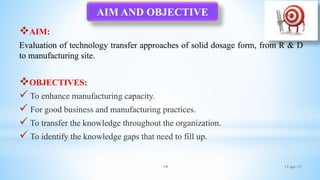
AIM:
Evaluation of technology transfer approaches of solid dosage form, from R & D
to manufacturing site.
OBJECTIVES:
 To enhance manufacturing capacity.
 For good business and manufacturing practices.
 To transfer the knowledge throughout the organization.
 To identify the knowledge gaps that need to fill up.
AIM AND OBJECTIVE
17-Apr-1720
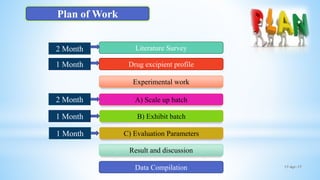
Plan of Work
Literature Survey
Drug excipient profile
A) Scale up batch
Experimental work
B) Exhibit batch
C) Evaluation Parameters
Data Compilation
Result and discussion
2 Month
1 Month
2 Month
1 Month
1 Month
17-Apr-1721
Drug Substance (API) and other excipients with their
manufacturer.
Material
Material and Method
Method
API and other excipients for various operation like,
Dispensing, Sifting, Mixing, Granulation, Drying, Blending,
Compression, Coating, etc.
17-Apr-1722
EVALUATION PARAMETERS
17-Apr-1723
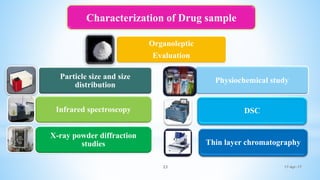
Particle size and size
distribution
Infrared spectroscopy
X-ray powder diffraction
studies
Physiochemical study
DSC
Thin layer chromatography
Characterization of Drug sample
Organoleptic
Evaluation
17-Apr-1724
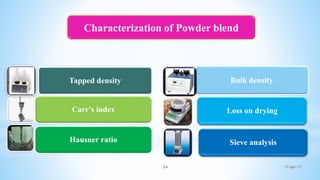
Tapped density
Carr's index
Hausner ratio
Bulk density
Loss on drying
Sieve analysis
Characterization of Powder blend
17-Apr-1725
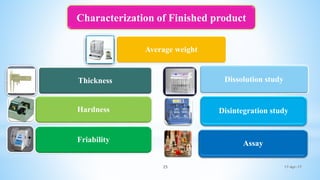
Thickness
Hardness
Friability
Dissolution study
Disintegration study
Assay
Characterization of Finished product
Average weight
17-Apr-1726
SOURCES OF DATA
R & D documents or Transferring site documents.
Lab Note Book ( LNB)
Trade Journal
Internet Sourcing
Sources of data
17-Apr-1727
Technology transfer is important to upgrade the quality of design to be the
quality of product, and ensure stable and high quality of product.
The ultimate goal is to effectively transfer product and specification,
manufacturing and control operations.
EXPECTED OUTCOME
1. WHO guideline on transfer of technology in pharmaceutical
manufacturing.
2. Gupta P, Agrawal A, Sara U, (2013),Technology transfer in Pharmaceutical
Industry, International journal of universal pharmacy and bio sciences.
2(2)93-101.
3. Gupta S, Saini S, Rana A.C., Chugh Isha, (2012), Technology transfer in
Pharmaceutical Industry, International Pharmaceutical Sciencia. 2(3)1-6.
17-Apr-1728
References
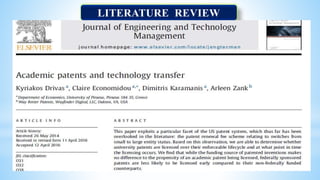
Kyrikos Drivas, Claire Economidou, Dimitris Karamanis, Arleen Zank,(2016),
Academic patents and technology transfer, Journal of engineering and
technology management.1-19.
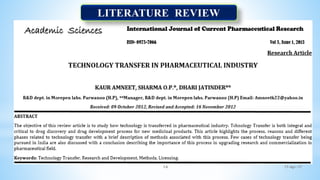
Kaur A, Sharma o, (2013), Technology Transfer in Pharmaceutical Industry.

International Journal of Current Pharmaceutical Research. 5(12)1-5.
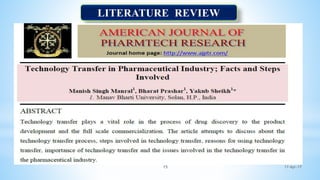
Manral M.S, Prashar B, Sheikh Y, (2012), Technology transfer in pharmaceutical
industry; Facts and steps involved. American journal of pharmaceutical research.
2(4)73-83.
17-Apr-1729
4.
5.
6.
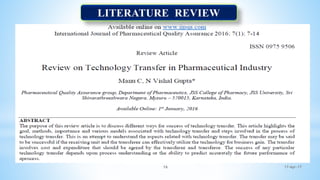
Manu C, N Vishal Gupta(2016), Review on technology transfer in
pharmaceutical industry, International journal of pharmaceutical quality
assurance. 7(1)7-14
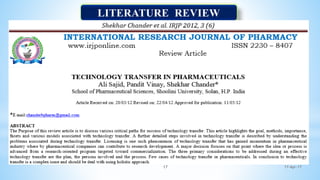
Ali s, Pandit v, Shekhar c, (2012), Technology transfer in
Pharmaceutics. International Research Journal of pharmacy. 3(6)43-48.
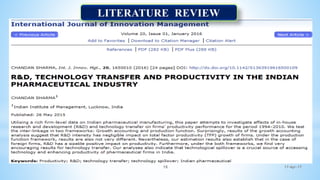
Chanad Sharma, (2016), R&D Technology transfer & Productivity in
the Indian pharmaceutical industry, International Journal Of Innovation
Management. 20(5)1-24.
17-Apr-1730
7.
8.
9.
17-Apr-1731

Technology transfer in pharmaceutical industry