TECHNOLOGY
TRANSFER FROM R&D
TO PRODUCTION
BY D ARSHIA SHARIFF
HEAD, DEPT OF QAT
DEFINITION
• “Technology Transfer” refers to the processes that are
needed for successful progress from drug discovery to
product development to clinical trials to full-scale
commercialization
or
• It is the process by which a developer of technology makes
it’s technology available to commercial partner that will
exploit the technology.
THE IMPORTANCES OF TECHNOLOGY TRANSFER
ARE:
• * To explain necessary information required for transfer technology from R&D to actual manufacturing
• * To explain necessary information required for transfer technology of existing products between various
manufacturing places.
• * To explain with specific examples, the specific procedures and points of concern for the two types of
technology transfer in the above to contribute to smooth technology transfer.
• This is applicable to the technology transfer through R&D and production of drug (chemically synthesized
drug substances and drug products) and the technology transfer related to post-marketing changes in
manufacturing places.
Various stages of formulation development are as follows
• Preformulation studies.
• Bench scale - (1/1000th of X)
• Lab scale – (1/100th of X)
• Scale up- (1/10th of X or 0.1M whichever is maximum)
• Commercial Scale Batch (X)
SCALE-UP AND DETECTION OF QUALITY
VARIABILITY FACTORS (DEVELOPMENT PHASE)
• Research for Factory Production
• To manufacture drugs with qualities as designed, it is required to establish
appropriate quality control methods and manufacturing method.
• This can be done by detecting variability factors to secure stable quality in the
scale-up validation that is performed to realize factory production of drugs
designed on the basis of results from small-scale experiments.
• In general, this process is called the research for factory production where the
quality of design will be upgraded to be the quality of product.
CONSISTENCY BETWEEN QUALITY AND
SPECIFICATION
• When the product specification is established on the basis of the quality of product, it is required to verify that the specification
adequately specifies the product quality. (Consistency between quality and specification).
•
In short, the consistency between quality and specification is to ensure in the product specification that the quality predetermined in
the quality design is assured as the manufacturing quality, and the product satisfies the quality of design.
•
In reviewing factory production, since manufacturing methods are established with limited amount of lots and limited resources of
raw materials, the product specification should be established based on data from study results with limited lots;
• however, relations between upper and lower limits of manufacturing formula (compositions and manufacturing methods) and upper
and lower of control limits of the product specification should be fully understood, and the consistency between the product quality
and specification should be maintained.
•
Also, since initial manufacturing formula and specification are established based on limited information, the consistency between
the quality and specification should be fully verified after the start of manufacturing, and the consistency should be revised through
appropriate change controls, if necessary.
ASSURANCE OF CONSISTENCY THROUGH
DEVELOPMENT AND MANUFACTURING
• To make developed product having indications as predetermined in clinical phases, the quality of design
should be reproducible as the quality of product (assurance of consistency). For this purpose,
• the transferring party in charge of development should fully understand what kind of technical information is
required by the transferred party in charge of manufacturing, and should establish an appropriate evaluation
method to determine whether a drug to be manufactured meets the quality of design.
• It should be recognized that technical information of developed product are generated from data of a limited
amount of batches, various standards have been established from the limited data, and quality evaluation
method established in development phase is not always sufficient for factory production.
• For stable production of consistent products, it is fundamental to fully refer to information of similar products of
the past maintained by the manufacturer when research for factory production is implemented, and this is a
key to successful technology transfer.
TECHNOLOGY TRANSFER FROM R&D TO
PRODUCTION
• Transfer of technical information is necessary to realize manufacturing formula
established in the above in the actual production facility.
• In the past, the technology transfer was mainly seen as standard transfer or as
technology instruction from technology department to production department within
the same company.
• In future, since contract manufacturing is expected to increase under the revised
Pharmaceutical Affairs Law, the technology transfer between companies will increase.
• When transfer technology of new products from R&D dept to production dept,
technical information to be transferred should be complied as R&D report
(development report and recommend to use the development report as a part of
technology transfer documentations).
VALIDATION AND PRODUCTION (PRODUCTION
PHASE)
• Production is implemented after various validation studies verify that it is able to
stably produce based on transferred manufacturing formula.
• If the mfg facility accepting technology is responsible for validation, the R&D dept
transferring technology should take responsibility for validations such as:
Performance qualification (PQ), Cleaning validation(CV), Process validation (PV)
unique to subject drugs.
• For validations such as installation qualification (IQ) and operational qualification
(OQ), which are not unique to the subject drugs, it is possible to effectively use
data of already implemented validations.
FEEDBACK OF INFORMATION GENERATED FROM
PRODUCTION PHASE AND TECHNOLOGY TRANSFER OF
MARKETED PRODUCTS
• Since the technical information of developed products are obtained from data of a limited amount of batches, various
standards have been established from the limited data, and quality evaluation method established in development phase
is not always sufficient for factory production, it is highly desired to feed back and accumulate technical information
obtained from repeated production, if necessary.
• Also, it is important to appropriately modify various standards established before on the basis of these information, and
accountability (responsibility for giving sufficient explanation) and responsibility (responsibility for outcomes of actions) for
design and manufacturing should be executed.
• For this purpose, appropriate feedback system for technical information and documentation management of technology
transfer should be established.
• For drugs having long product shelf life, documentation management should be performed because technology transfer
would occur several decades after the completion of development.
• Also since product improvements and changes of specifications and methods are often implemented, the initial technical
information should be reviewed and updated at regular intervals.
PROCEDURES AND DOCUMENTATION OF
TECHNOLOGY TRANSFER
Organization for Technology Transfer
• One of the most significant elements for successful technology transfer is close
communication between transferring and transferred parties.
• Organization for technology transfer should be established and composed of both party
members.
• Roles and scope of responsibilities of each party should be clarified, and adequate
communication and feedback of information should be ensured.
It is desirable that this organization complies with GMP.
R&D REPORT(DEVELOPMENTAL REPORT)
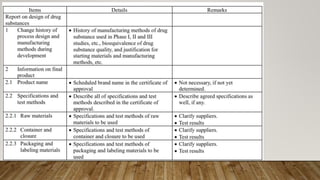
• The research and development report (development report) is a file of technical information necessary for drug manufacturing, which is obtained from
pharmaceutical development, and the research and development department is in charge of its documentation.
• This report is an important file to indicate rationale for the quality design of drug substances and drug products including information such as raw materials,
components, manufacturing methods, specifications and test methods. I
• It is desirable to document the report before the approval inspection.
• Also, this report can be used as raw data in case of post-marketing technology transfer.
• The following information should be contained in the development report:
1. Historical data of pharmaceutical development of new drug substances and drug products at stages from early development phase to final application of
approval
2. Raw materials and components.
3. Synthetic route
4. Rationale for dosage form and formula designs.
Rationale for design of manufacturing methods.
Rational and change histories of important processes and control parameters.
Quality profiles of manufacturing batches (including stability data).
Specifications and test methods of drug substances, intermediates, drug products, raw materials, and components, and their rationale .
5. Validity of specification range of important tests such as contents, impurities and dissolution,
6. Rationale for selection of test methods, regents, and columns, and traceability of raw data of those information
TECHNOLOGY TRANSFER DOCUMENTATION
• They are documents indicating
contents of technology transfer
for transferring and transferred
parties.
DEVELOPMENT REPORT SHOULD BE PREPARED
TASK ASSIGNMENTS AND RESPONSIBILITIES SHOULD
BE CLARIFIED
ACCEPTANCE CRITERIA FOR THE COMPLETION OF
TECHNOLOGY TRANSFER SHOULDD BE SET
PREPARE PRODUCT SPECIFICATION
DOCUMENT THE RESULTS AS THE TECHNOLOGY
TRANSFER REPORT.
PRODUCT SPECIFICATION (PRODUCT
SPECIFICATION FILE)
• The product specification is information which helps the manufacture of the product, and to define specification,
manufacturing and evaluation methods of the product and its quality, and the transferring party is responsible for
documenting the file.
• For new products, the development report can be used as a part of product specification file.
• The product specification file should contain the following.
1. Information necessary for the Start And Continuation Of Product Manufactuirng
2. Information necessary for Quality Assurance Of The Product
3. Information necessary for Assurance Of Operation Safety
4. Information necessary for Environmental Impact Assessment
5. Information of Costs
6. Other Specific Information of the product
TECHNOLOGY TRANSFER PLAN
• Describe items and contents of technology to be transferred and detailed procedures of individual transfer
and transfer schedule, and establish judgment criteria for the completion of the transfer.
• The transferring party should prepare the plan before the implementation of the transfer, and reach an
agreement on its contents with the transferred party.
Technology Transfer Report
Report the completion of technology transfer after data of actions taken according to the technology plan is
evaluated and the data is confirmed.
• Both transferring and transferred parties can document the technology transfer report; however, they
should reach an agreement on its contents.
CHECK AND APPROVAL BY QUALITY ASSURANCE
DEPARTMENT
• It is desirable that the quality assurance department should establish confirmation
process for all kinds of technology transfer documentation, and should check and
approve the documentation.
• For Implementation of Technology Transfer
• Avoid as much as possible the technology transfer just by handing over the
technology transfer documentation.
It is recommended that the both parties should cooperate to implement technology
education, training and validations at facilities where the transferred technology is
actually used.
• Manufacturing Related Documents Including Drug Product Standards
The transferred party should compile documents such as drug product standards necessary for
manufacturing, various standards and validation plans/reports after the completion of technology transfer.
The transferring party should make necessary confirmation for these documents.
• Verification of Results of Technology Transfer
After the completion of technology transfer and before the start of manufacturing of the product, the
transferring party should verify with appropriate methods such as product testing and audit that the product
manufactured after the technology transfer meets the predetermined quality, and should maintain records
of the results.
• Points of Concern for Post-Marketing Technology Transfer
IF, some marketed products do not have development report which can be used as raw data. In this case,
a development report needs not to be newly documented; This file can be used as reference file in case of
regular inspection.
EXAMPLES OF TECHNICAL INFORMATION TO BE
CONTAINED IN TECHNOLOGY TRANSFER
DOCUMENTATION
• 4.1 Technical Information of Facilities and Equipments
• For technology transfer, technical information of products as well as those of manufacturing facilities and equipments
are important. To establish facilities and equipments conforming to GMP, it is essential to obtain and understand
information from R&D process so that quality assurance of subject drugs can be secured and the facilities and
equipments can comply with required conditions for manufacturing. For that purpose, the following technical
information should be transferred.
• The R&D department should clarify considerations of GMP compliance specific to subject drugs and manufacturing
methods (manufacturing processes), and present them to a facility and equipment department.
• The facility and equipment department should establish facilities and equipments reflecting the above
considerations, clearly details of the establishment and operational considerations of those facilities and equipments,
and present them to a drug manufacturing department.
• The drug manufacturing department should fully understand the above information, implement validations, perform
appropriate operations and controls in conformity to the established facilities and equipments, and records results of
operations and controls.
• Information Necessary for the Establishment of Facilities and Equipments (Input Information)
• Information necessary for the establishment of facilities and equipments in conformity to GMP are classified into the following three categories.
• 1) Required Functions of facilities and equipments necessary for quality assurance of subject drugs
• 2) Required functions of facilities and equipments specific to manufacturing methods (manufacturing processes)
• 3) Basic required functions necessary for GMP compliance such as prevention of contamination, and human failures, etc.
• Regarding 1) and 2), the drug manufacturing department should extract information affecting facilities and equipments from results of quality design
during drug development (information on composition, manufacturing and specification), review results of scale-up and quality variability factors during
possible factory production, fully understand them and present documents containing
• clarified considerations of GMP compliance specific to subject drugs and manufacturing methods (manufacturing processes) to the facility and
equipment department.
The facility and equipment department should document interpretations of the above information in forms such as “quality requirement specification”
and present the documentation to the R&D department to confirm each other. The both departments should clarify differences of each thought by
conforming documents prepared from their own perspectives, and establish certain input data of facility and equipment establishment by obtaining
necessary or unnecessary evidence data, extracting unnecessary data, and feeding back them to the R&D department.
• Concerning 3), information can be collected by sorting out and reviewing GMP requirements for properties of subject drugs and manufacturing
methods and organization of facilities and equipments. Degree of contamination and acceptable contamination level of the subject drugs and
acceptable limit of residues are important to determine prevention level of contamination and cleaning methods at the facilities and equipments. Since
policies on facilities and equipments such as multi-item production level and automatic production level may have a great impact on granting levels to
facilities and equipments regarding prevention for human failures such as cross- contamination or mix-up, measures should be taken in view of all
properties of drugs and manufacturing methods which are to be used at the facilities and equipments to be established.
Information of Results of the Establishment of Facilities and Equipments (Output
Information)
Establishing facilities and equipments includes actions to upgrade facilities and
equipments to be functions for achieving established objectives (required specifications),
plan and design details while reflecting considerations specific to the facilities and
equipments, construct them in time for the start of manufacturing, and perform
qualifications upon the trial operation, while it is important to transfer results of the
establishment of facilities and equipments to the drug manufacturing department so that
the department can implement validations and production.
It is important for GMP compliance to prepare documents including series of activities
from initial stages of establishment (plan and design), the trial operation through
qualifications and present them to the third party. In short, output information should be
documented by extracting facility and equipment related information from documents
compiled during the establishment of facilities and equipments (design, procurement,
construction, and trial operation, etc.) to assure the quality of the subject drugs. Cross
checking of input and output information are equal to series of qualifications such as DQ,
IQ and OQ, while results of qualifications are integrations of output information.
4.1.2 Technical Information When Applied to Established Facilities and Equipments
Subject drugs are often manufactured in existing facilities and equipments. Although there are limitations attributable
to the characteristics of the existing facilities and equipments, technical documents should be prepared to
demonstrate that those facilities and equipments meet required specifications (so called objectives) for quality
assurance of drugs, and this kind of preparation can be equal to the establishment of facilities and equipments in
conformity to the subject drug manufacturing. Basic contents of necessary technical documents are similar to those of
new facilities and equipments, while only difference is documentation method.
Information necessary for the establishment of existing facilities and equipments are classified into the following three
categories as in the case of the new facilities and equipments.
1.1) Required Functions of facilities and equipments necessary for quality assurance of subject drugs
2.2) Required functions of facilities and equipments specific to manufacturing methods (manufacturing processes)
3.3) Basic required functions necessary for GMP compliance such as prevention of contamination, and human
failures, etc.
TECHNOLOGY TRANSFER OF TEST METHODS
• Development Report of Test Methods
• The main objective of documenting development report of test methods is to make quality assurance of drugs more secured one by appropriately
transferring technical information accumulated at each stage from design of test methods through those implementation between various
departments (organizations).
• Therefore, it is desirable that the development report should include details of test methods, information related to drug properties such as
physicochemical properties, biological properties, and safety information, background of development of the test methods and rationale for the
establishment, and validity and rationale for specifications from early research and development phase to production.
• Specifications and Test Methods
• Test methods subject to technology transfer include the following.
• Test methods for drug substances
Test methods for drug products
Test methods for raw materials and components Test methods for in-process tests
Test methods for drug residue tests
Test methods for environmental tests
• Rational for Specifications and Background
• Especially for historic records of specifications of contents, impurities, and degradation products, rationales for their establishment and changes should be included.
• Results of Validations
• Results of analytical validations for established test methods should be described.
• Development History of Important Test Methods (Development Report on Test Methods)
• Concerning test methods necessary for the evaluation of product quality and important attributes, development and change histories including their rationales should be described. The test methods
include the followings.
• Test methods to measure contents and organic impurities
• Test methods to measure residual solvents and volatile compounds
• Dissolution tests for oral solid drug products
• Test methods to measure residual minerals in drug substances such as metals
• Test methods to evaluate physicochemical properties of drug substances and drug products
• such as polymorphism and hygroscopicity
• Summary of Test Results (Summary of Batch Analysis)
• Summary of test results of batches used to develop test methods described in the development report should be
described as tables including references to raw data.
• Reference Standards
• Reference standards to be used in tests of subject substances and impurities should be described. The description
should include methods of manufacturing, purification, evaluation for the purity and quality, and storage.
• Other information
• Items other than the above such as information of drug substances and drug products (properties, stability,
manufacturing methods, and formula, background of drug development, containers, etc.) should be described if
necessary. If those information are described in the Common Technical Document (CTD), references to raw data
should be included.
• Technology Transfer Plan
• For technology transfer of test methods, it is required to clarify validation range and acceptance
criteria of conformity of technology transfer regarding individual test methods to be transferred.
The validation range (e.g. full validations, reproducibility, etc.) should be judged on the basis of
results of evaluation of technologies, facilities and equipments of transferred party, and the
range may be influenced by information to be contained in the technology transfer
documentation.
To compare test results, samples (including dose range, number of batches, etc.), specific test
methods and evaluation methods to be used in the transferring and transferred parties should
be specified.
Acceptance criteria should be established for each test method of subject items on the basis of
accumulated test results of the past and analytical validation data, and rationales for the
acceptance criteria should be clearly described.
• Information of Raw Materials
• Summary including physical and chemical properties and stability
• Name and structural formula
• Stability data
• Specifications and test methods
• Specific test methods and specifications
• Change history of specifications and test methods and its rationale
• Results of analytical validation
• List of reference standards (Test results should be attached.)
• Information of toxicity and stability for laboratory use
• List of subject samples for comparative evaluation and their test results
• Information of Drug Substances
• Summary including physicochemical properties and stability
• Name and structural formula
• Elucidation of chemical structure
• Possible isomers
• Physical and chemical properties (including physicochemical properties)
• Stability data (including severe test data)
• Batch records
• Chemical synthesis methods of subject batches
• Analytical data of batches
• Impurity profile of representative batch
• Specifications and test methods
• Specific test methods and specifications (including items related to efficacy such as
• particle size distribution, polymorphism, crystallinity, and hygroscopicity)
• Change history of specifications and test methods and their rationales
• Results of analytical method validation
• List of reference standards (Test results should be attached.)
• Development report on test methods (Interim report is acceptable depending on
• development phases.)
• Information of toxicity and stability for laboratory use
• List of subject samples for comparative evaluation and their test results
INFORMATION OF DRUG
PRODUCTS
• Summary including formula and stability
• Formula and contents
• Elucidation of dissolution profile
• Stability data (including severe test data)
• Storage conditions and expiry date (if
established)
• Analytical data of batches
• Specifications and test methods
• Specific test methods and specifications
(including items related to efficacy such as
particle size distribution and hygroscopicity)
• Change history of specifications and test
methods and its rationale
4.3 INFORMATION ON
IMPLEMENTATION OF TECHNOLOGY
TRANSFER
• Persons in charge of planning, checking and settlement of technology transfer Test
methods (test method number
Objectives
Persons in charge of transferring and transferred parties
• Training plan (including explanation of test methods and demonstration) Plan of
comparative evaluation study
• Samples: Lot No. (including rationale for the number of lots), storage condition
• during test, and handling after the completion of the test (disposal or return to the
• transferred party, etc.)
• Test period
• Number of repeated tests
• Handling of data (Handling method)
• Retest and handling of outlier
• Acceptance criteria
• Storage of raw data (storage department, storage place, and duration, etc.)
• Judge (person in charge of judgment in the transferring party)
DOCUMENTS TO CLARIFY APPLICABLE TECHNOLOGIES, BURDEN SHARES AND
RESPONSIBILITY SYSTEM, ETC. CONCERNING TECHNOLOGY TRANSFER
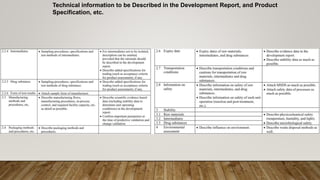
Technical information to be Described in the Development Report, and Product
Specification, etc.
QUANTITATIVE MODELS
• Sharif & Haq Model :Cocept is
“Measurement of PTD” (Potential
Technological Distance) between the
transferor and the transferee gives an
idea as to how effective the
technology Transfer will be. The
transferee should search for a
potential transferer with an optimum
PTD
• Raz et al: concept is
“Technological Catch up Rate”. It
helps both transferor and Transferee
to make effective technology transfer
strategies, plan of execution and
monitoring.
QUANTITATIVE MODELS
• Hamid Jafrieh Model:
• Concept is “rate of technology
Integration”. Helps to identify socio-
economic factors in technology
transfer. Helps in measuring
effectiveness of technology transfer
in developing countries.
• Technology Evaluation Model:
• Concept is “Technology Evaluation”.
Objective Valuation of technology
transfer is required to asess the price
involved in the process of technology
transfer
EXTENDED QUANTITATIVE MODEL
• Concept of this model is “Technology Index” where the technological Index of a
country is asessed. The measure of the technology transfer potential between
the tranferee and the transferor is asessed at the industrial by taking into acount
time, technological Level and dynamical potential technological Distance into
calculation.
QUALITATIVE MODELS-
• Approprability Model: Concept is that
“Quality Technology sells itself”.
There is no significant role of the
transferor , Transferee or the
environment. If the technology is
good and there is a demand, it will
sell itself.
• Bar Zakay model: Concept is “
Project Management Approach”.
Technology transfer process is
divided into 4 stages: Search,
Adaptation, Implementation and
Maintainence. The model depicts the
activities, milestones and Decision
points for every stage.
QUALITATIVE MODELS-
• Behrman Wallender Model:
• It gives “Seven stages for
International Technology Transfer
Process” like Location, Product
Design, Infrastructure Development,
Plant Construction and Production
start up and providing external
support to strengthen relationship
between transferor and Transferee.
• Dissemination Model:
• Dissemination of technology to
potential user shouuld be through a
technology expert.
• Once relationship between expert
and user is established, the
technology transfer will proceed as
smoothly as water running from a
pipe once the valve is opened.
QUALITATIVE MODELS-
• Knowledge utilization model:
• This model emphasises on
“interpersonal communication” and
“Organizational Barriers” in
Technology Transfer. It focuses on
how to organize information for the
technology user.
• Schlie radner and wad model:
• It has 7 elements to the process i.e
• Transferor, Transferee, Transfer
technology, Transfer mechanism, and
first time there is an emphasis on
Transferor environment, Transferee
environment and environment
encompassing the transferor and
Transferee.
4. 2017.2018 PD &TT.pptx

4. 2017.2018 PD &TT.pptx

  • 1.
    TECHNOLOGY TRANSFER FROM R&D TOPRODUCTION BY D ARSHIA SHARIFF HEAD, DEPT OF QAT
  • 2.
    DEFINITION • “Technology Transfer”refers to the processes that are needed for successful progress from drug discovery to product development to clinical trials to full-scale commercialization or • It is the process by which a developer of technology makes it’s technology available to commercial partner that will exploit the technology.
  • 3.
    THE IMPORTANCES OFTECHNOLOGY TRANSFER ARE: • * To explain necessary information required for transfer technology from R&D to actual manufacturing • * To explain necessary information required for transfer technology of existing products between various manufacturing places. • * To explain with specific examples, the specific procedures and points of concern for the two types of technology transfer in the above to contribute to smooth technology transfer. • This is applicable to the technology transfer through R&D and production of drug (chemically synthesized drug substances and drug products) and the technology transfer related to post-marketing changes in manufacturing places. Various stages of formulation development are as follows • Preformulation studies. • Bench scale - (1/1000th of X) • Lab scale – (1/100th of X) • Scale up- (1/10th of X or 0.1M whichever is maximum) • Commercial Scale Batch (X)
  • 6.
    SCALE-UP AND DETECTIONOF QUALITY VARIABILITY FACTORS (DEVELOPMENT PHASE) • Research for Factory Production • To manufacture drugs with qualities as designed, it is required to establish appropriate quality control methods and manufacturing method. • This can be done by detecting variability factors to secure stable quality in the scale-up validation that is performed to realize factory production of drugs designed on the basis of results from small-scale experiments. • In general, this process is called the research for factory production where the quality of design will be upgraded to be the quality of product.
  • 7.
    CONSISTENCY BETWEEN QUALITYAND SPECIFICATION • When the product specification is established on the basis of the quality of product, it is required to verify that the specification adequately specifies the product quality. (Consistency between quality and specification). • In short, the consistency between quality and specification is to ensure in the product specification that the quality predetermined in the quality design is assured as the manufacturing quality, and the product satisfies the quality of design. • In reviewing factory production, since manufacturing methods are established with limited amount of lots and limited resources of raw materials, the product specification should be established based on data from study results with limited lots; • however, relations between upper and lower limits of manufacturing formula (compositions and manufacturing methods) and upper and lower of control limits of the product specification should be fully understood, and the consistency between the product quality and specification should be maintained. • Also, since initial manufacturing formula and specification are established based on limited information, the consistency between the quality and specification should be fully verified after the start of manufacturing, and the consistency should be revised through appropriate change controls, if necessary.
  • 8.
    ASSURANCE OF CONSISTENCYTHROUGH DEVELOPMENT AND MANUFACTURING • To make developed product having indications as predetermined in clinical phases, the quality of design should be reproducible as the quality of product (assurance of consistency). For this purpose, • the transferring party in charge of development should fully understand what kind of technical information is required by the transferred party in charge of manufacturing, and should establish an appropriate evaluation method to determine whether a drug to be manufactured meets the quality of design. • It should be recognized that technical information of developed product are generated from data of a limited amount of batches, various standards have been established from the limited data, and quality evaluation method established in development phase is not always sufficient for factory production. • For stable production of consistent products, it is fundamental to fully refer to information of similar products of the past maintained by the manufacturer when research for factory production is implemented, and this is a key to successful technology transfer.
  • 9.
    TECHNOLOGY TRANSFER FROMR&D TO PRODUCTION • Transfer of technical information is necessary to realize manufacturing formula established in the above in the actual production facility. • In the past, the technology transfer was mainly seen as standard transfer or as technology instruction from technology department to production department within the same company. • In future, since contract manufacturing is expected to increase under the revised Pharmaceutical Affairs Law, the technology transfer between companies will increase. • When transfer technology of new products from R&D dept to production dept, technical information to be transferred should be complied as R&D report (development report and recommend to use the development report as a part of technology transfer documentations).
  • 10.
    VALIDATION AND PRODUCTION(PRODUCTION PHASE) • Production is implemented after various validation studies verify that it is able to stably produce based on transferred manufacturing formula. • If the mfg facility accepting technology is responsible for validation, the R&D dept transferring technology should take responsibility for validations such as: Performance qualification (PQ), Cleaning validation(CV), Process validation (PV) unique to subject drugs. • For validations such as installation qualification (IQ) and operational qualification (OQ), which are not unique to the subject drugs, it is possible to effectively use data of already implemented validations.
  • 11.
    FEEDBACK OF INFORMATIONGENERATED FROM PRODUCTION PHASE AND TECHNOLOGY TRANSFER OF MARKETED PRODUCTS • Since the technical information of developed products are obtained from data of a limited amount of batches, various standards have been established from the limited data, and quality evaluation method established in development phase is not always sufficient for factory production, it is highly desired to feed back and accumulate technical information obtained from repeated production, if necessary. • Also, it is important to appropriately modify various standards established before on the basis of these information, and accountability (responsibility for giving sufficient explanation) and responsibility (responsibility for outcomes of actions) for design and manufacturing should be executed. • For this purpose, appropriate feedback system for technical information and documentation management of technology transfer should be established. • For drugs having long product shelf life, documentation management should be performed because technology transfer would occur several decades after the completion of development. • Also since product improvements and changes of specifications and methods are often implemented, the initial technical information should be reviewed and updated at regular intervals.
  • 12.
    PROCEDURES AND DOCUMENTATIONOF TECHNOLOGY TRANSFER Organization for Technology Transfer • One of the most significant elements for successful technology transfer is close communication between transferring and transferred parties. • Organization for technology transfer should be established and composed of both party members. • Roles and scope of responsibilities of each party should be clarified, and adequate communication and feedback of information should be ensured. It is desirable that this organization complies with GMP.
  • 13.
    R&D REPORT(DEVELOPMENTAL REPORT) •The research and development report (development report) is a file of technical information necessary for drug manufacturing, which is obtained from pharmaceutical development, and the research and development department is in charge of its documentation. • This report is an important file to indicate rationale for the quality design of drug substances and drug products including information such as raw materials, components, manufacturing methods, specifications and test methods. I • It is desirable to document the report before the approval inspection. • Also, this report can be used as raw data in case of post-marketing technology transfer. • The following information should be contained in the development report: 1. Historical data of pharmaceutical development of new drug substances and drug products at stages from early development phase to final application of approval 2. Raw materials and components. 3. Synthetic route 4. Rationale for dosage form and formula designs. Rationale for design of manufacturing methods. Rational and change histories of important processes and control parameters. Quality profiles of manufacturing batches (including stability data). Specifications and test methods of drug substances, intermediates, drug products, raw materials, and components, and their rationale . 5. Validity of specification range of important tests such as contents, impurities and dissolution, 6. Rationale for selection of test methods, regents, and columns, and traceability of raw data of those information
  • 14.
    TECHNOLOGY TRANSFER DOCUMENTATION •They are documents indicating contents of technology transfer for transferring and transferred parties. DEVELOPMENT REPORT SHOULD BE PREPARED TASK ASSIGNMENTS AND RESPONSIBILITIES SHOULD BE CLARIFIED ACCEPTANCE CRITERIA FOR THE COMPLETION OF TECHNOLOGY TRANSFER SHOULDD BE SET PREPARE PRODUCT SPECIFICATION DOCUMENT THE RESULTS AS THE TECHNOLOGY TRANSFER REPORT.
  • 15.
    PRODUCT SPECIFICATION (PRODUCT SPECIFICATIONFILE) • The product specification is information which helps the manufacture of the product, and to define specification, manufacturing and evaluation methods of the product and its quality, and the transferring party is responsible for documenting the file. • For new products, the development report can be used as a part of product specification file. • The product specification file should contain the following. 1. Information necessary for the Start And Continuation Of Product Manufactuirng 2. Information necessary for Quality Assurance Of The Product 3. Information necessary for Assurance Of Operation Safety 4. Information necessary for Environmental Impact Assessment 5. Information of Costs 6. Other Specific Information of the product
  • 16.
    TECHNOLOGY TRANSFER PLAN •Describe items and contents of technology to be transferred and detailed procedures of individual transfer and transfer schedule, and establish judgment criteria for the completion of the transfer. • The transferring party should prepare the plan before the implementation of the transfer, and reach an agreement on its contents with the transferred party. Technology Transfer Report Report the completion of technology transfer after data of actions taken according to the technology plan is evaluated and the data is confirmed. • Both transferring and transferred parties can document the technology transfer report; however, they should reach an agreement on its contents.
  • 17.
    CHECK AND APPROVALBY QUALITY ASSURANCE DEPARTMENT • It is desirable that the quality assurance department should establish confirmation process for all kinds of technology transfer documentation, and should check and approve the documentation. • For Implementation of Technology Transfer • Avoid as much as possible the technology transfer just by handing over the technology transfer documentation. It is recommended that the both parties should cooperate to implement technology education, training and validations at facilities where the transferred technology is actually used.
  • 18.
    • Manufacturing RelatedDocuments Including Drug Product Standards The transferred party should compile documents such as drug product standards necessary for manufacturing, various standards and validation plans/reports after the completion of technology transfer. The transferring party should make necessary confirmation for these documents. • Verification of Results of Technology Transfer After the completion of technology transfer and before the start of manufacturing of the product, the transferring party should verify with appropriate methods such as product testing and audit that the product manufactured after the technology transfer meets the predetermined quality, and should maintain records of the results. • Points of Concern for Post-Marketing Technology Transfer IF, some marketed products do not have development report which can be used as raw data. In this case, a development report needs not to be newly documented; This file can be used as reference file in case of regular inspection.
  • 19.
    EXAMPLES OF TECHNICALINFORMATION TO BE CONTAINED IN TECHNOLOGY TRANSFER DOCUMENTATION • 4.1 Technical Information of Facilities and Equipments • For technology transfer, technical information of products as well as those of manufacturing facilities and equipments are important. To establish facilities and equipments conforming to GMP, it is essential to obtain and understand information from R&D process so that quality assurance of subject drugs can be secured and the facilities and equipments can comply with required conditions for manufacturing. For that purpose, the following technical information should be transferred. • The R&D department should clarify considerations of GMP compliance specific to subject drugs and manufacturing methods (manufacturing processes), and present them to a facility and equipment department. • The facility and equipment department should establish facilities and equipments reflecting the above considerations, clearly details of the establishment and operational considerations of those facilities and equipments, and present them to a drug manufacturing department. • The drug manufacturing department should fully understand the above information, implement validations, perform appropriate operations and controls in conformity to the established facilities and equipments, and records results of operations and controls.
  • 20.
    • Information Necessaryfor the Establishment of Facilities and Equipments (Input Information) • Information necessary for the establishment of facilities and equipments in conformity to GMP are classified into the following three categories. • 1) Required Functions of facilities and equipments necessary for quality assurance of subject drugs • 2) Required functions of facilities and equipments specific to manufacturing methods (manufacturing processes) • 3) Basic required functions necessary for GMP compliance such as prevention of contamination, and human failures, etc. • Regarding 1) and 2), the drug manufacturing department should extract information affecting facilities and equipments from results of quality design during drug development (information on composition, manufacturing and specification), review results of scale-up and quality variability factors during possible factory production, fully understand them and present documents containing • clarified considerations of GMP compliance specific to subject drugs and manufacturing methods (manufacturing processes) to the facility and equipment department. The facility and equipment department should document interpretations of the above information in forms such as “quality requirement specification” and present the documentation to the R&D department to confirm each other. The both departments should clarify differences of each thought by conforming documents prepared from their own perspectives, and establish certain input data of facility and equipment establishment by obtaining necessary or unnecessary evidence data, extracting unnecessary data, and feeding back them to the R&D department. • Concerning 3), information can be collected by sorting out and reviewing GMP requirements for properties of subject drugs and manufacturing methods and organization of facilities and equipments. Degree of contamination and acceptable contamination level of the subject drugs and acceptable limit of residues are important to determine prevention level of contamination and cleaning methods at the facilities and equipments. Since policies on facilities and equipments such as multi-item production level and automatic production level may have a great impact on granting levels to facilities and equipments regarding prevention for human failures such as cross- contamination or mix-up, measures should be taken in view of all properties of drugs and manufacturing methods which are to be used at the facilities and equipments to be established.
  • 21.
    Information of Resultsof the Establishment of Facilities and Equipments (Output Information) Establishing facilities and equipments includes actions to upgrade facilities and equipments to be functions for achieving established objectives (required specifications), plan and design details while reflecting considerations specific to the facilities and equipments, construct them in time for the start of manufacturing, and perform qualifications upon the trial operation, while it is important to transfer results of the establishment of facilities and equipments to the drug manufacturing department so that the department can implement validations and production. It is important for GMP compliance to prepare documents including series of activities from initial stages of establishment (plan and design), the trial operation through qualifications and present them to the third party. In short, output information should be documented by extracting facility and equipment related information from documents compiled during the establishment of facilities and equipments (design, procurement, construction, and trial operation, etc.) to assure the quality of the subject drugs. Cross checking of input and output information are equal to series of qualifications such as DQ, IQ and OQ, while results of qualifications are integrations of output information.
  • 22.
    4.1.2 Technical InformationWhen Applied to Established Facilities and Equipments Subject drugs are often manufactured in existing facilities and equipments. Although there are limitations attributable to the characteristics of the existing facilities and equipments, technical documents should be prepared to demonstrate that those facilities and equipments meet required specifications (so called objectives) for quality assurance of drugs, and this kind of preparation can be equal to the establishment of facilities and equipments in conformity to the subject drug manufacturing. Basic contents of necessary technical documents are similar to those of new facilities and equipments, while only difference is documentation method. Information necessary for the establishment of existing facilities and equipments are classified into the following three categories as in the case of the new facilities and equipments. 1.1) Required Functions of facilities and equipments necessary for quality assurance of subject drugs 2.2) Required functions of facilities and equipments specific to manufacturing methods (manufacturing processes) 3.3) Basic required functions necessary for GMP compliance such as prevention of contamination, and human failures, etc.
  • 23.
    TECHNOLOGY TRANSFER OFTEST METHODS • Development Report of Test Methods • The main objective of documenting development report of test methods is to make quality assurance of drugs more secured one by appropriately transferring technical information accumulated at each stage from design of test methods through those implementation between various departments (organizations). • Therefore, it is desirable that the development report should include details of test methods, information related to drug properties such as physicochemical properties, biological properties, and safety information, background of development of the test methods and rationale for the establishment, and validity and rationale for specifications from early research and development phase to production. • Specifications and Test Methods • Test methods subject to technology transfer include the following. • Test methods for drug substances Test methods for drug products Test methods for raw materials and components Test methods for in-process tests Test methods for drug residue tests Test methods for environmental tests
  • 24.
    • Rational forSpecifications and Background • Especially for historic records of specifications of contents, impurities, and degradation products, rationales for their establishment and changes should be included. • Results of Validations • Results of analytical validations for established test methods should be described. • Development History of Important Test Methods (Development Report on Test Methods) • Concerning test methods necessary for the evaluation of product quality and important attributes, development and change histories including their rationales should be described. The test methods include the followings. • Test methods to measure contents and organic impurities • Test methods to measure residual solvents and volatile compounds • Dissolution tests for oral solid drug products • Test methods to measure residual minerals in drug substances such as metals • Test methods to evaluate physicochemical properties of drug substances and drug products • such as polymorphism and hygroscopicity
  • 25.
    • Summary ofTest Results (Summary of Batch Analysis) • Summary of test results of batches used to develop test methods described in the development report should be described as tables including references to raw data. • Reference Standards • Reference standards to be used in tests of subject substances and impurities should be described. The description should include methods of manufacturing, purification, evaluation for the purity and quality, and storage. • Other information • Items other than the above such as information of drug substances and drug products (properties, stability, manufacturing methods, and formula, background of drug development, containers, etc.) should be described if necessary. If those information are described in the Common Technical Document (CTD), references to raw data should be included.
  • 26.
    • Technology TransferPlan • For technology transfer of test methods, it is required to clarify validation range and acceptance criteria of conformity of technology transfer regarding individual test methods to be transferred. The validation range (e.g. full validations, reproducibility, etc.) should be judged on the basis of results of evaluation of technologies, facilities and equipments of transferred party, and the range may be influenced by information to be contained in the technology transfer documentation. To compare test results, samples (including dose range, number of batches, etc.), specific test methods and evaluation methods to be used in the transferring and transferred parties should be specified. Acceptance criteria should be established for each test method of subject items on the basis of accumulated test results of the past and analytical validation data, and rationales for the acceptance criteria should be clearly described.
  • 27.
    • Information ofRaw Materials • Summary including physical and chemical properties and stability • Name and structural formula • Stability data • Specifications and test methods • Specific test methods and specifications • Change history of specifications and test methods and its rationale • Results of analytical validation • List of reference standards (Test results should be attached.) • Information of toxicity and stability for laboratory use • List of subject samples for comparative evaluation and their test results • Information of Drug Substances • Summary including physicochemical properties and stability • Name and structural formula • Elucidation of chemical structure • Possible isomers • Physical and chemical properties (including physicochemical properties) • Stability data (including severe test data) • Batch records • Chemical synthesis methods of subject batches • Analytical data of batches • Impurity profile of representative batch • Specifications and test methods • Specific test methods and specifications (including items related to efficacy such as • particle size distribution, polymorphism, crystallinity, and hygroscopicity) • Change history of specifications and test methods and their rationales • Results of analytical method validation • List of reference standards (Test results should be attached.) • Development report on test methods (Interim report is acceptable depending on • development phases.) • Information of toxicity and stability for laboratory use • List of subject samples for comparative evaluation and their test results
  • 28.
    INFORMATION OF DRUG PRODUCTS •Summary including formula and stability • Formula and contents • Elucidation of dissolution profile • Stability data (including severe test data) • Storage conditions and expiry date (if established) • Analytical data of batches • Specifications and test methods • Specific test methods and specifications (including items related to efficacy such as particle size distribution and hygroscopicity) • Change history of specifications and test methods and its rationale 4.3 INFORMATION ON IMPLEMENTATION OF TECHNOLOGY TRANSFER • Persons in charge of planning, checking and settlement of technology transfer Test methods (test method number Objectives Persons in charge of transferring and transferred parties • Training plan (including explanation of test methods and demonstration) Plan of comparative evaluation study • Samples: Lot No. (including rationale for the number of lots), storage condition • during test, and handling after the completion of the test (disposal or return to the • transferred party, etc.) • Test period • Number of repeated tests • Handling of data (Handling method) • Retest and handling of outlier • Acceptance criteria • Storage of raw data (storage department, storage place, and duration, etc.) • Judge (person in charge of judgment in the transferring party)
  • 29.
    DOCUMENTS TO CLARIFYAPPLICABLE TECHNOLOGIES, BURDEN SHARES AND RESPONSIBILITY SYSTEM, ETC. CONCERNING TECHNOLOGY TRANSFER
  • 32.
    Technical information tobe Described in the Development Report, and Product Specification, etc.
  • 34.
    QUANTITATIVE MODELS • Sharif& Haq Model :Cocept is “Measurement of PTD” (Potential Technological Distance) between the transferor and the transferee gives an idea as to how effective the technology Transfer will be. The transferee should search for a potential transferer with an optimum PTD • Raz et al: concept is “Technological Catch up Rate”. It helps both transferor and Transferee to make effective technology transfer strategies, plan of execution and monitoring.
  • 35.
    QUANTITATIVE MODELS • HamidJafrieh Model: • Concept is “rate of technology Integration”. Helps to identify socio- economic factors in technology transfer. Helps in measuring effectiveness of technology transfer in developing countries. • Technology Evaluation Model: • Concept is “Technology Evaluation”. Objective Valuation of technology transfer is required to asess the price involved in the process of technology transfer
  • 36.
    EXTENDED QUANTITATIVE MODEL •Concept of this model is “Technology Index” where the technological Index of a country is asessed. The measure of the technology transfer potential between the tranferee and the transferor is asessed at the industrial by taking into acount time, technological Level and dynamical potential technological Distance into calculation.
  • 37.
    QUALITATIVE MODELS- • ApproprabilityModel: Concept is that “Quality Technology sells itself”. There is no significant role of the transferor , Transferee or the environment. If the technology is good and there is a demand, it will sell itself. • Bar Zakay model: Concept is “ Project Management Approach”. Technology transfer process is divided into 4 stages: Search, Adaptation, Implementation and Maintainence. The model depicts the activities, milestones and Decision points for every stage.
  • 38.
    QUALITATIVE MODELS- • BehrmanWallender Model: • It gives “Seven stages for International Technology Transfer Process” like Location, Product Design, Infrastructure Development, Plant Construction and Production start up and providing external support to strengthen relationship between transferor and Transferee. • Dissemination Model: • Dissemination of technology to potential user shouuld be through a technology expert. • Once relationship between expert and user is established, the technology transfer will proceed as smoothly as water running from a pipe once the valve is opened.
  • 39.
    QUALITATIVE MODELS- • Knowledgeutilization model: • This model emphasises on “interpersonal communication” and “Organizational Barriers” in Technology Transfer. It focuses on how to organize information for the technology user. • Schlie radner and wad model: • It has 7 elements to the process i.e • Transferor, Transferee, Transfer technology, Transfer mechanism, and first time there is an emphasis on Transferor environment, Transferee environment and environment encompassing the transferor and Transferee.