Innovation Meetings


                              FITT
– Fostering Interregional Exchange in ICT Technology Transfer –


                                 www.FITT-for-Innovation.eu
Except where otherwise noted, this work is licensed under a Creative Commons Attribution 3.0 License.
Transfer awareness actions


       Measures to increase transfer awareness among researchers

       Designed and implemented recently by common efforts of technology
        transfer and communication officers

       Two elements:
             Technology transfer guide for research teams – published in the format
              of answers to the fundamental questions that a researcher can ask about
              transfer

             Innovation Meetings – series of regional events targeting R&D staff,
              based on presentation of “success stories” and interactive sessions
              moderated by the TT officers


2 | March 2011                             Innovation Meetings
Innovation Meetings


       Cycle of events about technology transfer, targeting researchers and
        engineers

       Organised in each of 8 INRIA regional centres, related to projects,
        inventions, start-ups etc. done by the local teams

       Composed of two parts:
                  technology transfer “success stories”

                  workshops & meetings with TT officers

       Opportunity for networking among all kinds of participants:
                  researchers (speakers and public), industry representatives and
                   entrepreneurs (invited), TT officers and TT associates (moderators)


3 | March 2011                                 Innovation Meetings
Innovation Meetings


     Technology transfer “success stories” (morning):
           Presented by the researchers who were involved

           4-5 presentations, each of them covers specific type of transfer operation

           Examples:

                  Collaboration between a research team and a SME

                  Lifecycle of complex software – development, open source protection,
                   exploitation through start-up created by researchers

                  Collaboration with a large industrial group

                  Creation of a company by a team of researchers


4 | March 2011                                 Innovation Meetings
Innovation Meetings


 Workshops (morning) and meetings (afternoon):
       After the presentations researchers are divided into small groups (10 people max)

       The groups go around 4 to 5 stands prepared by TT officers and TT associates (labs-
        industry interface with sectoral expertise) on different aspects of technology transfer:

                  Software, patents, research collaboration with companies, TT support services, ...

       At each stand there is a short presentation (15 min) and discussion with the group:

                  The objective is to present the              job of   TT office and opportunities
                   for researchers with transfer projects

       The last part of the day: after networking lunch - face-to-face meetings between
        researchers and TT officers from INRIA headquarters to talk about specific problems
        (appointments are available before the event)


5 | March 2011                                   Innovation Meetings
When?


    Innovation Meetings:
         The first edition: Saclay – Ile-de-France at the end of September 2010,
          the second one: Grenoble at the end of January 2011

         The audience was around 50 people each time

         The current idea is that each regional centre organises one event per
          year (8 events per year in total)


6 | March 2011                            Innovation Meetings
Who?


        Stakeholders
              INRIA headquarters:
                    - Transfer and Innovation Department
                    - Communication Department
              TT and Communication officers in INRIA regional centres
              Researchers, in particular young or newcomers


7 | March 2011                            Innovation Meetings
Where?


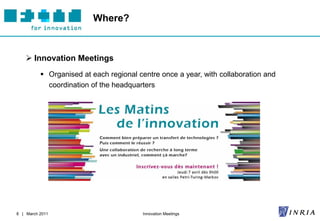
     Innovation Meetings
           Organised at each regional centre once a year, with collaboration and
            coordination of the headquarters


8 | March 2011                          Innovation Meetings
Pros & Cons


                        PROs                                                      CONs

         TT success stories communicated to                           Some efforts must be done to
            researchers by researchers sound                            make the event attractive:
            more credible
                                                                           Good promotion
         The interactive and light form of
            workshops facilitates discussions                              Providing high quality content
                                                                            and interesting speakers
         Time dedicated to discuss with
            researchers about their ideas,
            projects is also a possibility of
            preliminary detection


9 | March 2011                                  Innovation Meetings
Why ?


     Rationale:
           Re-thinking the general measures for internal communication and
              awareness creation
           The idea was to have a comprehensive measure/programme including
              a tool (paper guide) and a cycle of events (Innovation Meetings)
           It was essential to reach young researchers and newcomers, usually
              more open to transfer issues and curious about how the institute works
           No “preaching”, but encouraging and supporting the interested ones


10 | March 2011                             Innovation Meetings
Why ?


   Impact:
         INRIA’s experience in approaching researchers shows that:
                - Young researchers are more flexible and easily accept some new
                    ways of thinking and doing, while experienced researchers rarely
                    change their old habits
                  - It is important to choose well the target group; different profiles of
                    researchers exist and addressing all of them by the same measure
                    is less efficient
                  - There is a need of more focused actions instead of generalised
                    ones, even if they are going to reach fewer people
         It is important to avoid the feeling that the actions are top-down (that is
            why researchers are the main speakers during Innovation Meetings)


11 | March 2011                            Innovation Meetings
Outcome


      The regional events are quite recent and a more complete feedback will only
       be possibly at least after one year

      They have been well received by all stakeholders so far

      The two editions of Innovation Mornings can be judged successful, with
       satisfying number of attendees and high quality of presentations

      The teams of TT officers and communication officers are motivated and
       engaged to work on the organisation of the next ones

      There is a visible interest among researchers who participate


12 | March 2011                          Innovation Meetings
Outcome


   Plans for the future:
         The Innovation Meetings: each regional centre is going to organise one
            event during the first year
         After that there will be a question whether:
                    - to keep this frequency – if able to provide fresh and interesting
                       topics at each time
                    - to make longer breaks between the events – if risk of repetition
                       and lack of audience


13 | March 2011                              Innovation Meetings
Lessons Learned


    It is important to make the format relatively short in order to get enough
     audience

    The agenda should keep the balance between presentations and interactive
     part (workshops)

    It is important to schedule enough time for questions and answers after each
     presentation, as INRIA’s experience has showed that people asked many
     questions; for the next events we will shorten the presentations to privilege
     interaction with the audience

    We suggest that the director of the PRO opens the session, which reinforce
     the image of technology transfer as an important activity for the whole
     organisation


14 | March 2011                         Innovation Meetings
Suggested Readings


      Link to bibliography

      Link to code book

        Awareness, communication, people, researcher, idea, technology transfer

      Link to relevant websites

        INRIA’s Transfer and Innovation Department website:
        http://en.inria.fr/innovation/partnerships-transfer-of-technology


15 | March 2011                           Innovation Meetings

FITT Toolbox: Innovation Meetings

  • 1.
    Innovation Meetings FITT – Fostering Interregional Exchange in ICT Technology Transfer – www.FITT-for-Innovation.eu Except where otherwise noted, this work is licensed under a Creative Commons Attribution 3.0 License.
  • 2.
    Transfer awareness actions  Measures to increase transfer awareness among researchers  Designed and implemented recently by common efforts of technology transfer and communication officers  Two elements:  Technology transfer guide for research teams – published in the format of answers to the fundamental questions that a researcher can ask about transfer  Innovation Meetings – series of regional events targeting R&D staff, based on presentation of “success stories” and interactive sessions moderated by the TT officers 2 | March 2011 Innovation Meetings
  • 3.
    Innovation Meetings  Cycle of events about technology transfer, targeting researchers and engineers  Organised in each of 8 INRIA regional centres, related to projects, inventions, start-ups etc. done by the local teams  Composed of two parts:  technology transfer “success stories”  workshops & meetings with TT officers  Opportunity for networking among all kinds of participants:  researchers (speakers and public), industry representatives and entrepreneurs (invited), TT officers and TT associates (moderators) 3 | March 2011 Innovation Meetings
  • 4.
    Innovation Meetings  Technology transfer “success stories” (morning):  Presented by the researchers who were involved  4-5 presentations, each of them covers specific type of transfer operation  Examples:  Collaboration between a research team and a SME  Lifecycle of complex software – development, open source protection, exploitation through start-up created by researchers  Collaboration with a large industrial group  Creation of a company by a team of researchers 4 | March 2011 Innovation Meetings
  • 5.
    Innovation Meetings  Workshops(morning) and meetings (afternoon):  After the presentations researchers are divided into small groups (10 people max)  The groups go around 4 to 5 stands prepared by TT officers and TT associates (labs- industry interface with sectoral expertise) on different aspects of technology transfer:  Software, patents, research collaboration with companies, TT support services, ...  At each stand there is a short presentation (15 min) and discussion with the group:  The objective is to present the job of TT office and opportunities for researchers with transfer projects  The last part of the day: after networking lunch - face-to-face meetings between researchers and TT officers from INRIA headquarters to talk about specific problems (appointments are available before the event) 5 | March 2011 Innovation Meetings
  • 6.
    When?  Innovation Meetings:  The first edition: Saclay – Ile-de-France at the end of September 2010, the second one: Grenoble at the end of January 2011  The audience was around 50 people each time  The current idea is that each regional centre organises one event per year (8 events per year in total) 6 | March 2011 Innovation Meetings
  • 7.
    Who?  Stakeholders  INRIA headquarters: - Transfer and Innovation Department - Communication Department  TT and Communication officers in INRIA regional centres  Researchers, in particular young or newcomers 7 | March 2011 Innovation Meetings
  • 8.
    Where?  Innovation Meetings  Organised at each regional centre once a year, with collaboration and coordination of the headquarters 8 | March 2011 Innovation Meetings
  • 9.
    Pros & Cons PROs CONs  TT success stories communicated to  Some efforts must be done to researchers by researchers sound make the event attractive: more credible  Good promotion  The interactive and light form of workshops facilitates discussions  Providing high quality content and interesting speakers  Time dedicated to discuss with researchers about their ideas, projects is also a possibility of preliminary detection 9 | March 2011 Innovation Meetings
  • 10.
    Why ?  Rationale:  Re-thinking the general measures for internal communication and awareness creation  The idea was to have a comprehensive measure/programme including a tool (paper guide) and a cycle of events (Innovation Meetings)  It was essential to reach young researchers and newcomers, usually more open to transfer issues and curious about how the institute works  No “preaching”, but encouraging and supporting the interested ones 10 | March 2011 Innovation Meetings
  • 11.
    Why ?  Impact:  INRIA’s experience in approaching researchers shows that: - Young researchers are more flexible and easily accept some new ways of thinking and doing, while experienced researchers rarely change their old habits - It is important to choose well the target group; different profiles of researchers exist and addressing all of them by the same measure is less efficient - There is a need of more focused actions instead of generalised ones, even if they are going to reach fewer people  It is important to avoid the feeling that the actions are top-down (that is why researchers are the main speakers during Innovation Meetings) 11 | March 2011 Innovation Meetings
  • 12.
    Outcome  The regional events are quite recent and a more complete feedback will only be possibly at least after one year  They have been well received by all stakeholders so far  The two editions of Innovation Mornings can be judged successful, with satisfying number of attendees and high quality of presentations  The teams of TT officers and communication officers are motivated and engaged to work on the organisation of the next ones  There is a visible interest among researchers who participate 12 | March 2011 Innovation Meetings
  • 13.
    Outcome Plans for the future:  The Innovation Meetings: each regional centre is going to organise one event during the first year  After that there will be a question whether: - to keep this frequency – if able to provide fresh and interesting topics at each time - to make longer breaks between the events – if risk of repetition and lack of audience 13 | March 2011 Innovation Meetings
  • 14.
    Lessons Learned  It is important to make the format relatively short in order to get enough audience  The agenda should keep the balance between presentations and interactive part (workshops)  It is important to schedule enough time for questions and answers after each presentation, as INRIA’s experience has showed that people asked many questions; for the next events we will shorten the presentations to privilege interaction with the audience  We suggest that the director of the PRO opens the session, which reinforce the image of technology transfer as an important activity for the whole organisation 14 | March 2011 Innovation Meetings
  • 15.
    Suggested Readings  Link to bibliography  Link to code book Awareness, communication, people, researcher, idea, technology transfer  Link to relevant websites INRIA’s Transfer and Innovation Department website: http://en.inria.fr/innovation/partnerships-transfer-of-technology 15 | March 2011 Innovation Meetings