Technology Transfer Follow-up Committee


                                   FITT
     – Fostering Interregional Exchange in ICT Technology Transfer –


                                      www.FITT-for-Innovation.eu
     Except where otherwise noted, this work is licensed under a Creative Commons Attribution 3.0 License.
A committee to follow-up transfer actions

      Technology transfer actions concerned:
          Startup creation projects
          Industrial partnerships with transfer of assets (license or assignment)
          Industrial partnerships with transfer of competences (expertise)
          Participation to standardization actions within a transfer action
          An open source diffusions of an important INRIA code base
          Exit solutions for open source consortium led by INRIA


      Committee is advisory for the INRIA Transfer department:
             go/no go (initialization and follow-up)
             transfer strategy adoption
             asking for an opportunity/feasibility study
             allocation of resources for maturation if needed


2 | February 2010                        Technology Transfer Follow-up Committee
A committee to follow-up transfer actions

      Composition:
             3 INRIA people
             1 INRIA -Transfert
             4 senior private experts:
                     two competitiveness clusters: Systematic, Minalogic,
                     1 private company – Mandriva
                     1 from EPFL (Switzerland)
                     national agency for innovation – OSEO
      When: one meeting every two months
      Process:
             Template description of the project built by the researcher, TT officer and Sectoral
              TT Associate (available in the FITT toolbox)
             Submission sent a few days before the meeting (no late submission)
             A collaborative tool allows the follow-up by all the staff concerned


3 | February 2010                         Technology Transfer Follow-up Committee
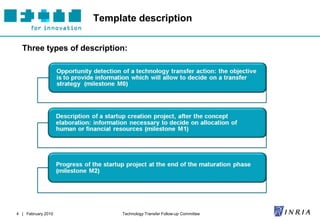
Template description

  Three types of description:


4 | February 2010          Technology Transfer Follow-up Committee
When & where?


   Timing
          Follow-up committee created in January 2009
          5 meetings held in 2009, 5 meetings expected in 2010
          45 transfer projects analysed in 2009


   Location
          in Paris
          organised at the national level, the committee reviews and follows up all
             technology transfer operations of the eight INRIA research centres


5 | February 2010                    Technology Transfer Follow-up Committee
Who?


 Stakeholders
         Before the committee meeting: researcher(s), a regional TT officer, the
            responsible of technology transfer in an application domain
               Preparation of the transfer case: file should be understandable and
                    analysable by the committee (no oral presentation of the case by project
                    leader)
         During the committee meeting:
               People from INRIA: Transfer and Innovation director, Transfer Strategies
                    manager, Technological Development director
               IT-Translation director: specialized in start-up creation
               Private sector experts: 2 people from “Competitiveness clusters”
                    (System@tic, Minalogic), 1 from EPFL (CH), 1 private company CEO,
                    1 person from OSEO


6 | February 2010                       Technology Transfer Follow-up Committee
Pros & Cons


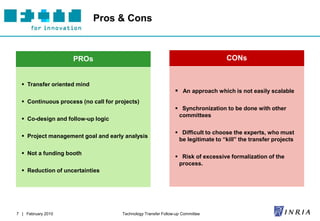
                    PROs                                                           CONs


   Transfer oriented mind
                                                                 An approach which is not easily scalable
   Continuous process (no call for projects)
                                                                 Synchronization to be done with other
                                                                 committees
   Co-design and follow-up logic

                                                                 Difficult to choose the experts, who must
   Project management goal and early analysis
                                                                 be legitimate to “kill” the transfer projects

   Not a funding booth
                                                                 Risk of excessive formalization of the
                                                                 process.
   Reduction of uncertainties


7 | February 2010                     Technology Transfer Follow-up Committee
Why ? (1/3)


     Rationale:

        The Technology Transfer Follow-up Committee has been created
        in order to:

             Have a clear and coherent view of all the transfer operations conducted
                by a large PRO (managing 170 research teams)

             Impose professionalization of the different stakeholders, who are now
                obliged to follow a path with clear guidelines, avoiding evident don’ts

             Have an access to advice from experts from the private sector (closer to
                the market than the TT officers)


8 | February 2010                      Technology Transfer Follow-up Committee
Why ? (2/3)


  Rationale:

 The Technology Transfer Follow-up Committee analyses and

        Does a follow-up: according to their maturity, transfer project are meant to be
            submitted more than once, which ensures the control of implementation of
            recommendations made by the committee

        The new dynamics has been created and it results in collective brainstorming
            sessions to decide on the best transfer strategy to be applied (which is not
            always the one that guarantees the best ROI)

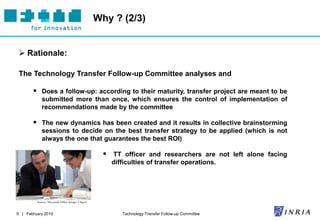
                                                      TT officer and researchers are not left alone facing
                                                       difficulties of transfer operations.


         Source: Microsoft Office Images Clipart


9 | February 2010                                         Technology Transfer Follow-up Committee
Why ? (2/3)


  Impact:

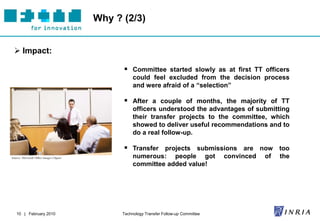
                                                 Committee started slowly as at first TT officers
                                                     could feel excluded from the decision process
                                                     and were afraid of a “selection”

                                                 After a couple of months, the majority of TT
                                                     officers understood the advantages of submitting
                                                     their transfer projects to the committee, which
                                                     showed to deliver useful recommendations and to
                                                     do a real follow-up.

                                                 Transfer projects submissions are now too
Source: Microsoft Office Images Clipart              numerous: people got                 convinced   of   the
                                                     committee added value!


   10 | February 2010                           Technology Transfer Follow-up Committee
Lessons Learned


     Added value of private external experts having experience in technology
      transfer at large

     A formalized process allowing people to brainstorm on elaborated transfer
      projects in search of more professional behaviour (asking themselves a lot of
      questions on the strategy)

     The need to go beyond evidence or conditioned reflex and to adopt a real
      strategy which can be followed up


11 | February 2010              Technology Transfer Follow-up Committee
Suggested Readings


     Link to bibliography:

     Link to code book:

               Opportunity Assessment

               Transfer strategy

               Start-up creation

               Exploitation

               External experts

     Link to related websites:

    www.inria-transfert.fr

    www.inria.fr/valorisation/index.fr


12 | February 2010                  Technology Transfer Follow-up Committee

FITT Toolbox: Technology Transfer Follow-up Committee

  • 1.
    Technology Transfer Follow-upCommittee FITT – Fostering Interregional Exchange in ICT Technology Transfer – www.FITT-for-Innovation.eu Except where otherwise noted, this work is licensed under a Creative Commons Attribution 3.0 License.
  • 2.
    A committee tofollow-up transfer actions Technology transfer actions concerned:  Startup creation projects  Industrial partnerships with transfer of assets (license or assignment)  Industrial partnerships with transfer of competences (expertise)  Participation to standardization actions within a transfer action  An open source diffusions of an important INRIA code base  Exit solutions for open source consortium led by INRIA Committee is advisory for the INRIA Transfer department:  go/no go (initialization and follow-up)  transfer strategy adoption  asking for an opportunity/feasibility study  allocation of resources for maturation if needed 2 | February 2010 Technology Transfer Follow-up Committee
  • 3.
    A committee tofollow-up transfer actions  Composition:  3 INRIA people  1 INRIA -Transfert  4 senior private experts:  two competitiveness clusters: Systematic, Minalogic,  1 private company – Mandriva  1 from EPFL (Switzerland)  national agency for innovation – OSEO  When: one meeting every two months  Process:  Template description of the project built by the researcher, TT officer and Sectoral TT Associate (available in the FITT toolbox)  Submission sent a few days before the meeting (no late submission)  A collaborative tool allows the follow-up by all the staff concerned 3 | February 2010 Technology Transfer Follow-up Committee
  • 4.
    Template description Three types of description: 4 | February 2010 Technology Transfer Follow-up Committee
  • 5.
    When & where? Timing  Follow-up committee created in January 2009  5 meetings held in 2009, 5 meetings expected in 2010  45 transfer projects analysed in 2009 Location  in Paris  organised at the national level, the committee reviews and follows up all technology transfer operations of the eight INRIA research centres 5 | February 2010 Technology Transfer Follow-up Committee
  • 6.
    Who? Stakeholders  Before the committee meeting: researcher(s), a regional TT officer, the responsible of technology transfer in an application domain  Preparation of the transfer case: file should be understandable and analysable by the committee (no oral presentation of the case by project leader)  During the committee meeting:  People from INRIA: Transfer and Innovation director, Transfer Strategies manager, Technological Development director  IT-Translation director: specialized in start-up creation  Private sector experts: 2 people from “Competitiveness clusters” (System@tic, Minalogic), 1 from EPFL (CH), 1 private company CEO, 1 person from OSEO 6 | February 2010 Technology Transfer Follow-up Committee
  • 7.
    Pros & Cons PROs CONs  Transfer oriented mind  An approach which is not easily scalable  Continuous process (no call for projects)  Synchronization to be done with other committees  Co-design and follow-up logic  Difficult to choose the experts, who must  Project management goal and early analysis be legitimate to “kill” the transfer projects  Not a funding booth  Risk of excessive formalization of the process.  Reduction of uncertainties 7 | February 2010 Technology Transfer Follow-up Committee
  • 8.
    Why ? (1/3)  Rationale: The Technology Transfer Follow-up Committee has been created in order to:  Have a clear and coherent view of all the transfer operations conducted by a large PRO (managing 170 research teams)  Impose professionalization of the different stakeholders, who are now obliged to follow a path with clear guidelines, avoiding evident don’ts  Have an access to advice from experts from the private sector (closer to the market than the TT officers) 8 | February 2010 Technology Transfer Follow-up Committee
  • 9.
    Why ? (2/3)  Rationale: The Technology Transfer Follow-up Committee analyses and  Does a follow-up: according to their maturity, transfer project are meant to be submitted more than once, which ensures the control of implementation of recommendations made by the committee  The new dynamics has been created and it results in collective brainstorming sessions to decide on the best transfer strategy to be applied (which is not always the one that guarantees the best ROI)  TT officer and researchers are not left alone facing difficulties of transfer operations. Source: Microsoft Office Images Clipart 9 | February 2010 Technology Transfer Follow-up Committee
  • 10.
    Why ? (2/3)  Impact:  Committee started slowly as at first TT officers could feel excluded from the decision process and were afraid of a “selection”  After a couple of months, the majority of TT officers understood the advantages of submitting their transfer projects to the committee, which showed to deliver useful recommendations and to do a real follow-up.  Transfer projects submissions are now too Source: Microsoft Office Images Clipart numerous: people got convinced of the committee added value! 10 | February 2010 Technology Transfer Follow-up Committee
  • 11.
    Lessons Learned  Added value of private external experts having experience in technology transfer at large  A formalized process allowing people to brainstorm on elaborated transfer projects in search of more professional behaviour (asking themselves a lot of questions on the strategy)  The need to go beyond evidence or conditioned reflex and to adopt a real strategy which can be followed up 11 | February 2010 Technology Transfer Follow-up Committee
  • 12.
    Suggested Readings  Link to bibliography:  Link to code book: Opportunity Assessment Transfer strategy Start-up creation Exploitation External experts  Link to related websites: www.inria-transfert.fr www.inria.fr/valorisation/index.fr 12 | February 2010 Technology Transfer Follow-up Committee