TRAINING AND DEVELOPMENT   MODULE 2
LEARNING Learning is defined as a relatively permanent change in cognition (ie understanding and thinking) that results from experience and directly influence one’s behaviour The effects of which persist and recur over a period of time Is  strengthened by repetition and practice.
Training Training is a process of  learning and unlearning- to acquire or enhance skills  and knowledge and  put it into practice to enable the trainee to do the  job efficiently Is about  behaving differently It is a process of  attitudinal change  that integrates with life ,work and  self development
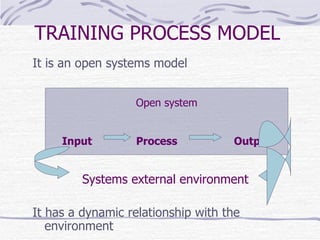
Training Training  is a transforming process that requires some input and in turn it produces output in the form of knowledge, skills, and attitudes (KSAs).
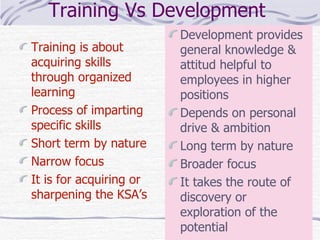
Training Vs Development  Training is about acquiring skills through organized learning Process of imparting specific skills Short term by nature  Narrow focus It is for acquiring or sharpening the KSA’s Development provides general knowledge & attitud helpful to employees in higher positions Depends on personal drive & ambition Long term by nature  Broader focus  It takes the route of discovery or exploration of the potential
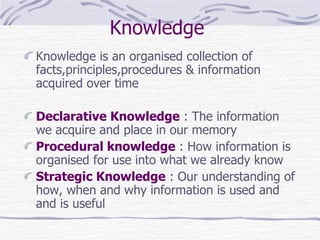
Knowledge  Knowledge is an organised collection of facts,principles,procedures & information acquired over time Declarative Knowledge  : The information we acquire and place in our memory Procedural knowledge  : How information is organised for use into what we already know Strategic Knowledge  : Our understanding of how, when and why information is used and and is useful
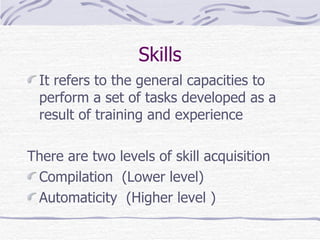
Skills It refers to the general capacities to perform a set of tasks developed as a result of training and experience  There are two levels of skill acquisition Compilation  (Lower level) Automaticity  (Higher level )
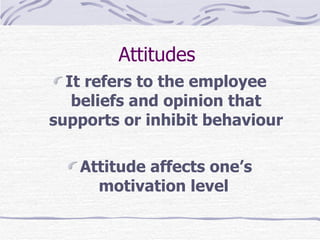
Attitudes  It refers to the employee beliefs and opinion that supports or inhibit behaviour Attitude affects one’s motivation level
Competency This is a set of knowledge, skills and attitudes that enable a person to be successsful at a number of similar tasks The ability to use the integrate and use the KSAs to perform a task successfully.
Why one needs  training ? Pre-service training  An individual may posses skills not relevant to the intended job and with training he acquire the necessary  skills  For improving the level of performance  For dealing with complex organizational problems For tackling human problems  For creating favourable attitudes and motivation to the employees  Assignment of new responsibilities/role dimensions  Introduction of new strategies and working methods in the organization
Why one needs  training ? Advancement in technology Organizational policy Enhancing organizational effectiveness  Fit into the company culture
Classification of training programmes   Based  on content  Technical  Skills  Based  on behavioral or soft skills training  Communication skills  motivation Based  on the work life stage of the employee Refresher training  Role transformation Virtual training
The process begins with some type of  triggering event Recognition  of operational performance deficiency(OPD) When actual operational performance(AOP) is less than expected operational performance(EOP) then OPD exists  When the OPD exists and if the firm believes that training is a solution to that, one goes for that……….. Training process
TRAINING PROCESS MODEL It is an open systems model Systems external environment It has a dynamic relationship with the environment Open system Input  Process  Output
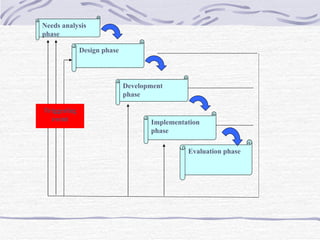
Design phase  Development phase  Implementation phase  Evaluation phase  Needs analysis phase  Triggering event
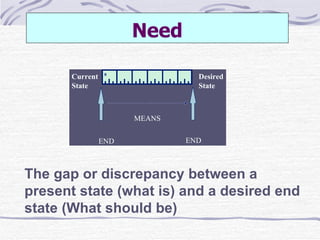
Need 0 Current State Desired State MEANS END END The gap or discrepancy between a present state (what is) and a desired end state (What should be)
Identify the deficiency in the system  Eg: profitability shortfall  Lower level of customer satisfaction  Once the deficiency is identified then cause must be determined  If  deficiency is due to inadequate KSA’s then training becomes the solution  Needs analysis phase
There are three levels of assessment Organisational analysis Task/operational analysis Individual/person analysis NEEDS ASSESSMENT
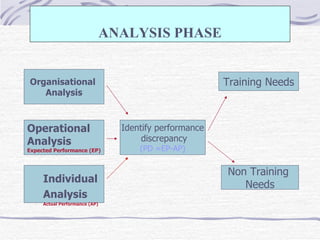
ANALYSIS PHASE Organisational  Analysis Operational  Analysis  Expected Performance (EP) Individual Analysis Actual Performance (AP)   Identify performance discrepancy (PD =EP-AP) Non Training  Needs Training Needs
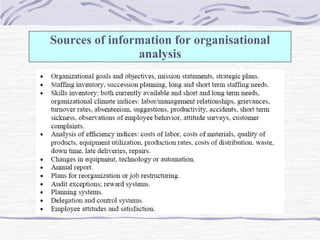
Sources of information for organisational analysis
Determines exactly what is required of employees in order for them to be effective  It provides data about a job or group of jobs and KSA’s to achieve optimum performance  Task /operational analysis
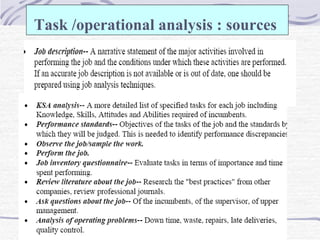
Task /operational analysis : sources
Determines how well the employee does the job and determines which employee needs training and what kind Individual analysis
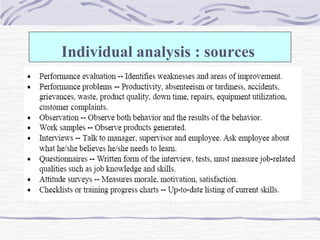
Individual analysis : sources
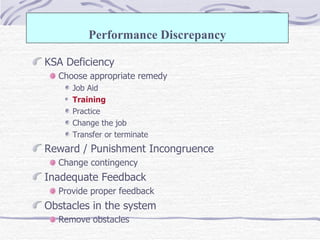
KSA Deficiency Choose appropriate remedy Job Aid Training Practice Change the job Transfer or terminate Reward / Punishment Incongruence  Change contingency Inadequate Feedback Provide proper feedback Obstacles in the system Remove obstacles  Performance Discrepancy
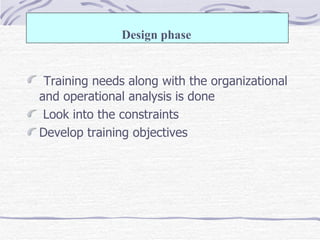
Training needs along with the organizational and operational analysis is done  Look into the constraints Develop training objectives  Design phase
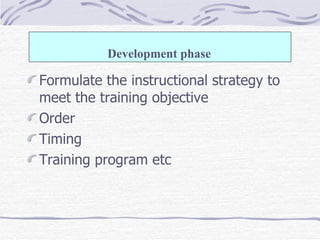
Formulate the instructional strategy to meet the training objective  Order  Timing  Training program etc  Development phase
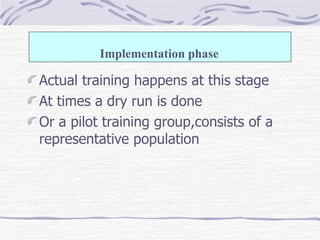
Actual training happens at this stage  At times a dry run is done  Or a pilot training group,consists of a representative population Implementation phase
Output of the training become the input for the evaluation  Evaluation is done for  Process Outcome  Evaluation phase
Reference Effective training ; systems strategies and practices,  P Nick Blanchard,James W Thacker Every Trainers Handbook   , Devendra Agochiya

Training and development

  • 1.
  • 2.
    LEARNING Learning isdefined as a relatively permanent change in cognition (ie understanding and thinking) that results from experience and directly influence one’s behaviour The effects of which persist and recur over a period of time Is strengthened by repetition and practice.
  • 3.
    Training Training isa process of learning and unlearning- to acquire or enhance skills and knowledge and put it into practice to enable the trainee to do the job efficiently Is about behaving differently It is a process of attitudinal change that integrates with life ,work and self development
  • 4.
    Training Training is a transforming process that requires some input and in turn it produces output in the form of knowledge, skills, and attitudes (KSAs).
  • 5.
    Training Vs Development Training is about acquiring skills through organized learning Process of imparting specific skills Short term by nature Narrow focus It is for acquiring or sharpening the KSA’s Development provides general knowledge & attitud helpful to employees in higher positions Depends on personal drive & ambition Long term by nature Broader focus It takes the route of discovery or exploration of the potential
  • 6.
    Knowledge Knowledgeis an organised collection of facts,principles,procedures & information acquired over time Declarative Knowledge : The information we acquire and place in our memory Procedural knowledge : How information is organised for use into what we already know Strategic Knowledge : Our understanding of how, when and why information is used and and is useful
  • 7.
    Skills It refersto the general capacities to perform a set of tasks developed as a result of training and experience There are two levels of skill acquisition Compilation (Lower level) Automaticity (Higher level )
  • 8.
    Attitudes Itrefers to the employee beliefs and opinion that supports or inhibit behaviour Attitude affects one’s motivation level
  • 9.
    Competency This isa set of knowledge, skills and attitudes that enable a person to be successsful at a number of similar tasks The ability to use the integrate and use the KSAs to perform a task successfully.
  • 10.
    Why one needs training ? Pre-service training An individual may posses skills not relevant to the intended job and with training he acquire the necessary skills For improving the level of performance For dealing with complex organizational problems For tackling human problems For creating favourable attitudes and motivation to the employees Assignment of new responsibilities/role dimensions Introduction of new strategies and working methods in the organization
  • 11.
    Why one needs training ? Advancement in technology Organizational policy Enhancing organizational effectiveness Fit into the company culture
  • 12.
    Classification of trainingprogrammes Based on content Technical Skills Based on behavioral or soft skills training Communication skills motivation Based on the work life stage of the employee Refresher training Role transformation Virtual training
  • 13.
    The process beginswith some type of triggering event Recognition of operational performance deficiency(OPD) When actual operational performance(AOP) is less than expected operational performance(EOP) then OPD exists When the OPD exists and if the firm believes that training is a solution to that, one goes for that……….. Training process
  • 14.
    TRAINING PROCESS MODELIt is an open systems model Systems external environment It has a dynamic relationship with the environment Open system Input Process Output
  • 15.
    Design phase Development phase Implementation phase Evaluation phase Needs analysis phase Triggering event
  • 16.
    Need 0 CurrentState Desired State MEANS END END The gap or discrepancy between a present state (what is) and a desired end state (What should be)
  • 17.
    Identify the deficiencyin the system Eg: profitability shortfall Lower level of customer satisfaction Once the deficiency is identified then cause must be determined If deficiency is due to inadequate KSA’s then training becomes the solution Needs analysis phase
  • 18.
    There are threelevels of assessment Organisational analysis Task/operational analysis Individual/person analysis NEEDS ASSESSMENT
  • 19.
    ANALYSIS PHASE Organisational Analysis Operational Analysis Expected Performance (EP) Individual Analysis Actual Performance (AP) Identify performance discrepancy (PD =EP-AP) Non Training Needs Training Needs
  • 20.
    Sources of informationfor organisational analysis
  • 21.
    Determines exactly whatis required of employees in order for them to be effective It provides data about a job or group of jobs and KSA’s to achieve optimum performance Task /operational analysis
  • 22.
  • 23.
    Determines how wellthe employee does the job and determines which employee needs training and what kind Individual analysis
  • 24.
  • 25.
    KSA Deficiency Chooseappropriate remedy Job Aid Training Practice Change the job Transfer or terminate Reward / Punishment Incongruence Change contingency Inadequate Feedback Provide proper feedback Obstacles in the system Remove obstacles Performance Discrepancy
  • 26.
    Training needs alongwith the organizational and operational analysis is done Look into the constraints Develop training objectives Design phase
  • 27.
    Formulate the instructionalstrategy to meet the training objective Order Timing Training program etc Development phase
  • 28.
    Actual training happensat this stage At times a dry run is done Or a pilot training group,consists of a representative population Implementation phase
  • 29.
    Output of thetraining become the input for the evaluation Evaluation is done for Process Outcome Evaluation phase
  • 30.
    Reference Effective training; systems strategies and practices, P Nick Blanchard,James W Thacker Every Trainers Handbook , Devendra Agochiya