By – Prof. Rohita Dwivedi
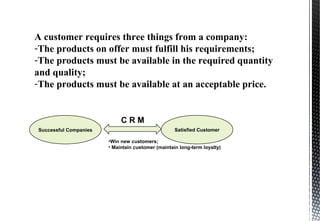
A customer requires three things from a company:
-The products on offer must fulfill his requirements;
-The products must be available in the required quantity
and quality;
-The products must be available at an acceptable price.
Successful Companies
C R M
Satisfied Customer
•Win new customers;
• Maintain customer (maintain long-term loyalty)
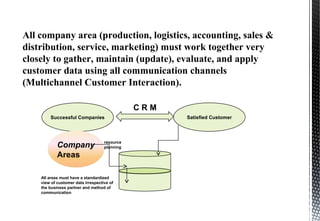
All company area (production, logistics, accounting, sales &
distribution, service, marketing) must work together very
closely to gather, maintain (update), evaluate, and apply
customer data using all communication channels
(Multichannel Customer Interaction).
Successful Companies
C R M
Satisfied Customer
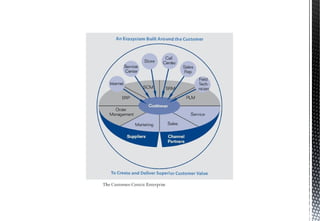
Company
Areas
resource
planning
All areas must have a standardized
view of customer data irrespective of
the business partner and method of
communication
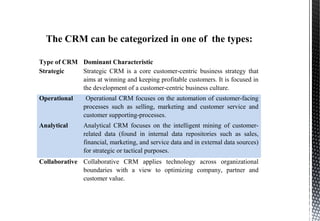
Type of CRM Dominant Characteristic
Strategic Strategic CRM is a core customer-centric business strategy that
aims at winning and keeping profitable customers. It is focused in
the development of a customer-centric business culture.
Operational Operational CRM focuses on the automation of customer-facing
processes such as selling, marketing and customer service and
customer supporting-processes.
Analytical Analytical CRM focuses on the intelligent mining of customer-
related data (found in internal data repositories such as sales,
financial, marketing, and service data and in external data sources)
for strategic or tactical purposes.
Collaborative Collaborative CRM applies technology across organizational
boundaries with a view to optimizing company, partner and
customer value.
The CRM can be categorized in one of the types:
Definition
A definition of customer relationship management (CRM) is ”The
infrastructure that enables the delineation of an increase in customer
value, and the correct means by which to motivate valuable customers
to remain loyal (to buy again).1
”
”The purpose of CRM is to enable businesses to track and manage all
of their customer interactions over the lifetime of the customer
relationship. CRM is a business strategy, and companies typically use
a CRM software system as a technology platform to help implement
their CRM strategy, processes, and procedures.2
”
1
CRM Handbook, The: A Business Guide to Customer Relationship Management, by Jill Dyché, Addison Wesley Professional, August 09, 2001
2
Working with Microsoft Dynamics™ CRM 4.0, Second Edition, by Jim Steger; Mike Snyder, Microsoft Press, March 10, 2008
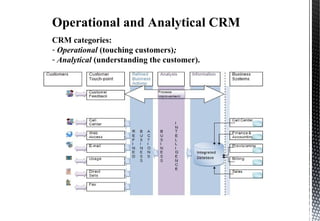
Operational and Analytical CRM
CRM categories:
- Operational (touching customers);
- Analytical (understanding the customer).
The minimal requirements for CRM applications are:
- Gather and manage customer data;
- Standardized view for all areas;
- Easy to understand and operate;
- Adaptable to current market conditions;
- Integration with other systems.
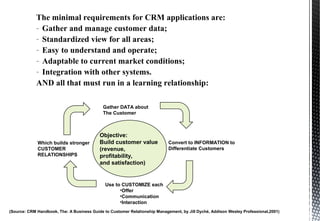
AND all that must run in a learning relationship:
Objective:
Build customer value
(revenue,
profitability,
and satisfaction)
Gather DATA about
The Customer
Convert to INFORMATION to
Differentiate Customers
Use to CUSTOMIZE each
•Offer
•Communication
•Interaction
Which builds stronger
CUSTOMER
RELATIONSHIPS
(Source: CRM Handbook, The: A Business Guide to Customer Relationship Management, by Jill Dyché, Addison Wesley Professional,2001)
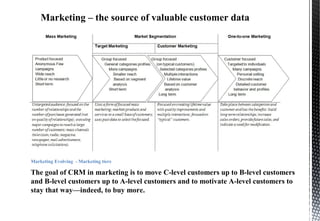
Marketing Evolving - Marketing tiers
The goal of CRM in marketing is to move C-level customers up to B-level customers
and B-level customers up to A-level customers and to motivate A-level customers to
stay that way—indeed, to buy more.
Marketing – the source of valuable customer data
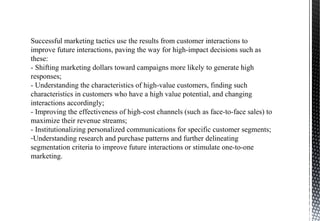
Successful marketing tactics use the results from customer interactions to
improve future interactions, paving the way for high-impact decisions such as
these:
- Shifting marketing dollars toward campaigns more likely to generate high
responses;
- Understanding the characteristics of high-value customers, finding such
characteristics in customers who have a high value potential, and changing
interactions accordingly;
- Improving the effectiveness of high-cost channels (such as face-to-face sales) to
maximize their revenue streams;
- Institutionalizing personalized communications for specific customer segments;
-Understanding research and purchase patterns and further delineating
segmentation criteria to improve future interactions or stimulate one-to-one
marketing.
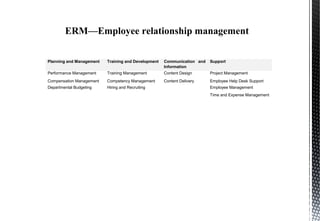
ERM—Employee relationship management
Planning and Management Training and Development Communication and
Information
Support
Performance Management Training Management Content Design Project Management
Compensation Management Competency Management Content Delivery Employee Help Desk Support
Departmental Budgeting Hiring and Recruiting Employee Management
Time and Expense Management
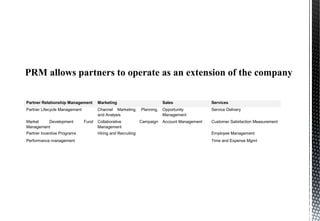
PRM allows partners to operate as an extension of the company
Partner Relationship Management Marketing Sales Services
Partner Lifecycle Management Channel Marketing, Planning,
and Analysis
Opportunity
Management
Service Delivery
Market Development Fund
Management
Collaborative Campaign
Management
Account Management Customer Satisfaction Measurement
Partner Incentive Programs Hiring and Recruiting Employee Management
Performance management Time and Expense Mgmt
Requirements for CRM software applications:
Gather and manage customer data;
Offer a standardized view for all area;
Be easy to understand and use;
Be adaptable to current market conditions;
To can be integrated with other applications;
To support evaluations.
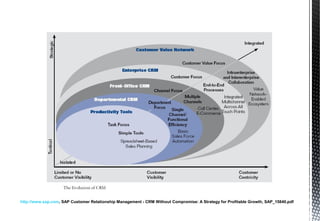
http://www.sap.com, SAP Customer Relationship Management - CRM Without Compromise: A Strategy for Profitable Growth, SAP_15840.pdf
CRMSession 1 - Introduction to Customer Relationship Management

CRMSession 1 - Introduction to Customer Relationship Management

  • 1.
    By – Prof.Rohita Dwivedi
  • 2.
    A customer requiresthree things from a company: -The products on offer must fulfill his requirements; -The products must be available in the required quantity and quality; -The products must be available at an acceptable price. Successful Companies C R M Satisfied Customer •Win new customers; • Maintain customer (maintain long-term loyalty)
  • 3.
    All company area(production, logistics, accounting, sales & distribution, service, marketing) must work together very closely to gather, maintain (update), evaluate, and apply customer data using all communication channels (Multichannel Customer Interaction). Successful Companies C R M Satisfied Customer Company Areas resource planning All areas must have a standardized view of customer data irrespective of the business partner and method of communication
  • 6.
    Type of CRMDominant Characteristic Strategic Strategic CRM is a core customer-centric business strategy that aims at winning and keeping profitable customers. It is focused in the development of a customer-centric business culture. Operational Operational CRM focuses on the automation of customer-facing processes such as selling, marketing and customer service and customer supporting-processes. Analytical Analytical CRM focuses on the intelligent mining of customer- related data (found in internal data repositories such as sales, financial, marketing, and service data and in external data sources) for strategic or tactical purposes. Collaborative Collaborative CRM applies technology across organizational boundaries with a view to optimizing company, partner and customer value. The CRM can be categorized in one of the types:
  • 8.
    Definition A definition ofcustomer relationship management (CRM) is ”The infrastructure that enables the delineation of an increase in customer value, and the correct means by which to motivate valuable customers to remain loyal (to buy again).1 ” ”The purpose of CRM is to enable businesses to track and manage all of their customer interactions over the lifetime of the customer relationship. CRM is a business strategy, and companies typically use a CRM software system as a technology platform to help implement their CRM strategy, processes, and procedures.2 ” 1 CRM Handbook, The: A Business Guide to Customer Relationship Management, by Jill Dyché, Addison Wesley Professional, August 09, 2001 2 Working with Microsoft Dynamics™ CRM 4.0, Second Edition, by Jim Steger; Mike Snyder, Microsoft Press, March 10, 2008
  • 9.
    Operational and AnalyticalCRM CRM categories: - Operational (touching customers); - Analytical (understanding the customer).
  • 10.
    The minimal requirementsfor CRM applications are: - Gather and manage customer data; - Standardized view for all areas; - Easy to understand and operate; - Adaptable to current market conditions; - Integration with other systems. AND all that must run in a learning relationship: Objective: Build customer value (revenue, profitability, and satisfaction) Gather DATA about The Customer Convert to INFORMATION to Differentiate Customers Use to CUSTOMIZE each •Offer •Communication •Interaction Which builds stronger CUSTOMER RELATIONSHIPS (Source: CRM Handbook, The: A Business Guide to Customer Relationship Management, by Jill Dyché, Addison Wesley Professional,2001)
  • 11.
    Marketing Evolving -Marketing tiers The goal of CRM in marketing is to move C-level customers up to B-level customers and B-level customers up to A-level customers and to motivate A-level customers to stay that way—indeed, to buy more. Marketing – the source of valuable customer data
  • 12.
    Successful marketing tacticsuse the results from customer interactions to improve future interactions, paving the way for high-impact decisions such as these: - Shifting marketing dollars toward campaigns more likely to generate high responses; - Understanding the characteristics of high-value customers, finding such characteristics in customers who have a high value potential, and changing interactions accordingly; - Improving the effectiveness of high-cost channels (such as face-to-face sales) to maximize their revenue streams; - Institutionalizing personalized communications for specific customer segments; -Understanding research and purchase patterns and further delineating segmentation criteria to improve future interactions or stimulate one-to-one marketing.
  • 13.
    ERM—Employee relationship management Planningand Management Training and Development Communication and Information Support Performance Management Training Management Content Design Project Management Compensation Management Competency Management Content Delivery Employee Help Desk Support Departmental Budgeting Hiring and Recruiting Employee Management Time and Expense Management
  • 14.
    PRM allows partnersto operate as an extension of the company Partner Relationship Management Marketing Sales Services Partner Lifecycle Management Channel Marketing, Planning, and Analysis Opportunity Management Service Delivery Market Development Fund Management Collaborative Campaign Management Account Management Customer Satisfaction Measurement Partner Incentive Programs Hiring and Recruiting Employee Management Performance management Time and Expense Mgmt
  • 16.
    Requirements for CRMsoftware applications: Gather and manage customer data; Offer a standardized view for all area; Be easy to understand and use; Be adaptable to current market conditions; To can be integrated with other applications; To support evaluations.
  • 17.
    http://www.sap.com, SAP CustomerRelationship Management - CRM Without Compromise: A Strategy for Profitable Growth, SAP_15840.pdf