UNIT - I


M. Mano Samuel
Lecturer , HR
The American College


                       1
Training refers to a planned
 effort by a company to
 facilitate employees’ learning
 of job-related competencies
 for the achievement of
 organizational goals.


                                  2
◦ Master the knowledge, skill, and
  behaviors emphasized in training
  programs, and

◦ Apply them to their day-to-day
  activities


                                     3
 Training is the process of proving
 employees with specific skills or
 helping them correct efficacies in
 their performance


                                       4
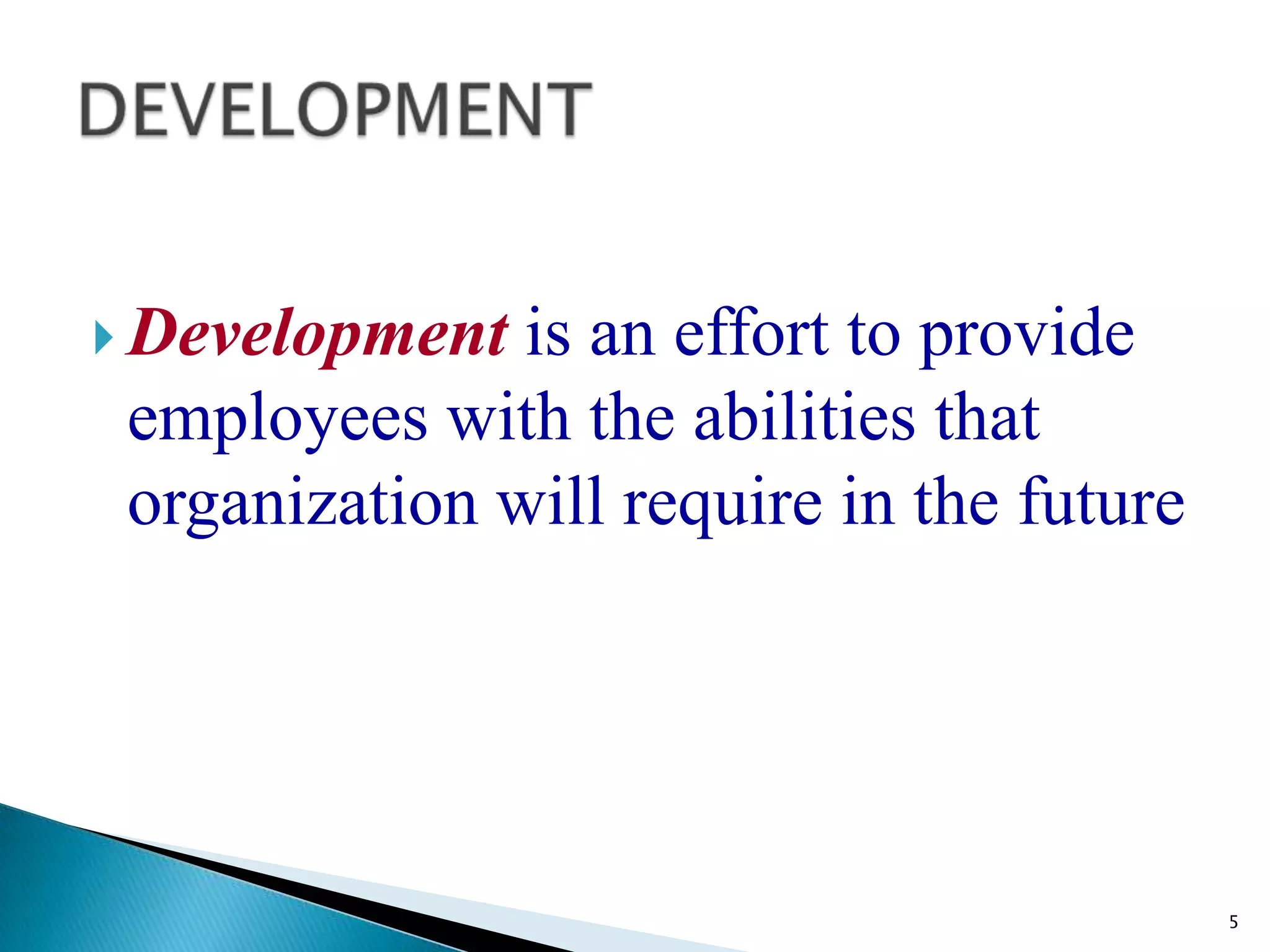
 Development  is an effort to provide
 employees with the abilities that
 organization will require in the future


                                           5
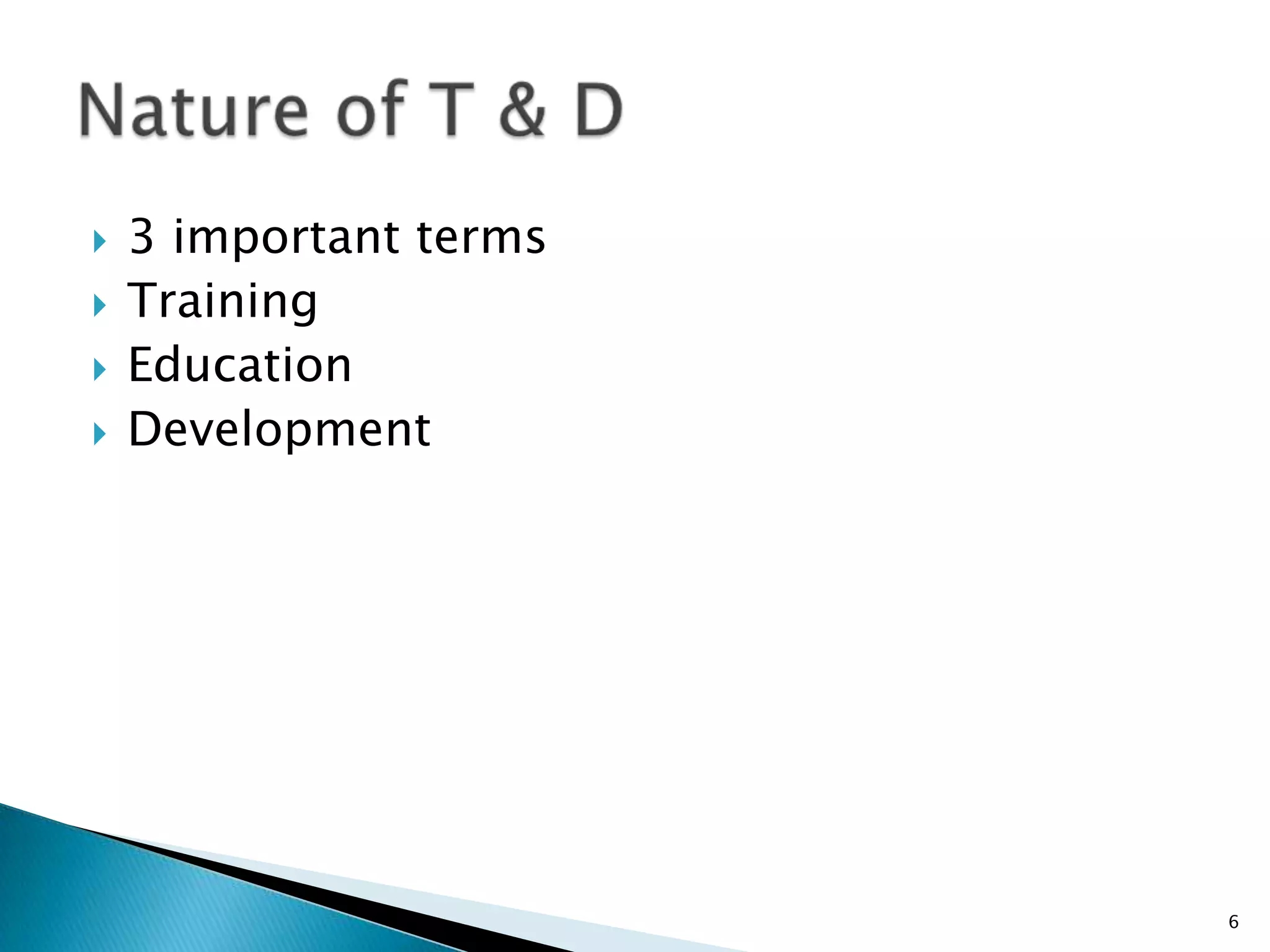
   3 important terms
   Training
   Education
   Development


                        6
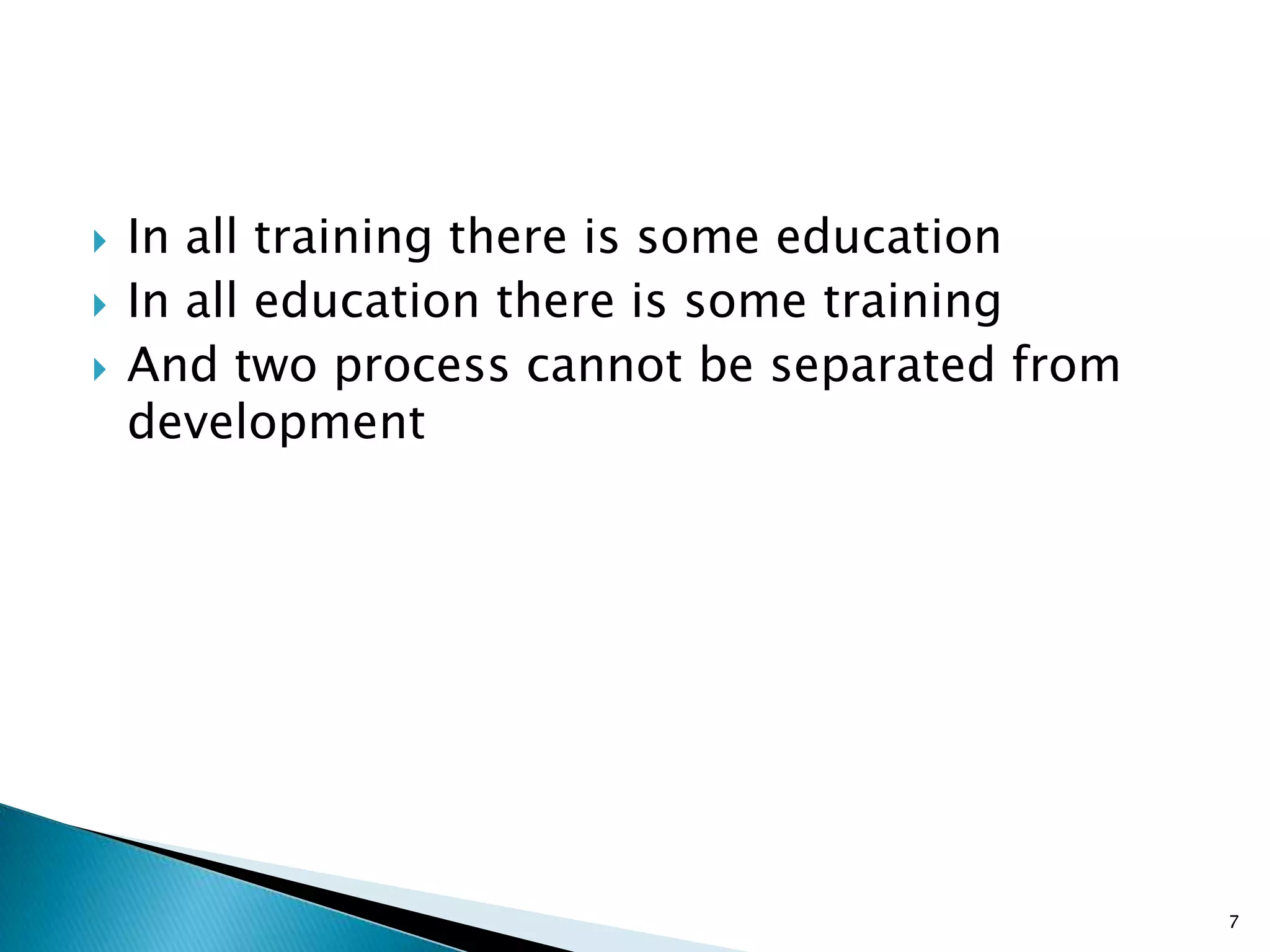
   In all training there is some education
   In all education there is some training
   And two process cannot be separated from
    development


                                               7
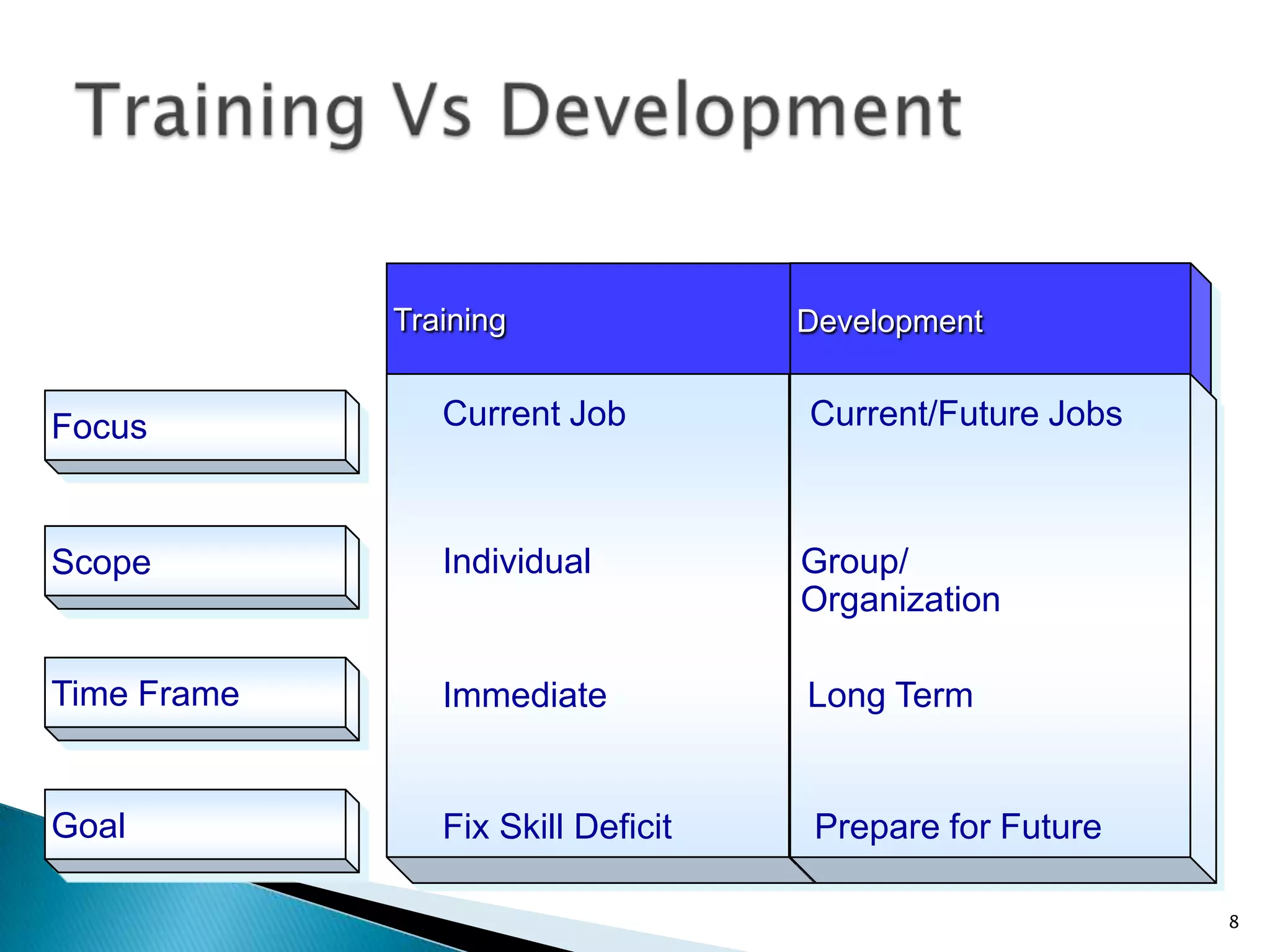
Training               Development


Focus           Current Job         Current/Future Jobs


Scope           Individual          Group/
                                    Organization

Time Frame      Immediate           Long Term


Goal            Fix Skill Deficit    Prepare for Future

                                                          8
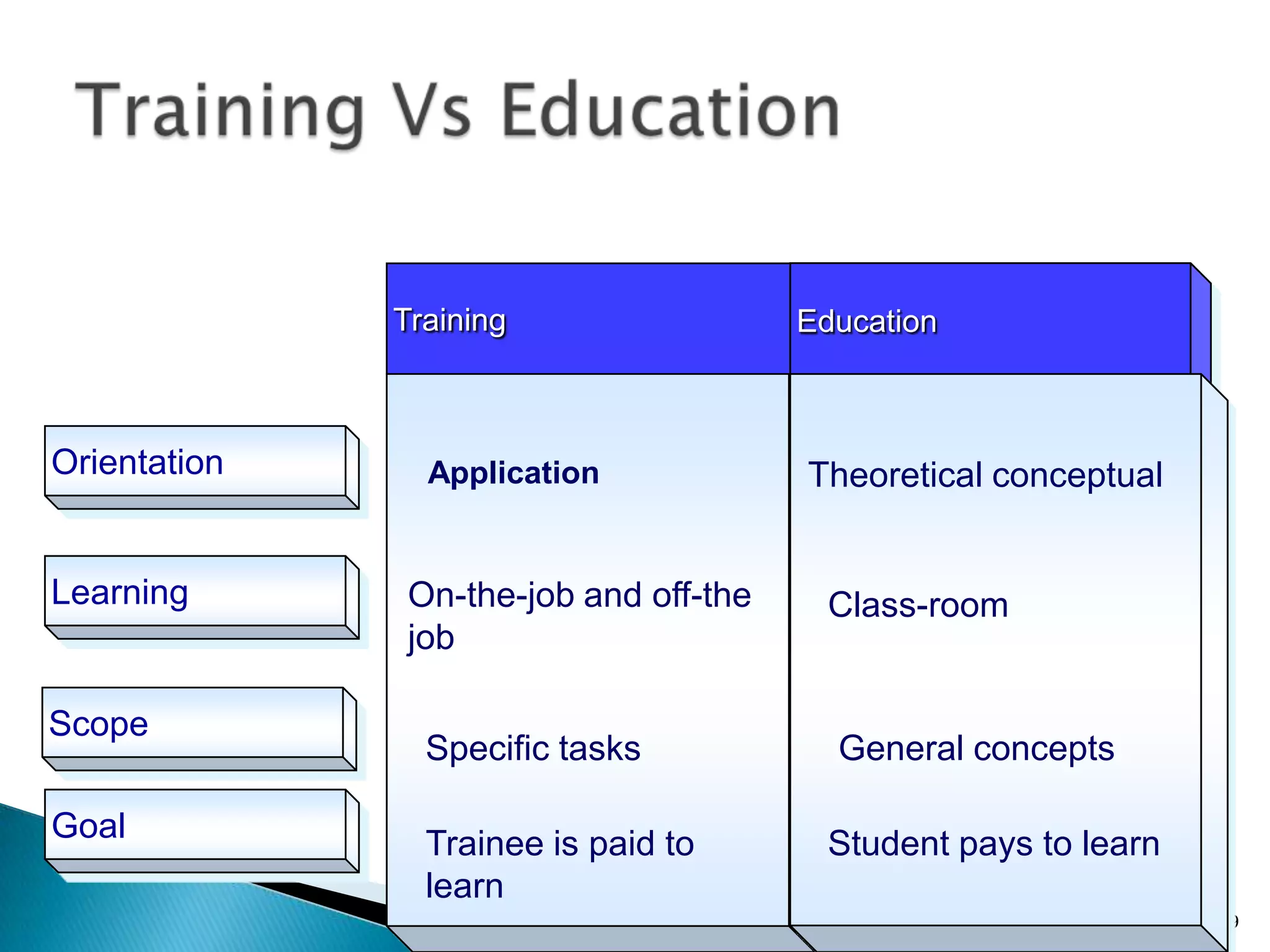
Training                    Education


Orientation     Application                Theoretical conceptual


Learning       On-the-job and off-the        Class-room
               job

Scope
                Specific tasks                General concepts

Goal            Trainee is paid to           Student pays to learn
                learn                     V.SUGUMARAN
                                        T&D UNIT-1, KSM              9
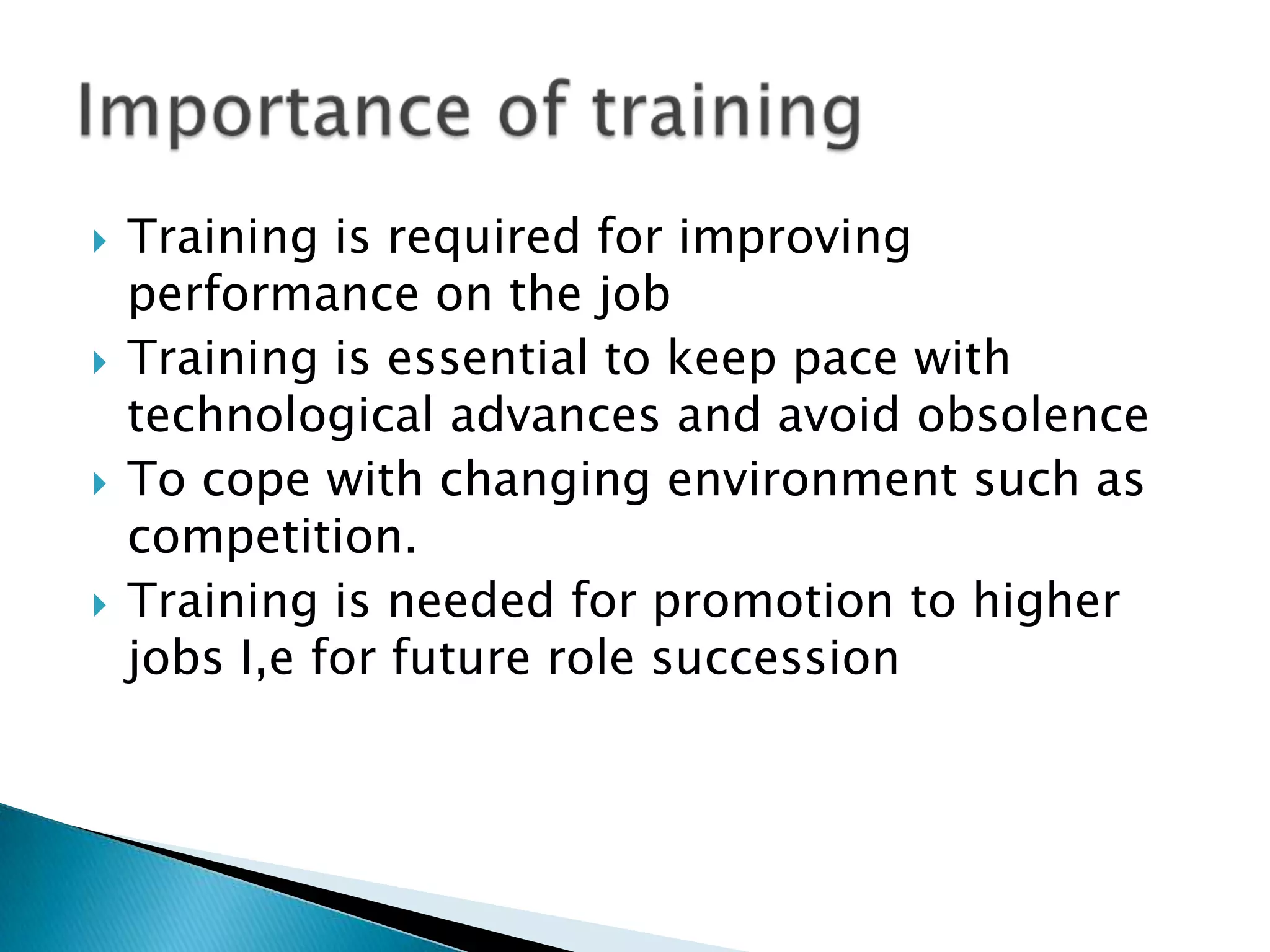
   Training is required for improving
    performance on the job
   Training is essential to keep pace with
    technological advances and avoid obsolence
   To cope with changing environment such as
    competition.
   Training is needed for promotion to higher
    jobs I,e for future role succession
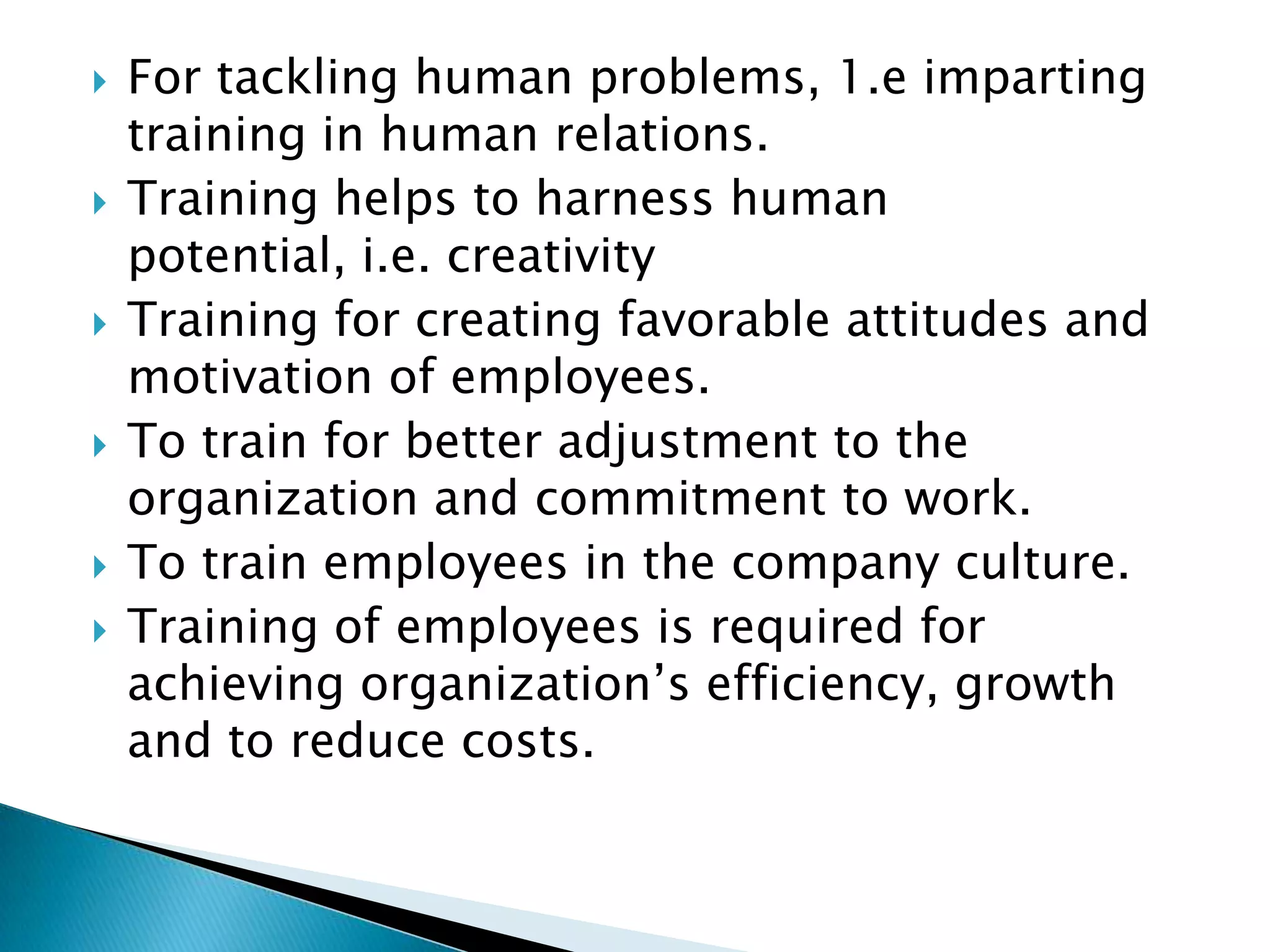
   For tackling human problems, 1.e imparting
    training in human relations.
   Training helps to harness human
    potential, i.e. creativity
   Training for creating favorable attitudes and
    motivation of employees.
   To train for better adjustment to the
    organization and commitment to work.
   To train employees in the company culture.
   Training of employees is required for
    achieving organization’s efficiency, growth
    and to reduce costs.
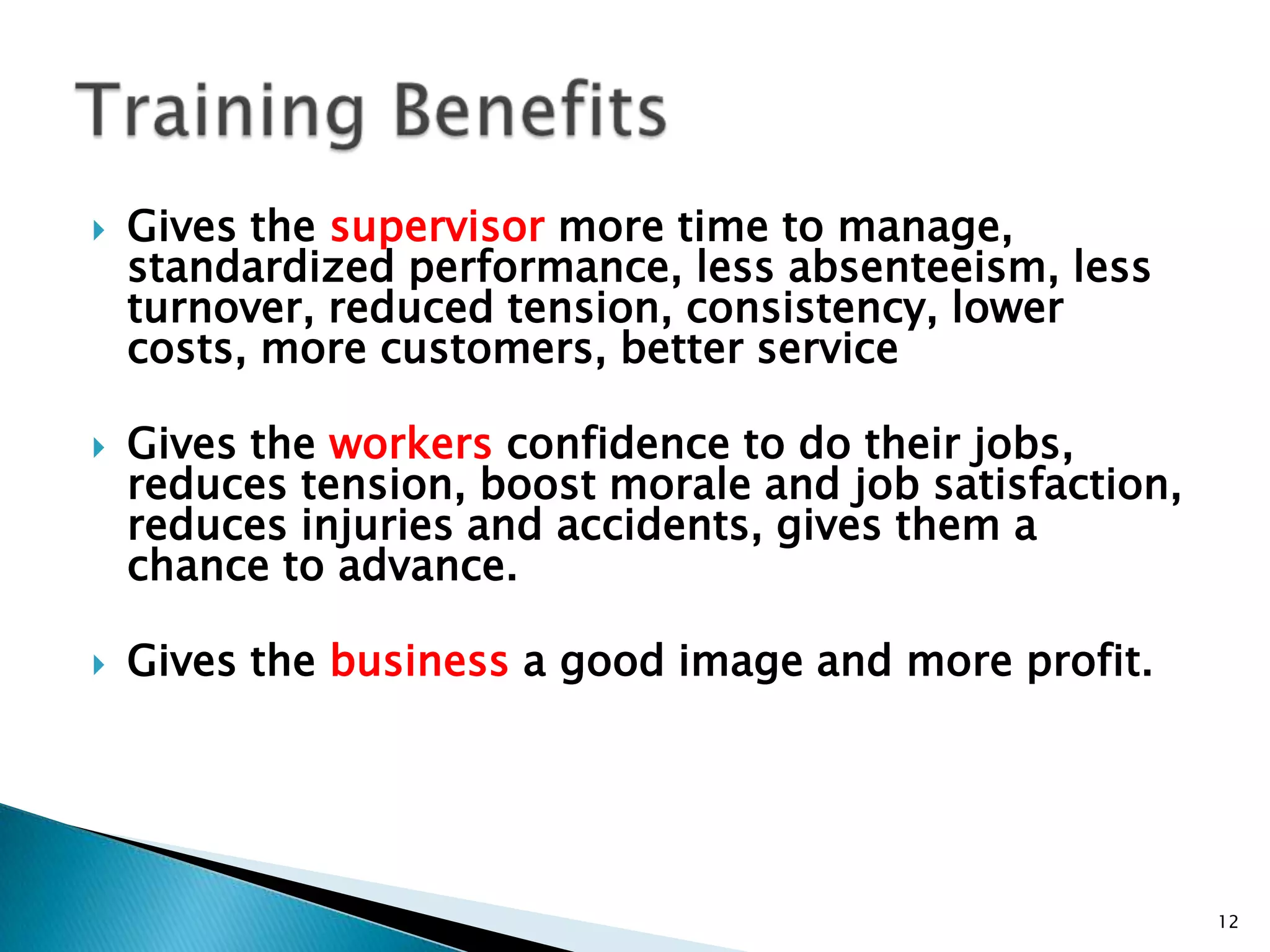
   Gives the supervisor more time to manage,
    standardized performance, less absenteeism, less
    turnover, reduced tension, consistency, lower
    costs, more customers, better service

   Gives the workers confidence to do their jobs,
    reduces tension, boost morale and job satisfaction,
    reduces injuries and accidents, gives them a
    chance to advance.

   Gives the business a good image and more profit.


                                                          12
   Managing Alignment
    ◦ Clarify team goals and company goals.
    ◦ Help employees manage their objectives.
    ◦ Scan organization environment for useful
      information for the team.

   Encouraging Continuous Learning
    ◦ Help team identify training needs.
    ◦ Help team become effective at on-the-job training.
    ◦ Create environment that encourages learning.


                                                           13
   A number of studies indicate that employee
    training has a positive impact on corporate
    performance.

   Training also improves
    ◦   Productivity
    ◦   Firm’s performance
    ◦   Revenues
    ◦   Profitability
    ◦   Client Satisfaction


                                                  14
   Training and development activities have been
    increasing
    ◦ Tight labour market - Organizations compete to attract &
      retain employees, by offering better Training &
      Development opportunities
    ◦ New and changing technology
    ◦ Globalization – training for employees with international
      assignments
    ◦ Mergers, acquisitions, restructuring


                                                                  15
16
 Learning is the acquisition of
 skills, knowledge, or attitudes.
   When they are actively involved in the learning process

   Training is relevant and practical.

   Training material is organized and presented in chunks.

   Training is in an informal, quiet, and comfortable setting.

   When they have a good trainer.

   When they receive feedback on performance.

   When they are rewarded.
There are 3 theories:

1. Behavioral Learning Theory
2. Social Learning Theory
3. Cognitive Learning Theory
   Primary Focus
    ◦ Observable behaviour
    ◦ Stimulus-response
      connections
   Assumptions
    ◦ Learning is a result of
      environmental forces
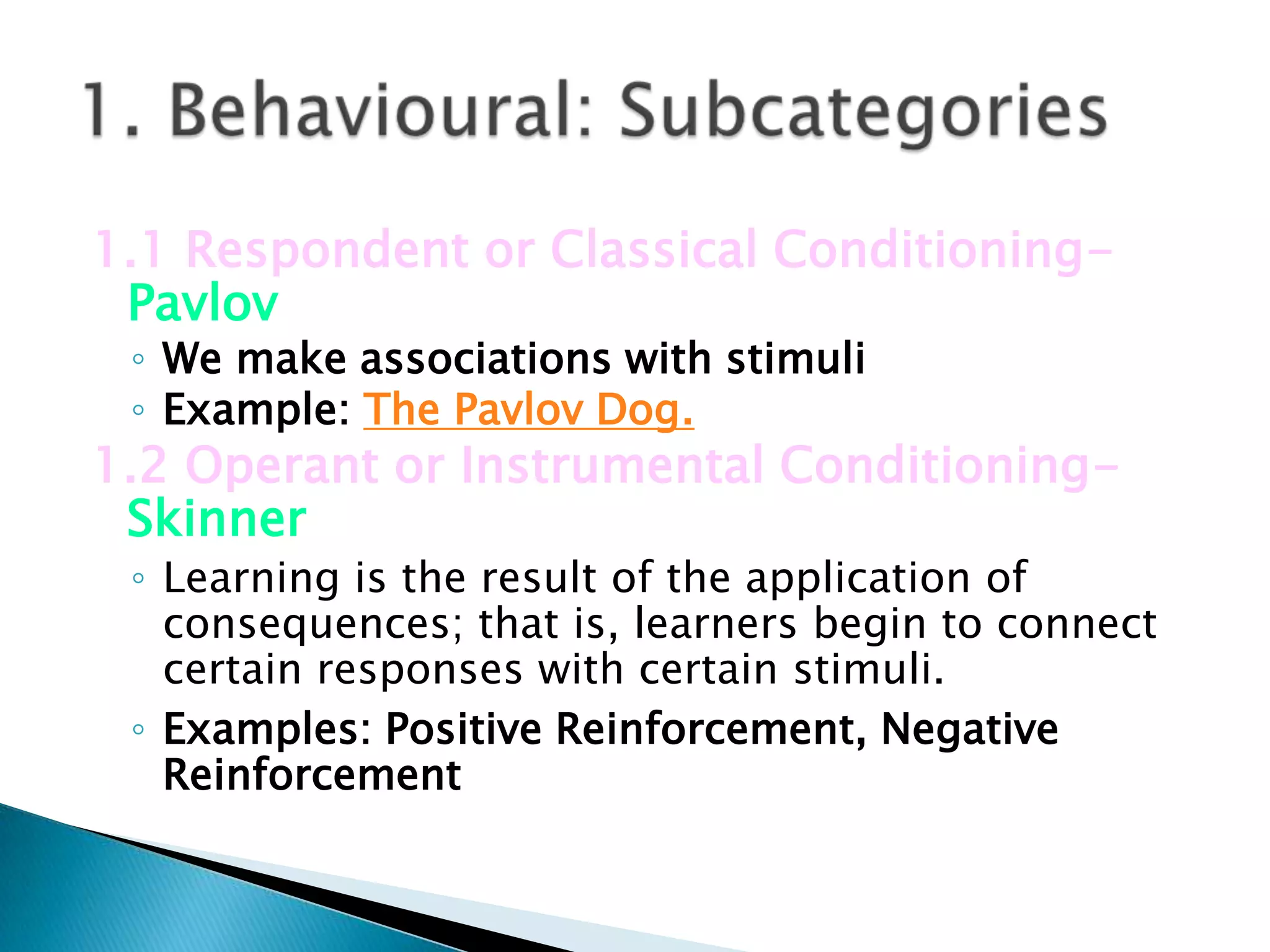
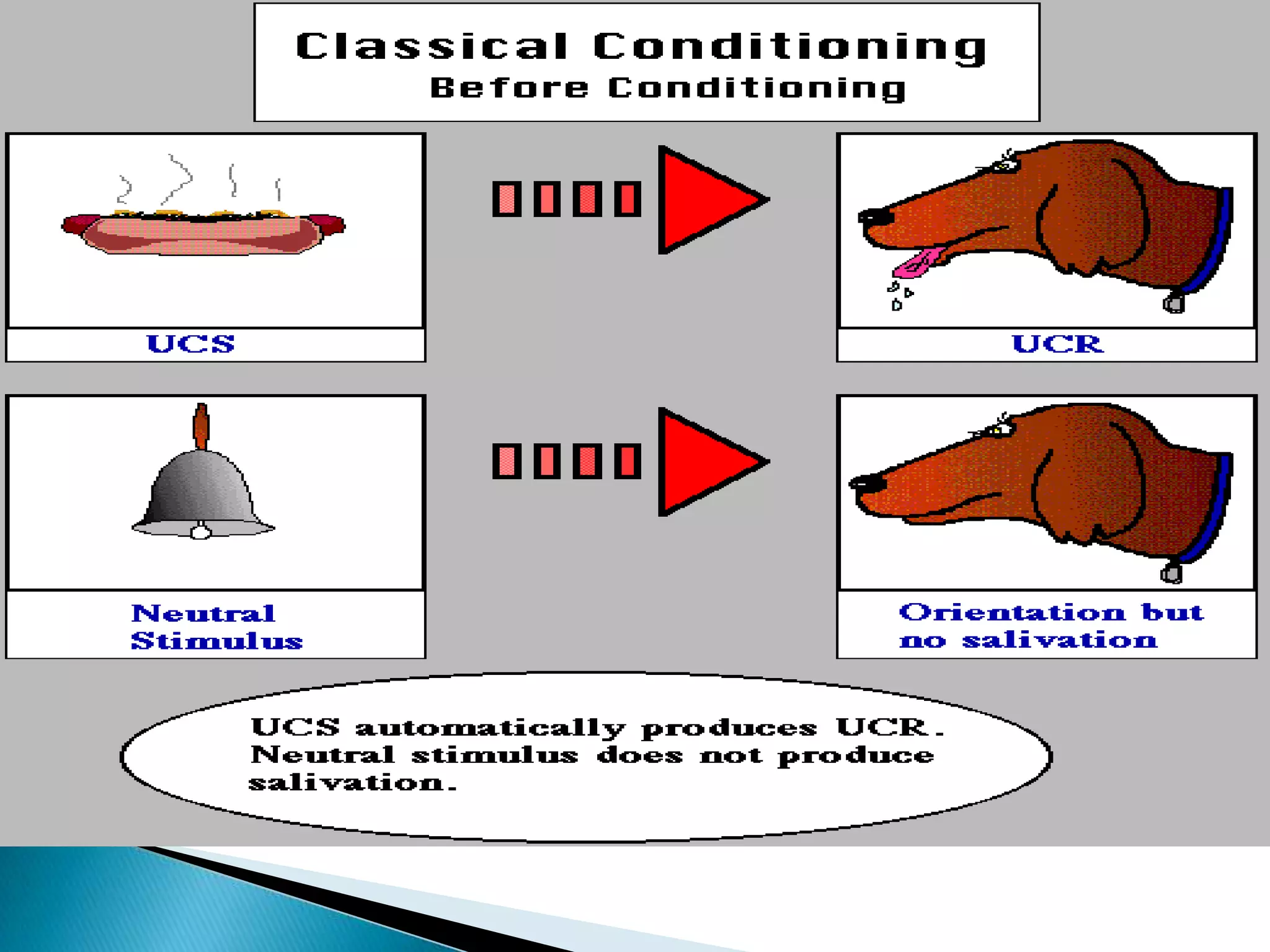
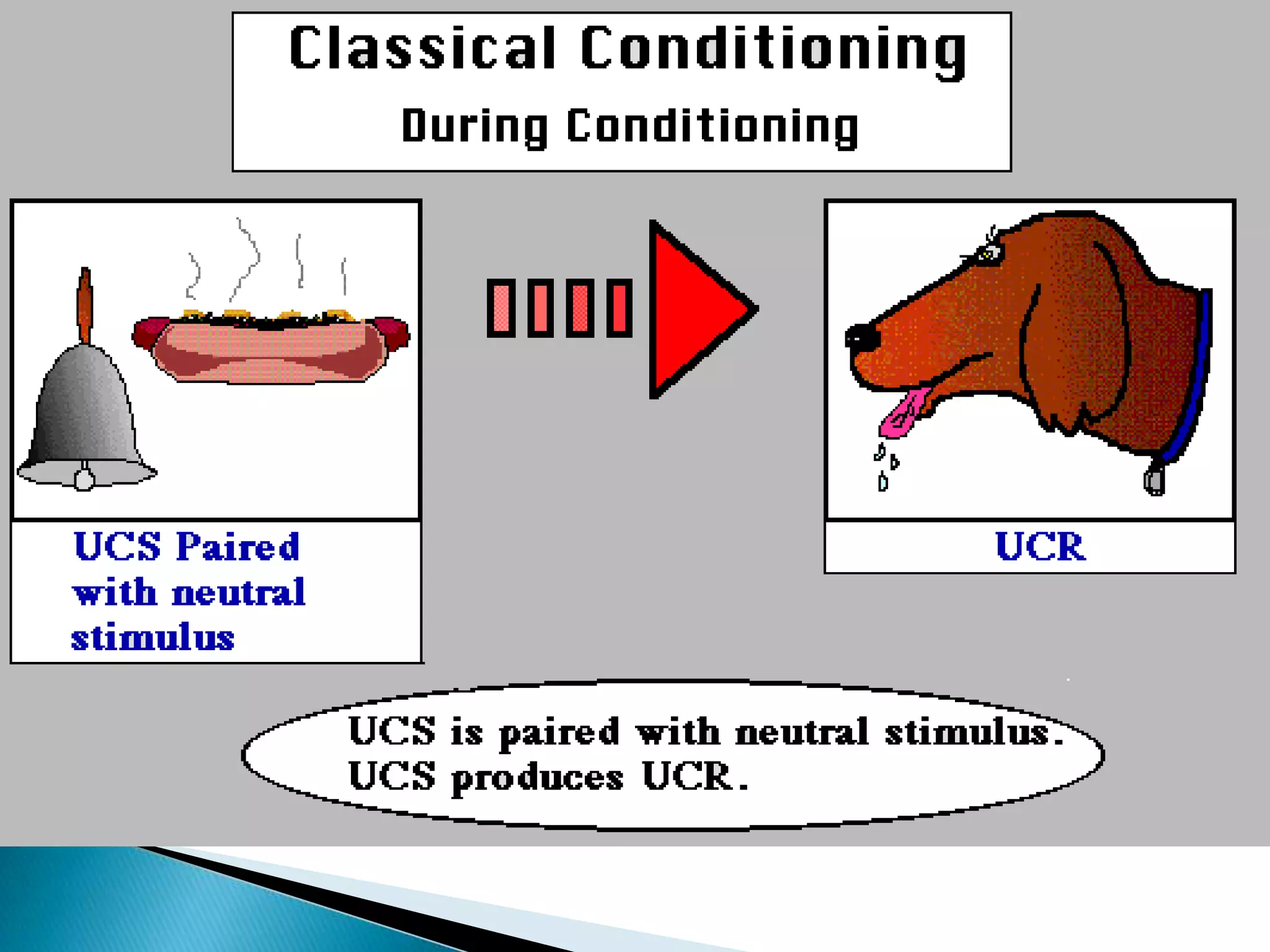
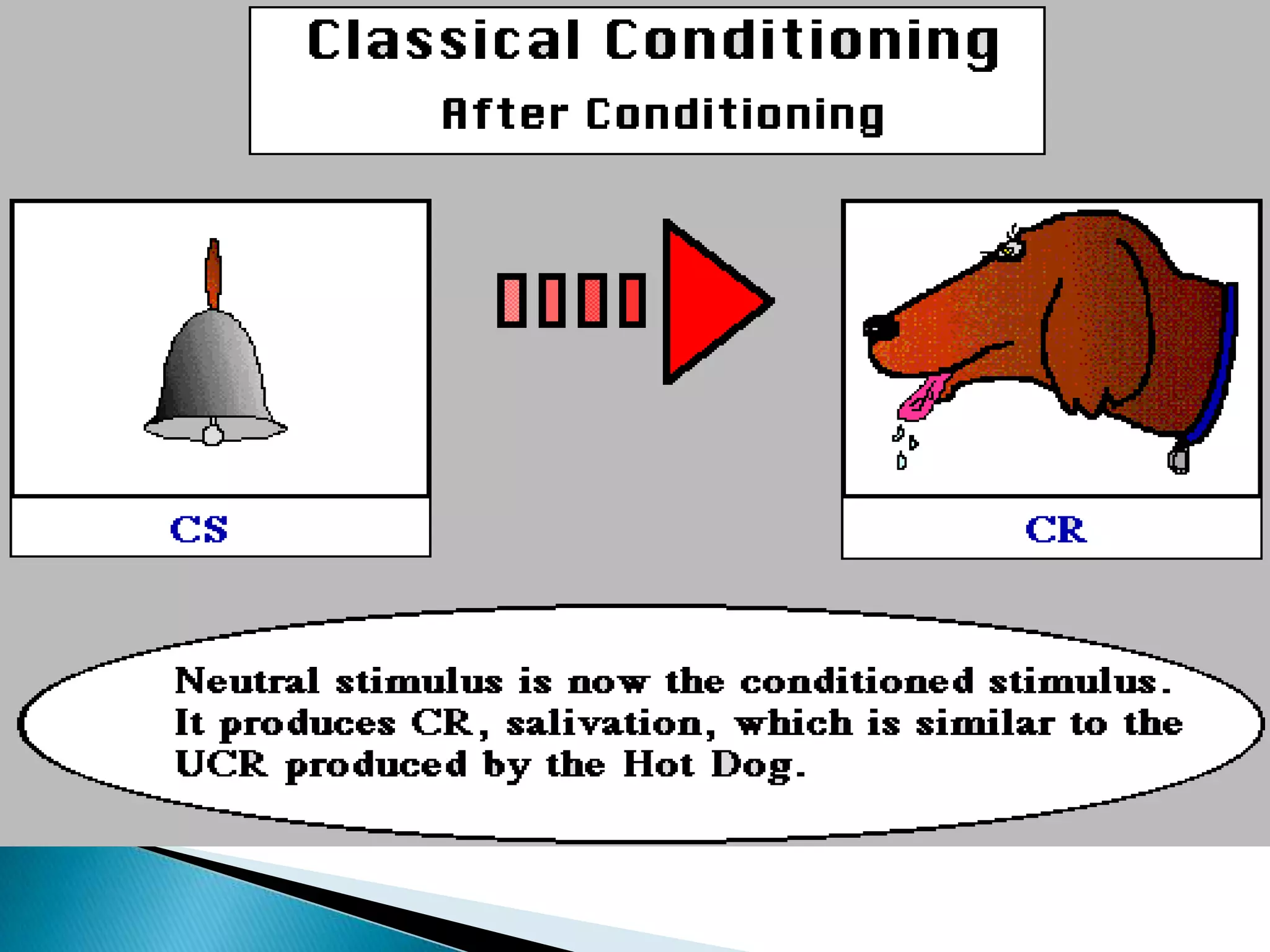
1.1 Respondent or Classical Conditioning-
 Pavlov
 ◦ We make associations with stimuli
 ◦ Example: The Pavlov Dog.
1.2 Operant or Instrumental Conditioning-
 Skinner
 ◦ Learning is the result of the application of
   consequences; that is, learners begin to connect
   certain responses with certain stimuli.
 ◦ Examples: Positive Reinforcement, Negative
   Reinforcement
Classical conditioning was the first type
of learning to be discovered and studied
within the behaviorist tradition (hence
the name classical).
  The major theorist in the development
of classical conditioning is Ivan Pavlov, a
Russian scientist trained in biology and
medicine.
Examples
 Employee is harassed at work
 Employee feels bad when harassed
 Employee associates being harassed and
 work
 Employee begins to feel bad when she
 thinks of work
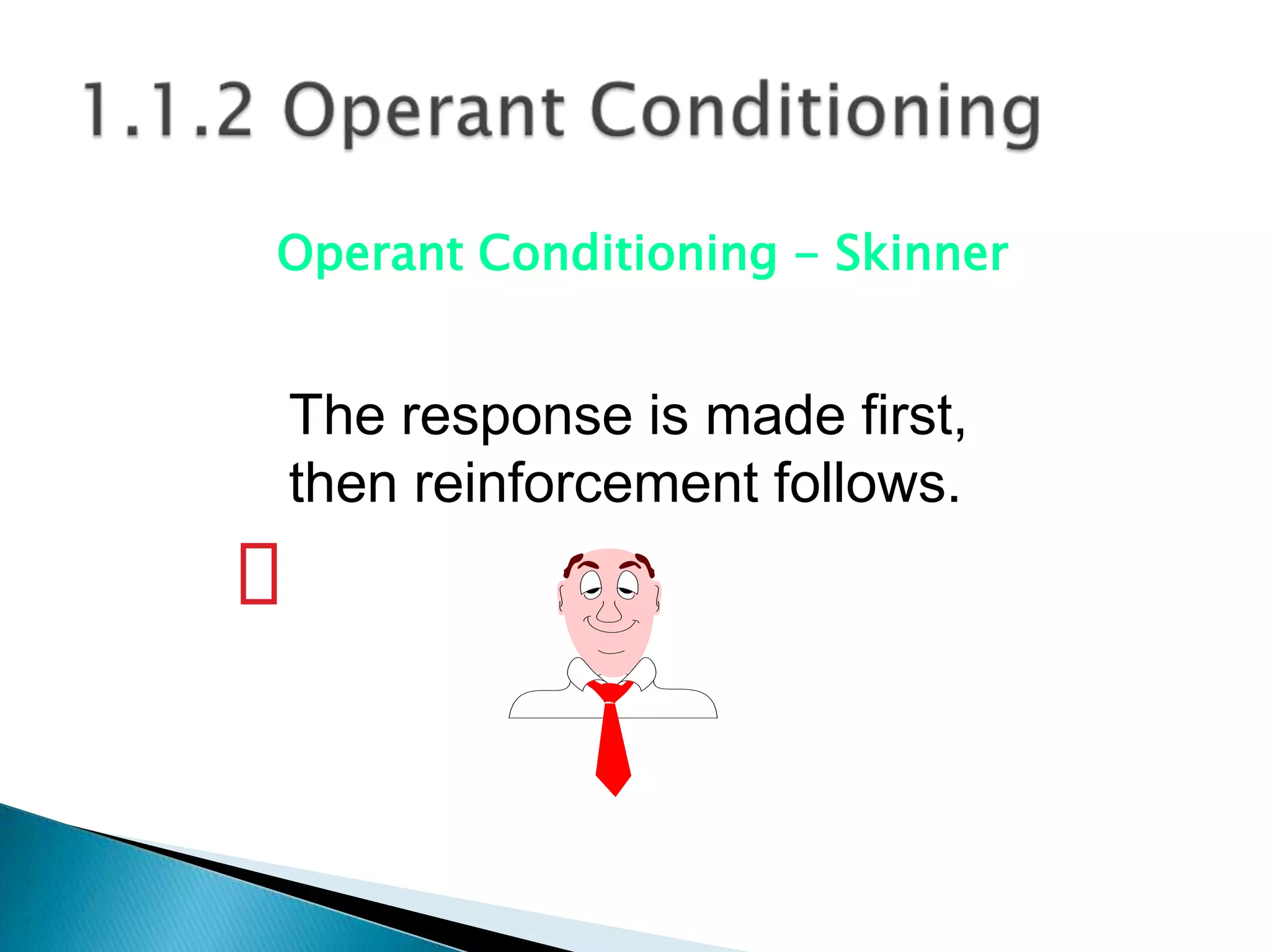
Operant Conditioning - Skinner


The response is made first,
then reinforcement follows.
Examples
Behaviours                                Consequences
The Individual
   works and                                  is paid.
   is late to work and                   is docked pay.
   enters a restaurant and                    eats.
   enters a football stadium and   watches a football game.
   enters a grocery store and            buys food.
Social Learning Theory- Albert Bandura

 The social learning theory emphasizes the
 importance of observing and modeling the
 behaviors, attitudes, and emotional reactions of
 others.


The learning cycle
 Attention
 Retention
 Reproduction
 Motivation
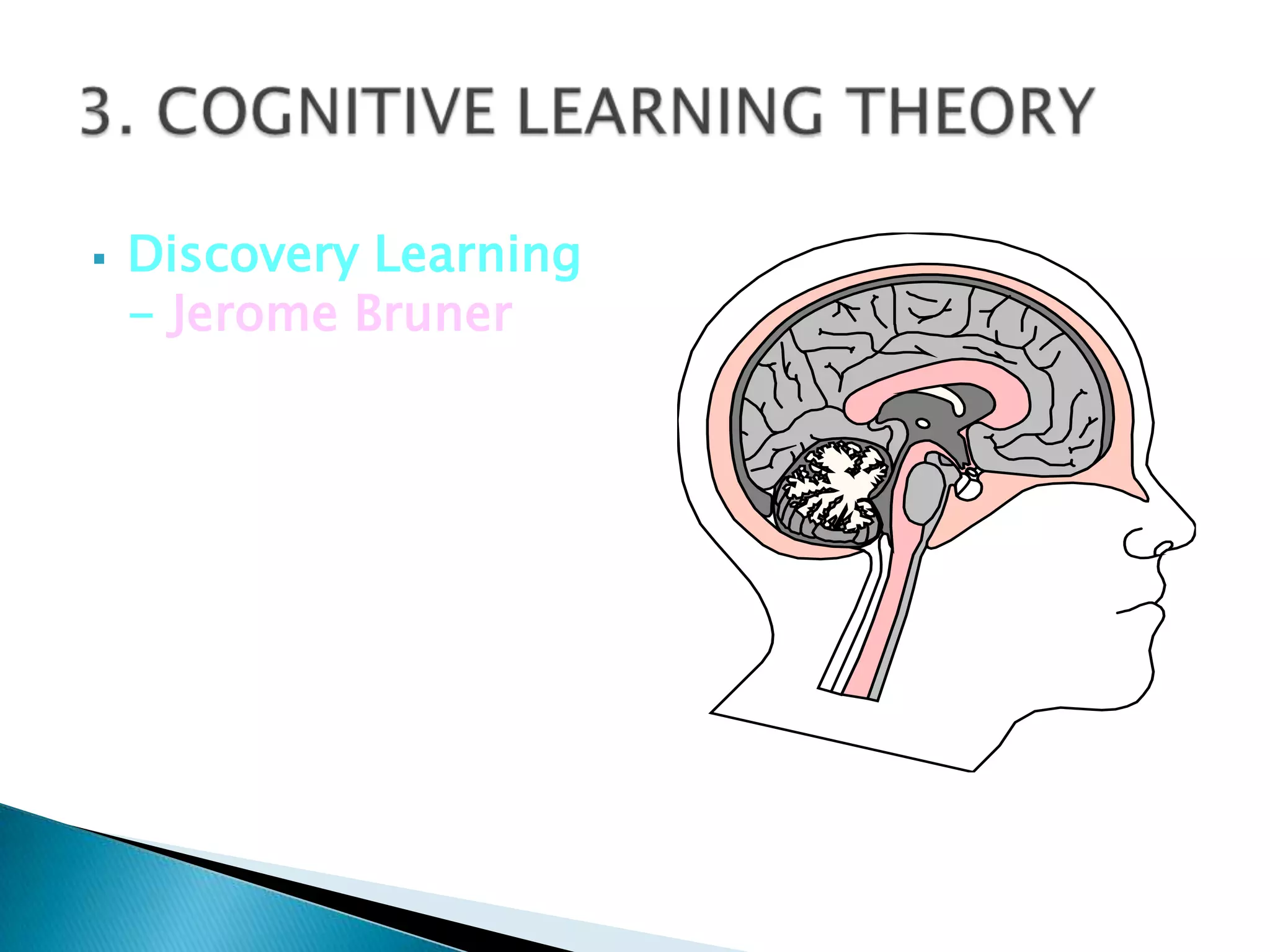
   Discovery Learning
    - Jerome Bruner
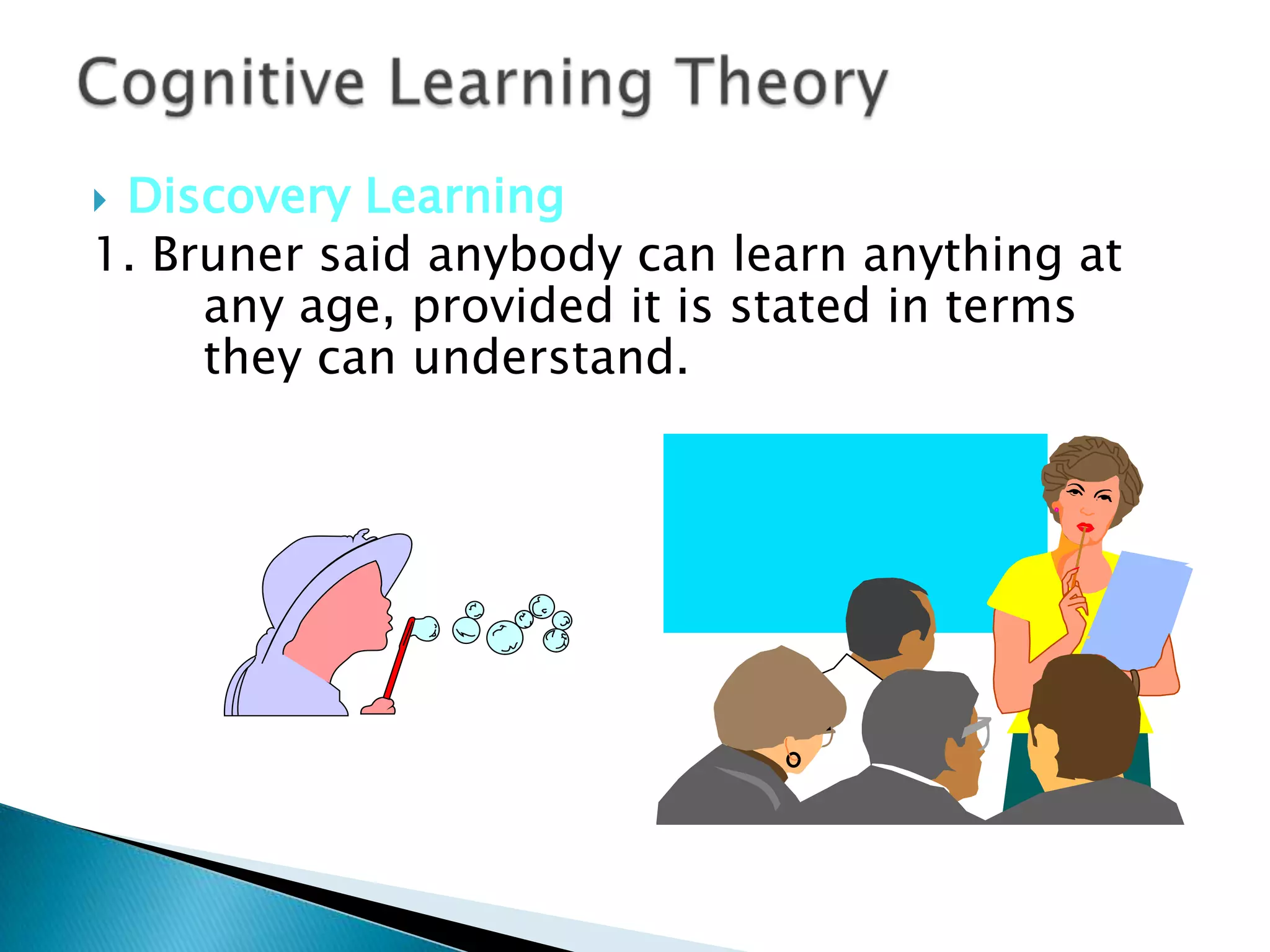
Discovery Learning
1. Bruner said anybody can learn anything at
     any age, provided it is stated in terms
     they can understand.
 Discovery Learning
2. Powerful concepts (not isolated facts)
 a. Transfer to many different situations
 b. Only possible through Discovery Learning
 c. Confront the learner with problems and
  help     them find solutions. Do not present
           sequenced materials.
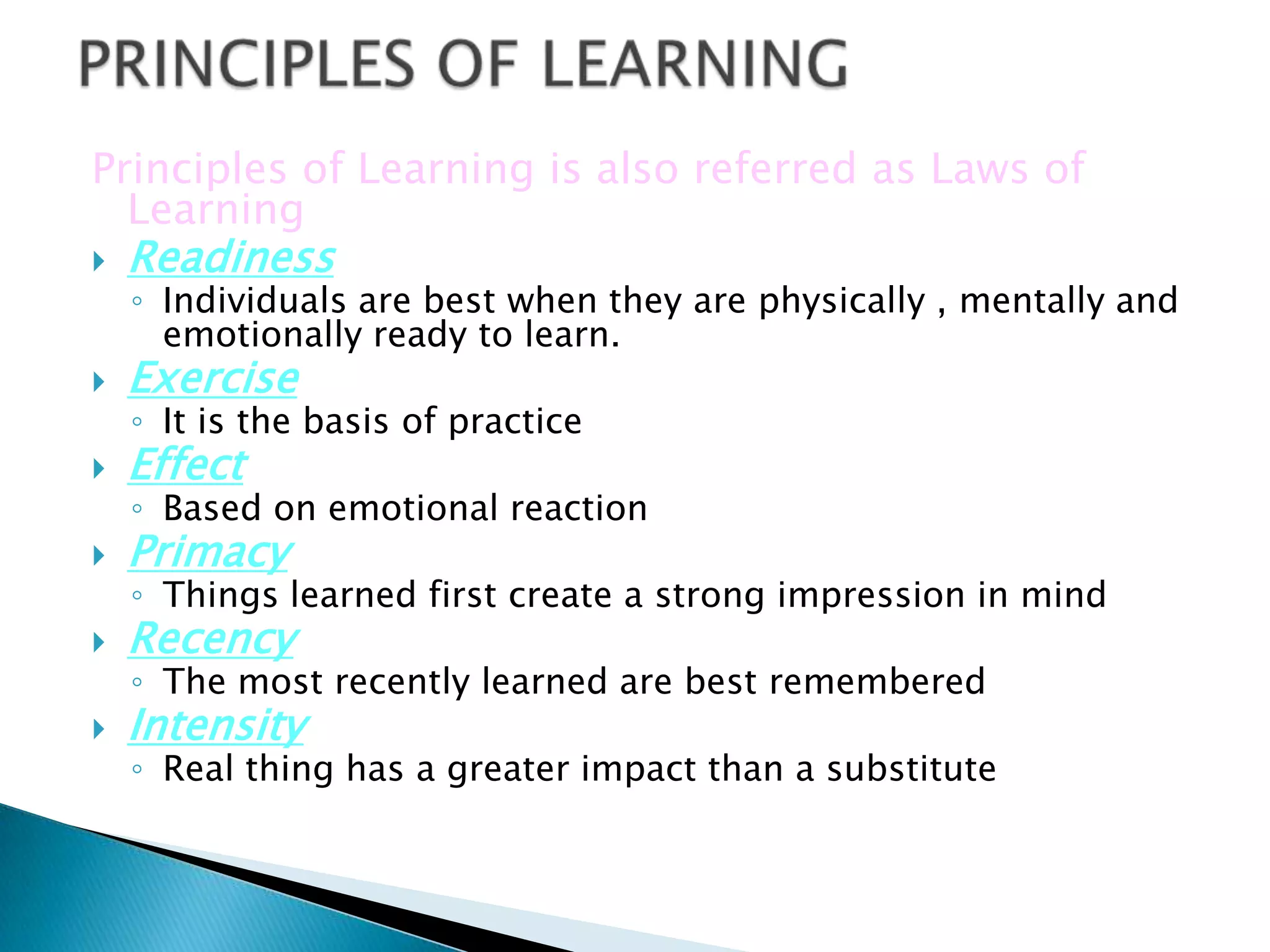
Principles of Learning is also referred as Laws of
  Learning
   Readiness
    ◦ Individuals are best when they are physically , mentally and
      emotionally ready to learn.
   Exercise
    ◦ It is the basis of practice
   Effect
    ◦ Based on emotional reaction
   Primacy
    ◦ Things learned first create a strong impression in mind
   Recency
    ◦ The most recently learned are best remembered
   Intensity
    ◦ Real thing has a greater impact than a substitute
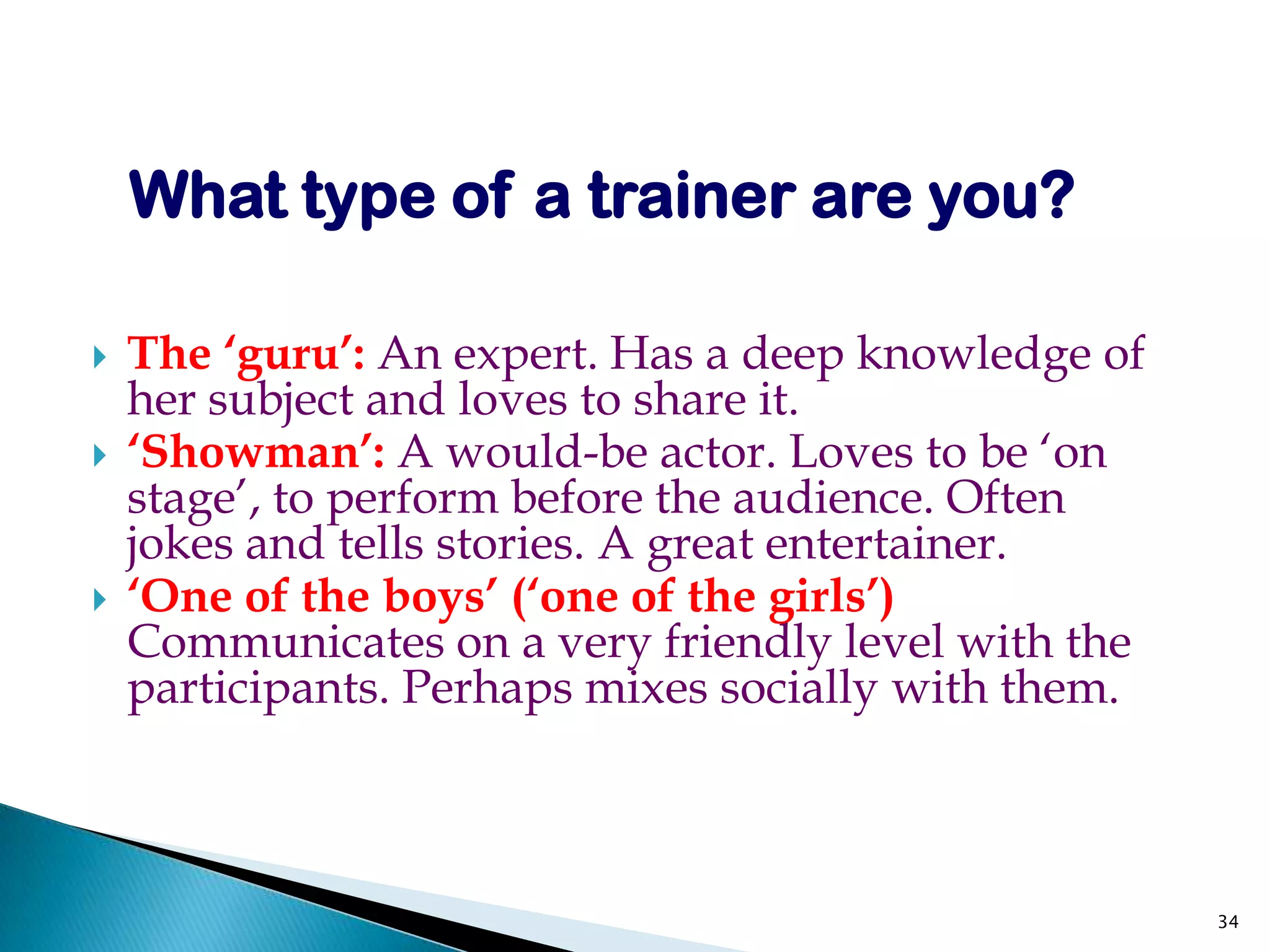
What type of a trainer are you?

   The ‘guru’: An expert. Has a deep knowledge of
    her subject and loves to share it.
   ‘Showman’: A would-be actor. Loves to be ‘on
    stage’, to perform before the audience. Often
    jokes and tells stories. A great entertainer.
   ‘One of the boys’ (‘one of the girls’)
    Communicates on a very friendly level with the
    participants. Perhaps mixes socially with them.


                                                      34
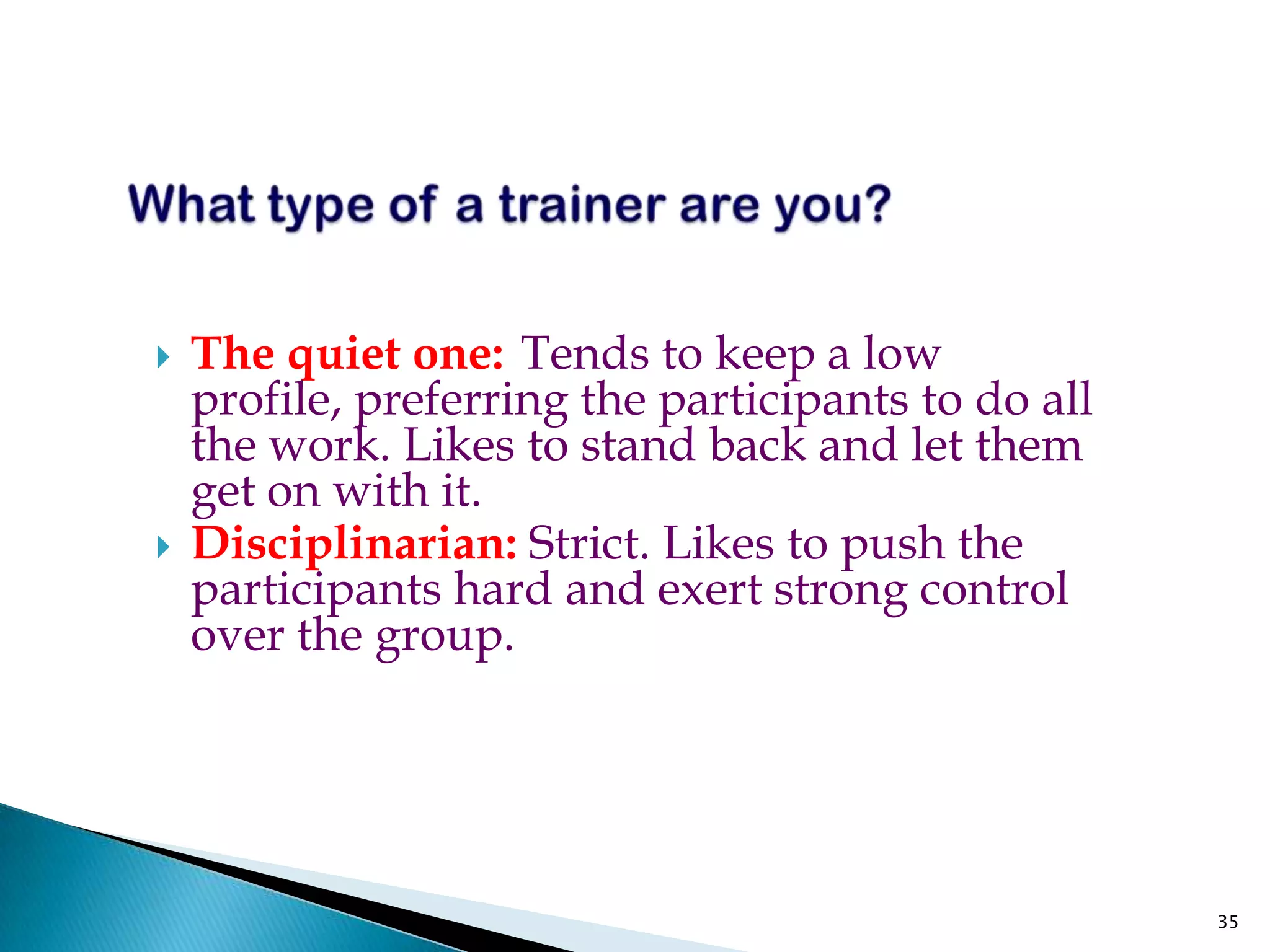
   The quiet one: Tends to keep a low
    profile, preferring the participants to do all
    the work. Likes to stand back and let them
    get on with it.
   Disciplinarian: Strict. Likes to push the
    participants hard and exert strong control
    over the group.


                                                     35
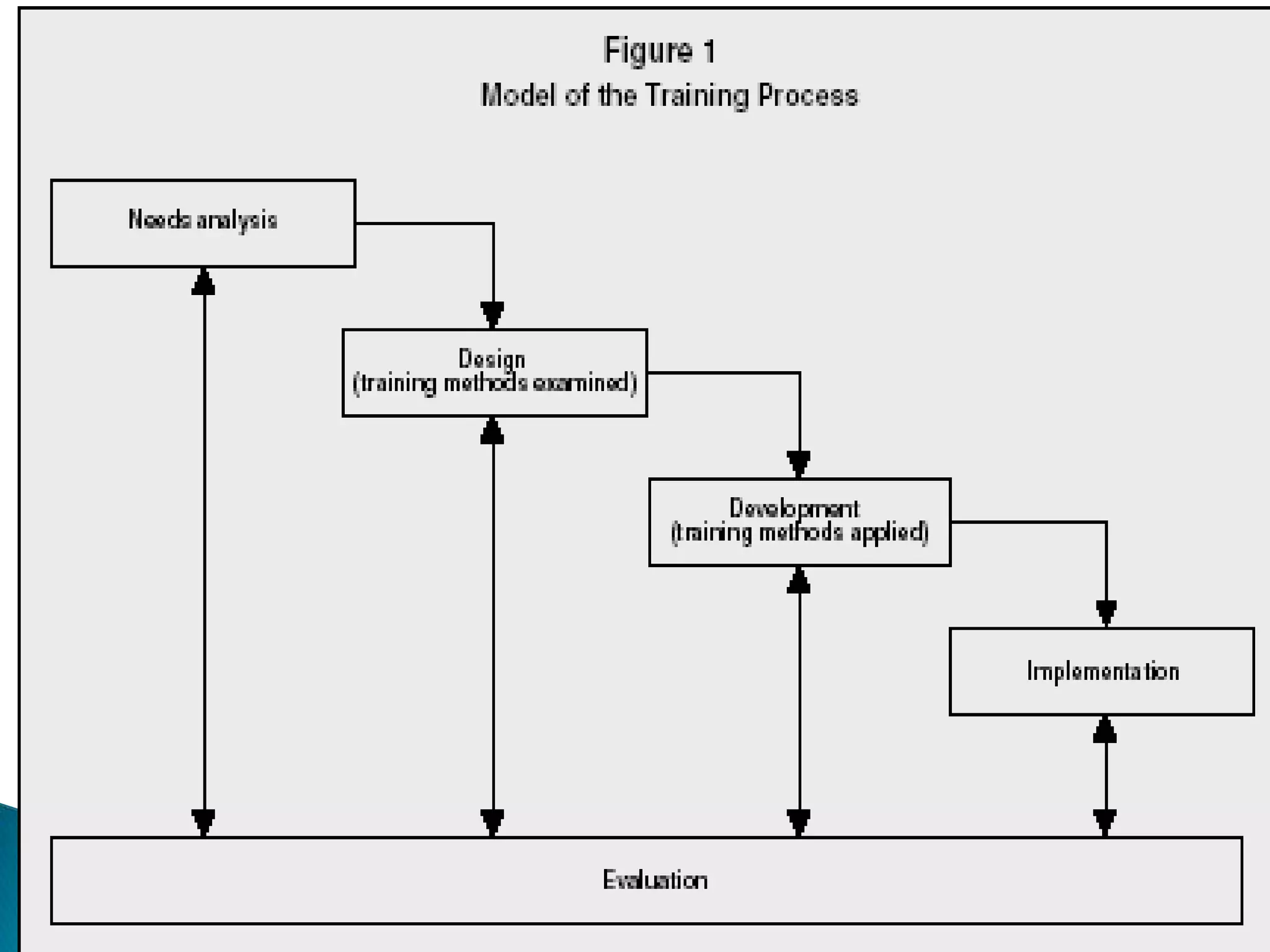
   Referred as training need analysis (TNA)
   Effective training system begin with
    identification of training need
   These need creates performance gap
   Ex: low profit , low customer satisfaction
    , more scrap
   Another type of performance gap is future
    oriented
   Company can perform poorly until changes
    are made
   Development of training objective
   What will be trained and how
   Identifying factors needed in training
    program
   Identifying alternative factors methods of
    instruction
   Formulating a instructional strategy to meet a
    set of training objectives
   Instructional strategy consist of order , timing
    , material , media , and combination of
    methods and elements used in training
    program
   Output of development phase act as input for
    implementation phase
   All aspects of training program come
    together during the implementation phase
   It is mistake to assume that everything will
    happen as planned
   It is useful to conduct a dry run or pilot study
    of the program
   Output becomes input for Evaluation Phase
   Two Types of Evaluation : Process , Outcome
   Process: Determined how well a particular
    process achieved its objectives ( I,e ouputs)
   Outcome: Is evaluation conducted at end of
    training to determine the effect of training on
    the trainee , job , and organization
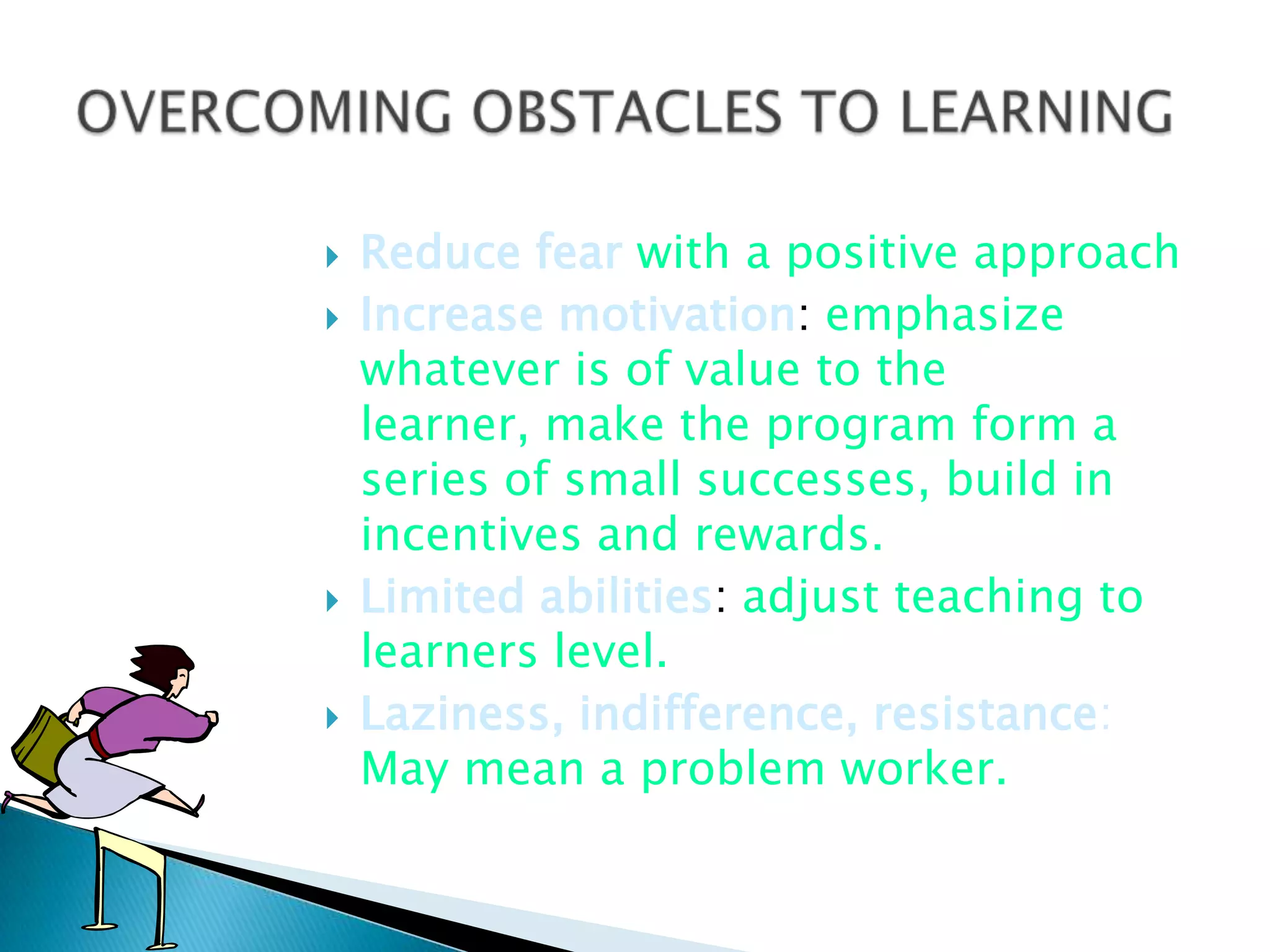
   Reduce fear with a positive approach
   Increase motivation: emphasize
    whatever is of value to the
    learner, make the program form a
    series of small successes, build in
    incentives and rewards.
   Limited abilities: adjust teaching to
    learners level.
   Laziness, indifference, resistance:
    May mean a problem worker.
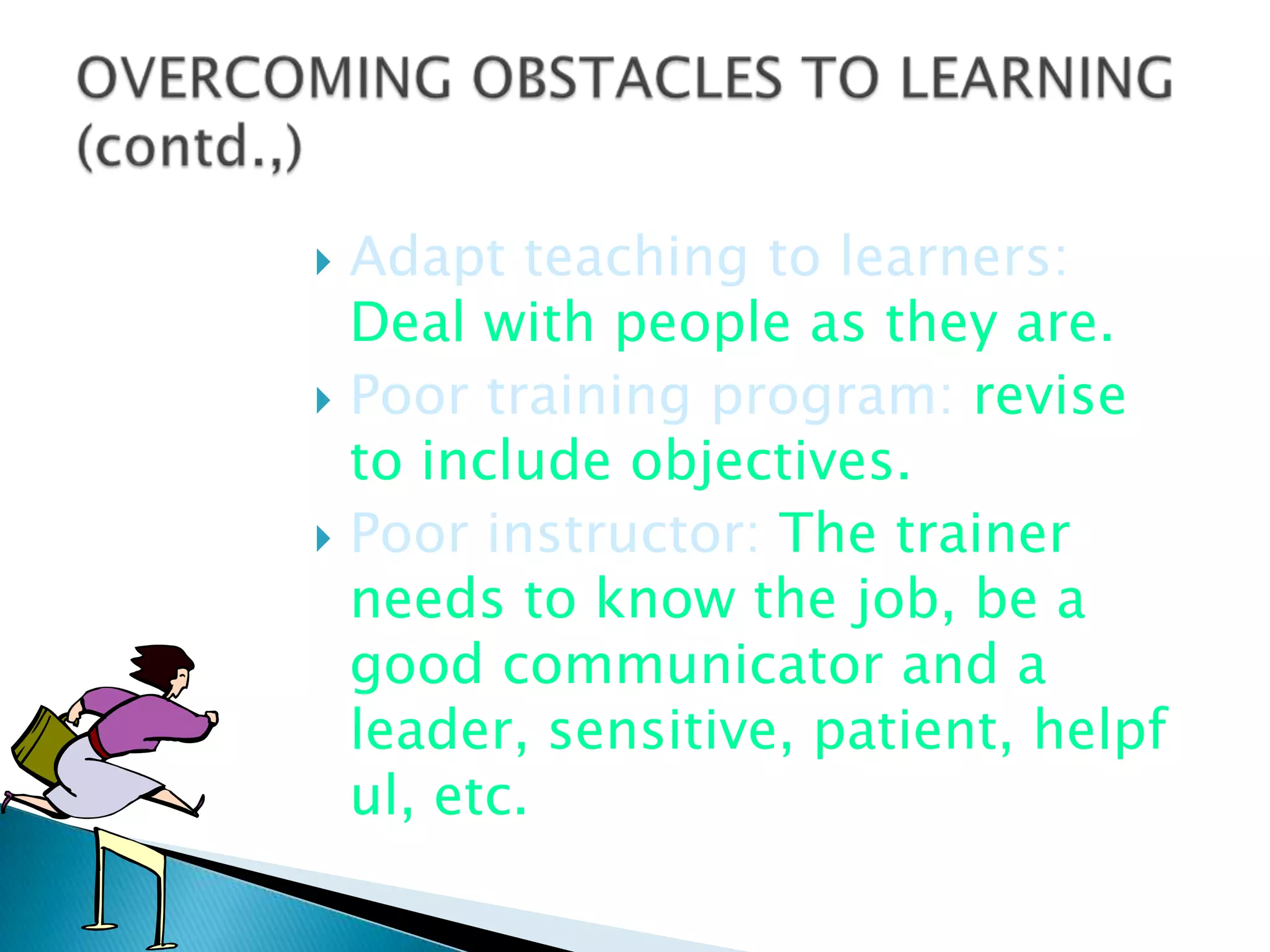
 Adapt teaching to learners:
  Deal with people as they are.
 Poor training program: revise
  to include objectives.
 Poor instructor: The trainer
  needs to know the job, be a
  good communicator and a
  leader, sensitive, patient, helpf
  ul, etc.
   Process used to determine how best to
    pursue the organizations mission while
    meeting the demand of the organization in
    the near and long term.
   2 types of strategy
      Proactive strategy
       Reactive Strategy
   Focus on longer term
   Process is more formalized
   Purpose is to build a good fit between the
    organization and its future environment
   Help to make a best guess about what the
    future will bring
   Focus on short term
   Process is less formalized
   It address how operations will confront what
    exist now and the next two years.
   Identify current mission, goals and objectives
   Environmental assessment
   Development of operational plans and
    budgets
   Implementation
   Evaluation and feedback
   A collection of planned change interventions
    , built on humanistic – democratic
    values, that seeks to improve organisational
    effectiveness and employee well-being
    ◦ Strong emphasis on colloboration
    ◦ Respect for people, trust and support, power
      equalisation, participation
   Sensitivity training
   Survey feedback
   Process consultation
   Team building
   Inter-group development
   Appreciative enquiry
   Also called laboratory training, encounter
    groups, T-groups( training groups)
   Changing behaviour through unstructured
    group interaction
   Free and open environment
   Members discuss, loosely directed by a
    professional behavioural scientist
   Group is process-oriented
   Individuals learn through observing and
    participating
   Objective is to increase awareness of their
    own behaviour, and others perception
   Results in increased empathy, listening
    skills, greater openness, increased
    tolerance, conflict resolution skills
   Use of questionnaires
   Identifies discrepancies among member
    perceptions, discussion follows and remedies are
    suggested
   Manager and his subordinates participate
   Concentrates on DM practices, communication
    effectiveness, coordination between units, job
    satisfaction
   Data is tabulated and distributed to employees
   Identify issues creating differences to employees
   An outside consultant helps client to deal
    with problems that need improvement
   More task oriented
   Consultants help clients in understanding the
    environment
   Guides client to solve his own problems
   Joint approach between client and consultant
   Develops greater understanding of the
    process and less resistance to the plan
    chosen
   Consultant only helps in problem
    identification
   Refers to an external expert if needed
   To increase trust and openness
   Activities include goal setting, role analysis
   Begins with defining goals and priorities
   Identify potential problem areas
   Analyzing key problems and effective ways of
    performing it
   To reduce conflict among groups
   To change attitudes, stereotypes &
    perceptions that groups have of each other
   Popular method is problem solving
    ◦ Each group meets independently to develop lists of
      perception of itself and how others perceive it
    ◦ Differences are identified and discussed
   Identifies the unique strengths/qualities of an
    organisation
   4 steps
     Discovery – identifying strengths
     Dreaming – speculating possible futures of the
      organisation
     Design – finding a common vision and agree on
      unique qualities
     Destiny – how organisation is going to fulfill its
      dream . Writing of action plans and development of
      implementation strategies

Training & development(unit 1)

  • 1.
    UNIT - I M.Mano Samuel Lecturer , HR The American College 1
  • 2.
    Training refers toa planned effort by a company to facilitate employees’ learning of job-related competencies for the achievement of organizational goals. 2
  • 3.
    ◦ Master theknowledge, skill, and behaviors emphasized in training programs, and ◦ Apply them to their day-to-day activities 3
  • 4.
     Training isthe process of proving employees with specific skills or helping them correct efficacies in their performance 4
  • 5.
     Development is an effort to provide employees with the abilities that organization will require in the future 5
  • 6.
    3 important terms  Training  Education  Development 6
  • 7.
    In all training there is some education  In all education there is some training  And two process cannot be separated from development 7
  • 8.
    Training Development Focus Current Job Current/Future Jobs Scope Individual Group/ Organization Time Frame Immediate Long Term Goal Fix Skill Deficit Prepare for Future 8
  • 9.
    Training Education Orientation Application Theoretical conceptual Learning On-the-job and off-the Class-room job Scope Specific tasks General concepts Goal Trainee is paid to Student pays to learn learn V.SUGUMARAN T&D UNIT-1, KSM 9
  • 10.
    Training is required for improving performance on the job  Training is essential to keep pace with technological advances and avoid obsolence  To cope with changing environment such as competition.  Training is needed for promotion to higher jobs I,e for future role succession
  • 11.
    For tackling human problems, 1.e imparting training in human relations.  Training helps to harness human potential, i.e. creativity  Training for creating favorable attitudes and motivation of employees.  To train for better adjustment to the organization and commitment to work.  To train employees in the company culture.  Training of employees is required for achieving organization’s efficiency, growth and to reduce costs.
  • 12.
    Gives the supervisor more time to manage, standardized performance, less absenteeism, less turnover, reduced tension, consistency, lower costs, more customers, better service  Gives the workers confidence to do their jobs, reduces tension, boost morale and job satisfaction, reduces injuries and accidents, gives them a chance to advance.  Gives the business a good image and more profit. 12
  • 13.
    Managing Alignment ◦ Clarify team goals and company goals. ◦ Help employees manage their objectives. ◦ Scan organization environment for useful information for the team.  Encouraging Continuous Learning ◦ Help team identify training needs. ◦ Help team become effective at on-the-job training. ◦ Create environment that encourages learning. 13
  • 14.
    A number of studies indicate that employee training has a positive impact on corporate performance.  Training also improves ◦ Productivity ◦ Firm’s performance ◦ Revenues ◦ Profitability ◦ Client Satisfaction 14
  • 15.
    Training and development activities have been increasing ◦ Tight labour market - Organizations compete to attract & retain employees, by offering better Training & Development opportunities ◦ New and changing technology ◦ Globalization – training for employees with international assignments ◦ Mergers, acquisitions, restructuring 15
  • 16.
  • 17.
     Learning isthe acquisition of skills, knowledge, or attitudes.
  • 18.
    When they are actively involved in the learning process  Training is relevant and practical.  Training material is organized and presented in chunks.  Training is in an informal, quiet, and comfortable setting.  When they have a good trainer.  When they receive feedback on performance.  When they are rewarded.
  • 19.
    There are 3theories: 1. Behavioral Learning Theory 2. Social Learning Theory 3. Cognitive Learning Theory
  • 20.
    Primary Focus ◦ Observable behaviour ◦ Stimulus-response connections  Assumptions ◦ Learning is a result of environmental forces
  • 21.
    1.1 Respondent orClassical Conditioning- Pavlov ◦ We make associations with stimuli ◦ Example: The Pavlov Dog. 1.2 Operant or Instrumental Conditioning- Skinner ◦ Learning is the result of the application of consequences; that is, learners begin to connect certain responses with certain stimuli. ◦ Examples: Positive Reinforcement, Negative Reinforcement
  • 22.
    Classical conditioning wasthe first type of learning to be discovered and studied within the behaviorist tradition (hence the name classical). The major theorist in the development of classical conditioning is Ivan Pavlov, a Russian scientist trained in biology and medicine.
  • 26.
    Examples Employee isharassed at work Employee feels bad when harassed Employee associates being harassed and work Employee begins to feel bad when she thinks of work
  • 27.
    Operant Conditioning -Skinner The response is made first, then reinforcement follows.
  • 28.
    Examples Behaviours Consequences The Individual  works and is paid.  is late to work and is docked pay.  enters a restaurant and eats.  enters a football stadium and watches a football game.  enters a grocery store and buys food.
  • 29.
    Social Learning Theory-Albert Bandura The social learning theory emphasizes the importance of observing and modeling the behaviors, attitudes, and emotional reactions of others. The learning cycle Attention Retention Reproduction Motivation
  • 30.
    Discovery Learning - Jerome Bruner
  • 31.
    Discovery Learning 1. Brunersaid anybody can learn anything at any age, provided it is stated in terms they can understand.
  • 32.
     Discovery Learning 2.Powerful concepts (not isolated facts)  a. Transfer to many different situations  b. Only possible through Discovery Learning  c. Confront the learner with problems and help them find solutions. Do not present sequenced materials.
  • 33.
    Principles of Learningis also referred as Laws of Learning  Readiness ◦ Individuals are best when they are physically , mentally and emotionally ready to learn.  Exercise ◦ It is the basis of practice  Effect ◦ Based on emotional reaction  Primacy ◦ Things learned first create a strong impression in mind  Recency ◦ The most recently learned are best remembered  Intensity ◦ Real thing has a greater impact than a substitute
  • 34.
    What type ofa trainer are you?  The ‘guru’: An expert. Has a deep knowledge of her subject and loves to share it.  ‘Showman’: A would-be actor. Loves to be ‘on stage’, to perform before the audience. Often jokes and tells stories. A great entertainer.  ‘One of the boys’ (‘one of the girls’) Communicates on a very friendly level with the participants. Perhaps mixes socially with them. 34
  • 35.
    The quiet one: Tends to keep a low profile, preferring the participants to do all the work. Likes to stand back and let them get on with it.  Disciplinarian: Strict. Likes to push the participants hard and exert strong control over the group. 35
  • 37.
    Referred as training need analysis (TNA)  Effective training system begin with identification of training need  These need creates performance gap  Ex: low profit , low customer satisfaction , more scrap  Another type of performance gap is future oriented  Company can perform poorly until changes are made
  • 38.
    Development of training objective  What will be trained and how  Identifying factors needed in training program  Identifying alternative factors methods of instruction
  • 39.
    Formulating a instructional strategy to meet a set of training objectives  Instructional strategy consist of order , timing , material , media , and combination of methods and elements used in training program  Output of development phase act as input for implementation phase
  • 40.
    All aspects of training program come together during the implementation phase  It is mistake to assume that everything will happen as planned  It is useful to conduct a dry run or pilot study of the program
  • 41.
    Output becomes input for Evaluation Phase  Two Types of Evaluation : Process , Outcome  Process: Determined how well a particular process achieved its objectives ( I,e ouputs)  Outcome: Is evaluation conducted at end of training to determine the effect of training on the trainee , job , and organization
  • 42.
    Reduce fear with a positive approach  Increase motivation: emphasize whatever is of value to the learner, make the program form a series of small successes, build in incentives and rewards.  Limited abilities: adjust teaching to learners level.  Laziness, indifference, resistance: May mean a problem worker.
  • 43.
     Adapt teachingto learners: Deal with people as they are.  Poor training program: revise to include objectives.  Poor instructor: The trainer needs to know the job, be a good communicator and a leader, sensitive, patient, helpf ul, etc.
  • 44.
    Process used to determine how best to pursue the organizations mission while meeting the demand of the organization in the near and long term.  2 types of strategy Proactive strategy Reactive Strategy
  • 45.
    Focus on longer term  Process is more formalized  Purpose is to build a good fit between the organization and its future environment  Help to make a best guess about what the future will bring
  • 46.
    Focus on short term  Process is less formalized  It address how operations will confront what exist now and the next two years.
  • 47.
    Identify current mission, goals and objectives  Environmental assessment  Development of operational plans and budgets  Implementation  Evaluation and feedback
  • 48.
    A collection of planned change interventions , built on humanistic – democratic values, that seeks to improve organisational effectiveness and employee well-being ◦ Strong emphasis on colloboration ◦ Respect for people, trust and support, power equalisation, participation
  • 49.
    Sensitivity training  Survey feedback  Process consultation  Team building  Inter-group development  Appreciative enquiry
  • 50.
    Also called laboratory training, encounter groups, T-groups( training groups)  Changing behaviour through unstructured group interaction  Free and open environment  Members discuss, loosely directed by a professional behavioural scientist
  • 51.
    Group is process-oriented  Individuals learn through observing and participating  Objective is to increase awareness of their own behaviour, and others perception  Results in increased empathy, listening skills, greater openness, increased tolerance, conflict resolution skills
  • 52.
    Use of questionnaires  Identifies discrepancies among member perceptions, discussion follows and remedies are suggested  Manager and his subordinates participate  Concentrates on DM practices, communication effectiveness, coordination between units, job satisfaction  Data is tabulated and distributed to employees  Identify issues creating differences to employees
  • 53.
    An outside consultant helps client to deal with problems that need improvement  More task oriented  Consultants help clients in understanding the environment  Guides client to solve his own problems
  • 54.
    Joint approach between client and consultant  Develops greater understanding of the process and less resistance to the plan chosen  Consultant only helps in problem identification  Refers to an external expert if needed
  • 55.
    To increase trust and openness  Activities include goal setting, role analysis  Begins with defining goals and priorities  Identify potential problem areas  Analyzing key problems and effective ways of performing it
  • 56.
    To reduce conflict among groups  To change attitudes, stereotypes & perceptions that groups have of each other  Popular method is problem solving ◦ Each group meets independently to develop lists of perception of itself and how others perceive it ◦ Differences are identified and discussed
  • 57.
    Identifies the unique strengths/qualities of an organisation  4 steps  Discovery – identifying strengths  Dreaming – speculating possible futures of the organisation  Design – finding a common vision and agree on unique qualities  Destiny – how organisation is going to fulfill its dream . Writing of action plans and development of implementation strategies