Idea Generation in New
Product Development
New Product Development
DEFINITIONS
PRODUCTS – Anything that can be offered to a
market for attention, acquisition, use or consumption that
might satisfy a want or need. It includes physical
objects, services, places, organizations, ideas and people.
Why is Product Development Important?
♦ To satisfy consumers (Demand)
♦ To create new jobs (Economy)
♦ To maintain margins (Market share)
♦ To expand the business (Growth)
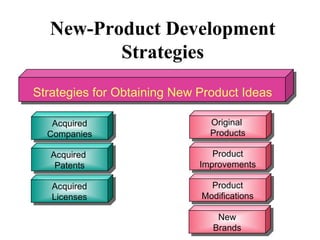
Original
Products
Original
Products
Product
Improvements
Product
Improvements
Product
Modifications
Product
Modifications
New
Brands
New
Brands
Acquired
Companies
Acquired
Companies
Acquired
Patents
Acquired
Patents
Acquired
Licenses
Acquired
Licenses
New-Product Development
Strategies
Strategies for Obtaining New Product Ideas
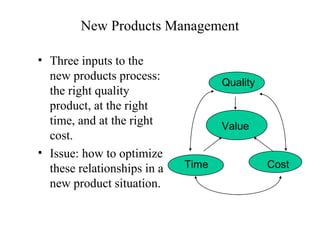
New Products Management
• Three inputs to the
new products process:
the right quality
product, at the right
time, and at the right
cost.
• Issue: how to optimize
these relationships in a
new product situation.
Quality
Time Cost
Value
Improving New-Product
Success
• New product success depends on having a:
– Unique superior product (one with higher quality, features,
and value in use), &
– Well-defined product concept (a defined target market,
product requirements, and benefits).
• To create successful new products, the company must:
– understand its customers, markets and competitors, &
– develop products that deliver superior value to customers.
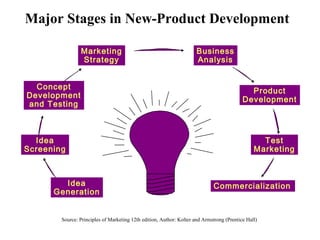
Idea
Generation
Idea
Screening
Concept
Development
and Testing
Marketing
Strategy
Business
Analysis
Product
Development
Test
Marketing
Commercialization
Major Stages in New-Product Development
Source: Principles of Marketing 12th edition, Author: Kolter and Armstrong (Prentice Hall)
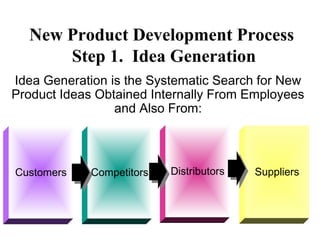
Customers Competitors Distributors Suppliers
Idea Generation is the Systematic Search for New
Product Ideas Obtained Internally From Employees
and Also From:
New Product Development Process
Step 1. Idea Generation
New Product Development
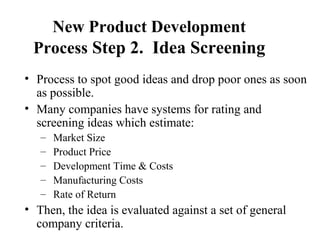
Process Step 2. Idea Screening
• Process to spot good ideas and drop poor ones as soon
as possible.
• Many companies have systems for rating and
screening ideas which estimate:
– Market Size
– Product Price
– Development Time & Costs
– Manufacturing Costs
– Rate of Return
• Then, the idea is evaluated against a set of general
company criteria.
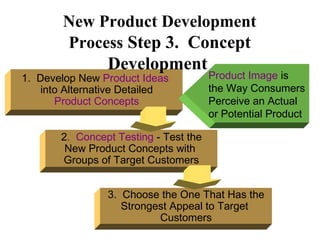
1. Develop New Product Ideas
into Alternative Detailed
Product Concepts
2. Concept Testing - Test the
New Product Concepts with
Groups of Target Customers
3. Choose the One That Has the
Strongest Appeal to Target
Customers
New Product Development
Process Step 3. Concept
Development
Product Image is
the Way Consumers
Perceive an Actual
or Potential Product
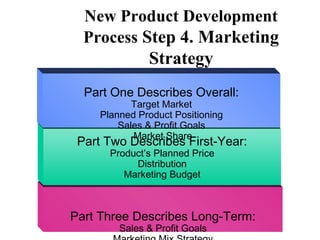
Part Three Describes Long-Term:
Sales & Profit Goals
Part Two Describes First-Year:
Product’s Planned Price
Distribution
Marketing Budget
Part One Describes Overall:
Target Market
Planned Product Positioning
Sales & Profit Goals
Market Share
New Product Development
Process Step 4. Marketing
Strategy
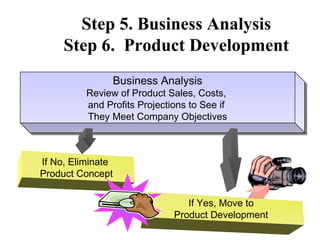
If No, Eliminate
Product Concept
Business Analysis
Review of Product Sales, Costs,
and Profits Projections to See if
They Meet Company Objectives
Business Analysis
Review of Product Sales, Costs,
and Profits Projections to See if
They Meet Company Objectives
Step 5. Business Analysis
Step 6. Product Development
If Yes, Move to
Product Development
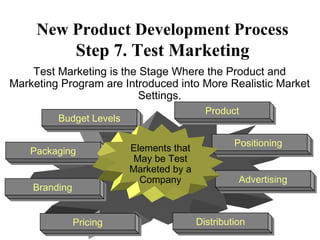
AdvertisingAdvertising
PackagingPackaging
ProductProduct
Budget LevelsBudget Levels
PositioningPositioning
DistributionDistributionPricingPricing
BrandingBranding
Elements that
May be Test
Marketed by a
Company
Test Marketing is the Stage Where the Product and
Marketing Program are Introduced into More Realistic Market
Settings.
New Product Development Process
Step 7. Test Marketing
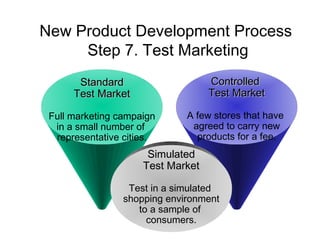
StandardStandard
Test MarketTest Market
Full marketing campaign
in a small number of
representative cities.
ControlledControlled
Test MarketTest Market
A few stores that have
agreed to carry new
products for a fee.
SimulatedSimulated
Test MarketTest Market
Test in a simulated
shopping environment
to a sample of
consumers.
New Product Development Process
Step 7. Test Marketing
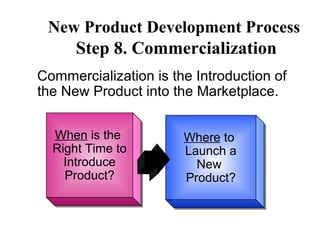
When is the
Right Time to
Introduce
Product?
When is the
Right Time to
Introduce
Product?
Where to
Launch a
New
Product?
Where to
Launch a
New
Product?
Commercialization is the Introduction of
the New Product into the Marketplace.
New Product Development Process
Step 8. Commercialization
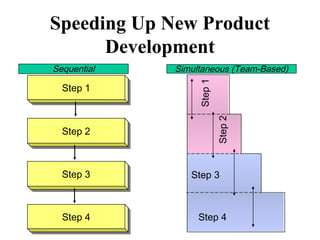
Step 1Step 1
Step 2Step 2
Step 3Step 3
Step 4Step 4
Sequential
Speeding Up New Product
Development
Step1
Step2
Step 3
Step 4
Simultaneous (Team-Based)
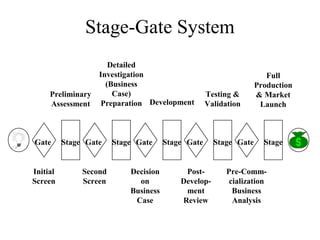
Stage-Gate System
Initial
Screen
Second
Screen
Decision
on
Business
Case
Post-
Develop-
ment
Review
Pre-Comm-
cialization
Business
Analysis
Preliminary
Assessment
Detailed
Investigation
(Business
Case)
Preparation Development
Testing &
Validation
Full
Production
& Market
Launch
Gate Gate Gate Gate GateStage Stage Stage Stage Stage
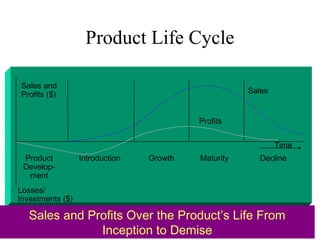
Time
Product
Develop-
ment
Introduction
Profits
Sales
Growth Maturity Decline
Losses/
Investments ($)
Sales and
Profits ($)
Sales and Profits Over the Product’s Life From
Inception to Demise
Product Life Cycle
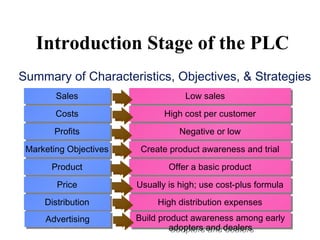
SalesSales
CostsCosts
ProfitsProfits
Marketing ObjectivesMarketing Objectives
ProductProduct
PricePrice
Low salesLow sales
High cost per customerHigh cost per customer
Negative or lowNegative or low
Create product awareness and trialCreate product awareness and trial
Offer a basic productOffer a basic product
Usually is high; use cost-plus formulaUsually is high; use cost-plus formula
DistributionDistribution High distribution expensesHigh distribution expenses
AdvertisingAdvertising Build product awareness among early
adopters and dealers
Build product awareness among early
adopters and dealers
Summary of Characteristics, Objectives, & Strategies
Introduction Stage of the PLC
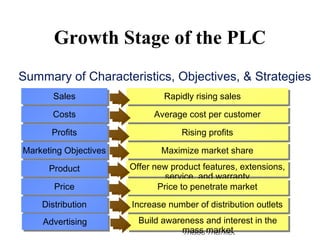
SalesSales
CostsCosts
ProfitsProfits
Marketing ObjectivesMarketing Objectives
ProductProduct
PricePrice
Rapidly rising salesRapidly rising sales
Average cost per customerAverage cost per customer
Rising profitsRising profits
Maximize market shareMaximize market share
Offer new product features, extensions,
service, and warranty
Offer new product features, extensions,
service, and warranty
Price to penetrate marketPrice to penetrate market
DistributionDistribution Increase number of distribution outletsIncrease number of distribution outlets
AdvertisingAdvertising Build awareness and interest in the
mass market
Build awareness and interest in the
mass market
Summary of Characteristics, Objectives, & Strategies
Growth Stage of the PLC
SalesSales
CostsCosts
ProfitsProfits
Marketing ObjectivesMarketing Objectives
ProductProduct
PricePrice
Peak salesPeak sales
Low cost per customerLow cost per customer
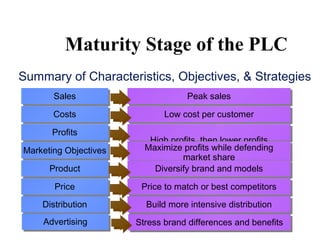
High profits, then lower profitsHigh profits, then lower profits
Maximize profits while defending
market share
Maximize profits while defending
market share
Diversify brand and modelsDiversify brand and models
Price to match or best competitorsPrice to match or best competitors
DistributionDistribution Build more intensive distributionBuild more intensive distribution
AdvertisingAdvertising Stress brand differences and benefitsStress brand differences and benefits
Summary of Characteristics, Objectives, & Strategies
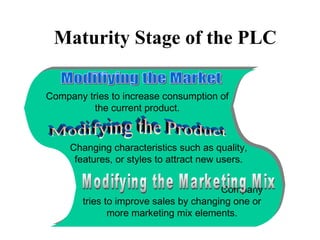
Maturity Stage of the PLC
Company tries to increase consumption of
the current product.
Changing characteristics such as quality,
features, or styles to attract new users.
Company
tries to improve sales by changing one or
more marketing mix elements.
SalesSales
CostsCosts
ProfitsProfits
Marketing ObjectivesMarketing Objectives
ProductProduct
PricePrice
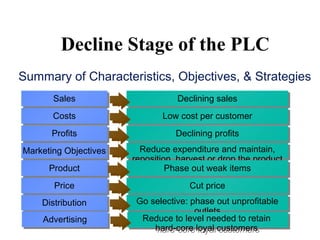
Declining salesDeclining sales
Low cost per customerLow cost per customer
Declining profitsDeclining profits
Reduce expenditure and maintain,
reposition, harvest or drop the product
Reduce expenditure and maintain,
reposition, harvest or drop the product
Phase out weak itemsPhase out weak items
Cut priceCut price
DistributionDistribution Go selective: phase out unprofitable
outlets
Go selective: phase out unprofitable
outlets
AdvertisingAdvertising Reduce to level needed to retain
hard-core loyal customers
Reduce to level needed to retain
hard-core loyal customers
Summary of Characteristics, Objectives, & Strategies
Decline Stage of the PLC
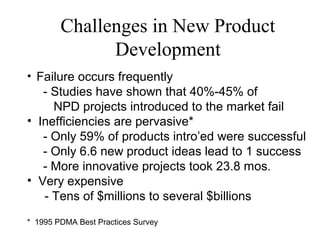
Challenges in New Product
Development
• Failure occurs frequently
- Studies have shown that 40%-45% of
NPD projects introduced to the market fail
• Inefficiencies are pervasive*
- Only 59% of products intro’ed were successful
- Only 6.6 new product ideas lead to 1 success
- More innovative projects took 23.8 mos.
• Very expensive
- Tens of $millions to several $billions
* 1995 PDMA Best Practices Survey
Market UncertaintyMarket Uncertainty
• Consumer fear, uncertainty, and doubt (FUD)Consumer fear, uncertainty, and doubt (FUD)
• Customer needs change rapidly andCustomer needs change rapidly and
unpredictablyunpredictably
• Customer anxiety over the lack of standardsCustomer anxiety over the lack of standards
and dominant designand dominant design
• Uncertainty over the pace of adoptionUncertainty over the pace of adoption
• Uncertainty over/inability to forecast market sizeUncertainty over/inability to forecast market size
Technology UncertaintyTechnology Uncertainty
• Uncertainty over whether the new innovationUncertainty over whether the new innovation
will function as promisedwill function as promised
• Uncertainty over timetable for NPDUncertainty over timetable for NPD
• Ambiguity over whether the supplier will be ableAmbiguity over whether the supplier will be able
to fix customer problems with the technologyto fix customer problems with the technology
• Concerns over unanticipated/unintendedConcerns over unanticipated/unintended
consequencesconsequences
• Concerns over obsolescenceConcerns over obsolescence
Competitive UncertaintyCompetitive Uncertainty
• Uncertainty over who will be future competitorsUncertainty over who will be future competitors
• Uncertainty over competitor’s strategiesUncertainty over competitor’s strategies
• Uncertainty over product form competitionUncertainty over product form competition
(competition between product classes vs.(competition between product classes vs.
between different brands of the same product)between different brands of the same product)
• Overestimation of Market Size
• Product Design Problems
• Product Incorrectly Positioned, Priced or Advertised
• Costs of Product Development
• Competitive Actions
• To create successful new products, the company must:
– understand it’s customers, markets and competitors
– develop products that deliver superior value to
customers.
Cause of Product Failures
Key Reasons for Failure
• Market too smallMarket too small
• Poor fit with company’s strengthsPoor fit with company’s strengths
• No real benefit for customerNo real benefit for customer
• Not new/not different productNot new/not different product
• Poor competitive positioningPoor competitive positioning
• Poor timing of product introductionPoor timing of product introduction
Key Reasons for Failure (cont.)
• Lack of coordination across functional areasLack of coordination across functional areas
• Organizational problems (e.g. conflict,Organizational problems (e.g. conflict,
communication, top management support)communication, top management support)
• Inaccurate forecastsInaccurate forecasts
• Inadequate support by channelInadequate support by channel
• Market changes in customer tastesMarket changes in customer tastes
• Competitive response to new productCompetitive response to new product
• Major shifts in technologyMajor shifts in technology

New Product Development

  • 1.
    Idea Generation inNew Product Development
  • 2.
    New Product Development DEFINITIONS PRODUCTS– Anything that can be offered to a market for attention, acquisition, use or consumption that might satisfy a want or need. It includes physical objects, services, places, organizations, ideas and people.
  • 3.
    Why is ProductDevelopment Important? ♦ To satisfy consumers (Demand) ♦ To create new jobs (Economy) ♦ To maintain margins (Market share) ♦ To expand the business (Growth)
  • 4.
  • 5.
    New Products Management •Three inputs to the new products process: the right quality product, at the right time, and at the right cost. • Issue: how to optimize these relationships in a new product situation. Quality Time Cost Value
  • 6.
    Improving New-Product Success • Newproduct success depends on having a: – Unique superior product (one with higher quality, features, and value in use), & – Well-defined product concept (a defined target market, product requirements, and benefits). • To create successful new products, the company must: – understand its customers, markets and competitors, & – develop products that deliver superior value to customers.
  • 7.
    Idea Generation Idea Screening Concept Development and Testing Marketing Strategy Business Analysis Product Development Test Marketing Commercialization Major Stagesin New-Product Development Source: Principles of Marketing 12th edition, Author: Kolter and Armstrong (Prentice Hall)
  • 8.
    Customers Competitors DistributorsSuppliers Idea Generation is the Systematic Search for New Product Ideas Obtained Internally From Employees and Also From: New Product Development Process Step 1. Idea Generation
  • 9.
    New Product Development ProcessStep 2. Idea Screening • Process to spot good ideas and drop poor ones as soon as possible. • Many companies have systems for rating and screening ideas which estimate: – Market Size – Product Price – Development Time & Costs – Manufacturing Costs – Rate of Return • Then, the idea is evaluated against a set of general company criteria.
  • 10.
    1. Develop NewProduct Ideas into Alternative Detailed Product Concepts 2. Concept Testing - Test the New Product Concepts with Groups of Target Customers 3. Choose the One That Has the Strongest Appeal to Target Customers New Product Development Process Step 3. Concept Development Product Image is the Way Consumers Perceive an Actual or Potential Product
  • 11.
    Part Three DescribesLong-Term: Sales & Profit Goals Part Two Describes First-Year: Product’s Planned Price Distribution Marketing Budget Part One Describes Overall: Target Market Planned Product Positioning Sales & Profit Goals Market Share New Product Development Process Step 4. Marketing Strategy
  • 12.
    If No, Eliminate ProductConcept Business Analysis Review of Product Sales, Costs, and Profits Projections to See if They Meet Company Objectives Business Analysis Review of Product Sales, Costs, and Profits Projections to See if They Meet Company Objectives Step 5. Business Analysis Step 6. Product Development If Yes, Move to Product Development
  • 13.
    AdvertisingAdvertising PackagingPackaging ProductProduct Budget LevelsBudget Levels PositioningPositioning DistributionDistributionPricingPricing BrandingBranding Elementsthat May be Test Marketed by a Company Test Marketing is the Stage Where the Product and Marketing Program are Introduced into More Realistic Market Settings. New Product Development Process Step 7. Test Marketing
  • 14.
    StandardStandard Test MarketTest Market Fullmarketing campaign in a small number of representative cities. ControlledControlled Test MarketTest Market A few stores that have agreed to carry new products for a fee. SimulatedSimulated Test MarketTest Market Test in a simulated shopping environment to a sample of consumers. New Product Development Process Step 7. Test Marketing
  • 15.
    When is the RightTime to Introduce Product? When is the Right Time to Introduce Product? Where to Launch a New Product? Where to Launch a New Product? Commercialization is the Introduction of the New Product into the Marketplace. New Product Development Process Step 8. Commercialization
  • 16.
    Step 1Step 1 Step2Step 2 Step 3Step 3 Step 4Step 4 Sequential Speeding Up New Product Development Step1 Step2 Step 3 Step 4 Simultaneous (Team-Based)
  • 17.
  • 18.
    Time Product Develop- ment Introduction Profits Sales Growth Maturity Decline Losses/ Investments($) Sales and Profits ($) Sales and Profits Over the Product’s Life From Inception to Demise Product Life Cycle
  • 19.
    SalesSales CostsCosts ProfitsProfits Marketing ObjectivesMarketing Objectives ProductProduct PricePrice LowsalesLow sales High cost per customerHigh cost per customer Negative or lowNegative or low Create product awareness and trialCreate product awareness and trial Offer a basic productOffer a basic product Usually is high; use cost-plus formulaUsually is high; use cost-plus formula DistributionDistribution High distribution expensesHigh distribution expenses AdvertisingAdvertising Build product awareness among early adopters and dealers Build product awareness among early adopters and dealers Summary of Characteristics, Objectives, & Strategies Introduction Stage of the PLC
  • 20.
    SalesSales CostsCosts ProfitsProfits Marketing ObjectivesMarketing Objectives ProductProduct PricePrice Rapidlyrising salesRapidly rising sales Average cost per customerAverage cost per customer Rising profitsRising profits Maximize market shareMaximize market share Offer new product features, extensions, service, and warranty Offer new product features, extensions, service, and warranty Price to penetrate marketPrice to penetrate market DistributionDistribution Increase number of distribution outletsIncrease number of distribution outlets AdvertisingAdvertising Build awareness and interest in the mass market Build awareness and interest in the mass market Summary of Characteristics, Objectives, & Strategies Growth Stage of the PLC
  • 21.
    SalesSales CostsCosts ProfitsProfits Marketing ObjectivesMarketing Objectives ProductProduct PricePrice PeaksalesPeak sales Low cost per customerLow cost per customer High profits, then lower profitsHigh profits, then lower profits Maximize profits while defending market share Maximize profits while defending market share Diversify brand and modelsDiversify brand and models Price to match or best competitorsPrice to match or best competitors DistributionDistribution Build more intensive distributionBuild more intensive distribution AdvertisingAdvertising Stress brand differences and benefitsStress brand differences and benefits Summary of Characteristics, Objectives, & Strategies Maturity Stage of the PLC
  • 22.
    Maturity Stage ofthe PLC Company tries to increase consumption of the current product. Changing characteristics such as quality, features, or styles to attract new users. Company tries to improve sales by changing one or more marketing mix elements.
  • 23.
    SalesSales CostsCosts ProfitsProfits Marketing ObjectivesMarketing Objectives ProductProduct PricePrice DecliningsalesDeclining sales Low cost per customerLow cost per customer Declining profitsDeclining profits Reduce expenditure and maintain, reposition, harvest or drop the product Reduce expenditure and maintain, reposition, harvest or drop the product Phase out weak itemsPhase out weak items Cut priceCut price DistributionDistribution Go selective: phase out unprofitable outlets Go selective: phase out unprofitable outlets AdvertisingAdvertising Reduce to level needed to retain hard-core loyal customers Reduce to level needed to retain hard-core loyal customers Summary of Characteristics, Objectives, & Strategies Decline Stage of the PLC
  • 24.
    Challenges in NewProduct Development • Failure occurs frequently - Studies have shown that 40%-45% of NPD projects introduced to the market fail • Inefficiencies are pervasive* - Only 59% of products intro’ed were successful - Only 6.6 new product ideas lead to 1 success - More innovative projects took 23.8 mos. • Very expensive - Tens of $millions to several $billions * 1995 PDMA Best Practices Survey
  • 25.
    Market UncertaintyMarket Uncertainty •Consumer fear, uncertainty, and doubt (FUD)Consumer fear, uncertainty, and doubt (FUD) • Customer needs change rapidly andCustomer needs change rapidly and unpredictablyunpredictably • Customer anxiety over the lack of standardsCustomer anxiety over the lack of standards and dominant designand dominant design • Uncertainty over the pace of adoptionUncertainty over the pace of adoption • Uncertainty over/inability to forecast market sizeUncertainty over/inability to forecast market size
  • 26.
    Technology UncertaintyTechnology Uncertainty •Uncertainty over whether the new innovationUncertainty over whether the new innovation will function as promisedwill function as promised • Uncertainty over timetable for NPDUncertainty over timetable for NPD • Ambiguity over whether the supplier will be ableAmbiguity over whether the supplier will be able to fix customer problems with the technologyto fix customer problems with the technology • Concerns over unanticipated/unintendedConcerns over unanticipated/unintended consequencesconsequences • Concerns over obsolescenceConcerns over obsolescence
  • 27.
    Competitive UncertaintyCompetitive Uncertainty •Uncertainty over who will be future competitorsUncertainty over who will be future competitors • Uncertainty over competitor’s strategiesUncertainty over competitor’s strategies • Uncertainty over product form competitionUncertainty over product form competition (competition between product classes vs.(competition between product classes vs. between different brands of the same product)between different brands of the same product)
  • 28.
    • Overestimation ofMarket Size • Product Design Problems • Product Incorrectly Positioned, Priced or Advertised • Costs of Product Development • Competitive Actions • To create successful new products, the company must: – understand it’s customers, markets and competitors – develop products that deliver superior value to customers. Cause of Product Failures
  • 29.
    Key Reasons forFailure • Market too smallMarket too small • Poor fit with company’s strengthsPoor fit with company’s strengths • No real benefit for customerNo real benefit for customer • Not new/not different productNot new/not different product • Poor competitive positioningPoor competitive positioning • Poor timing of product introductionPoor timing of product introduction
  • 30.
    Key Reasons forFailure (cont.) • Lack of coordination across functional areasLack of coordination across functional areas • Organizational problems (e.g. conflict,Organizational problems (e.g. conflict, communication, top management support)communication, top management support) • Inaccurate forecastsInaccurate forecasts • Inadequate support by channelInadequate support by channel • Market changes in customer tastesMarket changes in customer tastes • Competitive response to new productCompetitive response to new product • Major shifts in technologyMajor shifts in technology

Editor's Notes

  • #18 Preliminary Assessment - give some financial hurdles Detailed Investigation - Definition before development 1st generation - phase review. used by gov’t to track contracts. After each phase of the contract a renegotiation took place. 2nd generation - what is in the book. Problems: Time consumingToo many time wasters Too bureaucraticNo provision for focus 3rd generation Fluid and adaptable Incorporates fuzzy gates - situational and conditional Sharper focus of resources Flexible