CUSTOMER SATISFACTION Presented TO: BY:MAYA TOTAL QUALITY MANAGEMENT
TQM is a business management strategy aimed at embedding awareness of  Quality  in all organizational processes. Attainment  of  Total  Quality  Through   Everyone’s  Commitment  on  a  Daily Basis TOTAL QUALITY MANAGEMENT
Definition When used together as a phrase, the three words in this expression have the following meanings: Total  Involving the entire organization, supply chain, and/or product life cycle  Quality   With its usual definitions, with all its complexities Management   The system of managing with steps like Plan, Organize,  Control, Lead ,Staff, provisioning and organizing  ## ## ##
The Prime Directive of Total Quality Management and its Culture?  The TQM philosophy derives from one foundational idea: everything must be geared towards customer satisfaction, the engine which drives the company and on which its future survival depends.
ORGANIZATIONAL HIERARCHIAL DIAGRAMS Earlier approach   TQM approach   CEO SENIOR  MANAGER FUNCTIONAL OPERATIONAL  AREAS FRONT LINE  REPREENTATIVES CUSTOMERS CUSTOMERS FRONT LINE  REPREENTATIVES FUNCTIONAL OPERATIONAL  AREAS SENIOR  MANAGER CEO
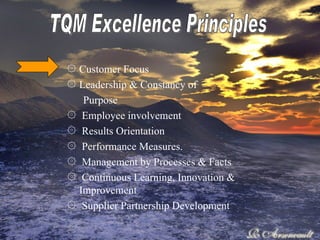
Customer Focus Leadership & Constancy of  Purpose Employee involvement Results Orientation Performance Measures. Management by Processes & Facts Continuous Learning, Innovation &  Improvement Supplier Partnership Development TQM Excellence Principles
External Customer Internal Customer Pleasing “internal” customers is fundamental to satisfying the final “external” customer.   CUSTOMER?
Continuous Satisfaction of  Customer Requirements. ISO 9000:   "Degree to which a set of inherent characteristics fulfills requirements." The standard defines requirement as need or expectation.  Six Sigma: "Number of defects per million opportunities. Quality?
Satisfaction is basically a  psychological state , care should be taken in the effort of quantitative measurement, although a large quantity of research in this area has recently been developed. The Research gives  ten domains of satisfaction  include: Quality,  Value,  Timeliness,  Efficiency,  Ease of Access,  Environment,  Inter-departmental Teamwork,  Front line Service Behaviors,  Commitment to the Customer & Innovation.  CUSTOMER SATISFACTION
The Most important Asset of any Organization is its Customers. Satisfied Customers     ---the Lifeblood of any Organization . CUSTOMER SATISFACTION
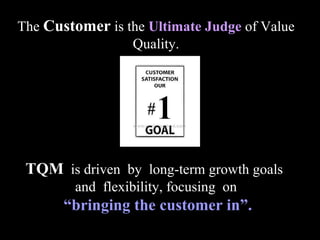
The  Customer  is the  Ultimate Judge  of Value Quality. TQM   is driven  by  long-term growth goals  and  flexibility, focusing  on “ bringing the customer in”.
Improve  each and everyday , Do not focus on problem,  focus on improvements . IF YOU’RE NOT PART OF THE SOLUTION, YOU’RE PART OF THE PROBLEM. CONTINUOUS IMPROVEMENT
Products must go through continuous improvement  Customers  are not interested in excuses, they’re interested in  results. We must Be proactive  - because if we don’t, someone else will.. Ishikawa Says:   “ The organization which does not make a  change in the 06 months is a dead  organizations”. CONTINUOUS IMPROVEMENT
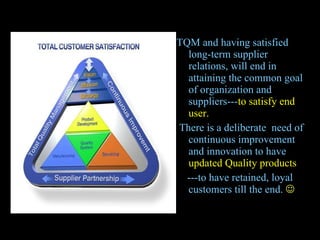
TQM and having satisfied long-term supplier relations, will end in attaining the common goal of organization and suppliers--- to satisfy end user.  There is a deliberate  need of continuous improvement and innovation to have  updated Quality products ---to have retained, loyal customers till the end.  
WHAT THE CUSTOMER SEEKS IN ANY PRODUCT?? An American society of quality (ASQ) Survey on the  end user perceptions  of important factors that influence purchases, are as following: Performance Features Services Warranty Price Reputation
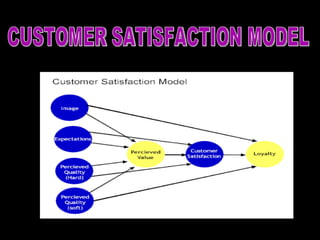
CUSTOMER SATISFACTION MODEL
The Kano model is a framework for  considering, measuring and implementing activities  to not only provide customer satisfaction, but  bring delight The Kano Model of Customer  (Consumer) Satisfaction classifies product attributes based on how they are  perceived by customers  and their  effect on customer satisfaction .. KANO MODEL
EXCITERS: (DELIGHTERS) If the requirement is absent it does not cause dissatisfaction, but it will delight clients if present – like the  “camera option”. MORE IS BETTER :  (FULFILLEMENT OF NORMAL REQUIREMENTS)  The more requirements are met the more one is  satisfied.    KANO MODEL
KANO MODEL
Customer Feedback is essential for the organization nowadays to beat the sharp  competition and to retain their customers. It enables us to know: About their  satisfaction level Priorities of qualities Performance  and  competition Opportunities for  improvement. CUSTOMER  FEEDBACK
HAVING COMMENT CARDS  AND  A BOX TO PUT THEM IN. COMMENT CARDS ENCLOSED WITH  EACH ORDER . CUSTOMER QUESTIONNAIRE.. FOCUS GROUP REPORT CARD  HIRING A TELEMARKETING FIRM TO CALL CUSTOMERS FOR FEEDBACK METHODS OF FEEDBACK
PUBLISIZING  ( toll-free number) . ASKING CUSTOMERS TO STAY ON PHONE AND COMPLETE  A SHORT SURVEY  AFTER THEY FINISH PLACING AN ORDER WEB BASED SURVEYS  VIA E-MAILS TO CUSTOMERS WITHIN A SHORT PERIOD OF TIME AFTER THEIR PURCHASE USE GOOGLE ALERTS  TO TRACK MENTIONS OF UR BUSINESS ON THE INTERNET AND IN THE BLOGOSPHERE. 111-123-123
MANAGERS AND OWNER CONTACT CUSTOMERS TO GET DIRECT REPORT CUSTOMER VISITS(MEETING THEM  AT LUNCH EMPLOYEE’S FEEDBACK PUTTING WEBSITE URL ON CUSTOMER RECEIPTS AND ASKING CUSTOMERS TO GO THERE TO DELIVER FEEDBACK FOR WINNING PRIZES.
***  TO GIVE CUSTOMER EXACTLY WHAT CUSTOMER WANTS  *** TYPES: Modular design: Is a form of standardization in which component parts are subdivided into modules that are easily replaced or interchanged Delayed differentiation: Producing but not quite completing a product or service until customer preferences or specifications are known as delayed. (Such as subway sandwiches) MASS CUSTOMIZATION
CUSTOMER COMPLAINTS THE FEEDBACK OBTAINED IN ALL ABOVE CASES IS PROACTIVE CUSTOMER COMPLAINT IS REACTIVE BUT VERY USEFUL. BY TAKING THE POSITIVE APPROACH TO THE COMPLAINTS IT IS POSSIBLE TO IMPROVE THE PRODUCTS/SERVICES IN FACT COMPLAINTS GIVE THE  ORGANIZATION A SECOND CHANCE  TO WIN!!
CUSTOMER SERVICES AND ELEMENTS Organization  Customer care Communication Frontline people Leadership Set of Activities an 0rg uses  to win and retain  their customer’s satisfaction. To provide  excellent customer services  these Elements should be considered
GOOD CUSTOMER SERVICES & RETENTION OF CUSTOMERS Good Customer Service   is all about bringing customers back.  And about sending them away happy… ---HAPPY   enough to pass   Positive Feedback   about your business along to others, who may then try the product or service you offer for themselves and in their turn become   Repeat Customers/  (loyal customers).
THANK  YOU!!

TOTAL QUALITY MANAGEMENT-Customer Satisfaction

  • 1.
    CUSTOMER SATISFACTION PresentedTO: BY:MAYA TOTAL QUALITY MANAGEMENT
  • 2.
    TQM is abusiness management strategy aimed at embedding awareness of Quality in all organizational processes. Attainment of Total Quality Through Everyone’s Commitment on a Daily Basis TOTAL QUALITY MANAGEMENT
  • 3.
    Definition When usedtogether as a phrase, the three words in this expression have the following meanings: Total Involving the entire organization, supply chain, and/or product life cycle Quality With its usual definitions, with all its complexities Management The system of managing with steps like Plan, Organize, Control, Lead ,Staff, provisioning and organizing ## ## ##
  • 4.
    The Prime Directiveof Total Quality Management and its Culture? The TQM philosophy derives from one foundational idea: everything must be geared towards customer satisfaction, the engine which drives the company and on which its future survival depends.
  • 5.
    ORGANIZATIONAL HIERARCHIAL DIAGRAMSEarlier approach TQM approach CEO SENIOR MANAGER FUNCTIONAL OPERATIONAL AREAS FRONT LINE REPREENTATIVES CUSTOMERS CUSTOMERS FRONT LINE REPREENTATIVES FUNCTIONAL OPERATIONAL AREAS SENIOR MANAGER CEO
  • 6.
    Customer Focus Leadership& Constancy of Purpose Employee involvement Results Orientation Performance Measures. Management by Processes & Facts Continuous Learning, Innovation & Improvement Supplier Partnership Development TQM Excellence Principles
  • 7.
    External Customer InternalCustomer Pleasing “internal” customers is fundamental to satisfying the final “external” customer. CUSTOMER?
  • 8.
    Continuous Satisfaction of Customer Requirements. ISO 9000: "Degree to which a set of inherent characteristics fulfills requirements." The standard defines requirement as need or expectation. Six Sigma: "Number of defects per million opportunities. Quality?
  • 9.
    Satisfaction is basicallya psychological state , care should be taken in the effort of quantitative measurement, although a large quantity of research in this area has recently been developed. The Research gives ten domains of satisfaction include: Quality, Value, Timeliness, Efficiency, Ease of Access, Environment, Inter-departmental Teamwork, Front line Service Behaviors, Commitment to the Customer & Innovation. CUSTOMER SATISFACTION
  • 10.
    The Most importantAsset of any Organization is its Customers. Satisfied Customers  ---the Lifeblood of any Organization . CUSTOMER SATISFACTION
  • 11.
    The Customer is the Ultimate Judge of Value Quality. TQM is driven by long-term growth goals and flexibility, focusing on “ bringing the customer in”.
  • 12.
    Improve eachand everyday , Do not focus on problem, focus on improvements . IF YOU’RE NOT PART OF THE SOLUTION, YOU’RE PART OF THE PROBLEM. CONTINUOUS IMPROVEMENT
  • 13.
    Products must gothrough continuous improvement Customers are not interested in excuses, they’re interested in results. We must Be proactive - because if we don’t, someone else will.. Ishikawa Says: “ The organization which does not make a change in the 06 months is a dead organizations”. CONTINUOUS IMPROVEMENT
  • 14.
    TQM and havingsatisfied long-term supplier relations, will end in attaining the common goal of organization and suppliers--- to satisfy end user. There is a deliberate need of continuous improvement and innovation to have updated Quality products ---to have retained, loyal customers till the end. 
  • 15.
    WHAT THE CUSTOMERSEEKS IN ANY PRODUCT?? An American society of quality (ASQ) Survey on the end user perceptions of important factors that influence purchases, are as following: Performance Features Services Warranty Price Reputation
  • 16.
  • 17.
    The Kano modelis a framework for considering, measuring and implementing activities to not only provide customer satisfaction, but bring delight The Kano Model of Customer (Consumer) Satisfaction classifies product attributes based on how they are perceived by customers and their effect on customer satisfaction .. KANO MODEL
  • 18.
    EXCITERS: (DELIGHTERS) Ifthe requirement is absent it does not cause dissatisfaction, but it will delight clients if present – like the “camera option”. MORE IS BETTER : (FULFILLEMENT OF NORMAL REQUIREMENTS) The more requirements are met the more one is satisfied.  KANO MODEL
  • 19.
  • 20.
    Customer Feedback isessential for the organization nowadays to beat the sharp competition and to retain their customers. It enables us to know: About their satisfaction level Priorities of qualities Performance and competition Opportunities for improvement. CUSTOMER FEEDBACK
  • 21.
    HAVING COMMENT CARDS AND A BOX TO PUT THEM IN. COMMENT CARDS ENCLOSED WITH EACH ORDER . CUSTOMER QUESTIONNAIRE.. FOCUS GROUP REPORT CARD HIRING A TELEMARKETING FIRM TO CALL CUSTOMERS FOR FEEDBACK METHODS OF FEEDBACK
  • 22.
    PUBLISIZING (toll-free number) . ASKING CUSTOMERS TO STAY ON PHONE AND COMPLETE A SHORT SURVEY AFTER THEY FINISH PLACING AN ORDER WEB BASED SURVEYS VIA E-MAILS TO CUSTOMERS WITHIN A SHORT PERIOD OF TIME AFTER THEIR PURCHASE USE GOOGLE ALERTS TO TRACK MENTIONS OF UR BUSINESS ON THE INTERNET AND IN THE BLOGOSPHERE. 111-123-123
  • 23.
    MANAGERS AND OWNERCONTACT CUSTOMERS TO GET DIRECT REPORT CUSTOMER VISITS(MEETING THEM AT LUNCH EMPLOYEE’S FEEDBACK PUTTING WEBSITE URL ON CUSTOMER RECEIPTS AND ASKING CUSTOMERS TO GO THERE TO DELIVER FEEDBACK FOR WINNING PRIZES.
  • 24.
    *** TOGIVE CUSTOMER EXACTLY WHAT CUSTOMER WANTS *** TYPES: Modular design: Is a form of standardization in which component parts are subdivided into modules that are easily replaced or interchanged Delayed differentiation: Producing but not quite completing a product or service until customer preferences or specifications are known as delayed. (Such as subway sandwiches) MASS CUSTOMIZATION
  • 25.
    CUSTOMER COMPLAINTS THEFEEDBACK OBTAINED IN ALL ABOVE CASES IS PROACTIVE CUSTOMER COMPLAINT IS REACTIVE BUT VERY USEFUL. BY TAKING THE POSITIVE APPROACH TO THE COMPLAINTS IT IS POSSIBLE TO IMPROVE THE PRODUCTS/SERVICES IN FACT COMPLAINTS GIVE THE ORGANIZATION A SECOND CHANCE TO WIN!!
  • 26.
    CUSTOMER SERVICES ANDELEMENTS Organization Customer care Communication Frontline people Leadership Set of Activities an 0rg uses to win and retain their customer’s satisfaction. To provide excellent customer services these Elements should be considered
  • 27.
    GOOD CUSTOMER SERVICES& RETENTION OF CUSTOMERS Good Customer Service is all about bringing customers back. And about sending them away happy… ---HAPPY enough to pass Positive Feedback about your business along to others, who may then try the product or service you offer for themselves and in their turn become Repeat Customers/ (loyal customers).
  • 28.