MARKETING MANAGEMENT Lecture Notes for Business Introduction By Fahmy Radhi
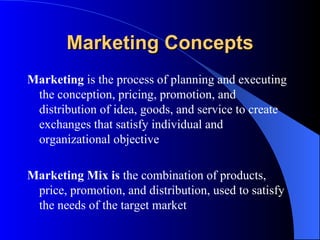
Marketing Concepts Marketing  is the process of planning and executing the conception, pricing, promotion, and distribution of idea, goods, and service to create exchanges that satisfy individual and organizational objective Marketing Mix is  the combination of products, price, promotion, and distribution, used to satisfy the needs of the target market
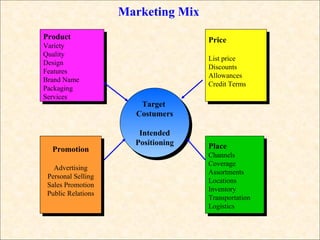
Product Variety Quality Design Features Brand Name Packaging Services Price List price Discounts Allowances Credit Terms Promotion Advertising Personal Selling Sales Promotion Public Relations Place Channels Coverage Assortments Locations Inventory Transportation Logistics Target  Costumers Intended Positioning Marketing Mix
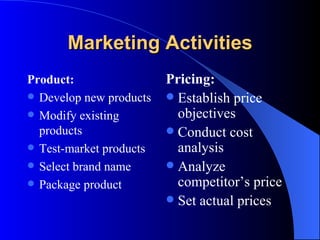
Marketing Activities Product: Develop new products Modify existing products Test-market products Select brand name Package product Pricing: Establish price objectives Conduct cost analysis Analyze competitor’s price Set actual prices
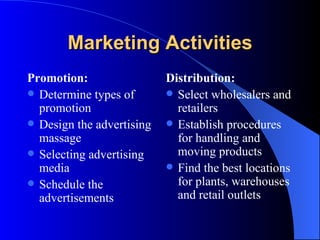
Marketing Activities Promotion: Determine types of promotion Design the advertising massage Selecting advertising media Schedule the advertisements Distribution: Select wholesalers and retailers Establish procedures for handling and moving products Find the best locations for plants, warehouses and retail outlets
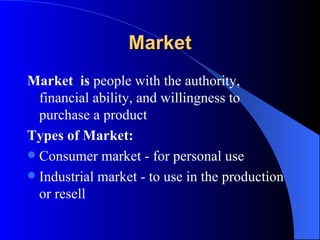
Market Market  is  people with the authority, financial ability, and willingness to purchase a product Types of Market: Consumer market - for personal use Industrial market - to use in the production or resell
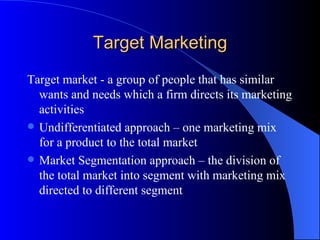
Target Marketing Target market - a group of people that has similar wants and needs which a firm directs its marketing activities Undifferentiated approach – one marketing mix for a product to the total market Market Segmentation approach – the division of the total market into segment with marketing mix directed to different segment
Market Segmentation Market segment  – division of heterogonous market into homogonous market based on different characteristics Segmentation Based: Geographic bases - city, region Demographic bases - sex, race, marital Psychographics - a person’s attitude, lifestyle Product-related - brand loyalty
PRODUCT   Product - a  good, service or idea, including all attributes provided in an exchange between buyer and seller   Product Classification : Consumer goods – products purchased by consumers for personal use Industrial goods – product purchased by companies to produce other products
Classifying Goods Consumer Goods : Convenience good  – inexpensive and regularly consumed Shopping goods  – moderately expensive and infrequently Specialty goods  – expensive and rarely Industrial goods : Raw material Components parts Equipment and installations Services
Product Line and Product Mix Product Line -  a group of related products that are considered a unit because of marketing, technical or use similarity   Product Mix  - the total group of product offer sale, or all of the firm’s product lines   Product Differentiation  – creation of product or product image that differs from existing product to attract consumers
Product Attributes Brand  - a name, sign, symbol, design, or combination a company’s product to distinguish it product from others   Packaging  - the development of a container and graphic design for a product   Labeling  - the display of important information on a product package
PRICING Price -  the value that buyer exchange for a product in the marketing transaction Pricing Objective : Market share Profit Return on Investment Status Quo
Pricing Decision and Methods Factors in Pricing Decisions: Price and non-price competition Supply and demand Consumer perception of price Pricing Methods: Cost-Oriented Pricing - Mark-up Pricing Demand-Oriented Pricing - Break event point Competition Oriented Pricing
Pricing Strategies   Pioneer pricing – leadership pricing in the market Price skimming – setting an initial high price to cover new product cost and generate a profit Penetration pricing – setting an initial low price to establish a new product in the market Psychological Pricing – setting an initial high price to respond irrationally consumers  Price Discounting – Price reduction offered as an incentive to purchase
PROMOTION Promotion - t he communication of favorable, persuasive information about a firm or product in order to influential buyers Promotional Objectives: Informing Increasing sales Stabilizing sales Positioning the product Building a public image
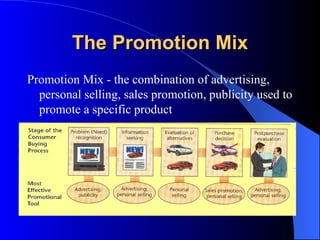
The Promotion Mix Promotion Mix - the combination of advertising, personal selling, sales promotion, publicity used to promote a specific product
Advertising Non-personal communication to a target audience through a mass medium, such as TV, Radio, newspapers, or magazines, and outdoor display Types of Advertising: Primary-Demand Advertising: for all products Selective Brand Advertising: for specific products Institutional Advertising: create public image
Advertising Promotion Advertising Media – variety of communication devices for carrying massage to potential customers Direct Mail – delivery massage directly to customer places Internet Advertising – put the massage into website or mailed directly to customer email
Personal Selling Person-to-person communication with one or more prospective customers in order to make sale Telemarketing – using telephone to perform the personal selling process Types of Salespeople: Order Getter Order taker Support salespeople
Sales Promotion An activity that offers customers or marketing intermediaries direct incentives for purchasing a product   Type of Sales Promotion: Coupon: reduces the price of a product by stated amount at the time of purchase Rebate: an extra discount Free Sample Contest: consumer compete for prizes Trade show
Publicity and Public Relation Publicity - a  non-personal form of communication transmitted in news story form and not paid for directly sponsor   Public Relations - a  set of communication activities designed to create and maintain a favorable public image for firm  
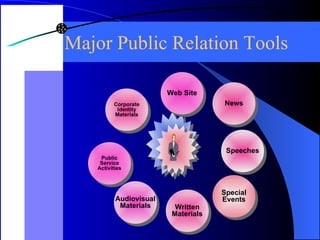
Major Public Relation Tools Special Events Written Materials Public Service Activities Speeches News Audiovisual Materials Corporate Identity Materials Web Site
Promotional Strategy: Push Strategy : promotion of a product to wholesaler or retailers in the marketing channel, who in turn promote the product to consumers Pull Strategy:  promotion of a product direct to consumers to stimulate strong consumer demands
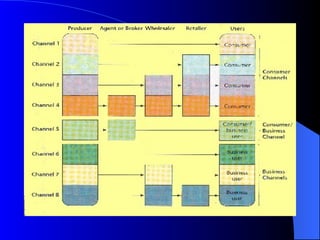
DISTRIBUTION Channel of Distribution - a  group of interrelated organization that directs the flow of products from producers to ultimate consumers Marketing Intermediary - a n individual or organization in marketing channel that provides a link among producers, other channel members, and final consumer
Type of Marketing Channels: Consumer Products: Producer-consumer: plant and flower, services Producer-retailer-consumer: automobile, furniture Producer-wholesaler-retailer-consumer: e.g. convenience goods Producer-Agent/broker-wholesaler-retailer-consumer: e.g. consumer products
Type of Marketing Channels Industrial Products: producer-industrial user: heavy equipment and machinery producer-wholesaler-industrial user: tools and automotive parts
 
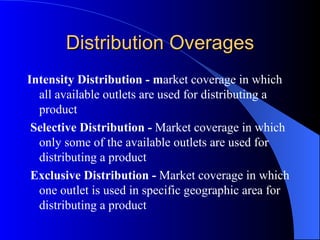
Distribution Overages Intensity Distribution - m arket coverage in which all available outlets are used for distributing a product   Selective Distribution -  Market coverage in which only some of the available outlets are used for distributing a product   Exclusive Distribution -  Market coverage in which one outlet is used in specific geographic area for distributing a product
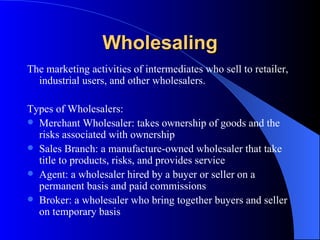
Wholesaling The marketing activities of intermediates who sell to retailer, industrial users, and other wholesalers.  Types of Wholesalers: Merchant Wholesaler: takes ownership of goods and the risks associated with ownership Sales Branch: a manufacture-owned wholesaler that take title to products, risks, and provides service Agent: a wholesaler hired by a buyer or seller on a permanent basis and paid commissions Broker: a wholesaler who bring together buyers and seller on temporary basis
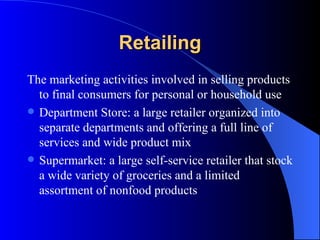
Retailing The marketing activities involved in selling products to final consumers for personal or household use Department Store: a large retailer organized into separate departments and offering a full line of services and wide product mix Supermarket: a large self-service retailer that stock a wide variety of groceries and a limited assortment of nonfood products
Retailing Catalog Showroom: a form of warehouse show-room where customers select products from catalogs sent to customers’ homes or available in the store Direct Marketing: non-store retailing that uses non-personal media to introduce products to consumers who then purchase the product by mail, telephone, computer, or TV
Physical Distribution Those activities that involve the movement of products through marketing channels from manufacturer to customer, including: Transportation:  shipping goods to customers by rail, air, truck, water, and pipeline Warehousing : the receiving, storing, and shipping activities involved in the physical distribution of goods Order Processing:  the receipt and preparation of an order for shipment Material Handling:  the physical handling of products during transportation and warehousing
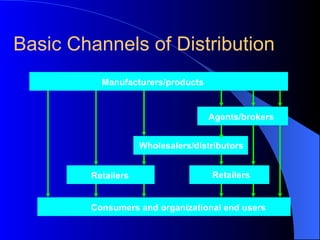
Basic Channels of Distribution Manufacturers/products Agents/brokers Wholesalers/distributors Retailers Retailers Consumers and organizational end users
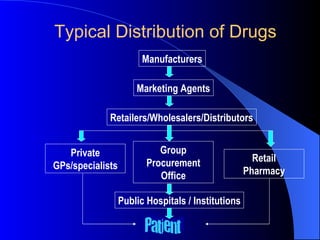
Typical Distribution of Drugs Manufacturers Marketing Agents Retailers/Wholesalers/Distributors Patient Public Hospitals / Institutions Private GPs/specialists Group Procurement Office Retail Pharmacy

07 Marketing Management

  • 1.
    MARKETING MANAGEMENT LectureNotes for Business Introduction By Fahmy Radhi
  • 2.
    Marketing Concepts Marketing is the process of planning and executing the conception, pricing, promotion, and distribution of idea, goods, and service to create exchanges that satisfy individual and organizational objective Marketing Mix is the combination of products, price, promotion, and distribution, used to satisfy the needs of the target market
  • 3.
    Product Variety QualityDesign Features Brand Name Packaging Services Price List price Discounts Allowances Credit Terms Promotion Advertising Personal Selling Sales Promotion Public Relations Place Channels Coverage Assortments Locations Inventory Transportation Logistics Target Costumers Intended Positioning Marketing Mix
  • 4.
    Marketing Activities Product:Develop new products Modify existing products Test-market products Select brand name Package product Pricing: Establish price objectives Conduct cost analysis Analyze competitor’s price Set actual prices
  • 5.
    Marketing Activities Promotion:Determine types of promotion Design the advertising massage Selecting advertising media Schedule the advertisements Distribution: Select wholesalers and retailers Establish procedures for handling and moving products Find the best locations for plants, warehouses and retail outlets
  • 6.
    Market Market is people with the authority, financial ability, and willingness to purchase a product Types of Market: Consumer market - for personal use Industrial market - to use in the production or resell
  • 7.
    Target Marketing Targetmarket - a group of people that has similar wants and needs which a firm directs its marketing activities Undifferentiated approach – one marketing mix for a product to the total market Market Segmentation approach – the division of the total market into segment with marketing mix directed to different segment
  • 8.
    Market Segmentation Marketsegment – division of heterogonous market into homogonous market based on different characteristics Segmentation Based: Geographic bases - city, region Demographic bases - sex, race, marital Psychographics - a person’s attitude, lifestyle Product-related - brand loyalty
  • 9.
    PRODUCT Product - a good, service or idea, including all attributes provided in an exchange between buyer and seller Product Classification : Consumer goods – products purchased by consumers for personal use Industrial goods – product purchased by companies to produce other products
  • 10.
    Classifying Goods ConsumerGoods : Convenience good – inexpensive and regularly consumed Shopping goods – moderately expensive and infrequently Specialty goods – expensive and rarely Industrial goods : Raw material Components parts Equipment and installations Services
  • 11.
    Product Line andProduct Mix Product Line - a group of related products that are considered a unit because of marketing, technical or use similarity   Product Mix - the total group of product offer sale, or all of the firm’s product lines Product Differentiation – creation of product or product image that differs from existing product to attract consumers
  • 12.
    Product Attributes Brand - a name, sign, symbol, design, or combination a company’s product to distinguish it product from others Packaging - the development of a container and graphic design for a product   Labeling - the display of important information on a product package
  • 13.
    PRICING Price - the value that buyer exchange for a product in the marketing transaction Pricing Objective : Market share Profit Return on Investment Status Quo
  • 14.
    Pricing Decision andMethods Factors in Pricing Decisions: Price and non-price competition Supply and demand Consumer perception of price Pricing Methods: Cost-Oriented Pricing - Mark-up Pricing Demand-Oriented Pricing - Break event point Competition Oriented Pricing
  • 15.
    Pricing Strategies Pioneer pricing – leadership pricing in the market Price skimming – setting an initial high price to cover new product cost and generate a profit Penetration pricing – setting an initial low price to establish a new product in the market Psychological Pricing – setting an initial high price to respond irrationally consumers Price Discounting – Price reduction offered as an incentive to purchase
  • 16.
    PROMOTION Promotion -t he communication of favorable, persuasive information about a firm or product in order to influential buyers Promotional Objectives: Informing Increasing sales Stabilizing sales Positioning the product Building a public image
  • 17.
    The Promotion MixPromotion Mix - the combination of advertising, personal selling, sales promotion, publicity used to promote a specific product
  • 18.
    Advertising Non-personal communicationto a target audience through a mass medium, such as TV, Radio, newspapers, or magazines, and outdoor display Types of Advertising: Primary-Demand Advertising: for all products Selective Brand Advertising: for specific products Institutional Advertising: create public image
  • 19.
    Advertising Promotion AdvertisingMedia – variety of communication devices for carrying massage to potential customers Direct Mail – delivery massage directly to customer places Internet Advertising – put the massage into website or mailed directly to customer email
  • 20.
    Personal Selling Person-to-personcommunication with one or more prospective customers in order to make sale Telemarketing – using telephone to perform the personal selling process Types of Salespeople: Order Getter Order taker Support salespeople
  • 21.
    Sales Promotion Anactivity that offers customers or marketing intermediaries direct incentives for purchasing a product   Type of Sales Promotion: Coupon: reduces the price of a product by stated amount at the time of purchase Rebate: an extra discount Free Sample Contest: consumer compete for prizes Trade show
  • 22.
    Publicity and PublicRelation Publicity - a non-personal form of communication transmitted in news story form and not paid for directly sponsor   Public Relations - a set of communication activities designed to create and maintain a favorable public image for firm  
  • 23.
    Major Public RelationTools Special Events Written Materials Public Service Activities Speeches News Audiovisual Materials Corporate Identity Materials Web Site
  • 24.
    Promotional Strategy: PushStrategy : promotion of a product to wholesaler or retailers in the marketing channel, who in turn promote the product to consumers Pull Strategy: promotion of a product direct to consumers to stimulate strong consumer demands
  • 25.
    DISTRIBUTION Channel ofDistribution - a group of interrelated organization that directs the flow of products from producers to ultimate consumers Marketing Intermediary - a n individual or organization in marketing channel that provides a link among producers, other channel members, and final consumer
  • 26.
    Type of MarketingChannels: Consumer Products: Producer-consumer: plant and flower, services Producer-retailer-consumer: automobile, furniture Producer-wholesaler-retailer-consumer: e.g. convenience goods Producer-Agent/broker-wholesaler-retailer-consumer: e.g. consumer products
  • 27.
    Type of MarketingChannels Industrial Products: producer-industrial user: heavy equipment and machinery producer-wholesaler-industrial user: tools and automotive parts
  • 28.
  • 29.
    Distribution Overages IntensityDistribution - m arket coverage in which all available outlets are used for distributing a product   Selective Distribution - Market coverage in which only some of the available outlets are used for distributing a product   Exclusive Distribution - Market coverage in which one outlet is used in specific geographic area for distributing a product
  • 30.
    Wholesaling The marketingactivities of intermediates who sell to retailer, industrial users, and other wholesalers. Types of Wholesalers: Merchant Wholesaler: takes ownership of goods and the risks associated with ownership Sales Branch: a manufacture-owned wholesaler that take title to products, risks, and provides service Agent: a wholesaler hired by a buyer or seller on a permanent basis and paid commissions Broker: a wholesaler who bring together buyers and seller on temporary basis
  • 31.
    Retailing The marketingactivities involved in selling products to final consumers for personal or household use Department Store: a large retailer organized into separate departments and offering a full line of services and wide product mix Supermarket: a large self-service retailer that stock a wide variety of groceries and a limited assortment of nonfood products
  • 32.
    Retailing Catalog Showroom:a form of warehouse show-room where customers select products from catalogs sent to customers’ homes or available in the store Direct Marketing: non-store retailing that uses non-personal media to introduce products to consumers who then purchase the product by mail, telephone, computer, or TV
  • 33.
    Physical Distribution Thoseactivities that involve the movement of products through marketing channels from manufacturer to customer, including: Transportation: shipping goods to customers by rail, air, truck, water, and pipeline Warehousing : the receiving, storing, and shipping activities involved in the physical distribution of goods Order Processing: the receipt and preparation of an order for shipment Material Handling: the physical handling of products during transportation and warehousing
  • 34.
    Basic Channels ofDistribution Manufacturers/products Agents/brokers Wholesalers/distributors Retailers Retailers Consumers and organizational end users
  • 35.
    Typical Distribution ofDrugs Manufacturers Marketing Agents Retailers/Wholesalers/Distributors Patient Public Hospitals / Institutions Private GPs/specialists Group Procurement Office Retail Pharmacy