Training & Development
Presented by
Paramita Chakraborty
Siliguri Institute of Technology
Education is the process of imparting theoretical teaching/learning in classrooms
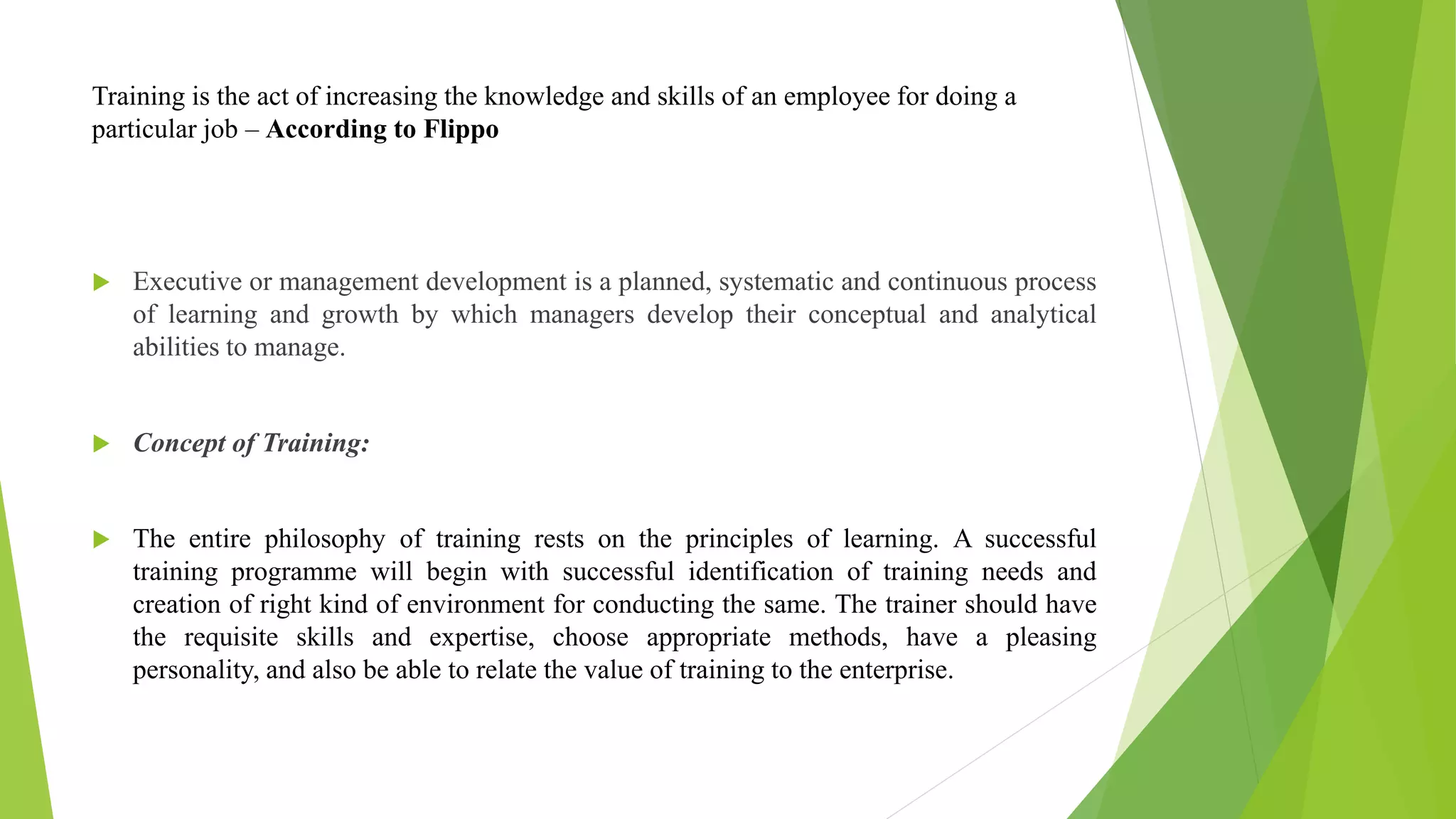
Training is the process of imparting skills.
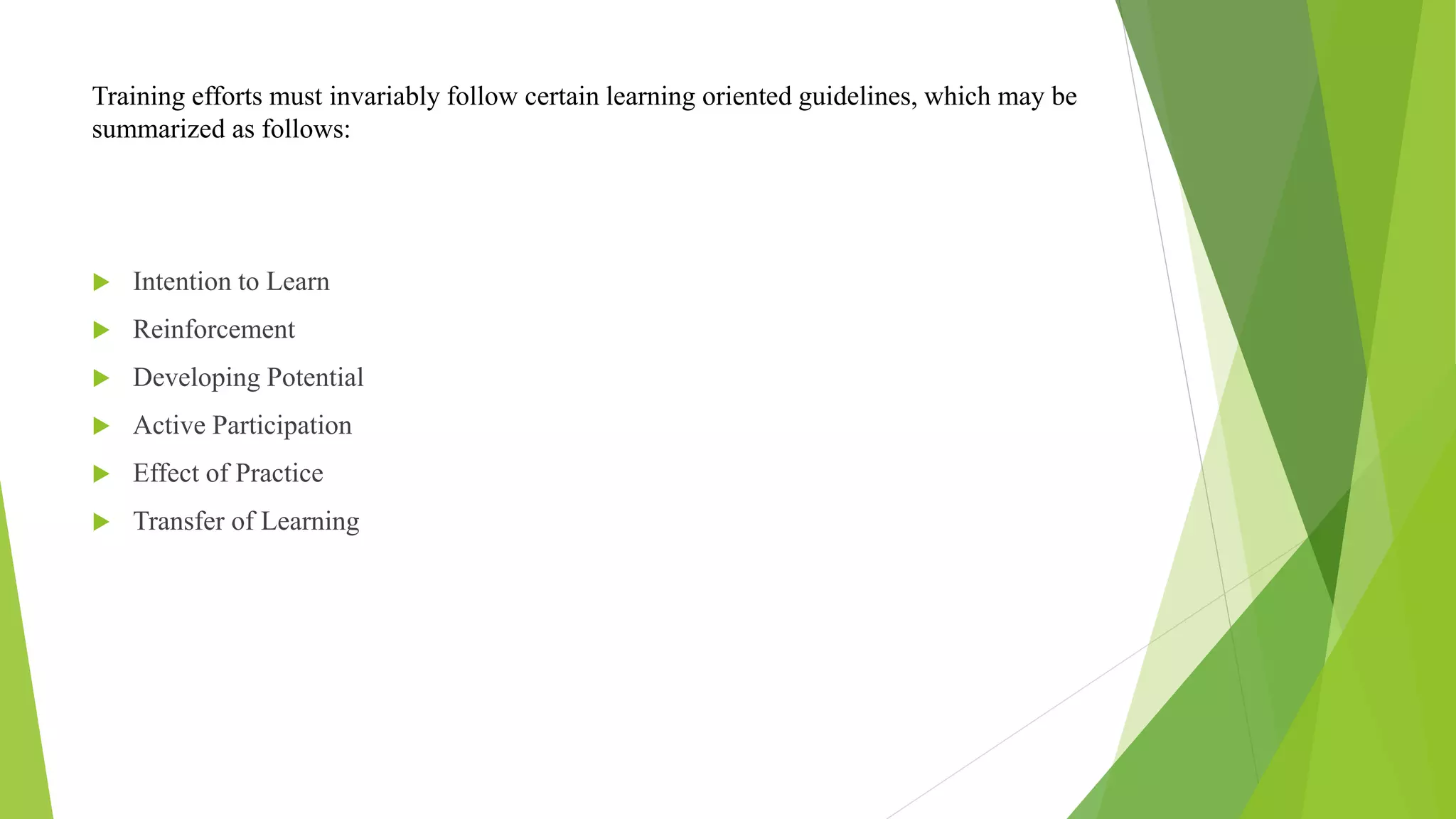
Development is the exposure of employees to general subject and attitudinal aspects of
overall self improvement aimed at helping employees to grow and assume responsibilities
in higher positions
Training is the act of increasing the knowledge and skills of an employee for doing a
particular job – According to Flippo
 Executive or management development is a planned, systematic and continuous process
of learning and growth by which managers develop their conceptual and analytical
abilities to manage.
 Concept of Training:
 The entire philosophy of training rests on the principles of learning. A successful
training programme will begin with successful identification of training needs and
creation of right kind of environment for conducting the same. The trainer should have
the requisite skills and expertise, choose appropriate methods, have a pleasing
personality, and also be able to relate the value of training to the enterprise.
Training efforts must invariably follow certain learning oriented guidelines, which may be
summarized as follows:
 Intention to Learn
 Reinforcement
 Developing Potential
 Active Participation
 Effect of Practice
 Transfer of Learning
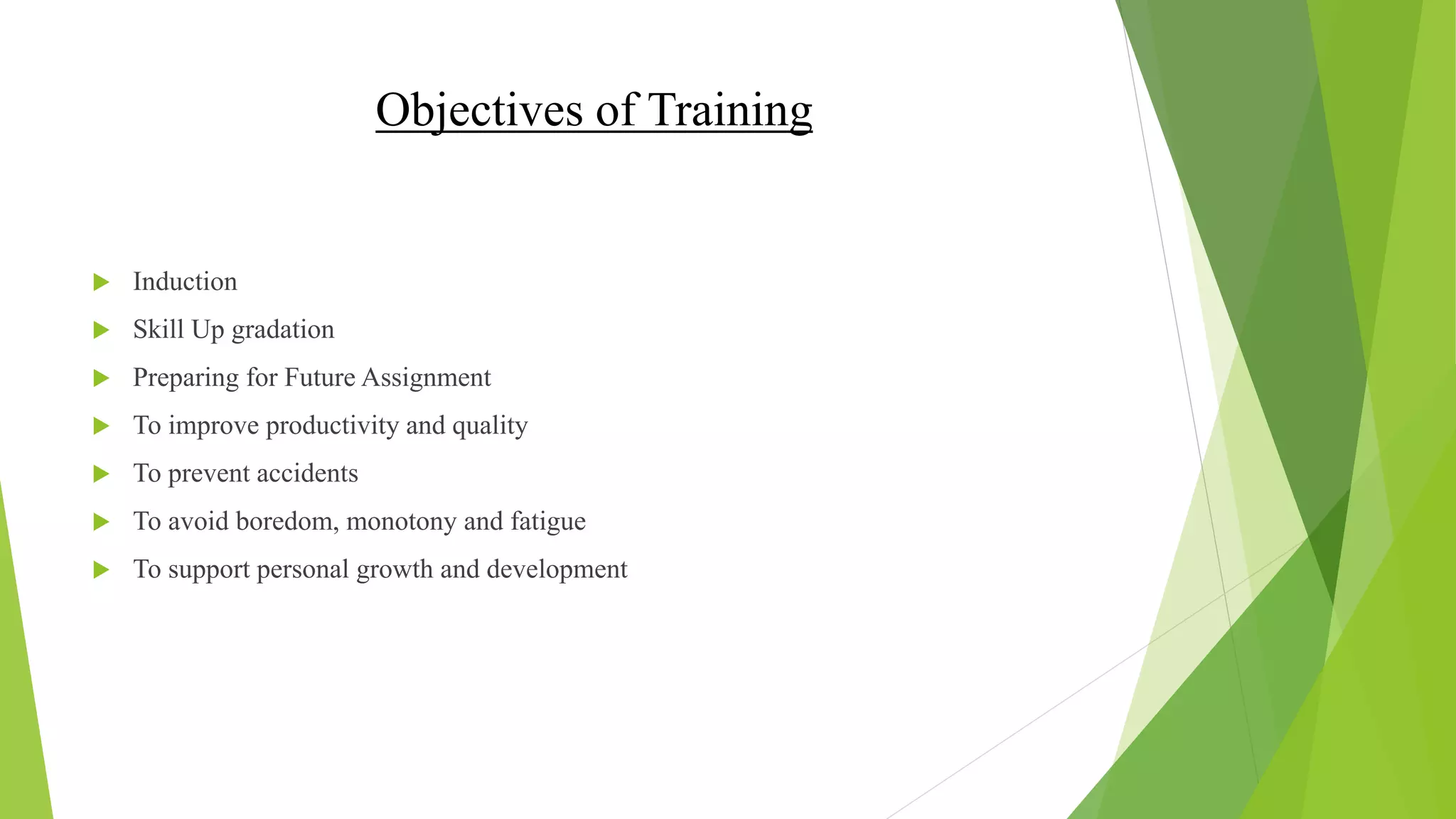
Objectives of Training
 Induction
 Skill Up gradation
 Preparing for Future Assignment
 To improve productivity and quality
 To prevent accidents
 To avoid boredom, monotony and fatigue
 To support personal growth and development
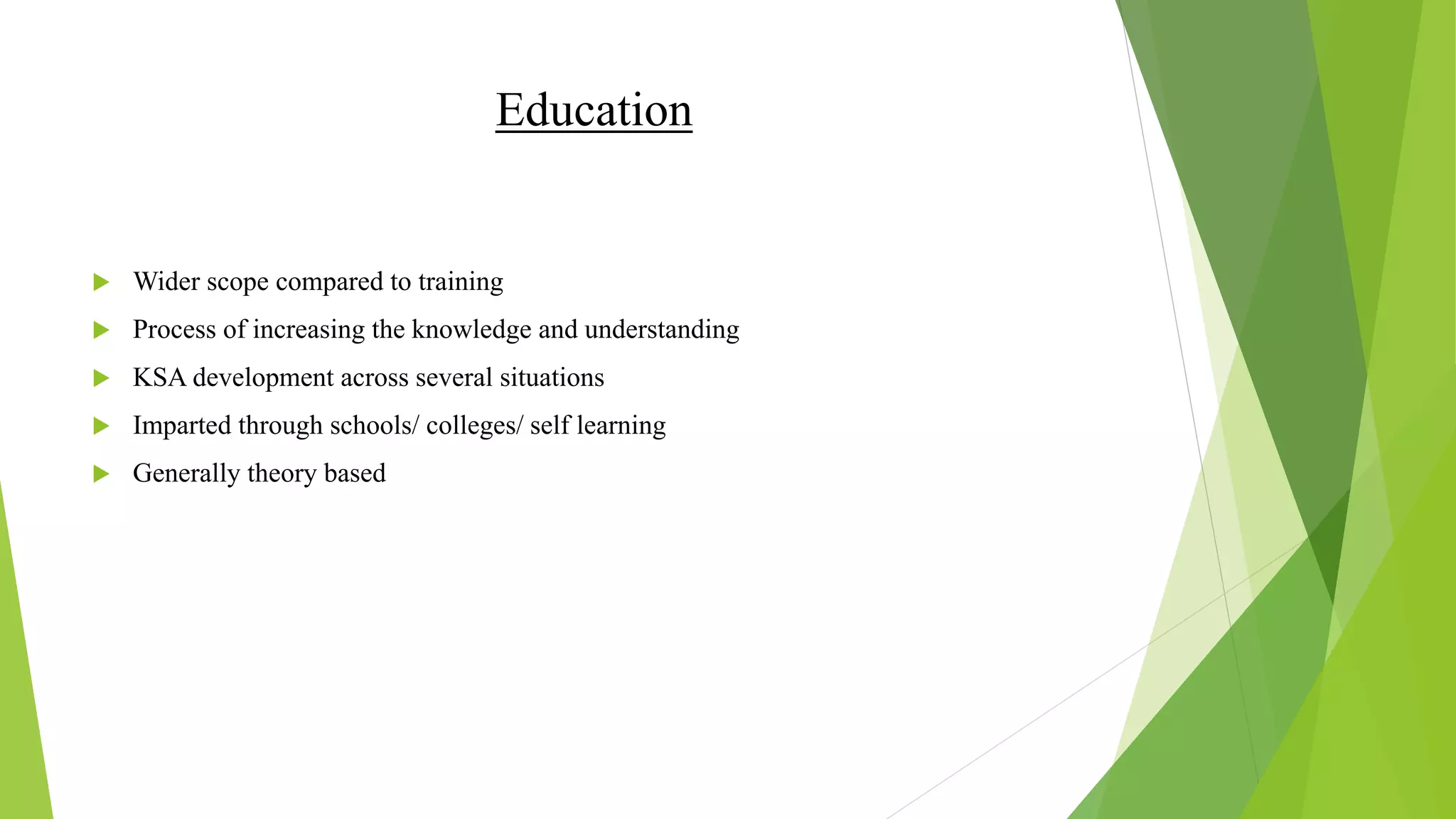
Education
 Wider scope compared to training
 Process of increasing the knowledge and understanding
 KSA development across several situations
 Imparted through schools/ colleges/ self learning
 Generally theory based
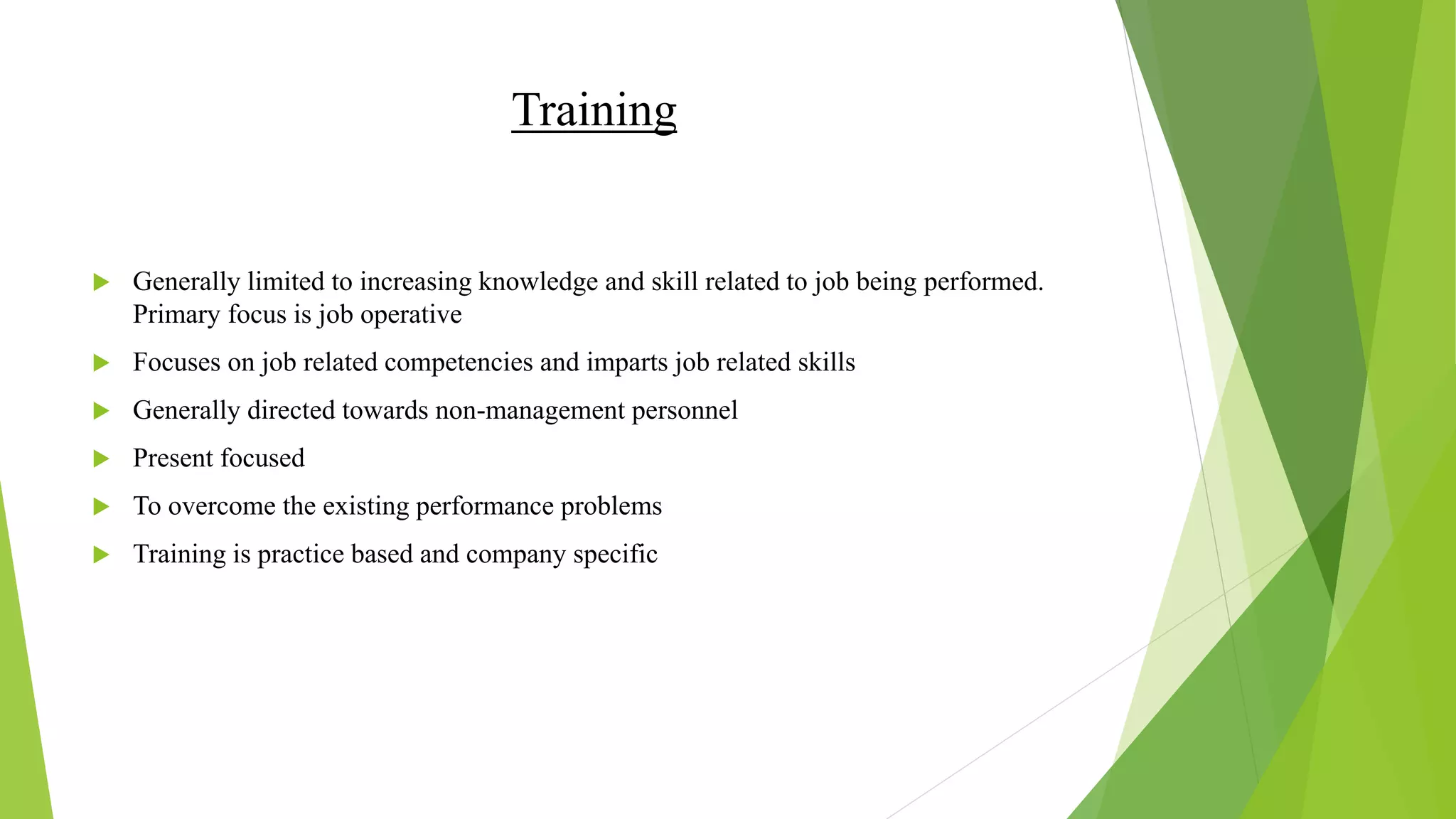
Training
 Generally limited to increasing knowledge and skill related to job being performed.
Primary focus is job operative
 Focuses on job related competencies and imparts job related skills
 Generally directed towards non-management personnel
 Present focused
 To overcome the existing performance problems
 Training is practice based and company specific
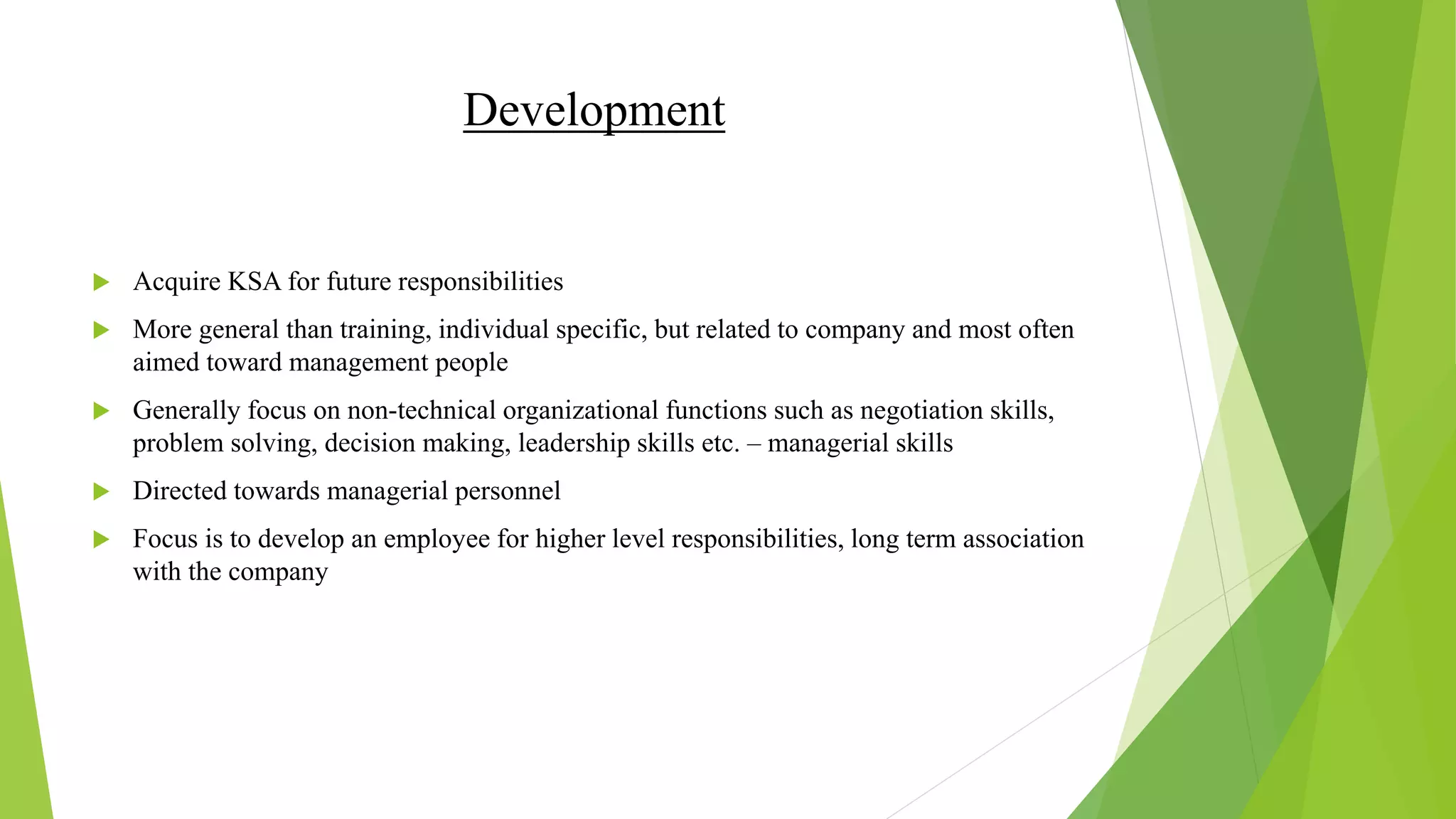
Development
 Acquire KSA for future responsibilities
 More general than training, individual specific, but related to company and most often
aimed toward management people
 Generally focus on non-technical organizational functions such as negotiation skills,
problem solving, decision making, leadership skills etc. – managerial skills
 Directed towards managerial personnel
 Focus is to develop an employee for higher level responsibilities, long term association
with the company
Differences between Training & Development
Basis Training Development
Focus Learn specific actions;
demonstrate techniques
and processes
Understand and
intercept knowledge;
Develop judgments and
decision making
Time Frame Short Term Long Term
Process Tries to improve a
specific skill relating to
a job (mostly technical
and mechanical)
Tries to improve
personality of an
individual(mostly
through behavioral
technique
Goal Meet current
requirements of a job;
aims at improving
performance on current
job
Meet future challenges
of the job and the
individual
Effectiveness Measures Performance Appraisal,
cost benefit, passing
tests and certificates
Qualified people
available when needed,
promotion from within
possible, HR based
competitive advantage
Importance of Training
Benefits to the Organisation Benefits to the Employees
1.Trained workers are effective and
efficient
2.They handle machines properly and
wastage is reduced
3.Fewer accidents
4.Micro managing / close supervision may
not be required
5.Trained workers exhibit better
performance
6.Produce better quality products
7.Growth opportunities are better
8.Become more loyal to the organization
1.Finds job work easy
2. Puts in less effort to achieve results
3. Facilitate growth and promotions
4. Realize career goals faster
5. Makes him better in the job market and
more mobility
6. Handle the job with confidence, hence
increase of morale
7. Can cope better with organizational
change
Methods of Training
A. On-the-Job Methods B. Off-the-job Methods
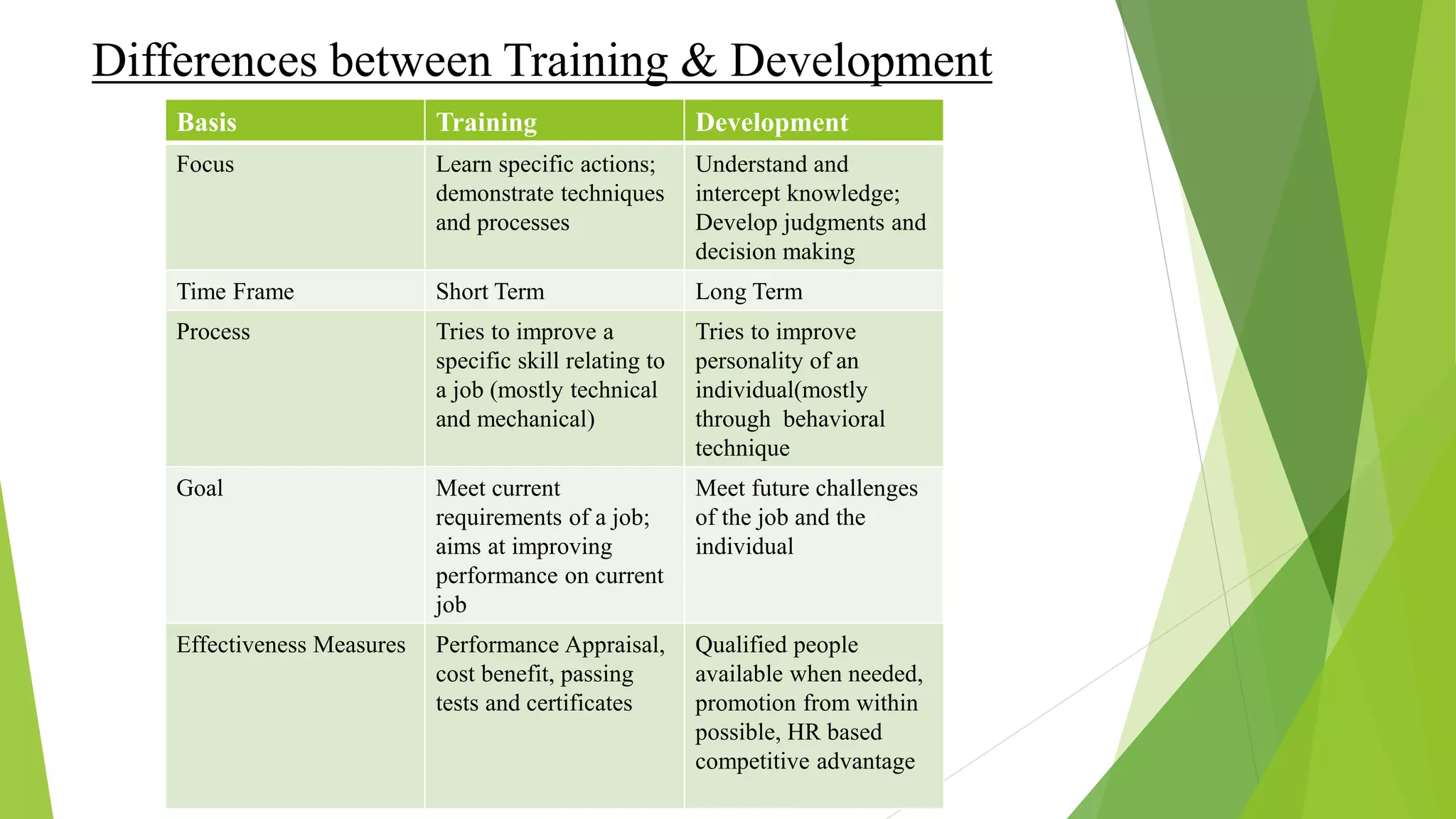
Orientation Training Vestibule Training
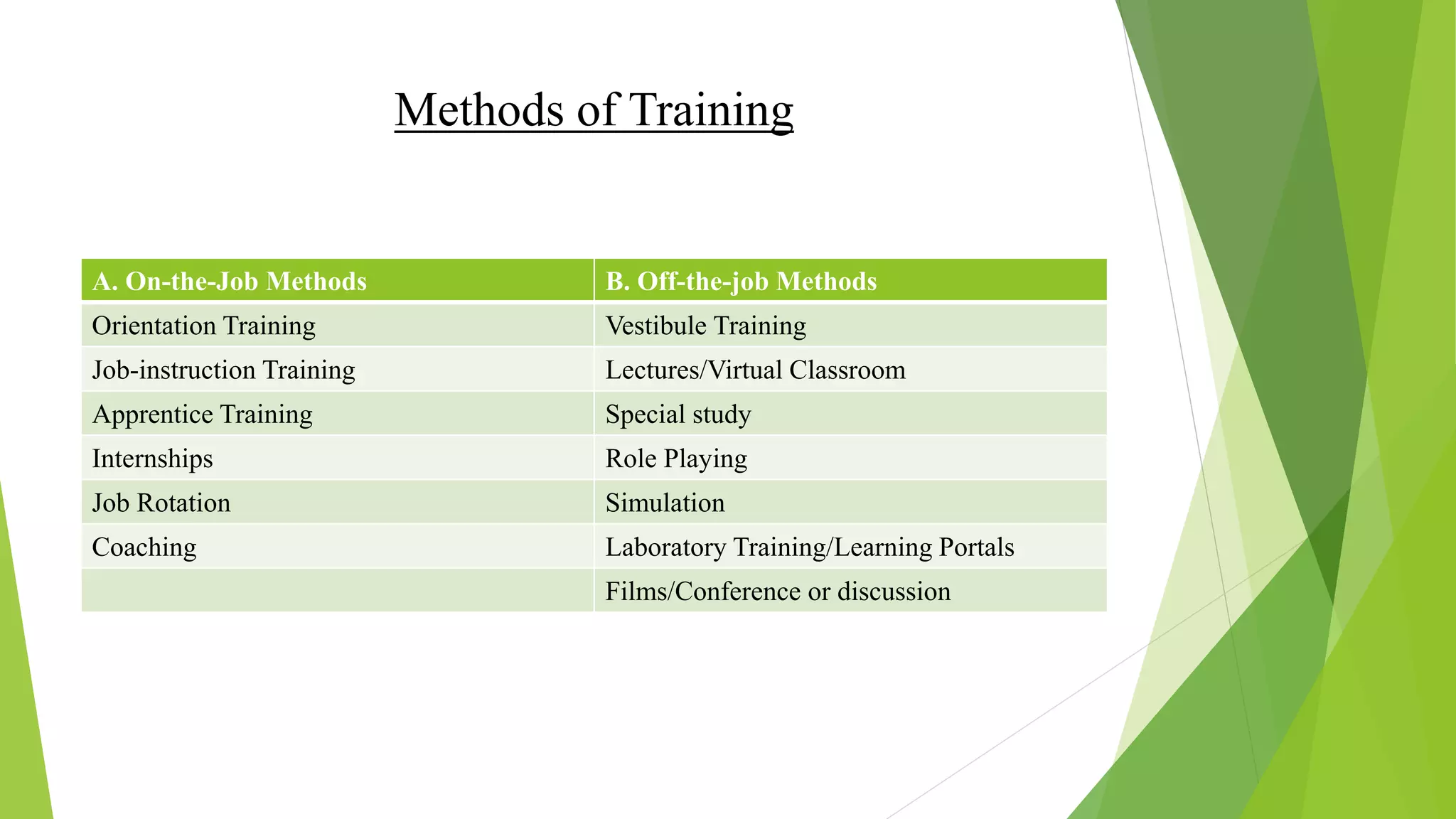
Job-instruction Training Lectures/Virtual Classroom
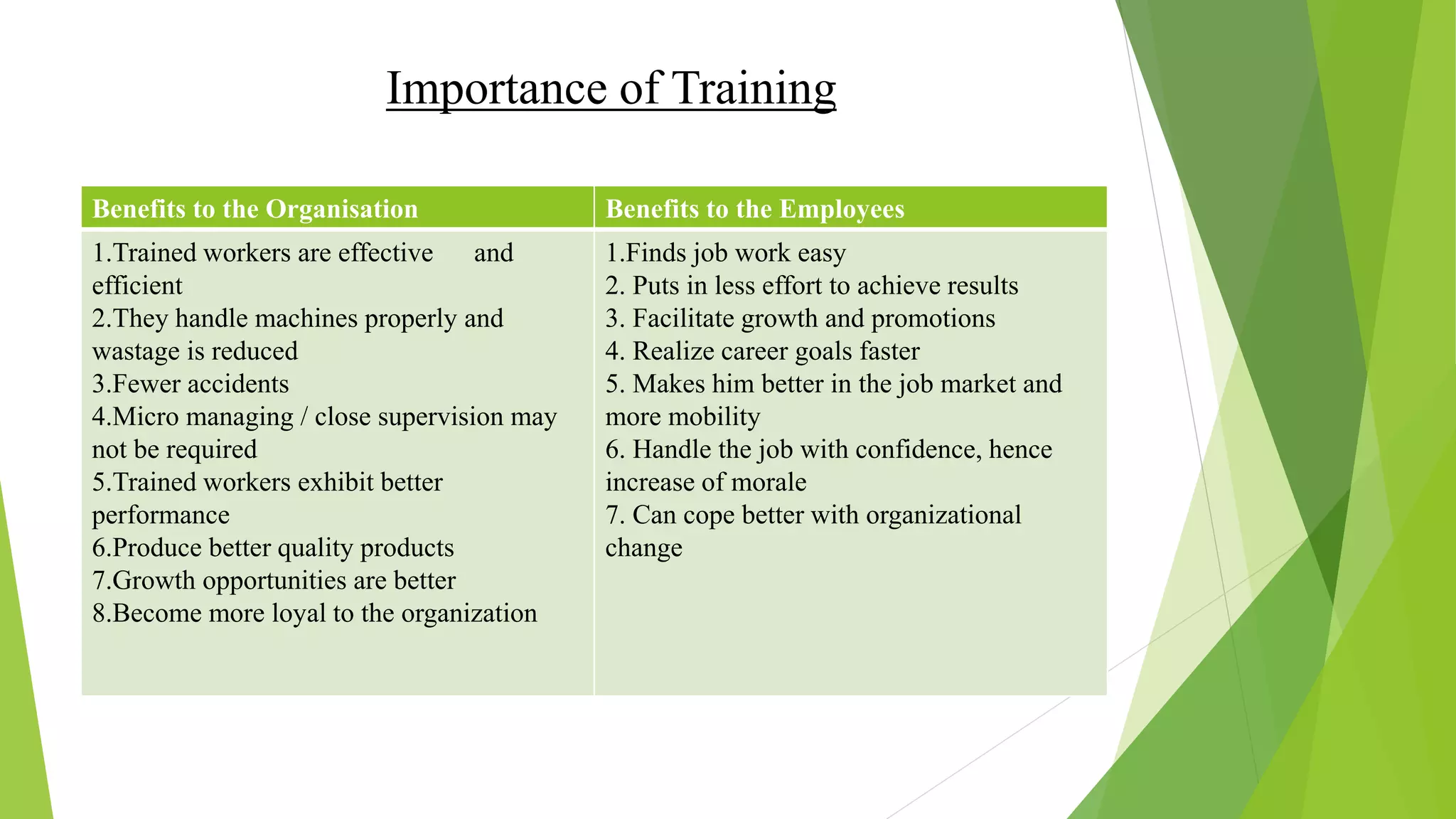
Apprentice Training Special study
Internships Role Playing
Job Rotation Simulation
Coaching Laboratory Training/Learning Portals
Films/Conference or discussion
Vestibule training Apprenticeship
Virtual Classroom
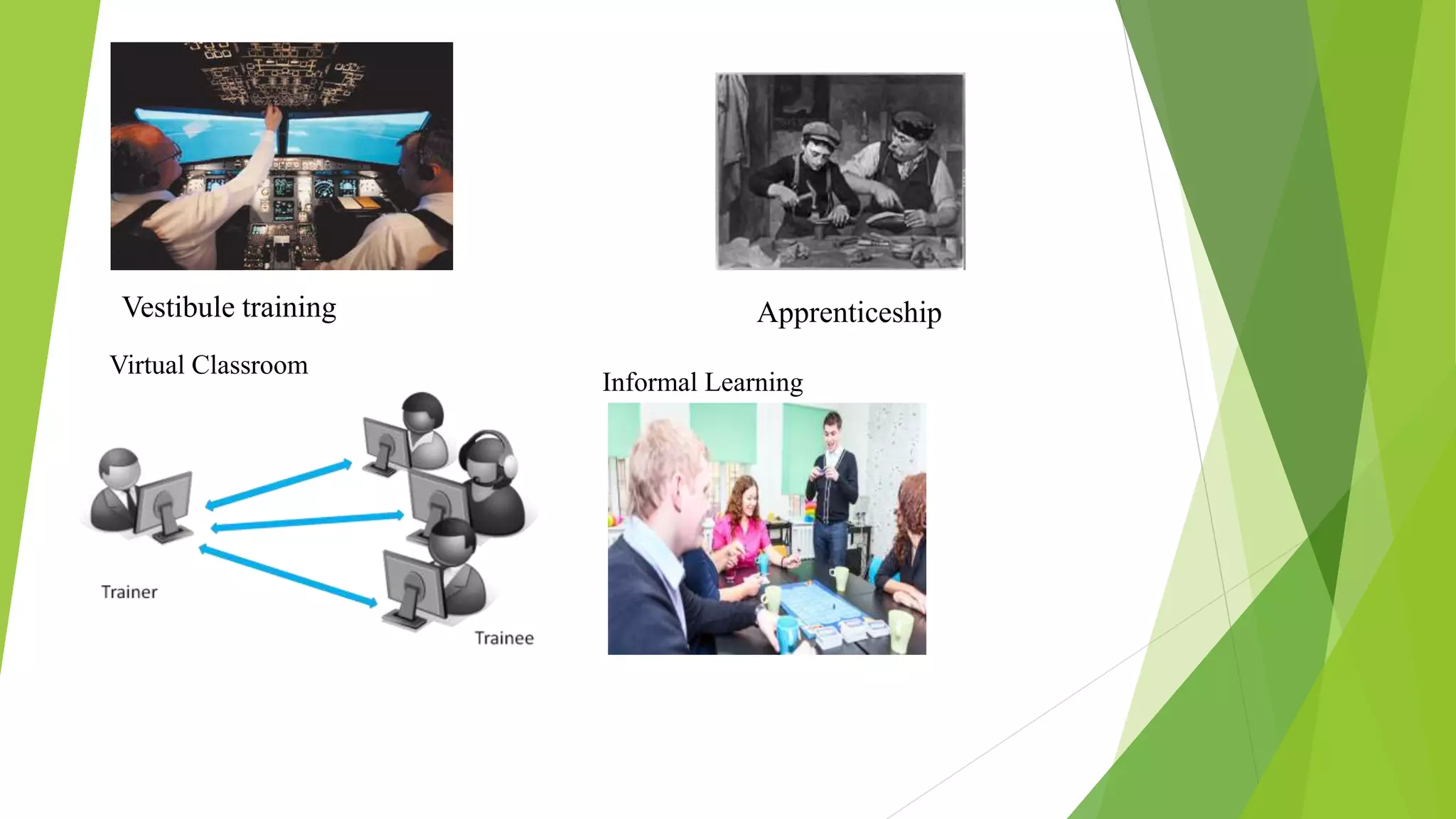
Informal Learning
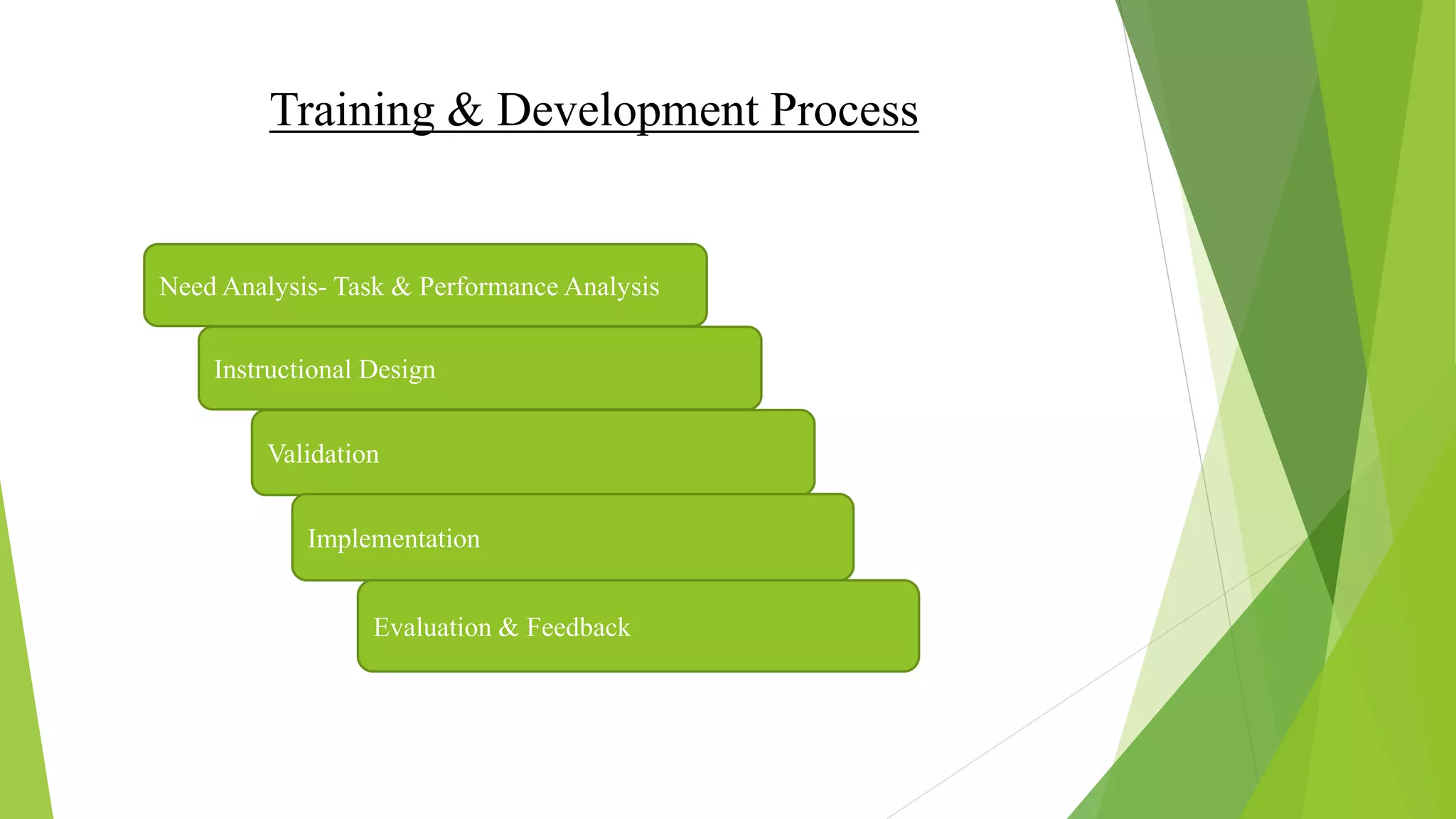
Training & Development Process
Need Analysis- Task & Performance Analysis
Instructional Design
Validation
Implementation
Evaluation & Feedback
Thank you

Training & Development.pptx

  • 1.
    Training & Development Presentedby Paramita Chakraborty Siliguri Institute of Technology
  • 2.
    Education is theprocess of imparting theoretical teaching/learning in classrooms Training is the process of imparting skills. Development is the exposure of employees to general subject and attitudinal aspects of overall self improvement aimed at helping employees to grow and assume responsibilities in higher positions
  • 3.
    Training is theact of increasing the knowledge and skills of an employee for doing a particular job – According to Flippo  Executive or management development is a planned, systematic and continuous process of learning and growth by which managers develop their conceptual and analytical abilities to manage.  Concept of Training:  The entire philosophy of training rests on the principles of learning. A successful training programme will begin with successful identification of training needs and creation of right kind of environment for conducting the same. The trainer should have the requisite skills and expertise, choose appropriate methods, have a pleasing personality, and also be able to relate the value of training to the enterprise.
  • 4.
    Training efforts mustinvariably follow certain learning oriented guidelines, which may be summarized as follows:  Intention to Learn  Reinforcement  Developing Potential  Active Participation  Effect of Practice  Transfer of Learning
  • 5.
    Objectives of Training Induction  Skill Up gradation  Preparing for Future Assignment  To improve productivity and quality  To prevent accidents  To avoid boredom, monotony and fatigue  To support personal growth and development
  • 6.
    Education  Wider scopecompared to training  Process of increasing the knowledge and understanding  KSA development across several situations  Imparted through schools/ colleges/ self learning  Generally theory based
  • 7.
    Training  Generally limitedto increasing knowledge and skill related to job being performed. Primary focus is job operative  Focuses on job related competencies and imparts job related skills  Generally directed towards non-management personnel  Present focused  To overcome the existing performance problems  Training is practice based and company specific
  • 8.
    Development  Acquire KSAfor future responsibilities  More general than training, individual specific, but related to company and most often aimed toward management people  Generally focus on non-technical organizational functions such as negotiation skills, problem solving, decision making, leadership skills etc. – managerial skills  Directed towards managerial personnel  Focus is to develop an employee for higher level responsibilities, long term association with the company
  • 9.
    Differences between Training& Development Basis Training Development Focus Learn specific actions; demonstrate techniques and processes Understand and intercept knowledge; Develop judgments and decision making Time Frame Short Term Long Term Process Tries to improve a specific skill relating to a job (mostly technical and mechanical) Tries to improve personality of an individual(mostly through behavioral technique Goal Meet current requirements of a job; aims at improving performance on current job Meet future challenges of the job and the individual Effectiveness Measures Performance Appraisal, cost benefit, passing tests and certificates Qualified people available when needed, promotion from within possible, HR based competitive advantage
  • 10.
    Importance of Training Benefitsto the Organisation Benefits to the Employees 1.Trained workers are effective and efficient 2.They handle machines properly and wastage is reduced 3.Fewer accidents 4.Micro managing / close supervision may not be required 5.Trained workers exhibit better performance 6.Produce better quality products 7.Growth opportunities are better 8.Become more loyal to the organization 1.Finds job work easy 2. Puts in less effort to achieve results 3. Facilitate growth and promotions 4. Realize career goals faster 5. Makes him better in the job market and more mobility 6. Handle the job with confidence, hence increase of morale 7. Can cope better with organizational change
  • 11.
    Methods of Training A.On-the-Job Methods B. Off-the-job Methods Orientation Training Vestibule Training Job-instruction Training Lectures/Virtual Classroom Apprentice Training Special study Internships Role Playing Job Rotation Simulation Coaching Laboratory Training/Learning Portals Films/Conference or discussion
  • 12.
    Vestibule training Apprenticeship VirtualClassroom Informal Learning
  • 13.
    Training & DevelopmentProcess Need Analysis- Task & Performance Analysis Instructional Design Validation Implementation Evaluation & Feedback
  • 14.