HUMAN RESOURCE MANAGEMENT
    AND DEVELOPMENT
        IMPORTANCE
         DEFINITION
           SCOPE
The Importance of Human
          Resources
• Important and vital factor in organization’s
  success and failure
• The quality and utilization of other m’s-
  money, machine, materials, methods and
  markets are almost always affected by
  decision about and by human resource
• Man does or undoes what exists
  Man creates or bypasses opportunities
Definition of Human Resource
             Management
• Deals with management of people

• The art and science of acquiring, motivating,
  maintaining and developing people in their
  jobs in light of their personal, professional and
  technical knowledge, skills, potentialities,
  needs and values and in synchronization with
  the achievement of individual, organization
  and society’s goals
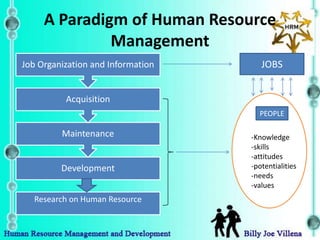
A Paradigm of Human Resource
              Management
Job Organization and Information      JOBS


          Acquisition
                                     PEOPLE
                                     PEOPLE

         Maintenance               -Knowledge
                                   -skills
                                   -attitudes
         Development               -potentialities
                                   -needs
                                   -values
  Research on Human Resource
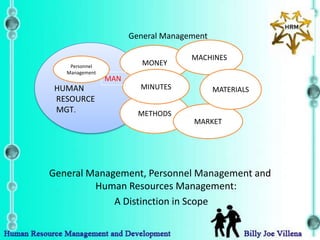
General Management

                                    MACHINES
    Personnel            MONEY
   Management
                MAN
 HUMAN                  MINUTES            MATERIALS
 RESOURCE
 MGT.                   METHODS
                                    MARKET


General Management, Personnel Management and
         Human Resources Management:
             A Distinction in Scope
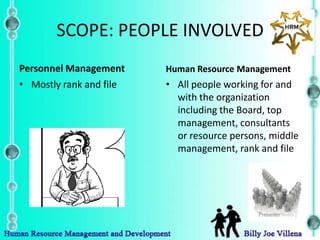
SCOPE: PEOPLE INVOLVED
Personnel Management     Human Resource Management
• Mostly rank and file   • All people working for and
                           with the organization
                           including the Board, top
                           management, consultants
                           or resource persons, middle
                           management, rank and file
HOURS OF WORK
Personnel Management   Human Resource Management


• Full-time Work       • Full-time, part-time, flex-
                         time
PLACE OF WORK
Personnel Management      Human Resource Management
• Formal Setting:         • Formal and Informal
  office, factory/plant     Settings
Type of Service/Function
Personnel Management            Human Resource Management
• Few and Simple: personnel     • Varied and Complex: Job
  information, recruitment, a     Organization and
  d screening social              Information, Acquisition of
  activities, management-         Human
  labor relationships             Resources, Maintenance, de
                                  velopment,
Department Head
               or Officer-in-Charge
Personnel Management          Human Resource Management
• Administrative Officer or   • Separate Human Resource
  Chief Executive Officer       Department manned by
                                human resource specialist
Department Staff:
                Qualifications
Personnel Management   Human Resource Management
• Lawyer               • Behavioral Scientist
• Records Clerk        • Social Science Researcher
Level of Reporting
Personnel Management    Human Resource Management
• Lower level to Line   • Higher Level to General
  Managers                Manager or Chief Executive
                          Officer
Goals
Personnel Management            Human Resource Management
• Accomplishments of            • Accomplishment of
  organization goals being        organization and individual
  emphasized                      goals
Technology
Personnel Management                Human Resource Management
• Mechanistic:                      • Developmental:
  reactive, structural, inflexibl     proactive, socio-technical
  e, technical, control-              orientation, flexible, particip
  oriented and organization-          atory, creative and
  oriented                            innovative
Strategies
Personnel Management            Human Resource Management
• Personally subjective based   • Objective and scientific
  on management’s needs           based on individual and
  and values                      organization culture total
  compartmentalized               systems approach
  approach
Philosophy
Personnel Management             Human Resource Management
• Traditional work orientation   • Humane with emphasis on
  with priorities on               respect for individual and
  organization and                 society’s well-being
  management welfare
  mainly for profit
                                 • People: an investment and
• People: an expense and           resource
  factor of production
THANK YOU!

Human resource management and development ppt

  • 1.
    HUMAN RESOURCE MANAGEMENT AND DEVELOPMENT IMPORTANCE DEFINITION SCOPE
  • 2.
    The Importance ofHuman Resources • Important and vital factor in organization’s success and failure • The quality and utilization of other m’s- money, machine, materials, methods and markets are almost always affected by decision about and by human resource • Man does or undoes what exists Man creates or bypasses opportunities
  • 3.
    Definition of HumanResource Management • Deals with management of people • The art and science of acquiring, motivating, maintaining and developing people in their jobs in light of their personal, professional and technical knowledge, skills, potentialities, needs and values and in synchronization with the achievement of individual, organization and society’s goals
  • 4.
    A Paradigm ofHuman Resource Management Job Organization and Information JOBS Acquisition PEOPLE PEOPLE Maintenance -Knowledge -skills -attitudes Development -potentialities -needs -values Research on Human Resource
  • 5.
    General Management MACHINES Personnel MONEY Management MAN HUMAN MINUTES MATERIALS RESOURCE MGT. METHODS MARKET General Management, Personnel Management and Human Resources Management: A Distinction in Scope
  • 6.
    SCOPE: PEOPLE INVOLVED PersonnelManagement Human Resource Management • Mostly rank and file • All people working for and with the organization including the Board, top management, consultants or resource persons, middle management, rank and file
  • 7.
    HOURS OF WORK PersonnelManagement Human Resource Management • Full-time Work • Full-time, part-time, flex- time
  • 8.
    PLACE OF WORK PersonnelManagement Human Resource Management • Formal Setting: • Formal and Informal office, factory/plant Settings
  • 9.
    Type of Service/Function PersonnelManagement Human Resource Management • Few and Simple: personnel • Varied and Complex: Job information, recruitment, a Organization and d screening social Information, Acquisition of activities, management- Human labor relationships Resources, Maintenance, de velopment,
  • 10.
    Department Head or Officer-in-Charge Personnel Management Human Resource Management • Administrative Officer or • Separate Human Resource Chief Executive Officer Department manned by human resource specialist
  • 11.
    Department Staff: Qualifications Personnel Management Human Resource Management • Lawyer • Behavioral Scientist • Records Clerk • Social Science Researcher
  • 12.
    Level of Reporting PersonnelManagement Human Resource Management • Lower level to Line • Higher Level to General Managers Manager or Chief Executive Officer
  • 13.
    Goals Personnel Management Human Resource Management • Accomplishments of • Accomplishment of organization goals being organization and individual emphasized goals
  • 14.
    Technology Personnel Management Human Resource Management • Mechanistic: • Developmental: reactive, structural, inflexibl proactive, socio-technical e, technical, control- orientation, flexible, particip oriented and organization- atory, creative and oriented innovative
  • 15.
    Strategies Personnel Management Human Resource Management • Personally subjective based • Objective and scientific on management’s needs based on individual and and values organization culture total compartmentalized systems approach approach
  • 16.
    Philosophy Personnel Management Human Resource Management • Traditional work orientation • Humane with emphasis on with priorities on respect for individual and organization and society’s well-being management welfare mainly for profit • People: an investment and • People: an expense and resource factor of production
  • 17.