TRAIN THE TRAINERS
Program
By
K. M. HASAN RIPON
Deputy Director, BSDI
INTRODUCTIONS ( 2 Minutes Each)
1.Work in Pairs
2.Find Out your partners
 Education
 Experience
 Hobbies & Interest
 Family
 What are the expectations of this training
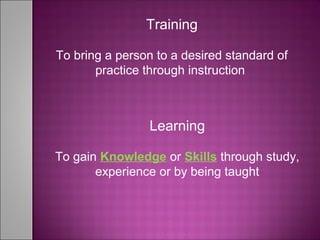
Training
To bring a person to a desired standard of
practice through instruction
Learning
To gain Knowledge or Skills through study,
experience or by being taught
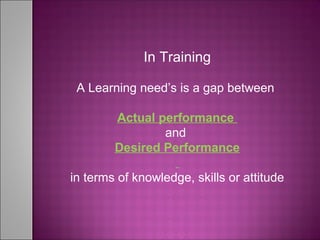
In Training
A Learning need’s is a gap between
Actual performance
and
Desired Performance
in terms of knowledge, skills or attitude
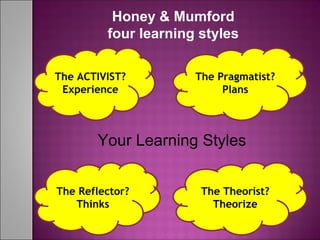
Honey & Mumford
four learning styles
The ACTIVIST?
Experience
The Pragmatist?
Plans
The Reflector?
Thinks
The Theorist?
Theorize
Your Learning Styles
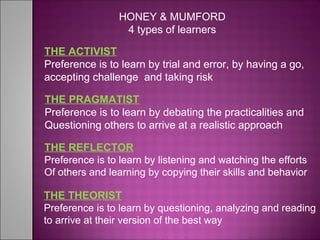
THE ACTIVIST
Preference is to learn by trial and error, by having a go,
accepting challenge and taking risk
THE PRAGMATIST
Preference is to learn by debating the practicalities and
Questioning others to arrive at a realistic approach
THE REFLECTOR
Preference is to learn by listening and watching the efforts
Of others and learning by copying their skills and behavior
THE THEORIST
Preference is to learn by questioning, analyzing and reading
to arrive at their version of the best way
HONEY & MUMFORD
4 types of learners
Syndicate Exercise
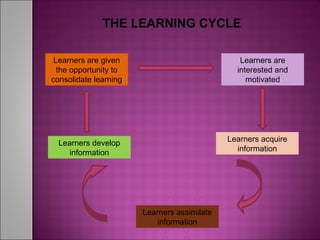
THE LEARNING CYCLE
Learners are given
the opportunity to
consolidate learning
Learners are
interested and
motivated
Learners acquire
information
Learners assimilate
information
Learners develop
information
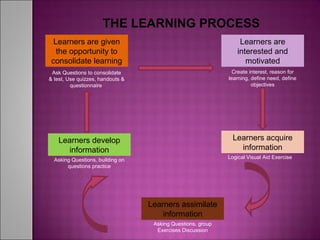
THE LEARNING PROCESS
Learners are given
the opportunity to
consolidate learning
Learners are
interested and
motivated
Learners acquire
information
Learners assimilate
information
Learners develop
information
Ask Questions to consolidate
& test, Use quizzes, handouts &
questionnaire
Create interest, reason for
learning, define need, define
objectives
Logical Visual Aid Exercise
Asking Questions, group
Exercises Discussion
Asking Questions, building on
questions practice
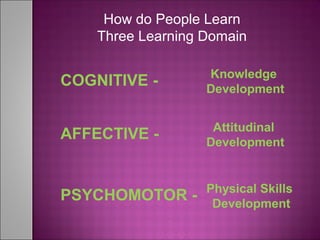
COGNITIVE -
How do People Learn
Three Learning Domain
Knowledge
Development
AFFECTIVE - Attitudinal
Development
PSYCHOMOTOR - Physical Skills
Development
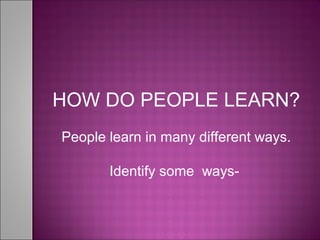
HOW DO PEOPLE LEARN?
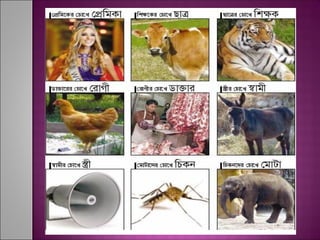
People learn in many different ways.
Identify some ways-
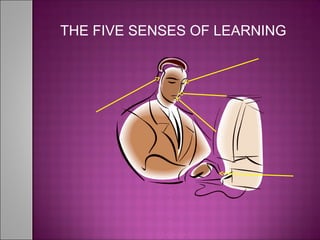
THE FIVE SENSES OF LEARNING
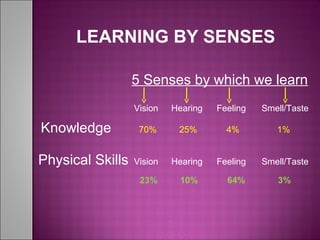
LEARNING BY SENSES
5 Senses by which we learn
Knowledge
Physical Skills
Vision Hearing Feeling Smell/Taste
70% 25% 4% 1%
Vision Hearing Feeling Smell/Taste
23% 10% 64% 3%
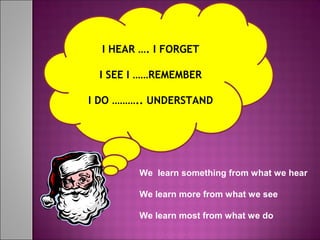
I HEAR …. I FORGET
I SEE I ……REMEMBER
I DO ……….. UNDERSTAND
We learn something from what we hear
We learn more from what we see
We learn most from what we do
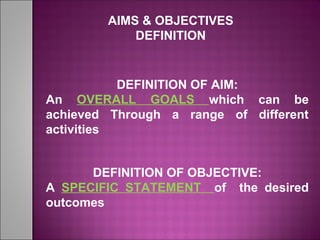
AIMS & OBJECTIVES
DEFINITION
DEFINITION OF AIM:
An OVERALL GOALS which can be
achieved Through a range of different
activities
DEFINITION OF OBJECTIVE:
A SPECIFIC STATEMENT of the desired
outcomes
INSTRUCTIONAL OBJECTIVE
A statement of the desired outcome of a learning
event, which Clearly states what the learner will be
able to do as a result of the training
LEARNING OBJECTIVE
It is about the learner and what it is specifically that
they need to develop in terms of their knowledge,
skills and attitude. It is usually set by the person
who needs to learn and agreed with the trainer
WHY WE START WITH AN
INSTRUCTIONAL OBJECTIVE
IF YOU DON’T KNOW WHERE YOU ARE GOING,
YOU WON’T GET THERE-BUT IF BY CHANCE
YOU DO, YOU WON’T KNOW YOU ARE THERE
BECAUSE YOU DIDN’T KNOW WHERE YOU
WERE GOING!
WHY WRITE AN
INSTRUCTIONAL OBJECTIVE
------------------------
We need to know precisely what our learners will
be able to do as a result of the learning event
------------------------
They will help us to stay on track and not get lost
-------------------------
We can check how successful the learning event
has be
STRUCTURING
LEARNING EVENT
OBJECTIVES:
At the end of this session you will be able to
•Explain why we have a structure for a learning
event
•Name the 3 phase of a structured learning event
and explain why each phase is necessary in the
structure for effective learning
•Explain the 5 components of the first phase
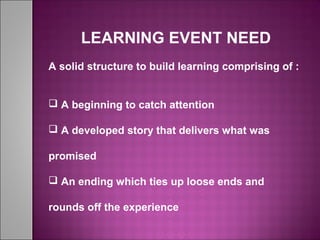
LEARNING EVENT NEED
A solid structure to build learning comprising of :
 A beginning to catch attention
 A developed story that delivers what was
promised
 An ending which ties up loose ends and
rounds off the experience
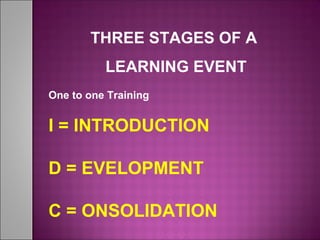
THREE STAGES OF A
LEARNING EVENT
One to one Training
I = INTRODUCTION
D = EVELOPMENT
C = ONSOLIDATION
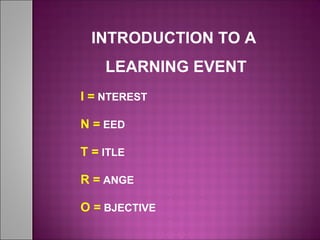
INTRODUCTION TO A
LEARNING EVENT
I = NTEREST
N = EED
T = ITLE
R = ANGE
O = BJECTIVE
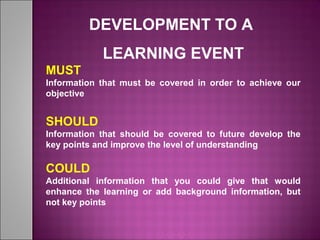
DEVELOPMENT TO A
LEARNING EVENT
MUST
Information that must be covered in order to achieve our
objective
SHOULD
Information that should be covered to future develop the
key points and improve the level of understanding
COULD
Additional information that you could give that would
enhance the learning or add background information, but
not key points
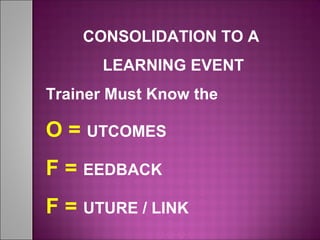
CONSOLIDATION TO A
LEARNING EVENT
Trainer Must Know the
O = UTCOMES
F = EEDBACK
F = UTURE / LINK
SEE U ON THE NEXT DAY ON
THE SAME TIME, SAME ROOM

Train the trainers

  • 1.
    TRAIN THE TRAINERS Program By K.M. HASAN RIPON Deputy Director, BSDI
  • 2.
    INTRODUCTIONS ( 2Minutes Each) 1.Work in Pairs 2.Find Out your partners  Education  Experience  Hobbies & Interest  Family  What are the expectations of this training
  • 4.
    Training To bring aperson to a desired standard of practice through instruction Learning To gain Knowledge or Skills through study, experience or by being taught
  • 5.
    In Training A Learningneed’s is a gap between Actual performance and Desired Performance in terms of knowledge, skills or attitude
  • 6.
    Honey & Mumford fourlearning styles The ACTIVIST? Experience The Pragmatist? Plans The Reflector? Thinks The Theorist? Theorize Your Learning Styles
  • 7.
    THE ACTIVIST Preference isto learn by trial and error, by having a go, accepting challenge and taking risk THE PRAGMATIST Preference is to learn by debating the practicalities and Questioning others to arrive at a realistic approach THE REFLECTOR Preference is to learn by listening and watching the efforts Of others and learning by copying their skills and behavior THE THEORIST Preference is to learn by questioning, analyzing and reading to arrive at their version of the best way HONEY & MUMFORD 4 types of learners
  • 8.
  • 9.
    THE LEARNING CYCLE Learnersare given the opportunity to consolidate learning Learners are interested and motivated Learners acquire information Learners assimilate information Learners develop information
  • 10.
    THE LEARNING PROCESS Learnersare given the opportunity to consolidate learning Learners are interested and motivated Learners acquire information Learners assimilate information Learners develop information Ask Questions to consolidate & test, Use quizzes, handouts & questionnaire Create interest, reason for learning, define need, define objectives Logical Visual Aid Exercise Asking Questions, group Exercises Discussion Asking Questions, building on questions practice
  • 11.
    COGNITIVE - How doPeople Learn Three Learning Domain Knowledge Development AFFECTIVE - Attitudinal Development PSYCHOMOTOR - Physical Skills Development
  • 12.
    HOW DO PEOPLELEARN? People learn in many different ways. Identify some ways-
  • 13.
    THE FIVE SENSESOF LEARNING
  • 14.
    LEARNING BY SENSES 5Senses by which we learn Knowledge Physical Skills Vision Hearing Feeling Smell/Taste 70% 25% 4% 1% Vision Hearing Feeling Smell/Taste 23% 10% 64% 3%
  • 15.
    I HEAR ….I FORGET I SEE I ……REMEMBER I DO ……….. UNDERSTAND We learn something from what we hear We learn more from what we see We learn most from what we do
  • 16.
    AIMS & OBJECTIVES DEFINITION DEFINITIONOF AIM: An OVERALL GOALS which can be achieved Through a range of different activities DEFINITION OF OBJECTIVE: A SPECIFIC STATEMENT of the desired outcomes
  • 17.
  • 18.
    INSTRUCTIONAL OBJECTIVE A statementof the desired outcome of a learning event, which Clearly states what the learner will be able to do as a result of the training LEARNING OBJECTIVE It is about the learner and what it is specifically that they need to develop in terms of their knowledge, skills and attitude. It is usually set by the person who needs to learn and agreed with the trainer
  • 19.
    WHY WE STARTWITH AN INSTRUCTIONAL OBJECTIVE IF YOU DON’T KNOW WHERE YOU ARE GOING, YOU WON’T GET THERE-BUT IF BY CHANCE YOU DO, YOU WON’T KNOW YOU ARE THERE BECAUSE YOU DIDN’T KNOW WHERE YOU WERE GOING!
  • 20.
    WHY WRITE AN INSTRUCTIONALOBJECTIVE ------------------------ We need to know precisely what our learners will be able to do as a result of the learning event ------------------------ They will help us to stay on track and not get lost ------------------------- We can check how successful the learning event has be
  • 21.
    STRUCTURING LEARNING EVENT OBJECTIVES: At theend of this session you will be able to •Explain why we have a structure for a learning event •Name the 3 phase of a structured learning event and explain why each phase is necessary in the structure for effective learning •Explain the 5 components of the first phase
  • 22.
    LEARNING EVENT NEED Asolid structure to build learning comprising of :  A beginning to catch attention  A developed story that delivers what was promised  An ending which ties up loose ends and rounds off the experience
  • 23.
    THREE STAGES OFA LEARNING EVENT One to one Training I = INTRODUCTION D = EVELOPMENT C = ONSOLIDATION
  • 24.
    INTRODUCTION TO A LEARNINGEVENT I = NTEREST N = EED T = ITLE R = ANGE O = BJECTIVE
  • 25.
    DEVELOPMENT TO A LEARNINGEVENT MUST Information that must be covered in order to achieve our objective SHOULD Information that should be covered to future develop the key points and improve the level of understanding COULD Additional information that you could give that would enhance the learning or add background information, but not key points
  • 26.
    CONSOLIDATION TO A LEARNINGEVENT Trainer Must Know the O = UTCOMES F = EEDBACK F = UTURE / LINK
  • 27.
    SEE U ONTHE NEXT DAY ON THE SAME TIME, SAME ROOM