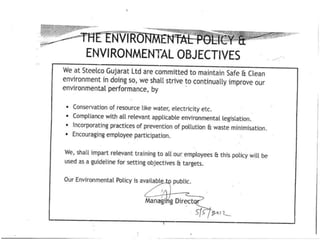
ISO14001 TRAINING
for Managers & Supervisor’s
By
Mahendra K Shukla
Head : Human Resources
STEELCO GUJARAT LTD.
GIDC – Palej, District Bharuch
Why are we here?
• Get ready for SGL’s ISO14001
Compliance
• Provide managers/supervisors an
overview of:
 ISO14001 Standard
 Environmental Management System (EMS)
• Define the Manager/Supervisor’s
responsibility for the EMS
implementation and continuous
improvement.
Why we need ISO14001?
• Minimize SGL’s Impact on the Environment
• Improve SGL’s Environmental Performance
• Reduce Operational Costs
• Reduce Risk of GPCB / MoEF enforcement
• Customers Requirement
Why Do We Need EMS?
For its activities, SGL has to comply with the
following Environmental Regulations :
•The Environmental Protection Act, 1986
•The Air (Prevention & Control of Pollution) Act, 1981
•The Water (Prevention & Control of Pollution) Act, 1974
•The Water (Cess)Act, 1977
•The Hazardous Waste (Management, Handling and
Transboundary Movement) Rules2008
•The Public Liability Insurance Act, 1991
•The Chemical Accidents (Emergency Planning,
Preparedness & Response) Rules, 1996
•The Noise Pollution (Regulation & Control) Rules, 2000
Manager/Supervisor’s Responsibility
• Know your Environmental Management
System including the following :
 Environmental Policy
 Significant Aspects
 Procedures/Work Instructions
• Communicate to Employees
• Training
• Keep Records
• Encourage Employee Involvement
6
Everyone Impacts the Environment
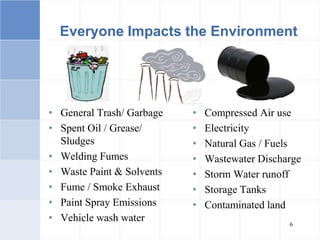
• General Trash/ Garbage
• Spent Oil / Grease/
Sludges
• Welding Fumes
• Waste Paint & Solvents
• Fume / Smoke Exhaust
• Paint Spray Emissions
• Vehicle wash water
• Compressed Air use
• Electricity
• Natural Gas / Fuels
• Wastewater Discharge
• Storm Water runoff
• Storage Tanks
• Contaminated land
What is EHS Performance?
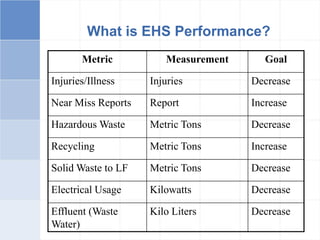
Metric Measurement Goal
Injuries/Illness Injuries Decrease
Near Miss Reports Report Increase
Hazardous Waste Metric Tons Decrease
Recycling Metric Tons Increase
Solid Waste to LF Metric Tons Decrease
Electrical Usage Kilowatts Decrease
Effluent (Waste
Water)
Kilo Liters Decrease
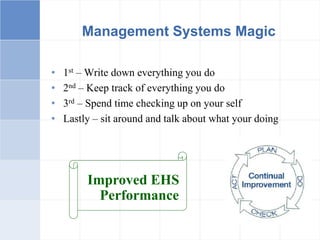
Management Systems Magic
• 1st – Write down everything you do
• 2nd – Keep track of everything you do
• 3rd – Spend time checking up on your self
• Lastly – sit around and talk about what your doing
Improved EHS
Performance
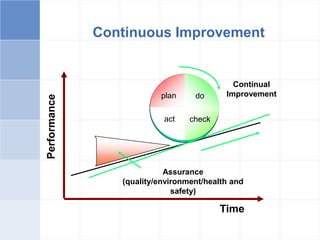
Continuous Improvement
Performance
Time
Continual
Improvement
Assurance
(quality/environment/health and
safety)
plan do
checkact
OVERVIEW OF ISO 14000
Overview of ISO 14000 Series Standards
• ISO 14001 & 14004 - EMS
• ISO 14010 to 14015 - Environmental Auditing
• ISO 14031 - Environmental Performance Evaluation (EPE)
• ISO 14021 - 25 - Environmental Labeling
• ISO 14040 - 43 - Life Cycle Assessment (LCA)
• ISO 14050 - Terms and Definitions
• ISO 14060 - Environmental Aspects in Product Standards
Origin of ISO 14001
Origin of ISO 14001 Environmental Management System
• ISO is a Geneva-based organization of over 120
countries
• ISO International Organization of Standards
• ISO 9000 (Quality Management Systems) was the first
"Management Systems" standard and set the template
for ISO 14000
• 1996 - Final International Standard - ISO 14001 and
14004 ( Original ISO 14001:1996 )
• Revision Finalized November 15, 2004
• No new requirements – just provides clarifications
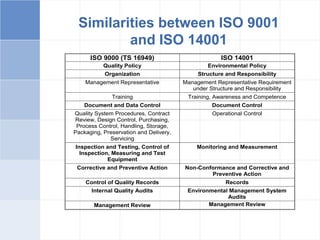
Similarities between ISO 9001
and ISO 14001
ISO 9000 (TS 16949) ISO 14001
Quality Policy Environmental Policy
Organization Structure and Responsibility
Management Representative Management Representative Requirement
under Structure and Responsibility
Training Training, Awareness and Competence
Document and Data Control Document Control
Quality System Procedures, Contract
Review, Design Control, Purchasing,
Process Control, Handling, Storage,
Packaging, Preservation and Delivery,
Servicing
Operational Control
Inspection and Testing, Control of
Inspection, Measuring and Test
Equipment
Monitoring and Measurement
Corrective and Preventive Action Non-Conformance and Corrective and
Preventive Action
Control of Quality Records Records
Internal Quality Audits Environmental Management System
Audits
Management Review Management Review
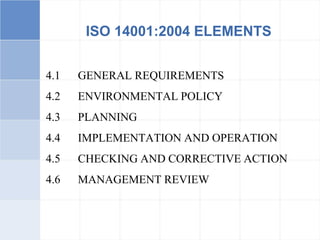
ISO 14001:2004 ELEMENTS
4.1 GENERAL REQUIREMENTS
4.2 ENVIRONMENTAL POLICY
4.3 PLANNING
4.4 IMPLEMENTATION AND OPERATION
4.5 CHECKING AND CORRECTIVE ACTION
4.6 MANAGEMENT REVIEW
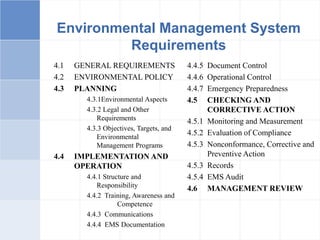
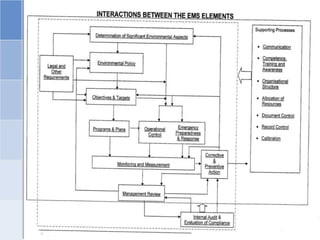
Environmental Management System
Requirements
4.1 GENERAL REQUIREMENTS
4.2 ENVIRONMENTAL POLICY
4.3 PLANNING
4.3.1Environmental Aspects
4.3.2 Legal and Other
Requirements
4.3.3 Objectives, Targets, and
Environmental
Management Programs
4.4 IMPLEMENTATION AND
OPERATION
4.4.1 Structure and
Responsibility
4.4.2 Training, Awareness and
Competence
4.4.3 Communications
4.4.4 EMS Documentation
4.4.5 Document Control
4.4.6 Operational Control
4.4.7 Emergency Preparedness
4.5 CHECKING AND
CORRECTIVE ACTION
4.5.1 Monitoring and Measurement
4.5.2 Evaluation of Compliance
4.5.3 Nonconformance, Corrective and
Preventive Action
4.5.3 Records
4.5.4 EMS Audit
4.6 MANAGEMENT REVIEW
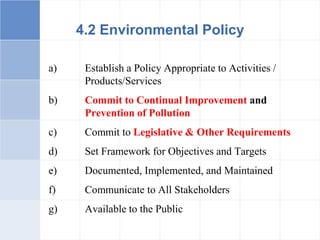
a) Establish a Policy Appropriate to Activities /
Products/Services
b) Commit to Continual Improvement and
Prevention of Pollution
c) Commit to Legislative & Other Requirements
d) Set Framework for Objectives and Targets
e) Documented, Implemented, and Maintained
f) Communicate to All Stakeholders
g) Available to the Public
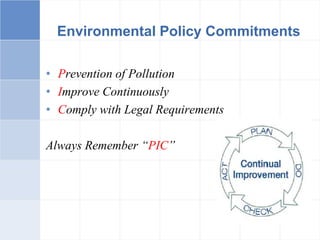
4.2 Environmental Policy
Environmental Policy Commitments
• Prevention of Pollution
• Improve Continuously
• Comply with Legal Requirements
Always Remember ā€œPICā€
Prevention of Pollution
Pollution Prevention =
Controlling Significant Aspects
Exterior Housekeeping
Preventing Spills
So yes, conserving electricity, fuel, steam and
recycling wastewater and garbage is ā€œPollution
Preventionā€
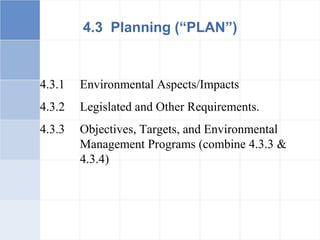
4.3.1 Environmental Aspects/Impacts
4.3.2 Legislated and Other Requirements.
4.3.3 Objectives, Targets, and Environmental
Management Programs (combine 4.3.3 &
4.3.4)
4.3 Planning (ā€œPLANā€)
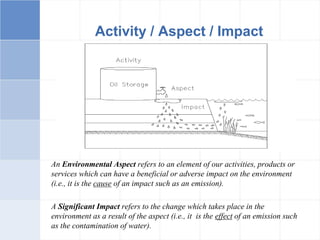
Activity / Aspect / Impact
An Environmental Aspect refers to an element of our activities, products or
services which can have a beneficial or adverse impact on the environment
(i.e., it is the cause of an impact such as an emission).
A Significant Impact refers to the change which takes place in the
environment as a result of the aspect (i.e., it is the effect of an emission such
as the contamination of water).
Significant Environmental Aspect
A significant environmental aspect is an
environmental aspect that has or can have a
significant environmental impact…….
Key Question:
What would happen if you ā€œlost controlā€ of
the aspect?
 Under normal operating conditions?
 Under start-up conditions?
 Under emergency conditions?
Aspects/ Impacts
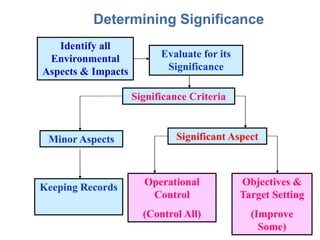
Determining Significance
Identify all
Environmental
Aspects & Impacts
Evaluate for its
Significance
Significance Criteria
Minor Aspects
Keeping Records
Significant Aspect
Operational
Control
(Control All)
Objectives &
Target Setting
(Improve
Some)
SGL’s Significant Aspects
• Electrical Usage
• Natural Gas / Diesel Usage
• Ground Water Usage
• Oil / Lubricants Usage
• Storm Water Run-off
• Use of Metals, Chemicals & Acids
Who determined these ? We did!!
25
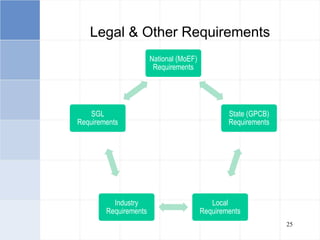
Legal & Other Requirements
National (MoEF)
Requirements
State (GPCB)
Requirements
Local
Requirements
Industry
Requirements
SGL
Requirements
Objectives & Targets
(Improvement Goals)
• Set Objectives and Targets to Prevent or Minimize the
Impacts
 Quantifiable, Time-bound, Accountable
 Detailed Plan(s) to Accomplish Objectives & Targets must be
Developed
• Incorporate into Plant Business Plan
 Gives Environmental the Same Level of Visibility and
Attention as Other Issues
 Establish Overall "Objectivesā€ for the Reduction or
Elimination of Environmental Impacts - Increases
Accountability
• Improve Business & Environmental Performance by
Meeting Objectives.& Targets
Environmental Management Programs
(Action Plans)
• Program For Achieving Objectives & Targets
• Every Objective & Target Must have a EMP
• EMP Must Include:
 Responsible Party
 Means to Achieve Objectives & Targets
 Time-frame
• Update If There Are New or Modified Site
Activities
SGLs Environmental Goals
• Reduce Energy Consumption (Natural Gas /
Electricity/ Fuel Oil)
• Optimum Metal Consumption
• Reduce Oil & Lubricants Usages
• Reduce Acid / Alkali / Chemical Usages
• Reduce Water & Steam Usages
• Reduce Housekeeping (Garbage) Waste
• Increase Wastewater Utilization
4.4.1 Define Roles, Responsibilities and Authorities
4.4.2 Identify Training Needs, Ensure Awareness and
Assess Competence
4.4.3 Establish Procedures for Communicating with All
Stakeholders
4.4.4 Establish and Maintain Procedures for Document
Control
4.4.5 Establish Procedures for Document Control
4.4.6 Establish Operational Control Procedures
4.4.7 Establish Procedures for Emergency Response
4.4 Implementation & Operation
(ā€œDOā€)
Environmental Management
Representative
• Oversees the Day to Day Environmental
Operations
• Coordinates Environmental Matters as
Appropriate
• Champions EMS Implementation
• Should Report Directly to Top Management
• At present Jt. GM (QAD) is EMR
• General Environmental Awareness Training
 Covers EMS Policy, System, Environmental Aspects &
General Environmental Awareness
 All Employees (Required by ISO 14001)
 Integrate with Routine Meetings (Monthly Safety Talks,
Department Meetings) and Other Awareness Techniques
• Work Station / Operational Control Training
 Required for All Significant Activities
 Aware of the Significant Impacts of Their Work Activities
and the Environmental Benefits of Improved Personal
Performance
 Key area for Managers/Supervisors
Trainings
• Regulatory - Mandated Functional Environmental
Training
 Training You Should Already be Doing - Current Requirement
 Training Required by Law
 Specific Employees Required by Their Job Assignment to Have this
Training
• Emergency Plan Training
 Training You Should Already by Doing - Current Requirement
 Training Required by Corporate HR Plan
 All Employees (Some Employees May Require More Detail
Training)
Trainings….
• Internal Auditor Training
 Develops Skills Needed to Prepare For & Conduct an
Effective EMS Assessment
 One Time Training Requirement
• Contractor / Supplier Orientation
 EMS Fundamentals and Facility Environmental Policy
 Selected Contractors Whose Work Could Affect the
Facility’s Environmental Performance
 Key area for Managers/Supervisors
Trainings…
34
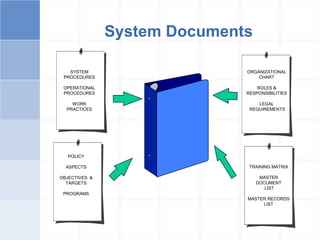
System Documents
SYSTEM
PROCEDURES
OPERATIONAL
PROCEDURES
WORK
PRACTICES
POLICY
ASPECTS
OBJECTIVES. &
TARGETS
PROGRAMS
ORGANIZATIONAL
CHART
ROLES &
RESPONSIBILITIES
LEGAL
REQUIREMENTS
TRAINING MATRIX
MASTER
DOCUMENT
LIST
MASTER RECORDS
LIST
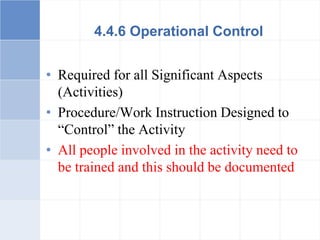
4.4.6 Operational Control
• Required for all Significant Aspects
(Activities)
• Procedure/Work Instruction Designed to
ā€œControlā€ the Activity
• All people involved in the activity need to
be trained and this should be documented
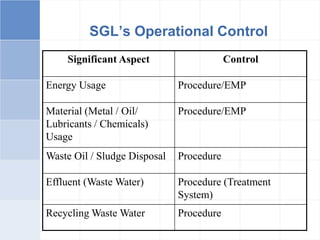
SGL’s Operational Control
Significant Aspect Control
Energy Usage Procedure/EMP
Material (Metal / Oil/
Lubricants / Chemicals)
Usage
Procedure/EMP
Waste Oil / Sludge Disposal Procedure
Effluent (Waste Water) Procedure (Treatment
System)
Recycling Waste Water Procedure
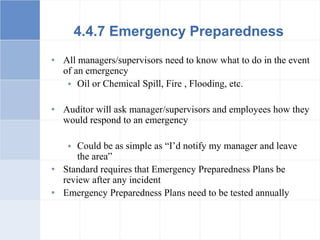
4.4.7 Emergency Preparedness
• All managers/supervisors need to know what to do in the event
of an emergency
 Oil or Chemical Spill, Fire , Flooding, etc.
• Auditor will ask manager/supervisors and employees how they
would respond to an emergency
 Could be as simple as ā€œI’d notify my manager and leave
the areaā€
• Standard requires that Emergency Preparedness Plans be
review after any incident
• Emergency Preparedness Plans need to be tested annually
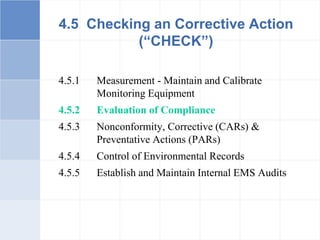
4.5.1 Measurement - Maintain and Calibrate
Monitoring Equipment
4.5.2 Evaluation of Compliance
4.5.3 Nonconformity, Corrective (CARs) &
Preventative Actions (PARs)
4.5.4 Control of Environmental Records
4.5.5 Establish and Maintain Internal EMS Audits
4.5 Checking an Corrective Action
(ā€œCHECKā€)
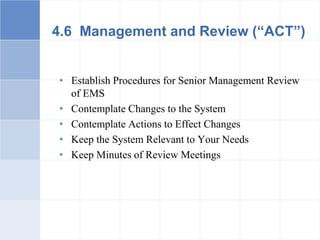
4.6 Management and Review (ā€œACTā€)
• Establish Procedures for Senior Management Review
of EMS
• Contemplate Changes to the System
• Contemplate Actions to Effect Changes
• Keep the System Relevant to Your Needs
• Keep Minutes of Review Meetings
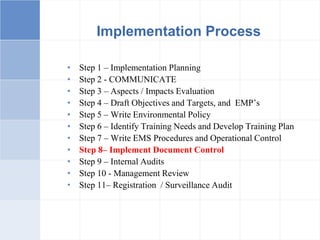
Implementation Process
• Step 1 – Implementation Planning
• Step 2 - COMMUNICATE
• Step 3 – Aspects / Impacts Evaluation
• Step 4 – Draft Objectives and Targets, and EMP’s
• Step 5 – Write Environmental Policy
• Step 6 – Identify Training Needs and Develop Training Plan
• Step 7 – Write EMS Procedures and Operational Control
• Step 8– Implement Document Control
• Step 9 – Internal Audits
• Step 10 - Management Review
• Step 11– Registration / Surveillance Audit
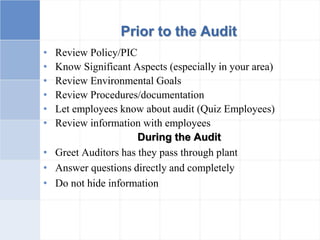
Prior to the Audit
• Review Policy/PIC
• Know Significant Aspects (especially in your area)
• Review Environmental Goals
• Review Procedures/documentation
• Let employees know about audit (Quiz Employees)
• Review information with employees
During the Audit
• Greet Auditors has they pass through plant
• Answer questions directly and completely
• Do not hide information
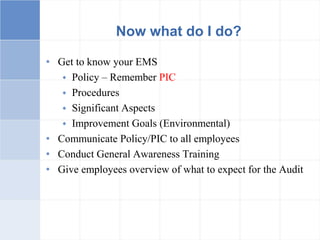
Now what do I do?
• Get to know your EMS
 Policy – Remember PIC
 Procedures
 Significant Aspects
 Improvement Goals (Environmental)
• Communicate Policy/PIC to all employees
• Conduct General Awareness Training
• Give employees overview of what to expect for the Audit
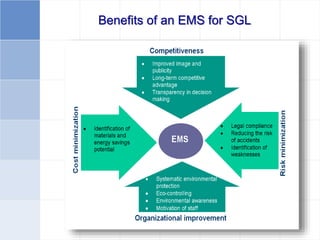
Benefits of an EMS for SGL
ISO 14001 EMS Awarness Training

ISO 14001 EMS Awarness Training

  • 1.
    ISO14001 TRAINING for Managers& Supervisor’s By Mahendra K Shukla Head : Human Resources STEELCO GUJARAT LTD. GIDC – Palej, District Bharuch
  • 2.
    Why are wehere? • Get ready for SGL’s ISO14001 Compliance • Provide managers/supervisors an overview of:  ISO14001 Standard  Environmental Management System (EMS) • Define the Manager/Supervisor’s responsibility for the EMS implementation and continuous improvement.
  • 3.
    Why we needISO14001? • Minimize SGL’s Impact on the Environment • Improve SGL’s Environmental Performance • Reduce Operational Costs • Reduce Risk of GPCB / MoEF enforcement • Customers Requirement
  • 4.
    Why Do WeNeed EMS? For its activities, SGL has to comply with the following Environmental Regulations : •The Environmental Protection Act, 1986 •The Air (Prevention & Control of Pollution) Act, 1981 •The Water (Prevention & Control of Pollution) Act, 1974 •The Water (Cess)Act, 1977 •The Hazardous Waste (Management, Handling and Transboundary Movement) Rules2008 •The Public Liability Insurance Act, 1991 •The Chemical Accidents (Emergency Planning, Preparedness & Response) Rules, 1996 •The Noise Pollution (Regulation & Control) Rules, 2000
  • 5.
    Manager/Supervisor’s Responsibility • Knowyour Environmental Management System including the following :  Environmental Policy  Significant Aspects  Procedures/Work Instructions • Communicate to Employees • Training • Keep Records • Encourage Employee Involvement
  • 6.
    6 Everyone Impacts theEnvironment • General Trash/ Garbage • Spent Oil / Grease/ Sludges • Welding Fumes • Waste Paint & Solvents • Fume / Smoke Exhaust • Paint Spray Emissions • Vehicle wash water • Compressed Air use • Electricity • Natural Gas / Fuels • Wastewater Discharge • Storm Water runoff • Storage Tanks • Contaminated land
  • 7.
    What is EHSPerformance? Metric Measurement Goal Injuries/Illness Injuries Decrease Near Miss Reports Report Increase Hazardous Waste Metric Tons Decrease Recycling Metric Tons Increase Solid Waste to LF Metric Tons Decrease Electrical Usage Kilowatts Decrease Effluent (Waste Water) Kilo Liters Decrease
  • 8.
    Management Systems Magic •1st – Write down everything you do • 2nd – Keep track of everything you do • 3rd – Spend time checking up on your self • Lastly – sit around and talk about what your doing Improved EHS Performance
  • 9.
  • 10.
    OVERVIEW OF ISO14000 Overview of ISO 14000 Series Standards • ISO 14001 & 14004 - EMS • ISO 14010 to 14015 - Environmental Auditing • ISO 14031 - Environmental Performance Evaluation (EPE) • ISO 14021 - 25 - Environmental Labeling • ISO 14040 - 43 - Life Cycle Assessment (LCA) • ISO 14050 - Terms and Definitions • ISO 14060 - Environmental Aspects in Product Standards
  • 11.
    Origin of ISO14001 Origin of ISO 14001 Environmental Management System • ISO is a Geneva-based organization of over 120 countries • ISO International Organization of Standards • ISO 9000 (Quality Management Systems) was the first "Management Systems" standard and set the template for ISO 14000 • 1996 - Final International Standard - ISO 14001 and 14004 ( Original ISO 14001:1996 ) • Revision Finalized November 15, 2004 • No new requirements – just provides clarifications
  • 12.
    Similarities between ISO9001 and ISO 14001 ISO 9000 (TS 16949) ISO 14001 Quality Policy Environmental Policy Organization Structure and Responsibility Management Representative Management Representative Requirement under Structure and Responsibility Training Training, Awareness and Competence Document and Data Control Document Control Quality System Procedures, Contract Review, Design Control, Purchasing, Process Control, Handling, Storage, Packaging, Preservation and Delivery, Servicing Operational Control Inspection and Testing, Control of Inspection, Measuring and Test Equipment Monitoring and Measurement Corrective and Preventive Action Non-Conformance and Corrective and Preventive Action Control of Quality Records Records Internal Quality Audits Environmental Management System Audits Management Review Management Review
  • 13.
    ISO 14001:2004 ELEMENTS 4.1GENERAL REQUIREMENTS 4.2 ENVIRONMENTAL POLICY 4.3 PLANNING 4.4 IMPLEMENTATION AND OPERATION 4.5 CHECKING AND CORRECTIVE ACTION 4.6 MANAGEMENT REVIEW
  • 14.
    Environmental Management System Requirements 4.1GENERAL REQUIREMENTS 4.2 ENVIRONMENTAL POLICY 4.3 PLANNING 4.3.1Environmental Aspects 4.3.2 Legal and Other Requirements 4.3.3 Objectives, Targets, and Environmental Management Programs 4.4 IMPLEMENTATION AND OPERATION 4.4.1 Structure and Responsibility 4.4.2 Training, Awareness and Competence 4.4.3 Communications 4.4.4 EMS Documentation 4.4.5 Document Control 4.4.6 Operational Control 4.4.7 Emergency Preparedness 4.5 CHECKING AND CORRECTIVE ACTION 4.5.1 Monitoring and Measurement 4.5.2 Evaluation of Compliance 4.5.3 Nonconformance, Corrective and Preventive Action 4.5.3 Records 4.5.4 EMS Audit 4.6 MANAGEMENT REVIEW
  • 15.
    a) Establish aPolicy Appropriate to Activities / Products/Services b) Commit to Continual Improvement and Prevention of Pollution c) Commit to Legislative & Other Requirements d) Set Framework for Objectives and Targets e) Documented, Implemented, and Maintained f) Communicate to All Stakeholders g) Available to the Public 4.2 Environmental Policy
  • 17.
    Environmental Policy Commitments •Prevention of Pollution • Improve Continuously • Comply with Legal Requirements Always Remember ā€œPICā€
  • 18.
    Prevention of Pollution PollutionPrevention = Controlling Significant Aspects Exterior Housekeeping Preventing Spills So yes, conserving electricity, fuel, steam and recycling wastewater and garbage is ā€œPollution Preventionā€
  • 19.
    4.3.1 Environmental Aspects/Impacts 4.3.2Legislated and Other Requirements. 4.3.3 Objectives, Targets, and Environmental Management Programs (combine 4.3.3 & 4.3.4) 4.3 Planning (ā€œPLANā€)
  • 20.
    Activity / Aspect/ Impact An Environmental Aspect refers to an element of our activities, products or services which can have a beneficial or adverse impact on the environment (i.e., it is the cause of an impact such as an emission). A Significant Impact refers to the change which takes place in the environment as a result of the aspect (i.e., it is the effect of an emission such as the contamination of water).
  • 21.
    Significant Environmental Aspect Asignificant environmental aspect is an environmental aspect that has or can have a significant environmental impact…….
  • 22.
    Key Question: What wouldhappen if you ā€œlost controlā€ of the aspect?  Under normal operating conditions?  Under start-up conditions?  Under emergency conditions? Aspects/ Impacts
  • 23.
    Determining Significance Identify all Environmental Aspects& Impacts Evaluate for its Significance Significance Criteria Minor Aspects Keeping Records Significant Aspect Operational Control (Control All) Objectives & Target Setting (Improve Some)
  • 24.
    SGL’s Significant Aspects •Electrical Usage • Natural Gas / Diesel Usage • Ground Water Usage • Oil / Lubricants Usage • Storm Water Run-off • Use of Metals, Chemicals & Acids Who determined these ? We did!!
  • 25.
    25 Legal & OtherRequirements National (MoEF) Requirements State (GPCB) Requirements Local Requirements Industry Requirements SGL Requirements
  • 26.
    Objectives & Targets (ImprovementGoals) • Set Objectives and Targets to Prevent or Minimize the Impacts  Quantifiable, Time-bound, Accountable  Detailed Plan(s) to Accomplish Objectives & Targets must be Developed • Incorporate into Plant Business Plan  Gives Environmental the Same Level of Visibility and Attention as Other Issues  Establish Overall "Objectivesā€ for the Reduction or Elimination of Environmental Impacts - Increases Accountability • Improve Business & Environmental Performance by Meeting Objectives.& Targets
  • 27.
    Environmental Management Programs (ActionPlans) • Program For Achieving Objectives & Targets • Every Objective & Target Must have a EMP • EMP Must Include:  Responsible Party  Means to Achieve Objectives & Targets  Time-frame • Update If There Are New or Modified Site Activities
  • 28.
    SGLs Environmental Goals •Reduce Energy Consumption (Natural Gas / Electricity/ Fuel Oil) • Optimum Metal Consumption • Reduce Oil & Lubricants Usages • Reduce Acid / Alkali / Chemical Usages • Reduce Water & Steam Usages • Reduce Housekeeping (Garbage) Waste • Increase Wastewater Utilization
  • 29.
    4.4.1 Define Roles,Responsibilities and Authorities 4.4.2 Identify Training Needs, Ensure Awareness and Assess Competence 4.4.3 Establish Procedures for Communicating with All Stakeholders 4.4.4 Establish and Maintain Procedures for Document Control 4.4.5 Establish Procedures for Document Control 4.4.6 Establish Operational Control Procedures 4.4.7 Establish Procedures for Emergency Response 4.4 Implementation & Operation (ā€œDOā€)
  • 30.
    Environmental Management Representative • Overseesthe Day to Day Environmental Operations • Coordinates Environmental Matters as Appropriate • Champions EMS Implementation • Should Report Directly to Top Management • At present Jt. GM (QAD) is EMR
  • 31.
    • General EnvironmentalAwareness Training  Covers EMS Policy, System, Environmental Aspects & General Environmental Awareness  All Employees (Required by ISO 14001)  Integrate with Routine Meetings (Monthly Safety Talks, Department Meetings) and Other Awareness Techniques • Work Station / Operational Control Training  Required for All Significant Activities  Aware of the Significant Impacts of Their Work Activities and the Environmental Benefits of Improved Personal Performance  Key area for Managers/Supervisors Trainings
  • 32.
    • Regulatory -Mandated Functional Environmental Training  Training You Should Already be Doing - Current Requirement  Training Required by Law  Specific Employees Required by Their Job Assignment to Have this Training • Emergency Plan Training  Training You Should Already by Doing - Current Requirement  Training Required by Corporate HR Plan  All Employees (Some Employees May Require More Detail Training) Trainings….
  • 33.
    • Internal AuditorTraining  Develops Skills Needed to Prepare For & Conduct an Effective EMS Assessment  One Time Training Requirement • Contractor / Supplier Orientation  EMS Fundamentals and Facility Environmental Policy  Selected Contractors Whose Work Could Affect the Facility’s Environmental Performance  Key area for Managers/Supervisors Trainings…
  • 34.
  • 35.
    4.4.6 Operational Control •Required for all Significant Aspects (Activities) • Procedure/Work Instruction Designed to ā€œControlā€ the Activity • All people involved in the activity need to be trained and this should be documented
  • 36.
    SGL’s Operational Control SignificantAspect Control Energy Usage Procedure/EMP Material (Metal / Oil/ Lubricants / Chemicals) Usage Procedure/EMP Waste Oil / Sludge Disposal Procedure Effluent (Waste Water) Procedure (Treatment System) Recycling Waste Water Procedure
  • 37.
    4.4.7 Emergency Preparedness •All managers/supervisors need to know what to do in the event of an emergency  Oil or Chemical Spill, Fire , Flooding, etc. • Auditor will ask manager/supervisors and employees how they would respond to an emergency  Could be as simple as ā€œI’d notify my manager and leave the areaā€ • Standard requires that Emergency Preparedness Plans be review after any incident • Emergency Preparedness Plans need to be tested annually
  • 38.
    4.5.1 Measurement -Maintain and Calibrate Monitoring Equipment 4.5.2 Evaluation of Compliance 4.5.3 Nonconformity, Corrective (CARs) & Preventative Actions (PARs) 4.5.4 Control of Environmental Records 4.5.5 Establish and Maintain Internal EMS Audits 4.5 Checking an Corrective Action (ā€œCHECKā€)
  • 39.
    4.6 Management andReview (ā€œACTā€) • Establish Procedures for Senior Management Review of EMS • Contemplate Changes to the System • Contemplate Actions to Effect Changes • Keep the System Relevant to Your Needs • Keep Minutes of Review Meetings
  • 40.
    Implementation Process • Step1 – Implementation Planning • Step 2 - COMMUNICATE • Step 3 – Aspects / Impacts Evaluation • Step 4 – Draft Objectives and Targets, and EMP’s • Step 5 – Write Environmental Policy • Step 6 – Identify Training Needs and Develop Training Plan • Step 7 – Write EMS Procedures and Operational Control • Step 8– Implement Document Control • Step 9 – Internal Audits • Step 10 - Management Review • Step 11– Registration / Surveillance Audit
  • 42.
    Prior to theAudit • Review Policy/PIC • Know Significant Aspects (especially in your area) • Review Environmental Goals • Review Procedures/documentation • Let employees know about audit (Quiz Employees) • Review information with employees During the Audit • Greet Auditors has they pass through plant • Answer questions directly and completely • Do not hide information
  • 43.
    Now what doI do? • Get to know your EMS  Policy – Remember PIC  Procedures  Significant Aspects  Improvement Goals (Environmental) • Communicate Policy/PIC to all employees • Conduct General Awareness Training • Give employees overview of what to expect for the Audit
  • 44.
    Benefits of anEMS for SGL