Welcome to

Training of Trainers
   with   R P Singh
Mingle Activity
• Selection of Training Subject
Introductions
•   First Name
•   Company name
•   One strength in my training area
•   One weakness in my training area
Your expectations
• What do you hope to achieve from these
  three days?
Our norms for these 3 days
Course objectives
By the end of this course, you will have:
• learned the value of training and how it helps
  individuals and organisations
• found out about learning styles of individuals and
  various learning theories
• known how to design a training course
• learned the main do's and don'ts of delivering a
  successful course
• practiced preparing and delivering short
  presentations on course
• received feedback and advice from the trainer and
  peers
• prepared an action plan for your continued
  improvement as a trainer
Introduction
By the end of this session, you will:

• have thought about what makes a good
  training course
• have considered just what training and
  learning are
• have got to know other participants on the
  course
• have thought about ways to open a training
  course
What makes a good training
           course?
• Case Study 1
What makes a good training
           course?
• Case Study 2
The 'perfect' training course
• Trainer

• Participants

• Environment

• Programme

• Resources
So just what is training?
1. What is learning?

2. What is teaching?

3. What is training?

4. What is facilitating?
Mini Quiz
Can you match the descriptions with the definitions?

A     Someone explaining how to assemble a rifle.
B     Someone preparing a class of O Level children for their GCSEs.
C     Someone preparing a group of athletes to run a marathon.
D     Someone encouraging workers to find ways to increase their
  employability.
E     Someone giving prepared lessons to a group of univ students.
F     Someone helping a student to prepare for a test.

Lecturer       -----   Trainer         -----   Instructor       -----
Tutor          -----   Teacher         -----   Facilitator      -----
A trainer's various hats
Can you think of one or two situations when
  you may perform some other ‘roles’:
• Motivator and inspirer
• Mediator or referee
• Mentor or coach
• Quality controller
• Chairperson
• Presenter
• Counsellor
The Learner
By the end of this session, you will:
• have considered what makes a good learner
• have considered what contributes to a good and a poor
  learning experience
• have identified different learning styles and sensory learning
  preferences, and thought about how these can inform our
  training
• have looked at various learning theories
• have seen the importance of establishing need in the mind of
  the learner
• have developed an understanding on how to identify training
  needs of your teams
• have looked at some caricatures of typical participants
• have discussed the pros and cons of learning in groups
The Active Learner, the Reluctant
  Learner and the Passive Learner
Your attitude to learning:

• People have different attitudes to
  learning. Complete the questionnaire to
  determine your own attitude to
  learning.
Learning experiences
• A good learning experience
Learning experiences
• A poor learning experience
What contributes to a
    poor learning experience?
• Can you list some factors?
How people learn?
• Can you list the different ways people
  learn – for example, by listening.
  Consider all likely ways…

• The emphasis here is on ‘quantity’…
What makes a good learner?
• Can you rank the strips into ‘top ten’
  good learning habits?
Establishing need in the
         mind of the learner
• Shaheen: I studied English for six years in school.
  By the time I left school I still couldn’t speak it. A few
  years later, when I followed my husband who had
  been sent to work in Karachi, I started to study
  English again. Within a few months I was becoming
  quite fluent.
• Sami: Since I started this job I don’t have time to go
  to the movies. I spend all my evenings at home
  brushing up on my IT skills.
• Ather: I fell in the canal when I was walking home
  from school one day. I learned to swim in ten
  seconds.
These learners illustrate the point that motivation is a
  crucial factor in successful learning.
How to do you identify the
  training needs of your teams?
Four possible ways:

1. Look at your team’s current and the required
   performance in future. This will give you a
   gap in their current skills.

2. Identify the changes that are occurring in
   your market or industry or in your
   organisation.
How to do you identify the
  training needs of your teams?
3. Another way could be involving your
   people. Ask them what areas they might
   like to have training in? This will give you a
   skill audit.

4. Finally, another possibility: informed
   guesswork. You can bet that particular
   organisations and teams at certain times
   need certain skills.
Now, prioritise these
Let’s learn something
          about learning
1. Classical learning theory (Pavlov-
   Skinner et al)
2. Kolb’s learning cycle
3. Bloom’s hierarchy of learning
4. Context-specific learning
5. Stages of learning
6. Multiple Intelligences (Gardner)
7. Sensory learning preferences
Task: 2-minute presentation
1. What does your chosen theory say
   about learning?

2. How can we use learning from this
   theory in our next training back at our
   workplace?

(through a visually appealing chart?)
The ‘hard cases’
Type                                             1. Why they do what they do?
                                                 2. What to do with them?
The Silent one. A participant doesn’t appear
to want to contribute.

The Griper. A participant often complains
about the tasks, facilities and other things.

The Know-all. A participant wants to display
his/her knowledge, dominating the session.

The Clash. Two or more participants clash
over personalities, abilities, facts, etc.

The Latecomer. A participant consistently
arrives late, returns late after breaks.

Difficult-to-understand. A participant is hard
to understand, maybe a non-English
speaker, a non-technical person on a
technical course.
Handling groups
1. During a two-day workshop, would you ask
   the participants to regroup several times?
2. If you regroup participants, do you do it
   randomly or carefully choose the personnel
   of each group?
3. There is pressure to conform in groups
   (groupthink). How can you counteract this
   pressure?
4. How can you deal with conflict within
   groups?
Training Delivery
By the end of this session, you will:

• have discussed the importance of objectives and
  purpose
• have shared different learning activities and
  techniques
• have practised giving demonstrations
• have considered ways of reviewing what is being
  learned
• have discussed ways of getting information across
• have practised some techniques and activities
• have drawn up a list of dos and don’ts for trainers
‘Why are we doing this?’
Learners will usually find an activity more
  rewarding if they know why they are doing it.

There are several reasons why this is so:
• they will be more motivated
• they will be able to relate the activity more
  closely to their lives
• they will be more focused
Activities in the training room
1.   What is the objective? (After this task, participants will be
     able to…)
2.   What might be the ultimate purpose (Why are they doing
     this?)
3.   How should the task be managed? In groups or individually?
4.   Should it be learner focused (ideas coming primarily from the
     learners themselves), or trainer focused?
5.   How could feedback be given? How will the participants
     know whether they have done well or not?
6.   How long would the task take?
7.   How could the task be ‘spiced up’, made more interesting or
     fun for the participants?
8.   How could the task be made more workplace-related, so that
     the participants see it as relevant to them?
Designing a short session
Design a short session on one of these
  topics by considering 8 questions:

1.   Courtesy towards customers
2.   Trust among team members
3.   Efficiency in processes
4.   Leadership readiness
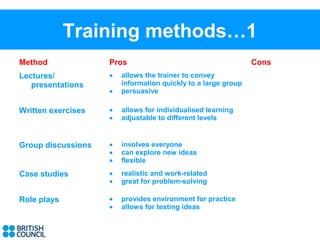
Training methods…1
Method              Pros                                       Cons
Lectures/           •   allows the trainer to convey
   presentations        information quickly to a large group
                    •   persuasive

Written exercises   •   allows for individualised learning
                    •   adjustable to different levels


Group discussions   •   involves everyone
                    •   can explore new ideas
                    •   flexible
Case studies        •   realistic and work-related
                    •   great for problem-solving

Role plays          •   provides environment for practice
                    •   allows for testing ideas
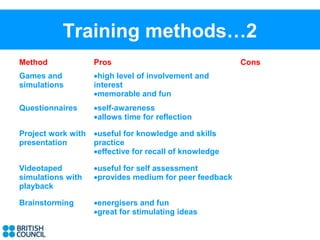
Training methods…2
Method              Pros                                 Cons
Games and           •high level of involvement and
simulations         interest
                    •memorable and fun
Questionnaires      •self-awareness
                    •allows time for reflection

Project work with   •useful for knowledge and skills
presentation        practice
                    •effective for recall of knowledge

Videotaped          •useful for self assessment
simulations with    •provides medium for peer feedback
playback

Brainstorming       •energisers and fun
                    •great for stimulating ideas
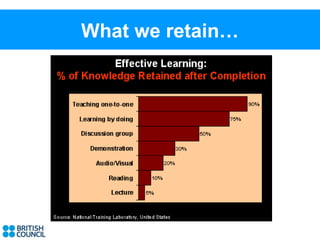
What we retain…
Demonstrations
A demonstration is useful when showing a group or a
   person how to use new technology. A good
   demonstration should serve these purposes:
• to show visually (and simply) how things work
• to show cause and effect
• to explain a sequence of events needed to use the
   equipment
• to allay doubts or worries about using the
   equipment
• to encourage the learner to use the equipment
• to discover the learner’s needs
• to show the capabilities of the equipment
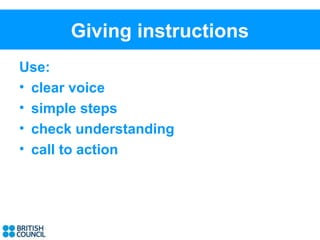
Giving instructions
Use:
• clear voice
• simple steps
• check understanding
• call to action
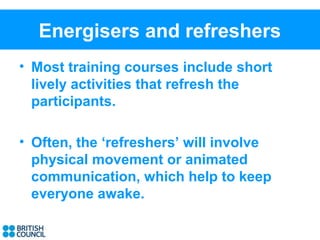
Energisers and refreshers
• Most training courses include short
  lively activities that refresh the
  participants.

• Often, the ‘refreshers’ will involve
  physical movement or animated
  communication, which help to keep
  everyone awake.
Anecdotes, or stories
• When we communicate on a ‘human’
  level we like to talk about things that
  happened to us, or stories we have
  heard. An abstract concept can be
  made more memorable by a real-life
  example, a brief anecdote, which
  touches the listener on a very personal
  level.
‘Does it make sense?’
A person’s sensory learning preference determines how he/she
   will best receive information.

•   Visual: These learners like to take in information through the
    eyes. They like to see things written down, read books, look at
    pictures and diagrams and take notes.

•   Auditory: These learners like to get information through their
    ears. They like to listen to the trainer, repeat things in their
    head, and take part in discussions.

•   Kinaesthetic: These learners like to get information through
    their hands, bodies or movement. They like to touch, move
    things around and write things down.
Presenting information
• Mini Quiz
Do’s and don’ts of delivery
• Divide the strips into dos and don’ts.
The Trainer
By the end of this session, you will:

• have looked at some different types of trainer
• have learned some tips for giving positive
  and negative feedback to learners
• have discussed how to pick up on signs from
  the class
• have looked at the principles of presenting
• have considered how to evaluate your own
  courses
What type of trainer are you?
• The ‘guru’        An expert. Has a deep knowledge of
  her subject and loves to share it.
• ‘Showman’         A would-be actor. Loves to be ‘on
  stage’, to perform before the audience. Often jokes
  and tells stories. A great entertainer.
• ‘One of the boys’ (‘one of the girls’) Communicates
  on a very friendly level with the participants.
  Perhaps mixes socially with them.
• The quiet one Tends to keep a low profile,
  preferring the participants to do all the work. Likes
  to stand back and let them get on with it.
• Disciplinarian Strict. Likes to push the participants
  hard and exert strong control over the group.
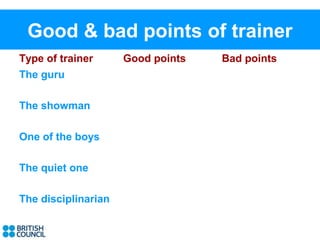
Good & bad points of trainer
Type of trainer      Good points   Bad points
The guru

The showman

One of the boys

The quiet one

The disciplinarian
Trainer Feedback
• Learners get feedback both from the
  trainer and from their peers. This
  feedback can take many forms.
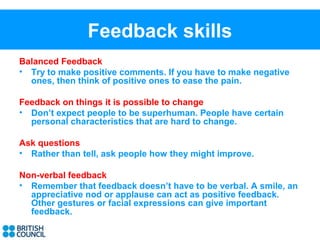
Feedback skills
Balanced Feedback
• Try to make positive comments. If you have to make negative
  ones, then think of positive ones to ease the pain.

Feedback on things it is possible to change
• Don’t expect people to be superhuman. People have certain
  personal characteristics that are hard to change.

Ask questions
• Rather than tell, ask people how they might improve.

Non-verbal feedback
• Remember that feedback doesn’t have to be verbal. A smile, an
  appreciative nod or applause can act as positive feedback.
  Other gestures or facial expressions can give important
  feedback.
Giving negative feedback
• Any phrases that do this effectively,
  without much pain?
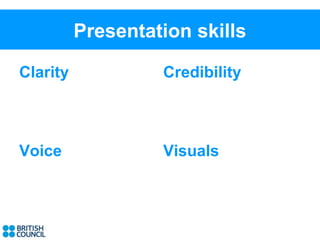
Presentation skills

Clarity            Credibility


Voice              Visuals
Picking up on signs from learner
• How can we deal with this?

• A Signs of inattentiveness

• B Signs of confusion or non-
  comprehension
Evaluating your training
1.   Self: via self-analysis, evaluation forms and
     feedback from colleagues in the training team.
     Could you have done better? Are there areas for
     improvement?
2.   The course materials: do they need replacing,
     revising, updating?
3.   The whole course: self, learners, observers
4.   Individual parts of the course: self, learners,
     observers
5.   The situation after the course: via a follow-up
     inquiry seeking to measure improved performance
     or behaviour in the work situation. How effective
     has the transfer of learning been to the real world?
     The stage ceases only when the course is no
     longer relevant.
Environment and Resources
By the end of this session, you will:

• have designed your ideal training room
• have discussed training room
  dynamics
• have considered creating a safe
  learning environment
• have discussed the pros and cons of
  various training room resources and
  tips for using them
My dream training room
•   Room – size, shape, lighting, etc
•   Windows
•   Tables, chairs
•   Music
•   Walls
•   Refreshments
•   Anything else? Heating or cooling?
How do you create a safe
     learning environment?
• Can you suggest some specific steps?
Training Resources
Whiteboard
Pros            Tips


Cons
Training Resources
Flip Chart
Pros            Tips


Cons
Training Resources
Overhead Projector
Pros             Tips


Cons
Training Resources
Computer Presentation
Pros             Tips


Cons
Training Resources
Videotaping with playback
Pros             Tips


Cons
Training Resources
Handouts
Pros            Tips


Cons
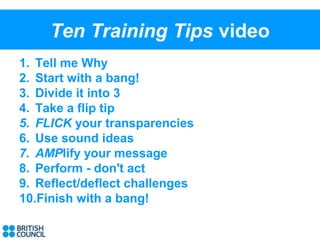
Ten Training Tips video
1. Tell me Why
2. Start with a bang!
3. Divide it into 3
4. Take a flip tip
5. FLICK your transparencies
6. Use sound ideas
7. AMPlify your message
8. Perform - don't act
9. Reflect/deflect challenges
10.Finish with a bang!
Good things
       about being a trainer
• Can you think of five reasons training
  is a great job?
Your Personal Action Plan
Thank You!

       And now…
Evaluations, certificates,
     and goodbye

Trainers training

  • 1.
    Welcome to Training ofTrainers with R P Singh
  • 2.
    Mingle Activity • Selectionof Training Subject
  • 3.
    Introductions • First Name • Company name • One strength in my training area • One weakness in my training area
  • 4.
    Your expectations • Whatdo you hope to achieve from these three days?
  • 5.
    Our norms forthese 3 days
  • 6.
    Course objectives By theend of this course, you will have: • learned the value of training and how it helps individuals and organisations • found out about learning styles of individuals and various learning theories • known how to design a training course • learned the main do's and don'ts of delivering a successful course • practiced preparing and delivering short presentations on course • received feedback and advice from the trainer and peers • prepared an action plan for your continued improvement as a trainer
  • 7.
    Introduction By the endof this session, you will: • have thought about what makes a good training course • have considered just what training and learning are • have got to know other participants on the course • have thought about ways to open a training course
  • 8.
    What makes agood training course? • Case Study 1
  • 9.
    What makes agood training course? • Case Study 2
  • 10.
    The 'perfect' trainingcourse • Trainer • Participants • Environment • Programme • Resources
  • 11.
    So just whatis training? 1. What is learning? 2. What is teaching? 3. What is training? 4. What is facilitating?
  • 12.
    Mini Quiz Can youmatch the descriptions with the definitions? A Someone explaining how to assemble a rifle. B Someone preparing a class of O Level children for their GCSEs. C Someone preparing a group of athletes to run a marathon. D Someone encouraging workers to find ways to increase their employability. E Someone giving prepared lessons to a group of univ students. F Someone helping a student to prepare for a test. Lecturer ----- Trainer ----- Instructor ----- Tutor ----- Teacher ----- Facilitator -----
  • 13.
    A trainer's varioushats Can you think of one or two situations when you may perform some other ‘roles’: • Motivator and inspirer • Mediator or referee • Mentor or coach • Quality controller • Chairperson • Presenter • Counsellor
  • 14.
    The Learner By theend of this session, you will: • have considered what makes a good learner • have considered what contributes to a good and a poor learning experience • have identified different learning styles and sensory learning preferences, and thought about how these can inform our training • have looked at various learning theories • have seen the importance of establishing need in the mind of the learner • have developed an understanding on how to identify training needs of your teams • have looked at some caricatures of typical participants • have discussed the pros and cons of learning in groups
  • 15.
    The Active Learner,the Reluctant Learner and the Passive Learner Your attitude to learning: • People have different attitudes to learning. Complete the questionnaire to determine your own attitude to learning.
  • 16.
    Learning experiences • Agood learning experience
  • 17.
    Learning experiences • Apoor learning experience
  • 18.
    What contributes toa poor learning experience? • Can you list some factors?
  • 19.
    How people learn? •Can you list the different ways people learn – for example, by listening. Consider all likely ways… • The emphasis here is on ‘quantity’…
  • 20.
    What makes agood learner? • Can you rank the strips into ‘top ten’ good learning habits?
  • 21.
    Establishing need inthe mind of the learner • Shaheen: I studied English for six years in school. By the time I left school I still couldn’t speak it. A few years later, when I followed my husband who had been sent to work in Karachi, I started to study English again. Within a few months I was becoming quite fluent. • Sami: Since I started this job I don’t have time to go to the movies. I spend all my evenings at home brushing up on my IT skills. • Ather: I fell in the canal when I was walking home from school one day. I learned to swim in ten seconds. These learners illustrate the point that motivation is a crucial factor in successful learning.
  • 22.
    How to doyou identify the training needs of your teams? Four possible ways: 1. Look at your team’s current and the required performance in future. This will give you a gap in their current skills. 2. Identify the changes that are occurring in your market or industry or in your organisation.
  • 23.
    How to doyou identify the training needs of your teams? 3. Another way could be involving your people. Ask them what areas they might like to have training in? This will give you a skill audit. 4. Finally, another possibility: informed guesswork. You can bet that particular organisations and teams at certain times need certain skills. Now, prioritise these
  • 24.
    Let’s learn something about learning 1. Classical learning theory (Pavlov- Skinner et al) 2. Kolb’s learning cycle 3. Bloom’s hierarchy of learning 4. Context-specific learning 5. Stages of learning 6. Multiple Intelligences (Gardner) 7. Sensory learning preferences
  • 25.
    Task: 2-minute presentation 1.What does your chosen theory say about learning? 2. How can we use learning from this theory in our next training back at our workplace? (through a visually appealing chart?)
  • 26.
    The ‘hard cases’ Type 1. Why they do what they do? 2. What to do with them? The Silent one. A participant doesn’t appear to want to contribute. The Griper. A participant often complains about the tasks, facilities and other things. The Know-all. A participant wants to display his/her knowledge, dominating the session. The Clash. Two or more participants clash over personalities, abilities, facts, etc. The Latecomer. A participant consistently arrives late, returns late after breaks. Difficult-to-understand. A participant is hard to understand, maybe a non-English speaker, a non-technical person on a technical course.
  • 27.
    Handling groups 1. Duringa two-day workshop, would you ask the participants to regroup several times? 2. If you regroup participants, do you do it randomly or carefully choose the personnel of each group? 3. There is pressure to conform in groups (groupthink). How can you counteract this pressure? 4. How can you deal with conflict within groups?
  • 28.
    Training Delivery By theend of this session, you will: • have discussed the importance of objectives and purpose • have shared different learning activities and techniques • have practised giving demonstrations • have considered ways of reviewing what is being learned • have discussed ways of getting information across • have practised some techniques and activities • have drawn up a list of dos and don’ts for trainers
  • 29.
    ‘Why are wedoing this?’ Learners will usually find an activity more rewarding if they know why they are doing it. There are several reasons why this is so: • they will be more motivated • they will be able to relate the activity more closely to their lives • they will be more focused
  • 30.
    Activities in thetraining room 1. What is the objective? (After this task, participants will be able to…) 2. What might be the ultimate purpose (Why are they doing this?) 3. How should the task be managed? In groups or individually? 4. Should it be learner focused (ideas coming primarily from the learners themselves), or trainer focused? 5. How could feedback be given? How will the participants know whether they have done well or not? 6. How long would the task take? 7. How could the task be ‘spiced up’, made more interesting or fun for the participants? 8. How could the task be made more workplace-related, so that the participants see it as relevant to them?
  • 31.
    Designing a shortsession Design a short session on one of these topics by considering 8 questions: 1. Courtesy towards customers 2. Trust among team members 3. Efficiency in processes 4. Leadership readiness
  • 32.
    Training methods…1 Method Pros Cons Lectures/ • allows the trainer to convey presentations information quickly to a large group • persuasive Written exercises • allows for individualised learning • adjustable to different levels Group discussions • involves everyone • can explore new ideas • flexible Case studies • realistic and work-related • great for problem-solving Role plays • provides environment for practice • allows for testing ideas
  • 33.
    Training methods…2 Method Pros Cons Games and •high level of involvement and simulations interest •memorable and fun Questionnaires •self-awareness •allows time for reflection Project work with •useful for knowledge and skills presentation practice •effective for recall of knowledge Videotaped •useful for self assessment simulations with •provides medium for peer feedback playback Brainstorming •energisers and fun •great for stimulating ideas
  • 34.
  • 35.
    Demonstrations A demonstration isuseful when showing a group or a person how to use new technology. A good demonstration should serve these purposes: • to show visually (and simply) how things work • to show cause and effect • to explain a sequence of events needed to use the equipment • to allay doubts or worries about using the equipment • to encourage the learner to use the equipment • to discover the learner’s needs • to show the capabilities of the equipment
  • 36.
    Giving instructions Use: • clearvoice • simple steps • check understanding • call to action
  • 37.
    Energisers and refreshers •Most training courses include short lively activities that refresh the participants. • Often, the ‘refreshers’ will involve physical movement or animated communication, which help to keep everyone awake.
  • 38.
    Anecdotes, or stories •When we communicate on a ‘human’ level we like to talk about things that happened to us, or stories we have heard. An abstract concept can be made more memorable by a real-life example, a brief anecdote, which touches the listener on a very personal level.
  • 39.
    ‘Does it makesense?’ A person’s sensory learning preference determines how he/she will best receive information. • Visual: These learners like to take in information through the eyes. They like to see things written down, read books, look at pictures and diagrams and take notes. • Auditory: These learners like to get information through their ears. They like to listen to the trainer, repeat things in their head, and take part in discussions. • Kinaesthetic: These learners like to get information through their hands, bodies or movement. They like to touch, move things around and write things down.
  • 40.
  • 41.
    Do’s and don’tsof delivery • Divide the strips into dos and don’ts.
  • 42.
    The Trainer By theend of this session, you will: • have looked at some different types of trainer • have learned some tips for giving positive and negative feedback to learners • have discussed how to pick up on signs from the class • have looked at the principles of presenting • have considered how to evaluate your own courses
  • 43.
    What type oftrainer are you? • The ‘guru’ An expert. Has a deep knowledge of her subject and loves to share it. • ‘Showman’ A would-be actor. Loves to be ‘on stage’, to perform before the audience. Often jokes and tells stories. A great entertainer. • ‘One of the boys’ (‘one of the girls’) Communicates on a very friendly level with the participants. Perhaps mixes socially with them. • The quiet one Tends to keep a low profile, preferring the participants to do all the work. Likes to stand back and let them get on with it. • Disciplinarian Strict. Likes to push the participants hard and exert strong control over the group.
  • 44.
    Good & badpoints of trainer Type of trainer Good points Bad points The guru The showman One of the boys The quiet one The disciplinarian
  • 45.
    Trainer Feedback • Learnersget feedback both from the trainer and from their peers. This feedback can take many forms.
  • 46.
    Feedback skills Balanced Feedback •Try to make positive comments. If you have to make negative ones, then think of positive ones to ease the pain. Feedback on things it is possible to change • Don’t expect people to be superhuman. People have certain personal characteristics that are hard to change. Ask questions • Rather than tell, ask people how they might improve. Non-verbal feedback • Remember that feedback doesn’t have to be verbal. A smile, an appreciative nod or applause can act as positive feedback. Other gestures or facial expressions can give important feedback.
  • 47.
    Giving negative feedback •Any phrases that do this effectively, without much pain?
  • 48.
    Presentation skills Clarity Credibility Voice Visuals
  • 49.
    Picking up onsigns from learner • How can we deal with this? • A Signs of inattentiveness • B Signs of confusion or non- comprehension
  • 50.
    Evaluating your training 1. Self: via self-analysis, evaluation forms and feedback from colleagues in the training team. Could you have done better? Are there areas for improvement? 2. The course materials: do they need replacing, revising, updating? 3. The whole course: self, learners, observers 4. Individual parts of the course: self, learners, observers 5. The situation after the course: via a follow-up inquiry seeking to measure improved performance or behaviour in the work situation. How effective has the transfer of learning been to the real world? The stage ceases only when the course is no longer relevant.
  • 51.
    Environment and Resources Bythe end of this session, you will: • have designed your ideal training room • have discussed training room dynamics • have considered creating a safe learning environment • have discussed the pros and cons of various training room resources and tips for using them
  • 52.
    My dream trainingroom • Room – size, shape, lighting, etc • Windows • Tables, chairs • Music • Walls • Refreshments • Anything else? Heating or cooling?
  • 53.
    How do youcreate a safe learning environment? • Can you suggest some specific steps?
  • 54.
  • 55.
  • 56.
  • 57.
  • 58.
    Training Resources Videotaping withplayback Pros Tips Cons
  • 59.
  • 60.
    Ten Training Tipsvideo 1. Tell me Why 2. Start with a bang! 3. Divide it into 3 4. Take a flip tip 5. FLICK your transparencies 6. Use sound ideas 7. AMPlify your message 8. Perform - don't act 9. Reflect/deflect challenges 10.Finish with a bang!
  • 61.
    Good things about being a trainer • Can you think of five reasons training is a great job?
  • 62.
  • 63.
    Thank You! And now… Evaluations, certificates, and goodbye