Training A-Z

Train the Trainer
Agenda
• Purpose of Training
• Qualities of a good trainer
• Needs Assessment and Objectives
• Designing & Developing Training
• Delivery
Knot Tying as a Teaching Problem

  •   Point of view
  •   Complicated task at first
  •   Skills require demonstration
  •   If need to learn to do it quickly and
      independently, require practice
      – a diagram or illustration
      – need to know why
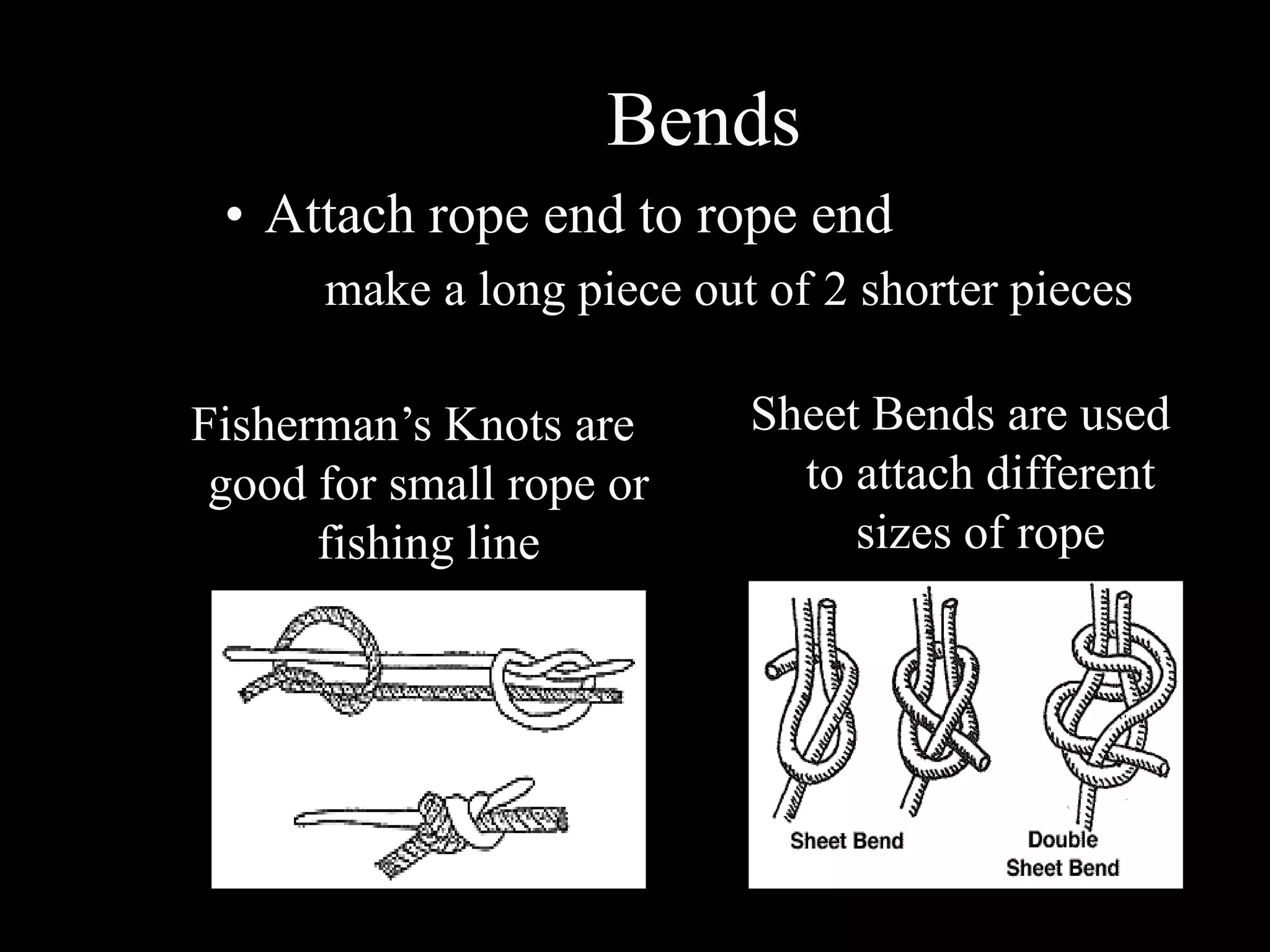
Bends
 • Attach rope end to rope end
    – make a long piece out of 2 shorter pieces

Fisherman’s Knots are      Sheet Bends are used
 good for small rope or      to attach different
      fishing line              sizes of rope
Why Offer Training

• Your training goals should support the
  goals of your organization
  – overall purpose(s)
  – long range visions
  – broad
Purpose of Training is to Produce
          Change In…
    • Skills
       – how to
       – steps
    • Knowledge
       – critical thinking
       – decision making
    • Attitudes
       – ethics/values
       – behavior
Skills Required to be a Trainer
   • Subject matter expertise
   • Design
     – instructional design
     – apply learning principles
   • Material production
     – graphics, layout, media creation
     – computer experience
   • Presentation
     – voice, personality, technical expertise
Personal Qualities to Look For in a
            Trainer

 • Self-confidence         • Ability to listen
 • Awareness of            • Sense of humor
   environment             • Communication &
 • Ability to build          theatrical skills
   bridges—relate old to   • Flexibility
   new                     • Patience
 • Organizational skills   • Cool head & warm
 • Desire to learn           heart
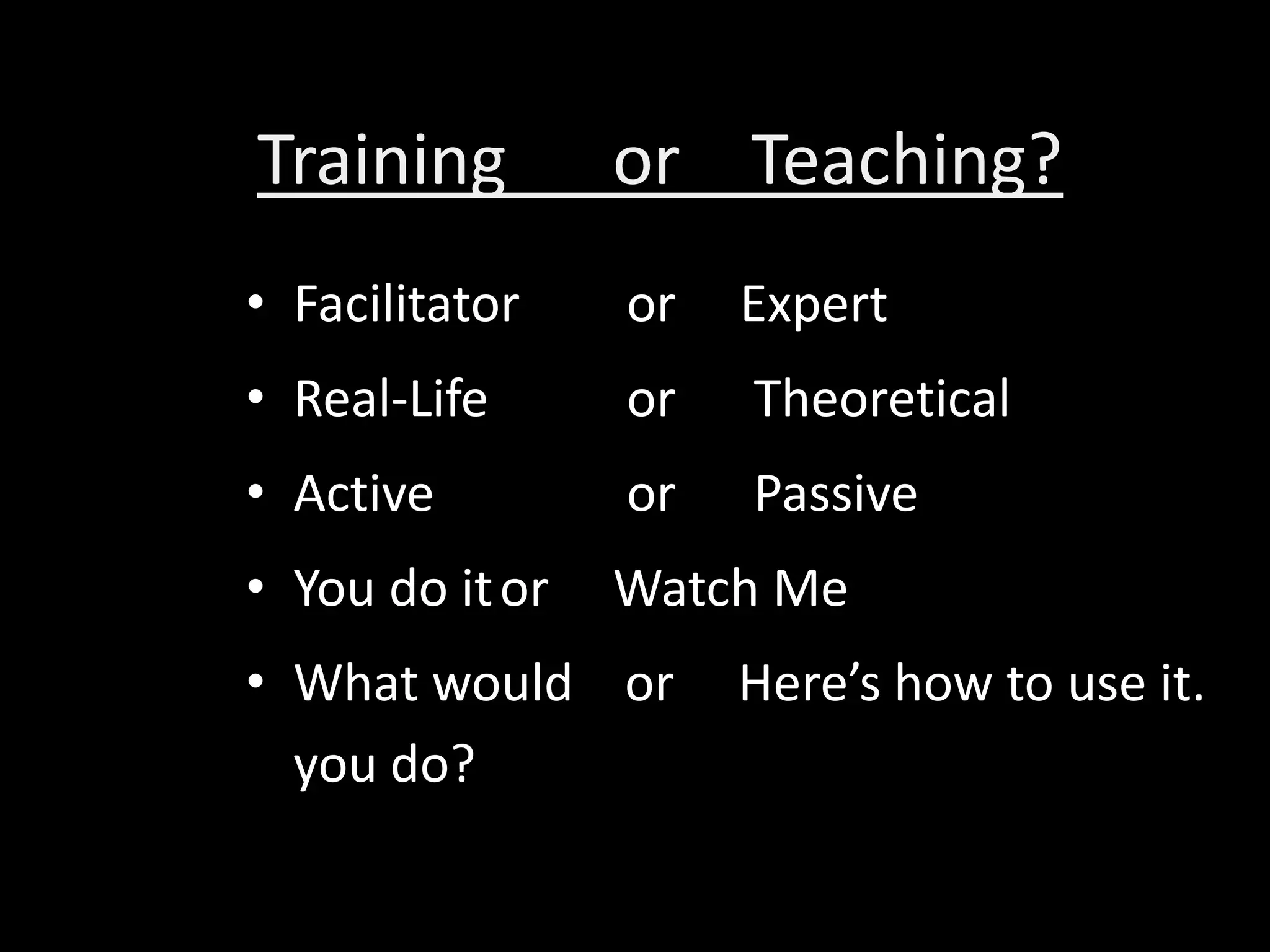
Training         or Teaching?
• Facilitator    or   Expert
• Real-Life      or   Theoretical
• Active         or   Passive
• You do it or   Watch Me
• What would or       Here’s how to use it.
  you do?
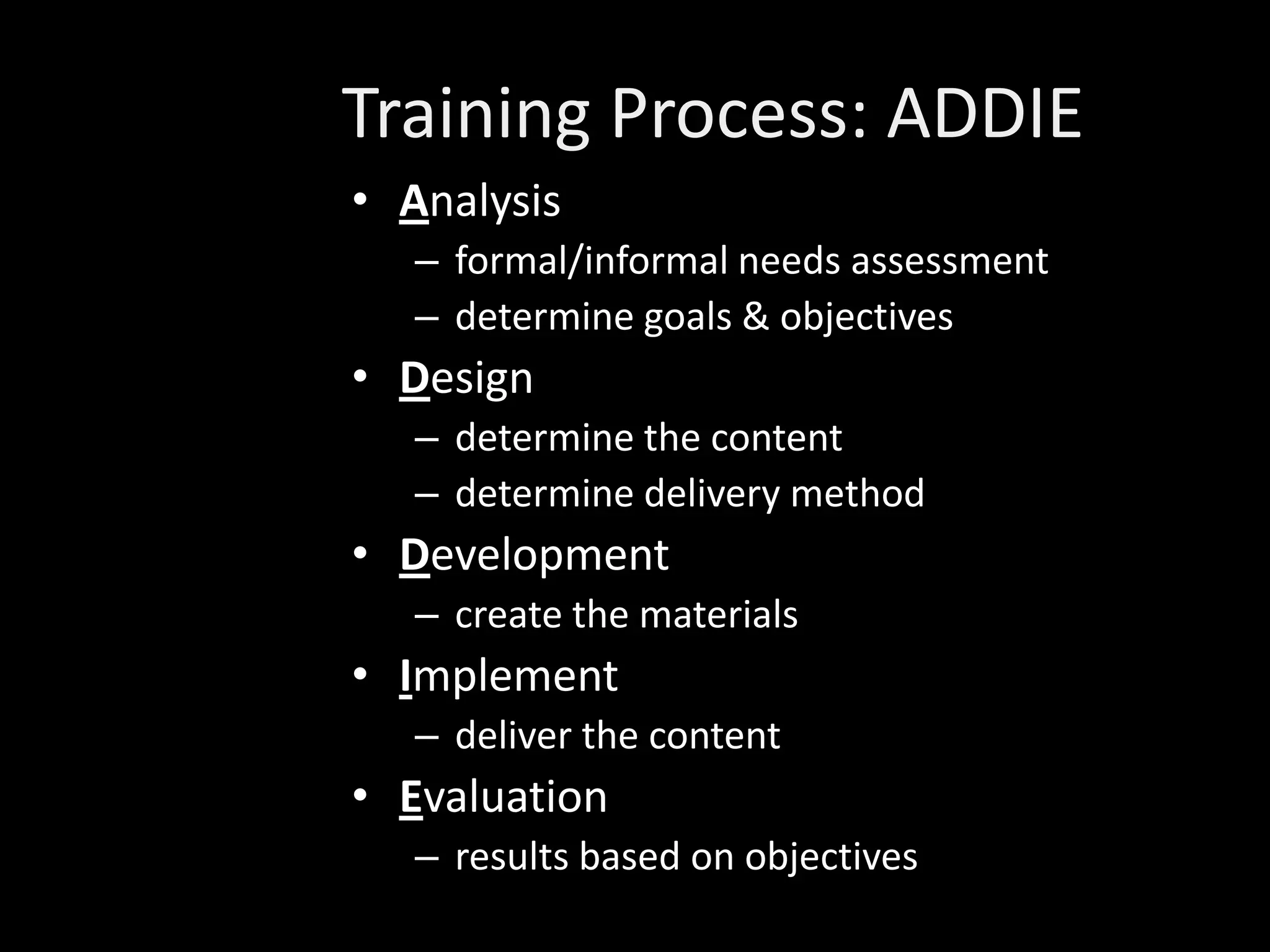
Training Process: ADDIE
• Analysis
   – formal/informal needs assessment
   – determine goals & objectives
• Design
   – determine the content
   – determine delivery method
• Development
   – create the materials
• Implement
   – deliver the content
• Evaluation
   – results based on objectives
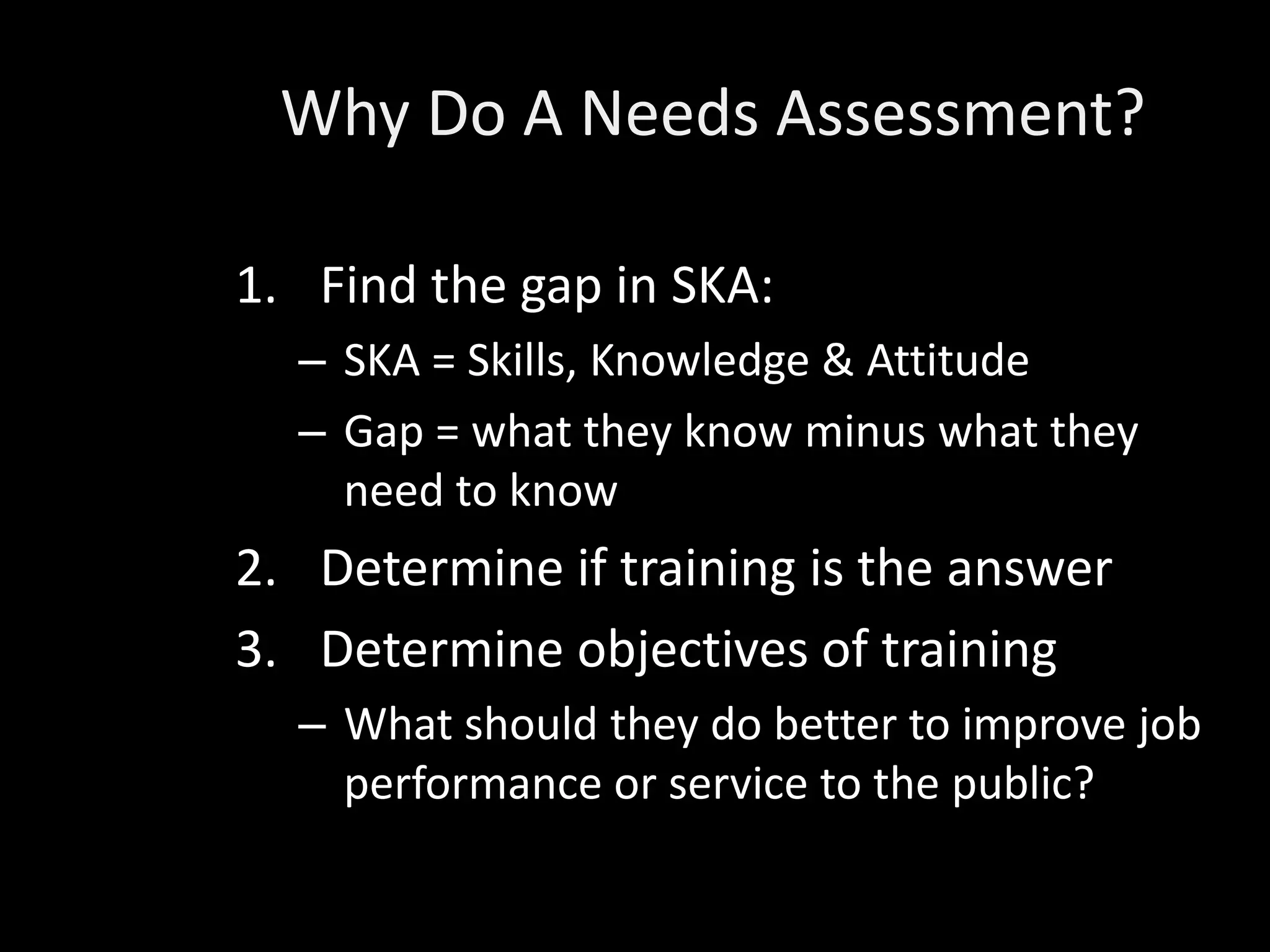
Why Do A Needs Assessment?

1. Find the gap in SKA:
  – SKA = Skills, Knowledge & Attitude
  – Gap = what they know minus what they
    need to know
2. Determine if training is the answer
3. Determine objectives of training
  – What should they do better to improve job
    performance or service to the public?
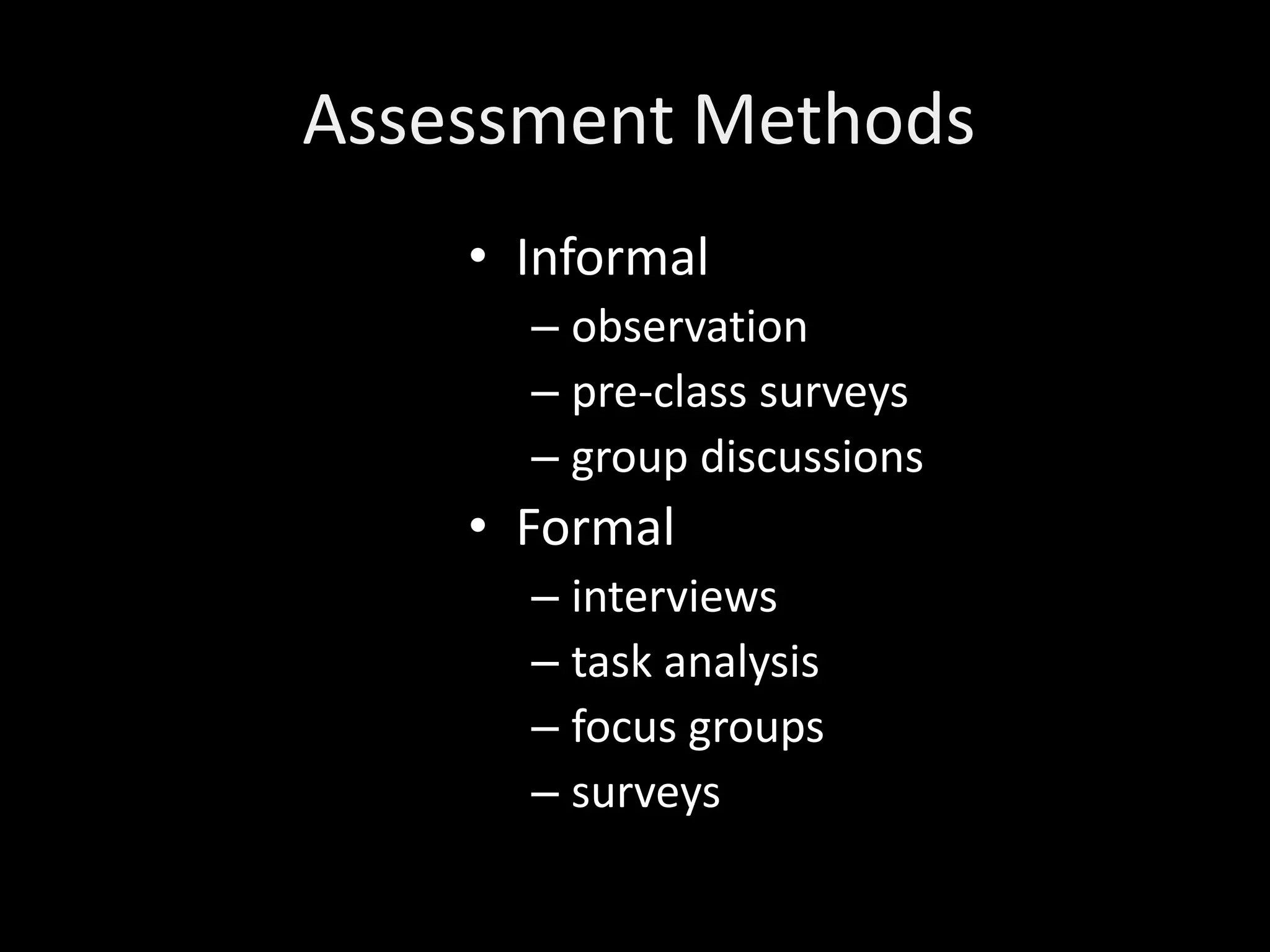
Assessment Methods
    • Informal
      – observation
      – pre-class surveys
      – group discussions
    • Formal
      – interviews
      – task analysis
      – focus groups
      – surveys
Needs Assessment Tips
 Interview key people:
   – admin and staff
   – use consistent questions
   – be careful not to bias input
 Choose a subgroup if unable to survey all
   – choose the middle of the pack,
     not the best, not the worst
 Do mini needs assessment before each
   training
Objectives (SMART)
• Specific
   – state desired results in detail
• Measurable ( or observable)
   – use verbs that describe what trainees will learn
• Action
   – describe an action that the trainee will perform
• Realistic
   – achievable
• Time frame
   – how long will it take the trainees to learn the skill?
Evaluations

• Evaluate based on objectives

• Did the participants:
  – learn what you had planned?
  – implement what they learned?
  – improve their job performance or service to
    the public?
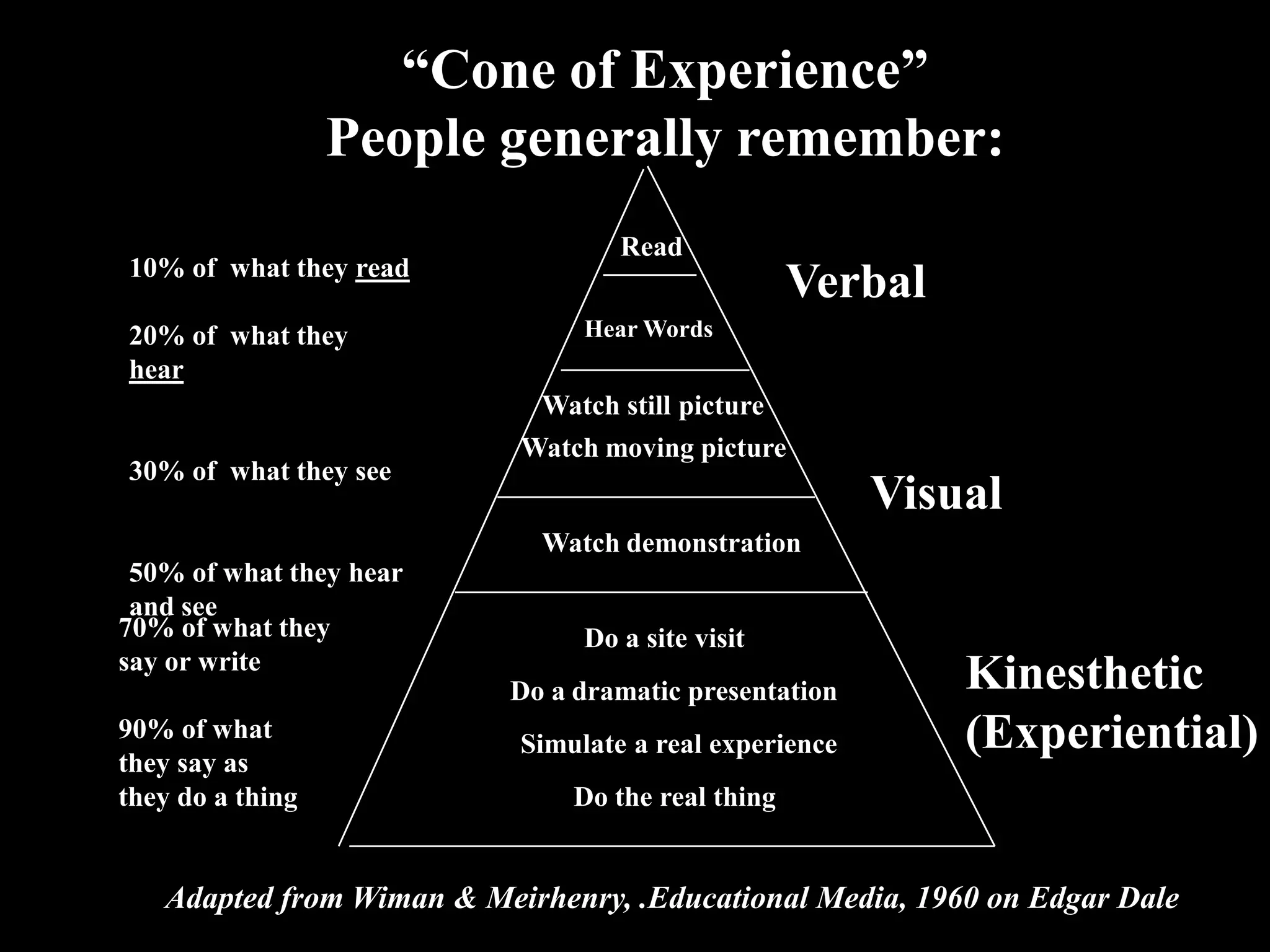
“Cone of Experience”
                  People generally remember:
                                   Read
10% of what they read
                                                   Verbal
20% of what they                Hear Words
hear
                             Watch still picture
                           Watch moving picture
30% of what they see
                                                        Visual
                             Watch demonstration
 50% of what they hear
 and see
70% of what they                Do a site visit
say or write
                          Do a dramatic presentation        Kinesthetic
90% of what
they say as
                           Simulate a real experience       (Experiential)
they do a thing                Do the real thing


   Adapted from Wiman & Meirhenry, .Educational Media, 1960 on Edgar Dale
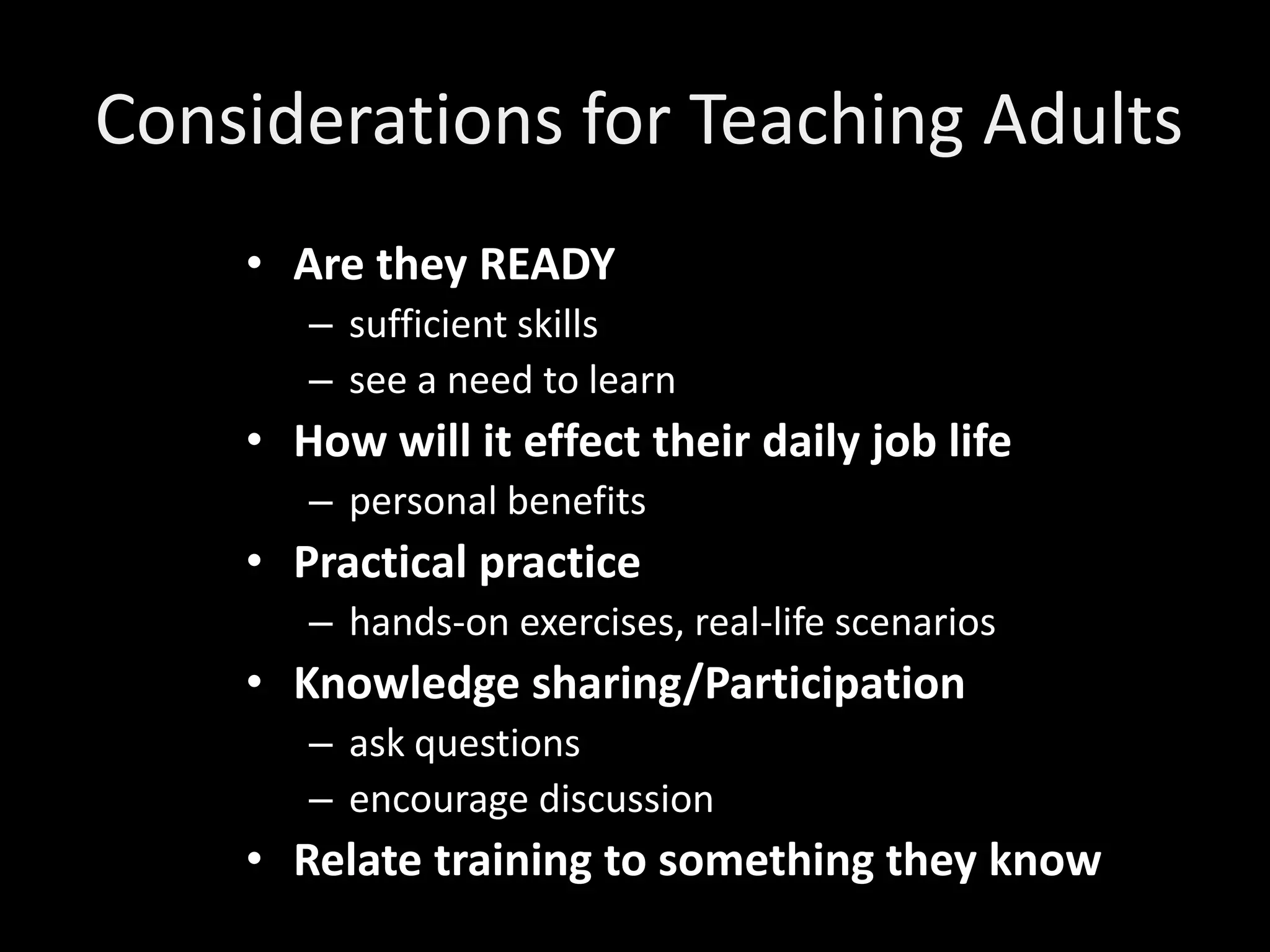
Considerations for Teaching Adults
    • Are they READY
       – sufficient skills
       – see a need to learn
    • How will it effect their daily job life
       – personal benefits
    • Practical practice
       – hands-on exercises, real-life scenarios
    • Knowledge sharing/Participation
       – ask questions
       – encourage discussion
    • Relate training to something they know
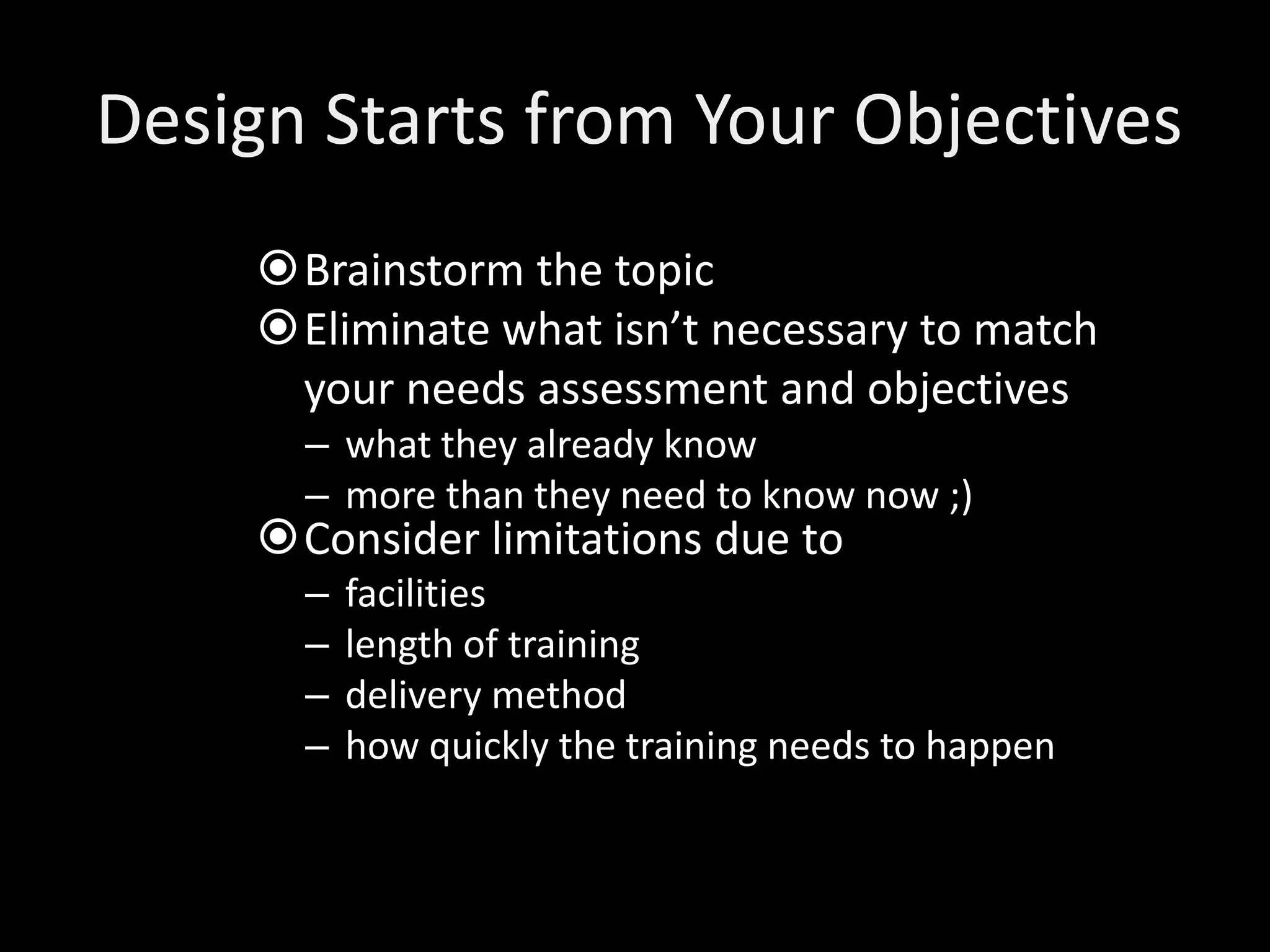
Design Starts from Your Objectives
     Brainstorm the topic
     Eliminate what isn’t necessary to match
      your needs assessment and objectives
       – what they already know
       – more than they need to know now ;)
     Consider limitations due to
       –   facilities
       –   length of training
       –   delivery method
       –   how quickly the training needs to happen
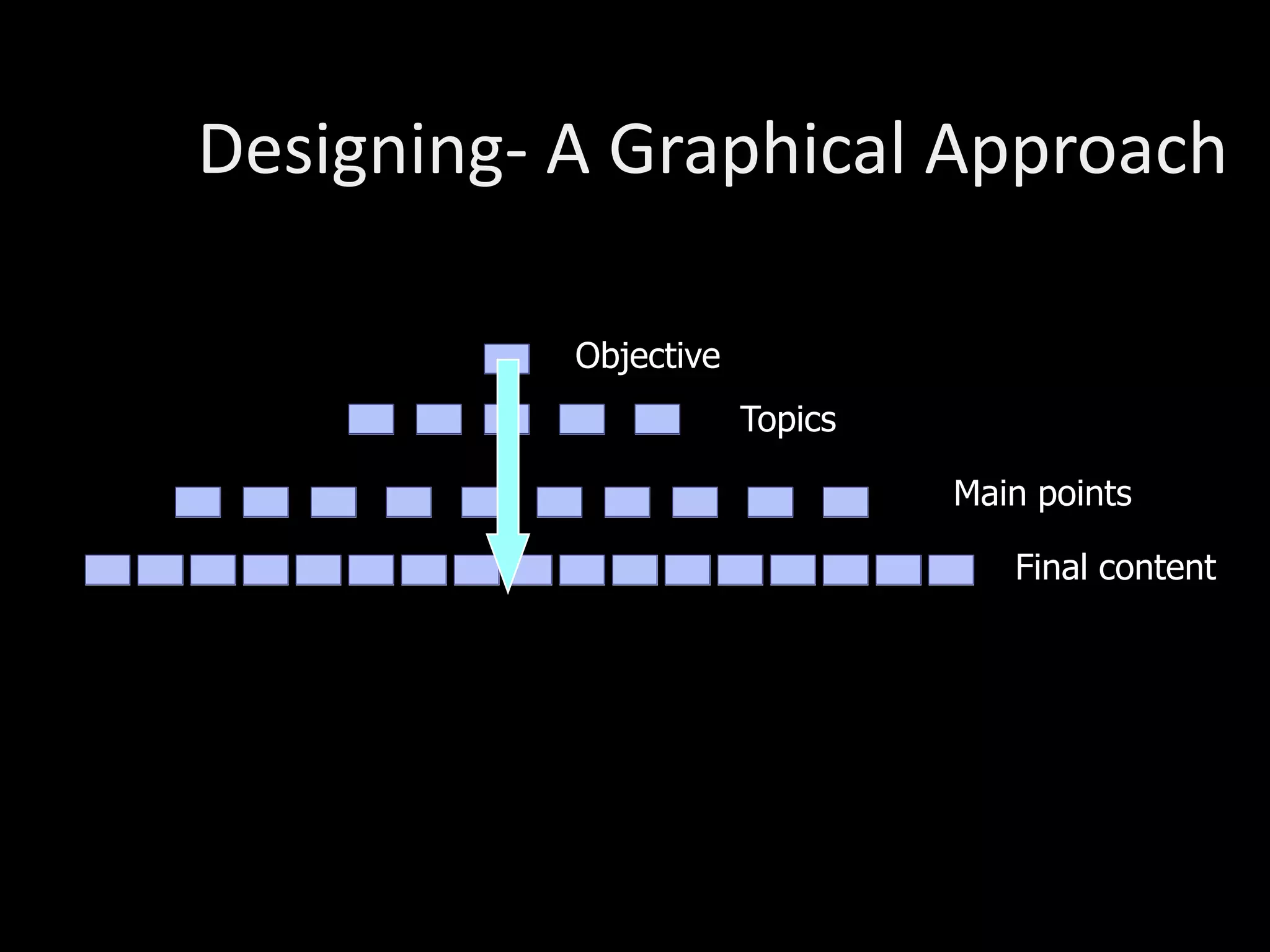
Designing- A Graphical Approach

           Objective
                       Topics

                                Main points

                                   Final content
Options for Sequencing Materials

       •   Storyboard
       •   Outline
       •   Powerpoint
       •   Index cards
       •   Sticky notes
Organizing the Presentation
  Set the stage
   – introductions (you & them)
   – agenda, breaks, bathrooms
   – get “buy-in” by telling them what and why
  Content
   – logically organize the main points (in chunks)
   – add sub-points to each chunk
   – include Visual Aids, Exercises, Handouts
  End
   – summary
   – questions
   – other learning opportunities
Chunking

• Long laundry list
• Put in order
• Chunk in to 3 to 5 main parts
  – Main point
     • subpoint
     • subpoint
How Much Detail is Needed?

  • It depends!
  • Does the audience need to:
    – have an idea of how to do it?
    – be able to do it?
    – be able to think about it independently?
    – come up with creative solutions?
Methods of Delivering Training
      • Instructor-led
        – One-on-one
        – Group
        – Lecture
        – Hands-on
      • Self-paced
        – Distance-Ed
        – Web tutorial
        – CD-ROM
It’s Ok to Have Fun!

    • Humor
    • Games
      – training tool
    • Icebreakers
      – introductions
      – questions
    • Music
Rehearsing & Revising
• Two purposes of rehearsing
  – logical order & transitions
  – timing

• Revise
  – learn from the rehearsal
  – make modifications in:
     •   chunks & logical order
     •   transition statements
     •   timing
     •   opportunities for interaction
Delivery Tips
• Make no assumptions
   – jargon
   – ask don’t tell
• Ask questions you really want an answer to
   – count to 7
• Vocal variety
• Non-verbals affect communication
   – tone
   – appearance appropriate for audience
Managing Fear
• Be prepared
   – know your presentation
   – rehearse
• Calm yourself
   – isometrics
   – deep breathing
• Turn your nervousness into energy

You don’t have to know everything.
Adults like to share what they know
It's not
what is poured into a
   student, but
  what is planted

     Linda Conway
“It’s always helpful to learn from
your mistakes because then your
    mistakes are worthwhile”
            Garry Marshall
Check out more great forwards at
vparakhiya@rediffmail.com
Train The Trainer A2z

Train The Trainer A2z

  • 1.
  • 2.
    Agenda • Purpose ofTraining • Qualities of a good trainer • Needs Assessment and Objectives • Designing & Developing Training • Delivery
  • 3.
    Knot Tying asa Teaching Problem • Point of view • Complicated task at first • Skills require demonstration • If need to learn to do it quickly and independently, require practice – a diagram or illustration – need to know why
  • 4.
    Bends • Attachrope end to rope end – make a long piece out of 2 shorter pieces Fisherman’s Knots are Sheet Bends are used good for small rope or to attach different fishing line sizes of rope
  • 5.
    Why Offer Training •Your training goals should support the goals of your organization – overall purpose(s) – long range visions – broad
  • 6.
    Purpose of Trainingis to Produce Change In… • Skills – how to – steps • Knowledge – critical thinking – decision making • Attitudes – ethics/values – behavior
  • 7.
    Skills Required tobe a Trainer • Subject matter expertise • Design – instructional design – apply learning principles • Material production – graphics, layout, media creation – computer experience • Presentation – voice, personality, technical expertise
  • 8.
    Personal Qualities toLook For in a Trainer • Self-confidence • Ability to listen • Awareness of • Sense of humor environment • Communication & • Ability to build theatrical skills bridges—relate old to • Flexibility new • Patience • Organizational skills • Cool head & warm • Desire to learn heart
  • 9.
    Training or Teaching? • Facilitator or Expert • Real-Life or Theoretical • Active or Passive • You do it or Watch Me • What would or Here’s how to use it. you do?
  • 10.
    Training Process: ADDIE •Analysis – formal/informal needs assessment – determine goals & objectives • Design – determine the content – determine delivery method • Development – create the materials • Implement – deliver the content • Evaluation – results based on objectives
  • 11.
    Why Do ANeeds Assessment? 1. Find the gap in SKA: – SKA = Skills, Knowledge & Attitude – Gap = what they know minus what they need to know 2. Determine if training is the answer 3. Determine objectives of training – What should they do better to improve job performance or service to the public?
  • 12.
    Assessment Methods • Informal – observation – pre-class surveys – group discussions • Formal – interviews – task analysis – focus groups – surveys
  • 13.
    Needs Assessment Tips Interview key people: – admin and staff – use consistent questions – be careful not to bias input  Choose a subgroup if unable to survey all – choose the middle of the pack, not the best, not the worst  Do mini needs assessment before each training
  • 14.
    Objectives (SMART) • Specific – state desired results in detail • Measurable ( or observable) – use verbs that describe what trainees will learn • Action – describe an action that the trainee will perform • Realistic – achievable • Time frame – how long will it take the trainees to learn the skill?
  • 15.
    Evaluations • Evaluate basedon objectives • Did the participants: – learn what you had planned? – implement what they learned? – improve their job performance or service to the public?
  • 16.
    “Cone of Experience” People generally remember: Read 10% of what they read Verbal 20% of what they Hear Words hear Watch still picture Watch moving picture 30% of what they see Visual Watch demonstration 50% of what they hear and see 70% of what they Do a site visit say or write Do a dramatic presentation Kinesthetic 90% of what they say as Simulate a real experience (Experiential) they do a thing Do the real thing Adapted from Wiman & Meirhenry, .Educational Media, 1960 on Edgar Dale
  • 17.
    Considerations for TeachingAdults • Are they READY – sufficient skills – see a need to learn • How will it effect their daily job life – personal benefits • Practical practice – hands-on exercises, real-life scenarios • Knowledge sharing/Participation – ask questions – encourage discussion • Relate training to something they know
  • 18.
    Design Starts fromYour Objectives Brainstorm the topic Eliminate what isn’t necessary to match your needs assessment and objectives – what they already know – more than they need to know now ;) Consider limitations due to – facilities – length of training – delivery method – how quickly the training needs to happen
  • 19.
    Designing- A GraphicalApproach Objective Topics Main points Final content
  • 20.
    Options for SequencingMaterials • Storyboard • Outline • Powerpoint • Index cards • Sticky notes
  • 21.
    Organizing the Presentation  Set the stage – introductions (you & them) – agenda, breaks, bathrooms – get “buy-in” by telling them what and why  Content – logically organize the main points (in chunks) – add sub-points to each chunk – include Visual Aids, Exercises, Handouts  End – summary – questions – other learning opportunities
  • 22.
    Chunking • Long laundrylist • Put in order • Chunk in to 3 to 5 main parts – Main point • subpoint • subpoint
  • 23.
    How Much Detailis Needed? • It depends! • Does the audience need to: – have an idea of how to do it? – be able to do it? – be able to think about it independently? – come up with creative solutions?
  • 24.
    Methods of DeliveringTraining • Instructor-led – One-on-one – Group – Lecture – Hands-on • Self-paced – Distance-Ed – Web tutorial – CD-ROM
  • 25.
    It’s Ok toHave Fun! • Humor • Games – training tool • Icebreakers – introductions – questions • Music
  • 26.
    Rehearsing & Revising •Two purposes of rehearsing – logical order & transitions – timing • Revise – learn from the rehearsal – make modifications in: • chunks & logical order • transition statements • timing • opportunities for interaction
  • 27.
    Delivery Tips • Makeno assumptions – jargon – ask don’t tell • Ask questions you really want an answer to – count to 7 • Vocal variety • Non-verbals affect communication – tone – appearance appropriate for audience
  • 28.
    Managing Fear • Beprepared – know your presentation – rehearse • Calm yourself – isometrics – deep breathing • Turn your nervousness into energy You don’t have to know everything. Adults like to share what they know
  • 29.
    It's not what ispoured into a student, but what is planted Linda Conway
  • 30.
    “It’s always helpfulto learn from your mistakes because then your mistakes are worthwhile” Garry Marshall
  • 32.
    Check out moregreat forwards at vparakhiya@rediffmail.com