2010 National Postal Forum . Course #:  COMM03 Title:  “ Train the Trainer” Scheduled For:  Monday, Period 6, 4:30-5:30 pm Presented By:  William L. Ware, CMDSM     Oce Business Services   and   James P. Mullan, CMDSM   Oce Business Services
Effective Training Preparing new employees to perform their jobs. Developing employees to be more efficient and productive. Preparing employees for advancement to more responsible positions.
Developing a Training Program Identify  training needs Establish  objectives Analyze  the target audience Develop  lesson plans Conduct  the training sessions Evaluate  the training program
1.  Identify  Training Needs Employees ask questions. Employees express a desire to learn something. Employees’ weaknesses or deficiencies. Management aware of specific needs. Position or functional requirements. Recommendations of regulatory agencies. Effectiveness of previous training.
2.  Establish  Obje ctives Objectives will - Specify what they will learn and do. Serve as a guide for determining content. Select and sequence topics or units of study. Identify instructional techniques and materials. Provide methods for evaluation and achievement.
3.  Analyze  the Target Audience Who will be in attendance? What does the audience know? What does the audience want to know? What does the audience need to know?
Analyze  the Target Aud ience People learn at different speeds. Anxiety and nervousness are natural. Peaks and valleys in the rate of learning are common. Trainees may become discouraged.
4.  Develop  Lesson Pla ns Introduction Subject Matter Presentation Training Techniques
4 A . Introduction Statement of the objectives Explanation of the value Definitions of the terms Descriptions of equipment Duration – length of session
4 B . Subject Matter Present 3 – 5 major points Points in logical order Present one point at a time Use text sparingly
4 C . Presentation Blackboard, Chalkboard, Chart Pads Overhead Transparency Projector Slide/Filmstrip Projectors Motion Picture Projector Model or Mock-up Tape Recorder Video Tape Recorder Video, PC Projector “ PowerPoint”, Computer Online - Internet
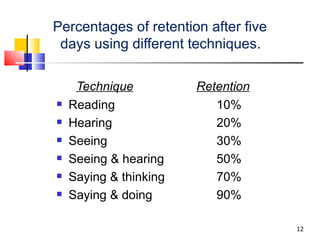
Percentages of retention after five   days using different techniques. Technique   Retention Reading 10% Hearing 20% Seeing 30% Seeing & hearing 50% Saying & thinking 70% Saying & doing 90%
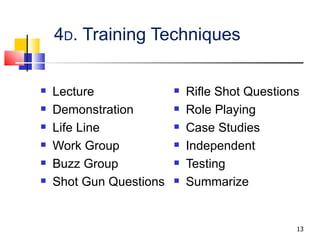
4 D . Training Techniques Lecture Demonstration Life Line Work Group Buzz Group Shot Gun Questions Rifle Shot Questions Role Playing Case Studies Independent Testing Summarize
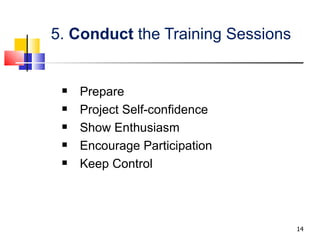
5.  Conduct  the Training Sessions Prepare Project Self-confidence Show Enthusiasm Encourage Participation Keep Control
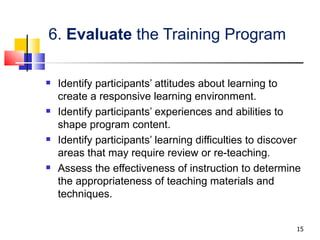
6.  Evaluate  the Training Program Identify participants’ attitudes about learning to create a responsive learning environment. Identify participants’ experiences and abilities to shape program content. Identify participants’ learning difficulties to discover areas that may require review or re-teaching. Assess the effectiveness of instruction to determine the appropriateness of teaching materials and techniques.
Training Program How To: Conduct  a needs assessment Identify  the training style Design  the instructional plan Utilize  active training techniques Deliver  the training Evaluate  the training
The Five “ P s ” of Successful Training Plan  Your Session Prepare  Your Trainee Present  the Session Prove  Understanding Practice  Time
List of Hints for Instructors The Introduction The Delivery The Summary Classroom Management Demonstrations Application - Practical Exercises Evaluations
“ Train the Trainer” Thank  You
Contact  Information William L. Ware , CMDSM Senior Site Manager Oce Business Services, Inc. Time, Inc. 1271 Ave. of the Americas, SB-66 New York, NY 10020 212-522-9258  office E-mail – mailroom@timeinc.com   James P. Mullan , CMDSM National Account Manager Oce Business Services, Inc. Chubb & Son 15 Mountain View Road Warren, NJ 07059 908-903-2869  office E-mail – jmullan@chubb.com

National Postal Forum 2010 Train The Trainer

  • 1.
    2010 National PostalForum . Course #: COMM03 Title: “ Train the Trainer” Scheduled For: Monday, Period 6, 4:30-5:30 pm Presented By: William L. Ware, CMDSM Oce Business Services and James P. Mullan, CMDSM Oce Business Services
  • 2.
    Effective Training Preparingnew employees to perform their jobs. Developing employees to be more efficient and productive. Preparing employees for advancement to more responsible positions.
  • 3.
    Developing a TrainingProgram Identify training needs Establish objectives Analyze the target audience Develop lesson plans Conduct the training sessions Evaluate the training program
  • 4.
    1. Identify Training Needs Employees ask questions. Employees express a desire to learn something. Employees’ weaknesses or deficiencies. Management aware of specific needs. Position or functional requirements. Recommendations of regulatory agencies. Effectiveness of previous training.
  • 5.
    2. Establish Obje ctives Objectives will - Specify what they will learn and do. Serve as a guide for determining content. Select and sequence topics or units of study. Identify instructional techniques and materials. Provide methods for evaluation and achievement.
  • 6.
    3. Analyze the Target Audience Who will be in attendance? What does the audience know? What does the audience want to know? What does the audience need to know?
  • 7.
    Analyze theTarget Aud ience People learn at different speeds. Anxiety and nervousness are natural. Peaks and valleys in the rate of learning are common. Trainees may become discouraged.
  • 8.
    4. Develop Lesson Pla ns Introduction Subject Matter Presentation Training Techniques
  • 9.
    4 A .Introduction Statement of the objectives Explanation of the value Definitions of the terms Descriptions of equipment Duration – length of session
  • 10.
    4 B .Subject Matter Present 3 – 5 major points Points in logical order Present one point at a time Use text sparingly
  • 11.
    4 C .Presentation Blackboard, Chalkboard, Chart Pads Overhead Transparency Projector Slide/Filmstrip Projectors Motion Picture Projector Model or Mock-up Tape Recorder Video Tape Recorder Video, PC Projector “ PowerPoint”, Computer Online - Internet
  • 12.
    Percentages of retentionafter five days using different techniques. Technique Retention Reading 10% Hearing 20% Seeing 30% Seeing & hearing 50% Saying & thinking 70% Saying & doing 90%
  • 13.
    4 D .Training Techniques Lecture Demonstration Life Line Work Group Buzz Group Shot Gun Questions Rifle Shot Questions Role Playing Case Studies Independent Testing Summarize
  • 14.
    5. Conduct the Training Sessions Prepare Project Self-confidence Show Enthusiasm Encourage Participation Keep Control
  • 15.
    6. Evaluate the Training Program Identify participants’ attitudes about learning to create a responsive learning environment. Identify participants’ experiences and abilities to shape program content. Identify participants’ learning difficulties to discover areas that may require review or re-teaching. Assess the effectiveness of instruction to determine the appropriateness of teaching materials and techniques.
  • 16.
    Training Program HowTo: Conduct a needs assessment Identify the training style Design the instructional plan Utilize active training techniques Deliver the training Evaluate the training
  • 17.
    The Five “P s ” of Successful Training Plan Your Session Prepare Your Trainee Present the Session Prove Understanding Practice Time
  • 18.
    List of Hintsfor Instructors The Introduction The Delivery The Summary Classroom Management Demonstrations Application - Practical Exercises Evaluations
  • 19.
    “ Train theTrainer” Thank You
  • 20.
    Contact InformationWilliam L. Ware , CMDSM Senior Site Manager Oce Business Services, Inc. Time, Inc. 1271 Ave. of the Americas, SB-66 New York, NY 10020 212-522-9258 office E-mail – mailroom@timeinc.com James P. Mullan , CMDSM National Account Manager Oce Business Services, Inc. Chubb & Son 15 Mountain View Road Warren, NJ 07059 908-903-2869 office E-mail – jmullan@chubb.com

Editor's Notes

  • #2 Introductions Bios Talk about the Technical Handout Talk about the 3 questions The objective of this course is to make you a better presenter. Bill is a seasoned professional speaker and an expert in presentation skills and public speaking techniques. The objective also includes learning how to project that professional image and one who displays confidence.
  • #3 Ask attendees if they have done training, presenting
  • #4 Tell them what you are going to tell them … Tell them what you are telling them … Tell them what you’ve told them …
  • #5 Employees express a desire to learn something – very important
  • #6 Set groundwork … Serve as a guide i.e. forklift, excel, scuba diving, driving …
  • #7 Who are we presenting to … Interactive …
  • #8 Nervousness is good … Mention empty seats up front … We cant all be a Bob Ross …
  • #9 Write notes on index cards Eye contact Drink water if you are thirsty, not iced water Vary your voice Watch your language – everyday language, friendly Mannerism – scratch ear or nose, brush back hair, adjust clothes
  • #11 Take this presentation for example …
  • #12 Digital Screen Whiteboard
  • #13 I say you do … Hands on …
  • #14 Puppets Hand Puppets (Shadowing) Budget for a Recipe (Chef) 10 Secrets (Agents)
  • #15 Leave your EGO at the door. This is not about YOU! Have a Quick Start and a Big Finish! Try never to talk more then 10-15 minutes without doing something interactive. And saying, “Any questions?” does not count as interactive! If you’re NOT passionate, don’t expect any energy from your audience! Your passion will keep them awake (if not I will wake you up) Your passion will be infectious. Do NOT think of yourself as a teacher or trainer … since that puts the focus on what YOU do. Put a lot more emphasis on the learning and a lot less emphasis on the teaching!
  • #16 Adjust as you go Evaluation at the end - Excellent
  • #17 Motivate your audience Tell a story Use natural humor Unusual Statistics Know their level of knowledge Speak their language Variety in a presentation Get yourself excited Apply contents to life
  • #19 Another 2 page handout on one sheet SME = SUBJECT MATTER EXPERT - YOU! CERTIFICATION IS THE KEY, CMDSM, EMCM, MQC, CSSGB, CMDSS, CRM, ERM, CDIA, 13 TRACKS – CERTIFICATE OF TRAINING
  • #21 3 questions for certificate track