Preparing Training Sessions BY. D.B.Shelke Tilak Maharashtra University
Same stuff Different Day
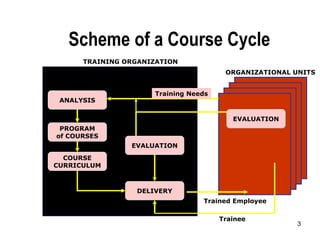
Scheme of a Course Cycle ORGANIZATIONAL UNITS Trainee TRAINING ORGANIZATION EVALUATION PROGRAM of COURSES COURSE CURRICULUM DELIVERY EVALUATION ANALYSIS Training Needs EVALUATION EVALUATION Trained Employee
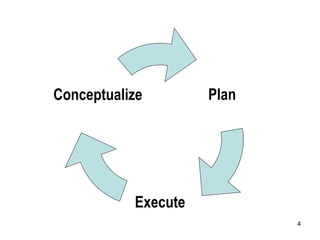
Plan Execute Conceptualize
Self-Check Identify a skill which you think you are really good at. (Skill A) Identify a skill which you think you are not very good at. (Skill B) How do you know that you are good at performing skill A? How do you know that you are not good at performing skill B?
Awareness & Competence Competence 1 3 2 4 High Low Conscious Competence Unconscious Competence High Conscious Incompetence Unconscious Incompetence Low Self-Awareness
Aiming for Conscious Competence Know entry level of trainees Assess trainees’ awareness of that level Needs analysis Performance appraisal Increase awareness of level of competence Move from 1 to 2 Increase skills Move from 2 to 3 Assess costs and benefits of moving from 3 to 4
Syllabus and Sessions Plan Overall learning objective Topics Prerequisites Sessions and session objectives Training Materials & References Training techniques Training aids
Training Methods
83% through sight 11% through hearing 3.5% through smell   1.5% through touch   1% through taste We Learn 90% of what we say as we act   80% of what we say   50% of what we see and hear   30% of what we see 20% of what we hear 10% of what we read We Remember
Lecture Demonstration Small Group Activity/ Discussion Case Study Role Play
Types of Training Techniques ‘Traditional’ lecture Class discussion Group discussion Practical exercise Project work Self learning Adult education Vocational training  Case-based learning E-learning
Using Training Techniques Apply always a  combination  of techniques Active  participation of students should be encouraged as  much as possible:  participative training Understanding  basics and relations of the course  subjects are  more important than learning facts Select a combination of techniques which is ' suitable ' for both  trainers as well as participants
Lecture Training  A dvantages : a quick and simple way to provide information to  large groups.     rather    when compared to the other forms of training allows for the  giving and taking of questions inexpensive
Lecture Convey information, theories or principles Depends on trainer for content Uses Introduce a subject Bring Facts/statistics Overview Large groups
Keep It Simple and Short
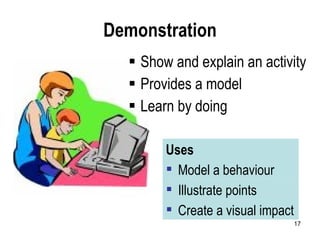
Demonstration Show and explain an activity  Provides a model Learn by doing Create a visual impact Uses Illustrate points Model a behaviour
Small Group Activity / Discussion Learners share their own experience 4- 8 participants in a group Involve all participants Practice new skills Learn from each other Uses In-depth exploration Planning / problem solving
 
Case Study Analysis of a hypothetical but realistic situation No “right answers” Participant devises his/her own solution Safe environment Uses Recognize multiple approaches Discuss typical situations
Role-Play Participants act out a hypothetical situation Everyone becomes part of the scenario Participants bring their own experience to role Rehearsal  preview Pushes for new solutions Uses Affects feelings and attitudes Skill building
 
 
Lecture Demonstration Small Group Activity/ Discussion Case Study Role Play Training Materials ?
Applying Principles of Adult Learning and Retention Recall : Principles of Adult Learning Learning Styles, Communication Styles
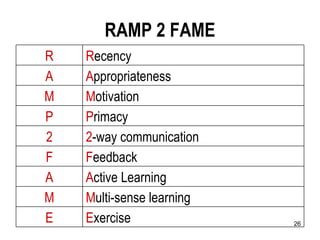
RAMP 2 FAME E xercise E M ulti-sense learning M A ctive Learning A F eedback F 2 -way communication 2 P rimacy P M otivation M A ppropriateness A R ecency R
R ecency Things that are learned last are best remembered Summarize frequently Plan review sections Divide subject into mini-topics of about 20 minutes in length
A ppropriateness All information, training aids, case studies, etc must be appropriate to participant’s needs Clearly identify a need  Use descriptions, examples or illustrations that the participants are familiar with
M otivation Participants must want to learn, must be ready to learn, must have some reason to learn Presenter must also be motivated Identify a need for the participants Move from the known to the unknown
P rimacy Things learned first are learnt best Short presentations Interesting beginning Updates on direction and progress of learning Get things right the first time
2 -way communication Communicate  with  participants Include interactive activities in sessions plan Match body language with verbal message
F eedback Trainer and trainee need information from each other Include feedback activities (e.g., questions; tests) in sessions plan Give feedback on performance immediately Positive  and  negative feedback Acknowledge good work (positive reinforcement)
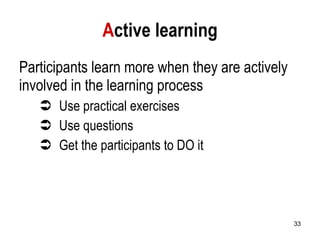
A ctive learning Participants learn more when they are actively involved in the learning process Use practical exercises Use questions Get the participants to DO it
M ultiple-sense learning Learning is more effective if participants use more than one of five senses Tell AND show I see and I forget I hear and I remember I do and I understand. Confucius a. 450 BC
E xercise Things that are repeated are best remembered Hear, see, practice, practice Frequent questions Frequent recall Give exercises
 

Training

  • 1.
    Preparing Training SessionsBY. D.B.Shelke Tilak Maharashtra University
  • 2.
  • 3.
    Scheme of aCourse Cycle ORGANIZATIONAL UNITS Trainee TRAINING ORGANIZATION EVALUATION PROGRAM of COURSES COURSE CURRICULUM DELIVERY EVALUATION ANALYSIS Training Needs EVALUATION EVALUATION Trained Employee
  • 4.
  • 5.
    Self-Check Identify askill which you think you are really good at. (Skill A) Identify a skill which you think you are not very good at. (Skill B) How do you know that you are good at performing skill A? How do you know that you are not good at performing skill B?
  • 6.
    Awareness & CompetenceCompetence 1 3 2 4 High Low Conscious Competence Unconscious Competence High Conscious Incompetence Unconscious Incompetence Low Self-Awareness
  • 7.
    Aiming for ConsciousCompetence Know entry level of trainees Assess trainees’ awareness of that level Needs analysis Performance appraisal Increase awareness of level of competence Move from 1 to 2 Increase skills Move from 2 to 3 Assess costs and benefits of moving from 3 to 4
  • 8.
    Syllabus and SessionsPlan Overall learning objective Topics Prerequisites Sessions and session objectives Training Materials & References Training techniques Training aids
  • 9.
  • 10.
    83% through sight11% through hearing 3.5% through smell 1.5% through touch 1% through taste We Learn 90% of what we say as we act 80% of what we say 50% of what we see and hear 30% of what we see 20% of what we hear 10% of what we read We Remember
  • 11.
    Lecture Demonstration SmallGroup Activity/ Discussion Case Study Role Play
  • 12.
    Types of TrainingTechniques ‘Traditional’ lecture Class discussion Group discussion Practical exercise Project work Self learning Adult education Vocational training Case-based learning E-learning
  • 13.
    Using Training TechniquesApply always a combination of techniques Active participation of students should be encouraged as much as possible: participative training Understanding basics and relations of the course subjects are more important than learning facts Select a combination of techniques which is ' suitable ' for both trainers as well as participants
  • 14.
    Lecture Training A dvantages : a quick and simple way to provide information to large groups.   rather when compared to the other forms of training allows for the giving and taking of questions inexpensive
  • 15.
    Lecture Convey information,theories or principles Depends on trainer for content Uses Introduce a subject Bring Facts/statistics Overview Large groups
  • 16.
    Keep It Simpleand Short
  • 17.
    Demonstration Show andexplain an activity Provides a model Learn by doing Create a visual impact Uses Illustrate points Model a behaviour
  • 18.
    Small Group Activity/ Discussion Learners share their own experience 4- 8 participants in a group Involve all participants Practice new skills Learn from each other Uses In-depth exploration Planning / problem solving
  • 19.
  • 20.
    Case Study Analysisof a hypothetical but realistic situation No “right answers” Participant devises his/her own solution Safe environment Uses Recognize multiple approaches Discuss typical situations
  • 21.
    Role-Play Participants actout a hypothetical situation Everyone becomes part of the scenario Participants bring their own experience to role Rehearsal preview Pushes for new solutions Uses Affects feelings and attitudes Skill building
  • 22.
  • 23.
  • 24.
    Lecture Demonstration SmallGroup Activity/ Discussion Case Study Role Play Training Materials ?
  • 25.
    Applying Principles ofAdult Learning and Retention Recall : Principles of Adult Learning Learning Styles, Communication Styles
  • 26.
    RAMP 2 FAMEE xercise E M ulti-sense learning M A ctive Learning A F eedback F 2 -way communication 2 P rimacy P M otivation M A ppropriateness A R ecency R
  • 27.
    R ecency Thingsthat are learned last are best remembered Summarize frequently Plan review sections Divide subject into mini-topics of about 20 minutes in length
  • 28.
    A ppropriateness Allinformation, training aids, case studies, etc must be appropriate to participant’s needs Clearly identify a need Use descriptions, examples or illustrations that the participants are familiar with
  • 29.
    M otivation Participantsmust want to learn, must be ready to learn, must have some reason to learn Presenter must also be motivated Identify a need for the participants Move from the known to the unknown
  • 30.
    P rimacy Thingslearned first are learnt best Short presentations Interesting beginning Updates on direction and progress of learning Get things right the first time
  • 31.
    2 -way communicationCommunicate with participants Include interactive activities in sessions plan Match body language with verbal message
  • 32.
    F eedback Trainerand trainee need information from each other Include feedback activities (e.g., questions; tests) in sessions plan Give feedback on performance immediately Positive and negative feedback Acknowledge good work (positive reinforcement)
  • 33.
    A ctive learningParticipants learn more when they are actively involved in the learning process Use practical exercises Use questions Get the participants to DO it
  • 34.
    M ultiple-sense learningLearning is more effective if participants use more than one of five senses Tell AND show I see and I forget I hear and I remember I do and I understand. Confucius a. 450 BC
  • 35.
    E xercise Thingsthat are repeated are best remembered Hear, see, practice, practice Frequent questions Frequent recall Give exercises
  • 36.

Editor's Notes

  • #16 Good because: A lot of material in a short time Good introduction Lecturer has control But... Communication is one-way Learner is passive Need good presentation skills Inappropriate for changing behaviour Retention is low unless complemented with a more practical technique
  • #18 Good because: Learners can see what is being explained Gives learners confidence in subject matter Holds group’s attention But: Time consuming Must be very accurate in order to serve as a good model
  • #19 Good because: Learners have control Individual experience comes out Reinforces issues raised in presentation But: Task and timeframe must be very clear Participants may need guidance on how to interact (ground rules)
  • #21 Good because: Learners can relate to real life examples Stimulating Hypothetical, therefore no risk in providing diverging solutions/opinions But... Case must be well-written and participants must be able to identify Requires a lot of time and planning Debriefing must be well crafted and executed
  • #22 Good because: Stimulating & fun Relevant – exact situations learners are dealing with Allows participants to see things from another (person’s) perspective But... Guidance for roles must be well thought-out and explained Facilitator must monitor closely and know when to intervene