Brian Stout
Developing Short, Impactful Training Sessions
Training and Knowledge Management
Team Lead Training:
After completing this module, you will be able to:
 Apply key principles of adult learning to improve agent performance
 Distinguish between telling and training in order to increase application of
new knowledge
 Design short training lesson based on adult learning principles
 Deliver the training session with feedback from instructor
Objectives
2
3
 How many of you want to be trainers?
● What is your motivation?
 How many of you are less excited about becoming trainers?
● Why are you hesitant?
Introduction
4
 “Today, I will show you how to use the all-new call documentation software.”
Teaching
 “If the customer says _________, then you say ____________.”
Telling
 “We are changing the way we document repurchase and replacement
requests. We will go through the process together today, and you’ll get time
to practice.”
Training
Teaching, Telling, Or Training?
5
At work and at home,
 When do you find yourself teaching?
 When do you find yourself telling?
 When do you find yourself training?
DISCUSS: Teaching, Telling, Or Training?
Know Your Audience: Adult Learners
6
What do adult learners value?
• Autonomy—participating, sharing thoughts and ideas
• Action—applying what was learned as quickly as possible
Know Your Audience: What’s In It For Me?
7
• Consider the lives of your team members
• Selling the relevance of the training helps learners see that
they should make room for it
• Motivation to learn increases as the perceived value of the
information increases
• Mood is a factor
What are the Key Ingredients for Learning?
8
 Ability
 Monetary Incentives
 The instructor
 PowerPoint slides with flashy
animations
 Prior Knowledge
 Not wanting to feel bad about oneself
 The setting/training room
 Competition
 Fear of repercussions for not learning
 Motivation
 Video content
 Refreshments
 Entertainment factor
The Key Ingredients for Learning
9
 Ability—the potential we have to leverage
 Prior Knowledge—what learners already know can help them learn easier
 Motivation—those who care, have drive, and the desire to achieve are
primed to learn, but these factors also affect motivation
● Confidence helps, but under and overconfidence do not
● Mood—if we aren’t in the mood to learn, motivation decreases
REFLECT: The Key Ingredients for Learning
10
 Write down how you think ability, prior knowledge, and motivation influence
your training efforts on this job
 How can you use these to create future training?
 How can you encourage motivation to learn?
 Share with the person next to you
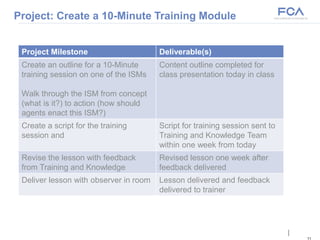
Project: Create a 10-Minute Training Module
11
Project Milestone Deliverable(s)
Create an outline for a 10-Minute
training session on one of the ISMs
Walk through the ISM from concept
(what is it?) to action (how should
agents enact this ISM?)
Content outline completed for
class presentation today in class
Create a script for the training
session and
Script for training session sent to
Training and Knowledge Team
within one week from today
Revise the lesson with feedback
from Training and Knowledge
Revised lesson one week after
feedback delivered
Deliver lesson with observer in room Lesson delivered and feedback
delivered to trainer
Choose Your ISM
12
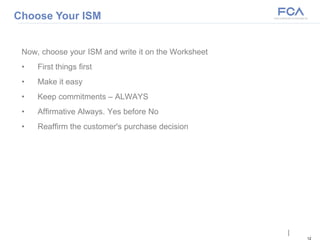
Now, choose your ISM and write it on the Worksheet
• First things first
• Make it easy
• Keep commitments – ALWAYS
• Affirmative Always. Yes before No
• Reaffirm the customer's purchase decision
13
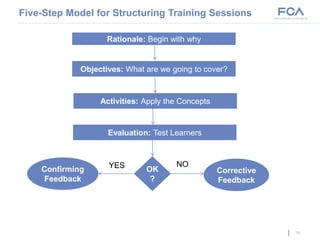
Five-Step Model for Structuring Training Sessions
Rationale: Begin with why
Objectives: What are we going to cover?
Activities: Apply the Concepts
Evaluation: Test Learners
OK
?
Confirming
Feedback
Corrective
Feedback
YES NO
14
Rationale
 Learners expect to be presented with the reason for the learning session
 If they can see a reason to learn the material, they will want to learn it
Objectives
 State what learners will be able to do by the end of the session in concrete,
verifiable terms
Activities
 If learners practice doing the objectives or something that leads to them,
they will be more likely to attain them
 Be sure that activities are directly related to the objectives
 They should be fun and a little challenging
 They must be related to how the learn will use the content
How to Structure Training for Adults that Sticks
15
Evaluation
 Check to see if the learners have learned
 Evaluate performance, not the person
Feedback
 Provide performance in terms of the objectives. Let learners know when
they’ve got it and provide correction when needed
How to Structure Training for Adults that Sticks
16
 Use your handout to determine the rationale for creating a lesson around the
ISM you chose
 Why should your learners need to learn this ISM?
 How does knowing the ISM apply to their work?
 Share your answers with another person in the room
 Stand up to have your idea exchange
ACTIVITY: Describe the Rationale
17
 If learners know what they are supposed to learn, there’s a better chance
that they will learn it
 State the objectives in terms of the learner
● You will be able to transfer calls to other departments
● I will show you how to transfer calls
 Also, state the objectives in concrete terms
● You will be able reassign a case to a case manager
● You will know the process for assigning a case to a case manager
Creating Performance Objectives
18
 Create two possible performance objectives for your ISMs-based lesson
 Write them on your Worksheet
 Share them with another person
 Discuss whether the objectives are learner-centered and concretely
verifiable
● Revise if necessary
 Write the performance objectives you plan to use on your Worksheet
ACTIVITY: Creating Performance Objectives
19
 Activities must lead learners to attaining performance objectives
● Review your objectives to determine what form the activities should take
 Remember, they should be appropriately challenging and should use some
of the learner’s prior knowledge if possible
 Activities must be relevant to how the learner will use the information
 For a 10-Minute session, aim for one 1-minute activity
 What are some activities that spring to mind, even from training you’ve
experienced?
Choosing and Developing Activities
20
 Activities can take many forms
● Self-directed write and reflect
● Share with a partner
● Report out to the group
● Signals (e.g. “Raise your hand if…”)
● Draw a visual to show understanding
● Pop-up (e.g. “Stand up and share an empathy statement”)
 Remember, they should be appropriately challenging and should use some
of the learner’s prior knowledge if possible
Choosing and Developing Activities
21
 Partner up with one other person
 Spend 10 minutes brainstorming activity ideas for your training sessions
 Be sure to consider how the activities:
● Stimulate transfer of training to the floor
● Encourage learners to contribute their own experience and judgment
● Difficulty level aligns with the learners’ knowledge, skills, and abilities
● Might be used in other aspects of the job
 Write the activities you plan to use on your Worksheet
ACTIVITY: Choosing and Developing Activities
22
 Evaluations should focus on the performance of the objectives
 Could take the form of performance tests, oral tests, written tests, and
performance results
Provides a way to deliver Confirmation Feedback or Corrective Feedback
Other Evaluation Methods:
 Ticket Out: Ask learners what they’ve learned, what’s still confusing, what
they think is most important
 Action Plan: Ask what learners are going to do with what they’ve learned
Evaluating Learner Performance
23
 Partner up with one other person
 Spend 10 minutes brainstorming activity ideas for evaluating learner
performance
 Be sure to consider how the activities:
● Will let the learner know he or she has got it right (Confirming Feedback)
● Will help them get back on course if they’ve got it wrong (Correcting Feedback)
 Write the evaluation methods you plan to use on your sheet
ACTIVITY: Evaluating Learner Performance
24
 Using a Script Sheet can help you develop content and plan the lesson
 Review the Handout
 Use it to develop your lesson
Developing Training Content
25
 Present your Worksheet to the Group
 Include:
● The ISM you are going to teach
● Rationale
● Objectives
● Activities
● Evaluation
ACTIVITY: Bring It All Together
26
RECAP: Adult Learning Principles in a Few Minutes
27
 Set clear a clear purpose
 Map out your lesson using the tools provided
 State the learning objectives in terms of the learner
 Remember “What’s in it for me?”
 Allow learners to share experience and leverage it for learning
 Use hands-on practice early and often
As You Begin Your Journey…
28
 Over the next week:
 Complete the Training Session Script Sheet
 Complete your ISM lesson and send it to me for feedback
 You will receive feedback from the Training and Knowledge Team to
enhance and develop your training
 Watch for emails and tips from me!
NEXT STEPS: Complete the Script and Lesson