1
Purpose of Training aids
 Telling people what we are going to tell them
 Telling them
 Telling them what we have told them
2
The Needs for Training Aids
 Variety and Retention
 Greater Impact
 Recall Reinforcement
 An Aid to clarity and Conciseness
 Consistency and Quality of thoughts
3
Available Aids
 ** Activities
 */+ Chalkboard
 ++ Combined Audio and Slid Presentation
 */+ Computers
 ** Flipcharts
 ++Episcopes
 ** Handouts
 + Interactive video
 ** Overhead projector
 * Slid projectors
 * The Object
 * Trainers themselves (Albeit Unwittingly)
 ** Videos
 + Video projectors
 ++ Whiteboards
Note: * or ** (for very common use) and + or ++ ( for very use)
4
Training Aids in Training and
Development
 Activities
 Case studies
 Computer-based training
 Demonstrations
 Group discussions
 Input sessions
 Interactive video
 One to one instruction
 Presentations
 projects
 Role plays
5
The relevant training aids effective
in the demonstration
 The object itself
 A video of the process
 A 3-D computer graphic
 A video projection
 A photograph of the object
 A line diagram of the object
 A process line chart
 A process description handout
6
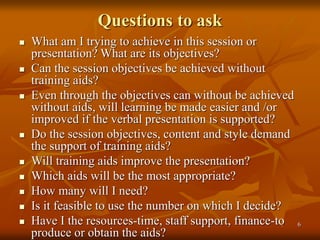
Questions to ask
 What am I trying to achieve in this session or
presentation? What are its objectives?
 Can the session objectives be achieved without
training aids?
 Even through the objectives can without be achieved
without aids, will learning be made easier and /or
improved if the verbal presentation is supported?
 Do the session objectives, content and style demand
the support of training aids?
 Will training aids improve the presentation?
 Which aids will be the most appropriate?
 How many will I need?
 Is it feasible to use the number on which I decide?
 Have I the resources-time, staff support, finance-to
produce or obtain the aids?
7
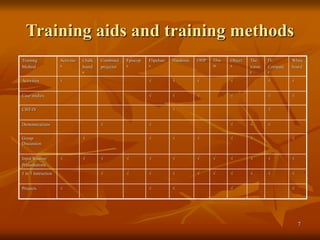
Training aids and training methods
Training
Method
Activitie
s
Chalk
board
s
Combined
projector
Episcop
e
Flipchart
s
Handouts OHP 35m
m
Object
s
The
traine
r
IV/
Compute
r
White
board
Activities √ √ √ √ √ √ √
Case studies √ √ √ √ √ √
CBT/IV √ √
Demonstrations √ √ √ √ √
Group
Discussion
√ √ √ √ √ √ √
Input Session/
Presentations
√ √ √ √ √ √ √ √ √ √ √ √
1 to 1 instruction √ √ √ √ √ √ √ √ √ √
Projects √ √ √ √ √
8
Definition of Learning Objectives
A Learning Objectives:
 Is a collection of words or symbols describing one of
your educational intents.
 Describes an intended outcome of instruction, a
proposed change in a learner when he has
successfully completed a learning experience.
 Describes an observable and measurable pattern of
behavior (performance) you want the learner to be
able to be to demonstrate.
9
REASON FOR SETTING LEARNING
OBJECTIVES
To ensure that both the trainer and the trainees know what target is
expected through the training actively.
 Trainer must know exactly where s/he is going, otherwise s/he may get
lost during the training session
 Trainees must know where they are going ,Otherwise no know what is
expected of them.
Objectives help the trainer develop and conduct training that provides the
trainees with the knowledge and skills they need.
Objectives provide the trainees with a clear understanding of what will
expected to do as a result of training.
Objectives help both the trainer and trainee evaluate the learning that has
taken place through instruction.
10
Types of Training Objectives
 C= Cognitive
* Aspects related to knowledge and intelligence.
 A= Affective
* Aspects related to attitudes and commitments.
 P= Psychomotor
* Aspects related to knowledge and skills.
Examples:
C = Able to distinguish the characteristics of different nursery
seedlings.
A = Participate in the plantation activity with positive
attitudes.
P = Build-up capacity of grading nursery seedlings at the end of the
training.
11
Types of Training Objectives
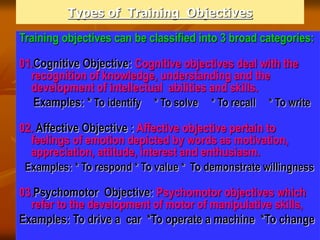
Training objectives can be classified into 3 broad categories:
01.Cognitive Objective: Cognitive objectives deal with the
recognition of knowledge, understanding and the
development of intellectual abilities and skills.
Examples: * To identify * To solve * To recall * To write
02. Affective Objective : Affective objective pertain to
feelings of emotion depicted by words as motivation,
appreciation, attitude, interest and enthusiasm.
Examples: * To respond * To value * To demonstrate willingness
03.Psychomotor Objective: Psychomotor objectives which
refer to the development of motor of manipulative skills,
Examples: To drive a car *To operate a machine *To change
12
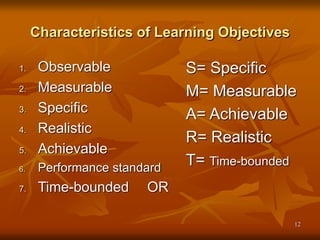
Characteristics of Learning Objectives
1. Observable
2. Measurable
3. Specific
4. Realistic
5. Achievable
6. Performance standard
7. Time-bounded OR
S= Specific
M= Measurable
A= Achievable
R= Realistic
T= Time-bounded
13
List of Action verbs
Related to knowledge and intellect (Cognitive)
Apply Assign Compare
Decide Define Design
Diagnose Discuss Distinguish
Examine Explain Identify
List Prepare
14
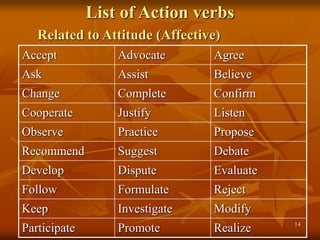
List of Action verbs
Accept Advocate Agree
Ask Assist Believe
Change Complete Confirm
Cooperate Justify Listen
Observe Practice Propose
Recommend Suggest Debate
Develop Dispute Evaluate
Follow Formulate Reject
Keep Investigate Modify
Participate Promote Realize
Related to Attitude (Affective)
15
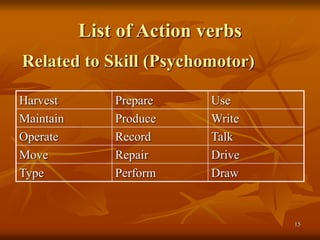
List of Action verbs
Harvest Prepare Use
Maintain Produce Write
Operate Record Talk
Move Repair Drive
Type Perform Draw
Related to Skill (Psychomotor)
16
Action and Vague Verbs
Action Verbs Vague Verbs
To write To know about
To differentiate To appreciate
To design To provide a general
To identify Knowledge of
To describe To grasp the significance of
To list To understand
To define To believe
To explain To have faith on
To compare To perceive
To recognize To be aware of
To recite To qualify
17
Checklist For Writing Learning Objectives.
1. Remember that “objectives”
refers to what the trainee is
expected to do and not to
what you are going to do.
“Objectives” describes trainee
behavior not trainer duties or
the learning process. Check
your objectives to make sure
they descried what trainees
will be to do when they have
mastered the skill.
02. .Make sure your objectives
identify expected trainee
performance verbs are not
ambiguous or the content
badly defined.
03. Do not use too many
objectives. You should have as
few objectives as possible,
and they should serve as clear
guidelines for your training.
04. Review your objectives to
make sure they include the
performance. And the
conditions and standers for
performance. Check to be
sure that the performance is
observable and measurable
and that it is a specific rather
than a general performance.
05. Write objectives in simple,
straightforward language.
Objectives which are too long,
use unnecessarily big words,
or try to cover too many
expected behaviors confuse
trainees. Check to make sure
your objectives communicate
well and cover one learning
outcome rather than several
18
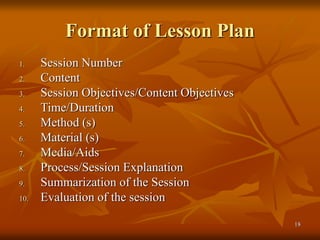
Format of Lesson Plan
1. Session Number
2. Content
3. Session Objectives/Content Objectives
4. Time/Duration
5. Method (s)
6. Material (s)
7. Media/Aids
8. Process/Session Explanation
9. Summarization of the Session
10. Evaluation of the session
19
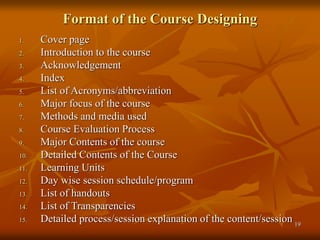
Format of the Course Designing
1. Cover page
2. Introduction to the course
3. Acknowledgement
4. Index
5. List of Acronyms/abbreviation
6. Major focus of the course
7. Methods and media used
8. Course Evaluation Process
9. Major Contents of the course
10. Detailed Contents of the Course
11. Learning Units
12. Day wise session schedule/program
13. List of handouts
14. List of Transparencies
15. Detailed process/session explanation of the content/session
20
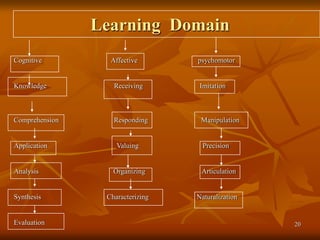
Learning Domain
Cognitive Affective psychomotor
Knowledge Receiving Imitation
Comprehension Responding Manipulation
Application Valuing Precision
Analysis Organizing Articulation
Synthesis Characterizing Naturalization
Evaluation
21
FORMAT OF LESSON PLAN
01.Content:
02.Session Objective (S):
03.Session No:
04.Time:
05.Method (S)
06. Materials (S):
07.Media:
08.Process/Session
Explanation:
09.Summarize the
Session:
10. Evaluation of the
session:
22
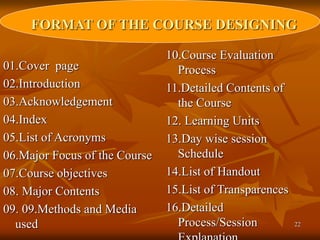
FORMAT OF THE COURSE DESIGNING
01.Cover page
02.Introduction
03.Acknowledgement
04.Index
05.List of Acronyms
06.Major Focus of the Course
07.Course objectives
08. Major Contents
09. 09.Methods and Media
used
10.Course Evaluation
Process
11.Detailed Contents of
the Course
12. Learning Units
13.Day wise session
Schedule
14.List of Handout
15.List of Transparences
16.Detailed
Process/Session
23
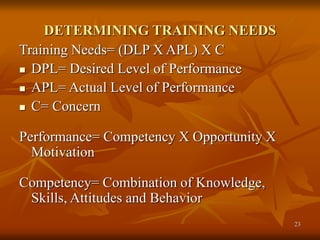
DETERMINING TRAINING NEEDS
Training Needs= (DLP X APL) X C
 DPL= Desired Level of Performance
 APL= Actual Level of Performance
 C= Concern
Performance= Competency X Opportunity X
Motivation
Competency= Combination of Knowledge,
Skills, Attitudes and Behavior
24
AREAS OF DIVERSITY OF THE PARTICIPANTS
 Age
 Experience
 Religion
 Color
 Ethnicity
 Caste
 Region
 Educational background
 Economic status
 Social status
 Sex
 Facial expression
 Designation
 Language
 And Others
25
FACILITATION
Facilitation is an art where accelerate
the session using improved questioning
to stimulate the participants and which
encourage the participants to actively
listen to each other, interact, create
new ideas, analysis them and learn.
26
PROCEDURAL MODEL FOR EFFECTIVE
FACILITATION
 Step 01: Identify your preference.
 Step 02: Identify participants’
preference
 Step 03: Design or revise the method to
suit participants’ preference.
 Step 04: Conduct the group activity.
 Step 05: Make modifications on the fly.
 Step 06: Debrief the group.
27
Preparation for presentation
CHECKLIST FOR PREPARING THE PRESENTATION
 What is your subject?
 Have you given thought to a plan for your presentation?
 Have you jotted down thoughts, especially main points you
wish to emphasize?
 Do you need assistance with information?
 Have determined at what level you wish to pitch your
presentation?
 How do you propose making the greatest impact?
 What aids do you propose to use?
 Do you propose using handouts?
 Do you proposing giving a demonstration?
 Have you in mind the questions to be asked?
 Have you discussed your subject or its presentation with
others? Do you intend to do so?
28
FACILITATION SKILLS
 PHRASING: Developing the topic (initiating the
discussion on the topic).
 THOUGHTS PROVOKING QUESTIONING:
Raising the thoughts and ideas of the audience.
 FISH CATCHING: Picking up the significant
thoughts and ideas of the audience.
 CASCADING: Sequencing the thoughts and ideas.
 PARAPHRASING: Explaining the whole ideas as
own manner.
 EXTENDING: Value adding the discussion with
data and references.
 SUMMARIZING: Have a conclusion of the topic
summarizing the thoughts and ideas of the facilitator
and audience.
29
TACTICS TO OVERCOME TENSIONS
 Tighten or loosen the structure.
 Speed up or slow down the pace.
 Increase competition or the cooperation
among the participants.
 Increase the focus on the process or on the
results.
 Pay more attention to the individual needs
or group needs.
 Increase internal or external control.
30
SECRETS OF SUCCESSFUL FACILITATORS
 Effective facilitators are flexible;
They modify their group activities before and during use.
 Effective facilitators are adaptive;
Thy modify their group activities along critical tensions.
 Effective facilitators are proactive;
Before using a group activity, they modify it on the basis of the
characteristics of the participants and the purpose of the
activities.
 Effective facilitators are responsive;
They make modifications during the group activities to keep the
different tensions within the acceptable ranges.
 Effective facilitators are resilient;
They accept what ever happens during the group activities as
valuable data and smoothly continue with the activities.
31
KINDS OF QUESTIONNAIRE
 Questionnaire For Pre And Post Test
 Questionnaire For Session Evaluation
 Questionnaire For Course Evaluation
 Questionnaire For Impact Evaluation
 Questionnaire For Trainers Evaluation
32
TYPES OF QUESTIONNAIRE
 Open Ended
 Close Ended
FORMS OF QUESTIONNAIRE
 Yes-no
 True-false
 Fill-up The Blanks
 Matching The Scale
 Rating Scale
 Multiple Choice
 Short Notes
 Note
 Steps
33
WHY EVALUATION
Evaluation helps in assessing
 The relevance of the training
objectives.
 The accomplishment of the objectives.
 The appropriateness of the training
methods and materials.
34
Mentoring
 Mentoring is a process by which a
experienced person who advises and
helps somebody with less experience
over a period of time.
35
Coaching
 Coaching is a Process of training
to do better or to improve a skill.
The process of giving student
extra teaching in a particular
subject.
36
Model of Evaluation
There are two common models are being used
by the evaluation. These are:
 Tylerian Model : Input output or objective
oriented model.
 Stufflebeam’ s Improvement-oriented model or
CIPP model : Context, Input, Process, Product.
37
Evaluation
The systematic assessment of worth and
merit of an object.
 Formative Evaluation : The use of tests to
obtain feedback during the course of a
program rather than at its termination point.
Formative evaluation allows projects to be
modified and improved upon while they are in
progress
 Summative Evaluation : A decision reached
near the end of a project that determines
whether it has been successful or not
;contrasted with formative evaluation.
 ----Stufflebeam
38
PROJECT PROPOSAL WRITING
Basic Sections of a Proposal
Three major sections:
01.Introduction
* Tells what your project is about.
* Why the project is worth doing.
* why the project is a good topic for fulfilling the
objectives of the degree requirement
02. Literature Review (or Background)
* Tells what the state is of the project.
03. Procedure (Methodology)
* Lays out the method allow to complete the project
successfully
04. Budget
*Tells the utilization of the financial resource.
39
CURRICULUM
 ILO defines the terms curriculum as ‘The
content of an organized program of study in an
educational or training institute indicating the
subjects, taught the time allocated to each and
their sequence. The curriculam then becomes
the plan which out lines the dimensions,
structure and elements of the training course.”
Source: Training Manual. Environment Management Training Project.
Trainer’s Instruction, published by Department of Environment . The
Government of the peoples Republic of Bangladesh.
40
QUALITY OF A TRAINER (5-DS)
 Trainer must have Direction
 Trainer must have Dedication
 Trainer must have Determination
 Trainer must have Discipline
 Trainer must have Deadline
41
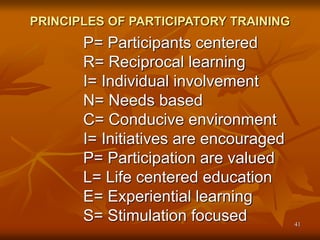
PRINCIPLES OF PARTICIPATORY TRAINING
P= Participants centered
R= Reciprocal learning
I= Individual involvement
N= Needs based
C= Conducive environment
I= Initiatives are encouraged
P= Participation are valued
L= Life centered education
E= Experiential learning
S= Stimulation focused
42
CONDITION OF LEARNING “ 5 - Cs”
C – 1 Conducive Environment
C – 2 Learning Culture
C - 3 Familiar Contents
C – 4 Appropriate Clarification
C - 5 Common Understanding
43
4 Ds of Training Cycle
D - 1 Determining the Training Needs
D – 2 Designing the Training Curriculum
D - 3 Delivering the Training Course
D – 4 Discerning the Training Course
44
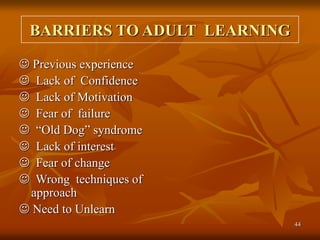
BARRIERS TO ADULT LEARNING
 Previous experience
 Lack of Confidence
 Lack of Motivation
 Fear of failure
 “Old Dog” syndrome
 Lack of interest
 Fear of change
 Wrong techniques of
approach
 Need to Unlearn
45
Learning Principles
07. Learning is both unique and individual
08. Learning has its richest resource in the
learner’s self
09. Learning is a co-operative and collaborative
process
10. Learning is both an emotional and
intellectual process
11. Learning is an evolutionary Process
46
Learning Condition
8. An emphasis on the uniquely personal nature
of learning
9. A Climate which recognizes the right of
individuals to make mistakes
10. An atmosphere that tolerates ambiguity
11.An emphasis on co-operative evaluation and
self-evaluation
12. Encouragement of openness
13. A feeling of acceptance
47
COURSE DESIGN
‘Course Design’ is also addressed as
 Curriculum Development or Design
 Program Design
 Instructional System Design
48
Stages of Curriculum Design
1. Job/Task analysis which involves
 Job description analysis
 Task analysis
2. Analysis of the required competencies
3. Analysis of the target population
4. Analysis of the training needs
5. Development of the training objectives which should involve three elements
 Description of specific terminal behavior
 Performing standard to describe how the learner’s most performance
will occur
 Important condition under which performance will occur
6. Development of criteria test
 Post training test to ascertain how the the performance of the
training coincides with present training objectives
7. Selection of course content
 Emanating from training objective, performance, deficiency and
needs
 Must know
 Should know
 Nice to know

Training Aids.ppt

  • 1.
    1 Purpose of Trainingaids  Telling people what we are going to tell them  Telling them  Telling them what we have told them
  • 2.
    2 The Needs forTraining Aids  Variety and Retention  Greater Impact  Recall Reinforcement  An Aid to clarity and Conciseness  Consistency and Quality of thoughts
  • 3.
    3 Available Aids  **Activities  */+ Chalkboard  ++ Combined Audio and Slid Presentation  */+ Computers  ** Flipcharts  ++Episcopes  ** Handouts  + Interactive video  ** Overhead projector  * Slid projectors  * The Object  * Trainers themselves (Albeit Unwittingly)  ** Videos  + Video projectors  ++ Whiteboards Note: * or ** (for very common use) and + or ++ ( for very use)
  • 4.
    4 Training Aids inTraining and Development  Activities  Case studies  Computer-based training  Demonstrations  Group discussions  Input sessions  Interactive video  One to one instruction  Presentations  projects  Role plays
  • 5.
    5 The relevant trainingaids effective in the demonstration  The object itself  A video of the process  A 3-D computer graphic  A video projection  A photograph of the object  A line diagram of the object  A process line chart  A process description handout
  • 6.
    6 Questions to ask What am I trying to achieve in this session or presentation? What are its objectives?  Can the session objectives be achieved without training aids?  Even through the objectives can without be achieved without aids, will learning be made easier and /or improved if the verbal presentation is supported?  Do the session objectives, content and style demand the support of training aids?  Will training aids improve the presentation?  Which aids will be the most appropriate?  How many will I need?  Is it feasible to use the number on which I decide?  Have I the resources-time, staff support, finance-to produce or obtain the aids?
  • 7.
    7 Training aids andtraining methods Training Method Activitie s Chalk board s Combined projector Episcop e Flipchart s Handouts OHP 35m m Object s The traine r IV/ Compute r White board Activities √ √ √ √ √ √ √ Case studies √ √ √ √ √ √ CBT/IV √ √ Demonstrations √ √ √ √ √ Group Discussion √ √ √ √ √ √ √ Input Session/ Presentations √ √ √ √ √ √ √ √ √ √ √ √ 1 to 1 instruction √ √ √ √ √ √ √ √ √ √ Projects √ √ √ √ √
  • 8.
    8 Definition of LearningObjectives A Learning Objectives:  Is a collection of words or symbols describing one of your educational intents.  Describes an intended outcome of instruction, a proposed change in a learner when he has successfully completed a learning experience.  Describes an observable and measurable pattern of behavior (performance) you want the learner to be able to be to demonstrate.
  • 9.
    9 REASON FOR SETTINGLEARNING OBJECTIVES To ensure that both the trainer and the trainees know what target is expected through the training actively.  Trainer must know exactly where s/he is going, otherwise s/he may get lost during the training session  Trainees must know where they are going ,Otherwise no know what is expected of them. Objectives help the trainer develop and conduct training that provides the trainees with the knowledge and skills they need. Objectives provide the trainees with a clear understanding of what will expected to do as a result of training. Objectives help both the trainer and trainee evaluate the learning that has taken place through instruction.
  • 10.
    10 Types of TrainingObjectives  C= Cognitive * Aspects related to knowledge and intelligence.  A= Affective * Aspects related to attitudes and commitments.  P= Psychomotor * Aspects related to knowledge and skills. Examples: C = Able to distinguish the characteristics of different nursery seedlings. A = Participate in the plantation activity with positive attitudes. P = Build-up capacity of grading nursery seedlings at the end of the training.
  • 11.
    11 Types of TrainingObjectives Training objectives can be classified into 3 broad categories: 01.Cognitive Objective: Cognitive objectives deal with the recognition of knowledge, understanding and the development of intellectual abilities and skills. Examples: * To identify * To solve * To recall * To write 02. Affective Objective : Affective objective pertain to feelings of emotion depicted by words as motivation, appreciation, attitude, interest and enthusiasm. Examples: * To respond * To value * To demonstrate willingness 03.Psychomotor Objective: Psychomotor objectives which refer to the development of motor of manipulative skills, Examples: To drive a car *To operate a machine *To change
  • 12.
    12 Characteristics of LearningObjectives 1. Observable 2. Measurable 3. Specific 4. Realistic 5. Achievable 6. Performance standard 7. Time-bounded OR S= Specific M= Measurable A= Achievable R= Realistic T= Time-bounded
  • 13.
    13 List of Actionverbs Related to knowledge and intellect (Cognitive) Apply Assign Compare Decide Define Design Diagnose Discuss Distinguish Examine Explain Identify List Prepare
  • 14.
    14 List of Actionverbs Accept Advocate Agree Ask Assist Believe Change Complete Confirm Cooperate Justify Listen Observe Practice Propose Recommend Suggest Debate Develop Dispute Evaluate Follow Formulate Reject Keep Investigate Modify Participate Promote Realize Related to Attitude (Affective)
  • 15.
    15 List of Actionverbs Harvest Prepare Use Maintain Produce Write Operate Record Talk Move Repair Drive Type Perform Draw Related to Skill (Psychomotor)
  • 16.
    16 Action and VagueVerbs Action Verbs Vague Verbs To write To know about To differentiate To appreciate To design To provide a general To identify Knowledge of To describe To grasp the significance of To list To understand To define To believe To explain To have faith on To compare To perceive To recognize To be aware of To recite To qualify
  • 17.
    17 Checklist For WritingLearning Objectives. 1. Remember that “objectives” refers to what the trainee is expected to do and not to what you are going to do. “Objectives” describes trainee behavior not trainer duties or the learning process. Check your objectives to make sure they descried what trainees will be to do when they have mastered the skill. 02. .Make sure your objectives identify expected trainee performance verbs are not ambiguous or the content badly defined. 03. Do not use too many objectives. You should have as few objectives as possible, and they should serve as clear guidelines for your training. 04. Review your objectives to make sure they include the performance. And the conditions and standers for performance. Check to be sure that the performance is observable and measurable and that it is a specific rather than a general performance. 05. Write objectives in simple, straightforward language. Objectives which are too long, use unnecessarily big words, or try to cover too many expected behaviors confuse trainees. Check to make sure your objectives communicate well and cover one learning outcome rather than several
  • 18.
    18 Format of LessonPlan 1. Session Number 2. Content 3. Session Objectives/Content Objectives 4. Time/Duration 5. Method (s) 6. Material (s) 7. Media/Aids 8. Process/Session Explanation 9. Summarization of the Session 10. Evaluation of the session
  • 19.
    19 Format of theCourse Designing 1. Cover page 2. Introduction to the course 3. Acknowledgement 4. Index 5. List of Acronyms/abbreviation 6. Major focus of the course 7. Methods and media used 8. Course Evaluation Process 9. Major Contents of the course 10. Detailed Contents of the Course 11. Learning Units 12. Day wise session schedule/program 13. List of handouts 14. List of Transparencies 15. Detailed process/session explanation of the content/session
  • 20.
    20 Learning Domain Cognitive Affectivepsychomotor Knowledge Receiving Imitation Comprehension Responding Manipulation Application Valuing Precision Analysis Organizing Articulation Synthesis Characterizing Naturalization Evaluation
  • 21.
    21 FORMAT OF LESSONPLAN 01.Content: 02.Session Objective (S): 03.Session No: 04.Time: 05.Method (S) 06. Materials (S): 07.Media: 08.Process/Session Explanation: 09.Summarize the Session: 10. Evaluation of the session:
  • 22.
    22 FORMAT OF THECOURSE DESIGNING 01.Cover page 02.Introduction 03.Acknowledgement 04.Index 05.List of Acronyms 06.Major Focus of the Course 07.Course objectives 08. Major Contents 09. 09.Methods and Media used 10.Course Evaluation Process 11.Detailed Contents of the Course 12. Learning Units 13.Day wise session Schedule 14.List of Handout 15.List of Transparences 16.Detailed Process/Session
  • 23.
    23 DETERMINING TRAINING NEEDS TrainingNeeds= (DLP X APL) X C  DPL= Desired Level of Performance  APL= Actual Level of Performance  C= Concern Performance= Competency X Opportunity X Motivation Competency= Combination of Knowledge, Skills, Attitudes and Behavior
  • 24.
    24 AREAS OF DIVERSITYOF THE PARTICIPANTS  Age  Experience  Religion  Color  Ethnicity  Caste  Region  Educational background  Economic status  Social status  Sex  Facial expression  Designation  Language  And Others
  • 25.
    25 FACILITATION Facilitation is anart where accelerate the session using improved questioning to stimulate the participants and which encourage the participants to actively listen to each other, interact, create new ideas, analysis them and learn.
  • 26.
    26 PROCEDURAL MODEL FOREFFECTIVE FACILITATION  Step 01: Identify your preference.  Step 02: Identify participants’ preference  Step 03: Design or revise the method to suit participants’ preference.  Step 04: Conduct the group activity.  Step 05: Make modifications on the fly.  Step 06: Debrief the group.
  • 27.
    27 Preparation for presentation CHECKLISTFOR PREPARING THE PRESENTATION  What is your subject?  Have you given thought to a plan for your presentation?  Have you jotted down thoughts, especially main points you wish to emphasize?  Do you need assistance with information?  Have determined at what level you wish to pitch your presentation?  How do you propose making the greatest impact?  What aids do you propose to use?  Do you propose using handouts?  Do you proposing giving a demonstration?  Have you in mind the questions to be asked?  Have you discussed your subject or its presentation with others? Do you intend to do so?
  • 28.
    28 FACILITATION SKILLS  PHRASING:Developing the topic (initiating the discussion on the topic).  THOUGHTS PROVOKING QUESTIONING: Raising the thoughts and ideas of the audience.  FISH CATCHING: Picking up the significant thoughts and ideas of the audience.  CASCADING: Sequencing the thoughts and ideas.  PARAPHRASING: Explaining the whole ideas as own manner.  EXTENDING: Value adding the discussion with data and references.  SUMMARIZING: Have a conclusion of the topic summarizing the thoughts and ideas of the facilitator and audience.
  • 29.
    29 TACTICS TO OVERCOMETENSIONS  Tighten or loosen the structure.  Speed up or slow down the pace.  Increase competition or the cooperation among the participants.  Increase the focus on the process or on the results.  Pay more attention to the individual needs or group needs.  Increase internal or external control.
  • 30.
    30 SECRETS OF SUCCESSFULFACILITATORS  Effective facilitators are flexible; They modify their group activities before and during use.  Effective facilitators are adaptive; Thy modify their group activities along critical tensions.  Effective facilitators are proactive; Before using a group activity, they modify it on the basis of the characteristics of the participants and the purpose of the activities.  Effective facilitators are responsive; They make modifications during the group activities to keep the different tensions within the acceptable ranges.  Effective facilitators are resilient; They accept what ever happens during the group activities as valuable data and smoothly continue with the activities.
  • 31.
    31 KINDS OF QUESTIONNAIRE Questionnaire For Pre And Post Test  Questionnaire For Session Evaluation  Questionnaire For Course Evaluation  Questionnaire For Impact Evaluation  Questionnaire For Trainers Evaluation
  • 32.
    32 TYPES OF QUESTIONNAIRE Open Ended  Close Ended FORMS OF QUESTIONNAIRE  Yes-no  True-false  Fill-up The Blanks  Matching The Scale  Rating Scale  Multiple Choice  Short Notes  Note  Steps
  • 33.
    33 WHY EVALUATION Evaluation helpsin assessing  The relevance of the training objectives.  The accomplishment of the objectives.  The appropriateness of the training methods and materials.
  • 34.
    34 Mentoring  Mentoring isa process by which a experienced person who advises and helps somebody with less experience over a period of time.
  • 35.
    35 Coaching  Coaching isa Process of training to do better or to improve a skill. The process of giving student extra teaching in a particular subject.
  • 36.
    36 Model of Evaluation Thereare two common models are being used by the evaluation. These are:  Tylerian Model : Input output or objective oriented model.  Stufflebeam’ s Improvement-oriented model or CIPP model : Context, Input, Process, Product.
  • 37.
    37 Evaluation The systematic assessmentof worth and merit of an object.  Formative Evaluation : The use of tests to obtain feedback during the course of a program rather than at its termination point. Formative evaluation allows projects to be modified and improved upon while they are in progress  Summative Evaluation : A decision reached near the end of a project that determines whether it has been successful or not ;contrasted with formative evaluation.  ----Stufflebeam
  • 38.
    38 PROJECT PROPOSAL WRITING BasicSections of a Proposal Three major sections: 01.Introduction * Tells what your project is about. * Why the project is worth doing. * why the project is a good topic for fulfilling the objectives of the degree requirement 02. Literature Review (or Background) * Tells what the state is of the project. 03. Procedure (Methodology) * Lays out the method allow to complete the project successfully 04. Budget *Tells the utilization of the financial resource.
  • 39.
    39 CURRICULUM  ILO definesthe terms curriculum as ‘The content of an organized program of study in an educational or training institute indicating the subjects, taught the time allocated to each and their sequence. The curriculam then becomes the plan which out lines the dimensions, structure and elements of the training course.” Source: Training Manual. Environment Management Training Project. Trainer’s Instruction, published by Department of Environment . The Government of the peoples Republic of Bangladesh.
  • 40.
    40 QUALITY OF ATRAINER (5-DS)  Trainer must have Direction  Trainer must have Dedication  Trainer must have Determination  Trainer must have Discipline  Trainer must have Deadline
  • 41.
    41 PRINCIPLES OF PARTICIPATORYTRAINING P= Participants centered R= Reciprocal learning I= Individual involvement N= Needs based C= Conducive environment I= Initiatives are encouraged P= Participation are valued L= Life centered education E= Experiential learning S= Stimulation focused
  • 42.
    42 CONDITION OF LEARNING“ 5 - Cs” C – 1 Conducive Environment C – 2 Learning Culture C - 3 Familiar Contents C – 4 Appropriate Clarification C - 5 Common Understanding
  • 43.
    43 4 Ds ofTraining Cycle D - 1 Determining the Training Needs D – 2 Designing the Training Curriculum D - 3 Delivering the Training Course D – 4 Discerning the Training Course
  • 44.
    44 BARRIERS TO ADULTLEARNING  Previous experience  Lack of Confidence  Lack of Motivation  Fear of failure  “Old Dog” syndrome  Lack of interest  Fear of change  Wrong techniques of approach  Need to Unlearn
  • 45.
    45 Learning Principles 07. Learningis both unique and individual 08. Learning has its richest resource in the learner’s self 09. Learning is a co-operative and collaborative process 10. Learning is both an emotional and intellectual process 11. Learning is an evolutionary Process
  • 46.
    46 Learning Condition 8. Anemphasis on the uniquely personal nature of learning 9. A Climate which recognizes the right of individuals to make mistakes 10. An atmosphere that tolerates ambiguity 11.An emphasis on co-operative evaluation and self-evaluation 12. Encouragement of openness 13. A feeling of acceptance
  • 47.
    47 COURSE DESIGN ‘Course Design’is also addressed as  Curriculum Development or Design  Program Design  Instructional System Design
  • 48.
    48 Stages of CurriculumDesign 1. Job/Task analysis which involves  Job description analysis  Task analysis 2. Analysis of the required competencies 3. Analysis of the target population 4. Analysis of the training needs 5. Development of the training objectives which should involve three elements  Description of specific terminal behavior  Performing standard to describe how the learner’s most performance will occur  Important condition under which performance will occur 6. Development of criteria test  Post training test to ascertain how the the performance of the training coincides with present training objectives 7. Selection of course content  Emanating from training objective, performance, deficiency and needs  Must know  Should know  Nice to know