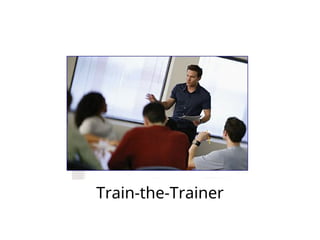
Train-the-Trainer
Surprise!!!
 Introduce yourself in the most creative
way
 In 5 minutes, explain to the audience
how to make a paper airplane
 You have 5 minutes to do the
preparation
Let’s Recap…
 What had happened?
 How do you feel?
 How do you rate your training session?
 What you want to learn today?
Module Learning Objectives
At the end of the module, participants should be
able to;
 Understand and apply adult learning principle
 Do the necessary preparation for training
 Write lesson plan and organize training
contents
 Facilitate training session
 Deliver training effectively
 Interact well with audience
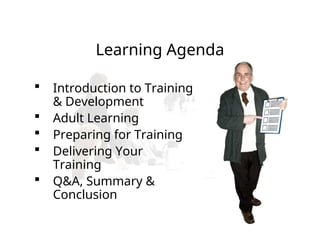
Learning Agenda
 Introduction to Training
& Development
 Adult Learning
 Preparing for Training
 Delivering Your
Training
 Q&A, Summary &
Conclusion
Life as a Trainer…
 Can you stand on your feet all day?
 Are you willing to work more than eight hour days
and 40 hour weeks?
 Can you stand on your feet and be on your toes all
day?
 Can you give and not receive?
 Are you the role model?
 Can you deal with the constant logistic issues?
 Can you cheer even without management support?
 Can you deliver hard feedback?
 Can you identify issues, document them, identify
solutions and make improvements?
Definition of Training
Training - improving the knowledge,
skills and attitudes of employees for
the short-term, particular to a specific
job or task.– e.g.,
 Employee orientation
 Skills & technical training
 Coaching
 Counseling
Definition of Development
•Development - planned program
preparing the employees for future
responsibilities, while increasing the
capacity to perform at a current job
 Management Training (DRM)
 Supervisor development (CRM)
Definition of Training & Development
 Planned programs to equip the
employees with necessary knowledge,
skills & attitude for them to perform
current job effectively and efficiently, as
well as to prepare them for future
responsibilities
Knowledge, Skill & Ability (KSA)
• Knowledge - information we place into memory
(i.e.: company rules, process & procedure,
management theory & practice, etc.)
• Skill - capacities needed to perform a set of
tasks that are developed as a result of training
and experience
• Ability - the quality of being able to perform; a
quality that permits or facilitates achievement
or accomplishment
Trainer, Coach & Facilitator
• Trainer - one who trains other persons
• Coach - Someone who assist others to
learn a skill or task. A person who gives
private instruction
• Facilitator - individual who enables
groups and organizations to work and
learn more effectively; to collaborate and
achieve synergy
WHICH IS YOU?
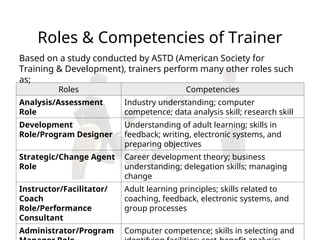
Roles & Competencies of Trainer
Roles Competencies
Analysis/Assessment
Role
Industry understanding; computer
competence; data analysis skill; research skill
Development
Role/Program Designer
Understanding of adult learning; skills in
feedback; writing, electronic systems, and
preparing objectives
Strategic/Change Agent
Role
Career development theory; business
understanding; delegation skills; managing
change
Instructor/Facilitator/
Coach
Role/Performance
Consultant
Adult learning principles; skills related to
coaching, feedback, electronic systems, and
group processes
Administrator/Program Computer competence; skills in selecting and
Based on a study conducted by ASTD (American Society for
Training & Development), trainers perform many other roles such
as;
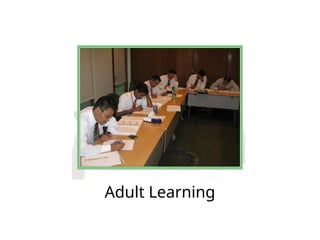
Adult Learning
Adult Learning Principles
 Reasons to learn and re-learn
 Learning is by doing
 •Tell Them, Show Them, They Tell You,
They Show You (OJT)
 What, Why, How, Where & When
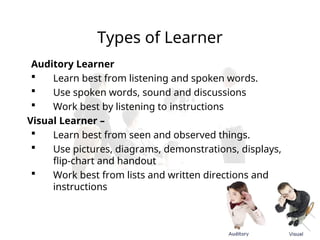
Types of Learner
Auditory Learner
 Learn best from listening and spoken words.
 Use spoken words, sound and discussions
 Work best by listening to instructions
Visual Learner –
 Learn best from seen and observed things.
 Use pictures, diagrams, demonstrations, displays,
flip-chart and handout
 Work best from lists and written directions and
instructions
Types of Learner
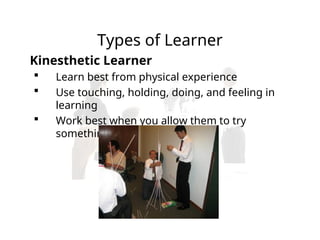
Kinesthetic Learner
 Learn best from physical experience
 Use touching, holding, doing, and feeling in
learning
 Work best when you allow them to try
something
How to Help Adult Learns?
 Learn by doing
 Learn by solving practical problems
 Learn through the application of past
experience
 Learn best in an informal environment
 Through a variety of training method
Teacher vs Trainer
• Teacher
 Tell them what you are going to tell
them
 Tell them what you are telling them
 Tell them what you’ve told them
Teacher vs Trainer
• Trainer
 Ask them what they’ve done
 Tell them what they are going to do
 Show them what they are going to do
 Let them do it
 Let them do it some more
 Ask them what they’ve just done
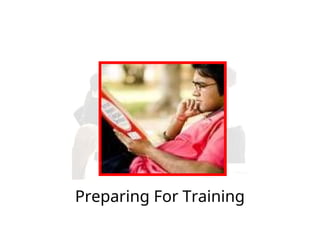
Preparing For Training
Preparation: Create a check list
 You will conduct Merchandising training for
your new stockers next week
 The training will be conducted in 1 day. First
half will be in the classroom, and second half
will be at the selling floor for practical session
 In pair, prepare the checklist for the training
 Write in the flipchart paper and present it
 Time given is 15 minutes
Course Outline & Lesson Plan
 Introduction - Agenda, Objective,
Expectations
 Contents - What, Why, How, When & Where
 Conclusion - Recap & Wrap-up
Exercise
 Refer to the handout
 Arrange the slides accordingly
 Justify and share your answer
 Time given is 10 minutes
Introduction
General guidelines
 Write notes on index card
 Eye contact
 Drink water if you are thirsty. Not iced water
 Vary your voice – pitch, volume, short
dramatic pauses, speed of delivery
 Watch your language! Use everyday language,
friendly
 Mannerism - avoid adjust your clothes,
scratch your ear or nose, brush back your hair
Introduction: gain attention
 Open with high energy, animation and
enthusiasm
 Give the audience an overview - tell
them the big picture
 Be aware of your appearance
 Be aware of your voice - tone, accent,
pace and speed, choice of word
Take One, Ready & Action!!!
 Select one topic/subject you are familiar
with
 Visualize that you are going to conduct
the training on the topic/subject
 Prepare an introduction of the training
 Time given is 5 minutes
 Present your Introduction
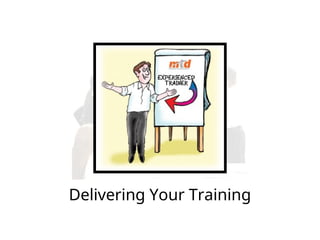
Delivering Your Training
Delivery Skills
• Verbal
 Pleasant
 Natural
 Dynamic
 Expressive
 Easily heard
• Nonverbal Delivery Skills
 Posture, confidence, alert
 hand gesture
 body movement, step forward, a step
backward, lateral movement
 facial expression
 eye contact
Delivery Skills
• Delivery of Contents
 Step by step
 Clear and concise
 Tell them why
 Stress key points
 Avoid jargon and buzz words
 Speak at moderate speed
Delivery Skills
How to Make Your Delivery Interesting?
 Quotation
 Challenging questions
 Stories and description of incidents
 Activities
 Visuals props
 Motivate your audience
How to Motivate Your Audience?
 Tell a story
 Use natural humor
 Unusual statistics
 Know their level of knowledge
 Speak their language
 Variety in a presentation - consistent
& inconsistent
 Create a need - WIIFM
 Get yourself excited - eye contact and make
yourself available before session, at breaks
and after session
 Establish a long range objectives - see
bigger pictures like the overall presentation
 Apply contents to life - role play and action
plans
How to Motivate Your Audience?
 Know their level of knowledge
 Speak their language
 Variety in a presentation
How to do this?
 Observe & learn from good instructors
 Practice
How to Motivate Your Audience?
Take Two, Ready & Action!!!
 Refer to your handout
 Deliver the topic in 5 minutes
 Time given is 5 minutes
 Present the topic
 Observe and give feedback
Transition
 Physical movement
 Use of media
 Change of Media
 Mini-Summary
 Q&A
 Pause
Use of Multimedia
• Presentation Slides & Flip Chart
 Write big and well
 Use color - red for underline,
black/blue/green for main text
 Use exact words,
 Face your audience,
 Post them
 Use symbol, box and bullet points
Facilitation Skills
 Set ground rules
 Learn to wait before responding - count to
10
 Redirect questions to the group
 Use the energy of the group - rest, humor,
stretch break
 Avoid making judgment statements - How
can you do that?
 Listen attentively - look into their eyes
 Paraphrase to clarify
 Use flipchart - keep track of ideas. KISS
 Combine - don’t just record. Get comment
and build on each other’s thought
 Summarize periodically
 Park it - parking lot
 Give reinforcement – verbal and non
verbal – thank you and thumb up
Facilitation Skills
 Check for understanding
 Ask participants to summarize
 Ask others for opinion
 Summarize and move on
Facilitation Skills
Demo & Role Play
 Position the employee correctly
 Explain the objective and steps
 Demo first the overall process
 Demo each & next step slowly, explain
each step elaborately and verify
understanding
 Practice and feedback
 Summary
Verify the Trainees Understanding
• Ask for questions
 Any questions before we move on?
 Anything I need to clarify further?
 Wait for questions
• Have trainee repeat instructions
 Anyone can tell me the complete steps?
 Praise them if they do it well
•Test verbally for understanding
 keep question short and to the point
 usually 2 to 3 questions
 gain confidence and making progress
Example: What is GST? Why we should
practice GST? How to do GST?
Verify the Trainees Understanding
Summary and Closing
 Ask questions
 Check parking lot
 Summarize any follow up action items
required of you
 Summarize key points
Last Scene, Final Take, Ready & Action!!!
The Challenge
 Choose one topic in training module
The Roles of Manager
 Prepare for 5 minutes delivery and 2
minutes Q&A session
 Present the topic
 Observe and give feedback
 Time given is 10 minutes
Q & A

Comprehensive Risk Management - Train The Trainer

  • 1.
  • 2.
    Surprise!!!  Introduce yourselfin the most creative way  In 5 minutes, explain to the audience how to make a paper airplane  You have 5 minutes to do the preparation
  • 3.
    Let’s Recap…  Whathad happened?  How do you feel?  How do you rate your training session?  What you want to learn today?
  • 4.
    Module Learning Objectives Atthe end of the module, participants should be able to;  Understand and apply adult learning principle  Do the necessary preparation for training  Write lesson plan and organize training contents  Facilitate training session  Deliver training effectively  Interact well with audience
  • 5.
    Learning Agenda  Introductionto Training & Development  Adult Learning  Preparing for Training  Delivering Your Training  Q&A, Summary & Conclusion
  • 6.
    Life as aTrainer…  Can you stand on your feet all day?  Are you willing to work more than eight hour days and 40 hour weeks?  Can you stand on your feet and be on your toes all day?  Can you give and not receive?  Are you the role model?  Can you deal with the constant logistic issues?  Can you cheer even without management support?  Can you deliver hard feedback?  Can you identify issues, document them, identify solutions and make improvements?
  • 7.
    Definition of Training Training- improving the knowledge, skills and attitudes of employees for the short-term, particular to a specific job or task.– e.g.,  Employee orientation  Skills & technical training  Coaching  Counseling
  • 8.
    Definition of Development •Development- planned program preparing the employees for future responsibilities, while increasing the capacity to perform at a current job  Management Training (DRM)  Supervisor development (CRM)
  • 9.
    Definition of Training& Development  Planned programs to equip the employees with necessary knowledge, skills & attitude for them to perform current job effectively and efficiently, as well as to prepare them for future responsibilities
  • 10.
    Knowledge, Skill &Ability (KSA) • Knowledge - information we place into memory (i.e.: company rules, process & procedure, management theory & practice, etc.) • Skill - capacities needed to perform a set of tasks that are developed as a result of training and experience • Ability - the quality of being able to perform; a quality that permits or facilitates achievement or accomplishment
  • 11.
    Trainer, Coach &Facilitator • Trainer - one who trains other persons • Coach - Someone who assist others to learn a skill or task. A person who gives private instruction • Facilitator - individual who enables groups and organizations to work and learn more effectively; to collaborate and achieve synergy WHICH IS YOU?
  • 12.
    Roles & Competenciesof Trainer Roles Competencies Analysis/Assessment Role Industry understanding; computer competence; data analysis skill; research skill Development Role/Program Designer Understanding of adult learning; skills in feedback; writing, electronic systems, and preparing objectives Strategic/Change Agent Role Career development theory; business understanding; delegation skills; managing change Instructor/Facilitator/ Coach Role/Performance Consultant Adult learning principles; skills related to coaching, feedback, electronic systems, and group processes Administrator/Program Computer competence; skills in selecting and Based on a study conducted by ASTD (American Society for Training & Development), trainers perform many other roles such as;
  • 13.
  • 14.
    Adult Learning Principles Reasons to learn and re-learn  Learning is by doing  •Tell Them, Show Them, They Tell You, They Show You (OJT)  What, Why, How, Where & When
  • 15.
    Types of Learner AuditoryLearner  Learn best from listening and spoken words.  Use spoken words, sound and discussions  Work best by listening to instructions Visual Learner –  Learn best from seen and observed things.  Use pictures, diagrams, demonstrations, displays, flip-chart and handout  Work best from lists and written directions and instructions
  • 16.
    Types of Learner KinestheticLearner  Learn best from physical experience  Use touching, holding, doing, and feeling in learning  Work best when you allow them to try something
  • 17.
    How to HelpAdult Learns?  Learn by doing  Learn by solving practical problems  Learn through the application of past experience  Learn best in an informal environment  Through a variety of training method
  • 18.
    Teacher vs Trainer •Teacher  Tell them what you are going to tell them  Tell them what you are telling them  Tell them what you’ve told them
  • 19.
    Teacher vs Trainer •Trainer  Ask them what they’ve done  Tell them what they are going to do  Show them what they are going to do  Let them do it  Let them do it some more  Ask them what they’ve just done
  • 20.
  • 21.
    Preparation: Create acheck list  You will conduct Merchandising training for your new stockers next week  The training will be conducted in 1 day. First half will be in the classroom, and second half will be at the selling floor for practical session  In pair, prepare the checklist for the training  Write in the flipchart paper and present it  Time given is 15 minutes
  • 22.
    Course Outline &Lesson Plan  Introduction - Agenda, Objective, Expectations  Contents - What, Why, How, When & Where  Conclusion - Recap & Wrap-up
  • 23.
    Exercise  Refer tothe handout  Arrange the slides accordingly  Justify and share your answer  Time given is 10 minutes
  • 24.
    Introduction General guidelines  Writenotes on index card  Eye contact  Drink water if you are thirsty. Not iced water  Vary your voice – pitch, volume, short dramatic pauses, speed of delivery  Watch your language! Use everyday language, friendly  Mannerism - avoid adjust your clothes, scratch your ear or nose, brush back your hair
  • 25.
    Introduction: gain attention Open with high energy, animation and enthusiasm  Give the audience an overview - tell them the big picture  Be aware of your appearance  Be aware of your voice - tone, accent, pace and speed, choice of word
  • 26.
    Take One, Ready& Action!!!  Select one topic/subject you are familiar with  Visualize that you are going to conduct the training on the topic/subject  Prepare an introduction of the training  Time given is 5 minutes  Present your Introduction
  • 27.
  • 28.
    Delivery Skills • Verbal Pleasant  Natural  Dynamic  Expressive  Easily heard
  • 29.
    • Nonverbal DeliverySkills  Posture, confidence, alert  hand gesture  body movement, step forward, a step backward, lateral movement  facial expression  eye contact Delivery Skills
  • 30.
    • Delivery ofContents  Step by step  Clear and concise  Tell them why  Stress key points  Avoid jargon and buzz words  Speak at moderate speed Delivery Skills
  • 31.
    How to MakeYour Delivery Interesting?  Quotation  Challenging questions  Stories and description of incidents  Activities  Visuals props  Motivate your audience
  • 32.
    How to MotivateYour Audience?  Tell a story  Use natural humor  Unusual statistics  Know their level of knowledge  Speak their language  Variety in a presentation - consistent & inconsistent
  • 33.
     Create aneed - WIIFM  Get yourself excited - eye contact and make yourself available before session, at breaks and after session  Establish a long range objectives - see bigger pictures like the overall presentation  Apply contents to life - role play and action plans How to Motivate Your Audience?
  • 34.
     Know theirlevel of knowledge  Speak their language  Variety in a presentation How to do this?  Observe & learn from good instructors  Practice How to Motivate Your Audience?
  • 35.
    Take Two, Ready& Action!!!  Refer to your handout  Deliver the topic in 5 minutes  Time given is 5 minutes  Present the topic  Observe and give feedback
  • 36.
    Transition  Physical movement Use of media  Change of Media  Mini-Summary  Q&A  Pause
  • 37.
    Use of Multimedia •Presentation Slides & Flip Chart  Write big and well  Use color - red for underline, black/blue/green for main text  Use exact words,  Face your audience,  Post them  Use symbol, box and bullet points
  • 38.
    Facilitation Skills  Setground rules  Learn to wait before responding - count to 10  Redirect questions to the group  Use the energy of the group - rest, humor, stretch break  Avoid making judgment statements - How can you do that?  Listen attentively - look into their eyes
  • 39.
     Paraphrase toclarify  Use flipchart - keep track of ideas. KISS  Combine - don’t just record. Get comment and build on each other’s thought  Summarize periodically  Park it - parking lot  Give reinforcement – verbal and non verbal – thank you and thumb up Facilitation Skills
  • 40.
     Check forunderstanding  Ask participants to summarize  Ask others for opinion  Summarize and move on Facilitation Skills
  • 41.
    Demo & RolePlay  Position the employee correctly  Explain the objective and steps  Demo first the overall process  Demo each & next step slowly, explain each step elaborately and verify understanding  Practice and feedback  Summary
  • 42.
    Verify the TraineesUnderstanding • Ask for questions  Any questions before we move on?  Anything I need to clarify further?  Wait for questions • Have trainee repeat instructions  Anyone can tell me the complete steps?  Praise them if they do it well
  • 43.
    •Test verbally forunderstanding  keep question short and to the point  usually 2 to 3 questions  gain confidence and making progress Example: What is GST? Why we should practice GST? How to do GST? Verify the Trainees Understanding
  • 44.
    Summary and Closing Ask questions  Check parking lot  Summarize any follow up action items required of you  Summarize key points
  • 45.
    Last Scene, FinalTake, Ready & Action!!!
  • 46.
    The Challenge  Chooseone topic in training module The Roles of Manager  Prepare for 5 minutes delivery and 2 minutes Q&A session  Present the topic  Observe and give feedback  Time given is 10 minutes
  • 47.

Editor's Notes
  • #33 WIIFM – What’s In It For Me?
  • #39 KISS – Keep It Short & Simple, Keep It Simple & Straight forward