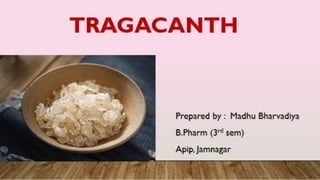
TRAGACANTH
Synonyms :
• Gum tragacanth, tragacanth
Biological source :
• It is the dried gummy exudation obtained by incision from stem
and branches of Astragalus gummifer L., Astragalus
membranaceus, and other species of Astragalus, Family
Leguminosae.
Geographical source :
• It is obtained from Iran, Greexe, Turkey, Iraq, Syria, In India,
Garhwal, Kumaon and Punjab this species is found.
Description :
Colour : white or pale yellowish
Odour : Odourless
Taste : Mucilaginous
Shape : Thin, flattened ribbon like flakes, more or less curved.
Size. : 25×12×2 mm in size.
• The gum is horny,translucent,with transverse and longitudinal
ridges. Fractures of drug is short.
• It is partly soluble in water and insoluble in alcohol.
Cultivation and Collection :
• The shrubs of tragacanth are grown altitude of 1000 – 3000 m
and they are thorny.
• The gum is exuding out immediately after injury to plants.
• Tragacanth gum is formed as a result of transformation of the cell
of pith and medullary rays into gummy substance.
• Incisions are made on various parts of stem.
• The fluid which oozes out, is called tragacanth and it is collected
after drying.
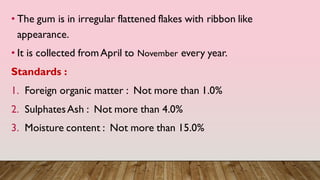
• The gum is in irregular flattened flakes with ribbon like
appearance.
• It is collected fromApril to November every year.
Standards :
1. Foreign organic matter : Not more than 1.0%
2. SulphatesAsh : Not more than 4.0%
3. Moisture content : Not more than 15.0%
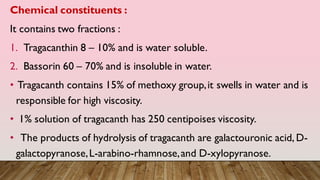
Chemical constituents :
It contains two fractions :
1. Tragacanthin 8 – 10% and is water soluble.
2. Bassorin 60 – 70% and is insoluble in water.
• Tragacanth contains 15% of methoxy group,it swells in water and is
responsible for high viscosity.
• 1% solution of tragacanth has 250 centipoises viscosity.
• The products of hydrolysis of tragacanth are galactouronic acid, D-
galactopyranose,L-arabino-rhamnose,and D-xylopyranose.
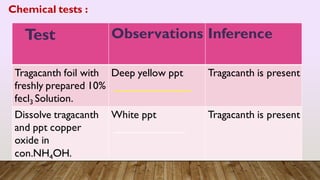
Chemical tests :
Test Observations Inference
Tragacanth foil with
freshly prepared 10%
fecl3 Solution.
Deep yellow ppt
_____________
Tragacanth is present
Dissolve tragacanth
and ppt copper
oxide in
con.NH4OH.
White ppt
____________
Tragacanth is present
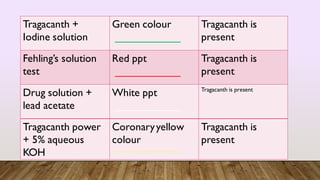
Tragacanth +
Iodine solution
Green colour
___________
Tragacanth is
present
Fehling’s solution
test
Red ppt
___________
Tragacanth is
present
Drug solution +
lead acetate
White ppt
___________
Tragacanth is present
Tragacanth power
+ 5% aqueous
KOH
Coronaryyellow
colour
______________________
Tragacanth is
present
Uses :
• It is used as a demulcent,emollient, thickening, suspending,
emulsifying agent.
• Mucilage of tragacanth is used a binding agent in tables and
excipient in the pills.
• Powder of tragacanth is used as an adhesive,in lotions for
external use,in spermicidal jellies, stabilizer in ice-crem sances.
Substitutes and Adulterations :
• Tragacanth gum of lower grades is used in textile industries and
in the pickles.. Citral gum & Shirij gum are the substitutes.
Tragacanth 2

Tragacanth 2

  • 1.
  • 2.
    Synonyms : • Gumtragacanth, tragacanth Biological source : • It is the dried gummy exudation obtained by incision from stem and branches of Astragalus gummifer L., Astragalus membranaceus, and other species of Astragalus, Family Leguminosae. Geographical source : • It is obtained from Iran, Greexe, Turkey, Iraq, Syria, In India, Garhwal, Kumaon and Punjab this species is found.
  • 3.
    Description : Colour :white or pale yellowish Odour : Odourless Taste : Mucilaginous Shape : Thin, flattened ribbon like flakes, more or less curved. Size. : 25×12×2 mm in size. • The gum is horny,translucent,with transverse and longitudinal ridges. Fractures of drug is short. • It is partly soluble in water and insoluble in alcohol.
  • 4.
    Cultivation and Collection: • The shrubs of tragacanth are grown altitude of 1000 – 3000 m and they are thorny. • The gum is exuding out immediately after injury to plants. • Tragacanth gum is formed as a result of transformation of the cell of pith and medullary rays into gummy substance. • Incisions are made on various parts of stem. • The fluid which oozes out, is called tragacanth and it is collected after drying.
  • 5.
    • The gumis in irregular flattened flakes with ribbon like appearance. • It is collected fromApril to November every year. Standards : 1. Foreign organic matter : Not more than 1.0% 2. SulphatesAsh : Not more than 4.0% 3. Moisture content : Not more than 15.0%
  • 6.
    Chemical constituents : Itcontains two fractions : 1. Tragacanthin 8 – 10% and is water soluble. 2. Bassorin 60 – 70% and is insoluble in water. • Tragacanth contains 15% of methoxy group,it swells in water and is responsible for high viscosity. • 1% solution of tragacanth has 250 centipoises viscosity. • The products of hydrolysis of tragacanth are galactouronic acid, D- galactopyranose,L-arabino-rhamnose,and D-xylopyranose.
  • 7.
    Chemical tests : TestObservations Inference Tragacanth foil with freshly prepared 10% fecl3 Solution. Deep yellow ppt _____________ Tragacanth is present Dissolve tragacanth and ppt copper oxide in con.NH4OH. White ppt ____________ Tragacanth is present
  • 8.
    Tragacanth + Iodine solution Greencolour ___________ Tragacanth is present Fehling’s solution test Red ppt ___________ Tragacanth is present Drug solution + lead acetate White ppt ___________ Tragacanth is present Tragacanth power + 5% aqueous KOH Coronaryyellow colour ______________________ Tragacanth is present
  • 9.
    Uses : • Itis used as a demulcent,emollient, thickening, suspending, emulsifying agent. • Mucilage of tragacanth is used a binding agent in tables and excipient in the pills. • Powder of tragacanth is used as an adhesive,in lotions for external use,in spermicidal jellies, stabilizer in ice-crem sances. Substitutes and Adulterations : • Tragacanth gum of lower grades is used in textile industries and in the pickles.. Citral gum & Shirij gum are the substitutes.