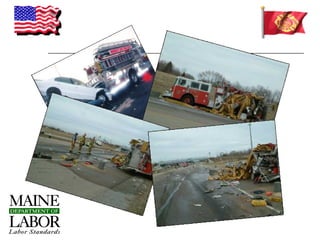
At Scene
TRAFFIC SAFETY
Special Thanks
   Freeport Fire Department
   Maine Dept. of Transportation
   Maine Municipal Association
   Presque Isle Fire Department
Mi
                                         sso
                                            uri
                                                       EM
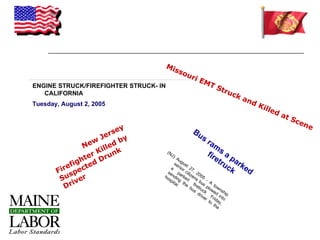
ENGINE STRUCK/FIREFIGHTER STRUCK- IN                     TS
                                                           tr u
   CALIFORNIA                                                   ck
                                                                   an
Tuesday, August 2, 2005                                               dK
                                                                         ille
                                                                             da
                                                                                tS
                                                                                  cen
                          y                                                             e
                      rse                          Bu
                    Je by                             s
                  w                                        ra
               Ne illed                                        m
                   K
                 er Drun
                         k             (N
                                         J)                f ir s a
              ht                           Au                  et pa
           fig ted                        se gus                 ru rk
          e                            a nior t 27                 ck ed
       Fir spec                      se pa citi , 20
                                   ho ndin rke zen 05
        Su iver                      sp g d          s
                                                        b - A
         Dr
                                        ita th
                                           l.   e fire us p to
                                                 bu tru low wn
                                                   s       c      ed shi
                                                       dr k
                                                         ive Fr int p
                                                             r    i    o
                                                               to day,
                                                                  the
Overview

   The training also identifies parking
    practices for
       Fire Rescue Apparatus
       Emergency Vehicles
       Provide maximum protection and safety
        for personnel operating in or near
        moving vehicle traffic.
       Practices to keep personnel safe
Objectives

   Maine Law
   MUTCD
   Liability
   Duration of Incidents
   Parts of a traffic control zone
   Proper devices
   Firefighter “Do’s and Don'ts
“Public Safety Traffic Flagger”
    “A municipal firefighter, a volunteer
     firefighter, or a member of an
     emergency medical service licensed by
     the Dept. of Public Safety, MEMS who is
     trained in accordance with subsection 2
     and authorized by the chief official of
     the fire department or emergency
     medical service to control vehicular
     traffic”
“Subsection 2--- training”
   “all PSTF’s must receive training
    approved by the Dept. of Labor, Bureau
    of Labor Standards in controlling traffic
    on public ways. Training may consist of
    video instruction, instruction in a
    classroom, distribution of informational
    handbooks, or other educational
    materials or other training materials.”
“Subsection 3--- authority”
   “….. a PSTF shall wear a reflective traffic
    vest or protective clothing as defined in
    26 MRSA § 2103(3), and has the
    authority to control vehicular traffic on a
    public way at or to reroute vehicular
    traffic around a public safety
    emergency, accident, fire……., unless
    otherwise directed by a law
    enforcement officer.”
Subsection 4
     “obeying the flagger”

   “….. an operator of a motor vehicle on a
    public way shall obey a request or
    signal of a person who is reasonable
    identifiable as a PSTF. A violation…… is
    a traffic violation.”
Manual on Uniform Traffic
Control Devices (MUTCD)
   NOT State law….but it is the national
    standard for all traffic control
   Federal law 23 CFR 655.603 adopts the
    MUTCD as “the national standard for all
    traffic control devices installed on any
    street, highway, or bicycle trail open to
    public travel.”
   The MUTCD “describes the application of
    traffic control devices, but shall not be a
    legal requirement for their installation.”
Intermediate Traffic Incidents
   Expected duration of 30 minutes to
    2 hours.
        Diverting traffic past the blockage.
        Using a Detour for a short duration.
        Be aware of your visibility to oncoming
         traffic
“Minor” Traffic Incidents
   Expected duration under 30 minutes
       Typically disabled vehicles and “fender
        benders”
       Diversion of traffic to other lanes is not
        needed or only needed briefly.
       If blocking a lane, move it to the
        shoulder as quickly as possible
Responder Safety Considerations
   Training– all responders directing traffic
    shall be trained.
   Worker Clothing – Responders exposed
    to the risks of moving traffic shall wear
    hi-visibility safety apparel meeting ANSI
    107-1999.
   Temp. traffic barriers – depends on
    type and length of the emergency, traffic
    volume & speed, time of day, type of
    road……
   Speed reduction – Emergency
    Responders, lane restrictions, etc.
Liability Exposures

   In addition to providing protection
    and safety for emergency personnel
    other considerations are:
       Through our actions, not causing or
        contributing to:
            Injury to the public
            Damage to other vehicles
            Damage to property
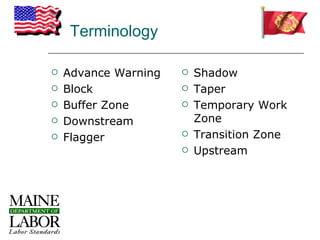
Terminology

   Advance Warning      Shadow
   Block                Taper
   Buffer Zone          Temporary Work
   Downstream            Zone
   Flagger              Transition Zone
                         Upstream
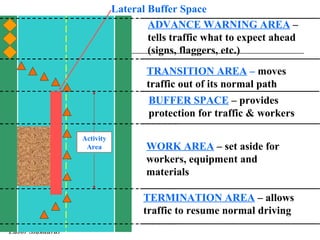
Lateral Buffer Space
                   ADVANCE WARNING AREA –
                   tells traffic what to expect ahead
                   (signs, flaggers, etc.)
                  TRANSITION AREA – moves
                  traffic out of its normal path
                   BUFFER SPACE – provides
                   protection for traffic & workers

Activity
 Area             WORK AREA – set aside for
                  workers, equipment and
                  materials

                  TERMINATION AREA – allows
                  traffic to resume normal driving
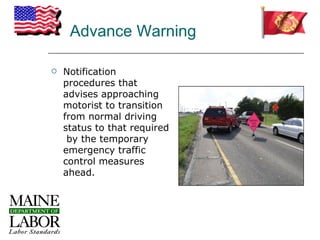
Advance Warning

   Notification
    procedures that
    advises approaching
    motorist to transition
    from normal driving
    status to that required
     by the temporary
    emergency traffic
    control measures
    ahead.
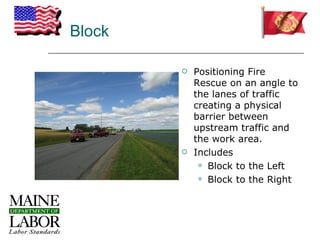
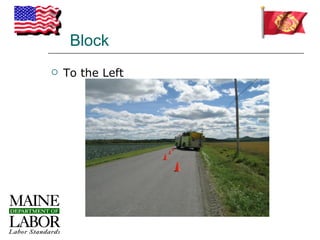
Block

           Positioning Fire
            Rescue on an angle to
            the lanes of traffic
            creating a physical
            barrier between
            upstream traffic and
            the work area.
           Includes
              Block to the Left

              Block to the Right
Block
   To the Left
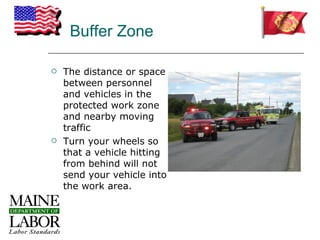
Buffer Zone

   The distance or space
    between personnel
    and vehicles in the
    protected work zone
    and nearby moving
    traffic
   Turn your wheels so
    that a vehicle hitting
    from behind will not
    send your vehicle into
    the work area.
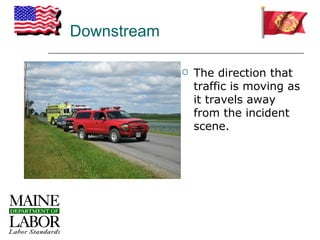
Downstream

                The direction that
                 traffic is moving as
                 it travels away
                 from the incident
                 scene.
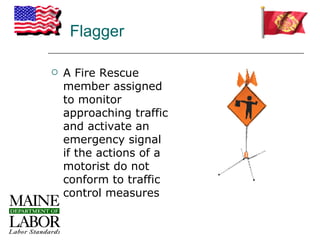
Flagger

   A Fire Rescue
    member assigned
    to monitor
    approaching traffic
    and activate an
    emergency signal
    if the actions of a
    motorist do not
    conform to traffic
    control measures
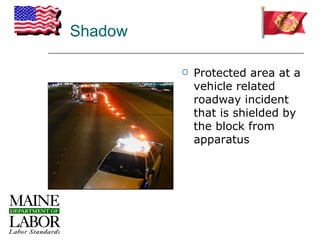
Shadow

            Protected area at a
             vehicle related
             roadway incident
             that is shielded by
             the block from
             apparatus
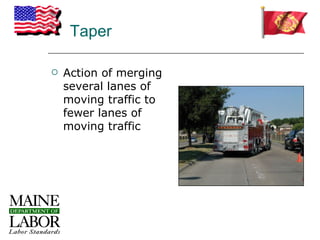
Taper

   Action of merging
    several lanes of
    moving traffic to
    fewer lanes of
    moving traffic
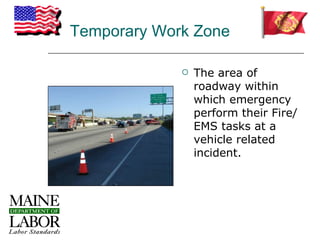
Temporary Work Zone

                The area of
                 roadway within
                 which emergency
                 perform their Fire/
                 EMS tasks at a
                 vehicle related
                 incident.
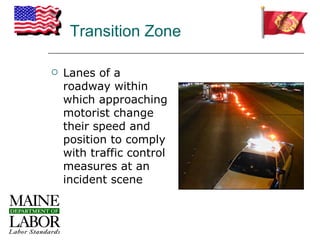
Transition Zone

   Lanes of a
    roadway within
    which approaching
    motorist change
    their speed and
    position to comply
    with traffic control
    measures at an
    incident scene
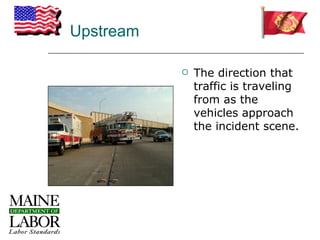
Upstream

              The direction that
               traffic is traveling
               from as the
               vehicles approach
               the incident scene.
Apparatus & Emergency Vehicle
     Benchmarks

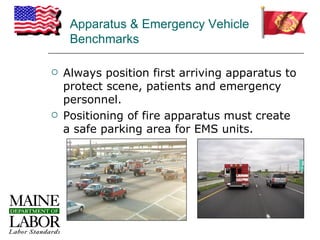
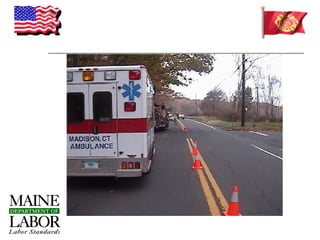
   Always position first arriving apparatus to
    protect scene, patients and emergency
    personnel.
   Positioning of fire apparatus must create
    a safe parking area for EMS units.
Apparatus & Emergency Vehicle
     Benchmarks

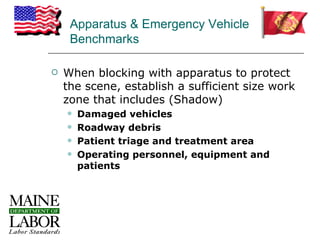
   When blocking with apparatus to protect
    the scene, establish a sufficient size work
    zone that includes (Shadow)
       Damaged vehicles
       Roadway debris
       Patient triage and treatment area
       Operating personnel, equipment and
        patients
Apparatus & Emergency Vehicle
     Benchmarks

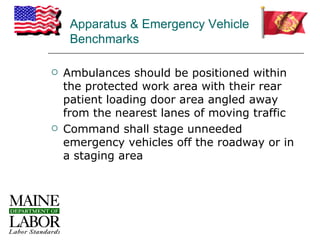
   Ambulances should be positioned within
    the protected work area with their rear
    patient loading door area angled away
    from the nearest lanes of moving traffic
   Command shall stage unneeded
    emergency vehicles off the roadway or in
    a staging area
Apparatus & Emergency Vehicle
     Benchmarks

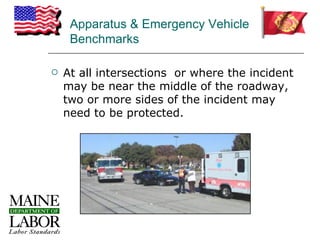
   At all intersections or where the incident
    may be near the middle of the roadway,
    two or more sides of the incident may
    need to be protected.
Apparatus & Emergency Vehicle
    Benchmarks

   Where a charged hoseline may be
    needed, block so the the pump
    panel is “downstream” to protect
    the pump operator
Apparatus & Emergency Vehicle
     Benchmarks

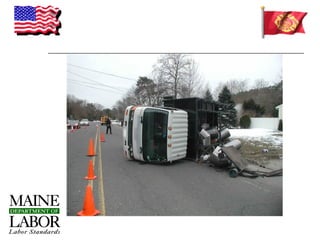
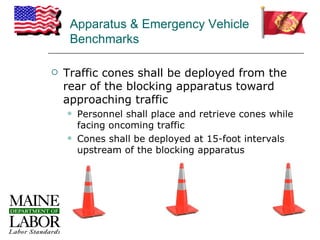
   Traffic cones shall be deployed from the
    rear of the blocking apparatus toward
    approaching traffic
       Personnel shall place and retrieve cones while
        facing oncoming traffic
       Cones shall be deployed at 15-foot intervals
        upstream of the blocking apparatus
Apparatus & Emergency Vehicle
     Benchmarks

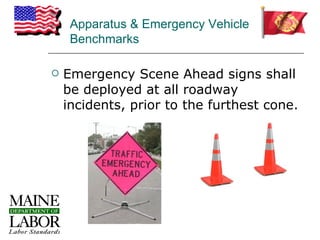
   Emergency Scene Ahead signs shall
    be deployed at all roadway
    incidents, prior to the furthest cone.
Incident Command Benchmarks

   The initial-arriving officer or
    member, and or Incident
    Commander must complete critical
    benchmarks to assure that a safe
    and protected work environment for
    emergency scene personnel is
    established.
Incident Command Benchmarks

   Assure that the first arriving apparatus
    establishes an initial block
   Assign parking location for all
    ambulances.
      Lanes shall be identified numerically as
       Breakdown, Lane 1, Lane 2.
      Typically, vehicles travel a lower speed
       in the lower number lanes
Incident Command Benchmarks

   Assign parking location for all
    ambulances.
      Directions “Right & Left” shall be as
       identified as from the approaching
       motorist point of view
      Instruct ambulance to block to the left
       or right to protect rear patient loading
       area.
Incident Command Benchmarks

   Assure that all ambulances on scene are
    placed within the protected work area.
    (Shadow)
   Assure that all patient loading into
    ambulances is done from within the
    protected work zone
   Operate as or assign a Scene Safety
    Officer
   Assure all traffic emitter devices are
    turned off.
Emergency Crew Personnel Benchmarks

   Always maintain an acute awareness of
    the high risk of working in or near moving
    traffic
   Never trust moving traffic
   Always look before you move(look both
    ways)
   NEVER turn your back to moving traffic.
   Exit & enter crew cabs from the protected
    side (shadow), away from traffic
Emergency Crew Personnel Benchmarks

   Protective clothing and Helmet must be
    donned prior to exiting the emergency
    vehicle
       Class II Vest or bunker coat with a Helmet as a
        minimum. (Full PPE when performing FF work)
Emergency Crew Personnel Benchmarks

   Always look before opening doors and
    stepping out of apparatus or emergency
    vehicles.
   Be alert when walking around apparatus.
       Stop at corner of the unit, check for traffic
       Stay on protected side when possible
       Maintain reduced profile when moving through
        any area where a minimum buffer zone exist.
Interstate Highway Operations

   State Police and DOT have a desire to
    keep the traffic moving on these
    roadways.
   When in the judgment of the IC it
    becomes essential for the safety of
    operating personnel and patients, any or
    all lanes can be shut down
   This should rarely occur and should be for
    a short period of time as practical
Interstate Highway Operations

   First arriving engine company shall
    establish an initial block of Lane 1 or Lane
    2.
       Traffic cones shall be placed farther apart with
        the last cone approximately 150 feet upstream
       Personnel shall place and retrieve cones while
        facing traffic
       “Emergency Scene Ahead” signs shall also be
        deployed at all highway incidents, prior to the
        furthest traffic cone.
Interstate Highway Operations

   Assign a flagger to monitor approaching
    traffic.
   Notify Command via radio of approaching
    traffic not responding to speed changes
   Police vehicles also used for advanced
    warning techniques
   Staging of additional companies off the
    highway may be required
Interstate Highway Operations

   Establish liaison with State Police as soon
    as possible to jointly coordinate a safe
    work zone
   Termination of the incident, removal of
    crews, apparatus and equipment must be
    done promptly to reduce exposure to
    moving traffic and minimize traffic
    congestion.
Officer’s Safe Parking
    “Cue Card”

   Block
       Block at least One Lane
       Block so pump panel is “Down Stream”
       Block most critical or highest traffic
        volume direction first
       Consider requesting addition PD units
        or Fire/Police
Officer’s Safe Parking
    “Cue Card”

   Crews wear proper PPE w/Helmet
       Bunker Coat or Class II vests at all
        times
       Helmet or hard hat at all times
Officer’s Safe Parking
    “Cue Card”

   Establish more than adequate
    advance warning.
       Traffic cones at 15’ intervals
       Deploy minimum 5 cones upstream
       Deploy “Emergency Scene Ahead” sign
        prior to last cone upstream
       Cones only Suggest, they don’t block
       Expand initial safe work zone
Officer’s Safe Parking
    “Cue Card”

   Direct placement of ambulances
       Assure ambulances park within shadow
        of larger apparatus as directed
       Lane 1 is furthest right lane, next is
        Lane 2 from approaching motorist’s
        point of view
       Direct ambulance to “block to the right
        or left” to protect loading doors
       All patient loading is done from within a
        protected work zone
Officer’s Safe Parking
     “Cue Card”

   Night or Reduced Light Conditions
       Turn off Headlights
       Turn off Traffic emitter
       Provide overall scene lighting
       All personnel in PPE w/helmets or vest
       Consider additional company for
        additional upstream block if necessary
Officer’s Safe Parking
    “Cue Card”

   Highway Operations
       Establish initial block of one lane
       Place cones and signs upstream of
        apparatus
       Last Cone 150’ upstream
       Deploy “Emergency Scene Ahead” sign
        prior to furthest cone
       Monitor approaching traffic
       Terminate incident aggressively
Traffic Control devices
   Signs
   Channelization Devices
   Lighting Devices
   Pavement Markers
Traffic Control Devices

Should meet 5 basic requirements
2. Fulfill the need

3. Command Attention

4. Convey a clear and simple meaning

5. Command respect from road users, and

6. Give appropriate time for response
   (reaction time)
Protective Clothing
   The outer garment shall have retro-
    reflective material which meets
    NFPA or ANSI standards.
   Firefighter helmet or hard hat with
    retro-reflective tape on front, sides
    and rear of helmet or hard hat.
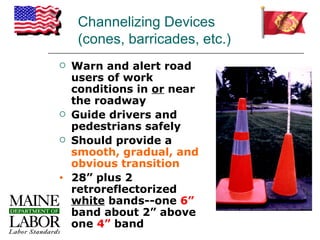
Channelizing Devices
     (cones, barricades, etc.)
   Warn and alert road
    users of work
    conditions in or near
    the roadway
   Guide drivers and
    pedestrians safely
   Should provide a
    smooth, gradual, and
    obvious transition
•   28” plus 2
    retroreflectorized
    white bands--one 6”
    band about 2” above
    one 4” band
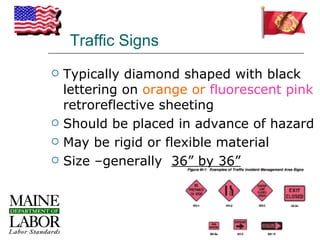
Traffic Signs
   Typically diamond shaped with black
    lettering on orange or fluorescent pink
    retroreflective sheeting
   Should be placed in advance of hazard
   May be rigid or flexible material
   Size –generally 36” by 36”
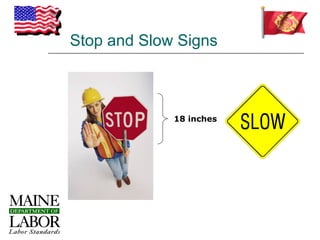
Stop and Slow Signs


             18 inches
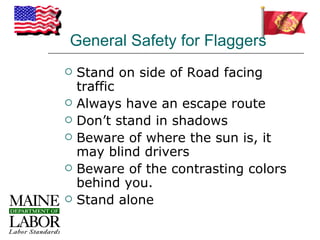
General Safety for Flaggers
   Stand on side of Road facing
    traffic
   Always have an escape route
   Don’t stand in shadows
   Beware of where the sun is, it
    may blind drivers
   Beware of the contrasting colors
    behind you.
   Stand alone
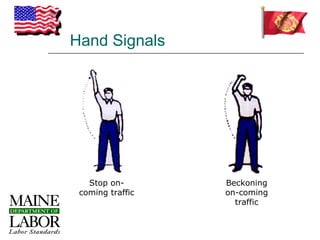
Hand Signals


   Stop on-       Beckoning
 coming traffic   on-coming
                    traffic
Safety Benchmarks

   Never trust approaching traffic
   NEVER turn your back to approaching
    traffic
   Establish an initial “Block” with first
    arriving fire apparatus
   Always wear firefighting helmet or hard
    hat with retro reflective tape.
   Wear Proper PPE
Safety Benchmarks

   Turn off sources of vision impairment to
    approaching motorist at nighttime
    incidents.
   Use apparatus or police vehicles to
    redirect the flow of moving traffic
   Establish advance warning upstream
   Use traffic cones and incident signs to
    control traffic direction
   Establish “Flagger” to monitor
    approaching traffic
Junior emergency
  personnel shall
 not be allowed to
   direct traffic.
   Under 18 years of age
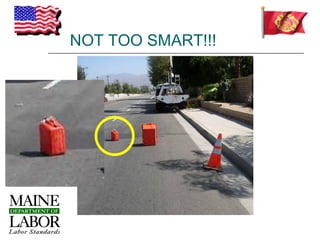
NOT TOO SMART!!!
Summary

 Protect   Yourself
 Protect your Scene

 Don’t Assume that all drivers
  will follow your directions.
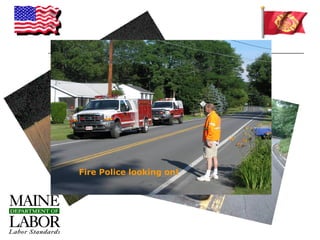
Fire Police looking on!
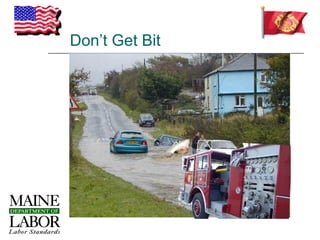
Don’t Get Bit
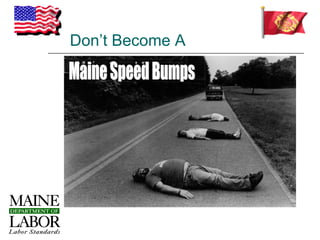
Don’t Become A

Traffic Control Training

  • 1.
  • 2.
    Special Thanks  Freeport Fire Department  Maine Dept. of Transportation  Maine Municipal Association  Presque Isle Fire Department
  • 3.
    Mi sso uri EM ENGINE STRUCK/FIREFIGHTER STRUCK- IN TS tr u CALIFORNIA ck an Tuesday, August 2, 2005 dK ille da tS cen y e rse Bu Je by s w ra Ne illed m K er Drun k (N J) f ir s a ht Au et pa fig ted se gus ru rk e a nior t 27 ck ed Fir spec se pa citi , 20 ho ndin rke zen 05 Su iver sp g d s b - A Dr ita th l. e fire us p to bu tru low wn s c ed shi dr k ive Fr int p r i o to day, the
  • 5.
    Overview  The training also identifies parking practices for  Fire Rescue Apparatus  Emergency Vehicles  Provide maximum protection and safety for personnel operating in or near moving vehicle traffic.  Practices to keep personnel safe
  • 6.
    Objectives  Maine Law  MUTCD  Liability  Duration of Incidents  Parts of a traffic control zone  Proper devices  Firefighter “Do’s and Don'ts
  • 7.
    “Public Safety TrafficFlagger”  “A municipal firefighter, a volunteer firefighter, or a member of an emergency medical service licensed by the Dept. of Public Safety, MEMS who is trained in accordance with subsection 2 and authorized by the chief official of the fire department or emergency medical service to control vehicular traffic”
  • 8.
    “Subsection 2--- training”  “all PSTF’s must receive training approved by the Dept. of Labor, Bureau of Labor Standards in controlling traffic on public ways. Training may consist of video instruction, instruction in a classroom, distribution of informational handbooks, or other educational materials or other training materials.”
  • 9.
    “Subsection 3--- authority”  “….. a PSTF shall wear a reflective traffic vest or protective clothing as defined in 26 MRSA § 2103(3), and has the authority to control vehicular traffic on a public way at or to reroute vehicular traffic around a public safety emergency, accident, fire……., unless otherwise directed by a law enforcement officer.”
  • 10.
    Subsection 4 “obeying the flagger”  “….. an operator of a motor vehicle on a public way shall obey a request or signal of a person who is reasonable identifiable as a PSTF. A violation…… is a traffic violation.”
  • 11.
    Manual on UniformTraffic Control Devices (MUTCD)  NOT State law….but it is the national standard for all traffic control  Federal law 23 CFR 655.603 adopts the MUTCD as “the national standard for all traffic control devices installed on any street, highway, or bicycle trail open to public travel.”  The MUTCD “describes the application of traffic control devices, but shall not be a legal requirement for their installation.”
  • 12.
    Intermediate Traffic Incidents  Expected duration of 30 minutes to 2 hours.  Diverting traffic past the blockage.  Using a Detour for a short duration.  Be aware of your visibility to oncoming traffic
  • 13.
    “Minor” Traffic Incidents  Expected duration under 30 minutes  Typically disabled vehicles and “fender benders”  Diversion of traffic to other lanes is not needed or only needed briefly.  If blocking a lane, move it to the shoulder as quickly as possible
  • 14.
    Responder Safety Considerations  Training– all responders directing traffic shall be trained.  Worker Clothing – Responders exposed to the risks of moving traffic shall wear hi-visibility safety apparel meeting ANSI 107-1999.  Temp. traffic barriers – depends on type and length of the emergency, traffic volume & speed, time of day, type of road……  Speed reduction – Emergency Responders, lane restrictions, etc.
  • 15.
    Liability Exposures  In addition to providing protection and safety for emergency personnel other considerations are:  Through our actions, not causing or contributing to:  Injury to the public  Damage to other vehicles  Damage to property
  • 16.
    Terminology  Advance Warning  Shadow  Block  Taper  Buffer Zone  Temporary Work  Downstream Zone  Flagger  Transition Zone  Upstream
  • 17.
    Lateral Buffer Space ADVANCE WARNING AREA – tells traffic what to expect ahead (signs, flaggers, etc.) TRANSITION AREA – moves traffic out of its normal path BUFFER SPACE – provides protection for traffic & workers Activity Area WORK AREA – set aside for workers, equipment and materials TERMINATION AREA – allows traffic to resume normal driving
  • 18.
    Advance Warning  Notification procedures that advises approaching motorist to transition from normal driving status to that required by the temporary emergency traffic control measures ahead.
  • 19.
    Block  Positioning Fire Rescue on an angle to the lanes of traffic creating a physical barrier between upstream traffic and the work area.  Includes  Block to the Left  Block to the Right
  • 20.
    Block  To the Left
  • 21.
    Buffer Zone  The distance or space between personnel and vehicles in the protected work zone and nearby moving traffic  Turn your wheels so that a vehicle hitting from behind will not send your vehicle into the work area.
  • 22.
    Downstream  The direction that traffic is moving as it travels away from the incident scene.
  • 23.
    Flagger  A Fire Rescue member assigned to monitor approaching traffic and activate an emergency signal if the actions of a motorist do not conform to traffic control measures
  • 24.
    Shadow  Protected area at a vehicle related roadway incident that is shielded by the block from apparatus
  • 25.
    Taper  Action of merging several lanes of moving traffic to fewer lanes of moving traffic
  • 26.
    Temporary Work Zone  The area of roadway within which emergency perform their Fire/ EMS tasks at a vehicle related incident.
  • 27.
    Transition Zone  Lanes of a roadway within which approaching motorist change their speed and position to comply with traffic control measures at an incident scene
  • 28.
    Upstream  The direction that traffic is traveling from as the vehicles approach the incident scene.
  • 29.
    Apparatus & EmergencyVehicle Benchmarks  Always position first arriving apparatus to protect scene, patients and emergency personnel.  Positioning of fire apparatus must create a safe parking area for EMS units.
  • 30.
    Apparatus & EmergencyVehicle Benchmarks  When blocking with apparatus to protect the scene, establish a sufficient size work zone that includes (Shadow)  Damaged vehicles  Roadway debris  Patient triage and treatment area  Operating personnel, equipment and patients
  • 31.
    Apparatus & EmergencyVehicle Benchmarks  Ambulances should be positioned within the protected work area with their rear patient loading door area angled away from the nearest lanes of moving traffic  Command shall stage unneeded emergency vehicles off the roadway or in a staging area
  • 32.
    Apparatus & EmergencyVehicle Benchmarks  At all intersections or where the incident may be near the middle of the roadway, two or more sides of the incident may need to be protected.
  • 33.
    Apparatus & EmergencyVehicle Benchmarks  Where a charged hoseline may be needed, block so the the pump panel is “downstream” to protect the pump operator
  • 34.
    Apparatus & EmergencyVehicle Benchmarks  Traffic cones shall be deployed from the rear of the blocking apparatus toward approaching traffic  Personnel shall place and retrieve cones while facing oncoming traffic  Cones shall be deployed at 15-foot intervals upstream of the blocking apparatus
  • 35.
    Apparatus & EmergencyVehicle Benchmarks  Emergency Scene Ahead signs shall be deployed at all roadway incidents, prior to the furthest cone.
  • 36.
    Incident Command Benchmarks  The initial-arriving officer or member, and or Incident Commander must complete critical benchmarks to assure that a safe and protected work environment for emergency scene personnel is established.
  • 37.
    Incident Command Benchmarks  Assure that the first arriving apparatus establishes an initial block  Assign parking location for all ambulances.  Lanes shall be identified numerically as Breakdown, Lane 1, Lane 2.  Typically, vehicles travel a lower speed in the lower number lanes
  • 38.
    Incident Command Benchmarks  Assign parking location for all ambulances.  Directions “Right & Left” shall be as identified as from the approaching motorist point of view  Instruct ambulance to block to the left or right to protect rear patient loading area.
  • 39.
    Incident Command Benchmarks  Assure that all ambulances on scene are placed within the protected work area. (Shadow)  Assure that all patient loading into ambulances is done from within the protected work zone  Operate as or assign a Scene Safety Officer  Assure all traffic emitter devices are turned off.
  • 40.
    Emergency Crew PersonnelBenchmarks  Always maintain an acute awareness of the high risk of working in or near moving traffic  Never trust moving traffic  Always look before you move(look both ways)  NEVER turn your back to moving traffic.  Exit & enter crew cabs from the protected side (shadow), away from traffic
  • 41.
    Emergency Crew PersonnelBenchmarks  Protective clothing and Helmet must be donned prior to exiting the emergency vehicle  Class II Vest or bunker coat with a Helmet as a minimum. (Full PPE when performing FF work)
  • 42.
    Emergency Crew PersonnelBenchmarks  Always look before opening doors and stepping out of apparatus or emergency vehicles.  Be alert when walking around apparatus.  Stop at corner of the unit, check for traffic  Stay on protected side when possible  Maintain reduced profile when moving through any area where a minimum buffer zone exist.
  • 43.
    Interstate Highway Operations  State Police and DOT have a desire to keep the traffic moving on these roadways.  When in the judgment of the IC it becomes essential for the safety of operating personnel and patients, any or all lanes can be shut down  This should rarely occur and should be for a short period of time as practical
  • 44.
    Interstate Highway Operations  First arriving engine company shall establish an initial block of Lane 1 or Lane 2.  Traffic cones shall be placed farther apart with the last cone approximately 150 feet upstream  Personnel shall place and retrieve cones while facing traffic  “Emergency Scene Ahead” signs shall also be deployed at all highway incidents, prior to the furthest traffic cone.
  • 45.
    Interstate Highway Operations  Assign a flagger to monitor approaching traffic.  Notify Command via radio of approaching traffic not responding to speed changes  Police vehicles also used for advanced warning techniques  Staging of additional companies off the highway may be required
  • 46.
    Interstate Highway Operations  Establish liaison with State Police as soon as possible to jointly coordinate a safe work zone  Termination of the incident, removal of crews, apparatus and equipment must be done promptly to reduce exposure to moving traffic and minimize traffic congestion.
  • 47.
    Officer’s Safe Parking “Cue Card”  Block  Block at least One Lane  Block so pump panel is “Down Stream”  Block most critical or highest traffic volume direction first  Consider requesting addition PD units or Fire/Police
  • 48.
    Officer’s Safe Parking “Cue Card”  Crews wear proper PPE w/Helmet  Bunker Coat or Class II vests at all times  Helmet or hard hat at all times
  • 49.
    Officer’s Safe Parking “Cue Card”  Establish more than adequate advance warning.  Traffic cones at 15’ intervals  Deploy minimum 5 cones upstream  Deploy “Emergency Scene Ahead” sign prior to last cone upstream  Cones only Suggest, they don’t block  Expand initial safe work zone
  • 50.
    Officer’s Safe Parking “Cue Card”  Direct placement of ambulances  Assure ambulances park within shadow of larger apparatus as directed  Lane 1 is furthest right lane, next is Lane 2 from approaching motorist’s point of view  Direct ambulance to “block to the right or left” to protect loading doors  All patient loading is done from within a protected work zone
  • 51.
    Officer’s Safe Parking “Cue Card”  Night or Reduced Light Conditions  Turn off Headlights  Turn off Traffic emitter  Provide overall scene lighting  All personnel in PPE w/helmets or vest  Consider additional company for additional upstream block if necessary
  • 52.
    Officer’s Safe Parking “Cue Card”  Highway Operations  Establish initial block of one lane  Place cones and signs upstream of apparatus  Last Cone 150’ upstream  Deploy “Emergency Scene Ahead” sign prior to furthest cone  Monitor approaching traffic  Terminate incident aggressively
  • 53.
    Traffic Control devices  Signs  Channelization Devices  Lighting Devices  Pavement Markers
  • 54.
    Traffic Control Devices Shouldmeet 5 basic requirements 2. Fulfill the need 3. Command Attention 4. Convey a clear and simple meaning 5. Command respect from road users, and 6. Give appropriate time for response (reaction time)
  • 55.
    Protective Clothing  The outer garment shall have retro- reflective material which meets NFPA or ANSI standards.  Firefighter helmet or hard hat with retro-reflective tape on front, sides and rear of helmet or hard hat.
  • 56.
    Channelizing Devices (cones, barricades, etc.)  Warn and alert road users of work conditions in or near the roadway  Guide drivers and pedestrians safely  Should provide a smooth, gradual, and obvious transition • 28” plus 2 retroreflectorized white bands--one 6” band about 2” above one 4” band
  • 57.
    Traffic Signs  Typically diamond shaped with black lettering on orange or fluorescent pink retroreflective sheeting  Should be placed in advance of hazard  May be rigid or flexible material  Size –generally 36” by 36”
  • 58.
    Stop and SlowSigns 18 inches
  • 59.
    General Safety forFlaggers  Stand on side of Road facing traffic  Always have an escape route  Don’t stand in shadows  Beware of where the sun is, it may blind drivers  Beware of the contrasting colors behind you.  Stand alone
  • 60.
    Hand Signals Stop on- Beckoning coming traffic on-coming traffic
  • 61.
    Safety Benchmarks  Never trust approaching traffic  NEVER turn your back to approaching traffic  Establish an initial “Block” with first arriving fire apparatus  Always wear firefighting helmet or hard hat with retro reflective tape.  Wear Proper PPE
  • 62.
    Safety Benchmarks  Turn off sources of vision impairment to approaching motorist at nighttime incidents.  Use apparatus or police vehicles to redirect the flow of moving traffic  Establish advance warning upstream  Use traffic cones and incident signs to control traffic direction  Establish “Flagger” to monitor approaching traffic
  • 63.
    Junior emergency personnel shall not be allowed to direct traffic. Under 18 years of age
  • 64.
  • 67.
    Summary  Protect Yourself  Protect your Scene  Don’t Assume that all drivers will follow your directions.
  • 68.
  • 70.
  • 71.