Newport Fire Department
Driver/Operator
Operating Emergency Vehicles
Division ofTraining
Update: April 2013
This Objective of this class is intended to teach
how to safely drive/operate an emergency
vehicle when responding to an incident
 4 Parts of the Comprehensive Program:
 Driving Regulation
 Driver/Operator safety tips
 Defensive driving techniques
 Driver Awareness Course
Overview
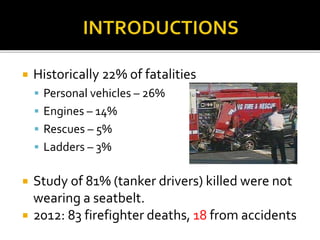
 Historically 22% of fatalities
 Personal vehicles – 26%
 Engines – 14%
 Rescues – 5%
 Ladders – 3%
 Study of 81% (tanker drivers) killed were not
wearing a seatbelt.
 2012: 83 firefighter deaths, 18 from accidents
 Prevention:
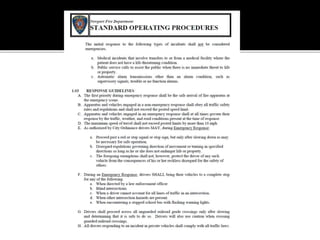
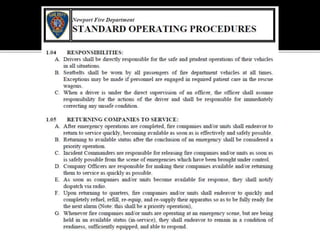
 Instituted the Emergency Response SOG
▪ (3-I-1 Emergency and Non-Emergency Response)
▪ Includes Seatbelt Use
 Enforcement:
 Officers and Drivers
▪ Both are responsible/liable for the crew
▪ Supervisor Liability – if training
inadequate.
 This lesson follows Pumping Apparatus
Driver/Operator certification according to:
 NFPA 1002 Standard for Fire Apparatus
Driver/Operator Professional Qualifications
1. List the five most common causes of fire
apparatus collisions
2. Regulations governing fire apparatus
driver/operators
3. VehicleOperations
4. Apparatus rider safety
5. Defensive DrivingTechniques
6. VehicleControl
7. Driver Awareness Course outline
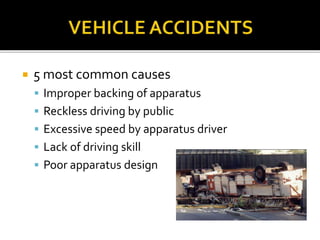
 5 most common causes
 Improper backing of apparatus
 Reckless driving by public
 Excessive speed by apparatus driver
 Lack of driving skill
 Poor apparatus design
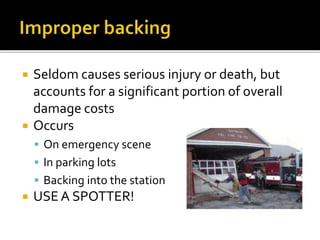
 Seldom causes serious injury or death, but
accounts for a significant portion of overall
damage costs
 Occurs
 On emergency scene
 In parking lots
 Backing into the station
 USE A SPOTTER!
 Failure to obey posted traffic regulations
 Failure to yield right of way
 Excessive speed
 Unpredictable behavior created by panic to
approaching emergency apparatus
 Inattentiveness
 Cell phones
 Radios
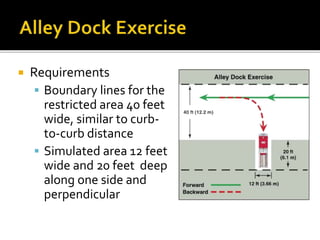
 Children
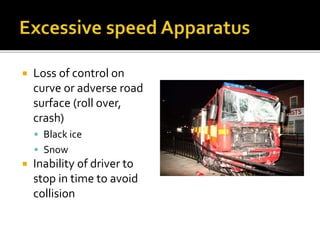
 Loss of control on
curve or adverse road
surface (roll over,
crash)
 Black ice
 Snow
 Inability of driver to
stop in time to avoid
collision
 Overconfidence in one’s driving ability
 It’s always the other guy that is a bad driver
 Inability to recognize a dangerous situation
 False sense of security because of good driving
record
 Misunderstanding of apparatus capabilities
▪ Turning radius
 Lack of knowledge about how to operate the
controls of the apparatus in an emergency
 Most often in “homebuilt” vehicles or local
mechanics
 Vehicles not baffled properly
 Liquid surges
 Maintenance
 Vehicle system failure, especially brakes
 Truck 1, Engine 2
 State
 City Ordinances
 Department policy
 Unless specifically exempt, fire apparatus are
subject to all statute, rule, regulations, or
ordinances that governs any vehicle operator
 Drivers must always exercise care for the
safety of others
 Regulations pertain to dry, clear roads during
daylight hours
 Adjust for wet roads, fog, darkness
 Special Privileges: RIGL 31-12-6
 Privilege, NOT a RIGHT!
 RIGL 31-12-7
 Park or stand, irrespective of any law
 Proceed past a red light or stop sign, but only after
slowing down as may be necessary for safe
operations
 May Exceed the speed limit, so long as does
not endanger life or property
 Disregard regulations governing direction of
movement, or turning
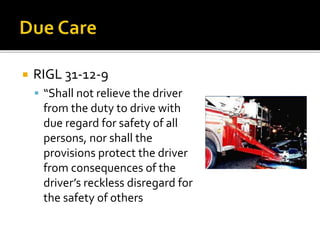
 RIGL 31-12-9
 “Shall not relieve the driver
from the duty to drive with
due regard for safety of all
persons, nor shall the
provisions protect the driver
from consequences of the
driver’s reckless disregard for
the safety of others
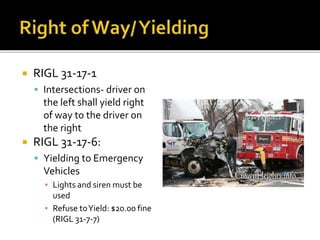
 RIGL 31-17-1
 Intersections- driver on
the left shall yield right
of way to the driver on
the right
 RIGL 31-17-6:
 Yielding to Emergency
Vehicles
▪ Lights and siren must be
used
▪ Refuse toYield: $20.00 fine
(RIGL 31-7-7)
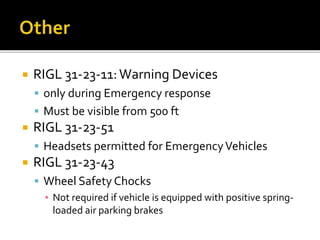
 RIGL 31-23-11:Warning Devices
 only during Emergency response
 Must be visible from 500 ft
 RIGL 31-23-51
 Headsets permitted for EmergencyVehicles
 RIGL 31-23-43
 Wheel Safety Chocks
▪ Not required if vehicle is equipped with positive spring-
loaded air parking brakes
NOT Exempt from laws that require a
stop for school buses with flashing
signal lights
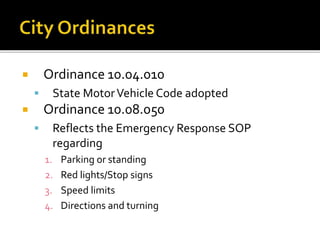
 Ordinance 10.04.010
 State MotorVehicle Code adopted
 Ordinance 10.08.050
 Reflects the Emergency Response SOP
regarding
1. Parking or standing
2. Red lights/Stop signs
3. Speed limits
4. Directions and turning
 If involved in a collision, both the driver and
department may be held liable
 Supervisory Liability (Officer) – SOP # 3-I-1
 Negligent Failure to Direct
 Negligent Assignment
 Negligent Failure to Discipline
Failure to provide knowledgeable
guidance, instruction, and/or
direction as how to properly perform
an action
• Not or inadequately providing training
Assigning (or allowing) an individual to
perform an act with the knowledge that
the individual is not competent to perform
that activity, or is not qualified or not
properly trained to perform a given
function
• ie. Allowing someone to drive apparatus that
has shown that they cannot “acceptably”
complete the Driver Competency Course
Failure to take proper corrective action
steps in order to insure that critical
infractions of rules or polices are not
repeated.
 Allowing personnel to drive through intersections
without stopping or reducing speed
▪ Discipline need not necessarily be harsh, but must be
sufficient to discourage repeat violations
 Driver must assure safety of all personnel on the
apparatus
 Don gear before getting into apparatus
 No riding on the tailboard
 Seatbelt use
 NFPA 1901 Fire Apparatus – requires a seat and belt for
all firefighters
 NFPA 1500: 3 exceptions to Seated or seat-belt use
1. Loading hose – driving forward
2. EMS call
3. PerformingTiller training
 Start as soon as possible so that it is warmed
up when rest of the crew is assembled and
ready to respond
 Let it idle as long as possible
 Consider response – road closings
 Do Not move the vehicle until all occupants
are within the cab, seated, and wearing a
seatbelt
 Accelerate gradually
 No need to stomp on the throttle
 Automatic transmissions downshift
automatically to prevent lugging.
 When ascending a steep grade, may downshift to
avoid the lugging
 Things in motion tend to remain in motion
 Whenever a vehicle undergoes a change in
speed or direction, weight transfer takes
place relative to the severity of change
 Weight carried on vehicle contributes to
skidding an rollover due to:
 Too much speed in turns
 Harsh or abrupt steering
 Driving on too steep slope
 Drivers respond better to sounds that change
pitch often, so short bursts with the air horns
or changing oscillation is best
 Be careful not to “outrun” the siren
 40 mph – siren can project 300 ft to front
 60 mph – audible only 12 ft or less in front
 Use discretion on type of call
 Psychiatric patient
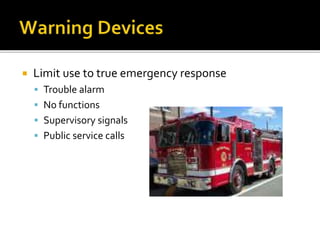
 Limit use to true emergency response
 Trouble alarm
 No functions
 Supervisory signals
 Public service calls
 Decrease speed gradually, keep off soft
shoulders
 Bridges, shady areas, northern slopes
become slippery first
 Test brakes to determine braking distance
 Increase following distances
 It takes 3 – 15 times more distance to stop a
vehicle in snow and ice than on dry surface
 Develop a safety-conscious attitude
 Remain calm and drive in a safe manner
 Do not drive recklessly or aggressively
 Do not DEMAND the right-of-way although
you may legally have it
 Be prepared to yield the right-of-way in the
interest of safety
 Strive to present a positive fire department
image at all times
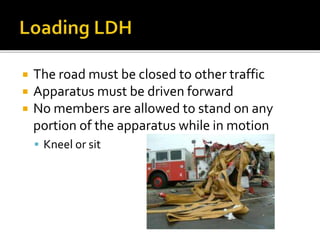
 The road must be closed to other traffic
 Apparatus must be driven forward
 No members are allowed to stand on any
portion of the apparatus while in motion
 Kneel or sit
 Avoid backing whenever possible
 Normally safer and sometimes quicker to drive
around the block
 Use at least 1 firefighter with a radio,
positioned on the drivers side, approx. 1
vehicle length behind, to warn of obstacles or
overhead objects
 No spotter, do not back up!
 Slow the apparatus at intersections, be
prepared to stop
 Even at a Green light
 Red lights/stop signs
 Slow down as necessary
 You are responsible if get into an accident
 Be alert to the unexpected
 Cars pulling out in front of you
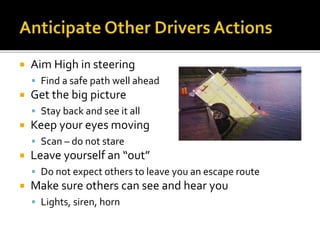
 Aim High in steering
 Find a safe path well ahead
 Get the big picture
 Stay back and see it all
 Keep your eyes moving
 Scan – do not stare
 Leave yourself an “out”
 Do not expect others to leave you an escape route
 Make sure others can see and hear you
 Lights, siren, horn
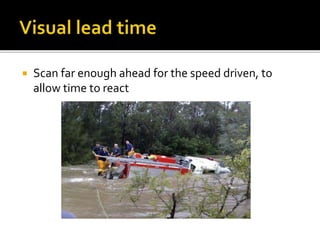
 Scan far enough ahead for the speed driven, to
allow time to react
 Avoid passing vehicles that do not pull over
 Always travel in the innermost lane on
multilane roads, if possible
 Avoid passing on the right
 People may try to pull over into you
 Avoid passing other emergency vehicles
 Let the slower vehicle move to the right, and
communicate intensions on the radio
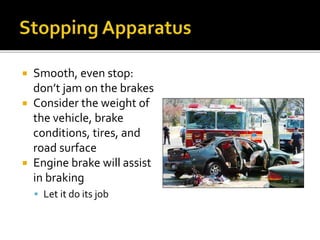
 Smooth, even stop:
don’t jam on the brakes
 Consider the weight of
the vehicle, brake
conditions, tires, and
road surface
 Engine brake will assist
in braking
 Let it do its job
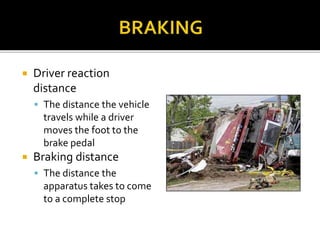
 Driver reaction
distance
 The distance the vehicle
travels while a driver
moves the foot to the
brake pedal
 Braking distance
 The distance the
apparatus takes to come
to a complete stop
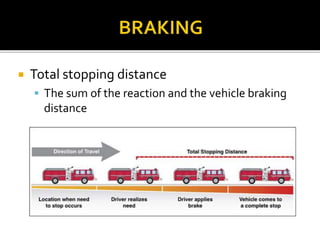
 Total stopping distance
 The sum of the reaction and the vehicle braking
distance
 Conditions of the road surface
 Dry, flat vs. wet, steep, icy, snow, or unpaved
 Speed being traveled
 Weight of the vehicle
 Type and condition of the vehicle braking
system
 Properly maintained vehicle will stop faster
 Driving too fast for road conditions
 Failing to appreciate weight shifts of
apparatus
 Failing to anticipate obstacles
 Improper use of aux braking devices
 Improper maintenance of tire pressure (over-
inflated tires)
 Improper maintenance of tire tread depth
 ABS: maintain a steady pressure on brake
pedal, do not pump
 Air brakes: slight delay between time from
pushing brake until sufficient air is sent to the
brake (approx 0.4 sec)
 No ABS, release brake, turn into the skid
 Once skid is controlled, apply power to allow
vehicle to get traction
 Front brake-limiting valve system
 Known as “Dry road/slippery road” switches
 Were intended to help maintain control on
slippery roads
 Reduced the air on the front steering axle by 50%,
when the switch was in slippery-road position,
preventing the front wheels from locking
▪ The switch reduced the breaking ability to 25%
 Turns itself on and off
 Decreases the engine speed as needed until
traction is acquired
 Reduces wheel over-spin
 Works in two ways:
 Wheel spins, the ATC applies air pressure to brake
the wheel, transferring torque to the wheels with
better traction
 Wheels spin: engine torque reduced
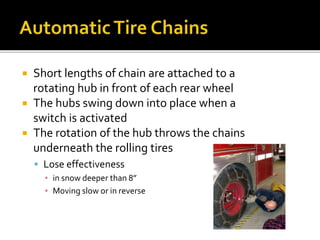
 Short lengths of chain are attached to a
rotating hub in front of each rear wheel
 The hubs swing down into place when a
switch is activated
 The rotation of the hub throws the chains
underneath the rolling tires
 Lose effectiveness
▪ in snow deeper than 8”
▪ Moving slow or in reverse
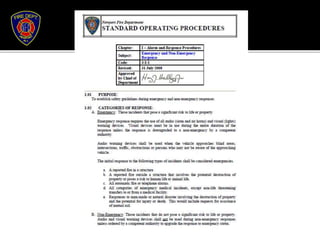
 Code # 1-IV-8
 Outlines the Procedures IF an accident occurs
during Emergency or Non-Emergency
conditions
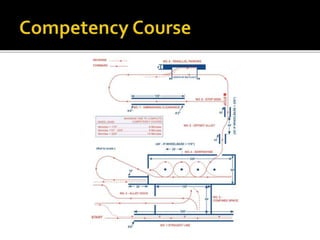
 NFPA 1002
 Straight line
 Confined SpaceTurnaround
 Alley Dock
 Serpentine Course
 Offset Alley
 Diminishing Clearance
 Stop Sign
 RoadTests
 To familiarize the driver with operating the
vehicle within close quarters both in forward
and reverse at a steady speed.
 To enable the driver to adjust the mirrors for
proper viewing, and make minor steering
adjustments.
 To allow the driver to become familiar with
the turning radius of the vehicle
 Tests depth perception while using mirrors
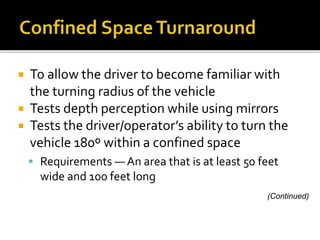
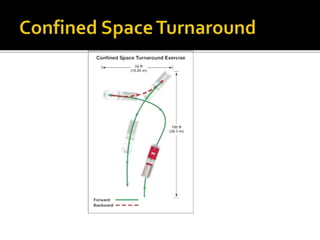
 Tests the driver/operator’s ability to turn the
vehicle 180º within a confined space
 Requirements — An area that is at least 50 feet
wide and 100 feet long
(Continued)
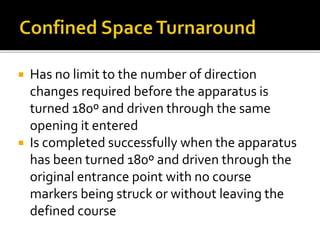
 Has no limit to the number of direction
changes required before the apparatus is
turned 180º and driven through the same
opening it entered
 Is completed successfully when the apparatus
has been turned 180º and driven through the
original entrance point with no course
markers being struck or without leaving the
defined course
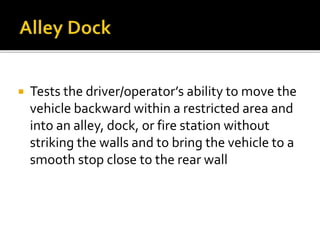
 Tests the driver/operator’s ability to move the
vehicle backward within a restricted area and
into an alley, dock, or fire station without
striking the walls and to bring the vehicle to a
smooth stop close to the rear wall
 Requirements
 Boundary lines for the
restricted area 40 feet
wide, similar to curb-
to-curb distance
 Simulated area 12 feet
wide and 20 feet deep
along one side and
perpendicular
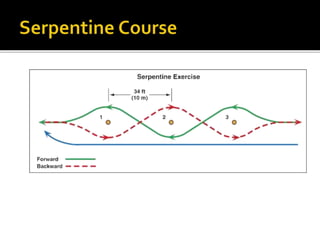
 Simulates maneuvering around parked and
stopped vehicles and tight corners
 Must be completed in each direction in one
continuous motion without touching any of
the course markers
(Continued)
 Requirements
 Markers between 30 and 38 feet apart,
depending on the size of the apparatus being
used
 Adequate space on each side of the markers
for the apparatus to move freely
(Continued)
 To allow the driver to become aware of the
front and rear tracking of the vehicle.
 To familiarize depth perception through the
use of mirrors, especially the location of the
right rear wheel
 To allow the driver to understand the
importance of vehicle positioning prior to
starting a movement that requires an exact
right side placement.
 Familiarizes the driver to turning radius.
 To familiarize the driver with the importance
of properly aligning a vehicle when entering a
very confined asymmetrical area.
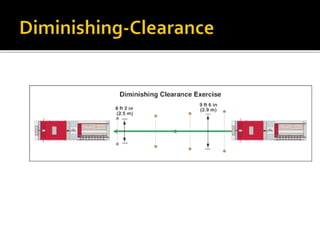
 Requirements —Two rows of stanchions that form
a lane 75 feet long, narrowing from a width of 9
feet 6 inches to a diminishing clearance of 8 feet 2
inches (Continued)
 To familiarize the driver with the position of
the front of the vehicle.
 To require the driver to brake smoothly and
precisely while bringing the vehicle to a stop
at a specified point.
 Four left and four right turns
 A straight section of urban business street or
two-lane rural road at least one mile in length
 One through intersection and two
intersections where a stop must be made
 A railroad crossing
 One curve, either left or right
(Continued)
 A section of limited-access highway that includes
an on ramp, off-ramp, and a section of road long
enough to allow for at least two lane changes
 A downgrade that is steep enough and long
enough to require downshift and braking
 An upgrade that is steep enough and long
enough to require gear changing to maintain
speed
 One underpass or a low-clearance bridge
 Remember that speed is less important than
arriving safely
 Slow down at intersections, or stop
 Anticipate the worst possible situation
 Drive defensively – be aware of everything
 Expect motorists and pedestrians not to see
you
 Be aware of season, weather, day of week
and time of day
QUESTIONS?

2013.05.02 NFD Driver training introduction

  • 1.
    Newport Fire Department Driver/Operator OperatingEmergency Vehicles Division ofTraining Update: April 2013
  • 2.
    This Objective ofthis class is intended to teach how to safely drive/operate an emergency vehicle when responding to an incident
  • 3.
     4 Partsof the Comprehensive Program:  Driving Regulation  Driver/Operator safety tips  Defensive driving techniques  Driver Awareness Course Overview
  • 8.
     Historically 22%of fatalities  Personal vehicles – 26%  Engines – 14%  Rescues – 5%  Ladders – 3%  Study of 81% (tanker drivers) killed were not wearing a seatbelt.  2012: 83 firefighter deaths, 18 from accidents
  • 9.
     Prevention:  Institutedthe Emergency Response SOG ▪ (3-I-1 Emergency and Non-Emergency Response) ▪ Includes Seatbelt Use  Enforcement:  Officers and Drivers ▪ Both are responsible/liable for the crew ▪ Supervisor Liability – if training inadequate.
  • 10.
     This lessonfollows Pumping Apparatus Driver/Operator certification according to:  NFPA 1002 Standard for Fire Apparatus Driver/Operator Professional Qualifications
  • 11.
    1. List thefive most common causes of fire apparatus collisions 2. Regulations governing fire apparatus driver/operators 3. VehicleOperations 4. Apparatus rider safety 5. Defensive DrivingTechniques 6. VehicleControl 7. Driver Awareness Course outline
  • 12.
     5 mostcommon causes  Improper backing of apparatus  Reckless driving by public  Excessive speed by apparatus driver  Lack of driving skill  Poor apparatus design
  • 13.
     Seldom causesserious injury or death, but accounts for a significant portion of overall damage costs  Occurs  On emergency scene  In parking lots  Backing into the station  USE A SPOTTER!
  • 14.
     Failure toobey posted traffic regulations  Failure to yield right of way  Excessive speed  Unpredictable behavior created by panic to approaching emergency apparatus  Inattentiveness  Cell phones  Radios  Children
  • 15.
     Loss ofcontrol on curve or adverse road surface (roll over, crash)  Black ice  Snow  Inability of driver to stop in time to avoid collision
  • 16.
     Overconfidence inone’s driving ability  It’s always the other guy that is a bad driver  Inability to recognize a dangerous situation  False sense of security because of good driving record  Misunderstanding of apparatus capabilities ▪ Turning radius  Lack of knowledge about how to operate the controls of the apparatus in an emergency
  • 17.
     Most oftenin “homebuilt” vehicles or local mechanics  Vehicles not baffled properly  Liquid surges  Maintenance  Vehicle system failure, especially brakes  Truck 1, Engine 2
  • 18.
     State  CityOrdinances  Department policy
  • 19.
     Unless specificallyexempt, fire apparatus are subject to all statute, rule, regulations, or ordinances that governs any vehicle operator  Drivers must always exercise care for the safety of others  Regulations pertain to dry, clear roads during daylight hours  Adjust for wet roads, fog, darkness
  • 20.
     Special Privileges:RIGL 31-12-6  Privilege, NOT a RIGHT!  RIGL 31-12-7  Park or stand, irrespective of any law  Proceed past a red light or stop sign, but only after slowing down as may be necessary for safe operations
  • 21.
     May Exceedthe speed limit, so long as does not endanger life or property  Disregard regulations governing direction of movement, or turning
  • 22.
     RIGL 31-12-9 “Shall not relieve the driver from the duty to drive with due regard for safety of all persons, nor shall the provisions protect the driver from consequences of the driver’s reckless disregard for the safety of others
  • 23.
     RIGL 31-17-1 Intersections- driver on the left shall yield right of way to the driver on the right  RIGL 31-17-6:  Yielding to Emergency Vehicles ▪ Lights and siren must be used ▪ Refuse toYield: $20.00 fine (RIGL 31-7-7)
  • 24.
     RIGL 31-23-11:WarningDevices  only during Emergency response  Must be visible from 500 ft  RIGL 31-23-51  Headsets permitted for EmergencyVehicles  RIGL 31-23-43  Wheel Safety Chocks ▪ Not required if vehicle is equipped with positive spring- loaded air parking brakes
  • 25.
    NOT Exempt fromlaws that require a stop for school buses with flashing signal lights
  • 26.
     Ordinance 10.04.010 State MotorVehicle Code adopted  Ordinance 10.08.050  Reflects the Emergency Response SOP regarding 1. Parking or standing 2. Red lights/Stop signs 3. Speed limits 4. Directions and turning
  • 30.
     If involvedin a collision, both the driver and department may be held liable  Supervisory Liability (Officer) – SOP # 3-I-1  Negligent Failure to Direct  Negligent Assignment  Negligent Failure to Discipline
  • 31.
    Failure to provideknowledgeable guidance, instruction, and/or direction as how to properly perform an action • Not or inadequately providing training
  • 32.
    Assigning (or allowing)an individual to perform an act with the knowledge that the individual is not competent to perform that activity, or is not qualified or not properly trained to perform a given function • ie. Allowing someone to drive apparatus that has shown that they cannot “acceptably” complete the Driver Competency Course
  • 33.
    Failure to takeproper corrective action steps in order to insure that critical infractions of rules or polices are not repeated.  Allowing personnel to drive through intersections without stopping or reducing speed ▪ Discipline need not necessarily be harsh, but must be sufficient to discourage repeat violations
  • 34.
     Driver mustassure safety of all personnel on the apparatus  Don gear before getting into apparatus  No riding on the tailboard  Seatbelt use  NFPA 1901 Fire Apparatus – requires a seat and belt for all firefighters  NFPA 1500: 3 exceptions to Seated or seat-belt use 1. Loading hose – driving forward 2. EMS call 3. PerformingTiller training
  • 36.
     Start assoon as possible so that it is warmed up when rest of the crew is assembled and ready to respond  Let it idle as long as possible  Consider response – road closings  Do Not move the vehicle until all occupants are within the cab, seated, and wearing a seatbelt
  • 37.
     Accelerate gradually No need to stomp on the throttle  Automatic transmissions downshift automatically to prevent lugging.  When ascending a steep grade, may downshift to avoid the lugging
  • 38.
     Things inmotion tend to remain in motion  Whenever a vehicle undergoes a change in speed or direction, weight transfer takes place relative to the severity of change  Weight carried on vehicle contributes to skidding an rollover due to:  Too much speed in turns  Harsh or abrupt steering  Driving on too steep slope
  • 39.
     Drivers respondbetter to sounds that change pitch often, so short bursts with the air horns or changing oscillation is best  Be careful not to “outrun” the siren  40 mph – siren can project 300 ft to front  60 mph – audible only 12 ft or less in front  Use discretion on type of call  Psychiatric patient
  • 40.
     Limit useto true emergency response  Trouble alarm  No functions  Supervisory signals  Public service calls
  • 41.
     Decrease speedgradually, keep off soft shoulders  Bridges, shady areas, northern slopes become slippery first  Test brakes to determine braking distance  Increase following distances  It takes 3 – 15 times more distance to stop a vehicle in snow and ice than on dry surface
  • 42.
     Develop asafety-conscious attitude  Remain calm and drive in a safe manner  Do not drive recklessly or aggressively  Do not DEMAND the right-of-way although you may legally have it  Be prepared to yield the right-of-way in the interest of safety  Strive to present a positive fire department image at all times
  • 43.
     The roadmust be closed to other traffic  Apparatus must be driven forward  No members are allowed to stand on any portion of the apparatus while in motion  Kneel or sit
  • 44.
     Avoid backingwhenever possible  Normally safer and sometimes quicker to drive around the block  Use at least 1 firefighter with a radio, positioned on the drivers side, approx. 1 vehicle length behind, to warn of obstacles or overhead objects  No spotter, do not back up!
  • 46.
     Slow theapparatus at intersections, be prepared to stop  Even at a Green light  Red lights/stop signs  Slow down as necessary  You are responsible if get into an accident  Be alert to the unexpected  Cars pulling out in front of you
  • 47.
     Aim Highin steering  Find a safe path well ahead  Get the big picture  Stay back and see it all  Keep your eyes moving  Scan – do not stare  Leave yourself an “out”  Do not expect others to leave you an escape route  Make sure others can see and hear you  Lights, siren, horn
  • 48.
     Scan farenough ahead for the speed driven, to allow time to react
  • 49.
     Avoid passingvehicles that do not pull over  Always travel in the innermost lane on multilane roads, if possible  Avoid passing on the right  People may try to pull over into you  Avoid passing other emergency vehicles  Let the slower vehicle move to the right, and communicate intensions on the radio
  • 50.
     Smooth, evenstop: don’t jam on the brakes  Consider the weight of the vehicle, brake conditions, tires, and road surface  Engine brake will assist in braking  Let it do its job
  • 51.
     Driver reaction distance The distance the vehicle travels while a driver moves the foot to the brake pedal  Braking distance  The distance the apparatus takes to come to a complete stop
  • 52.
     Total stoppingdistance  The sum of the reaction and the vehicle braking distance
  • 53.
     Conditions ofthe road surface  Dry, flat vs. wet, steep, icy, snow, or unpaved  Speed being traveled  Weight of the vehicle  Type and condition of the vehicle braking system  Properly maintained vehicle will stop faster
  • 54.
     Driving toofast for road conditions  Failing to appreciate weight shifts of apparatus  Failing to anticipate obstacles  Improper use of aux braking devices  Improper maintenance of tire pressure (over- inflated tires)  Improper maintenance of tire tread depth
  • 55.
     ABS: maintaina steady pressure on brake pedal, do not pump  Air brakes: slight delay between time from pushing brake until sufficient air is sent to the brake (approx 0.4 sec)  No ABS, release brake, turn into the skid  Once skid is controlled, apply power to allow vehicle to get traction
  • 57.
     Front brake-limitingvalve system  Known as “Dry road/slippery road” switches  Were intended to help maintain control on slippery roads  Reduced the air on the front steering axle by 50%, when the switch was in slippery-road position, preventing the front wheels from locking ▪ The switch reduced the breaking ability to 25%
  • 58.
     Turns itselfon and off  Decreases the engine speed as needed until traction is acquired  Reduces wheel over-spin  Works in two ways:  Wheel spins, the ATC applies air pressure to brake the wheel, transferring torque to the wheels with better traction  Wheels spin: engine torque reduced
  • 59.
     Short lengthsof chain are attached to a rotating hub in front of each rear wheel  The hubs swing down into place when a switch is activated  The rotation of the hub throws the chains underneath the rolling tires  Lose effectiveness ▪ in snow deeper than 8” ▪ Moving slow or in reverse
  • 60.
     Code #1-IV-8  Outlines the Procedures IF an accident occurs during Emergency or Non-Emergency conditions
  • 61.
     NFPA 1002 Straight line  Confined SpaceTurnaround  Alley Dock  Serpentine Course  Offset Alley  Diminishing Clearance  Stop Sign  RoadTests
  • 62.
     To familiarizethe driver with operating the vehicle within close quarters both in forward and reverse at a steady speed.  To enable the driver to adjust the mirrors for proper viewing, and make minor steering adjustments.
  • 63.
     To allowthe driver to become familiar with the turning radius of the vehicle  Tests depth perception while using mirrors  Tests the driver/operator’s ability to turn the vehicle 180º within a confined space  Requirements — An area that is at least 50 feet wide and 100 feet long (Continued)
  • 64.
     Has nolimit to the number of direction changes required before the apparatus is turned 180º and driven through the same opening it entered  Is completed successfully when the apparatus has been turned 180º and driven through the original entrance point with no course markers being struck or without leaving the defined course
  • 66.
     Tests thedriver/operator’s ability to move the vehicle backward within a restricted area and into an alley, dock, or fire station without striking the walls and to bring the vehicle to a smooth stop close to the rear wall
  • 67.
     Requirements  Boundarylines for the restricted area 40 feet wide, similar to curb- to-curb distance  Simulated area 12 feet wide and 20 feet deep along one side and perpendicular
  • 68.
     Simulates maneuveringaround parked and stopped vehicles and tight corners  Must be completed in each direction in one continuous motion without touching any of the course markers (Continued)
  • 69.
     Requirements  Markersbetween 30 and 38 feet apart, depending on the size of the apparatus being used  Adequate space on each side of the markers for the apparatus to move freely (Continued)
  • 71.
     To allowthe driver to become aware of the front and rear tracking of the vehicle.  To familiarize depth perception through the use of mirrors, especially the location of the right rear wheel
  • 72.
     To allowthe driver to understand the importance of vehicle positioning prior to starting a movement that requires an exact right side placement.  Familiarizes the driver to turning radius.
  • 73.
     To familiarizethe driver with the importance of properly aligning a vehicle when entering a very confined asymmetrical area.  Requirements —Two rows of stanchions that form a lane 75 feet long, narrowing from a width of 9 feet 6 inches to a diminishing clearance of 8 feet 2 inches (Continued)
  • 75.
     To familiarizethe driver with the position of the front of the vehicle.  To require the driver to brake smoothly and precisely while bringing the vehicle to a stop at a specified point.
  • 76.
     Four leftand four right turns  A straight section of urban business street or two-lane rural road at least one mile in length  One through intersection and two intersections where a stop must be made  A railroad crossing  One curve, either left or right (Continued)
  • 77.
     A sectionof limited-access highway that includes an on ramp, off-ramp, and a section of road long enough to allow for at least two lane changes  A downgrade that is steep enough and long enough to require downshift and braking  An upgrade that is steep enough and long enough to require gear changing to maintain speed  One underpass or a low-clearance bridge
  • 79.
     Remember thatspeed is less important than arriving safely  Slow down at intersections, or stop  Anticipate the worst possible situation  Drive defensively – be aware of everything  Expect motorists and pedestrians not to see you  Be aware of season, weather, day of week and time of day
  • 80.

Editor's Notes

  • #20 RIGL 31-12-6: allows the other privileges to exist
  • #21 Privilege: Not a Right, privileges can be taken away
  • #25 RIGL 31-23-12: Salvation Army Vehicle is an authorized emergency vehicle may be equipped with lights and sirens
  • #75 NOTE: Spotters are Allowed on all portions of the drill, with the EXCEPTION of the ALLEY DOCK (#3) and the STOP SIGN (#8).