Defensive Driving
Please Click on the Advertisements 2 times Shown on the Site to support the
blogger and motivate for upload Documents in the Site Which may help you and
others
Thanks
https://hseprofessionalspakistan.blogspot.com/
3
Purpose
 This Course is intended to:
– Improve your traffic safety awareness
– Lessen the likelihood of collisions
– Eliminate
 the misery and tragic cost in human lives
 the financial expense involved in motor vehicle
accidents
4
Course Goals & Objectives
 To help you understand how Your attitude affects
your driving
 To enable you to recognise and evaluate your
current driving patterns
 To ensure that you understand the responsibilities of
driving
 To help improve the standard of driving on the
Project
5
What is Defensive Driving?
 Planning ahead
 Being observant
 Being aware of others and what they may do
 Anticipating other people’s errors
 Showing consideration for other road users,
including pedestrians, cyclists etc.
6
Road Statistics
 Number 4 cause of Death in the
World as per statistics
 World Wide - every year
– Killed - over 500,000!
– Seriously Injured -
over 15 Million
7
Common Causes of Vehicle Accidents
 Failure to GIVE WAY the right of way
 Driving too close to the vehicle in front (tailgating)
 Ignoring signals
 Poor standard of vehicles and lack of maintenance
 EXCESSIVE SPEED
 Driving while under the influence of alcohol
or drugs
8
Major Factors
 Environment
– poor driving standards
– poor road surfaces
– extreme weather / poor
visibility
 Attitude
– anger & impatience
– tiredness
– driving under the
influence of alcohol or
drugs
9
Major Factors.
 Distractions
– passengers
– day-dreams
– Problems
– Using mobile phones
while driving
 Poor Vehicle Condition
– no lights
– bad tyres
– chassis alignment
10
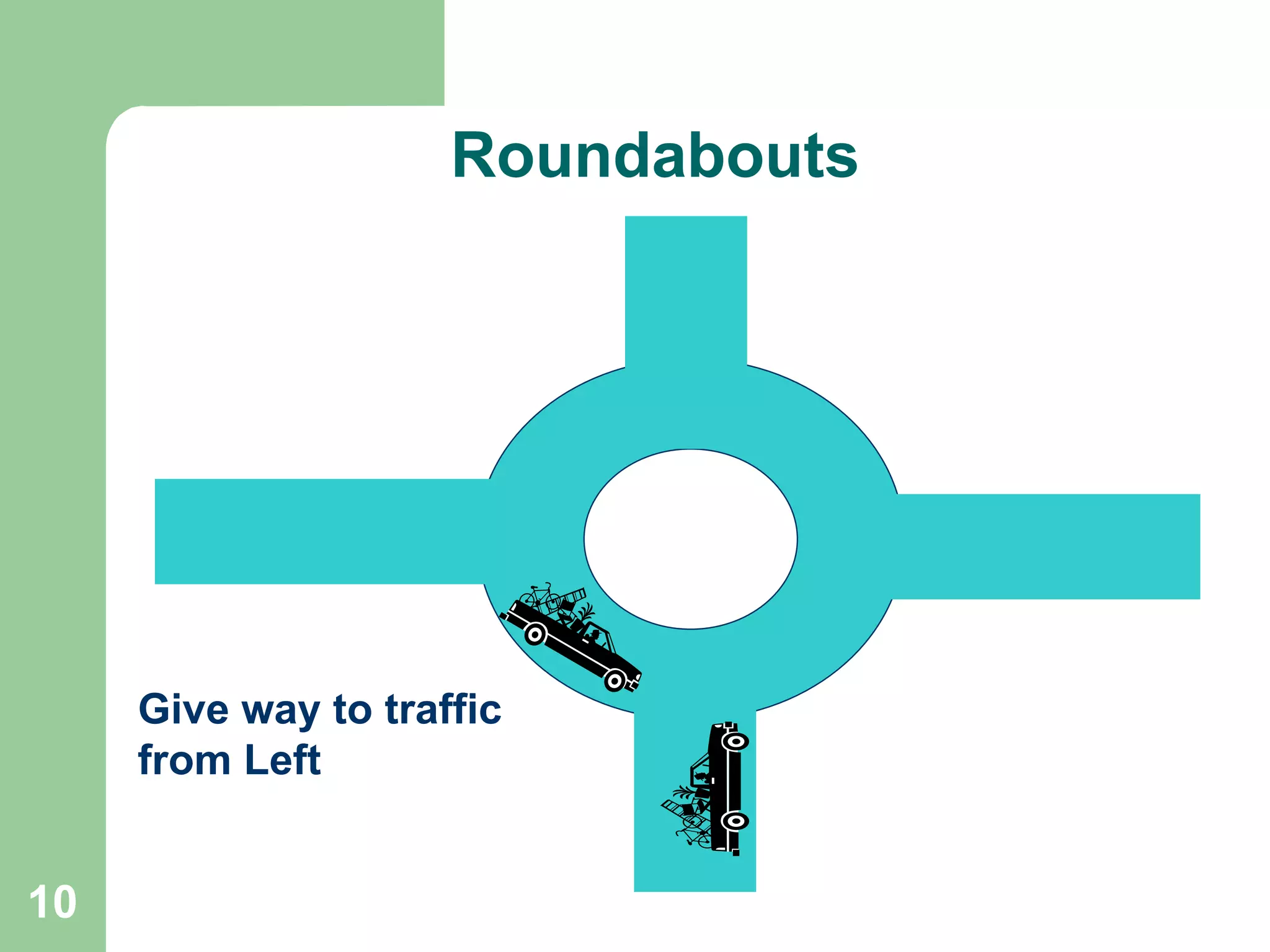
Give way to traffic
from Left
Roundabouts
11
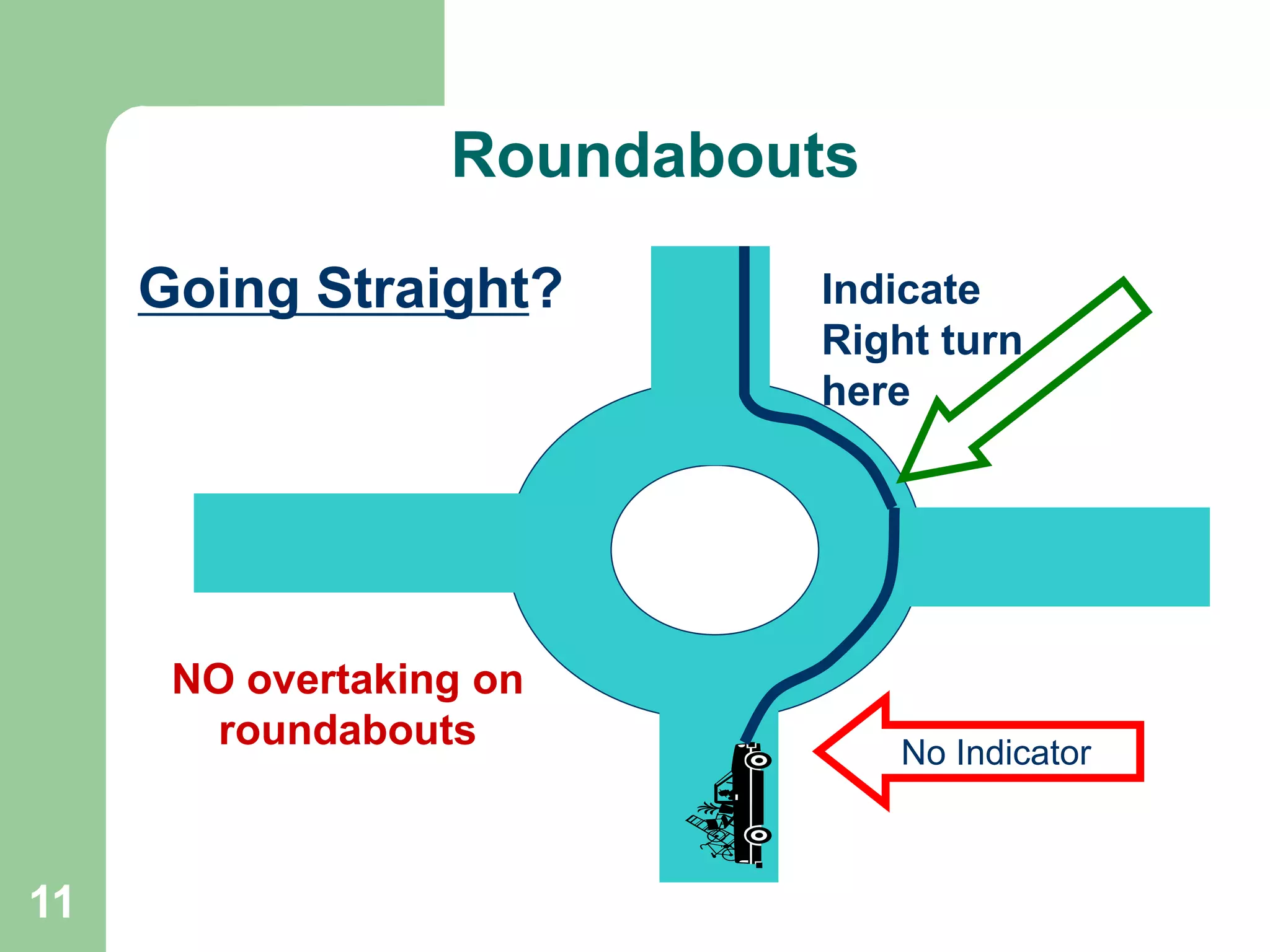
Going Straight?
No Indicator
Indicate
Right turn
here
NO overtaking on
roundabouts
Roundabouts
12
Right Turn?
Indicate Right turn
Roundabouts
13
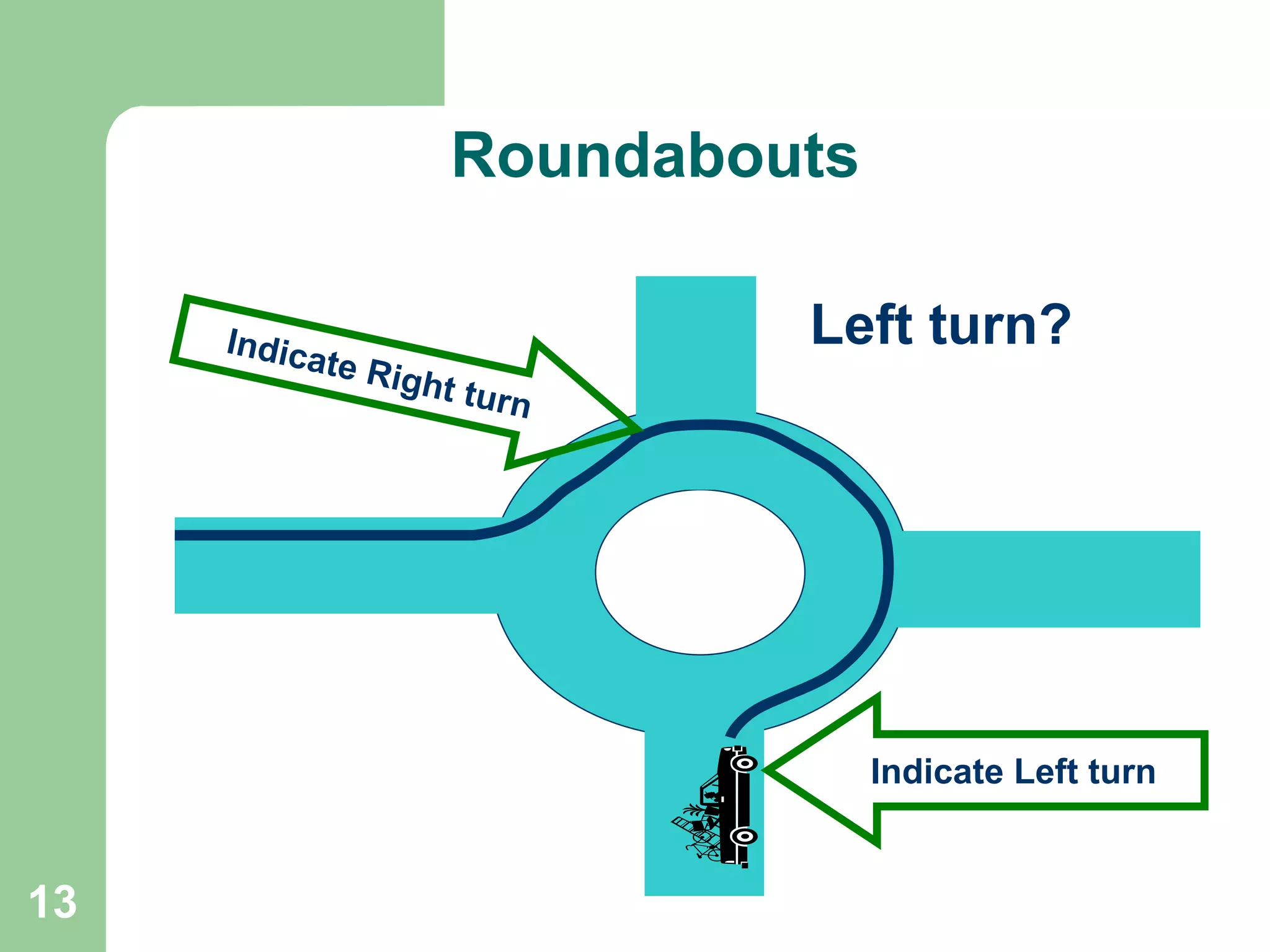
Left turn?
Indicate Left turn
Roundabouts
14
95% of Road Accidents are
Caused by Driver Error
 Attitude
– “IT WON’T HAPPEN
TO ME”
– taking risks
 overtaking
 speeding
– abuse of alcohol or
drugs
– arrogance, impatience
15
Driver’s Responsibility
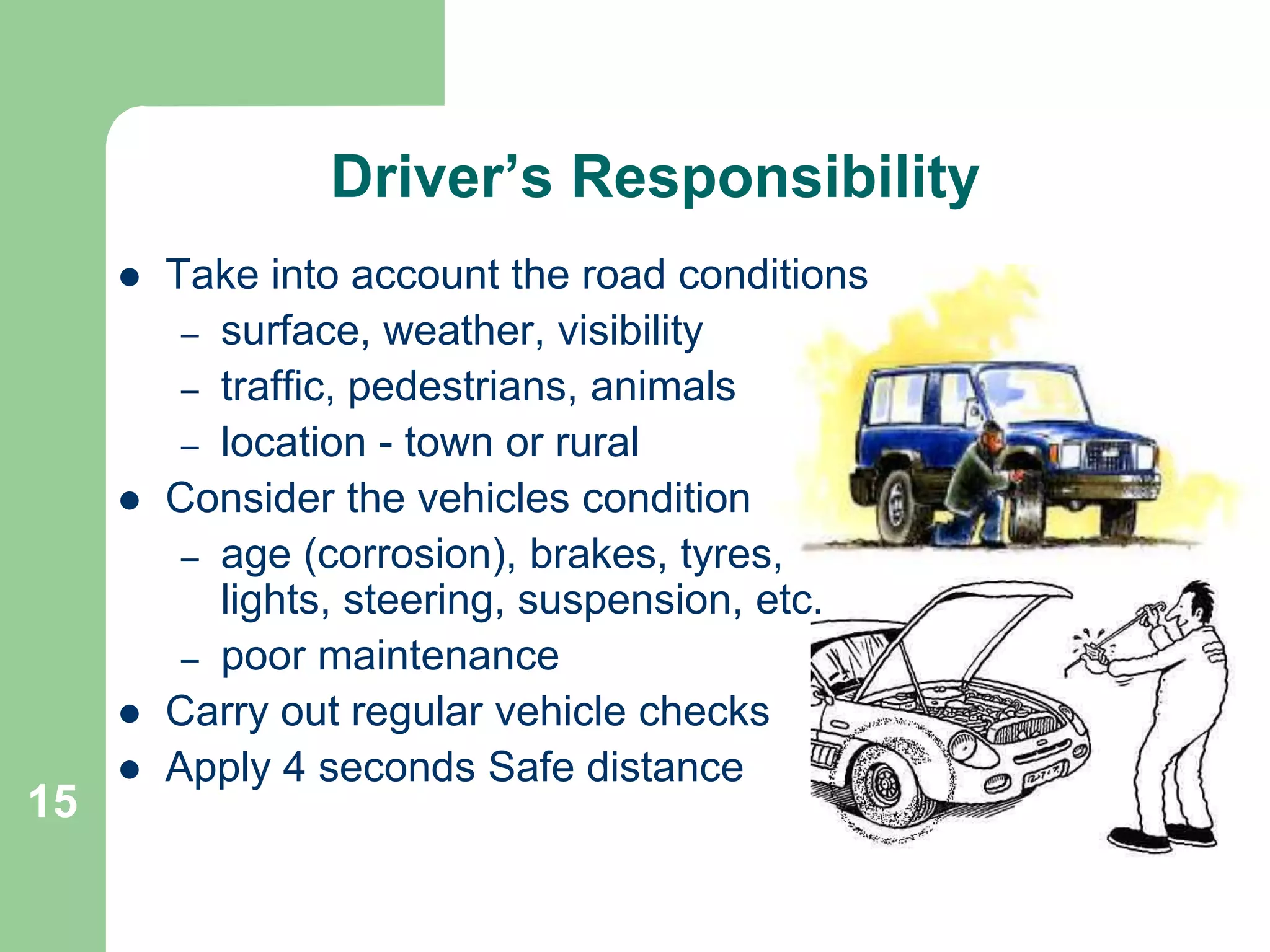
 Take into account the road conditions
– surface, weather, visibility
– traffic, pedestrians, animals
– location - town or rural
 Consider the vehicles condition
– age (corrosion), brakes, tyres,
lights, steering, suspension, etc.
– poor maintenance
 Carry out regular vehicle checks
 Apply 4 seconds Safe distance
16
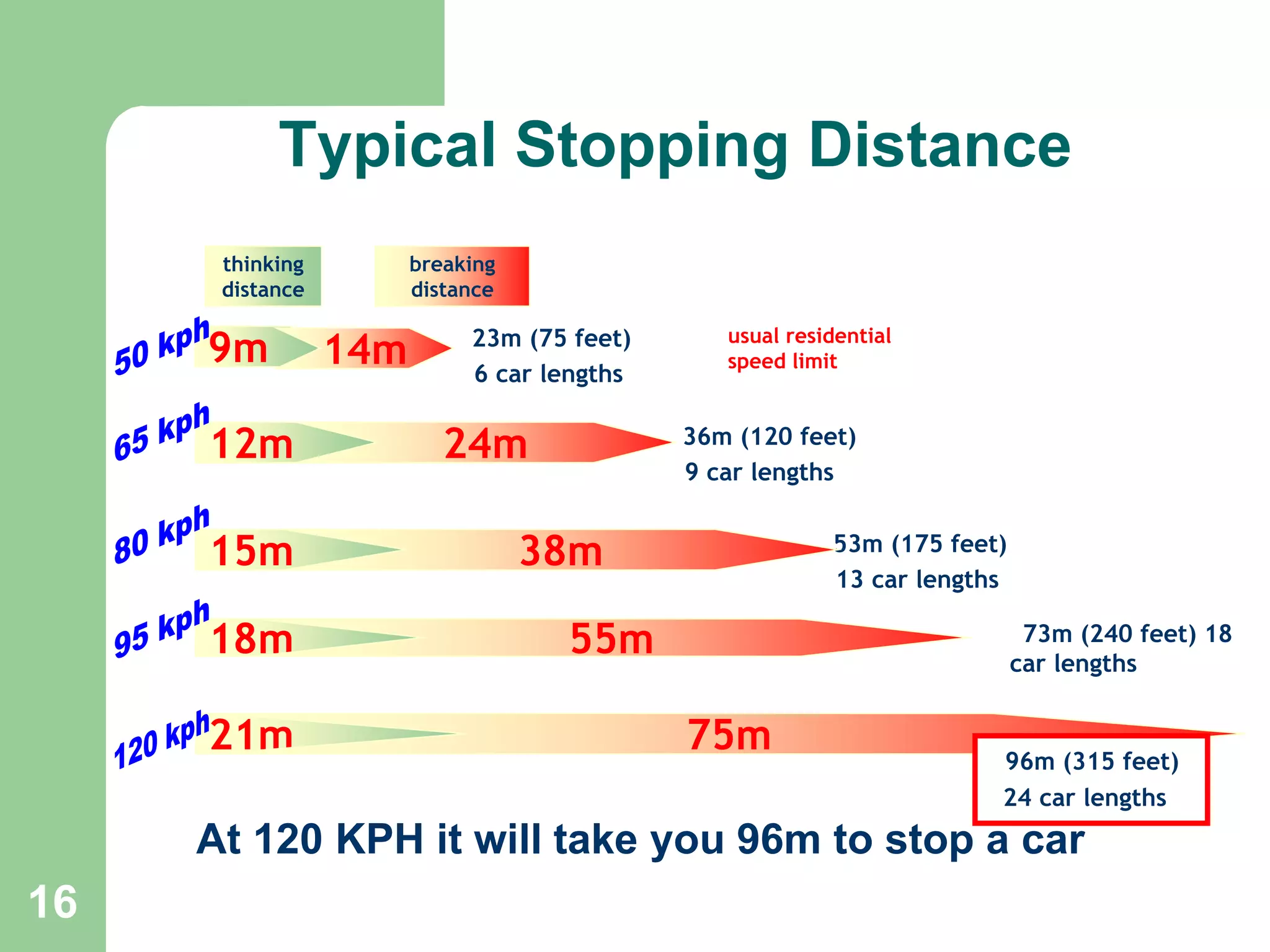
Typical Stopping Distance
usual residential
speed limit
thinking
distance
breaking
distance
9m 14m 23m (75 feet)
6 car lengths
53m (175 feet)
13 car lengths
15m 38m
36m (120 feet)
9 car lengths
12m 24m
73m (240 feet) 18
car lengths
18m 55m
21m 75m
At 120 KPH it will take you 96m to stop a car
96m (315 feet)
24 car lengths
17
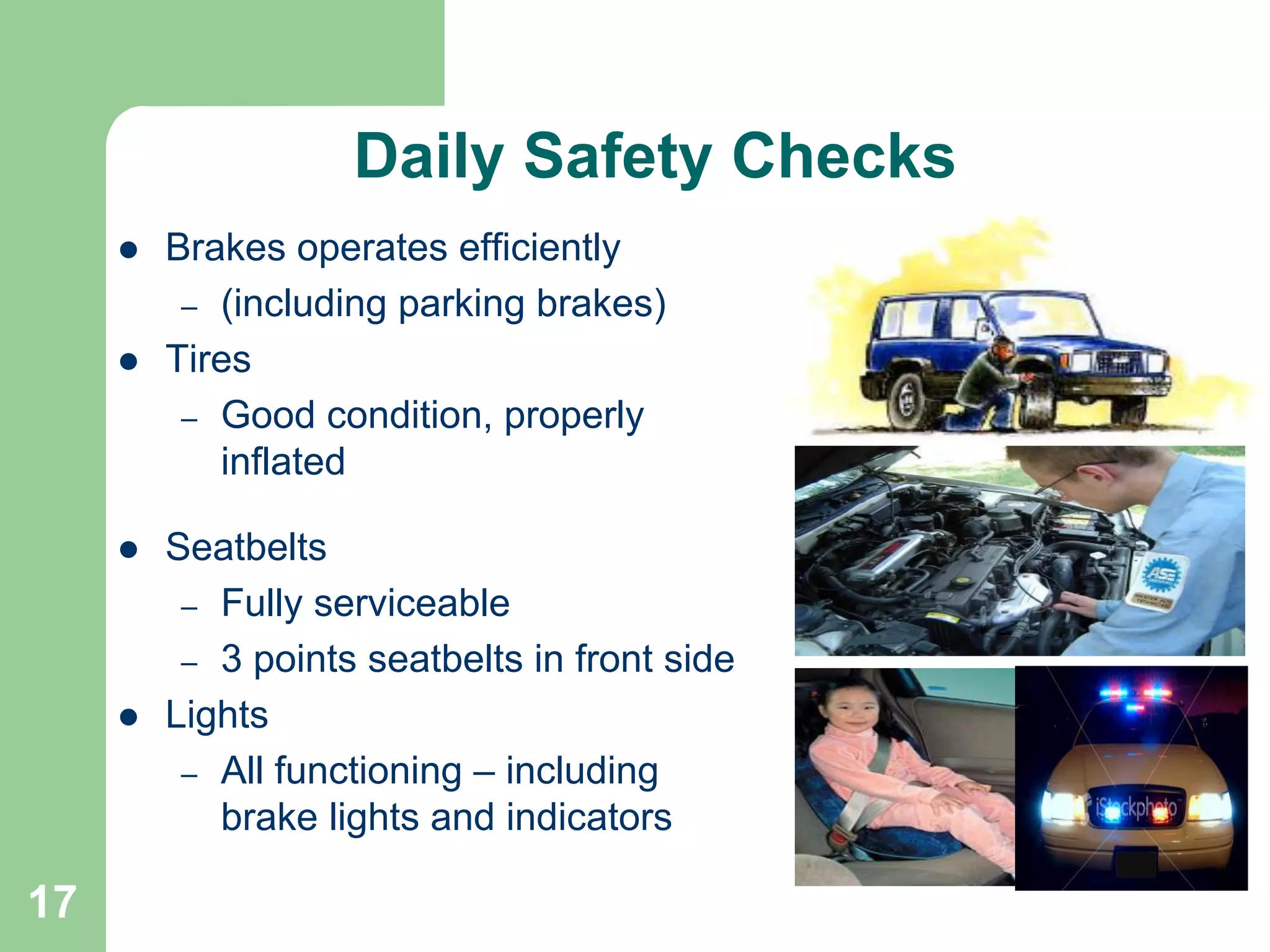
Daily Safety Checks
 Brakes operates efficiently
– (including parking brakes)
 Tires
– Good condition, properly
inflated
 Seatbelts
– Fully serviceable
– 3 points seatbelts in front side
 Lights
– All functioning – including
brake lights and indicators
18
Headlights
 Use dipped headlights in
rain or when light is poor
– See and be seen - you
may be able to see,
others may not see you.
– DO NOT DAZZLE
OTHER ROAD USERS
WITH YOUR “MAIN”
BEAM!
– If you are dazzled, pull
over and give your eyes
time to recover.
19
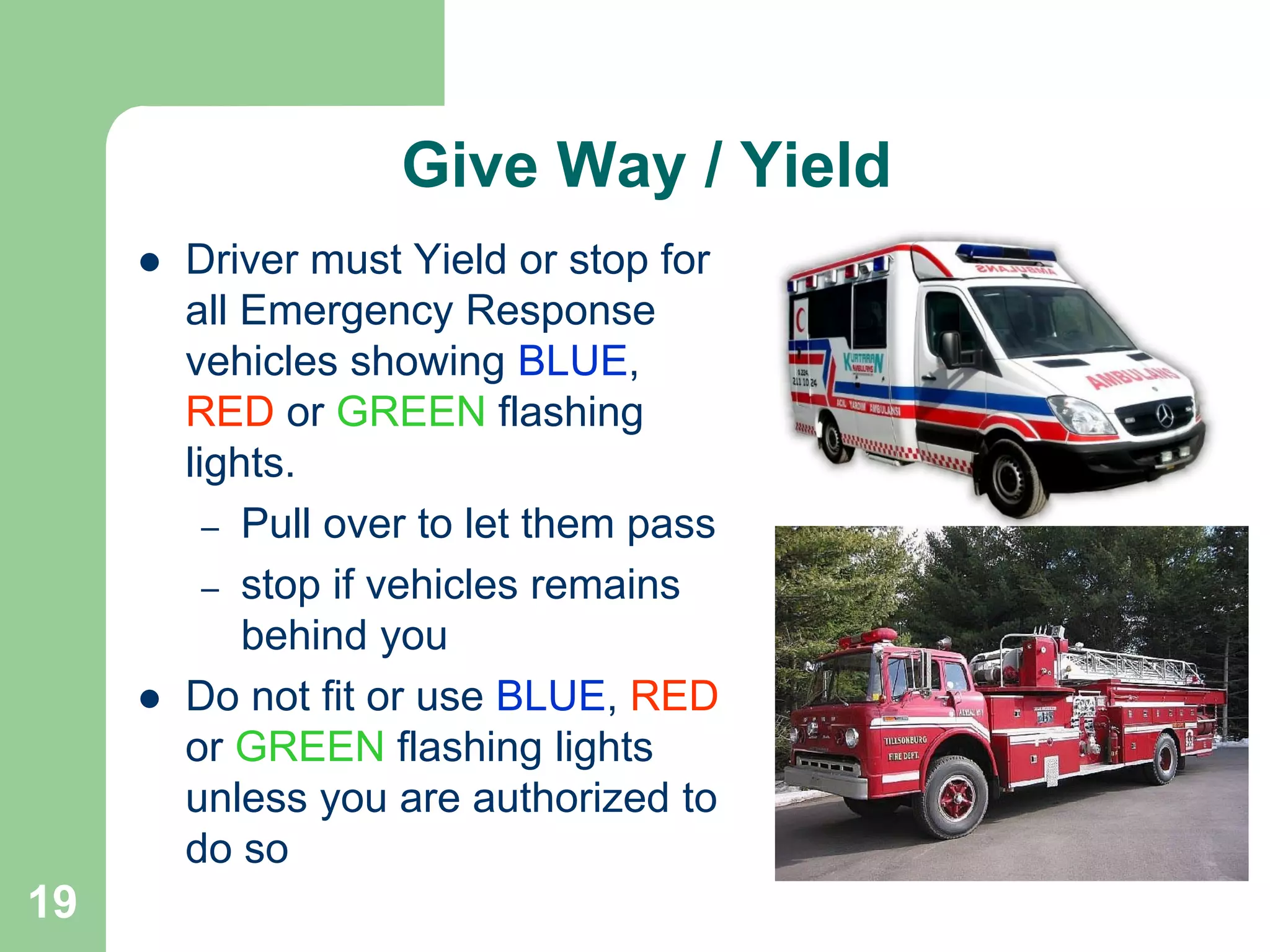
Give Way / Yield
 Driver must Yield or stop for
all Emergency Response
vehicles showing BLUE,
RED or GREEN flashing
lights.
– Pull over to let them pass
– stop if vehicles remains
behind you
 Do not fit or use BLUE, RED
or GREEN flashing lights
unless you are authorized to
do so
20
Four Way Flashers
 Use only to indicate a
STATIONARY HAZARD
 Not:-
– I’m important and I’m coming through
– I’m going straight on
– I’m breaking the speed limit but flashing my “Four
Ways” makes it
IT DOESN’T!
21
Safe Driving Rules
 Seatbelts must be worn at all
times by the DRIVER and ALL
passengers
 Drivers must wear footwear
that is properly fastened and
will not slip of the foot.
– Footwear that is held on by
single strap either through the
toes or over the foot shall not
be worn when driving
22
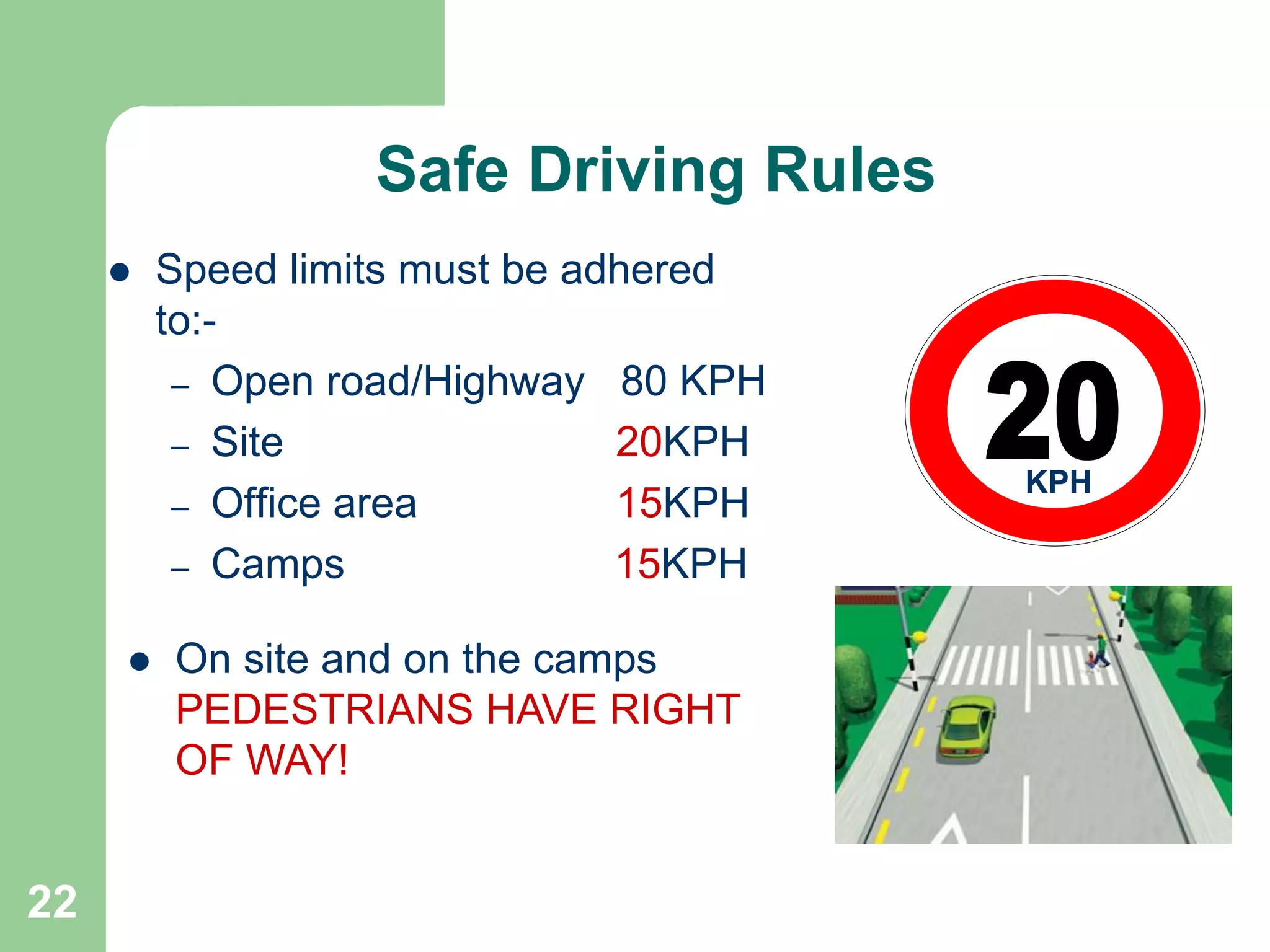
Safe Driving Rules
 Speed limits must be adhered
to:-
– Open road/Highway 80 KPH
– Site 20KPH
– Office area 15KPH
– Camps 15KPH
KPH
 On site and on the camps
PEDESTRIANS HAVE RIGHT
OF WAY!
23
Fail to meet your Responsibilities:-
 INJURY/DEATH,
 LOSS OF LOVED
ONES,
JAIL
 PROPERTY DAMAGE,
24
Remedial Measures
 The Three E’s
– Education- skills training
 hazard perception
 attitude changes -
concentration, consideration
and patience
– Engineering - well
maintained vehicle
– Enforcement
25
Driving While Under the Influence of
Alcohol or Drugs
 Daewoo has a zero tolerance to driving while
under the influence of Alcohol or Drugs. It will
result in:
IMMEDIATE DISMISSAL FROM
EMPLOYMENT IN ANY
PROJECT OF DAEWOO
26
Drug and Alcohol Testing
 You WILL be tested for drugs
and alcohol if;
– You are the driver of the
vehicle that has been
involved in a collision with
any other object
– If your conduct gives cause
for concern, having
committed and unsafe act,
failed to comply with the
rules of the road or breached
any HSE requirements
27
Driving To Stay Alive
 Driver error is the major contributor in 95% of
all collisions
THIS DOES REDUCE IF DRIVERS DRIVE DEFENSIVELY
 A collision WILL happen if
– Driver has failed to do everything reasonably
practical to prevent it
 DEFENSIVE DRIVING is when the Driver
conscientiously drives to PREVENT
accidents
28
Five seeing habits
 Aim high in steering
 Get The big picture
 Keep your eyes moving
 Leave yourself an out
 Make sure they see you
29
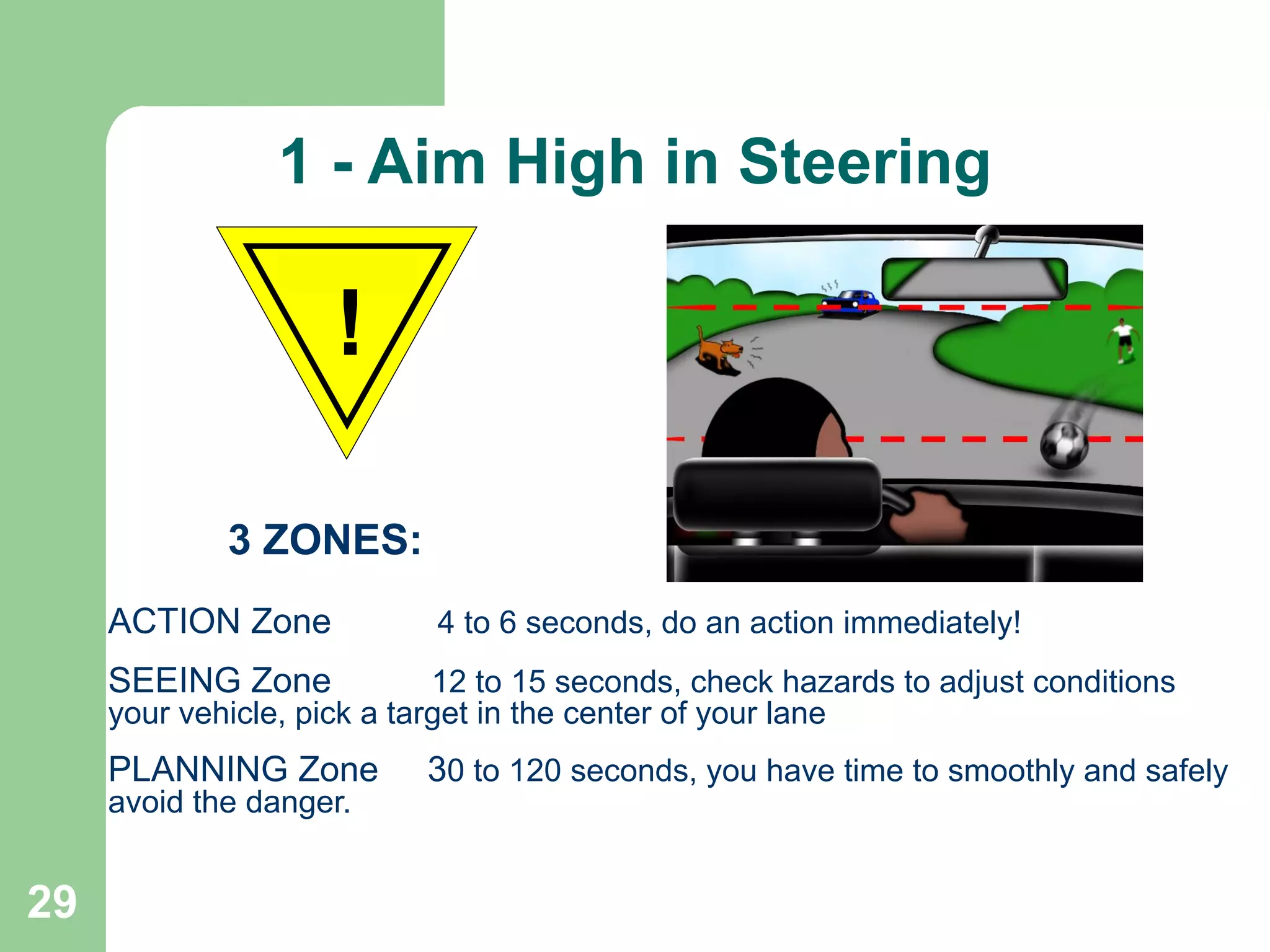
1 - Aim High in Steering
ACTION Zone 4 to 6 seconds, do an action immediately!
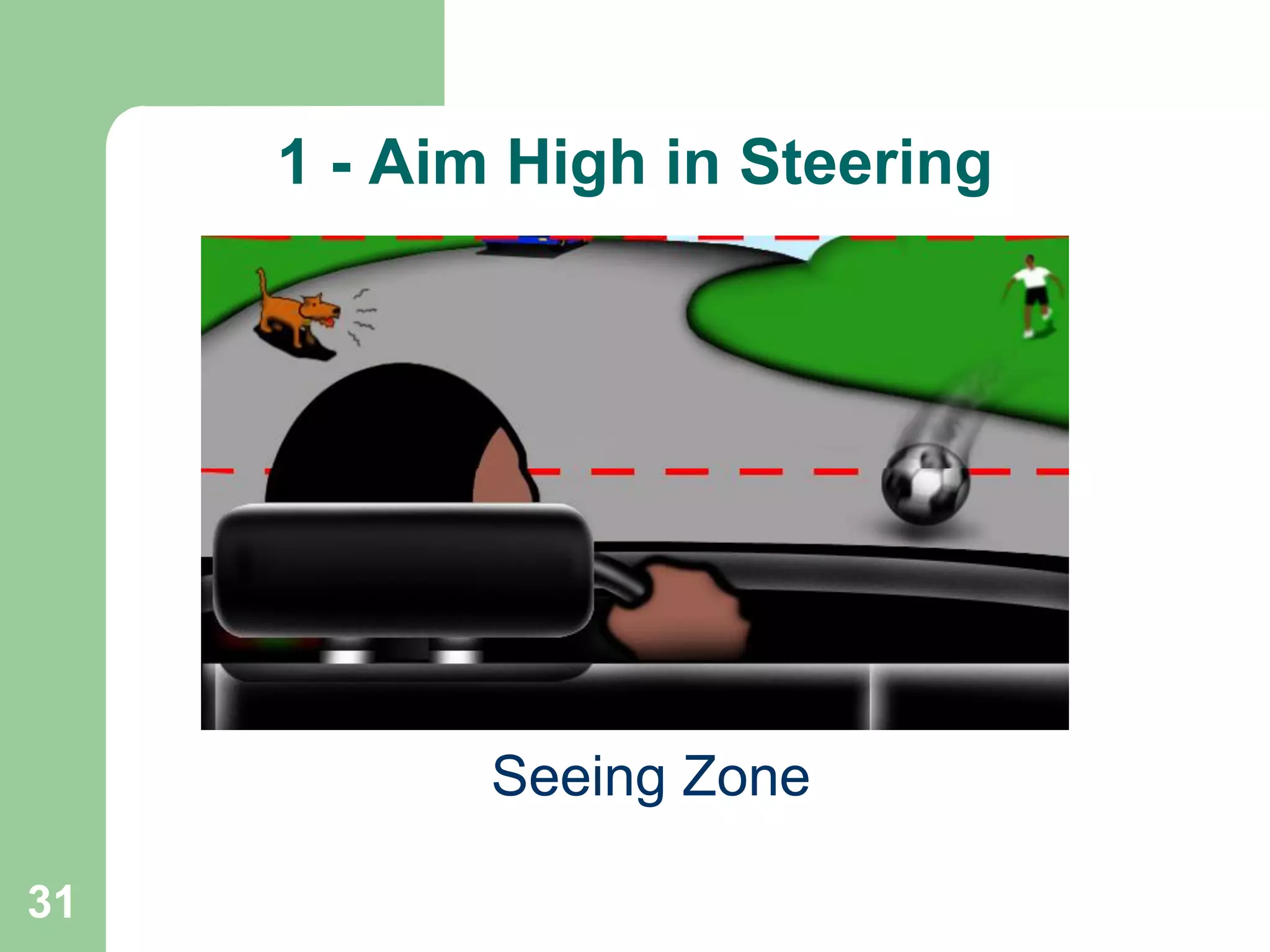
SEEING Zone 12 to 15 seconds, check hazards to adjust conditions
your vehicle, pick a target in the center of your lane
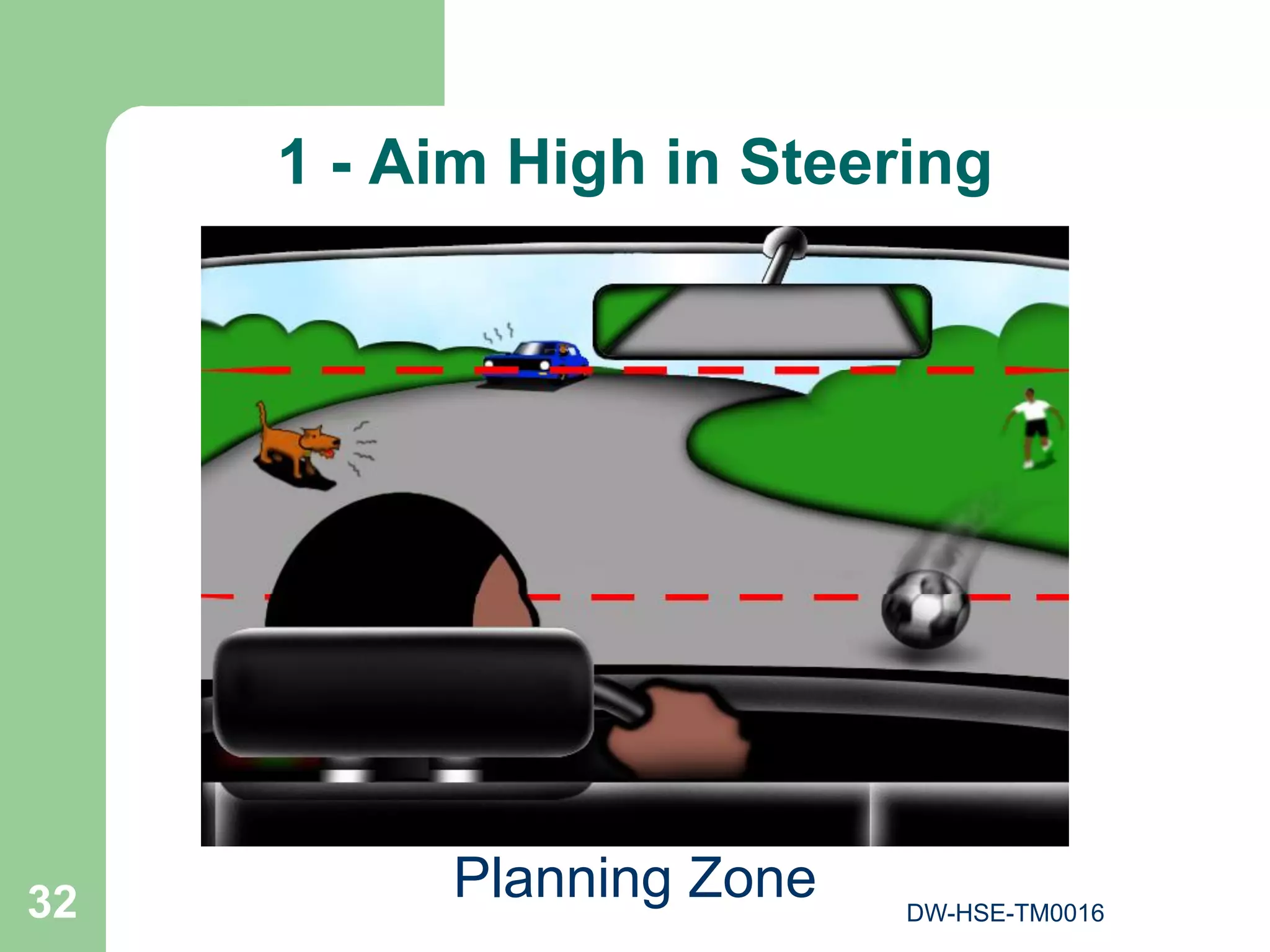
PLANNING Zone 30 to 120 seconds, you have time to smoothly and safely
avoid the danger.
!
3 ZONES:
30
Action Zone
1 - Aim High in Steering
31
Seeing Zone
1 - Aim High in Steering
DW-HSE-TM0016
32 Planning Zone
1 - Aim High in Steering
33
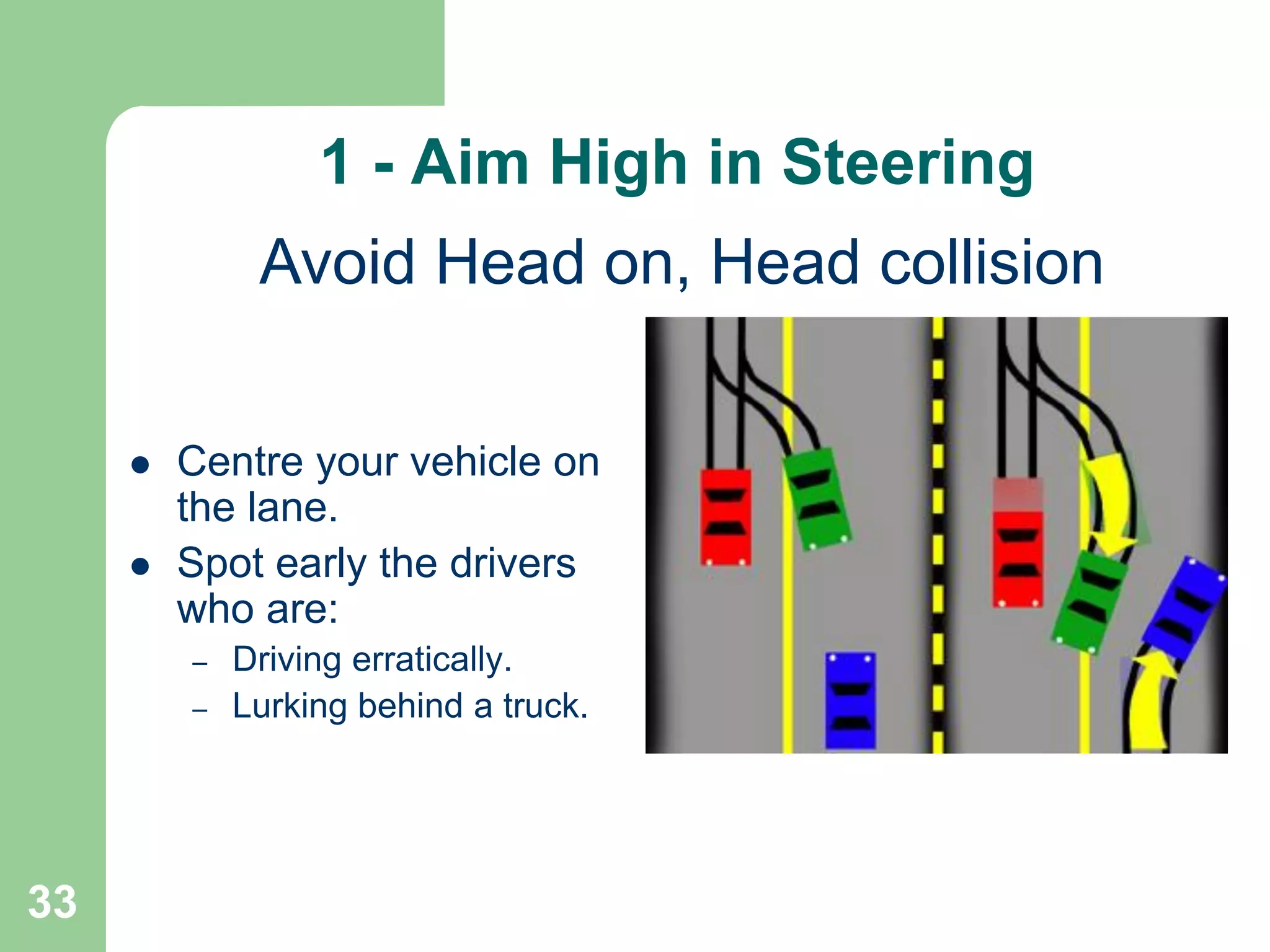
 Centre your vehicle on
the lane.
 Spot early the drivers
who are:
– Driving erratically.
– Lurking behind a truck.
Avoid Head on, Head collision
1 - Aim High in Steering
34
Avoid
Head
on
Head
collision
1 - Aim High in Steering
!
35
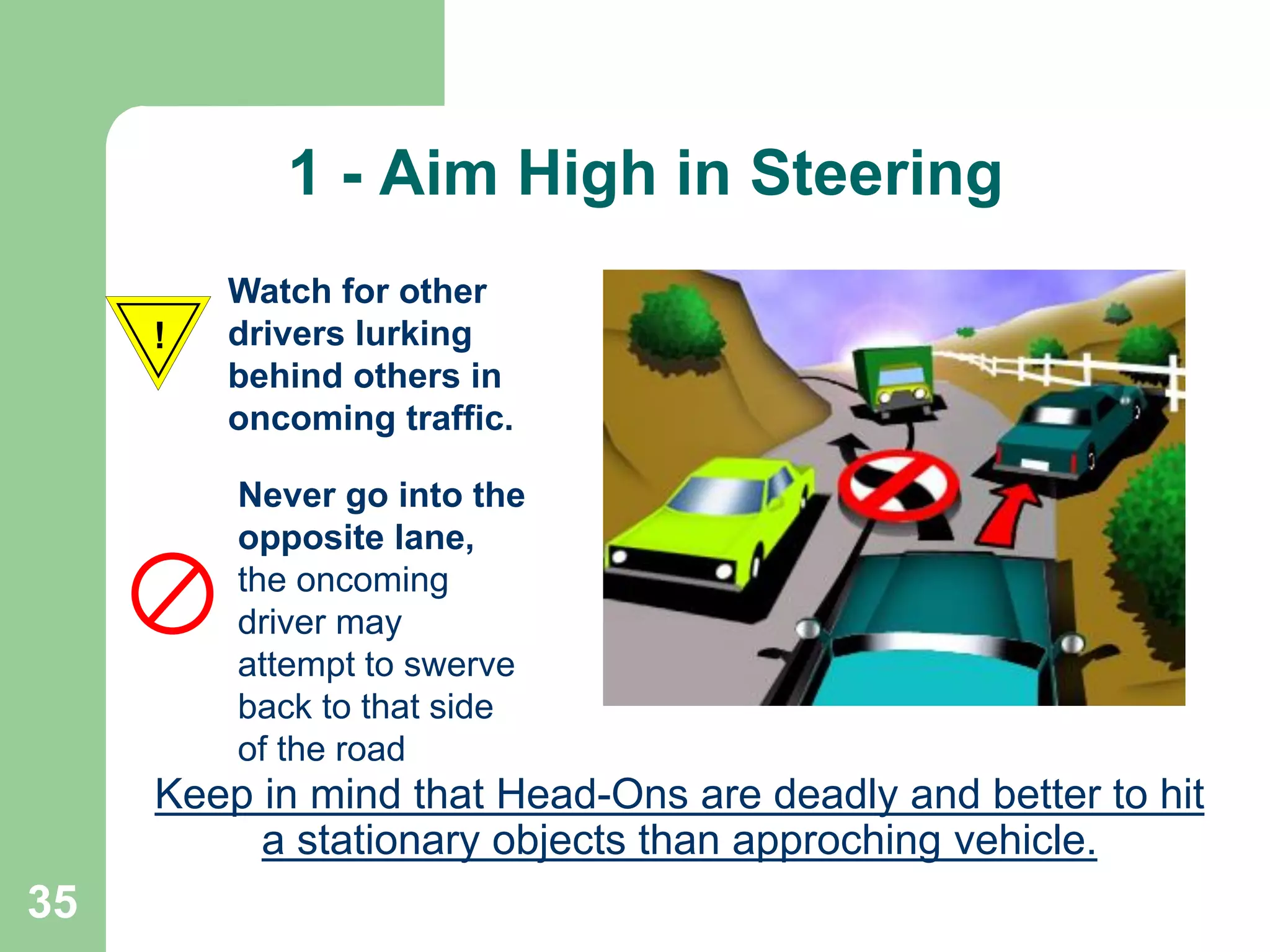
1 - Aim High in Steering
Watch for other
drivers lurking
behind others in
oncoming traffic.
!
Never go into the
opposite lane,
the oncoming
driver may
attempt to swerve
back to that side
of the road
Keep in mind that Head-Ons are deadly and better to hit
a stationary objects than approching vehicle.
36
2 - Get the Big Picture
 In front you.
 On your Left
 On your Right
 Behind you
 Below you
 Above you
Driver must analyze the route continually, you
must look :
37
 Re-establish your visibility.
 Maintain your space.
 Create a safe area or “bubble” around your
vehicle.
2 - Get the Big Picture
38
 Driving is a full time job
 Stay focused on the task at hand, don’t be
distracted.
 Avoid fixed vision.
 ”Understand ” the road rather than simply “
Looking ” at the road
2 - Get the Big Picture
39
Back off and Get the Big
Picture!!!
If you cannot see around
the truck!
2 - Get the Big Picture
40
If you plan to pass the next car, think first :
 Do you really need to do this? Perhaps it
would be better to wait!
 Is it safe, do you have enough space and
time?
 Is it legal?
2 - Get the Big Picture
41
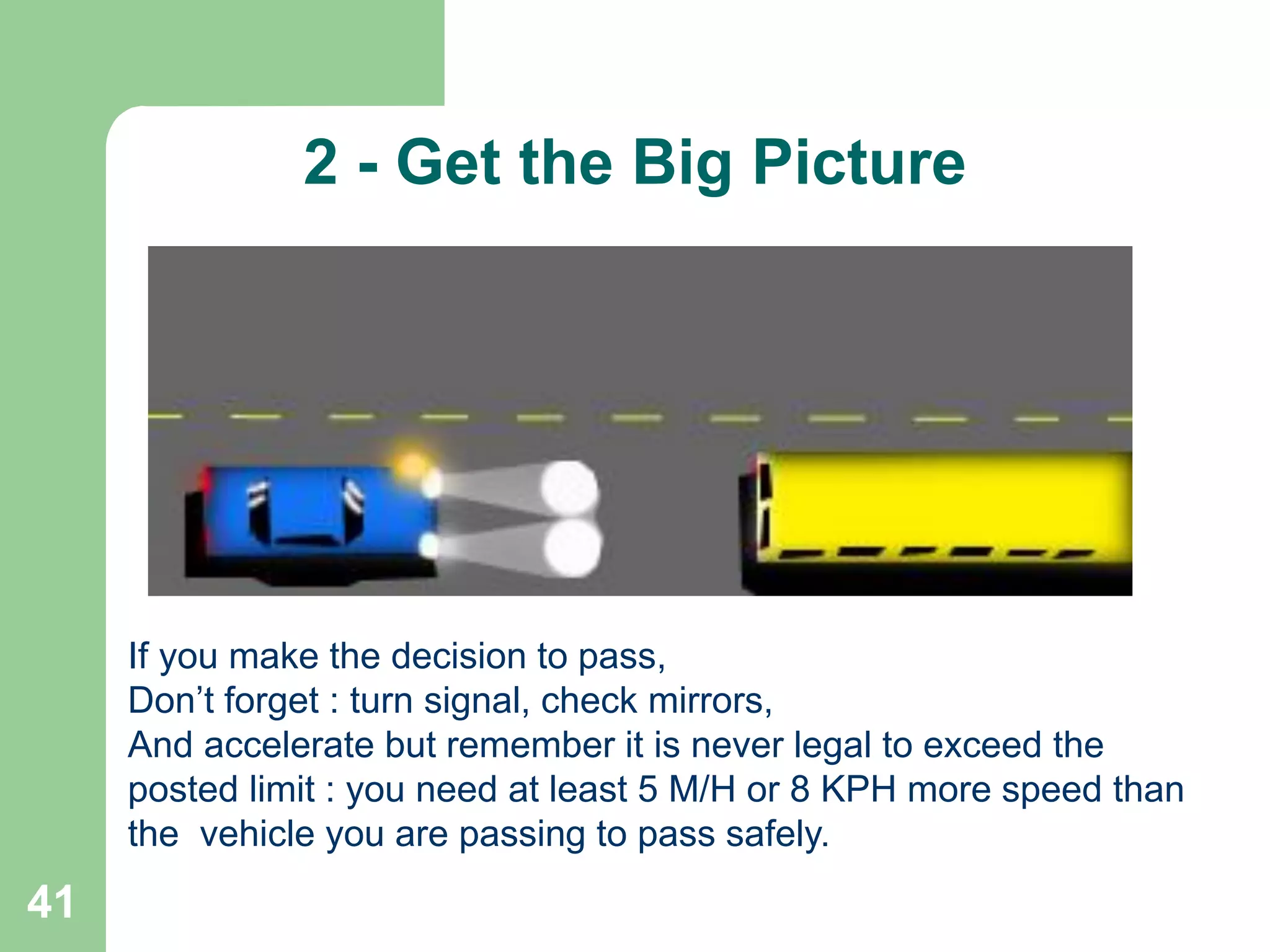
If you make the decision to pass,
Don’t forget : turn signal, check mirrors,
And accelerate but remember it is never legal to exceed the
posted limit : you need at least 5 M/H or 8 KPH more speed than
the vehicle you are passing to pass safely.
2 - Get the Big Picture
42
 On hills or curves, you must
drive at a speed that you will
be able control, maintain a
‘Stop-ability’.
 SLOW DOWN!, Driving in the
mountains is not the same as
driving where you can see for
miles ahead.
2 - Get the Big Picture
43
3 – Keep Your Eyes Moving
 Two types of vision:
 Only the Sharp central core has the clearly
vision
Central vision
Peripheral
vision
44
Make a habit of:
 Moving your eyes focusing your central vision every 2
seconds.
 Scan from side to side.
 Include your mirrors in your scanning every 5 to 8
seconds
3 – Keep Your Eyes Moving
45
Keep your eyes moving
habits is particularly
important in preventing
intersection collisions
3 – Keep Your Eyes Moving
46
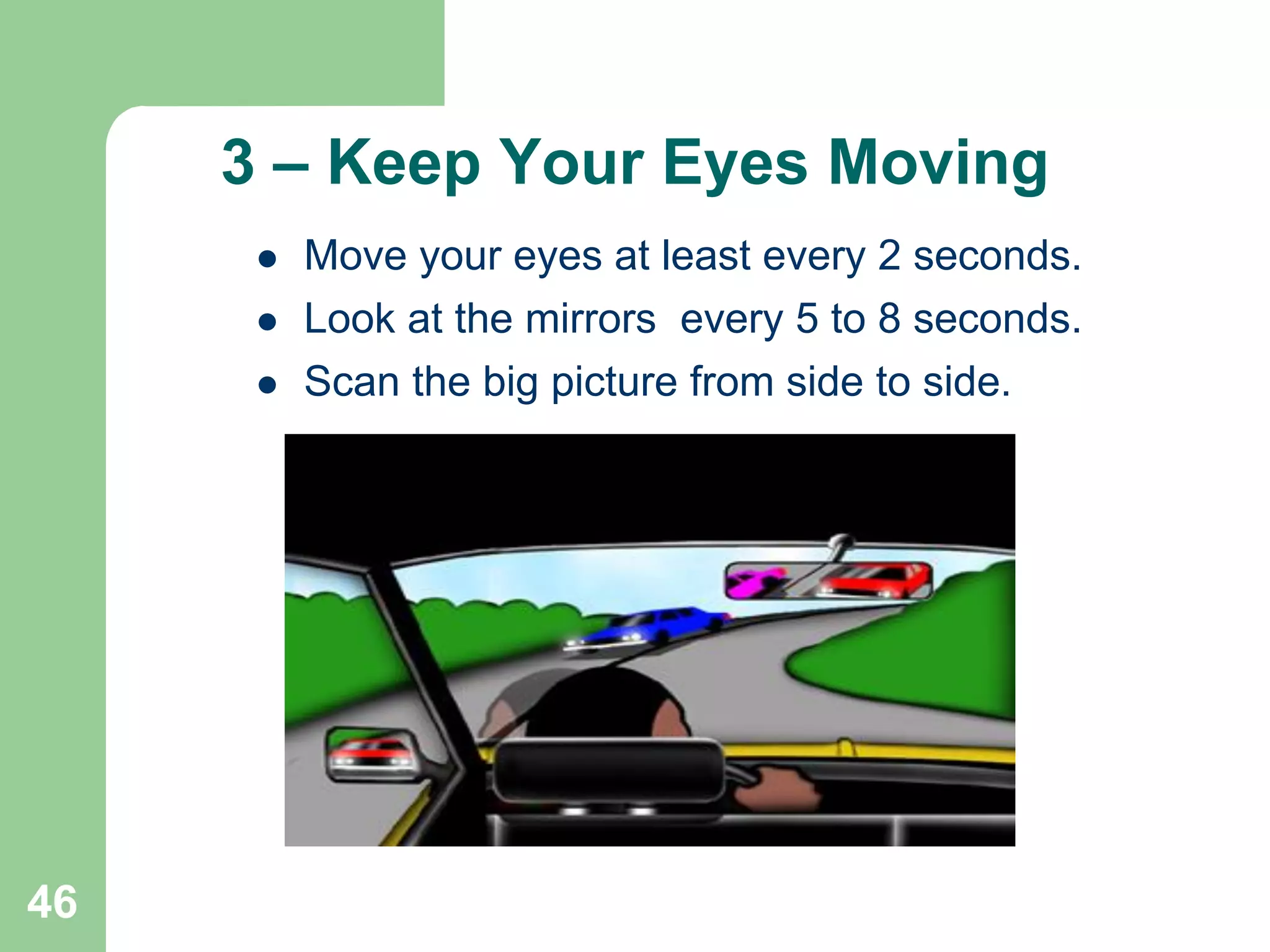
 Move your eyes at least every 2 seconds.
 Look at the mirrors every 5 to 8 seconds.
 Scan the big picture from side to side.
3 – Keep Your Eyes Moving
47
Nine recommended rules for backing :
1. Clear the rear
2. Sound the horn before you start to move.
3. Never trust the scene you checked to stay the same.
4. Back slowly
5. As you back, check both side mirrors.
6. Don’t back further than necessary.
7. Back to the driver’s side.
8. Use the ground guide
9. Always park so your first move is forward.
4 - Leave Yourself an Out
48
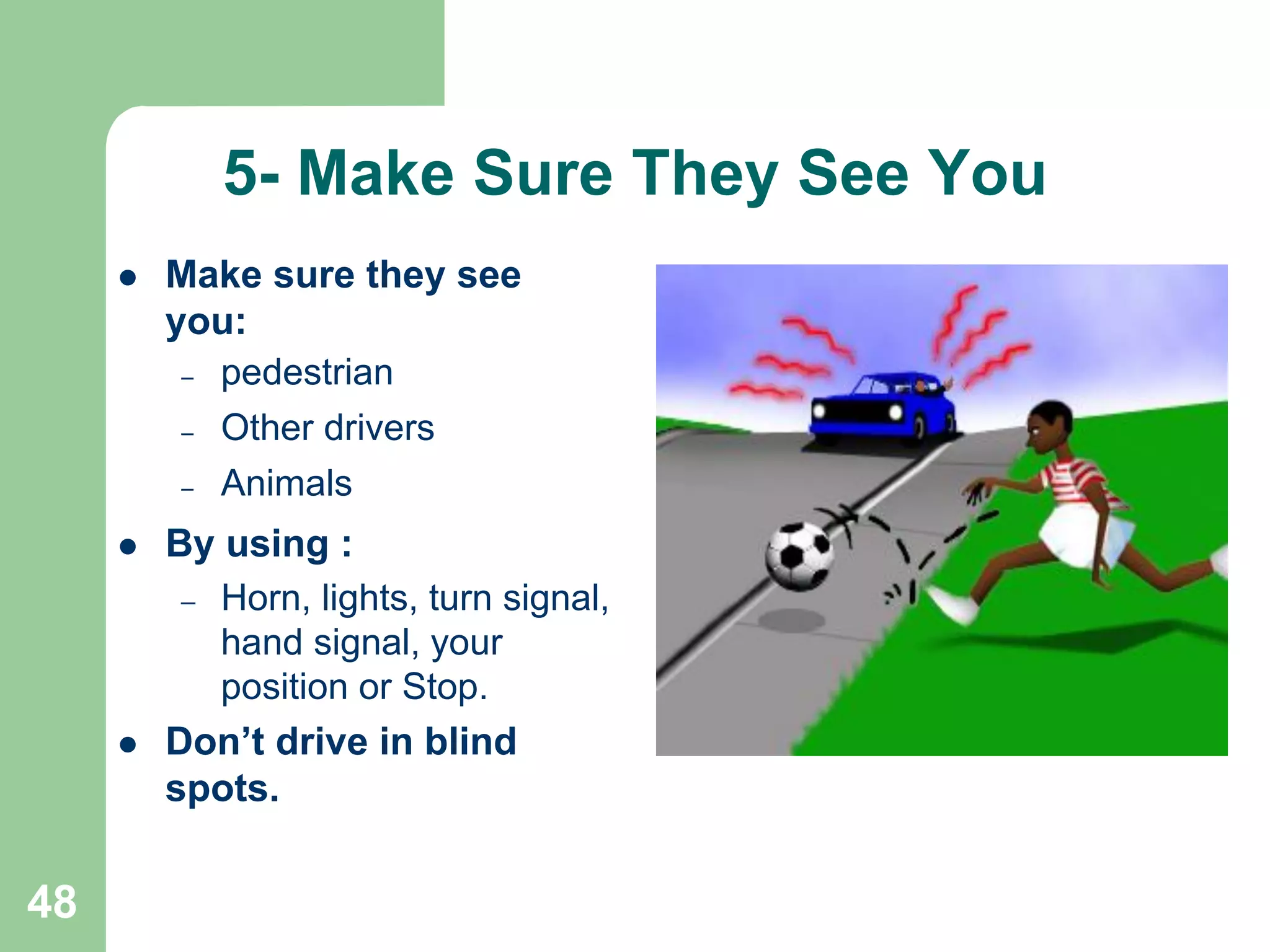
5- Make Sure They See You
 Make sure they see
you:
– pedestrian
– Other drivers
– Animals
 By using :
– Horn, lights, turn signal,
hand signal, your
position or Stop.
 Don’t drive in blind
spots.
49
Parked vehicle, drivers or passengers ready to open doors.
 Check the intentions of incoming traffic
 Use your signals well in advance.
 Wait for a response.
 Keep eye contact.
 Headlights on at dawn & dusk - at least 30 minutes before
sunset (dusk) and 30 minutes after sunrise (dawn), and
during poor visibility (Ex. SANDSTORM).
5- Make Sure They See You
50
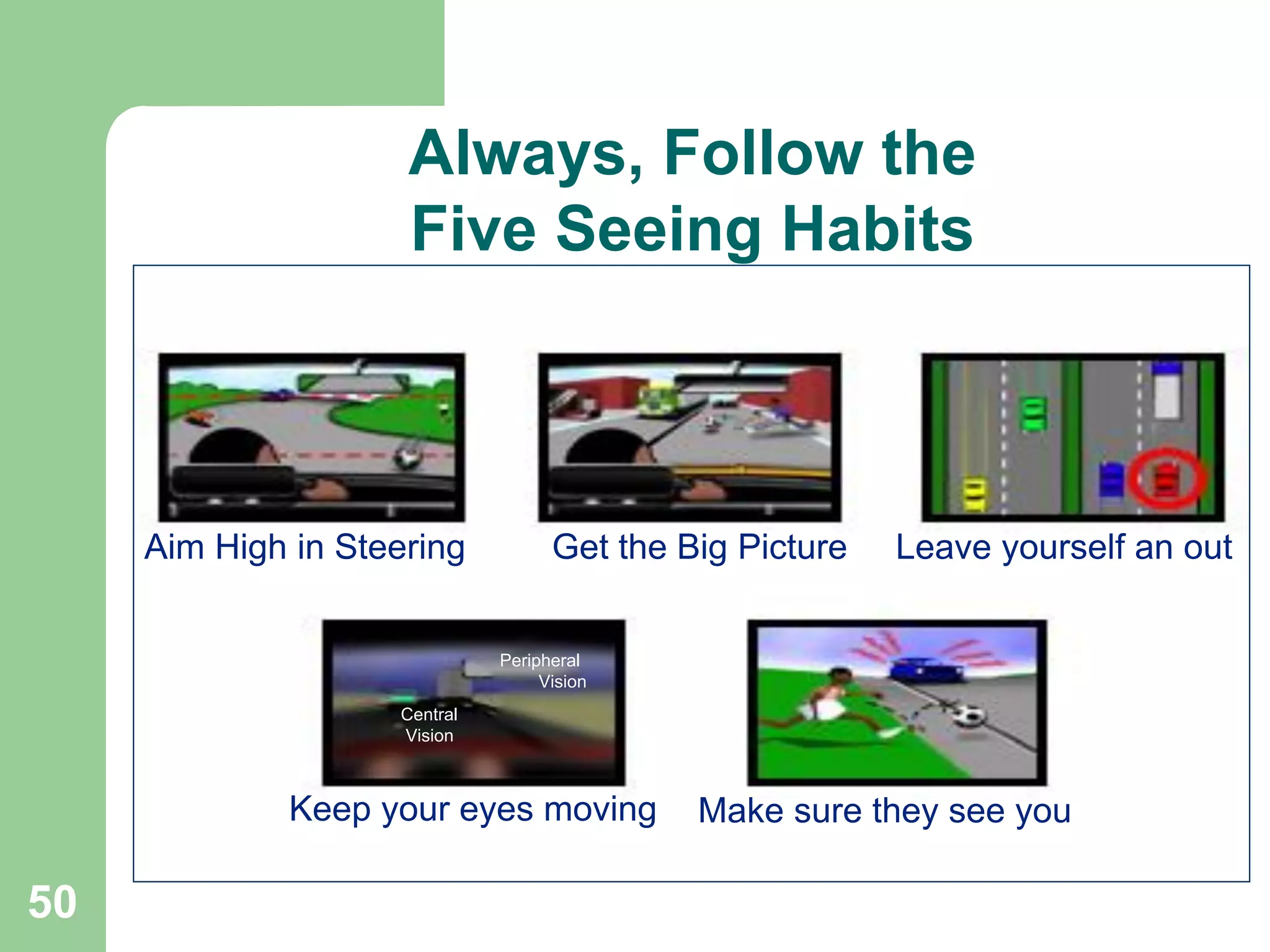
Aim High in Steering Get the Big Picture Leave yourself an out
Keep your eyes moving Make sure they see you
Central
Vision
Peripheral
Vision
Always, Follow the
Five Seeing Habits
51
Standard Accident Prevention
Techniques
 Recognise the hazard
 Understand the defence
 Act correctly in good time
Remember it takes Time to See, Understand & Act.
Defensive Drivers allow themselves a few seconds of
“thinking time”.
So in terms of the Lives, Time and Money that can be
Saved, these techniques are a measure worth taking
52
Good Drivers Are:-
 SKILLED
 AWARE
 CAUTIOUS
 CONSIDERATE
 COURTEOUS
ALIVE
53
The “Do’s” for Good Drivers
 DO wear your seatbelt
– and make sure ALL of your passengers wear theirs
too - it’s your responsibility
 DO keep your speed down
 DO maintain your vehicle
 DO drive defensively at ALL times
– concentrate
– think ahead
 BE A SAFE DRIVER - NOT A SHAMEFUL DRIVER
54
The “Don’ts” for Good Drivers
 DON’T drink and drive
 DON’T carry excess loads
– passenger and/or materials
 DON’T take chances with lives
– yours or anyone else`s
55
How to Prevent an Accident
 Recognise the hazards
 Anticipate what others may or may not do
 Know and follow the rules
 Signal correctly and in good time
 Only move into another lane or road when it is
clear and it is safe to do so
 Do not ‘tailgate’
56
How to Prevent an Accident
 Use dipped headlights in rain or when light is
poor
– See and be seen - you may be able to see, others
may not see you
 Do not exceed the speed limits
– Speed limits are maximum limits, at times it may be
necessary to drive below the limit
57
Project Requirements
 Only AUTHORISED drivers may
drive vehicles on site
 Site speed limits MUST be obeyed
 REVERSE park whenever possible
58
If It All Goes Wrong
 In the event of having an accident:
 STOP IMMEDIATELY
 If there is anybody hurt, get medical help
immediately (Call 000-xxxx-zzzz)
 All collisions are to be reported to Daewoo HSE section
without delay to permit the road traffic unit to attend.
 Be pro-active, help in the investigation
 Remember, all drivers involved in an accident are to
be tested for drugs and alcohol
59
Things to Think About
 Do not use a hand held radio or mobile
telephone while driving
 Do not smoke while driving
 Ensure that you and all passengers wear
seatbelts
– if your vehicle has only 2 seatbelts, only 2
persons will travel.
60
Project Driving Permit
 Permit system is controlled by Daewoo HSE
 The permit shall be carried at all times.
 It is to be produced at the request of any Project
Supervisor, Road Traffic Officer, Safety Personnel
or Security Staff
 It is not to be given to, or used by, any other person
61
Drive badly
An Accident waiting to
happen
Drive Safely
Live Long - Be Happy
Summary
If you want this file in Microsoft PowerPoint
click on the advertisements shown in the site
https://hseprofessionalspakistan.blogspot.com/
Read or stay on the advertisement content at
least for one minute on each minute and then
email me “Done” with your name and country
then I emailed the PPT file to you
khudabux22081985@gmail.com
62

Defensive Driving Safety Training

  • 1.
  • 2.
    Please Click onthe Advertisements 2 times Shown on the Site to support the blogger and motivate for upload Documents in the Site Which may help you and others Thanks https://hseprofessionalspakistan.blogspot.com/
  • 3.
    3 Purpose  This Courseis intended to: – Improve your traffic safety awareness – Lessen the likelihood of collisions – Eliminate  the misery and tragic cost in human lives  the financial expense involved in motor vehicle accidents
  • 4.
    4 Course Goals &Objectives  To help you understand how Your attitude affects your driving  To enable you to recognise and evaluate your current driving patterns  To ensure that you understand the responsibilities of driving  To help improve the standard of driving on the Project
  • 5.
    5 What is DefensiveDriving?  Planning ahead  Being observant  Being aware of others and what they may do  Anticipating other people’s errors  Showing consideration for other road users, including pedestrians, cyclists etc.
  • 6.
    6 Road Statistics  Number4 cause of Death in the World as per statistics  World Wide - every year – Killed - over 500,000! – Seriously Injured - over 15 Million
  • 7.
    7 Common Causes ofVehicle Accidents  Failure to GIVE WAY the right of way  Driving too close to the vehicle in front (tailgating)  Ignoring signals  Poor standard of vehicles and lack of maintenance  EXCESSIVE SPEED  Driving while under the influence of alcohol or drugs
  • 8.
    8 Major Factors  Environment –poor driving standards – poor road surfaces – extreme weather / poor visibility  Attitude – anger & impatience – tiredness – driving under the influence of alcohol or drugs
  • 9.
    9 Major Factors.  Distractions –passengers – day-dreams – Problems – Using mobile phones while driving  Poor Vehicle Condition – no lights – bad tyres – chassis alignment
  • 10.
    10 Give way totraffic from Left Roundabouts
  • 11.
    11 Going Straight? No Indicator Indicate Rightturn here NO overtaking on roundabouts Roundabouts
  • 12.
  • 13.
  • 14.
    14 95% of RoadAccidents are Caused by Driver Error  Attitude – “IT WON’T HAPPEN TO ME” – taking risks  overtaking  speeding – abuse of alcohol or drugs – arrogance, impatience
  • 15.
    15 Driver’s Responsibility  Takeinto account the road conditions – surface, weather, visibility – traffic, pedestrians, animals – location - town or rural  Consider the vehicles condition – age (corrosion), brakes, tyres, lights, steering, suspension, etc. – poor maintenance  Carry out regular vehicle checks  Apply 4 seconds Safe distance
  • 16.
    16 Typical Stopping Distance usualresidential speed limit thinking distance breaking distance 9m 14m 23m (75 feet) 6 car lengths 53m (175 feet) 13 car lengths 15m 38m 36m (120 feet) 9 car lengths 12m 24m 73m (240 feet) 18 car lengths 18m 55m 21m 75m At 120 KPH it will take you 96m to stop a car 96m (315 feet) 24 car lengths
  • 17.
    17 Daily Safety Checks Brakes operates efficiently – (including parking brakes)  Tires – Good condition, properly inflated  Seatbelts – Fully serviceable – 3 points seatbelts in front side  Lights – All functioning – including brake lights and indicators
  • 18.
    18 Headlights  Use dippedheadlights in rain or when light is poor – See and be seen - you may be able to see, others may not see you. – DO NOT DAZZLE OTHER ROAD USERS WITH YOUR “MAIN” BEAM! – If you are dazzled, pull over and give your eyes time to recover.
  • 19.
    19 Give Way /Yield  Driver must Yield or stop for all Emergency Response vehicles showing BLUE, RED or GREEN flashing lights. – Pull over to let them pass – stop if vehicles remains behind you  Do not fit or use BLUE, RED or GREEN flashing lights unless you are authorized to do so
  • 20.
    20 Four Way Flashers Use only to indicate a STATIONARY HAZARD  Not:- – I’m important and I’m coming through – I’m going straight on – I’m breaking the speed limit but flashing my “Four Ways” makes it IT DOESN’T!
  • 21.
    21 Safe Driving Rules Seatbelts must be worn at all times by the DRIVER and ALL passengers  Drivers must wear footwear that is properly fastened and will not slip of the foot. – Footwear that is held on by single strap either through the toes or over the foot shall not be worn when driving
  • 22.
    22 Safe Driving Rules Speed limits must be adhered to:- – Open road/Highway 80 KPH – Site 20KPH – Office area 15KPH – Camps 15KPH KPH  On site and on the camps PEDESTRIANS HAVE RIGHT OF WAY!
  • 23.
    23 Fail to meetyour Responsibilities:-  INJURY/DEATH,  LOSS OF LOVED ONES, JAIL  PROPERTY DAMAGE,
  • 24.
    24 Remedial Measures  TheThree E’s – Education- skills training  hazard perception  attitude changes - concentration, consideration and patience – Engineering - well maintained vehicle – Enforcement
  • 25.
    25 Driving While Underthe Influence of Alcohol or Drugs  Daewoo has a zero tolerance to driving while under the influence of Alcohol or Drugs. It will result in: IMMEDIATE DISMISSAL FROM EMPLOYMENT IN ANY PROJECT OF DAEWOO
  • 26.
    26 Drug and AlcoholTesting  You WILL be tested for drugs and alcohol if; – You are the driver of the vehicle that has been involved in a collision with any other object – If your conduct gives cause for concern, having committed and unsafe act, failed to comply with the rules of the road or breached any HSE requirements
  • 27.
    27 Driving To StayAlive  Driver error is the major contributor in 95% of all collisions THIS DOES REDUCE IF DRIVERS DRIVE DEFENSIVELY  A collision WILL happen if – Driver has failed to do everything reasonably practical to prevent it  DEFENSIVE DRIVING is when the Driver conscientiously drives to PREVENT accidents
  • 28.
    28 Five seeing habits Aim high in steering  Get The big picture  Keep your eyes moving  Leave yourself an out  Make sure they see you
  • 29.
    29 1 - AimHigh in Steering ACTION Zone 4 to 6 seconds, do an action immediately! SEEING Zone 12 to 15 seconds, check hazards to adjust conditions your vehicle, pick a target in the center of your lane PLANNING Zone 30 to 120 seconds, you have time to smoothly and safely avoid the danger. ! 3 ZONES:
  • 30.
    30 Action Zone 1 -Aim High in Steering
  • 31.
    31 Seeing Zone 1 -Aim High in Steering
  • 32.
    DW-HSE-TM0016 32 Planning Zone 1- Aim High in Steering
  • 33.
    33  Centre yourvehicle on the lane.  Spot early the drivers who are: – Driving erratically. – Lurking behind a truck. Avoid Head on, Head collision 1 - Aim High in Steering
  • 34.
  • 35.
    35 1 - AimHigh in Steering Watch for other drivers lurking behind others in oncoming traffic. ! Never go into the opposite lane, the oncoming driver may attempt to swerve back to that side of the road Keep in mind that Head-Ons are deadly and better to hit a stationary objects than approching vehicle.
  • 36.
    36 2 - Getthe Big Picture  In front you.  On your Left  On your Right  Behind you  Below you  Above you Driver must analyze the route continually, you must look :
  • 37.
    37  Re-establish yourvisibility.  Maintain your space.  Create a safe area or “bubble” around your vehicle. 2 - Get the Big Picture
  • 38.
    38  Driving isa full time job  Stay focused on the task at hand, don’t be distracted.  Avoid fixed vision.  ”Understand ” the road rather than simply “ Looking ” at the road 2 - Get the Big Picture
  • 39.
    39 Back off andGet the Big Picture!!! If you cannot see around the truck! 2 - Get the Big Picture
  • 40.
    40 If you planto pass the next car, think first :  Do you really need to do this? Perhaps it would be better to wait!  Is it safe, do you have enough space and time?  Is it legal? 2 - Get the Big Picture
  • 41.
    41 If you makethe decision to pass, Don’t forget : turn signal, check mirrors, And accelerate but remember it is never legal to exceed the posted limit : you need at least 5 M/H or 8 KPH more speed than the vehicle you are passing to pass safely. 2 - Get the Big Picture
  • 42.
    42  On hillsor curves, you must drive at a speed that you will be able control, maintain a ‘Stop-ability’.  SLOW DOWN!, Driving in the mountains is not the same as driving where you can see for miles ahead. 2 - Get the Big Picture
  • 43.
    43 3 – KeepYour Eyes Moving  Two types of vision:  Only the Sharp central core has the clearly vision Central vision Peripheral vision
  • 44.
    44 Make a habitof:  Moving your eyes focusing your central vision every 2 seconds.  Scan from side to side.  Include your mirrors in your scanning every 5 to 8 seconds 3 – Keep Your Eyes Moving
  • 45.
    45 Keep your eyesmoving habits is particularly important in preventing intersection collisions 3 – Keep Your Eyes Moving
  • 46.
    46  Move youreyes at least every 2 seconds.  Look at the mirrors every 5 to 8 seconds.  Scan the big picture from side to side. 3 – Keep Your Eyes Moving
  • 47.
    47 Nine recommended rulesfor backing : 1. Clear the rear 2. Sound the horn before you start to move. 3. Never trust the scene you checked to stay the same. 4. Back slowly 5. As you back, check both side mirrors. 6. Don’t back further than necessary. 7. Back to the driver’s side. 8. Use the ground guide 9. Always park so your first move is forward. 4 - Leave Yourself an Out
  • 48.
    48 5- Make SureThey See You  Make sure they see you: – pedestrian – Other drivers – Animals  By using : – Horn, lights, turn signal, hand signal, your position or Stop.  Don’t drive in blind spots.
  • 49.
    49 Parked vehicle, driversor passengers ready to open doors.  Check the intentions of incoming traffic  Use your signals well in advance.  Wait for a response.  Keep eye contact.  Headlights on at dawn & dusk - at least 30 minutes before sunset (dusk) and 30 minutes after sunrise (dawn), and during poor visibility (Ex. SANDSTORM). 5- Make Sure They See You
  • 50.
    50 Aim High inSteering Get the Big Picture Leave yourself an out Keep your eyes moving Make sure they see you Central Vision Peripheral Vision Always, Follow the Five Seeing Habits
  • 51.
    51 Standard Accident Prevention Techniques Recognise the hazard  Understand the defence  Act correctly in good time Remember it takes Time to See, Understand & Act. Defensive Drivers allow themselves a few seconds of “thinking time”. So in terms of the Lives, Time and Money that can be Saved, these techniques are a measure worth taking
  • 52.
    52 Good Drivers Are:- SKILLED  AWARE  CAUTIOUS  CONSIDERATE  COURTEOUS ALIVE
  • 53.
    53 The “Do’s” forGood Drivers  DO wear your seatbelt – and make sure ALL of your passengers wear theirs too - it’s your responsibility  DO keep your speed down  DO maintain your vehicle  DO drive defensively at ALL times – concentrate – think ahead  BE A SAFE DRIVER - NOT A SHAMEFUL DRIVER
  • 54.
    54 The “Don’ts” forGood Drivers  DON’T drink and drive  DON’T carry excess loads – passenger and/or materials  DON’T take chances with lives – yours or anyone else`s
  • 55.
    55 How to Preventan Accident  Recognise the hazards  Anticipate what others may or may not do  Know and follow the rules  Signal correctly and in good time  Only move into another lane or road when it is clear and it is safe to do so  Do not ‘tailgate’
  • 56.
    56 How to Preventan Accident  Use dipped headlights in rain or when light is poor – See and be seen - you may be able to see, others may not see you  Do not exceed the speed limits – Speed limits are maximum limits, at times it may be necessary to drive below the limit
  • 57.
    57 Project Requirements  OnlyAUTHORISED drivers may drive vehicles on site  Site speed limits MUST be obeyed  REVERSE park whenever possible
  • 58.
    58 If It AllGoes Wrong  In the event of having an accident:  STOP IMMEDIATELY  If there is anybody hurt, get medical help immediately (Call 000-xxxx-zzzz)  All collisions are to be reported to Daewoo HSE section without delay to permit the road traffic unit to attend.  Be pro-active, help in the investigation  Remember, all drivers involved in an accident are to be tested for drugs and alcohol
  • 59.
    59 Things to ThinkAbout  Do not use a hand held radio or mobile telephone while driving  Do not smoke while driving  Ensure that you and all passengers wear seatbelts – if your vehicle has only 2 seatbelts, only 2 persons will travel.
  • 60.
    60 Project Driving Permit Permit system is controlled by Daewoo HSE  The permit shall be carried at all times.  It is to be produced at the request of any Project Supervisor, Road Traffic Officer, Safety Personnel or Security Staff  It is not to be given to, or used by, any other person
  • 61.
    61 Drive badly An Accidentwaiting to happen Drive Safely Live Long - Be Happy Summary
  • 62.
    If you wantthis file in Microsoft PowerPoint click on the advertisements shown in the site https://hseprofessionalspakistan.blogspot.com/ Read or stay on the advertisement content at least for one minute on each minute and then email me “Done” with your name and country then I emailed the PPT file to you khudabux22081985@gmail.com 62