JIET SCHOOL OF ENGINEERING &
TECHOLOGY FOR GIRLS, JODHPUR
Submitted by: Submitted to:
Pratibha maurya Prof. Anshu mathur
DEFINITIONS OF DISASTER
 A disaster can be defined as any occurrence that
cause damage, ecological disruption, loss of human
life, deterioration of health and health services on a
scale ,sufficient to
DISASTERS CLASSIFICATIONS
MANMADE NATURAL
NATURAL DISASTER
 Avalanches
 Earthquakes
 Volcanic eruptions
 Hydrological disasters
 Cyclonic storms
 Space disasters
 Health disasters
 Wildfires
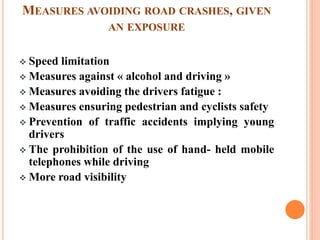
MAN- MADE DISASTERS
 fires
 transport accidents
 industrial accidents
 oil spills
 nuclear explosions/radiation
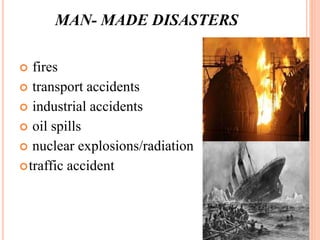
traffic accident
DEFININTION OF ACCIDENT
 The who definition:
- Unpremeditated event resulting in recognizable
damage
- An unexpected, unplanned occurrence which may
involve injury.
TRAFFIC ACCIDENT IMAGES

OTHER LAWS YOU NEED
TO KNOW!
 Headlights must be lighted from sunset to sunrise or
when visibility is poor.
 You must dim your brights 500’ before meeting and 200’
before overtaking another vehicle.
 It is illegal to engage in any vehicle race, exhibit of
speed, or speed contest on any public road, street, or
highway.
 Windows and windshields must be kept clean and free
of stickers, signs, posters, except those required by law.
 When a load extends 4’ or more out the back, a red flag
must be attached to the load.
 It is illegal to drive recklessly or inattentively.
 It is illegal to send or read text messages while
driving!
SPEED LIMITS
 The Basic Rule: No matter what the posted speed,
you must judge the situation and conditions and
adjust your speed accordingly.
 The maximum speed on a freeway is 75mph,
65mph on a highway, and 35mph on city streets
(unless posted otherwise).
 It is illegal to drive so slowly that you disrupt the
normal flow of traffic.
 Observe posted speeds in school and construction
zones to protect students and workers (penalties
are higher in these areas).
FACT ABOUT SIGNALING & TURNING
 You must signal when turning at an intersection or
into a driveway!
 You must signal when changing lanes.
 You must signal when entering or leaving the
freeway.
 You must signal when pulling toward or away from
the curb.
 You must signal 100 feet (about 5 seconds) before
turning.
 In Idaho, you may turn right on a red light, after
stopping.
 In Idaho, you may turn left on a red light, after
stopping, and if turning onto a one-way street.
TEXTING AND DRIVING
 As of July 1, 2012, it is illegal to text while driving in
Idaho.
 “Texting” means, “engaging in the review of, or
manual preparation and transmission of, written
communication via handheld wireless devices.”
PERFORMANCE OF ORIGINAL ARPANET
ALGORITHM
 Light load
 Delay dominated by the constant part (transmission
delay and propagation delay)
 Medium load
 Queuing delay is no longer negligible
 Moderate traffic shifts to avoid congestion
 Heavy load
 Very high metrics on congested links
 Busy links look bad to all of the routers
 All routers avoid the busy links
 Routers may send packets on longer paths
MOTOROLA ESENSOR™
 DNA Detection System.
 Binding properties of DNA and RNA.
 Electronic circuit element.
 Detectable electronic signal.
 Disposable biochip cartridges, detection reagents,
electronic biochip reader, software and protocols.
 Convenient, economically feasible.
AIM
INVESTIGATE THE CAUSES OF THE MAJOR REDUCTION
IN THE NUMBER OF ROAD ACCIDENT FATALITIES IN 2007-10
0
20
40
60
80
100
120
2000 2001 2002 2003 2004 2005 2006 2007 2008 2009 2010
Casualtiesindexedto2000figure
Killed Seriously injured
RISK FACTORS
The risk depends on four elements :
 A) Exposure excess (need to travel)
 B) Risk of crash, given a particular exposure,
 C) Risk of injury, given a crash,
 D) Risk of death or severe consequences,
given an injury.
PREVENTION
 Traffic accidents are preventable.
 The three targets of the road safety actions :
- the road users
- the vehicles
- the roads infrastructure as well as the
traffic management.
PREVENTION
A scientific approach to the issue is necessary :
Many conditions are required to guarantee the
efficiency of the prevention strategies which are
adopted.
 To collect, analyse and carefully interpret reliable
data : The National Traffic Observatory in Tunisia was
established to fulfill theses missions.
 To define objectives.
 To promote research, which subjects are concerned with
road safety.
 To encourage the cooperation between different
organizations intervening in traffic accidents prevention
(NETWORKING).
THE KEY ORGANIZATIONS
INTERVENING IN THE PREVENTION
STRATEGIES :
Organizations intervening
in road safety actions
PREVENTION MEASURES
Prevention strategies are made of interventions
which are aiming to :
 diminish the exposure risk.
 avoid road crashes, given a particular
exposure.
 reduce the severity of injuries caused by
crashes
 improve the medical care for victims.
MEASURES AVOIDING ROAD CRASHES, GIVEN
AN EXPOSURE
 Speed limitation
 Measures against « alcohol and driving »
 Measures avoiding the drivers fatigue :
 Measures ensuring pedestrian and cyclists safety
 Prevention of traffic accidents implying young
drivers
 The prohibition of the use of hand- held mobile
telephones while driving
 More road visibility
MEASURES REDUCING THE SEVERITY OF
INJURIES CAUSED BY CRASHES :
a – The use of seat-belts
 When use, the seat- belt reduce the risk of fatal or
severe accident, between 40% and 65 % (1).
 Making the wearing of safety belts compulsory
improves their use rates.
b- Use of helmets
c- Availability of air bags
ACTIONS IMPROVING POST-CRASH
INJURY OUTCOME
- pre-hospital mesures :
* Bystanders : call for help, carry out simple acts to
rescue victims, protect victims from
an other accident
* Larger access to emergency services
* Better pre- hospital medical care
- actions in the hospital :

CONCLUSIONS
Traffic
Vehicle
safety
Financial
stability
Vehicle
safety
CONCLUSIONS
 General reduction in traffic
 Reduction in young male drivers
 Drink driving accidents reduce
 Small reduction in speeding
 Progressively colder winters
TTTTT

traffic accident - Copy

  • 1.
    JIET SCHOOL OFENGINEERING & TECHOLOGY FOR GIRLS, JODHPUR Submitted by: Submitted to: Pratibha maurya Prof. Anshu mathur
  • 2.
    DEFINITIONS OF DISASTER A disaster can be defined as any occurrence that cause damage, ecological disruption, loss of human life, deterioration of health and health services on a scale ,sufficient to
  • 3.
  • 4.
    NATURAL DISASTER  Avalanches Earthquakes  Volcanic eruptions  Hydrological disasters  Cyclonic storms  Space disasters  Health disasters  Wildfires
  • 5.
    MAN- MADE DISASTERS fires  transport accidents  industrial accidents  oil spills  nuclear explosions/radiation traffic accident
  • 6.
    DEFININTION OF ACCIDENT The who definition: - Unpremeditated event resulting in recognizable damage - An unexpected, unplanned occurrence which may involve injury.
  • 7.
  • 8.
    OTHER LAWS YOUNEED TO KNOW!  Headlights must be lighted from sunset to sunrise or when visibility is poor.  You must dim your brights 500’ before meeting and 200’ before overtaking another vehicle.  It is illegal to engage in any vehicle race, exhibit of speed, or speed contest on any public road, street, or highway.  Windows and windshields must be kept clean and free of stickers, signs, posters, except those required by law.  When a load extends 4’ or more out the back, a red flag must be attached to the load.  It is illegal to drive recklessly or inattentively.  It is illegal to send or read text messages while driving!
  • 9.
    SPEED LIMITS  TheBasic Rule: No matter what the posted speed, you must judge the situation and conditions and adjust your speed accordingly.  The maximum speed on a freeway is 75mph, 65mph on a highway, and 35mph on city streets (unless posted otherwise).  It is illegal to drive so slowly that you disrupt the normal flow of traffic.  Observe posted speeds in school and construction zones to protect students and workers (penalties are higher in these areas).
  • 10.
    FACT ABOUT SIGNALING& TURNING  You must signal when turning at an intersection or into a driveway!  You must signal when changing lanes.  You must signal when entering or leaving the freeway.  You must signal when pulling toward or away from the curb.  You must signal 100 feet (about 5 seconds) before turning.  In Idaho, you may turn right on a red light, after stopping.  In Idaho, you may turn left on a red light, after stopping, and if turning onto a one-way street.
  • 11.
    TEXTING AND DRIVING As of July 1, 2012, it is illegal to text while driving in Idaho.  “Texting” means, “engaging in the review of, or manual preparation and transmission of, written communication via handheld wireless devices.”
  • 12.
    PERFORMANCE OF ORIGINALARPANET ALGORITHM  Light load  Delay dominated by the constant part (transmission delay and propagation delay)  Medium load  Queuing delay is no longer negligible  Moderate traffic shifts to avoid congestion  Heavy load  Very high metrics on congested links  Busy links look bad to all of the routers  All routers avoid the busy links  Routers may send packets on longer paths
  • 13.
    MOTOROLA ESENSOR™  DNADetection System.  Binding properties of DNA and RNA.  Electronic circuit element.  Detectable electronic signal.  Disposable biochip cartridges, detection reagents, electronic biochip reader, software and protocols.  Convenient, economically feasible.
  • 14.
    AIM INVESTIGATE THE CAUSESOF THE MAJOR REDUCTION IN THE NUMBER OF ROAD ACCIDENT FATALITIES IN 2007-10 0 20 40 60 80 100 120 2000 2001 2002 2003 2004 2005 2006 2007 2008 2009 2010 Casualtiesindexedto2000figure Killed Seriously injured
  • 15.
    RISK FACTORS The riskdepends on four elements :  A) Exposure excess (need to travel)  B) Risk of crash, given a particular exposure,  C) Risk of injury, given a crash,  D) Risk of death or severe consequences, given an injury.
  • 16.
    PREVENTION  Traffic accidentsare preventable.  The three targets of the road safety actions : - the road users - the vehicles - the roads infrastructure as well as the traffic management.
  • 17.
    PREVENTION A scientific approachto the issue is necessary : Many conditions are required to guarantee the efficiency of the prevention strategies which are adopted.  To collect, analyse and carefully interpret reliable data : The National Traffic Observatory in Tunisia was established to fulfill theses missions.  To define objectives.  To promote research, which subjects are concerned with road safety.  To encourage the cooperation between different organizations intervening in traffic accidents prevention (NETWORKING).
  • 18.
    THE KEY ORGANIZATIONS INTERVENINGIN THE PREVENTION STRATEGIES : Organizations intervening in road safety actions
  • 19.
    PREVENTION MEASURES Prevention strategiesare made of interventions which are aiming to :  diminish the exposure risk.  avoid road crashes, given a particular exposure.  reduce the severity of injuries caused by crashes  improve the medical care for victims.
  • 20.
    MEASURES AVOIDING ROADCRASHES, GIVEN AN EXPOSURE  Speed limitation  Measures against « alcohol and driving »  Measures avoiding the drivers fatigue :  Measures ensuring pedestrian and cyclists safety  Prevention of traffic accidents implying young drivers  The prohibition of the use of hand- held mobile telephones while driving  More road visibility
  • 21.
    MEASURES REDUCING THESEVERITY OF INJURIES CAUSED BY CRASHES : a – The use of seat-belts  When use, the seat- belt reduce the risk of fatal or severe accident, between 40% and 65 % (1).  Making the wearing of safety belts compulsory improves their use rates. b- Use of helmets c- Availability of air bags
  • 22.
    ACTIONS IMPROVING POST-CRASH INJURYOUTCOME - pre-hospital mesures : * Bystanders : call for help, carry out simple acts to rescue victims, protect victims from an other accident * Larger access to emergency services * Better pre- hospital medical care - actions in the hospital :
  • 23.
  • 24.
  • 25.
    CONCLUSIONS  General reductionin traffic  Reduction in young male drivers  Drink driving accidents reduce  Small reduction in speeding  Progressively colder winters
  • 26.