Road Safety Training
Ajeet Kumar
VISION
To spread awareness, alertness
towards the safety of people,
property & environment while using
the road. To strive for continual
improvement for the long term goal
to achieve zero harm to people,
property & environment.
2
OBJECTIVE
• Understanding the major causes of accidents on road.
• To control over the risk involved in operating vehicles.
• How to become a better driver.
• Introduction to the road monitoring procedures, standard
draft and incident reporting for jsw employees.
• To suggest improvement for safe working of vehicles on 3
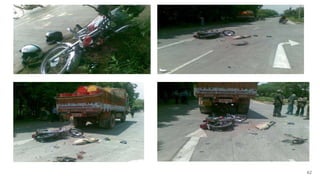
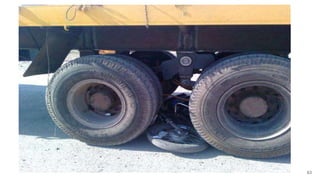
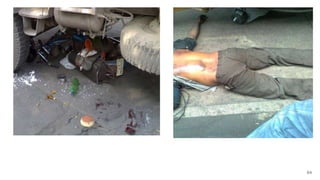
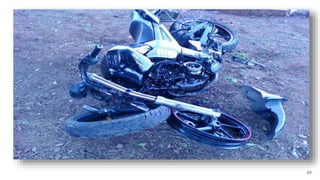
PLEASE THINK OF ANY ACCIDENT THAT
HAS BEEN TAKEN PLACE NEAR BY YOU,
WHICH HAS CAUSED SERIOUS INJURY
OR DAMAGE TO THE PROPERTY & THE
REASON OF THAT ACCIDENT
4
THINK:
5
REPORTS
6
7
8
9
10
THAT’S WHY
DRIVER & DRIVING IS
THE MOST
SIGNIFICANT KEY TO
PREVENT ACCIDENTS
11
12
CAUSE OF
ACCIDENT
CAUSES OF ACCIDENT
SYSTEM FACTOR
▪ No established traffic rules
▪ No standardized approach for training & skill development
▪ No monitoring & correction of conditions.
ENVIORNMENT FACTOR
▪ Road layout
▪ Constraint for visibility like rain, fog etc
13
CAUSES OF ACCIDENT
PEOPLE FACTOR
▪ Excessive speed
▪ Distractions
▪ Unfit to drive (under impression of alcohol , fatigue etc)
▪ Less knowledge or inadequate skills.
▪ Over confidence, aggressive driving etc.
EQUIPMENT FACTOR
▪ Defects in brake & steering
▪ Defects with fuel & lubricating lines
14
1. Visibility is greatly reduced in rain, fog etc. So
take extra precaution & slow down.
2. Always use low beam in such weather.
3. If your vehicles skids, then DON’T BRAKE,
instead take foot of accelerator.
15
CAUSES OF ACCIDENT
BAD WEATHER
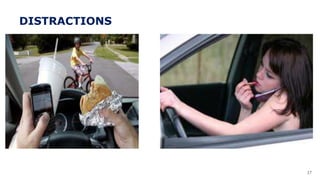
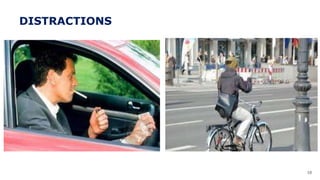
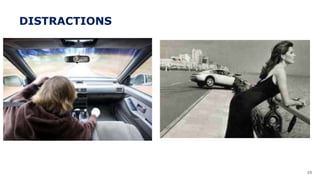
DISTRACTIONS
• Talking on phone
• Talking & driving
• Smoking while driving
• Listening music or turning on the player
• Viewing the beautiful scene outside .
16
17
DISTRACTIONS
18
DISTRACTIONS
19
DISTRACTIONS
CAUSES OF FATIGUE
• Driving after consuming a large meal
• Driving long distances at highway
• Insufficient rest
• Driving after hectic duty
• Improper ventilation or temperature control
20
21
DEFENSIVE
DRIVING
TELL THE QUALITY OF A DEFENSIVE DRIVER
• A)
• B)
• C)
• D)
• E)
• F) 22
DEFENSIVE DRIVING
Defensive driver is one who
• Commits no driving errors
• Compensate for others drivers inadequate skills
or improper driving styles
• Adjust his driving to suit traffic conditions &
unusual weather
• Careful enough to recognize the accident
producing conditions & take preventive actions
in advance.
23
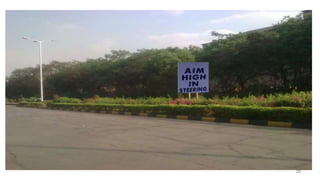
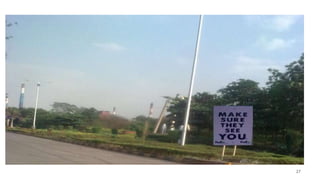
TECHNIQUES OF DEFENSIVE DRIVING
• Aim High in Steering
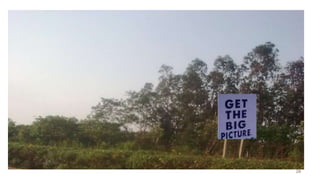
• Get the Big Picture
• Keep Your Eyes Moving.
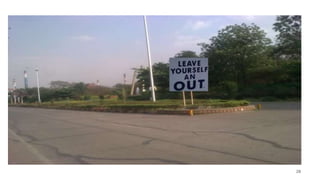
• Leave Yourself an Out
• Make Sure They See You
24
25
26
27
28
29
In short, broadly, a defensive driver is
one who is not involved in any kind of
accidents not even by others errors.
So our aim is learn how one can become a
defensive driver & effectively practice those
techniques.
30
INTERACTIVE
TIPS ON DEFENSIVE DRIVING
• Don’t get aggressive even if aggravated.
• Never place complete faith on other drivers signal.
• Be prepared for motorist who ignored lane & signal
• Slow down at all crossings.
• Keep to the left & let the inexperience & speeding driver go on
their way.
• Don’t fight on high beams issue with the drive coming from
opposite. Keep your beam at low.
31
TIPS ON DEFENSIVE DRIVING
• Do not drive more than 2- 2 ½ hr in a stretch.
• For AC fitted vehicles, stop AC after every 1 hr, open
the window & let the fresh air come in.
• Beware of pedestrian.
• Look 360 degree after every 10-15 sec.
32
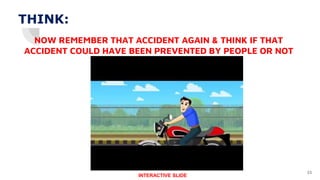
NOW REMEMBER THAT ACCIDENT AGAIN & THINK IF THAT
ACCIDENT COULD HAVE BEEN PREVENTED BY PEOPLE OR NOT
????
INTERACTIVE SLIDE
33
THINK:
VEHICLE PRE START
1. Walk around the machine for physical damages or crack etc.
2. Inspect the tyres for flat or low air.
3. Clean the windows from dust/dirt.
4. Make sure that mirror are cleaned & properly set.
5. Check the levels of all fluids like engine oil, hydraulic,
transmission, steering, coolant & brake etc.
6. Check for other activities happening in the vicinity of site.
7. Check for any leakages. Ensure that all caps, Plugs are properly
fastened.
8. Clean the reflectors of head light, tail light, Brake light etc.
9. Before starting ensure that gear lever is in neutral position.
34
35
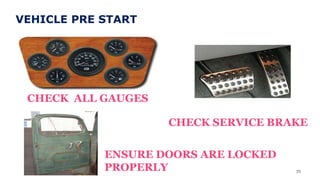
CHECK ALL GAUGES
CHECK SERVICE BRAKE
ENSURE DOORS ARE LOCKED
PROPERLY
VEHICLE PRE START
36
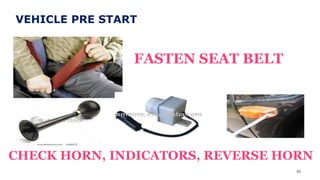
FASTEN SEAT BELT
CHECK HORN, INDICATORS, REVERSE HORN
VEHICLE PRE START
OPERATION
1. Check whether all gauges are working fine.
2. Check for functioning of all controls & shut down controls.
3. Check for forward & reverse movement of equipment.
4. Check service brake.
5. If machine is equipped with cabin, ensure that doors are securely
closed.
6. Fasten your seat belts.
7. Check horn, reverse horn & lights, indicators etc.
8. Always operate the machine slowly until fully familiarized with its
control.
37
38
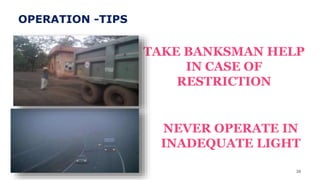
TAKE BANKSMAN HELP
IN CASE OF
RESTRICTION
NEVER OPERATE IN
INADEQUATE LIGHT
OPERATION -TIPS
39
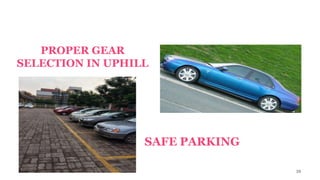
PROPER GEAR
SELECTION IN UPHILL
SAFE PARKING
1. In case of restriction of the view of the operator, do not operate the
machine unless a banks man is available for giving signal for safe
operation.
2. Under wet or rainy conditions when the ground became too slippery
for the machine, stop the earth moving operation.
3. Never operate the machine in any place of inadequate lighting
4. Never leave the machine while the engine is running and ignition
key is on the machine.
5. Never use the machine for any purposes other than it is designed
for. 40
OPERATION –TIPS EARTH MOVING
1. Park on level ground, with the parking brake firmly applied and
blocked by suitable wedges, where appropriate. Avoid parking near
edges of slopes and excavations.
1. Lower the attachments or working tools to the ground.
1. Remove the ignition key and hand it back to the site personnel for
safe custody.
1. Use proper ladder to come down from work station.
41
OPERATION -TIPS
42
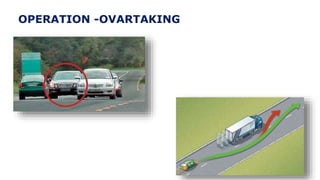
OPERATION -OVARTAKING
43
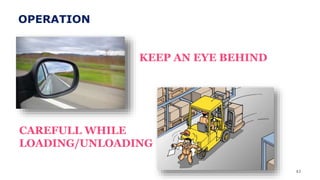
KEEP AN EYE BEHIND
CAREFULL WHILE
LOADING/UNLOADING
OPERATION
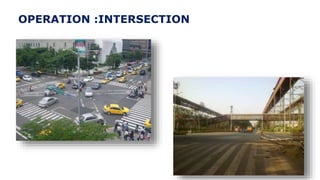
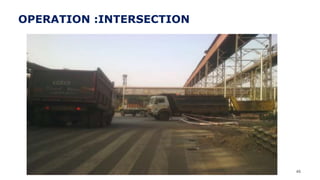
INTERSECTIONS
1. Most accidents occur at intersections. So slow
down your speed, look around then move.
2. When the light turns green, look around, never
assume that every vehicle has stopped.
3. Always watch for pedestrian at intersections.
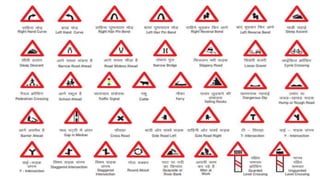
4. Always watch for signage & follow it.
44
45
OPERATION :INTERSECTION
46
OPERATION :INTERSECTION
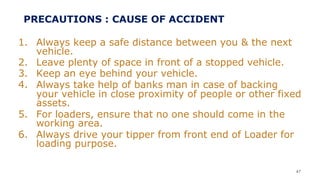
PRECAUTIONS : CAUSE OF ACCIDENT
1. Always keep a safe distance between you & the next
vehicle.
2. Leave plenty of space in front of a stopped vehicle.
3. Keep an eye behind your vehicle.
4. Always take help of banks man in case of backing
your vehicle in close proximity of people or other fixed
assets.
5. For loaders, ensure that no one should come in the
working area.
6. Always drive your tipper from front end of Loader for
loading purpose.
47
48
EARTH MOVING
EQUIPMENT
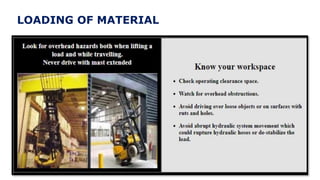
LOADING OF MATERIAL
49
• Never over load your vehicle.
• Make sure that back door is closed properly.
• The load should not obstruct your rear view by
mirrors.
• Always check in between for any spillage of
materials.
• Always look for height arrester.
• After empty your load make sure that bucket
(Box body) is seated back to its place. 50
LOADING OF MATERIAL
TRAILERS
1. Side mirrors must allow for full rear view. Use extra
mirror/ extended mirror if required.
2. Avoid hard turn, turn slow & wide.
3. Ensure that load is properly secured.
4. Do not exceed the rated load capacity.
5. Load should not extend the trailer body.
6. Avoid hard braking.
7. While backing, watch out for pedestrian, other obstruction.
Take assistance of banks man.
51
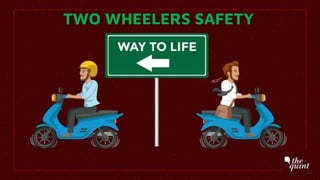
TWO WHEELERS SAFETY
52
TWO WHEELERS SAFETY
REMEMBER :-
➢Two wheelers demands better coordination & balance.
➢They are severely affected by bad affected & road
conditions.
➢Being smaller in size most prone for serious injuries in case
of accidents.
➢PLANT ROADS ARE NEITHER HIGH WAY NOR
FOR RACING.
53
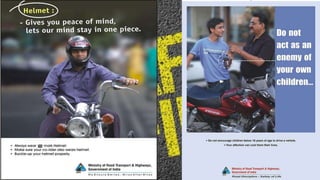
• Always wear a helmet, preferably of bright colour. Affix
reflective tapes on helmet. Your clothing like jacket, leather
boots project you against serious injuries.
• Wear clearly visible clothing.
• Wear helmet visors or goggles to protect your eyes.
• Drive with headlights ON in bad weather condition to attract
attention
• Avoid using worn out tyres.
54
TWO WHEELERS SAFETY
❑ CORNERING
▪ Shift to correct gear in advance before entering a turn.
▪ Reduce your speed before entering into a turn.
▪ Maintain a constant speed during turn.
❑ BRAKING
▪ Develop practice of using both brakes.
▪ Apply both brake at a time.
▪ Front brake should be used with care. It may cause skid.
❑ SKIDDING
▪ Avoid excessive speeds.
▪ Look for pedestrian or animals etc.
▪ Be aware of muddy or dusty roads.
❑ EXTRA CARE
▪ Never position yourself ahead of driver in blind spot.
▪ Do not squeeze between two lanes or weave through traffic.
55
OPERATION -TIPS
IN CASE OF EMERGENCY
❑ TYRE BLOW OUT
▪ DO NOT apply brakes instantly.
▪ Lower down the accelerator.
▪ Hold the handlebar firmly till the vehicles slows down
❑ FRONT TYRE WOBBLING
▪ Firmly grip the handle bar.
▪ Close the throttle.
▪ Do not apply brakes till the wobble is under control.
❑ THROTTLE STUCK
▪ Press the clutch to disengage the engine.
▪ Apply both brakes together gently. 56
❑NIGHT RIDING
▪ Use high beam .
▪ Drive slower.
▪ Avoid over taking.
▪ Drive with increased distance from other vehicles.
❑STRONG WIND
▪ Ensure eye protection.
▪ Grip the handle bar firmly.
▪ Move the vehicle towards the upwind side to avoid being swept off the road.57
OPERATION -TIPS
59
60
WHAT AN ACCIDENT CAN
DO TO YOU & TO YOUR
FAMILY
?????
61
62
63
64
65
WHAT HAPPENS TO THE
FAMILY ….
66
67
LIFE IS PRECIOUS
PLEASE DRIVE SAFELY
TAKE CARE OF YOURSELF & OTHERS
68

Road safety ppt

  • 1.
  • 2.
    VISION To spread awareness,alertness towards the safety of people, property & environment while using the road. To strive for continual improvement for the long term goal to achieve zero harm to people, property & environment. 2
  • 3.
    OBJECTIVE • Understanding themajor causes of accidents on road. • To control over the risk involved in operating vehicles. • How to become a better driver. • Introduction to the road monitoring procedures, standard draft and incident reporting for jsw employees. • To suggest improvement for safe working of vehicles on 3
  • 4.
    PLEASE THINK OFANY ACCIDENT THAT HAS BEEN TAKEN PLACE NEAR BY YOU, WHICH HAS CAUSED SERIOUS INJURY OR DAMAGE TO THE PROPERTY & THE REASON OF THAT ACCIDENT 4 THINK:
  • 5.
  • 6.
  • 7.
  • 8.
  • 9.
  • 10.
  • 11.
    THAT’S WHY DRIVER &DRIVING IS THE MOST SIGNIFICANT KEY TO PREVENT ACCIDENTS 11
  • 12.
  • 13.
    CAUSES OF ACCIDENT SYSTEMFACTOR ▪ No established traffic rules ▪ No standardized approach for training & skill development ▪ No monitoring & correction of conditions. ENVIORNMENT FACTOR ▪ Road layout ▪ Constraint for visibility like rain, fog etc 13
  • 14.
    CAUSES OF ACCIDENT PEOPLEFACTOR ▪ Excessive speed ▪ Distractions ▪ Unfit to drive (under impression of alcohol , fatigue etc) ▪ Less knowledge or inadequate skills. ▪ Over confidence, aggressive driving etc. EQUIPMENT FACTOR ▪ Defects in brake & steering ▪ Defects with fuel & lubricating lines 14
  • 15.
    1. Visibility isgreatly reduced in rain, fog etc. So take extra precaution & slow down. 2. Always use low beam in such weather. 3. If your vehicles skids, then DON’T BRAKE, instead take foot of accelerator. 15 CAUSES OF ACCIDENT BAD WEATHER
  • 16.
    DISTRACTIONS • Talking onphone • Talking & driving • Smoking while driving • Listening music or turning on the player • Viewing the beautiful scene outside . 16
  • 17.
  • 18.
  • 19.
  • 20.
    CAUSES OF FATIGUE •Driving after consuming a large meal • Driving long distances at highway • Insufficient rest • Driving after hectic duty • Improper ventilation or temperature control 20
  • 21.
  • 22.
    TELL THE QUALITYOF A DEFENSIVE DRIVER • A) • B) • C) • D) • E) • F) 22
  • 23.
    DEFENSIVE DRIVING Defensive driveris one who • Commits no driving errors • Compensate for others drivers inadequate skills or improper driving styles • Adjust his driving to suit traffic conditions & unusual weather • Careful enough to recognize the accident producing conditions & take preventive actions in advance. 23
  • 24.
    TECHNIQUES OF DEFENSIVEDRIVING • Aim High in Steering • Get the Big Picture • Keep Your Eyes Moving. • Leave Yourself an Out • Make Sure They See You 24
  • 25.
  • 26.
  • 27.
  • 28.
  • 29.
  • 30.
    In short, broadly,a defensive driver is one who is not involved in any kind of accidents not even by others errors. So our aim is learn how one can become a defensive driver & effectively practice those techniques. 30 INTERACTIVE
  • 31.
    TIPS ON DEFENSIVEDRIVING • Don’t get aggressive even if aggravated. • Never place complete faith on other drivers signal. • Be prepared for motorist who ignored lane & signal • Slow down at all crossings. • Keep to the left & let the inexperience & speeding driver go on their way. • Don’t fight on high beams issue with the drive coming from opposite. Keep your beam at low. 31
  • 32.
    TIPS ON DEFENSIVEDRIVING • Do not drive more than 2- 2 ½ hr in a stretch. • For AC fitted vehicles, stop AC after every 1 hr, open the window & let the fresh air come in. • Beware of pedestrian. • Look 360 degree after every 10-15 sec. 32
  • 33.
    NOW REMEMBER THATACCIDENT AGAIN & THINK IF THAT ACCIDENT COULD HAVE BEEN PREVENTED BY PEOPLE OR NOT ???? INTERACTIVE SLIDE 33 THINK:
  • 34.
    VEHICLE PRE START 1.Walk around the machine for physical damages or crack etc. 2. Inspect the tyres for flat or low air. 3. Clean the windows from dust/dirt. 4. Make sure that mirror are cleaned & properly set. 5. Check the levels of all fluids like engine oil, hydraulic, transmission, steering, coolant & brake etc. 6. Check for other activities happening in the vicinity of site. 7. Check for any leakages. Ensure that all caps, Plugs are properly fastened. 8. Clean the reflectors of head light, tail light, Brake light etc. 9. Before starting ensure that gear lever is in neutral position. 34
  • 35.
    35 CHECK ALL GAUGES CHECKSERVICE BRAKE ENSURE DOORS ARE LOCKED PROPERLY VEHICLE PRE START
  • 36.
    36 FASTEN SEAT BELT CHECKHORN, INDICATORS, REVERSE HORN VEHICLE PRE START
  • 37.
    OPERATION 1. Check whetherall gauges are working fine. 2. Check for functioning of all controls & shut down controls. 3. Check for forward & reverse movement of equipment. 4. Check service brake. 5. If machine is equipped with cabin, ensure that doors are securely closed. 6. Fasten your seat belts. 7. Check horn, reverse horn & lights, indicators etc. 8. Always operate the machine slowly until fully familiarized with its control. 37
  • 38.
    38 TAKE BANKSMAN HELP INCASE OF RESTRICTION NEVER OPERATE IN INADEQUATE LIGHT OPERATION -TIPS
  • 39.
    39 PROPER GEAR SELECTION INUPHILL SAFE PARKING
  • 40.
    1. In caseof restriction of the view of the operator, do not operate the machine unless a banks man is available for giving signal for safe operation. 2. Under wet or rainy conditions when the ground became too slippery for the machine, stop the earth moving operation. 3. Never operate the machine in any place of inadequate lighting 4. Never leave the machine while the engine is running and ignition key is on the machine. 5. Never use the machine for any purposes other than it is designed for. 40 OPERATION –TIPS EARTH MOVING
  • 41.
    1. Park onlevel ground, with the parking brake firmly applied and blocked by suitable wedges, where appropriate. Avoid parking near edges of slopes and excavations. 1. Lower the attachments or working tools to the ground. 1. Remove the ignition key and hand it back to the site personnel for safe custody. 1. Use proper ladder to come down from work station. 41 OPERATION -TIPS
  • 42.
  • 43.
    43 KEEP AN EYEBEHIND CAREFULL WHILE LOADING/UNLOADING OPERATION
  • 44.
    INTERSECTIONS 1. Most accidentsoccur at intersections. So slow down your speed, look around then move. 2. When the light turns green, look around, never assume that every vehicle has stopped. 3. Always watch for pedestrian at intersections. 4. Always watch for signage & follow it. 44
  • 45.
  • 46.
  • 47.
    PRECAUTIONS : CAUSEOF ACCIDENT 1. Always keep a safe distance between you & the next vehicle. 2. Leave plenty of space in front of a stopped vehicle. 3. Keep an eye behind your vehicle. 4. Always take help of banks man in case of backing your vehicle in close proximity of people or other fixed assets. 5. For loaders, ensure that no one should come in the working area. 6. Always drive your tipper from front end of Loader for loading purpose. 47
  • 48.
  • 49.
  • 50.
    • Never overload your vehicle. • Make sure that back door is closed properly. • The load should not obstruct your rear view by mirrors. • Always check in between for any spillage of materials. • Always look for height arrester. • After empty your load make sure that bucket (Box body) is seated back to its place. 50 LOADING OF MATERIAL
  • 51.
    TRAILERS 1. Side mirrorsmust allow for full rear view. Use extra mirror/ extended mirror if required. 2. Avoid hard turn, turn slow & wide. 3. Ensure that load is properly secured. 4. Do not exceed the rated load capacity. 5. Load should not extend the trailer body. 6. Avoid hard braking. 7. While backing, watch out for pedestrian, other obstruction. Take assistance of banks man. 51
  • 52.
  • 53.
    TWO WHEELERS SAFETY REMEMBER:- ➢Two wheelers demands better coordination & balance. ➢They are severely affected by bad affected & road conditions. ➢Being smaller in size most prone for serious injuries in case of accidents. ➢PLANT ROADS ARE NEITHER HIGH WAY NOR FOR RACING. 53
  • 54.
    • Always weara helmet, preferably of bright colour. Affix reflective tapes on helmet. Your clothing like jacket, leather boots project you against serious injuries. • Wear clearly visible clothing. • Wear helmet visors or goggles to protect your eyes. • Drive with headlights ON in bad weather condition to attract attention • Avoid using worn out tyres. 54 TWO WHEELERS SAFETY
  • 55.
    ❑ CORNERING ▪ Shiftto correct gear in advance before entering a turn. ▪ Reduce your speed before entering into a turn. ▪ Maintain a constant speed during turn. ❑ BRAKING ▪ Develop practice of using both brakes. ▪ Apply both brake at a time. ▪ Front brake should be used with care. It may cause skid. ❑ SKIDDING ▪ Avoid excessive speeds. ▪ Look for pedestrian or animals etc. ▪ Be aware of muddy or dusty roads. ❑ EXTRA CARE ▪ Never position yourself ahead of driver in blind spot. ▪ Do not squeeze between two lanes or weave through traffic. 55 OPERATION -TIPS
  • 56.
    IN CASE OFEMERGENCY ❑ TYRE BLOW OUT ▪ DO NOT apply brakes instantly. ▪ Lower down the accelerator. ▪ Hold the handlebar firmly till the vehicles slows down ❑ FRONT TYRE WOBBLING ▪ Firmly grip the handle bar. ▪ Close the throttle. ▪ Do not apply brakes till the wobble is under control. ❑ THROTTLE STUCK ▪ Press the clutch to disengage the engine. ▪ Apply both brakes together gently. 56
  • 57.
    ❑NIGHT RIDING ▪ Usehigh beam . ▪ Drive slower. ▪ Avoid over taking. ▪ Drive with increased distance from other vehicles. ❑STRONG WIND ▪ Ensure eye protection. ▪ Grip the handle bar firmly. ▪ Move the vehicle towards the upwind side to avoid being swept off the road.57 OPERATION -TIPS
  • 59.
  • 60.
    60 WHAT AN ACCIDENTCAN DO TO YOU & TO YOUR FAMILY ?????
  • 61.
  • 62.
  • 63.
  • 64.
  • 65.
  • 66.
    WHAT HAPPENS TOTHE FAMILY …. 66
  • 67.
    67 LIFE IS PRECIOUS PLEASEDRIVE SAFELY TAKE CARE OF YOURSELF & OTHERS
  • 68.