
RHINOPLASTY
Mrs. REVATHY.A
INTRODUCTION
• Rhinoplasty is a frequent operation that only few
surgeons are considered to truly master the wide
scope of technical nuances.
• John Orlando Roe entered history as the father
of aesthetic rhinoplasty after having reported a
“simple operation” in 1887.
DEFINITION
☻Rhinoplasty commonly known as a nose job, is
a plastic surgery procedure for correcting and
reconstructing the nose.
• There are two types of plastic surgery used –
reconstructive surgery that restores the form and
functions of the nose and cosmetic surgery that
improves the appearance of the nose.
INDICATIONS
Indications for open rhinoplasty include the
following:
• Nasal tip modification
• Internal nasal valve dysfunction
• Thick nasal skin
• Repair of septal perforations
• Posttraumatic nasal deformity with a deviated
septum or dorsum
• Cleft lip and palate nasal deformity
• Nasal tumor excision
• Secondary rhinoplasty
CONTRAINDICATIONS
• Intranasal substance abuse (eg, cocaine)
• Psychological or psychiatric instability
• Comorbid medical conditions that preclude
surgical clearance
• Preoperative diagnosis of nasal dysfunction
(with or without aesthetic deformity) that may
be better treated with a closed approach (ie,
septoplasty for airway obstruction) or medical
management
• Patient refusal of external scar
• Very thick nasal skin in which postoperative
edema can be permanent
PREPARATION
• Avoid aspirin, ibuprofen (Advil, Motrin),
naproxen (Aleve), and other non-steroidal
anti-inflammatory medications.
• Refrain from smoking two weeks before and
two weeks after surgery.
• Avoid sun damage two weeks before surgery.
• NPO
• Consent
• Post operative teaching- nasal dressing
PROCEDURE
Rhinoplasty surgery includes the following
steps:
Step 1 – Anesthesia
intravenous sedation or general anesthesia.
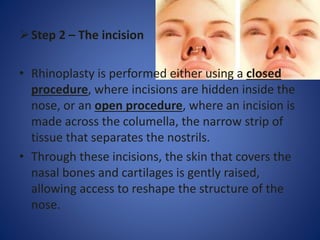
Step 2 – The incision
• Rhinoplasty is performed either using a closed
procedure, where incisions are hidden inside the
nose, or an open procedure, where an incision is
made across the columella, the narrow strip of
tissue that separates the nostrils.
• Through these incisions, the skin that covers the
nasal bones and cartilages is gently raised,
allowing access to reshape the structure of the
nose.
Step 3 – Reshaping the nose structure
• An overly large nose may be reduced by removing
bone or cartilage. Sometimes surgery of the nose
may require the addition of cartilage grafts.
• Most commonly, cartilage from the septum, the
partition in the middle of the nose, is used for
this purpose. Occasionally cartilage from the ear
or rarely a section of rib cartilage can be used.
Step 4 – Correcting a deviated septum
• If the septum is deviated, it can be
straightened and the projections inside the
nose reduced to improve breathing.
Step 5 – Closing the incision
• Once the underlying structure of the nose is
sculpted to the desired shape, nasal skin and
tissue is redraped and incisions are closed.
POST OPERATIVE MANAGEMENT
• Provide head elevation (30degree)
• Administer analgesics, steroids and antibiotics
• Avoid strenuous activities such as aerobics and jogging.
• Take baths instead of showers.
• Not blow the nose.
• Eat high-fiber foods, such as fruits and vegetables.
• Avoid extreme facial expressions, such as smiling or
laughing.
• Brush teeth gently to limit movement of upper lip.
• Wear clothes that fasten in the front. Don't pull
clothing, such as shirts or sweaters, over the head.
RISKS
• Anesthesia risks
• Infection
• Poor wound healing or scarring
• Change in skin sensation (numbness or pain)
• Nasal septal perforation (a hole in the nasal
septum) is rare.
• Difficulty breathing
• Unsatisfactory nasal appearance
• Skin discoloration and swelling
• Possibility of revisional surgery
Rhinoplasty
Rhinoplasty

Rhinoplasty

  • 1.
  • 2.
    INTRODUCTION • Rhinoplasty isa frequent operation that only few surgeons are considered to truly master the wide scope of technical nuances. • John Orlando Roe entered history as the father of aesthetic rhinoplasty after having reported a “simple operation” in 1887.
  • 3.
    DEFINITION ☻Rhinoplasty commonly knownas a nose job, is a plastic surgery procedure for correcting and reconstructing the nose. • There are two types of plastic surgery used – reconstructive surgery that restores the form and functions of the nose and cosmetic surgery that improves the appearance of the nose.
  • 4.
    INDICATIONS Indications for openrhinoplasty include the following: • Nasal tip modification • Internal nasal valve dysfunction • Thick nasal skin • Repair of septal perforations
  • 5.
    • Posttraumatic nasaldeformity with a deviated septum or dorsum • Cleft lip and palate nasal deformity • Nasal tumor excision • Secondary rhinoplasty
  • 6.
    CONTRAINDICATIONS • Intranasal substanceabuse (eg, cocaine) • Psychological or psychiatric instability • Comorbid medical conditions that preclude surgical clearance • Preoperative diagnosis of nasal dysfunction (with or without aesthetic deformity) that may be better treated with a closed approach (ie, septoplasty for airway obstruction) or medical management
  • 7.
    • Patient refusalof external scar • Very thick nasal skin in which postoperative edema can be permanent
  • 8.
    PREPARATION • Avoid aspirin,ibuprofen (Advil, Motrin), naproxen (Aleve), and other non-steroidal anti-inflammatory medications. • Refrain from smoking two weeks before and two weeks after surgery. • Avoid sun damage two weeks before surgery. • NPO • Consent • Post operative teaching- nasal dressing
  • 9.
    PROCEDURE Rhinoplasty surgery includesthe following steps: Step 1 – Anesthesia intravenous sedation or general anesthesia.
  • 10.
    Step 2 –The incision • Rhinoplasty is performed either using a closed procedure, where incisions are hidden inside the nose, or an open procedure, where an incision is made across the columella, the narrow strip of tissue that separates the nostrils. • Through these incisions, the skin that covers the nasal bones and cartilages is gently raised, allowing access to reshape the structure of the nose.
  • 11.
    Step 3 –Reshaping the nose structure • An overly large nose may be reduced by removing bone or cartilage. Sometimes surgery of the nose may require the addition of cartilage grafts. • Most commonly, cartilage from the septum, the partition in the middle of the nose, is used for this purpose. Occasionally cartilage from the ear or rarely a section of rib cartilage can be used.
  • 12.
    Step 4 –Correcting a deviated septum • If the septum is deviated, it can be straightened and the projections inside the nose reduced to improve breathing. Step 5 – Closing the incision • Once the underlying structure of the nose is sculpted to the desired shape, nasal skin and tissue is redraped and incisions are closed.
  • 13.
    POST OPERATIVE MANAGEMENT •Provide head elevation (30degree) • Administer analgesics, steroids and antibiotics • Avoid strenuous activities such as aerobics and jogging. • Take baths instead of showers. • Not blow the nose. • Eat high-fiber foods, such as fruits and vegetables. • Avoid extreme facial expressions, such as smiling or laughing. • Brush teeth gently to limit movement of upper lip. • Wear clothes that fasten in the front. Don't pull clothing, such as shirts or sweaters, over the head.
  • 14.
    RISKS • Anesthesia risks •Infection • Poor wound healing or scarring • Change in skin sensation (numbness or pain) • Nasal septal perforation (a hole in the nasal septum) is rare. • Difficulty breathing • Unsatisfactory nasal appearance • Skin discoloration and swelling • Possibility of revisional surgery