REVIEW
TRACHEAL
BRONCHUS

One-Lung Ventilation in patients
with

Young-Jin Moon

tment
rtment of Anesthesiology and Pain Med
Asan Medical Center
CONTENTS
CAS
E

I. CASE presentation
REVIE
W

II. Tracheal
Bronchus?
III. Classification
IV. OLV of tracheal bronchus
; using bronchial blocker and DLT
V. In single lumen tube
BRONCHUS
0.1 - 3 %
Congenital anomaly of central airway
Bronchus originating from
Trachea
Right upper lobe >> Left upper lobe /
Both
Childhood : Wheezing, Infection,
Bronchiectasis,
Associated anomalies
Adult : Asymtommatic, Rarely malignancies

have minimal clinical implication,
BUT When OLV is ne
Normal Anatomy
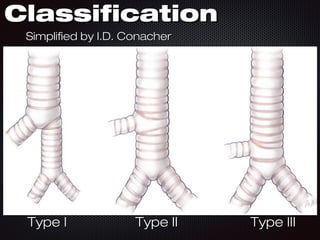
Classification
Simplified by I.D. Conacher

Type I

Type II

Type III
Classification
Simplified by I.D. Conacher
Type 2Icm above the carina

with the distal trachea narrowed
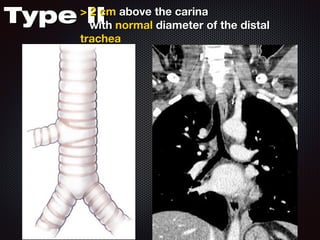
Type II

> 2 cm above the carina
with normal diameter of the distal
trachea
Type III

< 2 cm above the level of the
carina
One-Lung Ventilation
Strategy
Sarah H., A&A 2011 : Challenging Lung Isolation Secondary
to Aberrant Tracheobronchial Anatomy
Rt.
main

Lt. main

Tracheal
bronchus
One-Lung Ventilation
Strategy
Anthony M.-H. Ho, A&A 2004
:tracheal bronchus <2 cm of the carina
DLT is available

Type III

Lt.
One-Lung Ventilation
Strategy : Sequential One-Lung Isolation
William C. Culp, A&A 2004
Using a Double Arndt Bronchial
Blocker Technique
In Single lumen
Y.S. Choi, Y.L. Kwak,
tube? KJA 2010 :
Problematic tracheal intubation
with unrecognized
tracheal bronchus

Repeated sudden increased of PIP with a falling VT

Tracheal Bronchus was diagnosed
after operation
Reference
1.

Conacher, I. D. (2000). Implications of a tracheal bronchus for adult anaesthetic practice. British Journal of Anaesthesia, 85(2), 317–320.

2.

Brodsky, J. B., & Mark, J. B. (1991). Bilateral upper lobe obstruction from a single double-lumen tube. Anesthesiology, 74(6), 1163–1164.

3.

Campos, J. H. (2007). Which device should be considered the best for lung isolation: double-lumen endotracheal tube versus bronchial
blockers. Current opinion in anaesthesiology, 20(1), 27–31. doi:10.1097/ACO.0b013e3280111e2a

4.

Choi, Y. S., Kwak, Y. L., Choi, H. G., Oh, S. Y., & Lee, J. W. (2010). Anesthetic experience of an adult patient with an unrecognized tracheal
bronchus -A case report. Korean Journal of Anesthesiology, 59(Suppl), S13. doi:10.4097/kjae.2010.59.S.S13

5.

Culp, W. C., Jr., & Kinsky, M. P. (2004). Sequential One-Lung Isolation Using a Double Arndt Bronchial Blocker Technique. Anesthesia &
Analgesia, 99(3), 945–946. doi:10.1213/01.ANE.0000132697.22933.8C

6.

Ho, A. M. H., Karmakar, M. K., Lam, W. W. M., Lam, F. O., Lee, T. W., Ng, S. K., & Chung, D. C. (2004). Does the Presence of a Tracheal
Bronchus Affect the Margin of Safety of Double-Lumen Tube Placement? Anesthesia & Analgesia, 99(1), 293–295.
doi:10.1213/01.ANE.0000118106.09944.E7

7.

Lee, H.-L., Ho, A. C., Cheng, R. K., & Shyr, M.-H. (2002). Successful one-lung ventilation in a patient with aberrant tracheal bronchus.
Anesthesia & Analgesia, 95(2), 492–493. doi:10.1213/01.ANE.0000021364.42109.AA

8.

Stene, R., Rose, M., Weinger, M. B., Benumof, J. L., & Harrell, J. (1994). Bronchial trifurcation at the carina complicating use of a doublelumen tracheal tube. Anesthesiology, 80(5), 1162–1164.

9.

Suzuki, M., Matsui, O., Takemura, A., Kobayashi, T., Yoneda, K., & Shibata, Y. (2006). Four cases of accessory cardiac bronchus
incidentally detected on multi-detector CT. European Journal of Radiology Extra, 57(2), 47–50. doi:10.1016/j.ejrex.2005.11.003

10. Wiser, S. H., & Hartigan, P. M. (2011). Challenging Lung Isolation Secondary to Aberrant Tracheobronchial Anatomy. Anesthesia &
Analgesia, 112(3), 688–692. doi:10.1213/ANE.0b013e318206917a
11. Yildiz, H., Ugurel, S., Soylu, K., Tasar, M., & Somuncu, I. (2006). Accessory cardiac bronchus and tracheal bronchus anomalies: CTbronchoscopy and CT-bronchography findings. Surgical and Radiologic Anatomy, 28(6), 646–649. doi:10.1007/s00276-006-0147-3

Tracheal bronchus slide

  • 1.
    REVIEW TRACHEAL BRONCHUS One-Lung Ventilation inpatients with Young-Jin Moon tment rtment of Anesthesiology and Pain Med Asan Medical Center
  • 2.
    CONTENTS CAS E I. CASE presentation REVIE W II.Tracheal Bronchus? III. Classification IV. OLV of tracheal bronchus ; using bronchial blocker and DLT V. In single lumen tube
  • 3.
    BRONCHUS 0.1 - 3% Congenital anomaly of central airway Bronchus originating from Trachea Right upper lobe >> Left upper lobe / Both Childhood : Wheezing, Infection, Bronchiectasis, Associated anomalies Adult : Asymtommatic, Rarely malignancies have minimal clinical implication, BUT When OLV is ne
  • 5.
  • 6.
    Classification Simplified by I.D.Conacher Type I Type II Type III
  • 7.
  • 8.
    Type 2Icm abovethe carina with the distal trachea narrowed
  • 9.
    Type II > 2cm above the carina with normal diameter of the distal trachea
  • 10.
    Type III < 2cm above the level of the carina
  • 11.
    One-Lung Ventilation Strategy Sarah H.,A&A 2011 : Challenging Lung Isolation Secondary to Aberrant Tracheobronchial Anatomy Rt. main Lt. main Tracheal bronchus
  • 12.
    One-Lung Ventilation Strategy Anthony M.-H.Ho, A&A 2004 :tracheal bronchus <2 cm of the carina DLT is available Type III Lt.
  • 13.
    One-Lung Ventilation Strategy :Sequential One-Lung Isolation William C. Culp, A&A 2004 Using a Double Arndt Bronchial Blocker Technique
  • 14.
    In Single lumen Y.S.Choi, Y.L. Kwak, tube? KJA 2010 : Problematic tracheal intubation with unrecognized tracheal bronchus Repeated sudden increased of PIP with a falling VT Tracheal Bronchus was diagnosed after operation
  • 15.
    Reference 1. Conacher, I. D.(2000). Implications of a tracheal bronchus for adult anaesthetic practice. British Journal of Anaesthesia, 85(2), 317–320. 2. Brodsky, J. B., & Mark, J. B. (1991). Bilateral upper lobe obstruction from a single double-lumen tube. Anesthesiology, 74(6), 1163–1164. 3. Campos, J. H. (2007). Which device should be considered the best for lung isolation: double-lumen endotracheal tube versus bronchial blockers. Current opinion in anaesthesiology, 20(1), 27–31. doi:10.1097/ACO.0b013e3280111e2a 4. Choi, Y. S., Kwak, Y. L., Choi, H. G., Oh, S. Y., & Lee, J. W. (2010). Anesthetic experience of an adult patient with an unrecognized tracheal bronchus -A case report. Korean Journal of Anesthesiology, 59(Suppl), S13. doi:10.4097/kjae.2010.59.S.S13 5. Culp, W. C., Jr., & Kinsky, M. P. (2004). Sequential One-Lung Isolation Using a Double Arndt Bronchial Blocker Technique. Anesthesia & Analgesia, 99(3), 945–946. doi:10.1213/01.ANE.0000132697.22933.8C 6. Ho, A. M. H., Karmakar, M. K., Lam, W. W. M., Lam, F. O., Lee, T. W., Ng, S. K., & Chung, D. C. (2004). Does the Presence of a Tracheal Bronchus Affect the Margin of Safety of Double-Lumen Tube Placement? Anesthesia & Analgesia, 99(1), 293–295. doi:10.1213/01.ANE.0000118106.09944.E7 7. Lee, H.-L., Ho, A. C., Cheng, R. K., & Shyr, M.-H. (2002). Successful one-lung ventilation in a patient with aberrant tracheal bronchus. Anesthesia & Analgesia, 95(2), 492–493. doi:10.1213/01.ANE.0000021364.42109.AA 8. Stene, R., Rose, M., Weinger, M. B., Benumof, J. L., & Harrell, J. (1994). Bronchial trifurcation at the carina complicating use of a doublelumen tracheal tube. Anesthesiology, 80(5), 1162–1164. 9. Suzuki, M., Matsui, O., Takemura, A., Kobayashi, T., Yoneda, K., & Shibata, Y. (2006). Four cases of accessory cardiac bronchus incidentally detected on multi-detector CT. European Journal of Radiology Extra, 57(2), 47–50. doi:10.1016/j.ejrex.2005.11.003 10. Wiser, S. H., & Hartigan, P. M. (2011). Challenging Lung Isolation Secondary to Aberrant Tracheobronchial Anatomy. Anesthesia & Analgesia, 112(3), 688–692. doi:10.1213/ANE.0b013e318206917a 11. Yildiz, H., Ugurel, S., Soylu, K., Tasar, M., & Somuncu, I. (2006). Accessory cardiac bronchus and tracheal bronchus anomalies: CTbronchoscopy and CT-bronchography findings. Surgical and Radiologic Anatomy, 28(6), 646–649. doi:10.1007/s00276-006-0147-3

Editor's Notes

  • #7 Tracheal bronchus 를 분류하는 방법은 여러가지가 있지만, 그 중에서도 같은 마취과의사인 Conacher 의 분류법이 airway를 다루는 저희에겐 가장 유용한 분류방법입니다. type I,II,III로 나뉘어져있고 각각에 대해서는 잠시뒤에 설명드리겠습니다.
  • #8 모양에 따른 분류말고도 ventilation 에 따라서