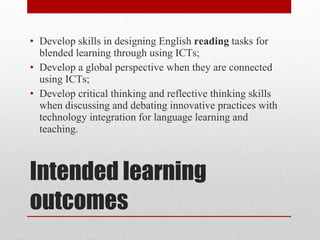
Using IT to develop/improve reading skills Dr Paula Hodgson
Intended learning outcomes Develop skills in designing English  reading  tasks for blended learning through using ICTs; Develop a global perspective when they are connected using ICTs; Develop critical thinking and reflective thinking skills when discussing and debating innovative practices with technology integration for language learning and teaching.
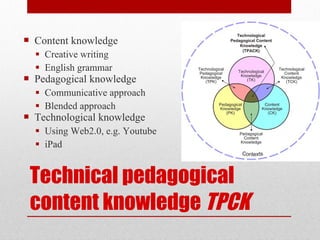
Technical pedagogical content knowledge  TPCK Content knowledge Creative writing English grammar Pedagogical knowledge Communicative approach Blended approach Technological knowledge Using Web2.0, e.g. Youtube iPad
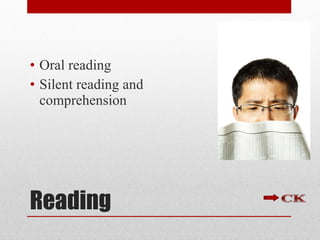
Reading Oral reading Silent reading and comprehension
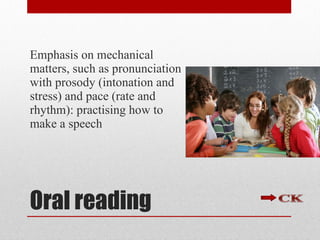
Oral reading Emphasis on mechanical matters, such as pronunciation with prosody (intonation and stress) and pace (rate and rhythm): practising how to make a speech
Oral reading Purposes: Word recognition [word decoding] Providing assistance to students with SLD Being aware of patterns of words that present difficulties Understanding: involving thinking and feeling [comprehension] Achievement: Oral reading fluency
Hypothesis Practical oral reading with assistance can improve oral reading fluency.
Oral reading fluency  (1) Round robin reading, public oral reading without rehearsal Issue: Time-consuming for individual readings Students may feel embarrassed by public display of their incompetence
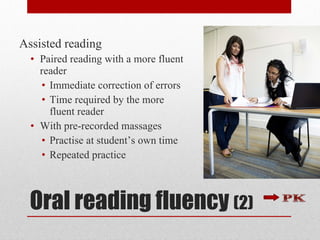
Oral reading fluency  (2) Assisted reading Paired reading with a more fluent reader Immediate correction of errors Time required by the more fluent reader With pre-recorded massages Practise at student’s own time Repeated practice
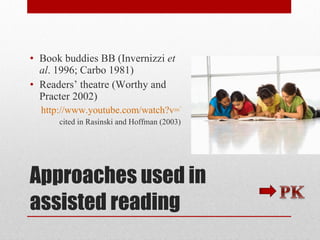
Approaches used in assisted reading Book buddies BB (Invernizzi  et al . 1996; Carbo 1981) Readers’ theatre (Worthy and Practer 2002) http://www.youtube.com/watch?v=Vu2GKqwrIGM&feature=autoplay&list=QL&index=2&playnext=1 cited in Rasinski and Hoffman (2003)
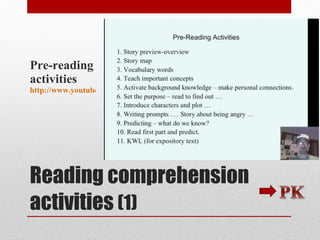
Reading comprehension activities  (1) Pre-reading activities  http://www.youtube.com/watch?v=687U0o7KFgY&feature=related
Reading comprehension activities  [2] In-class activities:  e.g. literacy circle ( http://www.youtube.com/watch?v=F-W46ApUVDo&feature=BF&list=QL&index=4 ) Summarizer : prepares a brief summary of  “today’s reading”. Investigator : digs up one piece of background information on any topic related to the book. Literary luminary : locates parts of the text to read aloud to the group. Vocabulary enricher : searches for a few especially important words in today’s reading. Illustrator : draws some kind of picture related to the reading. Discussion   direc t or : directs the discussion; helps people to talk over the big ideas in the reading and share their reactions. Connector : finds connections between the book and the outside world.
Reading comprehension activities  [3] In-class activities Write down connection in codes Self (pragmatic); text (semantic) Act out Illustrate sequence of events Analyse character traits Infer Predict http://www.youtube.com/watch?v=ZobdcwO_c8U&NR=1
Reading comprehension activities  [4] Post-reading activities http :// www.youtube.com/watch?v=vYt6f8_RY0g&feature=related ;  http://www.youtube.com/watch?v=JDTGSLmMiXI&feature=related   (Bloom’s taxonomy)
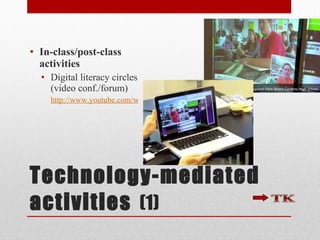
Technology-mediated activities   (1) In-class/post-class activities Digital literacy circles (video conf./forum) http://www.youtube.com/watch?v=7pFi7fJgGOA&feature=related
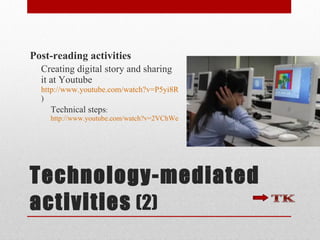
Technology-mediated activities   (2) Post-reading activities  Creating digital story and sharing it at Youtube  http://www.youtube.com/watch?v=P5yi8R5l9e4&feature=related ) Technical steps :  http://www.youtube.com/watch?v=2VChWeNN9pc&feature=related
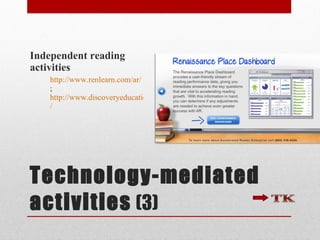
Technology-mediated activities   (3) Independent reading activities  http ://www.renlearn.com/ar / ;  http://www.discoveryeducation.com /
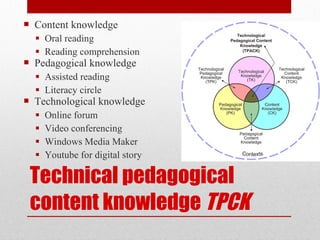
Technical pedagogical content knowledge  TPCK Content knowledge Oral reading Reading comprehension Pedagogical knowledge Assisted reading Literacy circle Technological knowledge Online forum Video conferencing Windows Media Maker Youtube for digital story
References Blum, H.T., Lipsett, L.R. and Yocom, D.J. (2002). Literature circles.  Remedial and Special Education , 23(2), 99–108.  Cumming-Potvin, W. (2007). Scaffolding, multiliteracies, and reading circles.  Canadian Journal of Education/Revue, canadienne de l'éducation , 30(2), 483–507. Kramarski, B. and Feldman, Y. (2000). Internet in the classroom: effects on reading comprehension, motivation and metacognitive awareness.  Educational Media International , 37(3), 149–55. Moeller, V.J. and Moeller, M.V. (2007).  Literature Circles that Engage Middle and High School Students . Larchmont, NY: Eye on Education. Rasinski, T.V. and Hoffman, J.V. (2003). Theory and research into practice: oral reading in the school literacy curriculum.  Reading Research Quarterly , 38(4), 510–22. Roby, T.Y. (2010). Opus in the classroom: striking CoRDS with content-related digital storytelling.  Contemporary Issues in Technology and Teacher Education , 10(1), 133–44.
Web references Reading strategies http://www.youtube.com/watch?v=ZobdcwO_c8U&NR=1 Pre-reading activities http://www.youtube.com/watch?v=687U0o7KFgY&feature=related Literacy circle  http://www.youtube.com/watch?v=F-W46ApUVDo&feature=BF&list=QL&index=4 Digital storytelling project http://www.youtube.com/watch?v=P5yi8R5l9e4&feature=related Making a digital story http://www.youtube.com/watch?v=LknwS15wSx8&feature=related Using Windows Media Maker to create a digital story http://www.youtube.com/watch?v=2VChWeNN9pc&feature=related Accelerated reader http://www.renlearn.com/ar/

TPCK: Using IT to develop/improve reading skills

  • 1.
    Using IT todevelop/improve reading skills Dr Paula Hodgson
  • 2.
    Intended learning outcomesDevelop skills in designing English reading tasks for blended learning through using ICTs; Develop a global perspective when they are connected using ICTs; Develop critical thinking and reflective thinking skills when discussing and debating innovative practices with technology integration for language learning and teaching.
  • 3.
    Technical pedagogical contentknowledge TPCK Content knowledge Creative writing English grammar Pedagogical knowledge Communicative approach Blended approach Technological knowledge Using Web2.0, e.g. Youtube iPad
  • 4.
    Reading Oral readingSilent reading and comprehension
  • 5.
    Oral reading Emphasison mechanical matters, such as pronunciation with prosody (intonation and stress) and pace (rate and rhythm): practising how to make a speech
  • 6.
    Oral reading Purposes:Word recognition [word decoding] Providing assistance to students with SLD Being aware of patterns of words that present difficulties Understanding: involving thinking and feeling [comprehension] Achievement: Oral reading fluency
  • 7.
    Hypothesis Practical oralreading with assistance can improve oral reading fluency.
  • 8.
    Oral reading fluency (1) Round robin reading, public oral reading without rehearsal Issue: Time-consuming for individual readings Students may feel embarrassed by public display of their incompetence
  • 9.
    Oral reading fluency (2) Assisted reading Paired reading with a more fluent reader Immediate correction of errors Time required by the more fluent reader With pre-recorded massages Practise at student’s own time Repeated practice
  • 10.
    Approaches used inassisted reading Book buddies BB (Invernizzi et al . 1996; Carbo 1981) Readers’ theatre (Worthy and Practer 2002) http://www.youtube.com/watch?v=Vu2GKqwrIGM&feature=autoplay&list=QL&index=2&playnext=1 cited in Rasinski and Hoffman (2003)
  • 11.
    Reading comprehension activities (1) Pre-reading activities http://www.youtube.com/watch?v=687U0o7KFgY&feature=related
  • 12.
    Reading comprehension activities [2] In-class activities: e.g. literacy circle ( http://www.youtube.com/watch?v=F-W46ApUVDo&feature=BF&list=QL&index=4 ) Summarizer : prepares a brief summary of “today’s reading”. Investigator : digs up one piece of background information on any topic related to the book. Literary luminary : locates parts of the text to read aloud to the group. Vocabulary enricher : searches for a few especially important words in today’s reading. Illustrator : draws some kind of picture related to the reading. Discussion direc t or : directs the discussion; helps people to talk over the big ideas in the reading and share their reactions. Connector : finds connections between the book and the outside world.
  • 13.
    Reading comprehension activities [3] In-class activities Write down connection in codes Self (pragmatic); text (semantic) Act out Illustrate sequence of events Analyse character traits Infer Predict http://www.youtube.com/watch?v=ZobdcwO_c8U&NR=1
  • 14.
    Reading comprehension activities [4] Post-reading activities http :// www.youtube.com/watch?v=vYt6f8_RY0g&feature=related ; http://www.youtube.com/watch?v=JDTGSLmMiXI&feature=related (Bloom’s taxonomy)
  • 15.
    Technology-mediated activities (1) In-class/post-class activities Digital literacy circles (video conf./forum) http://www.youtube.com/watch?v=7pFi7fJgGOA&feature=related
  • 16.
    Technology-mediated activities (2) Post-reading activities Creating digital story and sharing it at Youtube http://www.youtube.com/watch?v=P5yi8R5l9e4&feature=related ) Technical steps : http://www.youtube.com/watch?v=2VChWeNN9pc&feature=related
  • 17.
    Technology-mediated activities (3) Independent reading activities http ://www.renlearn.com/ar / ; http://www.discoveryeducation.com /
  • 18.
    Technical pedagogical contentknowledge TPCK Content knowledge Oral reading Reading comprehension Pedagogical knowledge Assisted reading Literacy circle Technological knowledge Online forum Video conferencing Windows Media Maker Youtube for digital story
  • 19.
    References Blum, H.T.,Lipsett, L.R. and Yocom, D.J. (2002). Literature circles. Remedial and Special Education , 23(2), 99–108. Cumming-Potvin, W. (2007). Scaffolding, multiliteracies, and reading circles. Canadian Journal of Education/Revue, canadienne de l'éducation , 30(2), 483–507. Kramarski, B. and Feldman, Y. (2000). Internet in the classroom: effects on reading comprehension, motivation and metacognitive awareness. Educational Media International , 37(3), 149–55. Moeller, V.J. and Moeller, M.V. (2007). Literature Circles that Engage Middle and High School Students . Larchmont, NY: Eye on Education. Rasinski, T.V. and Hoffman, J.V. (2003). Theory and research into practice: oral reading in the school literacy curriculum. Reading Research Quarterly , 38(4), 510–22. Roby, T.Y. (2010). Opus in the classroom: striking CoRDS with content-related digital storytelling. Contemporary Issues in Technology and Teacher Education , 10(1), 133–44.
  • 20.
    Web references Readingstrategies http://www.youtube.com/watch?v=ZobdcwO_c8U&NR=1 Pre-reading activities http://www.youtube.com/watch?v=687U0o7KFgY&feature=related Literacy circle http://www.youtube.com/watch?v=F-W46ApUVDo&feature=BF&list=QL&index=4 Digital storytelling project http://www.youtube.com/watch?v=P5yi8R5l9e4&feature=related Making a digital story http://www.youtube.com/watch?v=LknwS15wSx8&feature=related Using Windows Media Maker to create a digital story http://www.youtube.com/watch?v=2VChWeNN9pc&feature=related Accelerated reader http://www.renlearn.com/ar/