
Developing higher-order thinking through blended problem-based learning   Mr TONG, Edmond Tak Fai School of Nursing,  Dr Paula Hodgson Education Development Centre,  Hong Kong Polytechnic University, Hong Kong SAR, China This work is licensed under a  Creative Commons Attribution-Noncommercial-Share Alike 3.0 Unported License .
Blended learning face-to-face mode online mode
Background Year 3 students of a four-year Bachelor of Science (Nursing) programme Class of 124 students Five groups were randomly formed 3 cases were reconstructed from real cases and each case was split into 3 parts. Case analysis: Face-to-face tutorials & online tasks ( 5% ): Based on each case, students posted topics, issues and hypotheses, peer group members were to post subsequent threaded discussions.
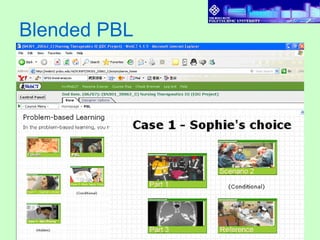
Blended PBL
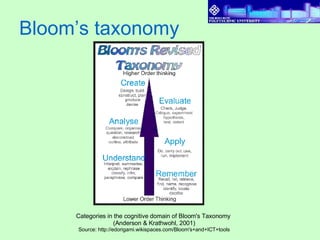
Bloom’s taxonomy Categories in the cognitive domain of Bloom's Taxonomy  (Anderson & Krathwohl, 2001) Source: http://edorigami.wikispaces.com/Bloom's+and+ICT+tools
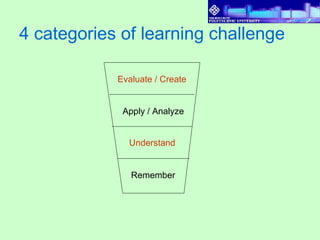
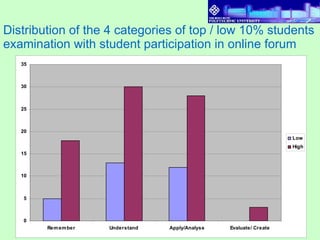
4 categories of learning challenge  Remember Understand Apply / Analyze Evaluate / Create
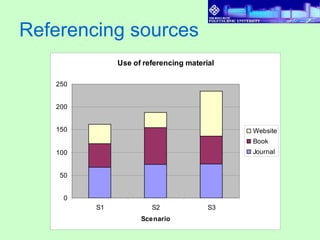
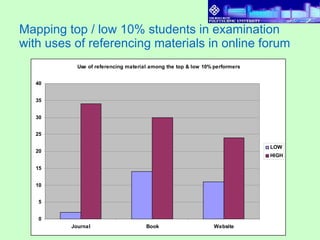
Results and findings Group participation (5 groups) Referencing sources (websites, books, and journals) Distribution of the four categories modified from Bloom’s taxonomy in online forum discussion
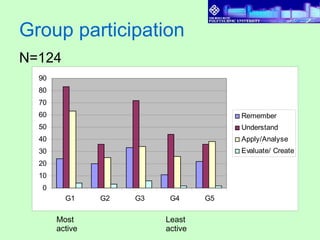
Group participation N=124 Most active Least active
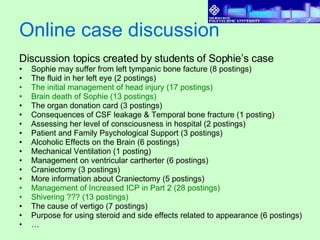
Online case discussion  Discussion topics created by students of Sophie’s case Sophie may suffer from left tympanic bone facture (8 postings) The fluid in her left eye (2 postings) The initial management of head injury (17 postings) Brain death of Sophie (13 postings) The organ donation card (3 postings) Consequences of CSF leakage & Temporal bone fracture (1 posting) Assessing her level of consciousness in hospital (2 postings) Patient and Family Psychological Support (3 postings) Alcoholic Effects on the Brain (6 postings) Mechanical Ventilation (1 posting) Management on ventricular cartherter (6 postings) Craniectomy (3 postings) More information about Craniectomy (5 postings) Management of Increased ICP in Part 2 (28 postings) Shivering ??? (13 postings) The cause of vertigo (7 postings) Purpose for using steroid and side effects related to appearance (6 postings) …
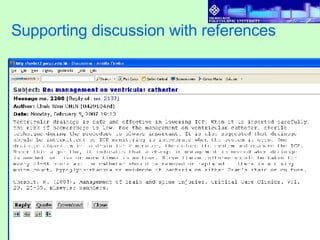
Supporting discussion with references
Referencing sources
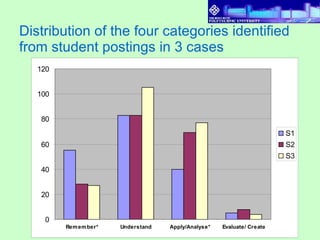
Distribution of the four categories identified from student postings in 3 cases
Significantly different between cases “ Remember” were significantly different between cases, c2 (2,  N  = 559) = 28.0,  p  < .001 Similar findings were seen in the postings categorized as “Analyse/Apply” with c2 (2,  N  = 559) = 8.66,  p  < .013
Mapping top / low 10% students in examination with uses of referencing materials in online forum
Distribution of the 4 categories of top / low 10% students examination with student participation in online forum
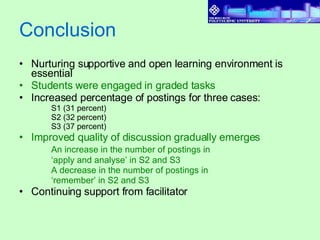
Conclusion Nurturing supportive and open learning environment is essential Students were engaged in graded tasks Increased percentage of postings for three cases: S1 (31 percent) S2 (32 percent)  S3 (37 percent) Improved quality of discussion gradually emerges An increase in the number of postings in  ‘ apply and analyse’ in S2 and S3  A decrease in the number of postings in  ‘ remember’ in S2 and S3 Continuing support from facilitator

Developing higher-order thinking through blended problem-based learning

  • 1.
    Developing higher-order thinkingthrough blended problem-based learning Mr TONG, Edmond Tak Fai School of Nursing, Dr Paula Hodgson Education Development Centre, Hong Kong Polytechnic University, Hong Kong SAR, China This work is licensed under a Creative Commons Attribution-Noncommercial-Share Alike 3.0 Unported License .
  • 2.
  • 3.
    Background Year 3students of a four-year Bachelor of Science (Nursing) programme Class of 124 students Five groups were randomly formed 3 cases were reconstructed from real cases and each case was split into 3 parts. Case analysis: Face-to-face tutorials & online tasks ( 5% ): Based on each case, students posted topics, issues and hypotheses, peer group members were to post subsequent threaded discussions.
  • 4.
  • 5.
    Bloom’s taxonomy Categoriesin the cognitive domain of Bloom's Taxonomy (Anderson & Krathwohl, 2001) Source: http://edorigami.wikispaces.com/Bloom's+and+ICT+tools
  • 6.
    4 categories oflearning challenge Remember Understand Apply / Analyze Evaluate / Create
  • 7.
    Results and findingsGroup participation (5 groups) Referencing sources (websites, books, and journals) Distribution of the four categories modified from Bloom’s taxonomy in online forum discussion
  • 8.
    Group participation N=124Most active Least active
  • 9.
    Online case discussion Discussion topics created by students of Sophie’s case Sophie may suffer from left tympanic bone facture (8 postings) The fluid in her left eye (2 postings) The initial management of head injury (17 postings) Brain death of Sophie (13 postings) The organ donation card (3 postings) Consequences of CSF leakage & Temporal bone fracture (1 posting) Assessing her level of consciousness in hospital (2 postings) Patient and Family Psychological Support (3 postings) Alcoholic Effects on the Brain (6 postings) Mechanical Ventilation (1 posting) Management on ventricular cartherter (6 postings) Craniectomy (3 postings) More information about Craniectomy (5 postings) Management of Increased ICP in Part 2 (28 postings) Shivering ??? (13 postings) The cause of vertigo (7 postings) Purpose for using steroid and side effects related to appearance (6 postings) …
  • 10.
  • 11.
  • 12.
    Distribution of thefour categories identified from student postings in 3 cases
  • 13.
    Significantly different betweencases “ Remember” were significantly different between cases, c2 (2, N = 559) = 28.0, p < .001 Similar findings were seen in the postings categorized as “Analyse/Apply” with c2 (2, N = 559) = 8.66, p < .013
  • 14.
    Mapping top /low 10% students in examination with uses of referencing materials in online forum
  • 15.
    Distribution of the4 categories of top / low 10% students examination with student participation in online forum
  • 16.
    Conclusion Nurturing supportiveand open learning environment is essential Students were engaged in graded tasks Increased percentage of postings for three cases: S1 (31 percent) S2 (32 percent) S3 (37 percent) Improved quality of discussion gradually emerges An increase in the number of postings in ‘ apply and analyse’ in S2 and S3 A decrease in the number of postings in ‘ remember’ in S2 and S3 Continuing support from facilitator