CALLing on
Ethiopia:
Computer Assisted
Language
Learning at         Sarah Guth, University
Adama University    Language Center

Day 1               Francesca Helm, Dept. of
                    Political Science

                    University of Padova, Italy
Part 1

          Personal Introductions
Brief History of CALL Theory & Practice
What are we doing here?
Introductions: Sarah‟s story
          • Course websites: provide info
1999-2004
          • Student group websites: share info


          • Give students access to students in other parts of the
 2005-      world
present


          • Use of Web 2.0 to give students access to authentic
            contexts of use (e.g. blogs, forums, Facebook), updated
 2007-
present     information, and many different online resources
Introductions: Francesca‟s
story
          •MA in TESOL by distance learning with Institute of Education,
           University of London
1996-2000 •Online Education and Training Course, worked as facilitator


           •Started doing exchanges between students in Italy and the
  2000-     US, then Guatemala, Jordan, Holland, Kuwait, Palestine
 present


           •Collaborate with Soliya as coordinator for Padova, facilitator
            training, facilitator and now coach. Using blogs with
  2008-     students for English courses at Faculty of Political Science.
 present
Introductions: your story?
    • Do you use CALL? If so, how? Since
      when?


    • What benefits do you think it can offer?


    • Why are you here? What do you hope
      to learn during these workshops?
Why use CALL?
What „they „ say, or originally said:
 To cut costs
 To reduce number of teachers
 To cater for a growing number of students


What CALL practioners know:
 To increase access to education
 To enhance the learning experience
 To innovate and change
 Because technology is now part of our life
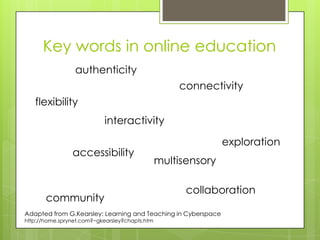
Key words in online education
                 authenticity
                                                    connectivity
   flexibility
                           interactivity

                                                               exploration
                accessibility
                                                multisensory

                                                      collaboration
       community
Adapted from G.Kearsley: Learning and Teaching in Cyberspace
http://home.sprynet.com?~gkearsley?chapts.htm
What can we use CALL for?
Some educational uses of technology:
 publishing and disseminating information
 retrieving information
 communicating
 collaborating
 developing online literacies
What is literacy?
 Basic human right: reading and writing
 In today‟s society we have new literacies:
     Computer literacy
     Internet literacy
     Information literacy
     Multimedia literacy
     Participation literacy
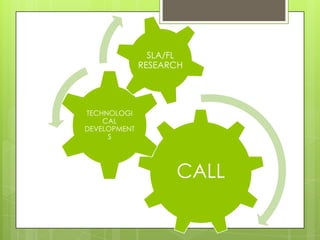
SLA/FL
              RESEARCH


TECHNOLOGI
    CAL
DEVELOPMENT
     S


                    CALL
A brief history: stage 1
            Computer as Tutor


technology     •Mainframe computers, mostly available only at
                institutions and not in people‟s homes


               •Behaviouristic approach

 research      •learning takes place through mechanical
                production, memorization and repetition of given
                grammar patterns


               •repetitive language drills which aimed at helping

 practice       learners master the foreign grammar and
                vocabulary by responding to the stimuli made
                available through technology
A brief history: stage 2
   Computer as Tool to stimulate learning


technology     •Advent of personal computers and increasing multimedia
                capabilities of software programs


 research      •Communicative approach
               •focus on the actual use of language forms in context


               •computer as a means to access, gather and process
                information through hands-on experiments, hypothesis
 practice       testing and problem-solving to stimulate students' discussion,
                writing, or critical thinking: learner as researcher, teacher as
                facilitator
A brief history: stage 3
      Computer for communication

             •Advent of the World Wide Web and the Internet in the 1990s
technology   •Advent of Web 2.0 in the first decade of the 21st Century
             •Greater access to computers and broadband


             •Sociocognitive approach/socioconstructivism
 research    •learning takes place through social interaction in authentic
              contexts


             •NBLT : «language teaching that involves the use of
              computers connected to one another in either local or

 practice     global networks»
             •the machine serves to support collaborative activity and
              enhance the learning process both on-line, during the
              interaction, and off-line, in reflective practices
Today, in 2012?
 Although    practices from all 3 stages are
 still in use, during the next few days we will
 focus on the types of activities that
 characterized stages 2 and 3, i.e.:
    Using the computer to access resources
    Using the computer to access other people
PART 2

How to integrate CALL into the classroom:
             Blends & Tools
Is blended coffee better?
 Many  coffee manufacturers claim that
 their blends of Ethiopian coffee with
 beans from other places, such as Yemen
 or Colombia, is „better‟ than pure
 Ethiopian coffee.
            Is the blend better?

 We can‟t argue about coffee, but in the
  foreign language classroom, it often is.
Blending classroom & lab
 What  can you do in a lab that you can‟t
  do in a classroom?
 What can you do better in a classroom
  rather than in a lab?
Blending F2F and online
 Can  your students only attend, let‟s say,
  one F2F lesson a week? And do they have
  Internet access?
 Or, are there things that are just as well
  done autonomously online?
 Or, do you want to develop your
  students‟ ability to communicate
  effectively online?
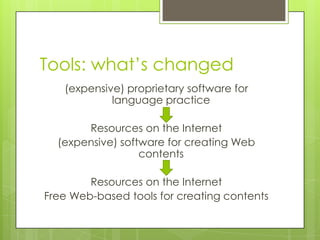
Tools: what‟s changed
   (expensive) proprietary software for
            language practice

       Resources on the Internet
  (expensive) software for creating Web
                  contents

        Resources on the Internet
Free Web-based tools for creating contents
The changing nature of the Web
                            Web 2.0
                    users produce and share
                     content
                    the „wisdom of the
                     crowds‟ (Surowiecki, 2005)
                    websites where
                     knowledge and content
                     are created and shared
Benefits
   access and produce real language
   real audience: increased responsibility
   new tools: increased autonomy, competence and
    confidence
                In your opinion,
    proactive learning
                what might the


   improved information literacy
   improved reflective and criticalbe? skills
                  benefits thinking
   improved participation literacy
   potential for informal learning
Challenges
   technical challenges: broadband, computer access, etc.

   tools don‟t necessarily appeal to all students


         In your opinion, what
    time consuming for students and teachers

    learning how to effectively collaborate
         mightstable challenges
                      the


   not all tools are


                          be?
    assessment: process or product? individual or group?

   teacher needs basic skills in e-tutoring

   empowering students means teacher giving up control
PART 3

How to develop CALL tasks
Have we forgotten anything?
 What  is our main aim?
 To help students learn


 Don‟t   be dazzled by technology
 Remember basic pedagogical practice
 In a structured institutional context, tasks
  are a good way to ensure we are working
  towards our main aim
A practical example
 Learning   aims:
    improve listening for intermediate learners
    discuss and reflect on culture
 How:find a web-based audio/video
 students can access on their own
Step 1: Explore
   Surf the Web for appropriate materials, this
    involves:
       Choosing appropriate key words (such as…?)
       Evaluating the websites you find (based on what
        criteria…?
   So, we eventually found a website which met
    these criteria:
       Site hosted by a respectable organization that
        openly shares inspiring talks on the Web
       Videos can be downloaded and embedded in
        other webpages, such as blogs
       Subtitles available in numerous languages,
        translation in some and interactive tapescript
Step 2: Develop a task
                Word
             association
             & discussion


                        Listening
   Discussion &
                       with guiding
      writing
                        questions
Step 3: What tools?
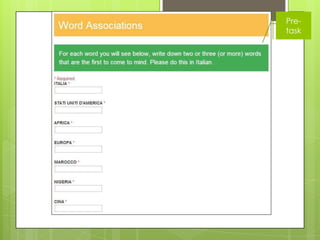
 Word  associations: google forms
 Comprehension and discussion questions:
  course blog
 Video: embedded in course blog, link to
  website (where it can also be
  downloaded)
 Student reflection and discussion: first as
  comments to the blog, then class
  discussion
Recycling language
             Listening skills

   Reading questions/writing answers

       Reading peer comments

    Speaking during class discussion

      Writing your own single story
Pre-
task
Africa                      Nigeria                      USA          Pre-
                                                                               task
Villaggi, savana, elefanti   Guerra, calcio, petrolio   Repubblicani,
povertà, terzo mondo,        sud, Africa, nero          hamburger, Wall Street
infibulazione                africa, niger              fastfood, gran canion, 11
deserto, povertà. egitto     povertà, guerra, quarto    settembre
deserto, safari, animali     mondo                      obama, 4 luglio, football
selvatici                    miniere di diamanti,       fastfood, NYC, obama,
Mandela, safari, piramidi    guerre interne,            Martin Luther King,
tanzania safari deserto      dispotismo                 schiavitù, zio Sam
Gazzella, Povertà,           guerra povertà quarto      obama oceano world
Solidarietà                  mondo                      trade center
tribù, riti magici           Povertà, Immigrazione,     Statua della Libertà,
corno ghana                  Fango                      Dollaro, Obama
poverta'                     povertà, capanne           mc donald's, new york
povertà,acqua,savana         povertà                    stelle strisce hamburger
Colore, Leone, Sole          guerra                     hamburger
Zebra, deserto, Marocco      scuro,altezza,bandiera     hot dog,new york,gossip
pelle scura, deserto,        Poveri, Fame, Aids         girl
povertà                      Aids, caldo, missioni      NewYork, Disney,
Savana - Caldo - Animali     rifugiati polaitci,        Macchine
sahara                       persecuzioni               New York, hamburger,
favelas, vestiti, capanne    Fame - Povertà –           California
                             Diversità                  orgoglio nazionale
                             nero baracche malaria
Pre-
                                                 task


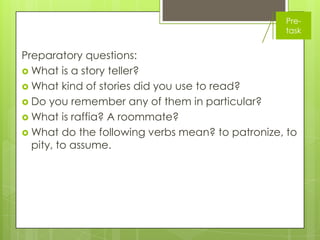
Preparatory questions:
 What is a story teller?
 What kind of stories did you use to read?
 Do you remember any of them in particular?
 What is raffia? A roommate?
 What do the following verbs mean? to patronize, to
  pity, to assume.
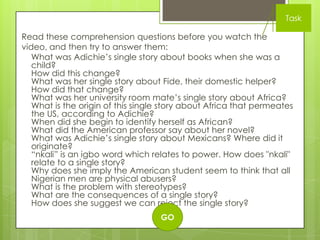
Task

Read these comprehension questions before you watch the
video, and then try to answer them:
   What was Adichie‟s single story about books when she was a
   child?
   How did this change?
   What was her single story about Fide, their domestic helper?
   How did that change?
   What was her university room mate‟s single story about Africa?
   What is the origin of this single story about Africa that permeates
   the US, according to Adichie?
   When did she begin to identify herself as African?
   What did the American professor say about her novel?
   What was Adichie‟s single story about Mexicans? Where did it
   originate?
   “nkali” is an igbo word which relates to power. How does "nkali"
   relate to a single story?
   Why does she imply the American student seem to think that all
   Nigerian men are physical abusers?
   What is the problem with stereotypes?
   What are the consequences of a single story?
   How does she suggest we can reject the single story?
                                   GO
Post-
                                                  task

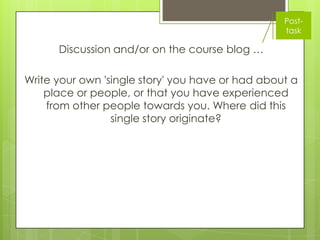
      Discussion and/or on the course blog …

Write your own 'single story' you have or had about a
    place or people, or that you have experienced
    from other people towards you. Where did this
                 single story originate?
Silvia 21 ottobre 2012 10:26
My single story is about the stereotypes of one of my Norwegian family
about the Italians.
I lived one year in Norway and there I had two host families. This summer
one of them came to visit my family and me.
They lived in my house for five days, they tried to live as if they where
Italians, they strongly wanted to try this experience; but they came here
with a single story of “the Italian family and the Italian way of live”. They
thought that Italian children where spoiled and not able to think by
themselves. They believed that all the Italian women were submitted by
their husbands, that all the Italian men were totally dependent from their
mothers also when they had left their family houses and so never ready
to become good fathers or responsible mates.
I could perceive that they felt pity for my mother just because she use to
cook dinner and to wash the dishes, they where abrupt with my father
and they where enables to see that he helped my mom in many other
ways. They were angry with my brother because in their opinion he was
spoiled just because my sister and I like to play with him and to cuddle
with him, he is just ten years old and we are over twenty both so for us its
normal to take care of him; in Norway parents don‟t have much
physical contact with their children and they not use to hug or kiss them
so they believed that to receive hug for my brother meant to never
became a strong man.

Adama day 1_done

  • 1.
    CALLing on Ethiopia: Computer Assisted Language Learningat Sarah Guth, University Adama University Language Center Day 1 Francesca Helm, Dept. of Political Science University of Padova, Italy
  • 2.
    Part 1 Personal Introductions Brief History of CALL Theory & Practice
  • 3.
    What are wedoing here?
  • 4.
    Introductions: Sarah‟s story • Course websites: provide info 1999-2004 • Student group websites: share info • Give students access to students in other parts of the 2005- world present • Use of Web 2.0 to give students access to authentic contexts of use (e.g. blogs, forums, Facebook), updated 2007- present information, and many different online resources
  • 5.
    Introductions: Francesca‟s story •MA in TESOL by distance learning with Institute of Education, University of London 1996-2000 •Online Education and Training Course, worked as facilitator •Started doing exchanges between students in Italy and the 2000- US, then Guatemala, Jordan, Holland, Kuwait, Palestine present •Collaborate with Soliya as coordinator for Padova, facilitator training, facilitator and now coach. Using blogs with 2008- students for English courses at Faculty of Political Science. present
  • 6.
    Introductions: your story? • Do you use CALL? If so, how? Since when? • What benefits do you think it can offer? • Why are you here? What do you hope to learn during these workshops?
  • 7.
    Why use CALL? What„they „ say, or originally said:  To cut costs  To reduce number of teachers  To cater for a growing number of students What CALL practioners know:  To increase access to education  To enhance the learning experience  To innovate and change  Because technology is now part of our life
  • 8.
    Key words inonline education authenticity connectivity flexibility interactivity exploration accessibility multisensory collaboration community Adapted from G.Kearsley: Learning and Teaching in Cyberspace http://home.sprynet.com?~gkearsley?chapts.htm
  • 9.
    What can weuse CALL for? Some educational uses of technology:  publishing and disseminating information  retrieving information  communicating  collaborating  developing online literacies
  • 10.
    What is literacy? Basic human right: reading and writing  In today‟s society we have new literacies:  Computer literacy  Internet literacy  Information literacy  Multimedia literacy  Participation literacy
  • 11.
    SLA/FL RESEARCH TECHNOLOGI CAL DEVELOPMENT S CALL
  • 12.
    A brief history:stage 1 Computer as Tutor technology •Mainframe computers, mostly available only at institutions and not in people‟s homes •Behaviouristic approach research •learning takes place through mechanical production, memorization and repetition of given grammar patterns •repetitive language drills which aimed at helping practice learners master the foreign grammar and vocabulary by responding to the stimuli made available through technology
  • 13.
    A brief history:stage 2 Computer as Tool to stimulate learning technology •Advent of personal computers and increasing multimedia capabilities of software programs research •Communicative approach •focus on the actual use of language forms in context •computer as a means to access, gather and process information through hands-on experiments, hypothesis practice testing and problem-solving to stimulate students' discussion, writing, or critical thinking: learner as researcher, teacher as facilitator
  • 14.
    A brief history:stage 3 Computer for communication •Advent of the World Wide Web and the Internet in the 1990s technology •Advent of Web 2.0 in the first decade of the 21st Century •Greater access to computers and broadband •Sociocognitive approach/socioconstructivism research •learning takes place through social interaction in authentic contexts •NBLT : «language teaching that involves the use of computers connected to one another in either local or practice global networks» •the machine serves to support collaborative activity and enhance the learning process both on-line, during the interaction, and off-line, in reflective practices
  • 15.
    Today, in 2012? Although practices from all 3 stages are still in use, during the next few days we will focus on the types of activities that characterized stages 2 and 3, i.e.:  Using the computer to access resources  Using the computer to access other people
  • 16.
    PART 2 How tointegrate CALL into the classroom: Blends & Tools
  • 17.
    Is blended coffeebetter?  Many coffee manufacturers claim that their blends of Ethiopian coffee with beans from other places, such as Yemen or Colombia, is „better‟ than pure Ethiopian coffee. Is the blend better? We can‟t argue about coffee, but in the foreign language classroom, it often is.
  • 18.
    Blending classroom &lab  What can you do in a lab that you can‟t do in a classroom?  What can you do better in a classroom rather than in a lab?
  • 19.
    Blending F2F andonline  Can your students only attend, let‟s say, one F2F lesson a week? And do they have Internet access?  Or, are there things that are just as well done autonomously online?  Or, do you want to develop your students‟ ability to communicate effectively online?
  • 20.
    Tools: what‟s changed (expensive) proprietary software for language practice Resources on the Internet (expensive) software for creating Web contents Resources on the Internet Free Web-based tools for creating contents
  • 21.
    The changing natureof the Web Web 2.0  users produce and share content  the „wisdom of the crowds‟ (Surowiecki, 2005)  websites where knowledge and content are created and shared
  • 22.
    Benefits  access and produce real language  real audience: increased responsibility  new tools: increased autonomy, competence and confidence In your opinion, proactive learning what might the   improved information literacy  improved reflective and criticalbe? skills benefits thinking  improved participation literacy  potential for informal learning
  • 23.
    Challenges  technical challenges: broadband, computer access, etc.  tools don‟t necessarily appeal to all students  In your opinion, what time consuming for students and teachers learning how to effectively collaborate mightstable challenges the   not all tools are  be? assessment: process or product? individual or group?  teacher needs basic skills in e-tutoring  empowering students means teacher giving up control
  • 24.
    PART 3 How todevelop CALL tasks
  • 25.
    Have we forgottenanything?  What is our main aim?  To help students learn  Don‟t be dazzled by technology  Remember basic pedagogical practice  In a structured institutional context, tasks are a good way to ensure we are working towards our main aim
  • 26.
    A practical example Learning aims:  improve listening for intermediate learners  discuss and reflect on culture  How:find a web-based audio/video students can access on their own
  • 27.
    Step 1: Explore  Surf the Web for appropriate materials, this involves:  Choosing appropriate key words (such as…?)  Evaluating the websites you find (based on what criteria…?  So, we eventually found a website which met these criteria:  Site hosted by a respectable organization that openly shares inspiring talks on the Web  Videos can be downloaded and embedded in other webpages, such as blogs  Subtitles available in numerous languages, translation in some and interactive tapescript
  • 28.
    Step 2: Developa task Word association & discussion Listening Discussion & with guiding writing questions
  • 29.
    Step 3: Whattools?  Word associations: google forms  Comprehension and discussion questions: course blog  Video: embedded in course blog, link to website (where it can also be downloaded)  Student reflection and discussion: first as comments to the blog, then class discussion
  • 30.
    Recycling language Listening skills Reading questions/writing answers Reading peer comments Speaking during class discussion Writing your own single story
  • 31.
  • 32.
    Africa Nigeria USA Pre- task Villaggi, savana, elefanti Guerra, calcio, petrolio Repubblicani, povertà, terzo mondo, sud, Africa, nero hamburger, Wall Street infibulazione africa, niger fastfood, gran canion, 11 deserto, povertà. egitto povertà, guerra, quarto settembre deserto, safari, animali mondo obama, 4 luglio, football selvatici miniere di diamanti, fastfood, NYC, obama, Mandela, safari, piramidi guerre interne, Martin Luther King, tanzania safari deserto dispotismo schiavitù, zio Sam Gazzella, Povertà, guerra povertà quarto obama oceano world Solidarietà mondo trade center tribù, riti magici Povertà, Immigrazione, Statua della Libertà, corno ghana Fango Dollaro, Obama poverta' povertà, capanne mc donald's, new york povertà,acqua,savana povertà stelle strisce hamburger Colore, Leone, Sole guerra hamburger Zebra, deserto, Marocco scuro,altezza,bandiera hot dog,new york,gossip pelle scura, deserto, Poveri, Fame, Aids girl povertà Aids, caldo, missioni NewYork, Disney, Savana - Caldo - Animali rifugiati polaitci, Macchine sahara persecuzioni New York, hamburger, favelas, vestiti, capanne Fame - Povertà – California Diversità orgoglio nazionale nero baracche malaria
  • 33.
    Pre- task Preparatory questions:  What is a story teller?  What kind of stories did you use to read?  Do you remember any of them in particular?  What is raffia? A roommate?  What do the following verbs mean? to patronize, to pity, to assume.
  • 34.
    Task Read these comprehensionquestions before you watch the video, and then try to answer them: What was Adichie‟s single story about books when she was a child? How did this change? What was her single story about Fide, their domestic helper? How did that change? What was her university room mate‟s single story about Africa? What is the origin of this single story about Africa that permeates the US, according to Adichie? When did she begin to identify herself as African? What did the American professor say about her novel? What was Adichie‟s single story about Mexicans? Where did it originate? “nkali” is an igbo word which relates to power. How does "nkali" relate to a single story? Why does she imply the American student seem to think that all Nigerian men are physical abusers? What is the problem with stereotypes? What are the consequences of a single story? How does she suggest we can reject the single story? GO
  • 35.
    Post- task Discussion and/or on the course blog … Write your own 'single story' you have or had about a place or people, or that you have experienced from other people towards you. Where did this single story originate?
  • 37.
    Silvia 21 ottobre2012 10:26 My single story is about the stereotypes of one of my Norwegian family about the Italians. I lived one year in Norway and there I had two host families. This summer one of them came to visit my family and me. They lived in my house for five days, they tried to live as if they where Italians, they strongly wanted to try this experience; but they came here with a single story of “the Italian family and the Italian way of live”. They thought that Italian children where spoiled and not able to think by themselves. They believed that all the Italian women were submitted by their husbands, that all the Italian men were totally dependent from their mothers also when they had left their family houses and so never ready to become good fathers or responsible mates. I could perceive that they felt pity for my mother just because she use to cook dinner and to wash the dishes, they where abrupt with my father and they where enables to see that he helped my mom in many other ways. They were angry with my brother because in their opinion he was spoiled just because my sister and I like to play with him and to cuddle with him, he is just ten years old and we are over twenty both so for us its normal to take care of him; in Norway parents don‟t have much physical contact with their children and they not use to hug or kiss them so they believed that to receive hug for my brother meant to never became a strong man.