ICT in PRONUNCIATION INSTRUCTION
YULIYANTO SABAT
ABD. RAJAB
PIPING RAHADIANTO
LULUK ISWATI
By Presenter Name Here
Relevant articles
 Gilakjani, A. P. (2016). English pronunciation instruction: A literature
review. International Journal of Research in English Education, 1(1),
1-6.
 Bellés-Calvera, L. & Bellés-Fortuño, B. (2018). Teaching English
pronunciation with OERs: The case of Voki. Sintagma, 30, 57-80.
BRAINSTORMING
 She sees the seashell on the seashore.
 Betty bought a bit of butter
But, the bit of butter was bitter
So, Betty bought a bit of better butter
But, the bit of better butter Betty bought was also biter.
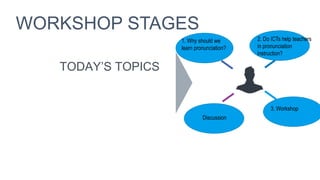
TODAY’S TOPICS
WORKSHOP STAGES
1. Why should we
learn pronunciation?
2. Do ICTs help teachers
in pronunciation
instruction?
3. Workshop
Discussion
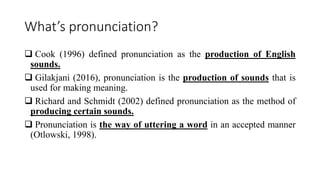
What’s pronunciation?
 Cook (1996) defined pronunciation as the production of English
sounds.
 Gilakjani (2016), pronunciation is the production of sounds that is
used for making meaning.
 Richard and Schmidt (2002) defined pronunciation as the method of
producing certain sounds.
 Pronunciation is the way of uttering a word in an accepted manner
(Otlowski, 1998).
Why should be
pronunciation?
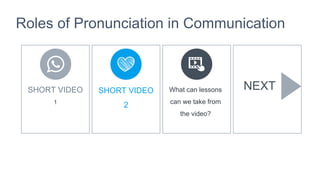
SHORT VIDEO
1
SHORT VIDEO
2
What can lessons
can we take from
the video?
Roles of Pronunciation in Communication
NEXT
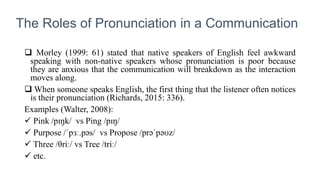
The Roles of Pronunciation in a Communication
 Morley (1999: 61) stated that native speakers of English feel awkward
speaking with non-native speakers whose pronunciation is poor because
they are anxious that the communication will breakdown as the interaction
moves along.
 When someone speaks English, the first thing that the listener often notices
is their pronunciation (Richards, 2015: 336).
Examples (Walter, 2008):
 Pink /pɪŋk/ vs Ping /pɪŋ/
 Purpose /ˈpɜː.pəs/ vs Propose /prəˈpəʊz/
 Three /θriː/ vs Tree /triː/
 etc.
Cont...
 Pronunciation can also become the factors of one’s confidence in a
communication such a great self-esteem while speaking ( Farhat &
Dzakiria, 2017: 53).
 Fraser (2001) stresses that poor pronunciation can completely mask
speaker’s excellent grammar.
 If non-native speakers cannot communicate in spoken English
effectively they may be at risk educationally, occupationally,
professionally, and socially Fraser (2000).
Levels of one’s acceptable pronunciation
(James, 2010)
1) What the speaker is saying is not understandable to people.
The speaker uses the wrong sounds when producing English words or
uses the wrong prosodic features when producing English sentences.
2) What the speaker is saying can be understandable to people but the
speaker’s pronunciation is not acceptable to listen to because he/she
has a strange and heavy accent.
 Morley (1994) said that when a speaker’s pronunciation is heavily
accented it can affect the speaker’s understanding.
3) People understand the speaker and the speaker’s English is acceptable
to listen to.
However,...
 Many teachers avoid dealing with this crucial language component
with various reasons (Atli and Bergilb, 2012:3665).
 Hammer (2001) reveals that one of the major reasons which causes
teachers ignore pronunciation is due to lack of time.
 Many teachers are nervous about teaching the sounds and intonation
and assert that even without teaching formal pronunciation syllabus,
students would be able to acquire functional pronunciation of their
studies (Hammer, 1998).
 Overcrowded classes do not permit them to teach it effectively
(Hayati 2010).
Therefore,...
 The presence of technology will benefit teachers a lot in teaching
pronunciation.
 Technology will help teachers cope the problems regarding lack of
time, teaching anxiety, big size of class, and many other problems.
 Rosyidi (2018: 1) highlights that the advances of ICTs have
facilitated teachers to share any interesting and innovative teaching
strategies implemented in the classroom.
Mehrpour et al. (2016) stated that pronunciation instruction has
experienced many changes through the advent of modern
technologies.
Reseach-based article review
Title:
Teaching English pronunciation with OERS: the
case of Voki
Purposes of the study:
• To investigate to what extent university students enrolled in the
Pronunciation and Understanding of Spoken English module
are able to improve their pronunciation through an online tool
called Voki.
• To examine if they have a positive attitude towards the use of
ICTs for the learning of pronunciation.
Method
Participants:
• 22 first year undergraduate students taking the module Pronunciation and
Understanding of Spoken English, delivered at a Spanish university within
the English Studies degree.
• 17 females and 5 males, with ages ranging from 18 to 27 years old (mean
age: 20.68 years)
• The total number of learners who completed all the surveys and activities
was 20
• Most of them were Spanish whereas two of them were international
students from South Korea.
Materials:
• Two different course materials: three activities which assessed participants’ pronunciation
competence and performance, and two questionnaires providing the subjects’ attitudes
towards the implementation of new ICTs in the teaching of pronunciation.
• Two Likert -scales questionnaires:
 The first survey included 11 items or questions measured in a ranging scale from 1 to
5, that is, from I totally disagree to I totally agree. The survey included questions about
their personal background and their ICT usage
 The second survey included 10 questions in a Likert scale ranging from 1 to 5, which
stand for I totally disagree to I totally agree. Within this questionnaire participants were
given the option to make suggestions for improvement, thus facilitating qualitative
results.
• The data was also collected from students’ work on course activities ,which had been
designed to promote the use of ICTs and online resources (Voki and lyricstraining.com).
Data analysis
• Data were analysed mainly quantitatively, though in combination with qualitative methods. First,
students’ questionnaires, course work, and Voki recordings were analysed in search for progress
related to foreign language learning.
• The qualitative analysis involved observation and reflection on students’ suggestions for
improvement, whereas in the quantitative analysis subjects’ recordings were examined in depth to
check whether they improved their pronunciation in the target language or not (e.g. minimal pairs,
diphthongs, connected speech).
Setting
• In a university lab equipped with twenty-five computers connected to the university network, which
allow students to surf on the Internet and so make use of online dictionaries on a regular basis.
• The laboratory is fully equipped with audio software and hardware that students were expected to
use, including headphones and audio programs like Mymp3 and Audacity.
Procedure:
• Taught during the second semester of the academic year, twice a week in two-hour
sessions, eight sessions were allocated to carry out this case study.
• 1st session: Introducing ICTs for education, Voki and its advantages. Creating Voki
account. Distributing a questionnaire to measure their command about ICT.
• 2nd session: Minimal pairs’ activity. Adding voice to Voki characters by uploading an
audio file or recording themselves with a microphone saying nine minimal pairs. Ss check
their own pronunciation.
• 3rd & 4th session: Diphtongs activity. Listening to a song full of dipthongs. Accessing to
lyricstraining.com. Identifying diphtongs and recording themselves.
• 5th, 6th, 7th, 8th session: Connected speech activities (assimilation, elision, and
contractions). Distributing the second questionnaire to find out how ICTs helped students’
pronunciation and their impressions & feelings towards the program.
Results
• Students’ initial questionnaire
 Students’ English level is heterogenous
 Most Ss use ICT regularly
 Ss use ICT for various purposes: Internet access, e-mail, blog,
Facebook, Twitter & online dictionaries.
 Ss lack knowledge on pedagogical ICT tools
 Ss prefer speaking more English in class rather than doing
book activities
 Most students are satisfied with their English pronunciation
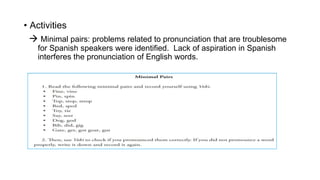
• Activities
 Minimal pairs: problems related to pronunciation that are troublesome
for Spanish speakers were identified. Lack of aspiration in Spanish
interferes the pronunciation of English words.
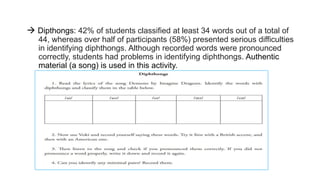
 Dipthongs: 42% of students classified at least 34 words out of a total of
44, whereas over half of participants (58%) presented serious difficulties
in identifying diphthongs. Although recorded words were pronounced
correctly, students had problems in identifying diphthongs. Authentic
material (a song) is used in this activity.
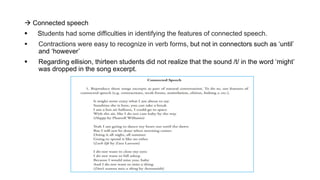
 Connected speech
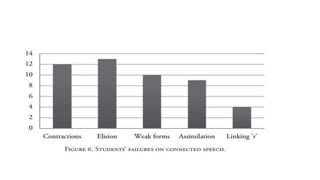
 Students had some difficulties in identifying the features of connected speech.
 Contractions were easy to recognize in verb forms, but not in connectors such as ‘until’
and ‘however’
 Regarding ellision, thirteen students did not realize that the sound /t/ in the word ‘might’
was dropped in the song excerpt.
Students’ final questionnaire
• 14 students disagree that using ICTs is a waste of time.
• Most students prefer working in groups and using spoken language
because that would be better for their learning process.
• A large number of students believe that they can monitor their own
progress when using ICT tools.
• Most students somewhat agree that the implementation of ICTs is aimed at
developing the competencies established in the course syllabus.
• Most students agree that the use of ICT tools help them improve their
English pronunciation
• Most students will keep using ICTs at home & they are satisfied with the
teaching program.
Conclusion
• The use of ICT tools to learn English pronunciation is a
satisfactory experience for learners.
• Students show a positive attitude towards the use of ICTs as
they consider that Voki is potentially useful for the learning of
English pronunciation.
• Limitations of the research:
 Voki provides students with neither phonetic symbols nor the
characteristic features of connected speech, so it should be
combined with other ICT tools (e.g. Online dictionaries and
lyricstraining.com).
 Not all of the students attended class regularly, so it was
difficult to gather all the data in the same session, and thus
give them feedback.
 Network problems might discourage participants from
enjoying the learning experience.
Suggestions
1. The implementation of ICT tools should consider the following aspects:
a) broad and high quality access to online resources,
b) online resources should be used on a regular basis, and
c) training should be held not only for students but also teachers to use
ICTs –in (the use of Voki in the EFL classroom).
2. As Voki does not contain features of connected speech, it should be
employed together with other ICTs to complete the activity competently. At
the same time, it could be used to expose EFL learners to a variety of
accents, including Scottish, Australian, and South African among others.
3. Some longitudinal research could be useful in the Pronunciation and
Understanding of Spoken English module to get a chronological view of
students’ progress.

Ict presentation group 8

  • 1.
    ICT in PRONUNCIATIONINSTRUCTION YULIYANTO SABAT ABD. RAJAB PIPING RAHADIANTO LULUK ISWATI By Presenter Name Here
  • 2.
    Relevant articles  Gilakjani,A. P. (2016). English pronunciation instruction: A literature review. International Journal of Research in English Education, 1(1), 1-6.  Bellés-Calvera, L. & Bellés-Fortuño, B. (2018). Teaching English pronunciation with OERs: The case of Voki. Sintagma, 30, 57-80.
  • 3.
    BRAINSTORMING  She seesthe seashell on the seashore.  Betty bought a bit of butter But, the bit of butter was bitter So, Betty bought a bit of better butter But, the bit of better butter Betty bought was also biter.
  • 4.
    TODAY’S TOPICS WORKSHOP STAGES 1.Why should we learn pronunciation? 2. Do ICTs help teachers in pronunciation instruction? 3. Workshop Discussion
  • 5.
    What’s pronunciation?  Cook(1996) defined pronunciation as the production of English sounds.  Gilakjani (2016), pronunciation is the production of sounds that is used for making meaning.  Richard and Schmidt (2002) defined pronunciation as the method of producing certain sounds.  Pronunciation is the way of uttering a word in an accepted manner (Otlowski, 1998).
  • 6.
  • 7.
    SHORT VIDEO 1 SHORT VIDEO 2 Whatcan lessons can we take from the video? Roles of Pronunciation in Communication NEXT
  • 8.
    The Roles ofPronunciation in a Communication  Morley (1999: 61) stated that native speakers of English feel awkward speaking with non-native speakers whose pronunciation is poor because they are anxious that the communication will breakdown as the interaction moves along.  When someone speaks English, the first thing that the listener often notices is their pronunciation (Richards, 2015: 336). Examples (Walter, 2008):  Pink /pɪŋk/ vs Ping /pɪŋ/  Purpose /ˈpɜː.pəs/ vs Propose /prəˈpəʊz/  Three /θriː/ vs Tree /triː/  etc.
  • 9.
    Cont...  Pronunciation canalso become the factors of one’s confidence in a communication such a great self-esteem while speaking ( Farhat & Dzakiria, 2017: 53).  Fraser (2001) stresses that poor pronunciation can completely mask speaker’s excellent grammar.  If non-native speakers cannot communicate in spoken English effectively they may be at risk educationally, occupationally, professionally, and socially Fraser (2000).
  • 10.
    Levels of one’sacceptable pronunciation (James, 2010) 1) What the speaker is saying is not understandable to people. The speaker uses the wrong sounds when producing English words or uses the wrong prosodic features when producing English sentences. 2) What the speaker is saying can be understandable to people but the speaker’s pronunciation is not acceptable to listen to because he/she has a strange and heavy accent.  Morley (1994) said that when a speaker’s pronunciation is heavily accented it can affect the speaker’s understanding. 3) People understand the speaker and the speaker’s English is acceptable to listen to.
  • 11.
    However,...  Many teachersavoid dealing with this crucial language component with various reasons (Atli and Bergilb, 2012:3665).  Hammer (2001) reveals that one of the major reasons which causes teachers ignore pronunciation is due to lack of time.  Many teachers are nervous about teaching the sounds and intonation and assert that even without teaching formal pronunciation syllabus, students would be able to acquire functional pronunciation of their studies (Hammer, 1998).  Overcrowded classes do not permit them to teach it effectively (Hayati 2010).
  • 12.
    Therefore,...  The presenceof technology will benefit teachers a lot in teaching pronunciation.  Technology will help teachers cope the problems regarding lack of time, teaching anxiety, big size of class, and many other problems.  Rosyidi (2018: 1) highlights that the advances of ICTs have facilitated teachers to share any interesting and innovative teaching strategies implemented in the classroom. Mehrpour et al. (2016) stated that pronunciation instruction has experienced many changes through the advent of modern technologies.
  • 13.
    Reseach-based article review Title: TeachingEnglish pronunciation with OERS: the case of Voki
  • 14.
    Purposes of thestudy: • To investigate to what extent university students enrolled in the Pronunciation and Understanding of Spoken English module are able to improve their pronunciation through an online tool called Voki. • To examine if they have a positive attitude towards the use of ICTs for the learning of pronunciation.
  • 15.
    Method Participants: • 22 firstyear undergraduate students taking the module Pronunciation and Understanding of Spoken English, delivered at a Spanish university within the English Studies degree. • 17 females and 5 males, with ages ranging from 18 to 27 years old (mean age: 20.68 years) • The total number of learners who completed all the surveys and activities was 20 • Most of them were Spanish whereas two of them were international students from South Korea.
  • 16.
    Materials: • Two differentcourse materials: three activities which assessed participants’ pronunciation competence and performance, and two questionnaires providing the subjects’ attitudes towards the implementation of new ICTs in the teaching of pronunciation. • Two Likert -scales questionnaires:  The first survey included 11 items or questions measured in a ranging scale from 1 to 5, that is, from I totally disagree to I totally agree. The survey included questions about their personal background and their ICT usage  The second survey included 10 questions in a Likert scale ranging from 1 to 5, which stand for I totally disagree to I totally agree. Within this questionnaire participants were given the option to make suggestions for improvement, thus facilitating qualitative results. • The data was also collected from students’ work on course activities ,which had been designed to promote the use of ICTs and online resources (Voki and lyricstraining.com).
  • 17.
    Data analysis • Datawere analysed mainly quantitatively, though in combination with qualitative methods. First, students’ questionnaires, course work, and Voki recordings were analysed in search for progress related to foreign language learning. • The qualitative analysis involved observation and reflection on students’ suggestions for improvement, whereas in the quantitative analysis subjects’ recordings were examined in depth to check whether they improved their pronunciation in the target language or not (e.g. minimal pairs, diphthongs, connected speech). Setting • In a university lab equipped with twenty-five computers connected to the university network, which allow students to surf on the Internet and so make use of online dictionaries on a regular basis. • The laboratory is fully equipped with audio software and hardware that students were expected to use, including headphones and audio programs like Mymp3 and Audacity.
  • 18.
    Procedure: • Taught duringthe second semester of the academic year, twice a week in two-hour sessions, eight sessions were allocated to carry out this case study. • 1st session: Introducing ICTs for education, Voki and its advantages. Creating Voki account. Distributing a questionnaire to measure their command about ICT. • 2nd session: Minimal pairs’ activity. Adding voice to Voki characters by uploading an audio file or recording themselves with a microphone saying nine minimal pairs. Ss check their own pronunciation. • 3rd & 4th session: Diphtongs activity. Listening to a song full of dipthongs. Accessing to lyricstraining.com. Identifying diphtongs and recording themselves. • 5th, 6th, 7th, 8th session: Connected speech activities (assimilation, elision, and contractions). Distributing the second questionnaire to find out how ICTs helped students’ pronunciation and their impressions & feelings towards the program.
  • 19.
    Results • Students’ initialquestionnaire  Students’ English level is heterogenous  Most Ss use ICT regularly  Ss use ICT for various purposes: Internet access, e-mail, blog, Facebook, Twitter & online dictionaries.  Ss lack knowledge on pedagogical ICT tools  Ss prefer speaking more English in class rather than doing book activities  Most students are satisfied with their English pronunciation
  • 20.
    • Activities  Minimalpairs: problems related to pronunciation that are troublesome for Spanish speakers were identified. Lack of aspiration in Spanish interferes the pronunciation of English words.
  • 21.
     Dipthongs: 42%of students classified at least 34 words out of a total of 44, whereas over half of participants (58%) presented serious difficulties in identifying diphthongs. Although recorded words were pronounced correctly, students had problems in identifying diphthongs. Authentic material (a song) is used in this activity.
  • 22.
     Connected speech Students had some difficulties in identifying the features of connected speech.  Contractions were easy to recognize in verb forms, but not in connectors such as ‘until’ and ‘however’  Regarding ellision, thirteen students did not realize that the sound /t/ in the word ‘might’ was dropped in the song excerpt.
  • 24.
    Students’ final questionnaire •14 students disagree that using ICTs is a waste of time. • Most students prefer working in groups and using spoken language because that would be better for their learning process. • A large number of students believe that they can monitor their own progress when using ICT tools. • Most students somewhat agree that the implementation of ICTs is aimed at developing the competencies established in the course syllabus. • Most students agree that the use of ICT tools help them improve their English pronunciation • Most students will keep using ICTs at home & they are satisfied with the teaching program.
  • 25.
    Conclusion • The useof ICT tools to learn English pronunciation is a satisfactory experience for learners. • Students show a positive attitude towards the use of ICTs as they consider that Voki is potentially useful for the learning of English pronunciation.
  • 26.
    • Limitations ofthe research:  Voki provides students with neither phonetic symbols nor the characteristic features of connected speech, so it should be combined with other ICT tools (e.g. Online dictionaries and lyricstraining.com).  Not all of the students attended class regularly, so it was difficult to gather all the data in the same session, and thus give them feedback.  Network problems might discourage participants from enjoying the learning experience.
  • 27.
    Suggestions 1. The implementationof ICT tools should consider the following aspects: a) broad and high quality access to online resources, b) online resources should be used on a regular basis, and c) training should be held not only for students but also teachers to use ICTs –in (the use of Voki in the EFL classroom). 2. As Voki does not contain features of connected speech, it should be employed together with other ICTs to complete the activity competently. At the same time, it could be used to expose EFL learners to a variety of accents, including Scottish, Australian, and South African among others. 3. Some longitudinal research could be useful in the Pronunciation and Understanding of Spoken English module to get a chronological view of students’ progress.